Woodwind Music

This page has some woodwind performance reference books and music for mixed woodwind duos and larger ensembles (including horn). Music which is for one type of instrument (3 flutes, for example) is found on the pages for that instrument. The WW Quintets section has music for any five woodwinds not just traditional wind quintets. The music is arranged in order of composer or editor. 

You may search for a title, composer, or any other text on this page by using the
Edit menu Find command (shortcut Ctrl+F or Mac Command+F).
 |
 |
 |
 |
 |
 |
 |
 |
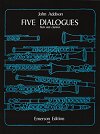 |
WW258: Five Dialogues for Flute and Clarinet by John Addison. Emerson Edition, 1992, SS, 13 pages in score format. John Addison (1920-1998) was a British composer (who studied both oboe and clarinet) best known for his film scores. This piece was part of a project by the publisher to commission works for these two instruments from composers whose writing for wind instruments was particularly skillful and imaginative. The dialogs are: I. Prelude al scherzo (Allegretto), II. Air (Andante), III. Caprice (Allegro moderato/Andante), IV. Entracte (Moderato), and V. Valse (Tempo di Valse). College level (although the slower movements are easier).
(Except other items with free shipping.) |
15.95

|
|
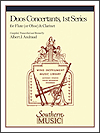
WW034: Duos Concertants for Flute or Oboe and Clarinet 1st Series compiled, transcribed, and revised by Albert J. Andraud. Southern Music Company, 1935, SS, 23 pages (one copy). All duets are in score format. This book contains six duets from the works of Bach, three from Handel and three from Mozart. For good high school players or better. WW035: Duos Concertants for Flute or Oboe and Clarinet 2nd Series compiled, transcribed, and revised by Albert J. Andraud. Southern Music Company, 1946, SS, 40 pages (two copies). This book has two duos concertants by G. Kummer (not in score format, all the rest are), and Symphony Concertante by Mozart KV 364 for violin, viola and orchestra or piano (accompaniment not included) transcribed, and shorter works by Bach, Handel, and Krebs. Some of the material in this book is more difficult than the first book. WW036: Duos Concertants for Flute or Oboe and Clarinet 3rd Series compiled, transcribed, and revised by Albert J. Andraud. Southern Music Company, 1946, SS, 40 pages (two copies). This book has three duos concertants by J.B. Gambaro (not in score format, all the rest are), 12 duets for 2 basset horns by Mozart (not transposed), an extended duet by J. Sellner, and shorter works by Bach, Handel, Lacome, and Rameu. A mix of difficulty levels similar to the second book. |
Series 1 12.95
Series 2 Series 329.95 28.95
|
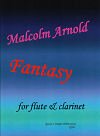 |
WW171: Fantasy for flute and clarinet by Malcolm Arnold. Queen's Temple Publications, 2003, SS, 2 pages (score format). A miniature (duration 1:30) Arnold wrote for his children to play together. Opens and closes with the flute playing a melody over arpeggios in the clarinet and has a contrasting interlude in between. Some pleasing dissonance in spots. Early high school level. (Except other items with free shipping.) |
7.95
|
|
WW314: Johann Sebastian Bach for Flute and Clarinet Duo Volume I arranged by Joe Armstrong and Liz Leehey. Van Cott Information Services Inc., 2013, SB, 16 + 6 + 6 pages (includes score and parts). This volume has three duos. Adagio from Concerto in C minor BWV 1060: Originally for oboe and violin, this Adagio is an example of Bach’s marvelous interweaving of exquisite lines. In this transcription the clarinet takes the oboe line while the flute takes the violin line. Frohe Hirten, eilt, ach eilet! from The Christmas Oratorio BWV 248: Bach’s delightful tenor aria Frohe Hirten, eilt, ach eilet! (Joyous Shepherds Hasten!), transcribed for flute and clarinet duo with the clarinet taking the vocal line. The two parts interweave and then join in running roulades that challenge both fingers and breath. Ich will leiden, ich will schweigen from Cantata BWV 87: A tenor aria (translated as I would suffer, I would keep silent) transcribed for flute and clarinet duo. The clarinet takes the vocal line while the flute takes the violin line, in this poignant, pastorale-like aria that embraces both sorrow and comforting. Click on the cover image to view the score of the first page of each duo. |
19.95
|
|
WW317: Johann Sebastian Bach for Flute and Clarinet Duo Volume II arranged by Joe Armstrong and Liz Leehey. Van Cott Information Services Inc., 2013, SB, 16 + 7 + 8 pages (includes score and parts). This volume has three duos. Schweigt, ihr Flöten, schweigt ihr Töne! from Cantata BWV 210: The clarinet takes the soprano vocal part. This is the second aria from Bach's wedding cantata O holder Tag, erwünschte Zeit! There is an alternate part for this piece for clarinet in A. Valet will ich dir gerben from Cantata BWV 95: Originally for solo soprano chorale with oboe d'amore obbligato, it has been transcribed for flute and clarinet duo. Was willst du dich mein Geist entsetzen? from Cantata BWV: This is the tenor aria from Cantata Liebster Gott. The flute takes the tenor line while the clarinet takes the oboe d'amore line. Click on the cover image to view the score of the first page of each duo. |
19.95
|
|
WW071: Duo Op. 25 Oboe and Clarinet by Marion Bauer. C.F. Peters, 1953, SS, 9 pages (score format). Marion Bauer (1892-1955) was a composer, critic, author, lecturer and teacher. She was also the first American student of Boulanger in Paris. This is a suite of four duets: Prelude (Allegretto Con Moto), Improvisation (Andante Expressivo e rubato), Pastoral (Allegretto), and Dance (Allegro Giocoso). Early college level. (Except other items with free shipping.) |
18.50
|
|
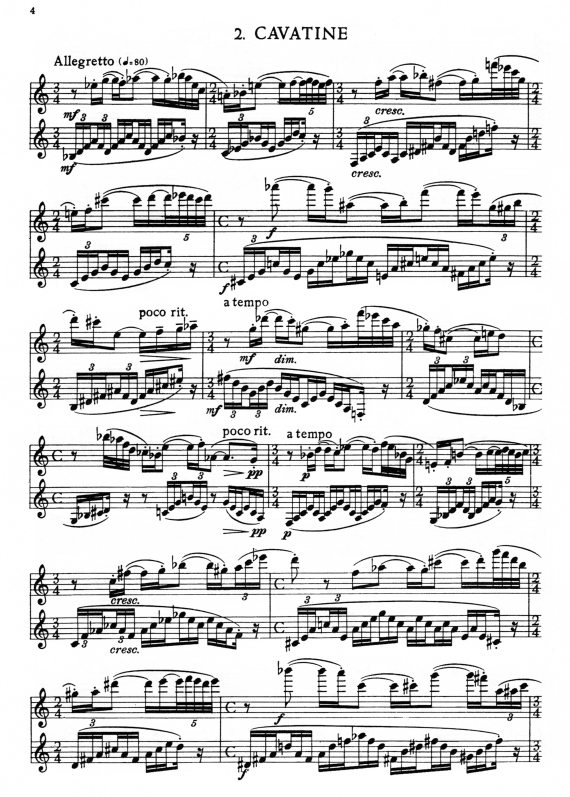
WW360: Serenade for Flute and Clarinet by Willy Burkhard. Baerenreiter, 1954, SS, 11 pages (score format). Willy Burkhard (1900-1955) was a Swiss composer, music educator and conductor. While he wrote orchestral and instrumental music he was especially known for his church music for voice. This piece is in four movements: 1. Dialog, 2. Cavatine, 3. Elegie, 4. Perpetuum Mobile, and 5. Marsch. Click on the cover image to view a sample page.
(Except other items with free shipping.) |
17.95
|
|
WW152: Three Duets WoO 27 for Clarinet and Bassoon by Ludwig van Beethoven edited by Jerry Kirkbride and Jane Taylor. International Music Co., 1979, SS, 13 pages for each part (no score). While there is some doubt that Beethoven wrote these pieces, they are popular nonetheless. I. Allegro commodo, Larghetto sostenuto, and Rondo (Allegretto); II. Allegro affecttuoso, Aria (Larghetto), and Rondo (Allegro moderato); and III. Allegro sostenuto, Andantino con moto, and Allegro assai. |
16.50
|
|
WW185: Drei Duos (Three Duets) WoO 27 for Clarinet and Bassoon by Ludwig van Beethoven edited by Egon Voss. Henle, 2010, SS. This edition includes a score with the bassoon part and separate parts for clarinet in C (for the first two duets which were originally for that instrument) and parts for all three duets for clarinet in B-flat. The Preface (in German, French, and English) describes the problematic history of these duets while a Comments section at the end has notes on the editing. I. Allegro commodo, Larghetto sostenuto, and Rondo (Allegretto); II. Allegro affecttuoso, Aria (Larghetto), and Rondo (Allegro moderato); and III. Allegro sostenuto, Aria con Variazioni (Andantino con moto), and Allegro assai. |
33.95
|
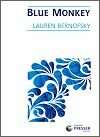 |
WW350: Blue Monkey for flute and clarinet by Lauren Bernofsky. Theodore Presser Co., 2015, 3 pages (score format). Lauren Bernofsky (1967-) is an American composer. This is a short (~2:30), jaunty duo, perfect for concert/recital programming. The main riff in swing eighths is repeated throughout, ensuring that it sticks in the mind of the audience. We also sell versions for clarinet and violin and 2 clarinets. Here is a video of the clarinet and violin version that will give you an idea how it goes. (Except other items with free shipping.) |
6.95
|
|
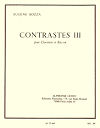
WW113: Contrastes III for Clarinet and Bassoon by Eugene Bozza. Alphonse Leduc, 1977, SS, 12 pages. Includes two copies of the parts in score format. There are eight short movements in this piece. Early college level. |
32.60
|
|
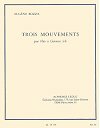
WW042: Trois Mouvements (Three Movements) for Flute and Clarinet in B-flat by Eugene Bozza. Alphonse Leduc, 1974. Includes two copies of the parts in score format. The three movements are Allegretto; Moderato, espressivo; and Allegro giocoso. Suitable for college or professional recitals. |
32.60
|
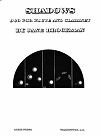 |
WW132: Shadows Duo for Flute and Clarinet by Jane Brockman. Arsis Press, 1985, SS, 7 pages (score format). The tradition of imitation which has historically inspired two-voice music can be likened to an object and its shadow, continually evident in this composition. At times, the instrumental identities become obscured, and one is not certain which instrument is playing which line. Also, the musical language of Richard Wagner still has much relevance for this composer. It is his shadow which is 'felt' throughout the work as the leitmotiv of Kundry (from Parsifal) is employed melodically, but without its characteristic rhythm--and in a new context. A college level work with a duration of about 6 minutes. |
6.95
|
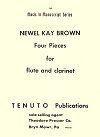 |
WW143: Four Pieces for Flute and Clarinet by Newel Kay Brown. Tenuto Publications, 1968, SS, two copies in score format each 7 pages. The four pieces are: I. Adagio, II. Allegretto, III. Adagietto, and IV. Allegro con brio. Better high school level and up. Duration 5:35. (Except other items with free shipping.) |
8.95
|
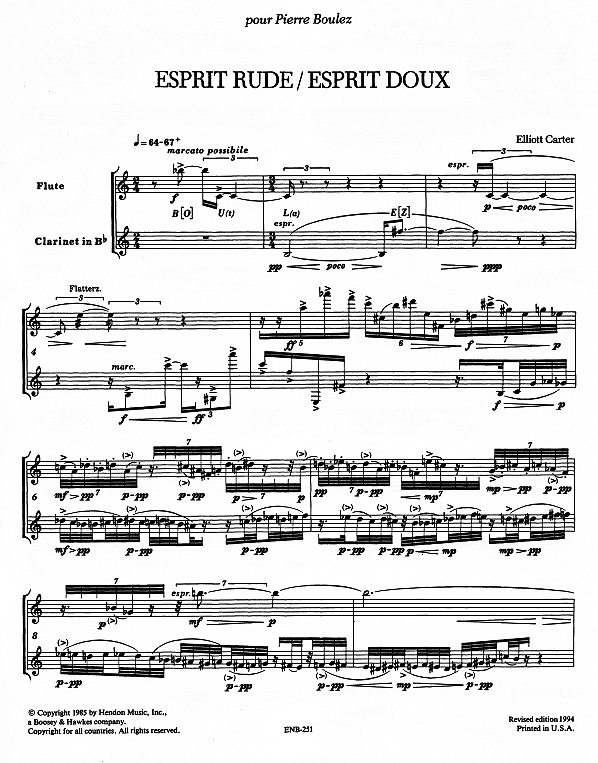 |
WW335: Esprit Rude/Esprit Doux for Flute and Clarinet by Elliot Carter. Boosey & Hawkes, 1985, SS, 8 pages in score format. The title means Rough Breathing/Smooth Breathing. It was composed for Pierre Boulez's 60th birthday in 1985. The title refers to the pronunciation of classical Greek words beginning with a vowel or an R. There is an explanation of how this applies to the music in English, French and German. Advanced college level. Click on the cover image to view the first page. (Except other items with free shipping.) |
15.95
|
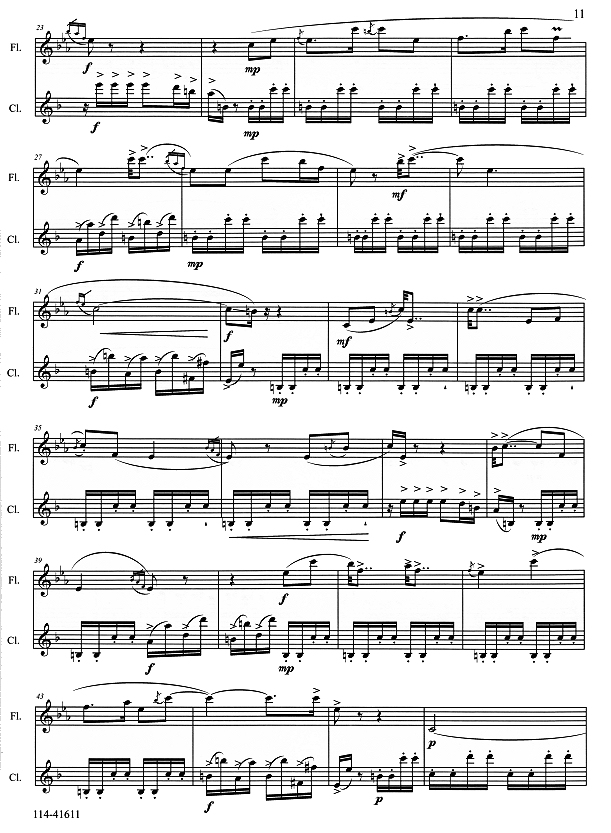 |
WW326: Three Bagatelles from China West Duet for Flute and Clarinet by Chen Yi. Theodore Presser Co., 2009/2014, SS, 10 pages in score format. This piece was originally written for flute and piano but seven additional versions have been created. The three bagatelles are I. Shan Ge (Lightly), II. Nai Guo Hou (Lively) and III. Dou Duo (Simply). As befits a piece originally for solo flute, the flute is the star and the clarinet is mostly in an accompanying role. In the first movement the flute is playing the melody (freely) while the clarinet has short rhythmic statements. In the second movement, the clarinet plays the melody. The flute enters after bar 23 with an obbligato part while the clarinet repeats the melody. In the third movement (which is the source of our example) the flute plays a melody while the clarinet plays a rhythmic accompaniment of 16th notes. College level. Click on the cover image to view a sample page from the third movement. (Except other items with free shipping.) |
19.95
|
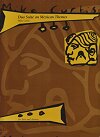 |
WW197: Duo Suite on Mexican Themes for Flute and Clarinet by Mike Curtis. Advance Music, 1997, SS, 15 pages in score format. There are six pieces: I. Plaza del Baratillo, II. El Burro Viejo, III. La Banda del Estado, IV. Dulcinea, V. Sancho Danza, and VI. La Rana Loca. Better high school players and up. |
14.95
|
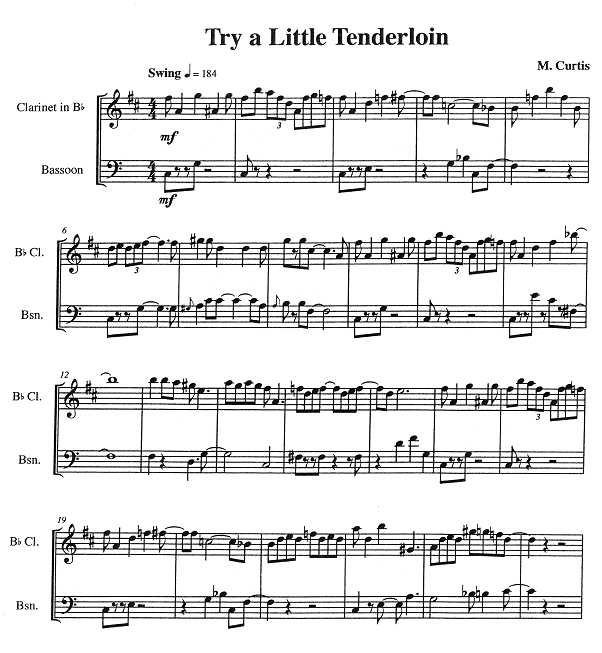 |
B166: 8 More Original Jazz Duos for Clarinet and Bassoon by Mike Curtis. MSS Publishing, 1993, SB, 31 pages (score format). These duets are in a variety of styles including swing, Latin, blues, etc. There are two pieces where part of the bassoon part is in tenor clef. Upper intermediate level and up. Click on the cover image to see a sample page. |
14.95
|
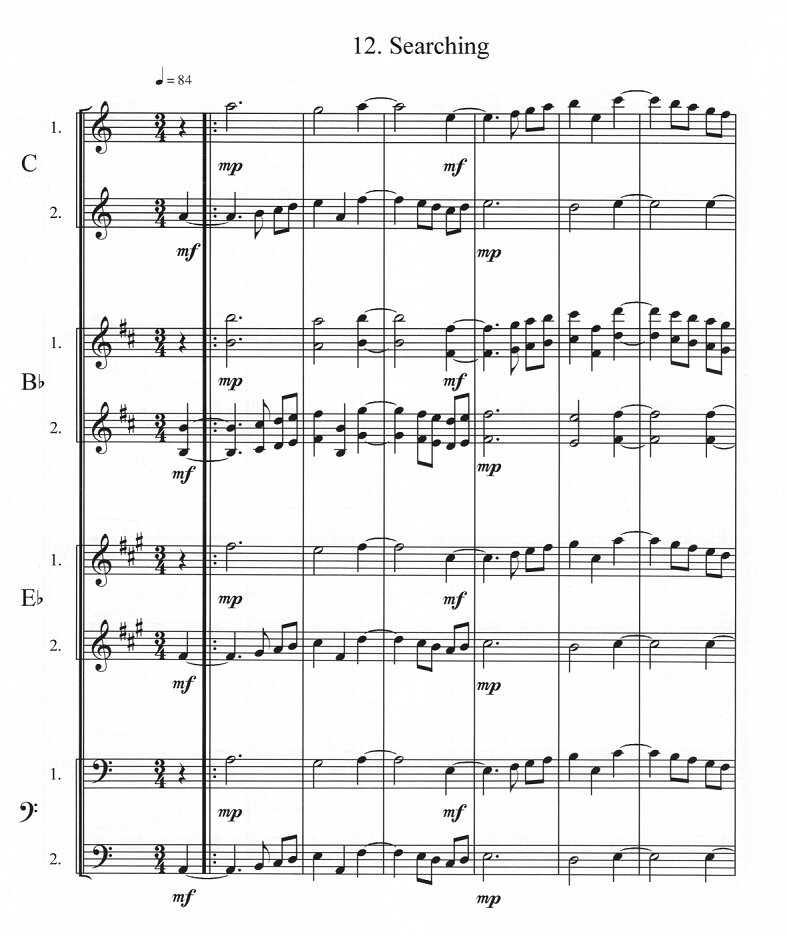 |
WW227: Woodwind Friends, 25 Intermediate Duets by Mike Curtis. MSS Publishing, 2010, SB, 73 pages in score format. This book has 25 intermediate duets with parts in C, B-flat, E-flat, and bass clef. The composer has computed that there are more than 50 possible combinations of woodwind instruments that can play them. These duets are progressive. They gradually build the student's experience of time signatures, articulations, tempi, dynamics, keys, styles and rhythmic complexity. They were written to be short and fun. Click on the cover image to see a sample page. |
14.95
|
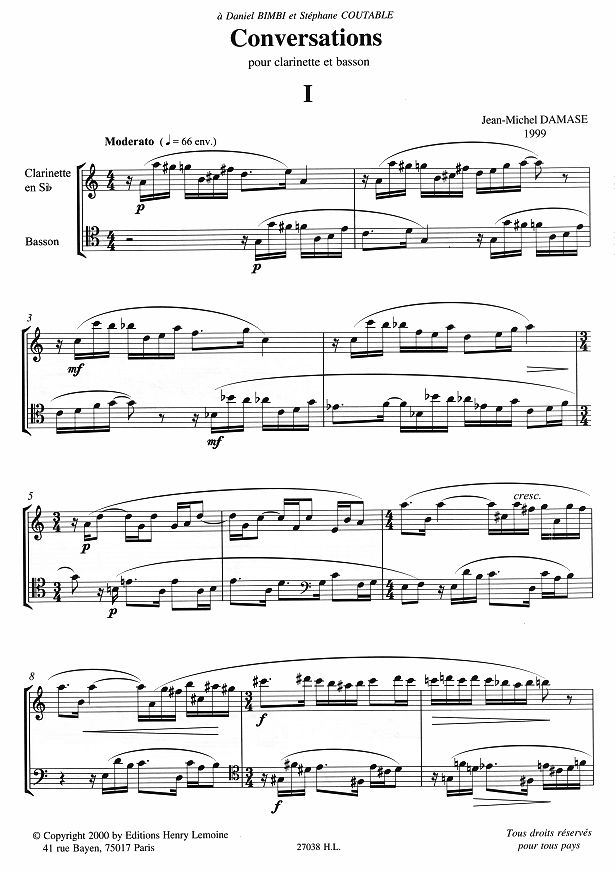 |
WW313: Conversations pour clarinette et basson by Jean-Michel Damase. Editions Henry Lemoine, 2000, SB, 20 pages in score format. Jean-Michel Damase (1928-2013) was a French pianist, conductor and composer. This suite for clarinet and bassoon has six "conversations" in a variety of tempos at the college level. Click on the cover image to see the first page page. |
18.95
|
 |
WW141: Four Little Duos for Flute and Clarinet by Robert Dickow. Manduca Music, 1997, SS, 8 pages. In score format with two copies. Robert Dickow (1949-) is an American composer who teaches horn, composition, and theory at the University of Idaho. These four duets are at the advanced college level and feature mixed meter. The publisher describes them as "Really nice recital material for good players. Stravinskyesque technique and textures." The duration is 8:30. |
11.95
|
 |
WW145: Andante Con Variazioni for Flute and Clarinet by Daniel Dorff. Tenuto Publications, 1986, SS, two copies in score format each 7 pages. The Andante is followed by five variations. The odd meters (7/16 and 5/8) in variation II make this an early college level piece. Duration about 4:30. (Except other items with free shipping.) |
8.95
|
 |
WW144: Dances and Canons for Flute and Clarinet by Daniel Dorff. Tenuto Publications, 1988/2010, SS, two copies in score format each 7 pages. There are nine short pieces which are: 1. Waltz (Tempo di valse), 2. Canon (Allegro), 3. Ballad (Andante cantabile), 4. Canon (Presto), 5. Invention (Maestoso), 6. Dance (Con spirito), 7. Nocturne (Largo amorosa), 8. Canon, (Leggiero), and 9. Dance (Allegro con brio). For better high school students and up. The duration is about 7 minutes. Here is an audio file of the first movement on YouTube. You can listen to several other movements but let me know if you need help to find them. |
12.95
|
 |
WW232: Old New Borrowed Blue, A collection of fun duets for Flute and B-flat Clarinet by Daniel Dorff. Tenuto Publications, 2010, SS, 23 pages. In score format. The duets are in three groups: Dances and Canons which has 9 pieces and a duration of 7 minutes, Three Little Waltzes with a duration of 6 minutes, and finally, Andante con Variazioni which has a short Andante and five variations with a total duration of 4:30. Most of these pieces are at the advanced intermediate level and will probably be of most interest to better high school students and adult amateurs. |
14.95
|
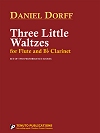 |
WW355: Three Little Waltzes for Flute and B-flat Clarinet by Daniel Dorff. Tenuto Publications, 2010/2015, SS, 10 pages. In score format with two copies. This is a quirky set of surprises composed for flutist Cindy Anne Broz. The first and third waltz are both shorter than a minute and serve as a prelude and postlude for the large middle movement which is over 5 minutes. Composed in 2010, the first and third movements are freely based on rhythmically-challenging waltzes that the composer wrote in high school (1974), frequently teasing between a waltz-like accompaniment and various ways of contradicting any sense of regularity, thereby providing a happy sense of arrival whenever the rhythms get back in sync. The central second movement is a sort of backwards-constructed set of variations, in which fragments are built together and tease at congealing throughout the movement, finally climaxing in a full statement of the theme for the grand finale that reveals the full theme. These pieces have minor updates from the versions in Old New Borrowed Blue (above). Here is an audio file of the end of Waltze No. 2. |
12.95
|
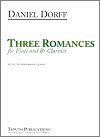 |
WW124: Three Romances for Flute and B-flat Clarinet by Daniel Dorff. Tenuto Publications, 2007, SS, 8 pages. In score format with two copies. The three romances are: 1. Languid (Allegro pastorale), 2. Sultry (Tango drammatico), and 3. Frisky (Brisk allegro). The music is lyrical, tonal, and rhythmic. It will be premeried by flutist Gary Schocker with the composer on clarinet at the 2007 National Flute Association's annual convention. Early college level. Duration about 8 minutes. |
14.95
|
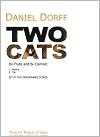 |
WW158: Two Cats for Flute and B-flat Clarinet by Daniel Dorff. Tenuto Publications, 2008, SS, 8 pages. In score format with two copies. Close on the heels (paws?) of his already popular Three Romances, composer Daniel Dorff has presented us with another flute and clarinet duet. The composer's program notes are as follows: "Being quite fond of my flutist-partner's two cats, I chose this opportunity to make musical portraits of Hootie, a handsome and elegant 20-pound tuxedo cat, and Tiki, a petite bengal princess. Hootie's music is generally in a slow pulse with lyrical 16ths flowing, just as Hootie is pensive and outwardly still, while clearly being very busy inside. The final phrase is marked snoozendo poco a poco. The final measures of the Hootie movement are identical to the beginning of the Tiki movement, just as in reality one cat's end is sometimes notably close to the other's beginning. After a 'peacefully lurking' introduction, Tiki's remarkable showcat grace and playful lightness are set as an effervescent scherzo, including some double-tonguing (after all, her name is ti-ki), a bit of fluttertonguing as Tiki can sound herself, and with a regally strutted circus march in the middle of the scherzo." College level with a duration of about 8:15. |
14.95
|
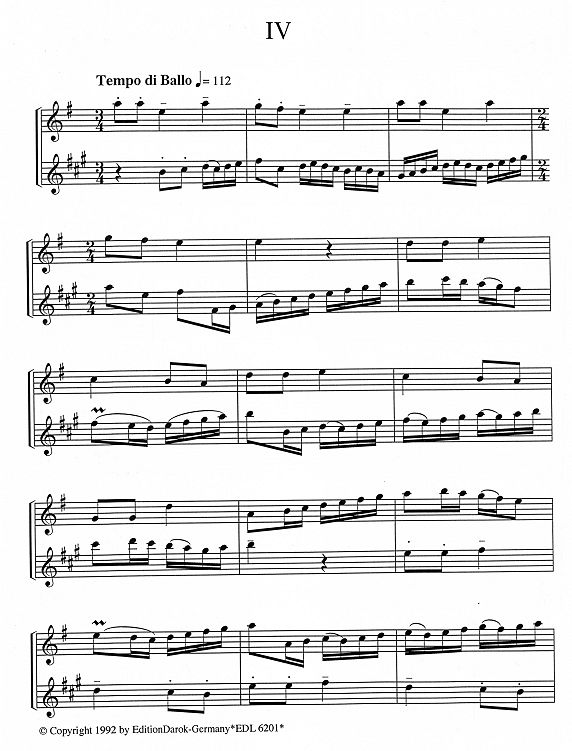 |
WW344: 4 Hungarian Folk Songs for Flute and Clarinet by László Draskóczy. EditionDarok, 1992, SS, 6 pages (score format). László Draskóczy (1905-1967) was a Hungarian composer and music educator. Four pieces: I. Allegro, II Andante, III. Allegro, and IV. Tempo di Ballo. There isn't any indication if these are original works in a folksong style or actual folksongs. The music has a range of difficulties at the intermediate level. Total duration of about 5 minutes. Click on the cover image to view a sample page. (Except other items with free shipping.) |
14.95
|
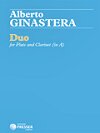 |
WW303: Duo for Flute and Clarinet (in A) by Alberto Ginastera adapted by Daniel Dorff. Theodore Presser Co., 2013, SS, 12 pages (score format). Ginastera's Duo (1945) is familiar and standard repertoire for most flute and oboe duos. In three movements (Sonata, Pastorale, Fuga), the composer immediately found a welcoming audience in the United States, including Virgil Thomson, who proclaimed, "This is the kind of music which makes one believe and have confidence in the New World." Now, Daniel Dorff retains the original flute part, while transposing the oboe to clarinet in A with an ear for idiomatic accuracy. Duration about 8:30 minutes. Early college level. Click on the cover image to view several pages from this piece. (Except other items with free shipping.) |
12.95
|
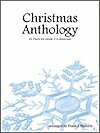 |
WW332: Christmas Anthology Flute and Clarinet Duet arranged by Frank J. Halferty. Almitra Music/Kendor Music, 2014, SS, 28 pages. Subtitled 24 Duets for Grade 3-4 Musicians. This grading is on the US 6 point scale but is on the easier side of that standard. Contents: Adeste Fidelis (O Come, All Ye Faithful); Angels We Have Heard On High; Away In A Manger; Bring A Torch, Jeanette, Isabella; Coventry Carol; Deck The Halls; The First Noel; God Rest Ye Merry, Gentlemen; Good Christian Men Rejoice; Good King Wenceslas; Hark! The Herald Angels Sing; The Holly And The Ivy; In The Bleak Midwinter (Holst); Infant Holy, Infant Lowly; It Came Upon A Midnight Clear; Jingle Bells; Jolly Old St. Nicholas; Joy To The World; O Little Town Of Bethlehem; Silent Night; Up On The Housetop; We Three Kings; We Wish You A Merry Christmas; and What Child Is This? Click on the cover image to view two sample pages. |
11.50
|
 |
G324: Festival FlexDuets for B-flat Instruments arranged by Frank J. Halferty. Almitra Music/Kendor Music, 2019, SS, 16 pages. These 8 US grade 3 duets are destined to become a staple of school music libraries as they can be mixed or matched using any combination of the 10 different books for wind and string instruments. They can also be combined and played by a larger ensemble that has challenging instrumentation. In addition to the B-flat and E-flat editions there are others which cover all the instruments in the band and orchestra. Contents: Blue Light Special (Halferty); Canon In Two Parts (Halferty); Crescent Moon Rising (Chinese folk song); Dirty Dish Rag (Halferty); Farandole (Bizet); March (Bach); The Rakes Of Mallow (Irish folk song); and Two Russian Folk Songs. Click on the cover image to view the table of contents and a sample page. |
10.50
|
|
|
G325: Festival FlexDuets for E-flat Instruments arranged by Frank J. Halferty. Almitra Music/Kendor Music, 2019, SS, 16 pages. These 8 US grade 3 duets are destined to become a staple of school music libraries as they can be mixed or matched using any combination of the 10 different books for wind and string instruments. They can also be combined and played by a larger ensemble that has challenging instrumentation. In addition to the B-flat and E-flat editions there are others which cover all the instruments in the band and orchestra. Contents: Blue Light Special (Halferty); Canon In Two Parts (Halferty); Crescent Moon Rising (Chinese folk song); Dirty Dish Rag (Halferty); Farandole (Bizet); March (Bach); The Rakes Of Mallow (Irish folk song); and Two Russian Folk Songs. Click on the cover image to view the table of contents and a sample page. |
10.50
|
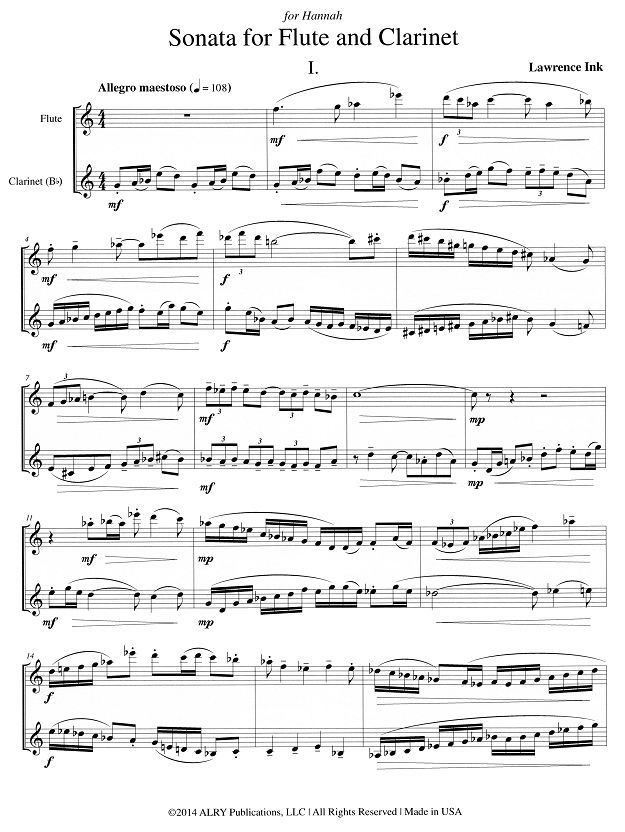 |
WW340: Sonata for Flute and Clarinet by Lawrence Ink. Alry Publications, 2014, SS, 15 + 5 + 6 pages. Lawrence Ink (1955-) is an American flutist and composer. A lyrical and playful work in three movements (Allegro maestoso; Adagio; Allegro) which uses a variety of modes to capture many different moods. Early college level/college level with a duration of about 11 minutes. Click on the cover image to view the first page of the score. |
16.95
|
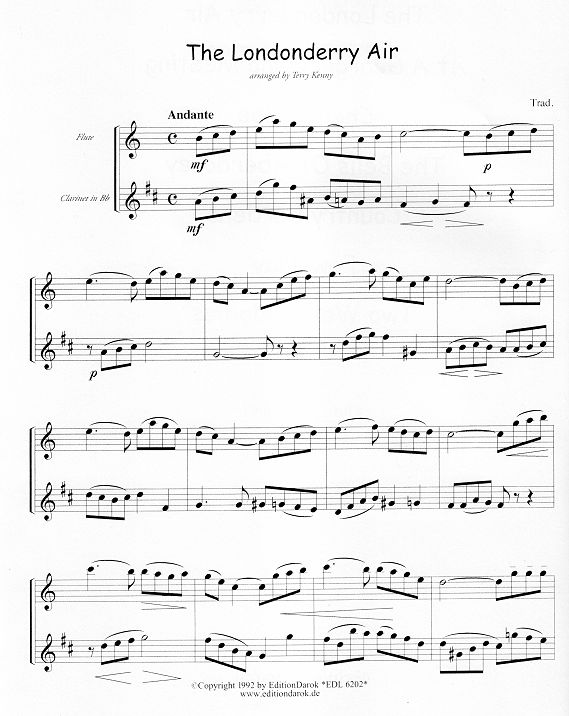 |
WW345: The Londonderry Air, 7 Easy Duets for Flute and Clarinet arranged by Terry Kenny. EditionDarok, 1992, SS, 14 pages (score format). In addition to Londonderry Air, the book includes At a Georgi Camp Meeting, Cherry Ripe (an English folk song), The Bells of Aberdovey (a Welsh folk song), Country Gardens, Fowl Play (Chicken Reel and Turkey in the Straw), and Two Welsh Melodies (All Through the Night and Suo Gân). The music has a range of difficulties at the intermediate level. Click on the cover image to view the first page. (Except other items with free shipping.) |
13.95
|
 |
WW168: Dialogues Op. 158 for Flute and Clarinet by Michael Kibbe. Michael Kibbe, 2006, SB, (includes score and parts). This work is in three movements: I. Allegretto, II. Andante, and III. Vivo. Duration about 8:30 minutes. Early college level. |
19.95
|
 |
WW167: Duo Op. 73 for Clarinet and Bassoon by Michael Kibbe. Michael Kibbe, 2007, SB, (includes score and parts). Premiered in 1983, this revised edtion was published in late 2007. The work is in three movements: I. Briskly, II. Quietly Moving, and III. Very fast. Duration about 8 minutes. Early college level. |
12.95
|
 |
C1158: Pink Flamingos Tango for Clarinet and Bass Clarinet (or Bassoon) by Michael Kibbe. Michael Kibbe, 2006, (includes all parts). Originally written for wind quintet, the composer has adapted this piece for two players. At an Allegro sensuoso tempo, this should be playable by good high school/adult amateur performers and beyond. (Except other items with free shipping.) |
11.95
|
 |
WW163: Sonatina for Flute and Clarinet Op. 92/2b by Ernst Krenek. Baerenreiter, 1960, SS, 5 pages (in score format). Ernst Krenek (1900-1991) was an Austrian born composer (of Czech heritage) who lived in the United States from 1938 on. In three movements: I. Allegretto comodo, II. Adagio, and III. Vivace. This piece, which as written in 1942, looks like a good piece for a college recital. The duration is about 8 minutes.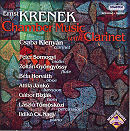 (Except other items with free shipping.) |
22.95
|
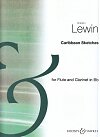 |
WW139: Caribbean Sketches for Flute and Clarinet by Gordon Lewin. Boosey & Hawkes, 1962, SS, (includes parts and score). Gordon Lewin (1921-2008) was a British composer, clarinetist, and saxophonist, who studied at the Royal College of Music and performed on more than 100 film scores. This piece has two movements: 1. Palm Tree Song (1:30) and 2. Cuban Calypso (2:10). The first could probably be performed by many good high school duos, while the second, which is mostly in 5/4 at Allegro giocoso con ritmo (mm=160-168), will require a somewhat higher skill level. (Except other items with free shipping.) |
25.95
|
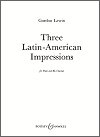 |
WW136: Three Latin-American Impressions for Flute and Clarinet by Gordon Lewin. Boosey & Hawkes, 1955, SS, 8 pages in score format. Another Gordon Lewin piece that looks like a lot of fun and has finally been received (in August 2010) after a lengthy wait. The three pieces are: 1. La Chica (Allegro, Valse Creole), 2. El Burro Pequeño (Tempo di Samba), and 3. Bailecito Mexicano (Allegro, Jarabe). Early college level (some high school level musicians will be able to play this) with the first and last pieces easier than the middle one. (Except other items with free shipping.) |
20.95
|
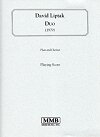 |
WW130: Duo Flute and Clarinet by David Liptak. MMB Music, 1992, SB, 9 pages. David Liptak (1949-) is an American composer and music educator. This piece was commissioned for the 1979 Rock Mountain Chamber Festival and was first perform by Doriot Anthony Dwyer flute and David Harman clarinet at Fort Collins, Colorado the same year. It was revised by the composer in 1992. It is in four movements: Andante con moto, Con forza, Andante languido, and Presto. It is in score format (11 x 17 size) with a copy for each performer. This is an advanced work with a duration of about 9 minutes.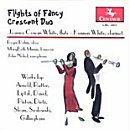 |
39.95
|
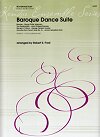 |
WW183: Baroque Dance Suite for Flute and Clarinet by arranged by Robert S. Frost. Kendor Music, 2010, 5 pages in score format. The dances of the Baroque period provide challenging and rewarding repertoire for festival and concert performance. They dances are: Georg Phillip Telemann Bourree, Jean-Philippe Rameau Two Sarabandes, George Frederic Handel Minuet in F minor, Johann Sebastian Bach Gavotte (from French Suite No. 5). The publisher rates this as US grade 3. It is suitable for younger (but progressing) high school students. Total duration 6:00. Click on the cover image to view the first page.
(Except other items with free shipping.) |
7.50
|
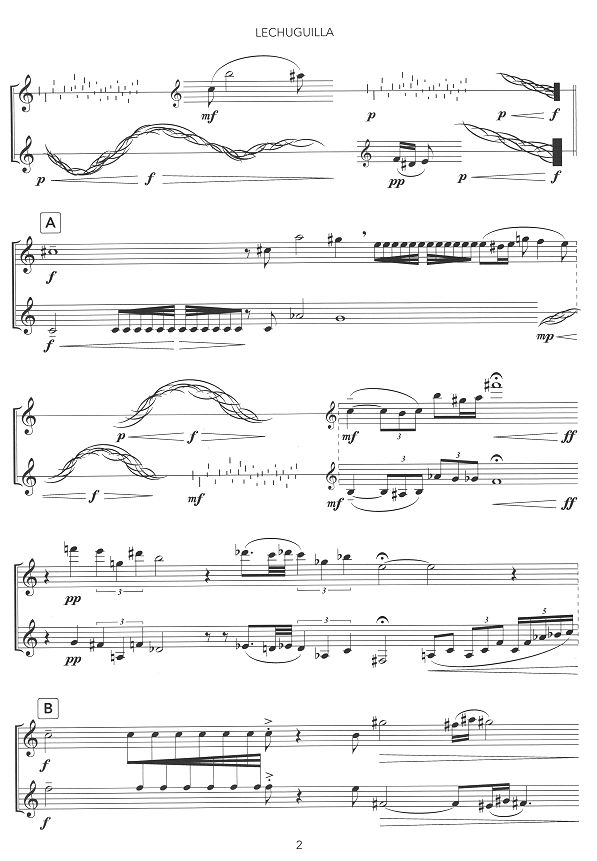 |
 WW403: Lechuguilla for Flute and Clarinet by Stephen Lias. Alias Press, 2019, SS, 6 pages in score format. In the Carlsbad Caverns National Park system, Lechuguilla was known as a small historic site with little importance. It wasn't until 1986 that a group of cavers broke through to discover what would eventually become more than 136 miles of mapped passages and caverns, making this the fifth longest cave in the world. Several documentaries have witnessed the exploration of Lechuguilla, and access today is limited to approved scientific researchers, survey and exploration teams. Lias expresses the magnificence and mystery of Lechuguilla in a duo for wind (breath) instruments. This five-minute work for flute and clarinet explores the interrelationships between themes representing air, rock, and water. It combines traditional techniques with extended demands on the players including key clicks (small vertical lines in the score, air blown through instrument-some stopped or started with the tongue, flutter tonging (flute), pitch bending (clarinet) and some contemporary notation. Click on the cover image to view the second page of the score. WW403: Lechuguilla for Flute and Clarinet by Stephen Lias. Alias Press, 2019, SS, 6 pages in score format. In the Carlsbad Caverns National Park system, Lechuguilla was known as a small historic site with little importance. It wasn't until 1986 that a group of cavers broke through to discover what would eventually become more than 136 miles of mapped passages and caverns, making this the fifth longest cave in the world. Several documentaries have witnessed the exploration of Lechuguilla, and access today is limited to approved scientific researchers, survey and exploration teams. Lias expresses the magnificence and mystery of Lechuguilla in a duo for wind (breath) instruments. This five-minute work for flute and clarinet explores the interrelationships between themes representing air, rock, and water. It combines traditional techniques with extended demands on the players including key clicks (small vertical lines in the score, air blown through instrument-some stopped or started with the tongue, flutter tonging (flute), pitch bending (clarinet) and some contemporary notation. Click on the cover image to view the second page of the score.
(Except other items with free shipping.) |
8.95
|
|
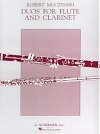
WW037: Duos for Flute and Clarinet Op. 24 by Robert Muczynski. G. Schirmer, 1991, SS, 13 pages. Includes two copies of the six duets which are in score format. Probably early college level but might be attempted by younger players if the flutist has good command of the third octave. |
16.95
|
|
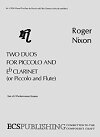
WW260: Two Duos for Piccolo and E-flat Clarinet (or Piccolo and Flute) by Roger Nixon. ECSPublishing/Galaxy Music, 1982, SS, 8 pages (2 copies in score format). Roger Nixon (1921-2009) was an American composer, musician (who had studied the clarinet), and professor of music. Duo I. is Moderato and Duo II. is Allegro moderato. College level. (Except other items with free shipping.) |
11.25
|
|
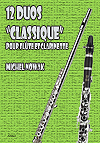
 WW406: 12 Duos “Classique” for flute and clarinet edited by Michel Nowak. Andel, SS, 24 pages. Intermediate flute and clarinet duets in score format. Contents: Mozart Mon coeur soupire Extrait des Noces de Figaro, Czibulka Songe D'Amour Apres le Bal - Intermezzo, Johann Strauss Le Beau Danuble Bleu, Schubert March Militaire, traditional Santa Lucia, traditional Le Carnaval de Venise, Schubert La Truite, Chopin Tristesse, Weber Invitation a la Valse, Rameau Tambourin, traditional Schwarze Augen - Les Yeux Noirs (Dark Eyes), and Liszt Rȇve D'Amour. Click on the cover image to view a sample page. WW406: 12 Duos “Classique” for flute and clarinet edited by Michel Nowak. Andel, SS, 24 pages. Intermediate flute and clarinet duets in score format. Contents: Mozart Mon coeur soupire Extrait des Noces de Figaro, Czibulka Songe D'Amour Apres le Bal - Intermezzo, Johann Strauss Le Beau Danuble Bleu, Schubert March Militaire, traditional Santa Lucia, traditional Le Carnaval de Venise, Schubert La Truite, Chopin Tristesse, Weber Invitation a la Valse, Rameau Tambourin, traditional Schwarze Augen - Les Yeux Noirs (Dark Eyes), and Liszt Rȇve D'Amour. Click on the cover image to view a sample page. |
21.95
|
|
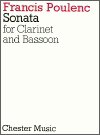
WW038: Sonata for Clarinet and Bassoon by Francis Poulenc. Chester Music, 1924, SS, 12 pages. The music is in score format. Somewhat similar in style to Sonata for Two Clarinets, it has three movements: Allegro, Romance, and Final. While the bassoonist faces some endurance issues in the second and third movements, this is excellent recital repertoire. (Except other items with free shipping.) |
11.95
|
|
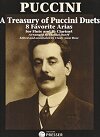
WW277: A Treasury of Puccini Duets, 8 Favorite Arias for Flute and Clarinet in B-flat arranged by Daniel Dorff, edited and annotated by Cindy Anne Broz. Theodore Presser Co., 2012, SS, 20 pages. Score format. Oh! Mio Babbino Caro from Gianni Schicchi; Musetta's Waltz from La Bohème; Butterfly's Entrance, Flower Duet, and Un Bel Di from Madama Butterfly; Donna Non Vidi Mai from Manon Lescaut; Vissi d'Arte from Tosca; and Ave Maria from Suor Angelica. Includes translations and scene descriptions. In addition, notes and suggestions for applying operatic lyricism through instrumental expression are provided by flutist-pedagogue Cindy Anne Broz. Upper intermediate level. Click on the cover image to see sample pages. |
16.95
|

|
WW249: Blue Clarinet and Saxophone Duets for Clarinet and Alto or Tenor Saxophone by James Rae. Universal Edition, 1996, SS, includes clarinet and alto saxophone parts in score format and a separate tenor saxophone part. Five original duets at various tempos. Four are swung, one is Latin. They include chord symbols in concert pitch. Intermediate/upper intermediate level. Click on the cover image to see a sample page. |
18.95
|
|
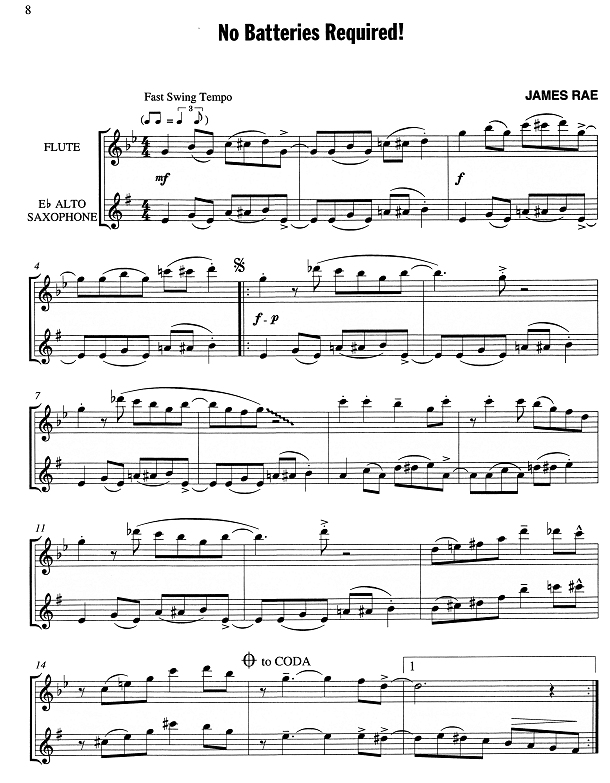
WW250: Blue Flute and Saxophone Duets for Flute and Alto or Tenor Saxophone by James Rae. Universal Edition, 1999, SS, includes flute and alto saxophone parts in score format and a separate tenor saxophone part. Five original duets (completely different than the book above) at various tempos. All are swung. They include chord symbols in concert pitch. Intermediate/upper intermediate level. Click on the cover image to see a sample page. |
14.95
|
|
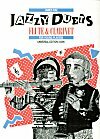
WW046: Jazzy Duets Flute & Clarinet by James Rae. Universal Edition, 1991, 11 pages. This book has five original duets in score format. They are intended for young players (about third or fourth year or so). |
15.95
|
|
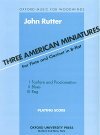
WW051: Three American Miniatures for Flute and Clarinet in B-flat by John Rutter. Oxford, 1981, SS, 8 pages. One of the foremost living composers and conductors of choral music, John Rutter has also written orchestral and instrumental music. This piece for unaccompanied flute and clarinet is in three movements: Fanfare and Proclamation (Vivace), Blues (Andante expressivo), and Rag (Allegretto). Early college level. Score format. (Except other items with free shipping.) |
12.50
|
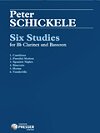 |
WW287: Six Studies for Clarinet and Bassoon by Peter Schickele. Theodore Press Co., 2012, SS, 12 pages (score format). As a teenage Schickele played both bassoon and clarinet has maintained a "fondness for the combination" ever since. Now, years later, he was presented with the opportunity to again compose for this duo, with the resulting Six Studies, a short (9' total) set of varied pieces ranging from reverent to raucous. For intermediate to advanced performers. The titles are Cantilena, Parallel Motion, Spanish Nights, Staccato, Hymn, and Vaudeville. (Except other items with free shipping.) |
9.95
|
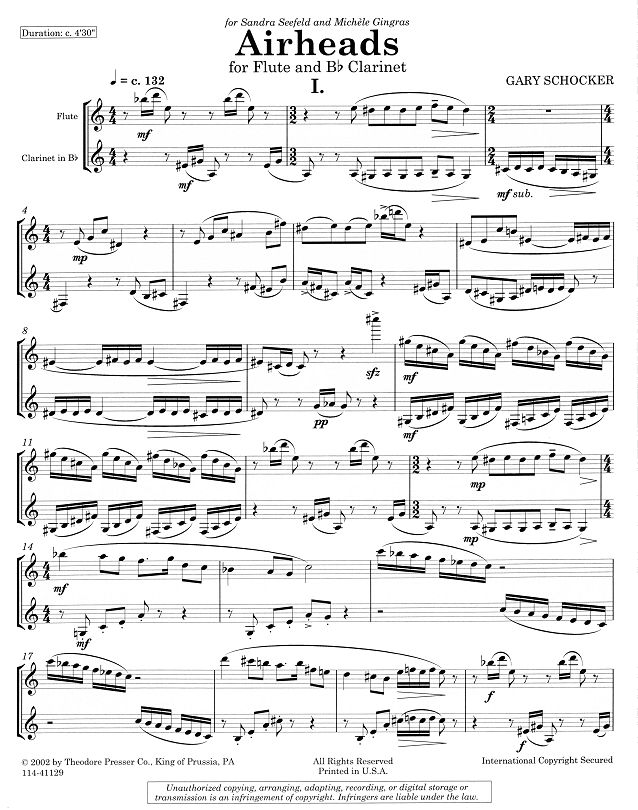 |
WW339: Airheads for Flute and B-flat Clarinet by Gary Schocker. Theodore Press Co., 2002, SS, 6 pages (2 copies in score format). This piece is in three short movements with a total duration of 4:30. College level. Here is a video performance of the entire piece. Click on the cover image to view the first page.
(Except other items with free shipping.) |
12.95
|
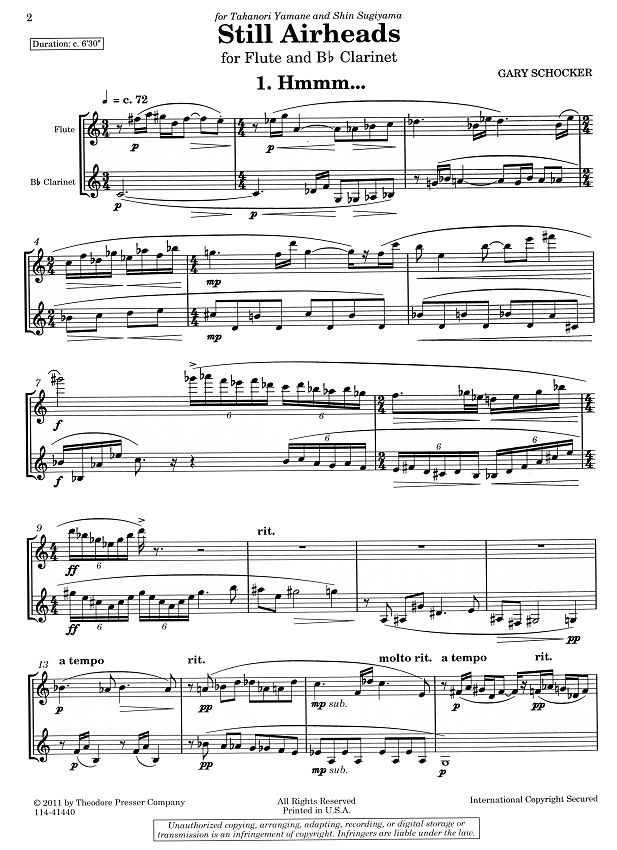 |
WW262: Still Airheads for Flute and B-flat Clarinet by Gary Schocker. Theodore Press Co., 2011, SS, 10 pages (score format). Following the success of the classic Airheads for flute and clarinet, Gary Schocker has provided a sequel, sporting the same lyricism, surprises, grace, and wit; teasing us with five evocatively named movements: “Hmmm...,” “Spritely,” “… While You Work,” “Brooding,” and “Royal Outing.” For advanced players, but the first two pieces are the most difficult. Duration of about 6:30. Click on the cover image to view the first page.
(Except other items with free shipping.) |
11.95
|
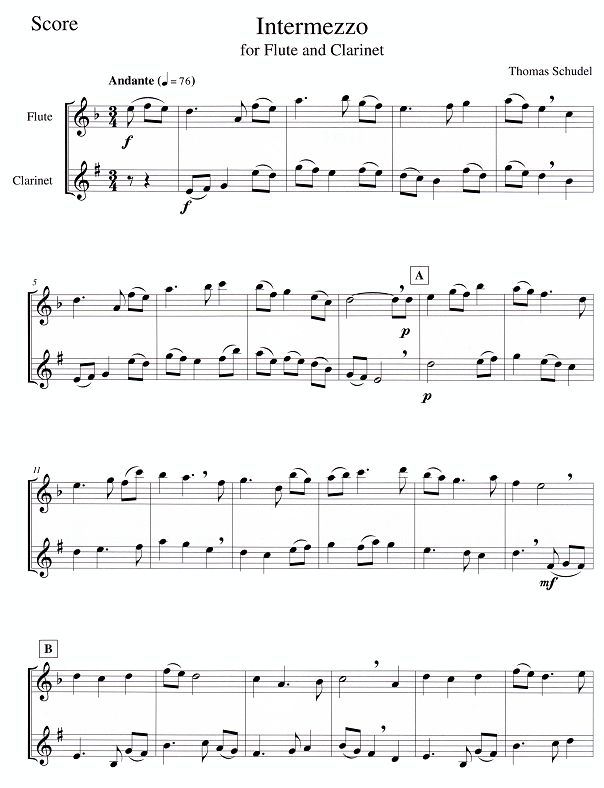 |
WW341: Intermezzo for Flute and Clarinet by Thomas Schudel. Alry Publications, 1988, SS, includes parts and score. This is a short piece at Andante tempo suitable for students at the early intermediate level. It is described on the publisher's website as "A brief conversation between the flute and clarinet with a simple melodic flow. Marvelous for showing contrast in timbre. Suitable for contests." Click on the cover image to view the first page of the two page score.
(Except other items with free shipping.) |
10.95
|
|
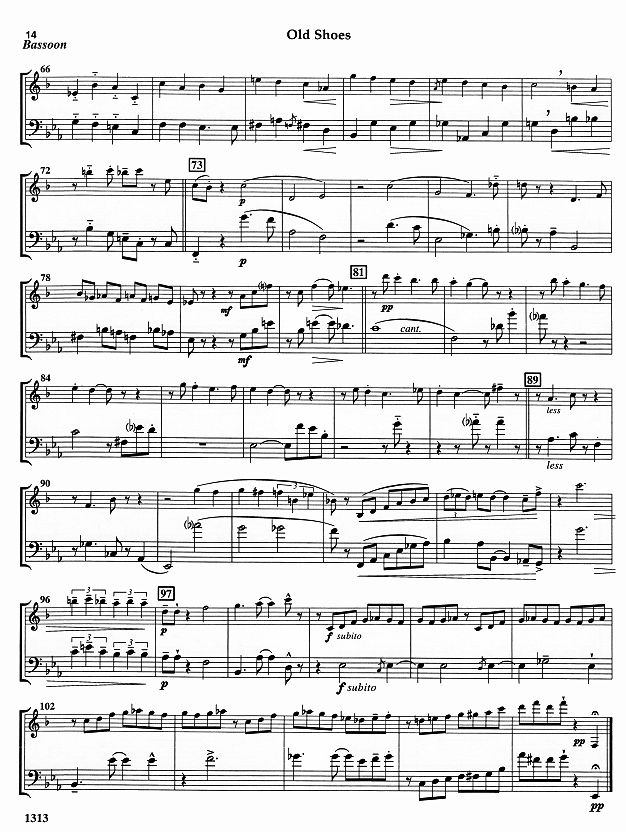
WW325: Old Shoes Op. 54 Duets for Clarinet and Bassoon by Don Stewart. Trillenium Music, 2013, SS, 13 pages. This work is in score format (2 copies) which some extra pages included to avoid page turns. This work is also available for clarinet and bass clarinet (C2147). Four pieces: 1. Some Blues, 2. After Mose (a down-south funk), 3. Waltz, and 4. After Cole (Porter, in the style of Billy May both a show-tune and a bop). College level. Click on the cover image to view a sample page. |
39.95
|
|
WW133: Three Duets for Flute and Clarinet by Don Stewart. Trillenium Music, 1999, SS, 8 pages (two parts in score format). Don Stewart (1935-) is an American composer and woodwind performer. This piece was written in 1959 and is one of his earliest compositions. The first duet is a perfect canon but with contrasting sections. The second which the composer originally regarded as "flamenco" in derivation, alternates an intensive melody with a brittle rhythmic background. The third is short and formally simple but polytonal. Early college level. |
9.95
|
|
WW395: 15 Melodious Duets for Flute and Clarinet arranged by Carl Strommen. Almitra Music Inc./Kendor Music Inc., 2018, SS, 34 pages (score format). Featuring an array of 15 classics for grade 3-4 players, the music has been carefully chosen and edited to ensure that it is idiomatic for each pair of instruments. Therefore, one book will not be compatible with any other in the series. Contents: Scarlatti Capriccio; Swedish folk song Slangpolska; Mozart Rondo, March, and Allegro; Beethoven Bagatelle; Hook Sonatina; Kullak Cradle Song; Joplin The Ragtime Dance; Delibes Pizzicato Polka; Purcell Prelude; Bach Air From Suite No. 3 In D; Saint-Saens Dance; Bizet Selections From Carmen; Irish Double Jig Biddy Maloney. Click on the cover image to view the Table of Contents and a sample page. |
13.50
|
|
WW108: Duo for Flute and Clarinet by Antoni Szalowski. Chester, 1948, SS, 14 pages (now with 2 copies in score format). Szalowski (1907-1973) was a Polish born composer who studied in Warsaw and Paris (with Boulanger). While most of his work was written for strings it is his pieces for winds that are most popular today. He has been described as a neo-classicist, favoring established forms, clear musical content, and contrapuntal writing. This is one of the more popular (advanced college level) flute and clarinet duets. It is in three movements: I. Allegro, II. Andante, and III. Allegro. It is in score format and has been printed without regard for page turns, so some preparation will be required for performance. Duration is about 8 minutes.
(Except other items with free shipping.) |
15.95
|
|
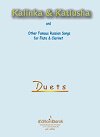
WW254: Kalinka & Katiusha and Other Famous Russian Songs for Flute and Clarinet traditional. EditionDarok, 2011, SS, 30 pages (score format). Fifteen Russian folk songs at the intermediate level but with a range of difficulty. Includes: Do Not Scold Me, The Silver Birch, Kalinka, The Light, My Heart, Behind the Walls, Poliushko-Pole, Moscow Nights, Stenka Razin, Snow Flurries & Troika Rushing, Song of the Volga Boatmen, In the Valley & the Slender, Katiusha, Along the Peterskaya Road, and Folk Song. |
16.95
|
|
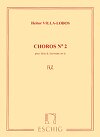
WW218: Choros No. 2 for Flute and Clarinet in A by Heitor Villa-Lobos. Eschig, 1927, SS, 4 pages (two parts in score format). This is one of 14 numbered choros that Villa-Lobos wrote between 1920 and 1929 for a variety of instruments and combinations of instruments including orchestra. The tempo is Pouco movido (mm=88 with some slower spots). College level with a duration of about 2:30. (Except other items with free shipping.) |
13.95
|
|
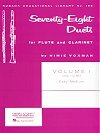
WW017: 78 Duets for Flute and Clarinet Vol. 1 (1-55) Easy-Medium by Himie Voxman. Rubank, 1960, SS, 72 pages. Adapted from the works of the Bachs, the Mozarts, Boismortier, Dietter, Handel and others.
WW018: 78 Duets for Flute and Clarinet Vol. 2 (56-78) Advanced by Himie Voxman. Rubank, 1960, SS, 72 pages. Adapted from the works of Bach, Mozart, Geminiani, Muffat, Quantz, Rameau, and C. Stamitz. |
Vol. 1
9.95
Vol. 2 |
|
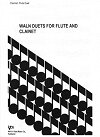
WW251: Waln Duets for Flute and Clarinet arranged by George Waln. Neil A Kjos Music Co., 1954, SS. Parts for flute and clarinet (no score). Sixteen duets from Mozart, Keller, Kummer, Mazas, Ferling, Berbiquier, W.F. Bach. Garibaldi, and Beethoven. A variety of difficulty levels from early to advanced high school. Adult players will also enjoy these duets. |
9.95
|
|
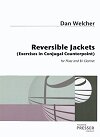
WW259: Reversible Jackets (Exercises in Conjugal Counterpoint) for Flute and Clarinet by Dan Welcher. Elkan-Vogel/Presser, 1997, SS, 11 pages in score format. This piece was composed in 1987 for Leone Buyse and Michael Webster as a wedding present. The title refers to the fact that the musical lines are constantly being exchanged, inverted, expanded and contracted by both players. In three movements: 1. Canon (Breezy), 2. Dialogue (Freely; like an improvisation), and Fugue (Suddenly fast). Duration 6:00. (Except other items with free shipping.) |
15.95
|
|
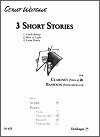
WW058: Three Short Stories for Clarinet and Bassoon by Gernot Wolfgang. Doblinger, 2003, SS, (includes parts and score). Gernot Wolfgang (1957-) is an Austrian born composer who lives in Los Angeles. He received his musical education in Austria and the United States. He has written chamber and orchestral music as well as for the film and TV industries. The three stories are: 1. Uncle Bebop (very fast with straight eighth notes), 2. Rays of Light (Rubato, expressive), 3. Latin Dance (also very fast with straight eighth notes). |
33.95
|
|
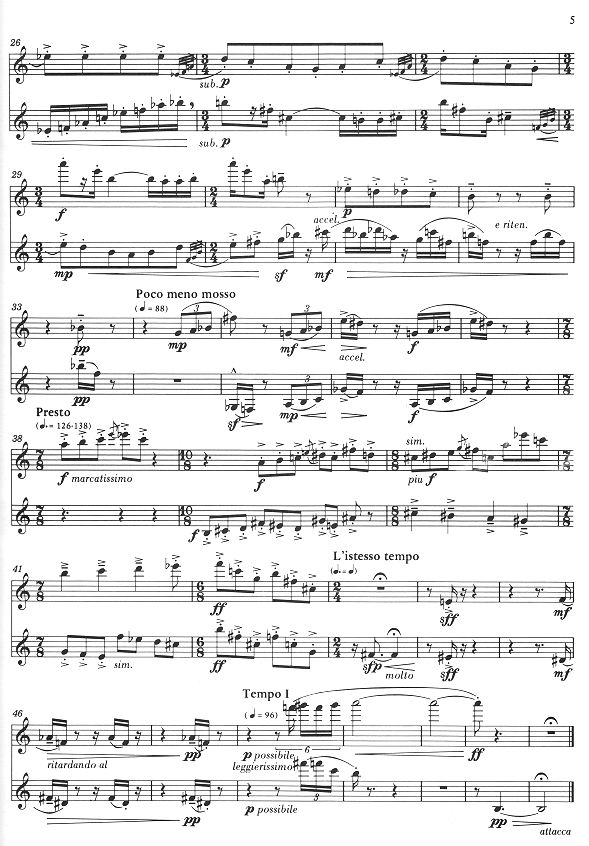
WW261: Serenade for Flute and Clarinet in B-flat by Jürg Wyttenbach. Schott, 1980, SS, 12 pages, score format. In four movements: I. Little March (in broken steps), II Duettino (in unequal voices), III. Waltz (in added values and Trio in false unison), and IV. Chase (in slow motion and accelerated). This is a relatively advanced work, suitable for upper division college recitals. Duration about 8 minutes. Click on the cover image to view the second page of the first movement. (The initial tempo on this page is mm=96.) (Except other items with free shipping.) |
18.95
|
|
WW396: Six Sacred Christmas Duets for Flute and Clarinet with optional Piano arranged by Keith Young. Kendor Music, 2018, SS, (includes parts and piano score). Written to be enjoyed either with or without the piano accompaniment, these six grade 4 duet settings include ten of the most popular carols in traditional to modern styles, along with a couple swing settings. Contents: Midwinter Lullaby (In The Bleak Midwinter and Away In A Manger), Midnight Still (Still, Still, Still and It Came Upon A Midnight Clear), Two French Carols (Sing We Now Of Christmas with He Is Born), What Child Is This?, Proclaim The Joy (Joy To The World and Go, Tell It On The Mountain), and God Rest Ye Swingin’ Gentlemen. Click on the cover image to see see the first two pages of the piano score. |
16.95
|
|
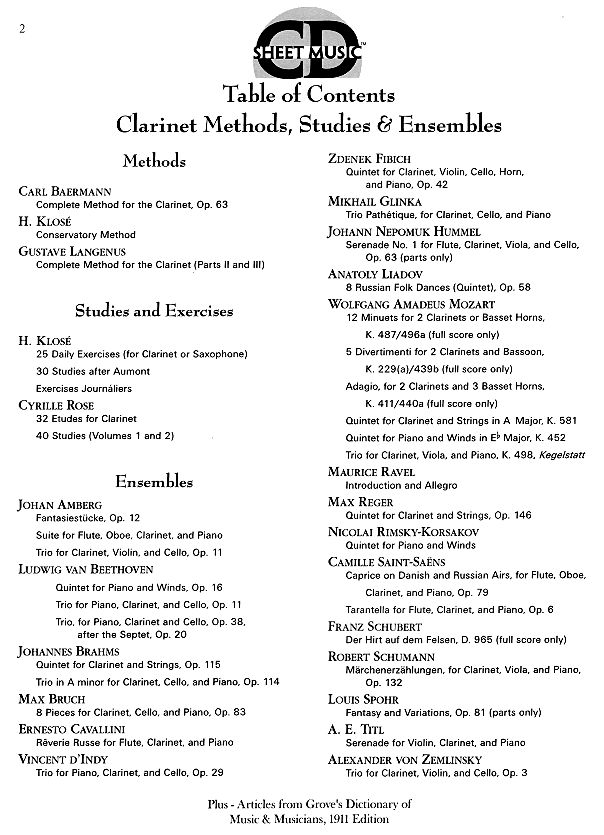
 C1574: Clarinet Methods, Studies & Ensembles. CD Sheet Music LLC, 2010, 2100+ pages. This collection makes available eight essential clarinet methods, studies and exercises, as well as over 30 works for clarinet with instruments including duos, trios and quartets by 20 familiar and lesser known composers from the 18th, 19th and early 20th centuries. Scores and parts are included for many ensemble works. Methods, Studies & Exercises include: Baermann (Complete Method for Clarinet, Op. 63); Klosé (Conservatory Method, 25 Daily Exercises, 30 Studies after Augmont); Langenus (Complete Method for Clarinet); Rose (32 Etudes for Clarinet). Ensembles include: Amberg (Fantasiestücke, Suite for Flute, Oboe, Clarinet & Piano); Beethoven (Quintet for Piano and Winds); Brahms (Quintet for Clarinet & Strings, Trio for Clarinet, Cello & Piano); Bruch (8 Piece for Clarinet, Cello & Piano); Cavallini (Rêverie Russe for Flute, Clarinet, and Piano); d'Indy (Trio for Piano, Clarinet, and Cello); Fibich (Quintet for Clarinet, Violin, Cello, Horn, & Piano); Glinka (Trio Pathétique, for Clarinet, Cello, & Piano); Hummel (Serenade No. 1 for Flute, Clarinet, Viola, & Cello); Liadov (8 Russian Folk Dances); Mozart (Twelve Minuets for 2 Clarinets or Basset Horns, Five Divertimenti for 2 Clarinets & Bassoon, Quintet for Clarinet & Strings, Quintet for Piano & Winds, Trio for Clarinet, Viola & Piano); Ravel (Introduction & Allegro); Reger (Quintet for Clarinet & Strings); Rimsky-Korsakov (Quintet for Piano & Winds); Saint-Saëns (Tarantella for Flute, Clarinet & Piano); Schubert (Der Hirt auf dem Felsen); Schumann (Märchenerzählungen, for Clarinet, Viola & Piano); Spohr (Fantasy & Variations); Titl (Serenade for Violin, Clarinet & Piano); Zemlinsky (Trio for Clarinet, Violin & Cello). Also includes composer biographies and relevant articles from the 1911 edition of Grove's Dictionary of Music and Musicians. This CD Sheet Music contains music for a variety of ensembles. Click on the image cover to view the complete Table of Contents. (Except other items with free shipping.) |
19.95
|
|
WW257: Pit Band for Alto Saxophone, Bass Clarinet and Piano by William Albright. C.F. Peters, 1996, SS. (includes parts and piano score). This work, with its unusual ensemble of three haphazard instruments--a pick-up band--attemps to digest an evening-long musical comedy in a few minutes (8 to be precise). The program is: Tune-up and Introduction, Overture, Opening Number, Vamps and Screams ("Nessun dorma"), Love Song, Waltz, alla Marcia, Fox-trot and Shimmeys, and Finale. An advanced work with some high altissimo for both instruments, but without the nasty key changes found in most musicals. |
39.95
|
|
WW255: Grand Fantasia for Flute, Clarinet (or Trumpet) and Piano by Malcolm Arnold. Queen's Temple Publications, 2004, SS, (includes parts and piano score). This piece was written in 1940 for flute, trumpet (played by the composer) and piano. It is not surprising that the clarinet is now listed first on the cover as the part would be more difficult on the trumpet than the clarinet. A sectional piece including a czardas, tango, blues, waltz and other elements. Early college level with a duration of 10 minutes. |
25.95
|
|
WW125: Le Calme de la Mer Trio for Flute, Clarinet and Piano by Tony Aubin. Alphonse Leduc, 1964, SS, (includes parts and piano score). A suggested piece for this combination. It is at an unhurried tempo (Lento, ma non troppo) and should be playable by many high school students although the flute part goes up to C7. |
20.55
|
|
WW109: Pastorale in A Minor for Oboe (Flute, Violin), Bassoon (Cello, Viola de Gamba) and Continuo by Wilhelm Friedemann Bach edited by Kurt Walther. Zimmermann, 1975. This piece has a "real" bassoon part as a featured instrument along with the oboe. It also includes a continuo part for cello, and a realized keyboard part for harpsichord, piano, or organ. When this piece was first published, Carl Philipp Emanuel Bach was listed as the composer. More information came to light afterwards and when it was reprinted in 1983 the composer's name was corrected.
(Except other items with free shipping.) |
14.95
|
|
WW030: Beethoven Trio for Piano, Flute and Bassoon WoO 37 by Ludwig van Beethoven edited by Friedhelm Klugman with piano fingerings by Hans-Martin Theopold. Henle, 1981, SS. Includes performance parts for flute, bassoon, and piano (which includes the other parts in the score). This trio was written between 1786-90. |
24.95
|
|
WW195: Lluna for flute, clarinet and piano by Daniel Bimbi. Emerson Edition, 2008, SS, (includes parts and piano score). Daniel Bimbi (1971-) was born in Carcassonne in Southern France. He studied clarinet with Guy Deplus and more recently has been studying composition with Jan Van der Roost. Lluna was originally intended to be the theme of a Children's Opera based upon "The Child and the Moon." The themes are very sultry and nostalgic in a Latin, Mediterranean style, finished with a brilliant pyrotechnical finale, both humorous and exciting. College level with a duration of about 7 minutes. |
21.95
|
 |
WW069: Trio in D minor for Oboe (Clarinet), Bassoon (Viola/Bass Clarinet/Basset Horn) and Piano by Alexander Brent-Smith. Rosewood Publications, 2003, (includes piano score and all parts). Alexander Brent-Smith (1889-1950) was a British composer, author, and teacher. This work was first performed in 1943. It is in three movements I. Allegro Moderato, II. Andante, and III. Allegretto. It should be playable by those at the early college level (and adult amateurs). |
35.95
|
 |
WW080: 7ème Trio Op. 56 for Oboe, Bassoon and Piano by Henri Brod. International Music Diffusion, 2001, SS, includes parts and piano score. Henri Bord (1799-1839) was a teacher, composer and instrument maker who was important in the development of the oboe in France. This is a sectional piece in two main parts. The first is Maestoso which is followed by a Theme (Allegretto) and five variations. The oboe and bassoon parts are early college level. The piano part (this is a true trio) is at least that level. |
27.95
|
 |
WW379: Rêverie Russe, Grand Duo for Flute, Clarinet and Piano by Ernesto Cavallini edited by Stephanie Jutt (flute part) and Alan Kay (clarinet part). International Music Company, 2017, SS, includes parts and piano score. Ernesto Cavallini (1807-1874) was an Italian clarinetist and composer who spent 15 years working in Russia. The piece consists of a gentle introduction followed by a simple theme, five variations, and a jaunty finale, after which the opening material returns briefly bringing this piece to its quiet finish. This is a relatively advanced work. There are some videos of this piece on YouTube but they predate this edition. |
28.95
|
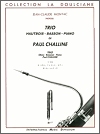 |
WW093: Trio for Oboe, Bassoon and Piano by Paul Challine. International Music Diffusion, 1990, PB/SS, 67 + 18 + 20 pages (includes parts and piano score). Paul Challine (1908-1994) was a French composer and lawyer who wrote mostly chamber music. While much of his music was written while he was a POW during World War II, this piece was written in 1981. It is a substantial trio in four movements: I. Allegro moderato, II. Scherzo (Léger it rythmé), III. Andante (triste et grave), and IV. Finale (Anime). All movements have tempo changes. College level. |
61.95
|
|
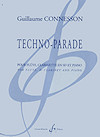
WW370: Techno-Parade for Flute, Clarinet and Piano by Guillaume Connesson. Billaudot, 2010, SS, includes parts and piano score. Guillaume Connesson (1970-) is a French composer who has written for a wide variety of ensembles. This is an advanced work which also exists in a version for 2 soprano saxophones and piano (it is here). The score contains some instructions for the pianist for manipulating the strings of the piano. The duration is 5 minutes. Here is a video of this version which is being played faster than the marked duration indicates. |
31.95
|
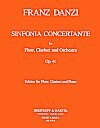 |
WW031: Sinfonia Concertante for Flute, Clarinet and Orchestra Op. 41 Piano Reduction by Franz Danzi edited by John P. Newhill. Music Rara, 1982, PB, 57 + 9 + 10 pages. In three movements: Allegro Moderato, Larghetto, and Allegretto polonaise. Includes extensive notes by the editor. |
46.95
|
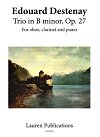 |
WW228: Trio in B minor Op. 27 for Oboe, Clarinet (in A) and Piano by Edouard Destenay. Lauren Publications, SS, includes parts and piano score. Recently reprinted from a 1906 Hamelle edition. Edouard Destenay (1850-1924) was a French composer and organist who was born in Algiers. In three movements: Allegro vivace, Andante non troppo, and Presto. College level. |
26.75
|
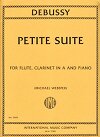 |
WW204: Petite Suite arranged for Flute, Clarinet in A and Piano by Claude Debussy arranged by Michael Webster. International Music Co., 2009, SS. A wonderful arrangement of a wonderful piece (originally for piano four hands). Four movements: I. En Bateau, II. Cortège, III. Menuet, and IV. Ballet. Generally college level. The duration is about 12:30. |
29.50
|
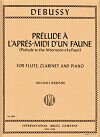 |
WW138: Prélude à l'après-midi d'un faune (Prelude to the Afternoon of a Faun) arranged for Flute, Clarinet and Piano by Claude Debussy arranged by Michael Webster. International Music Co., 1994, SS. This piece is one of the most popular flute solos in the repertoire, but as the arranger writes, adapting it for flute and piano has not been very successful because there is too much music to be covered by two instruments. Adding the clarinet produces a more satisfactory result. Both A and B-flat clarinet parts are included. The duration is about 9:20. |
13.95
|
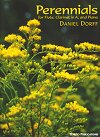 |
WW274: Perennials for Flute, Clarinet in A and Piano by Daniel Dorff. Tenuto Publications, 2012, SS, includes parts and piano score. This piece was commissioned by Walfrid and Sherry Kujala in celebration of the retirement of Helen and Richard Shanley from Baylor University. It was premiered by Sherry Kujala, Larry Combs and Nolan Pearson in October 2011. There are five movements (non-programatic): I. Joyous Overture, II. Romanza, III. Scherzo, IV. Winter Prayer, and V. Spring Awakening. Accessible college level music with a duration of about 21 minutes. Click on the cover image to view the first page of each movement. |
24.95
|
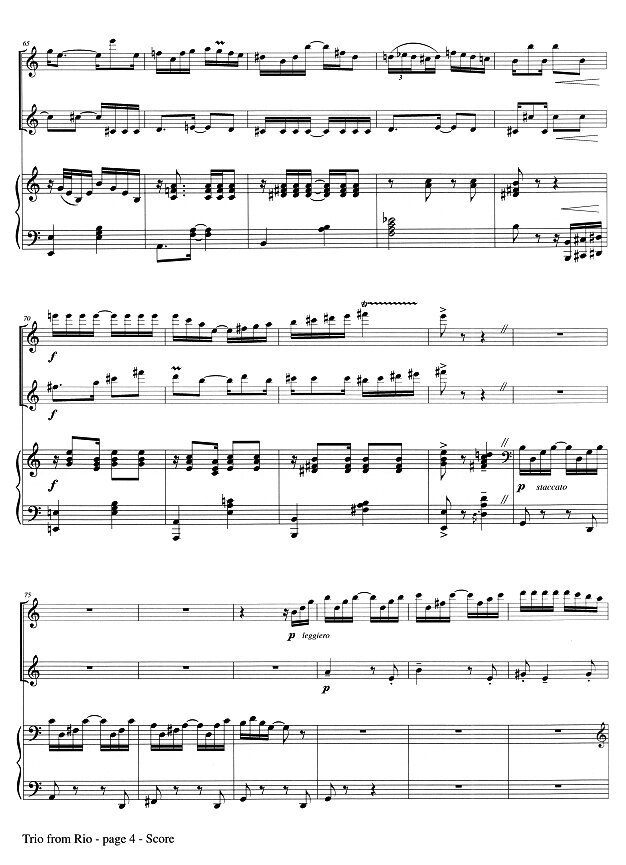 |
WW295: Trio from Rio, Three movements on Brazilian motives for Flute, Clarinet and Piano by Donald Draganski. Alry Publications, 2012, SS, includes parts and piano score. Donald Draganski (1936-) is from Chicago where he worked for many years as a university music librarian in addition to being a composer and a bassoonist. Three movements based on Brazilian motives and dance styles, originally written for the Pilgrim Chamber Players in 1999. I. Allegro energico, II. Andante, and III. Allegro moderato. College level with a duration of about 14.30. Click on the cover image to view the a page of the score from the first movement. |
24.95
|
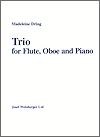 |
WW336: Trio for Flute, Oboe and Piano by Madeleine Dring. Josef Wienberger Ltd., 1970, SS, (includes parts and piano score). Madeleine Dring (1923-1977) was an English composer and actress. Her biographical information on Wikipedia is worth reading. In three movements: I. Allegro con brio, II. Andante semplice, and III. Allegro giocoso. College level with frequent meter changes in the first movement. Duration of about 10:45. Here is a performance on YouTube. |
26.95
|
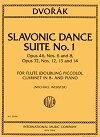 |
WW289: Slavonic Dance Suite No. 1 arranged for Flute, Clarinet and Piano by Antonin Dvorak arranged by Michael Webster. International Music, 2012, SS, (includes parts and piano score). Flute doubles piccolo on the first movement. Clarinet in B-flat only. The dances in this suite are: I. No. 8 Op. 46 (Presto), II. No. 14 Op. 72 (Moderato, quasi Menuetto), III. No 13. Op. 72 (Poco Adagio), IV. No. 12 Op. 72 (Allegretto grazioso), and V. No. 6 Op. 46 (Poco Allegro). They may be performed individually or together. College level with a duration of about 18:50. |
45.25
|
 |
WW327: Wildflowers A Trio for Piccolo (or Flute), Clarinet and Piano by Eric Ewazen. Theodore Presser Co., 2011/2013, SS, includes all parts and piano score. There are separate parts for piccolo and flute. Some of the flute part is in the same range as the piccolo while other portions are an octave lower. This lively, dance-filled chamber work was composed for piccoloist Jan Gippo and clarinetist Jane Carl. Inspired by the brilliant colors of wildflowers from America’s heartland, Wildflowers opens with the joyful energy of the Dense Blazing Star, followed by the beautiful and poignant ballad, Missouri Primrose, and ends with the exhilarating and celebratory dance depicting the Mexican Hat. For advanced performers. Duration of about 22 minutes. Here is the first movement of the flute version with the composer at the piano. Here is the first movement of the piccolo version. Click on the cover image to view the first page of the score. |
24.95
|
 |
WW235: Dolly Op. 56 arranged for Flute, Clarinet in A and B-flat, and Piano by Gabriel Fauré transcribed and edited by Michael Webster. International Music, 1999, SS. The Dolly suite was written for piano four hands between 1894 and 1897 with additional movements added on Dolly's birthdays. Michael Webster writes that the nature of the original composition makes it well suited for this instrumentation. Six movements: I. Berceuse, II. MI-A-OU, III. Le Jardin de Dolly, IV. Ketty - Valse, V. Tendresse, VI. Le Pas Espagnol. For the first and third movements, A clarinet is preferred but alternate parts for B-flat clarinet are provided (the other movements are for B-flat clarinet). College level with a duration of about 15 minutes. |
34.75
|
 |
WW368: Pavane arranged for Flute, Clarinet in A or B-flat, and Piano by Gabriel Fauré arranged by Michael Webster. Theodore Presser Co., 2016, SS, includes parts and score. Gabriel Fauré (1845-1924) was the leading French composer of his generation. The original version of this piece, composed in 1887, was for small orchestra. Fauré also produced a piano version of this piece. This transcription combines elements of both. There are two versions included. The version for A clarinet is in the original key of F-sharp minor. For B-flat clarinet the concert key is G minor (the clarinet parts are the same with the other parts transposed). |
18.95
|
 |
WW270: Trionometry for Flute, Clarinet/Bass Clarinet and Piano by Richard Festinger. C.F. Peters, 1996, SS, includes parts and piano score. Richard Festinger (1948-) studied composition at the University of California in Berkeley with Andrew Imbrie. Before turning to composing, he led his own groups as a jazz performer. He has taught at the University of California in Berkeley and Davis, Dartmouth College, and since 1990 at San Francisco State University. Written in 1996. In three movements: I. A la breve/Vivace, II. Andantino, and III. Allegro. An advanced work with a duration of about 15 minutes. The first and last movements are for bass clarinet with some notes in the extended range. "Richard Festinger's Trionometry was simply breathtaking... This technically demanding tour de force begins with a delicate exposition which... eventually explodes into a contrapuntal argument of grandiose proportions... like a multi-stage rocket that - ignoring gravity - traverses the earth's atmosphere. Bravo!" - Twentieth Century Music |
37.50
|
 |
WW256: Trio Flute, Oboe and Piano by Harald Genzmer. Edition Peters, 2010, includes parts and piano score. Harald Genzmer (1909-2007) was a German composer and music educator who studied with Hindemith. This work was written in 1993 but was not published until recently. This piece is in Genzmer's typical style while given the instrumentalists the opportunity to cooperate in contrapuntal textures and demonstrate their virtuosic ability. It is in three movements, generally in the fast/slow/fast format but with considerable variations in tempos within each movement. Duration is about 12:20. |
45.95
|
 |
WW049: Trio Pathétique for Clarinet, Bassoon (Violoncello) and Piano by Michail Glinka. Music Rara, 1957, SS. In four movements: Allegro Moderato, Scherzo, Largo and Allegro con spirito. This is a major work that brings out the best qualities of each instrument. The clarinet and bassoon parts are not especially difficult but it requires an excellent pianist. |
26.95
|
 |
WW363: Two Pieces Volume I, La Jota Aragonesa and Souvenir de la Havane by Louis Moreau Gottschalk arranged for Flute, Clarinet and Piano by Michael Webster. International Music Co., 2016, SS, includes parts and piano score. Louis Moreau Gottschalk (1829-1869) was an American composer and pianist, best known as a virtuoso performer of his own romantic piano works. He spent most of his working career outside of the United States. La Jota Aragonesa (Caprice Espagnol, Op. 14) is a famous Spanish tune (also used by other composers) cleverly and virtuosically embellished. Souvenir de la Havane (Grand Caprice de Concert, Op. 39) was written in 1859 in the Antilles. It is the earliest example the arranger has found of a habenera as the form of a concert piece. These pieces are at an advanced college level. |
27.95
|
 |
WW376: Two Pieces Volume II, Souvenir de Cuba (Mazurka) and Grande Tarantelle by Louis Moreau Gottschalk arranged for Flute, Clarinet (A and B-flat) and Piano by Michael Webster. International Music Co., 2016, SS, includes parts and piano score. Souvenir de Cuba (A clarinet) opens and closes with tropical languor, but is actually a mazurka with remarkable similarities to Chopin's Op. 6 No. 1. Grande Tarantelle (B-flat clarinet) is probably Gottschalk's most famous work for piano. The arranger has taken a few liberties in the spirit of Gottschalk's "no holds barred" virtuosity. |
30.95
|
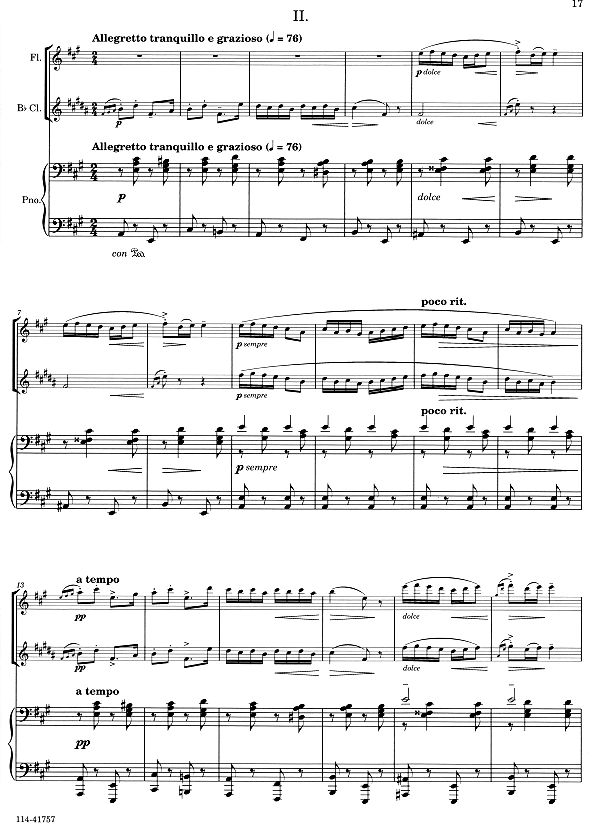 |
WW381: Norwegian Dances Op. 35 by Edvard Grieg arranged for Flute, Clarinet and Piano by Michael Webster. Theodore Presser Co., 2017, SS, includes parts and piano score. The famous set of dances by Norway's greatest composer were written for piano duet. Grieg later created a piano solo version, but refused to orchestrate the set. After some study of Grieg and his music, Michael Webster has arranged the four dances for Flute, Clarinet, and Piano in a faithful setting, using the piano duet version as a guide. This lively Grieg classic will be a welcome new addition to performance programs. For advanced performers (college level) with a duration of about 18 minutes. Click on the cover image to view a sample page from the score. |
28.95
|
|
WW075: Waltz and Interlude Duet for Flute and B-flat Clarinet with Piano Accompaniment by Clare Grundman. Boosey & Hawkes, 1964, SS, (includes piano score and individual parts). This is an intermediate duet with an easy piano part. It is in three sections: a waltz (Moderato con moto), then the interlude in 4/4 (Meno), followed by a return to the waltz in the original tempo. The flute part goes to a high G while the clarinet part does not go higher than a B above the staff and is frequently in the lower register. (Except other items with free shipping.) |
15.95
|
|
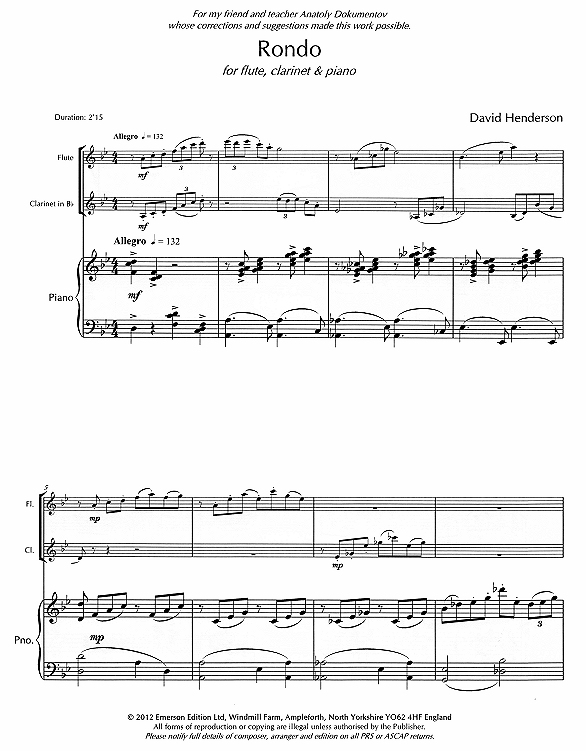
WW351: Rondo for Flute, Clarinet and Piano by David Henderson. Emerson Edition, 2012, SS, (includes piano score and individual parts). David Henderson (1942-) is an English composer and musician who emigrated to Australia in 1968. Advanced high school/early college level. It is at an Allegro tempo. Here is a video of this piece. Click on the cover image to view the first page of the score. (Except other items with free shipping.) |
12.95
|
|
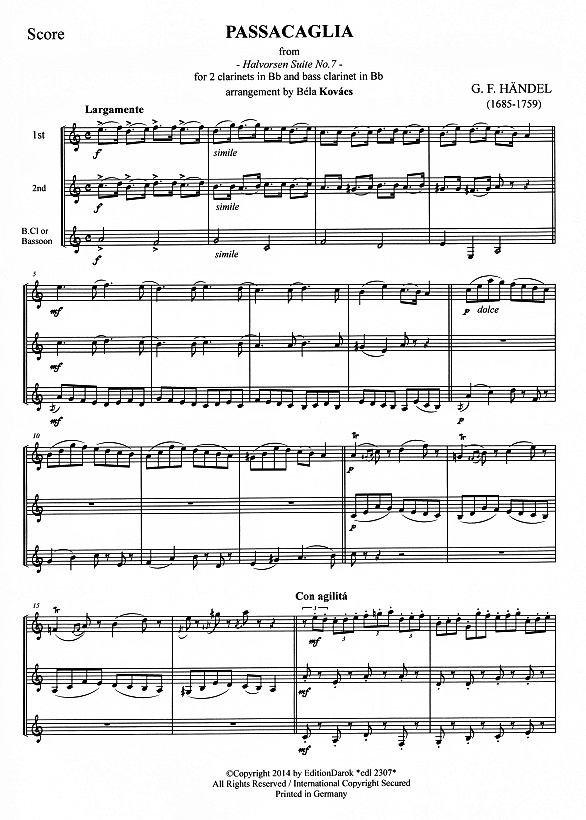
C2224: Passacaglia by G.F. Händel (Handel) arranged by Bela Kovacs. EditionDarok, 2014, SS, includes parts and score. For 2 B-flat clarinets and bass clarinet or bassoon. It is from the Halvorsen Suite no. 7. This is a sectional piece with many tempos. Early college level. Click on the cover image to view the first page of the score. (Except other items with free shipping.) |
22.95
|
 |
WW170: Five Waltzes for Flute, Clarinet and Piano by Paul Harris. Queen's Temple Publications, 1998, SS, 24 + 3 + 3 pages. The five waltzes are: I. Allegro, II Allegro grazioso, III. Moderato, IV. Allegretto, and V. Allegro con moto. High school level and the piano part is easy. |
15.95
|
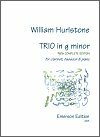 |
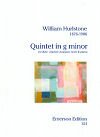
WW238: Trio in G minor for Clarinet, Bassoon and Piano by William Hurlstone. Emerson Edition, 2006, SS, 50 + 15 + 14 pages. William Yates Hurlstone (1876-1906) was a talented British composer whose untimely death, before he could reach full maturity as a composer, has resulted in undeserved obscurity. This work was written in 1896/97 but the third movement was lost for many years and this is the first publication of the complete work (the full story can be found here, scroll down to see it). The four movements are: I. Allegro moderato, II. Andante, III. Scherzo (Allegretto con moto), and IV. Andante maestoso/Allegro vivace. College level. |
45.95
|
|
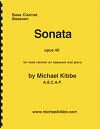
WW142: Sonata Op. 40 for Bass Clarinet (or Bassoon) and Piano by Michael Kibbe. Stretto Music, SB, 24 + 7 pages. This piece was composed in 1977-78 (and revised in 2005) and is in a very straightforward Neoclassical style in three contrasting movements with an emphasis on clarinet of form and of the melodic ideas. The movements are: I. Allegro deciso, II. Andante tranquillo, and III. Allegro vivo. College level with a duration of about 9:30. |
15.95
|
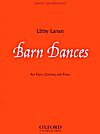 |
WW052: Barn Dances for Flute, Clarinet and Piano by Libby Larsen. Oxford University Press/Goodmusic, 2004, SS, 24 + 8 + 8 pages. The composer wrote: "Barn Dances is a set of four abstract pieces. . . Each piece draws from the name of a particular dance step used in cowboy dances. Taking the name of the step as a point of departure, my idea was to take a flight of fancy in each movement and to create the musical equivalent of a character drawing." The movements are: Forward Six and Fall Back Eight, Divide the Ring, Varsouvianna (a simple dream waltz), and Rattlesnake Twist. Upper college level. |
23.50
|
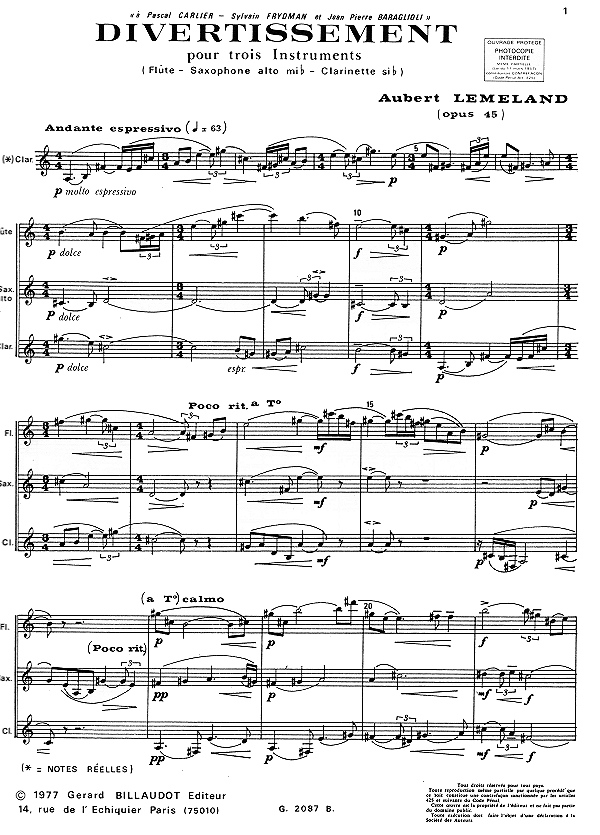 |
WW211: Divertissement Op. 45 for Flute, Alto Saxophone and Clarinet by Aubert Lemeland. Billaudot, 1977, SS, includes parts and score. Aubert Lemeland (1932-2010) was a French composer. This is a sectional piece with many tempo changes. College level with a duration of about 9 minutes. Here is a video performance. Click on the cover image to view the first page of the score (sounding pitch). |
19.95
|
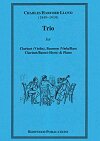 |
WW237: Trio for Clarinet (Violin), Bassoon (Viola/Bass Clarinet/Basset Horn) and Piano by Charles Harford Lloyd. Rosewood Publications, 1997, SB, (includes piano score and all parts). Charles Harford Lloyd (1864-1919) was a celebrated organist and music professor who also did some composing. Although most successful as a choral composer, he wrote a few other works including this one and a Duo Concertante for clarinet and piano. In three movements: I. Allegro con brio, II Andante espressivo, and III. Allegro moderato. (Early) college level. A low C bass clarinet would be desirable but is not required. |
27.95
|
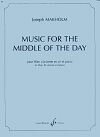 |
WW126: Music for the Middle of the Day for Flute, Clarinet in B-flat, and Piano by Joseph Makholm. Billaudot, 2006, SS. This piece was written for the Webster trio. Michael Webster describes it as "Sophisticated jazz. Joe has written everything out to sound natural, almost improvised at times, with lush chord changes and inventive melodies and rhythms. It is an outstanding example of its genre." In four movements: 1. Late One Afternoon (At a lazy, but regular, pace), 2. Dolores' Kitchen (Up-tempo bossa), 3. December (Molto rubato), and 4. You Think You Know, But You Don't (Up-tempo swing). The first and last movements should be swung. College level with a duration of about 9 minutes. |
43.95
|
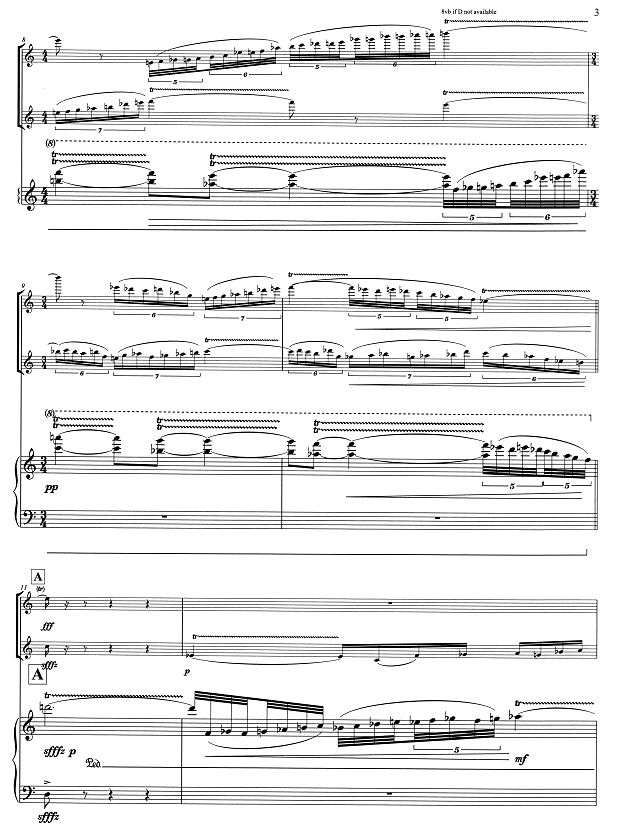 |
WW343: Spectred Light for Flute (doubling Piccolo), Clarinet, and Piano doubling suspended metal Wind Chimes by Paul Mealor. Novello, 2011, SS, includes parts and piano score. Paul Mealor (1975-) is a Welsh composer especially noted for music for chorus. In three movements with a duration of about 7 minutes, this is a virtuosic work. The first movement is Allegro Moderato and is by far the longest. At the end of this movement the pianist briefly plays the wind chimes and then imitates them on the piano and the beginning of the short second movement (Adagio, Molto Express). The third movement is Allegro Moderato and similar to the first movement although it uses piccolo, is slightly faster and is not as long. Click on the cover image to view the second page of the score. |
29.95
|
|
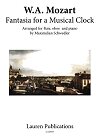
WW229: Mozart Fantasia for a Musical Clock for Flute, Oboe, and Piano arranged by Maximilian Schwedler. Lauren Publications, SS, includes parts and piano score. Reprinted from the 1919 Zimmermann edition. The second part can be played by a violin or a second flute. This piece was written for the Flötenuhr or Spielühr, a mechanical organ or clock. It is sectional: Allegro, Andante, and Tempo I. College level. |
12.50
|
|
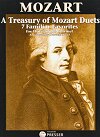
WW241: A Treasury of Mozart Duets (7 Familiar Favorites) for Flute and Clarinet arranged by Daniel Dorff. Theodore Presser Co., 2010, SS, 24 pages in score format. Composer and clarinetist Daniel Dorff has further expanded the repertoire for Flute and Clarinet duo with this book featuring Mozart’s best-loved arias and instrumental themes, the works in this collection have been transcribed into complete-sounding idiomatic adaptations, equally suitable for recital use and just-for-fun duet read-throughs. This collection also features a scholarly preface about ornamentation, interpretation, and authentic performance practice. Includes Overture to The Magic Flute (abridged); "Voi, che spete" and "non più andrai" from The Marriage of Figaro;, Adagio from the Clarinet Concerto (abridged);, "Alleluia" from Exsultate, Jubilate; "Bei Männern, welche Liebe" from The Magic Flute; and Twelve Variations on "Ah! Vous dirai-je, Maman" (Twinkle, Twinkle Little Star. Better high school level musicians and up. |
16.95
|
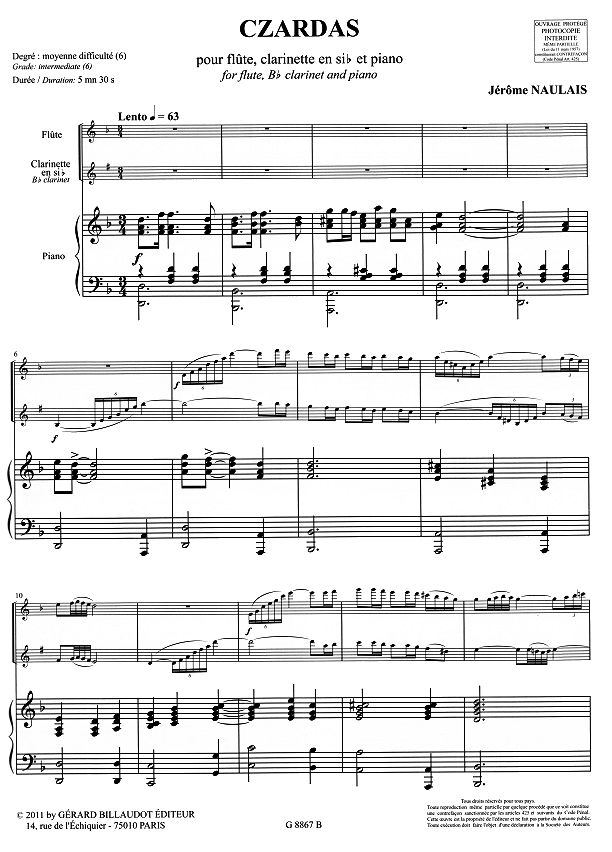 |
WW316: Czardas for Flute, Clarinet in B-flat, and Piano by Jerome Naulais. Billaudot, 2011, SS, includes parts and piano score. This is an original Czardas (a Hungarian folk dance) by French composer Naulais (1951-). It is rated by the publisher as a 6 which is the upper end of intermediate on their 9 level scale. It alternates between slow and fast sections and has a duration of about 5:30. Click on the cover image to view the first page of the score. |
19.95
|

|
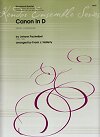
WW365: Pachelbel Canon for Flute, Clarinet and Piano by Johann Pachelbel arranged by Daniel Dorff. Theodore Presser Co., 2016, includes both wind parts and piano score. Daniel Dorff has arranged the famed Pachelbel Canon in D (in this case in concert F). The ingenious overlapping of this piece creates the intricate sounds when the instruments play off of each other in the world's most beloved canon. For intermediate to advanced performers. Click on the cover image to view a sample page from the score. (Except other items with free shipping.) |
9.95
|
|
WW410: Mother Goose Suite (Ma mere l'Oye) for Flute, Oboe and Piano by Maurice Ravel arranged by John Alley. Aurea Capra Editions, 2022. Includes parts and piano score. Includes I. Pavane de la Belle au bois dormant, II. Petit Poucet, III. Laideronette, Imperatrice des Pagodes, IV. Les entretiens de la Belle et la Bete, and V. Le jardin feerique. |
29.95
|
|
WW121: Tarentelle Op. 6 for Flute, Clarinet in A and Piano by Camille Saint-Saëns. Kalmus, SS, (includes parts and piano score). Originally with orchestral accompaniment, this is one of Saint-Saëns earlier adult works. While traditional in many respects it includes a surprising Prestissimo conclusion in 2/4. College level with a duration of about 6 minutes.
|
9.95
|
|
WW122: Sonatine en Trio Op. 85 for Flute, Clarinet in A and Harpsichord or Piano by Florent Schmitt. Durand, 1935, SS, includes parts and harpsichord/piano score. This is one of the more popular pieces for this combination. It is in four movements: I. Assez animé, II. Assez vif, III. Très lent, and IV. Animé. The flute and clarinet parts generally move together in harmony. College level with a duration of 8-9 minutes. Here is a video of a performance.
|
41.95
|
|
WW366: Sonata No. 2 for Flute, Clarinet and Piano by Gary Schocker. Theodore Presser Co., 2016, SS, includes parts and piano score. Commissioned by the Palisades Virtuosi, Gary Schocker’s Sonata No. 2 for Flute, Clarinet, and Piano is a formal work – perfect for recitals. The sonata is a joyous bridge fusing Schocker’s fondness for beauty and wit with all the architecture of traditional sonata construction. The opening movement, Flip, sets the stage with its quick interplay between the three performers, handing melodic elements back and forth among them. The middle movement, Old Flame, is a beautiful melancholic longing, while the finale, Fancypants, is a showcase of dynamic, rhythmic ensemble playing. College level with a duration of about 13 minutes. Click here for a video with highlights from this piece. Click on the cover image to view sample pages from the score. |
19.95
|
|
WW123: Four Waltzes for Flute, Clarinet, and Piano by Dmitri Shostakovich arranged by Levon Atovmian. Sikorski, 1958, SS, includes parts and piano score. A somewhat unusual arrangement in that the first waltz is for clarinet and piano and the second is for flute and piano with only the last two for all three instruments. The waltzes are I. Spring Waltz, II. Waltz Joke, III, Waltz, and IV. Barrel-Organ Waltz (piccolo instead of flute). Early college level.
|
33.95
|
|
WW202: Concerto in B-flat for Clarinet, Bassoon and Orchestra (Piano Reduction) by Karl Stamitz edited by Johannes Wojciechowski. Sikorski, 1954, 28 + 8 + 8 pages (includes both parts and piano score). In three movements: I. Allegro moderato, II. Andante moderato, and III. Rondo. The parts are well laid out with excellent page turns. Cues are often provided before entrances and the other solo part is provided for the two joint cadenzas. The 1954 publication of this work was the first time it had been published. 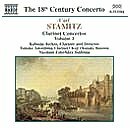 |
34.95
|
|
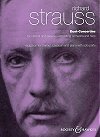
WW043: Duet-Concertino for Clarinet and Bassoon with String Orchestra and Harp (Piano Reduction) by Richard Strauss. Boosey & Hawkes, 1949, SS. Includes two copies of duet parts and the piano reduction in score format. The Concertino is in three movements: Allegro moderato, Rondo, and Tempo primo. |
54.95
|
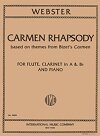 |
WW266: Carmen Rhapsody Based on Themes from Bizet's Carmen for Flute, Clarinet in A and B-flat, and Piano by Michael Webster. International Music, 1997, SS. Mostly for A clarinet with a section in the middle for B-flat. Includes Prelude, Habanera, Chorus of the Street Boys, Seguidilla, Entr'acte, Toreador Song, and Gypsy Song (which may be performed as a separate piece). College level. |
35.75
|
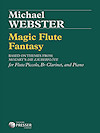 |
WW373: Magic Flute Fantasy, Based on Themes from Mozart's Die Zauberflöte for Flute/Piccolo, Clarinet in B-flat, and Piano by Michael Webster. Theodore Presser Co., 2016, SS, includes parts and piano score. In the spirit of the great 19th-century virtuoso fantasies on famous arias, Michael Webster has created a concert trio on the many great arias from Mozart's The Magic Flute, combining the most exciting and satisfying features of opera medleys and characteristic variations. Webster makes the most of the flute (doubling piccolo) and clarinet as versatile performers equally suited to deliver Mozart's beautiful vocal writing, and to ornament and embroider the themes in elegant Mozartean style. There is a spot for an optional clarinet Eingang for which the composer supplies an example. Duration about 19 minutes. For advanced performers. Here is a brief excerpt. |
29.95
|
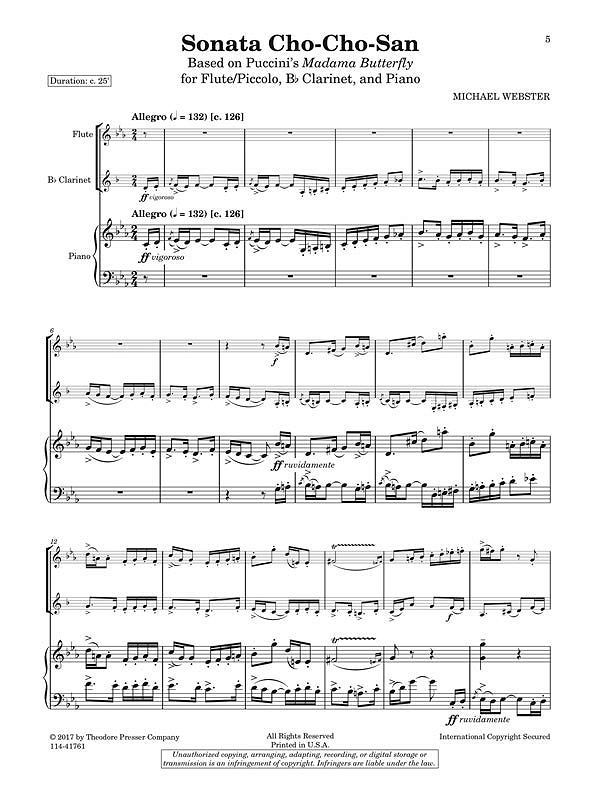 |
WW383: Sonata Cho-Cho-San (Based on Themes from Puccini's Madama Butterfly) for Flute/Piccolo, Clarinet in B-flat, and Piano by Michael Webster. Theodore Presser Co., 2017, SS, includes parts and piano score. Michael Webster has created a concert trio on the many great arias from Puccini's Madama Butterfly. However, as its name implies, Sonata Cho-Cho-San is not the typical virtuosic operatic potpourri. Rather, it follows the plot, resembling a sonata mirroring Puccini's use of recurring and developing themes. Webster makes the most of the winds as versatile performers - equally suited to deliver Puccini's beautiful vocal writing, and to ornament and embroider the poignant themes in symphonic style. For advanced performers. Duration about 24:30. Click on the cover image to view the first page of the score. |
38.95
|
|
|
WW396: Six Sacred Christmas Duets for Flute and Clarinet with optional Piano arranged by Keith Young. Kendor Music, 2018, SS, (includes parts and piano score). Written to be enjoyed either with or without the piano accompaniment, these six grade 4 duet settings include ten of the most popular carols in traditional to modern styles, along with a couple swing settings. Contents: Midwinter Lullaby (In The Bleak Midwinter and Away In A Manger), Midnight Still (Still, Still, Still and It Came Upon A Midnight Clear), Two French Carols (Sing We Now Of Christmas with He Is Born), What Child Is This?, Proclaim The Joy (Joy To The World and Go, Tell It On The Mountain), and God Rest Ye Swingin’ Gentlemen. Click on the cover image to see see the first two pages of the piano score. |
16.95
|
|
WW056: Divertimento for Flute, Oboe and Clarinet (Op. 37) by Malcolm Arnold. Paterson's Publications, 1952. This popular work is in six sections: Allegro energico, Languido, Vivace, Andantino, Maestoso/Prestissimo, and Piacevole. College level. Duration about 8:30. The score is available separately.
(Except other items with free shipping.) |
Parts 17.95
Score 13.95
|
|
C1554: "Baby Bach" Pieces for Beginning Piano transcribed for Basset Horn Trio, Clarinet Trio, Two Clarinets and Bassoon, or Two Clarinets and Bass Clarinet by David Glenn. Bassetti Paletti Publications, 2009, SB/SS. Includes score and parts. These short pieces are from BWV 691, 899, 900, 927, 928, 931, 933, 939, 941, 943, 952, 953, and 988. While the title make is sound as if these are easy pieces this is not the case. They are at the upper intermediate level at a minimum. In addition to the combinations listed above, they could also be played by two clarinets in A and a basset clarinet in A. |
49.95
|

|
G240: Classical FlexTrios B-Flat Woodwind Instruments arranged by Andrew Balent. Almitra Music/Kendor Music, 2013, SS, 29 pages. These 18 (US) grade 2-3 (several on the upper end of grade 3 at least) cover a wide range of styles from the Baroque era to the 20th Century. Published in score format for any combination of instruments using the appropriate key-compatible books. Click on the cover image to view the table of contents. G241: Classical FlexTrios E-Flat Instruments arranged by Andrew Balent. Almitra Music/Kendor Music, 2013, SS, 29 pages. We can also order books for Flute and Oboe, B-flat brass instruments, Horn, Bass Clef Instruments, and Percussion. G242: Classical FlexTrios Piano Accompaniment (optional) arranged by Andrew Balent. Almitra Music/Kendor Music, 2013, SS, 38 pages. These books include the instrumental parts and well as the piano. |
B-Flat WW
11.50
E-Flat
11.50 Piano12.50
|
|
WW380: Classical FlexTrios for Woodwinds arranged by Andrew Balent. Almitra Music/Kendor Music, 2017, SS, 10 pages (x 4). This flexible (US) grade 3 collection contains five well-known classical and traditional pieces that can be played by any combination of 3 woodwind instruments. Contents: Trumpet Voluntary (Clark), Turkish March (Beethoven), Greensleeves, March Of The Priests (Mozart) and Hungarian Dance No. 5 (Brahms). In score format for C, B-flat, E-flat and bass clef instruments. Click on the cover image to view the table of contents and a sample page from one book. |
13.95
|
|
WW315: Four Dances for Flute, Oboe and Clarinet by Christopher Ball. Emerson Edition, 2007, SS, includes score and parts. Christopher Ball (1936-) is a British composer who began his career as an orchestral clarinetist and also served as a conductor in the United Kingdom and Canada. The composer wrote "The Four Dances were composed as companion pieces to Malcolm Arnold's very popular Divertimento [see WW056, above] for the same instruments. Their intention is to be fun for both players and performers . . ." The dances are: 1. Lively Dance (Allegro), 2. Lyrical Dance, 3. Round Dance, and 4. Square Dance. There is a short section of optional piccolo in the last movement. College level with a duration of about 10:30. Click on the cover image to view the first page of the first two movements. |
26.95
|
 |
Ob185: Beethoven Trio in C Major Op. 87 & Variations in C Major WoO 28 for 2 Oboes and English Horn by Ludwig van Beethoven edited by Egon Voss. Henle, 2009, SS, (parts only). This new edition of these two Beethoven trios has a Preface with information on these pieces and their histories and notes on the editing. All text is in German, English, and French. |
39.95
|
 |
WW240: Beethoven Trio Op. 87 arranged for flute, oboe, and clarinet by Ludwig van Beethoven arranged by Gustave Langenus. Carl Fischer (formerly an Ensemble Music Press publication), 1938, SS, (includes parts and score). Transposed to B-flat major this arrangement will give trios at the early college level (and probably some advanced high school students) an opportunity to enjoy this piece. |
19.95
|
|
WW209: Triade Trio for oboe, clarinet and alto saxophone by Marcel Boucard. Billaudot, 1974, (parts only). This piece has four relatively short movements (each part is three pages long). They are 1. Allegro moderato, 2. Andante moderato, 3. Andante, and 4. Petit divertissement (Allegro). Better high school players and up. The first two movements have many tempo changes that will add to the challenge for the ensemble. (Except other items with free shipping.) |
14.95
|
|
WW041: Suite Brève en Trio Op. 67 by Eugene Bozza. Alphonse Leduc, 1947. For oboe, clarinet, and bassoon. Includes individual parts and the score. This is a four movement work: Allegro moderato, Allegro vivo, Adagio expressivo, and Allegro vivo. College level. |
41.30
|
 |
C1144: Bachanale for Clarinet Trio by Zefir Brezeanu. Woodwindiana, 2005, (includes score and parts). This piece is for two B-flat clarinets and bass clarinet (or bassoon). It is based on Bach's Invention XIII, using a jazz approach to give the familiar melody a new life. College level. |
12.95
|
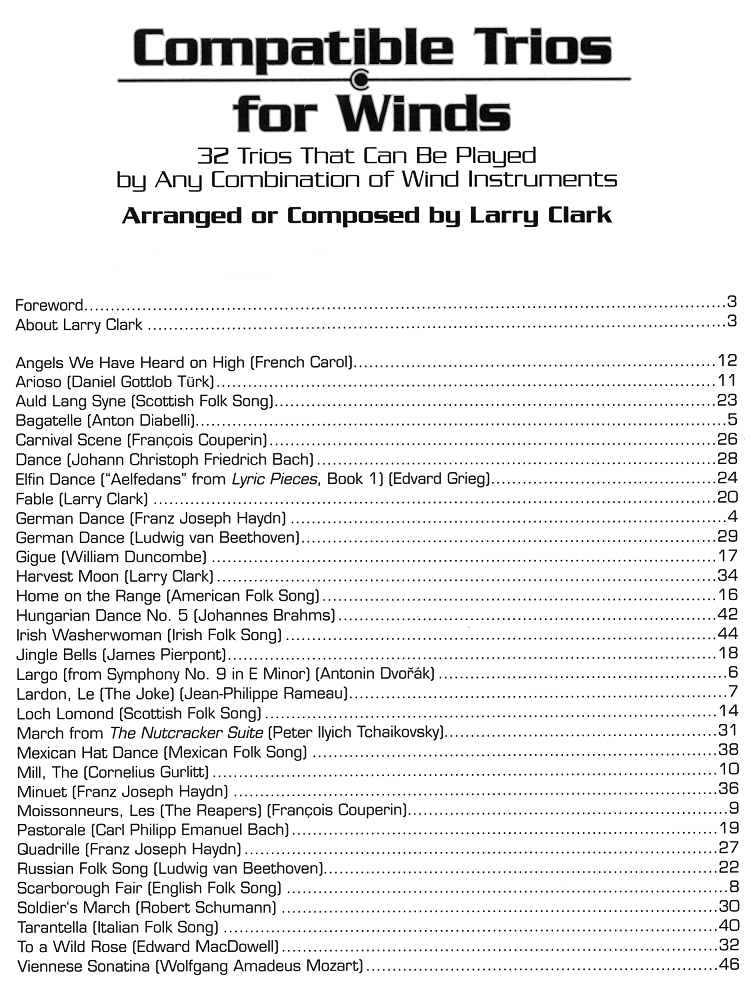
|
WW288: Compatible Trios for Winds for Flute and/or Oboe arranged or composed by Larry Clark. Carl Fischer, 2012, SS, 45 pages in score format. This collection contains 32 trios in a variety of styles from classical to folk, and includes some new original works as well. Each piece is playable by any combination of three wind instruments. Compatible Trios for Winds is especially useful in a school setting. Generally at an early intermediate level. Includes tunes such as The Irish Washerwoman, Brahms’ Hungarian Dance No. 5, MacDowell's To a Wild Rose, and more. In some cases the oboe parts may need to be played an octave lower than written. Parts for other wind instruments are listed under trios for clarinet and saxophone and music collections for bassoon. Click on the cover image to view the Table of Contents. |
11.95
|
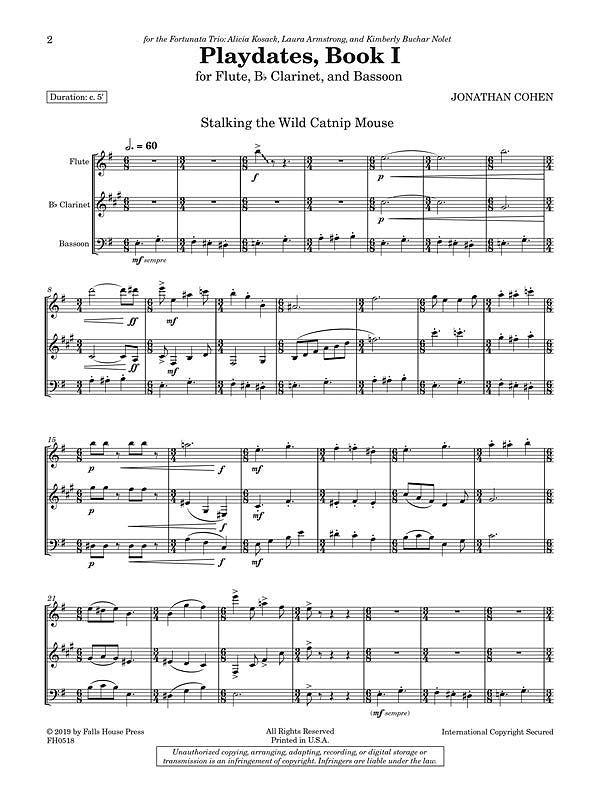
|
WW404: Playdates, Book I for Flute, Clarinet and Bassoon by Johathan Cohen. Falls House Press, 2019, SS, includes parts and score. Cohen’s compositions for flute ensembles, ranging from duets through large choirs, are well known and frequently performed. Less familiar than his flute chamber music is a treasure chest of gems for mixed wind trio, mostly written for the Fortunata Trio. Playdates, Book I introduces three of these short, charming works: Stalking the Wild Catnip Mouse, I’m Skipping, Even If Everyone Is Watching, and But I Always Have This Much Sugar for Breakfast!. Upper high school level and up. Click on the cover image to view the first page of the score. |
21.95
|
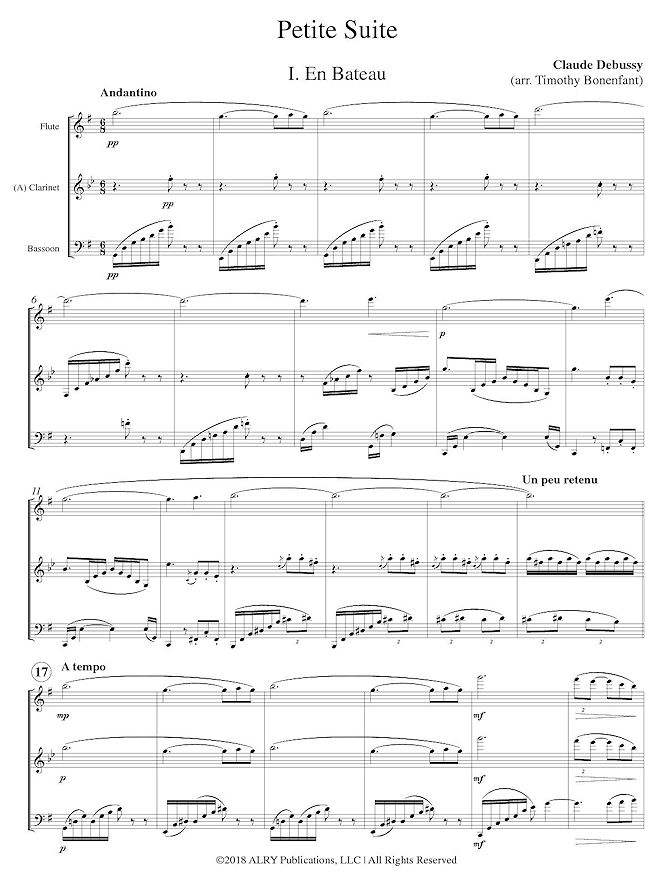
|
WW401: Petite Suite for Flute, Clarinet(A) and Bassoon by Claude Debussy arranged by Timothy Bonenfant. Alry Publications, 2018, SS, includes parts and score. This suite, which was composed from 1886 to 1889 for piano four-hands, was first performed in February 1889 by Debussy and pianist–publisher Jacques Durand at a salon in Paris. It has been arranged many times. The work, which lasts about 13 minutes in performance, has four movements: 1. En bateau (Sailing), Andantino; 2. Cortège (Retinue), Moderato; 3. Menuet, Moderato; and 4. Ballet, Allegro giusto. College level. Click on the cover image to view the first page of the score. |
19.95
|
|
WW230: Aubade Trio for Flute, Oboe and Clarinet in B-flat by Paul deWailly edited by Jerry Kirkbride. International Music Co., 1983, SS, includes parts and score. Paul deWailly (1854-1933) was a French composer and student of Cesar Frank. His music, most of which was written during the period from 1870-1900, is in a conservative style. This very pleasant piece is marked Allegro with a middle section that is more tranquil than the beginning and end. Early college level with a duration of 3 minutes. Here is a student performance on YouTube. |
11.75
|

|
WW217: Vents Pluvieux for Flute, Clarinet and Alto Saxophone by Philippe Di Betta. Fuzeau, 1993, SS, 3 pages (3 copies in score format). Philippe Di Betta (1962-) is a French composer. teacher, and saxophonist. This piece uses some contemporary notation. The clarinet part has several multiphonics and the saxophone has one (fingerings are given). Duration is about 6 minutes. Click on the cover image to view the first page which is not representative of the entire work. |
16.95
|
|
WW221: Habanera from Aires Tropicales for Woodwind Trio (Flute or Oboe, B-flat Clarinet and Bassoon) by Paquito D'Rivera. InternationalOpus, 1994. A movement from the Aires Tropicales (Suite) with challenging contrapuntal lines in a Latin style similar to the Ravel Habanera. (Except other items with free shipping.) |
11.95
|
 |
WW177: Tre Bagattelle for flute, clarinet and bassoon by Ferenc Farkas. Berben, 1993, SS, (includes score and parts). Ferenc Farkas (1905-2000) was a Hungarian composer and music educator who composed a number of popular pieces for woodwinds. In three movements: I. Allegretto, II. Andante, and III. Allegro. Suitable for early college level, amateur adult trios, and better high school ensembles. |
11.95
|
 |
WW169: Trio for flute, oboe and clarinet by Paul Harris. Queen's Temple Publications, 1998, SS, (includes score and parts). The movements are: 1. Prologue (Allegro scherzando), 2. Meditation (adagio sostenuto e cantabile), 3. Waltz (Allegro ma non troppo), 4. Dance (Con moto), 5. Soliloquy (Andante), and 6. Burlesque (Allegro energico). 24 + 3 + 3 pages. The five waltzes are: I. Allegro, II Allegro grazioso, III. Moderato, IV. Allegretto, and V. Allegro con moto. Advanced high school or early college level. |
15.95
|
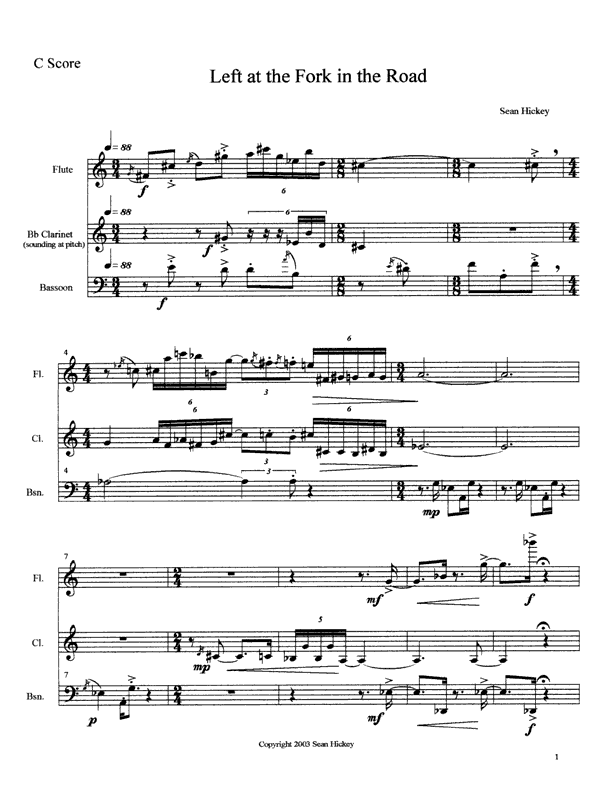
|
WW275: Left at the Fork in the Road for Flute, Clarinet and Bassoon by Sean Hickey. Muzyka Moscow, 2011, SS, (includes score and parts). Sean Hickey (1970-) is an American composer who works in most genres of classical music and is also an arranger for jazz and pop music. This piece was written in 2003. It is in one extended movement mostly at an andante tempo. There is quite a bit of mixed meter and all parts are challenging. The duration is about 6 minutes. (The supplied clarinet part is at concert pitch, even though both it and the score are clearly marked for B-flat clarinet. We have obtained a .pdf file of the transposed part you can download.) You can listen to an audio file here. Click on the cover image to see the first page of the score. |
14.95
|
 |
WW073: Trio No. 2 for Oboe, Clarinet and Bassoon Op. 31 by Charles Huguenin edited by R. Mark Rogers. Southern Music Co., 2006. SS. Includes a score and individual parts. Charles Huguenin (1870-1939) was a Swiss composer, violinist, and choir master. This Trio is in four movements: 1. Rèverie (Daydream) Andante; 2. La Fileuse au Rouet (The Maiden at the Spinning Wheel) Allegretto; 3. Le Chantre de mon Village (The Cantor of My Village) Grave et lent; and 4. La Poule, l'Âne et le Coucou (The Chicken, the Ass and the Cuckoo) Allegro. This edition includes the original clarinet part that calls for A clarinet in movements 1, 2, and 4; plus a version with all movements on B-flat clarinet. General at an early college level and may also be enjoyed by adult amateur players. |
9.95
|
 |
WW215: Introduction and Fugue for Piccolo, Flute, and Alto Flute or Clarinet by Gordon Jacob. Emerson Edition, 1983, SS. Includes the score and parts. The Introduction is Poco Adagio (mm=60) while the Fugue is Allegro (mm=120). Advanced high school level. |
16.95
|
 |
WW216: Divertissement Op. 90 for Two Flutes and Alto Flute (or Clarinet) by Charles Koechlin. Masters Music, SS. Includes score and parts. Charles Koechlin (1867-1950) was a French composer. While he wrote in many styles, much of his music was influenced by Fauré who was one of his teachers. The cover of this music says "Bass Flute" but the part is for flute in G (sol) which is an alto flute. This was written in the period 1923-24 and is in three movements. They are I. Très calme (Tranquillo), II. Allegretto quasi Andante (sans lenteur), and III. Final (Allegro, bien décidé). There are many cues in the parts to assist with the ensemble. College level. |
9.95
|
 |
WW276: Épitaphe de Jean Harlow Op. 164 Romance for Flute, Alto Saxophone and Piano (or Harp) by Charles Koechlin. Eschig, 1970, SS. Includes parts and piano score. Koechlin was fascinated by the movies. This is one of many pieces he composed that is film related. In one movement marked Andantino, sans traîner. Duration about 3:00. Here is a video of an excellent performance. |
31.95
|
 |
WW084: Suite Pour Trio D'Anches Op. 47 for Oboe, Clarinet (in A) and Bassoon by Marcel Labey. International Music Diffusion, 2005, SS, includes parts and score. Marcel Labey (1875-1968) was a French conductor and composer. This work was composed in 1944. I. Entrée (Modéré, sans lenteur), II. Divertissement (Animé), and III. Postlude (Modéré). This piece looks interesting. Click on the cover image to view the first page of the score. |
23.95
|
 |
WW398: Impromptu for Flute, Clarinet, and Bassoon by Libby Larsen. E.C. Schirmer, 1975/2018, SS, includes parts and score. Impromptu is a short, bright, up-tempo piece commissioned in 1975 by KTCA Public Television (Minnesota), to be used as introduction music for a community news and information show. In conversations about what kind of music should reflect the personality of the half-hour show, “optimism,” “serious lightness,” and “sense of positive outcome” were all given to me as goals for the sound of the music—at the time a strange request for a serious, post-modern, 24-year-old newly minted composer! I composed Impromptu for flute, oboe (or clarinet) and bassoon. It’s approximately one and a half minutes long, in ABA form, with mildly mixed meters (5/8, 3/8 and 6/8) set on a lively constant eighth note pulse. -Libby Larsen, 2018. Click on the cover image to view sample pages from the score. (Except other items with free shipping.) |
13.40
|
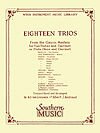 |
WW231: Eighteen Trios from the Classic Masters for Flute, Oboe and Clarinet or Two Flutes and Clarinet transcribed and arranged by Ary van Leeuwen and Albert J. Andraud. Southern Music Co., 1934/2000, SS. Includes score and parts. Includes the following: Wolfgang Amadeus Mozart Larghetto and Adagio and an Allegro; L.C. Daquin La Joyeuse; J. J. Mondonville Tambourin; Johann Sebastian Bach Two Gavottes; Franz Josef Haydn Allegro marziale, Andante and Allegro (from Trio No. 1) and two Prestos; J.P. Rameau Rigodon de Dardanus; Antonio Lotti Allegro; J. M. Leclair Musette; A. Järnefelt; and Paul de Wailly Aubade. Generally these are at the advanced intermediate level. |
24.95
|
 |
WW212: Terzetto for Oboe, Clarinet, and Alto Saxophone by Aubert Lemeland. Billaudot, 2004, SS, 9 pages, score format only. Aubert Lemeland (1932-2010) was a French composer. This piece has a number of meter and tempo changes. There are enough rests so that if each player has copies of the pages they will have time to shift to the next page during a performance. Click on the cover image to see the first page.
(Except other items with free shipping.) |
13.95
|
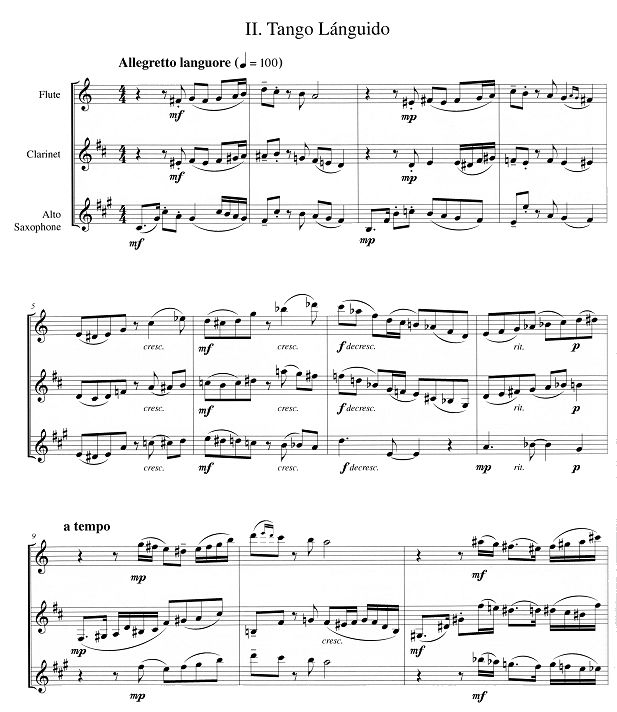 |
WW342: Eclectic Trio for Flute, Clarinet, and Alto Saxophone by Catherine McMichael. Alry Publications, 2004, SS, includes parts and score. This trio of dances for a somewhat unusual combination of instruments is in three movements: I. Sarabande, II. Tango Lánguido, and III. Jitterbug. The clarinet part was originally written for an A clarinet but a B-flat part is also included. This is an early college level/college level piece with a duration of about 5:30. You can listen to all three movements on the publisher's website or watch them on YouTube. Here is Jitterbug. Click on the cover image to see a sample page from the score. |
21.95
|
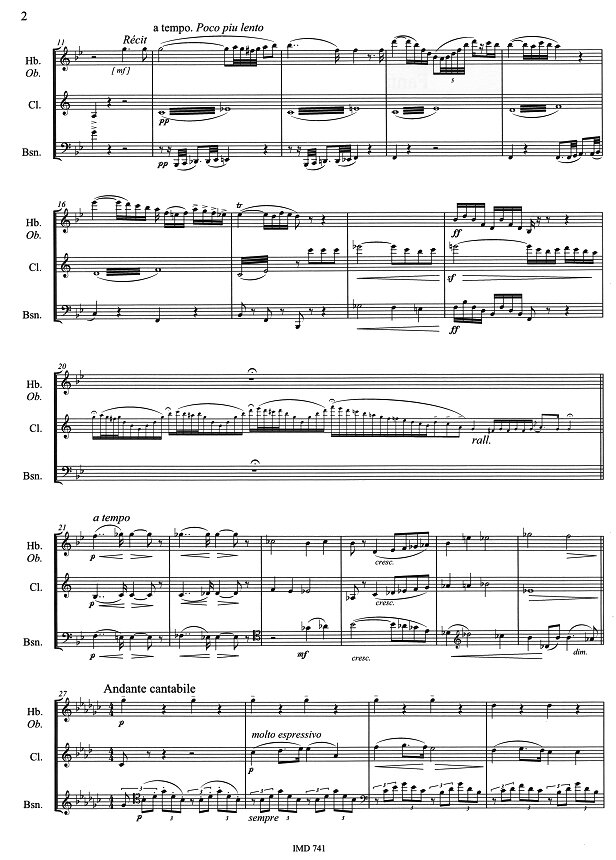 |
WW271: Erwinn Fantaisie for Clarinet for Clarinet, Oboe and Bassoon by Georges Meister arranged by Alexandre Ouzounoff. International Music Diffusion, 2010, SS, includes parts and score. While this is a clarinet solo and although the clarinet has most of the heavy lifting (and many cadenzas) the oboe and bassoon have their moments as well. Sectional with all but the last short: Allegro maestoso, Andante cantabile, Allegro moderato, 2 Variations, Adagio, and Polonaise. College level. Click on the cover image to see a sample page from the score. We also have the version for Clarinet and Piano (C1861). |
20.95
|
|
WW057: Pastorale Op. 147 for Oboe, Clarinet and Bassoon by Darius Milhaud. Masters Music, SS, (includes parts and score). The piece was written by Milhaud in 1935. One reference called it a tiny gem of the woodwind repertoire. Despite the name it moves right along in cut time with half note = 72. College level. Here is an audio recording. |
6.95
|
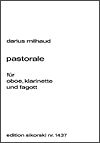
|
WW400: Pastorale Op. 147 for Oboe, Clarinet and Bassoon by Darius Milhaud. Sikorski, SS, (includes parts and score). Since we have had problems getting the Masters edition (above) we have ordered this one. It appears to be exactly the same, a reprint of the original publisher's version. Here is an audio recording.
(Except other items with free shipping.) |
11.95
|
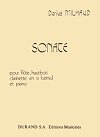 |
WW053: Sonate for Flute, Oboe, Clarinet and Piano by Darius Milhaud. Durand, 1923, SS. (includes parts and piano score). The piece was written by Milhaud in 1918. It is in four movements: I. Tranquille, II. Joyeux, III. Emporté, and IV. Douloureux. College level. We missed listing this when it was received. The current price is $56.95. |
44.95
|
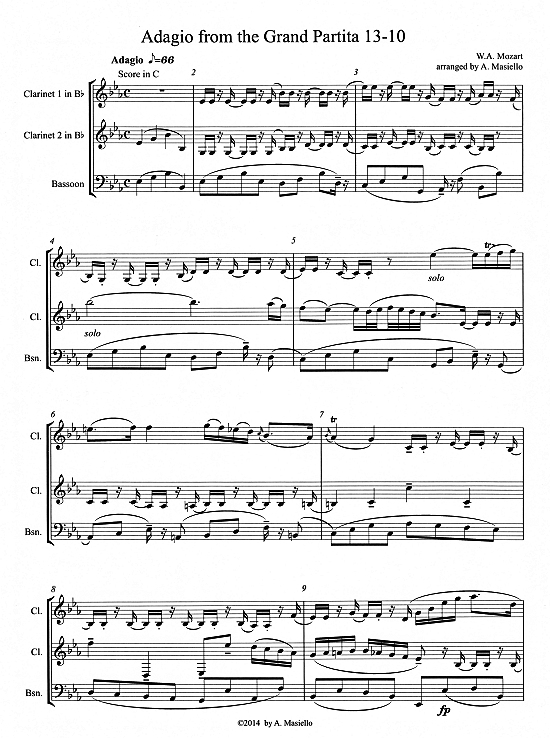 |
WW319: Adagio from the Serenade 'Gran Partitta' (K 361/370a) for 2 Clarinets and Bassoon or Bass Clarinet by Wolfgang Amadeus Mozart arranged by Anthony Masiello. MMHC Music Publications, 2014, SS, includes all parts and score. The lowest note in the bass clarinet part is a low F. Click on the cover image to view the first page of the score. |
16.95
|
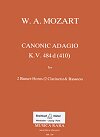 |
C1946: Canonic Adagio KV 484d (410) 2 Basset Horns (or Clarinets) and Bassoon by Wolfgang Amadeus Mozart edited by John P. Newhill. Musica Rara, 1984, SS, (includes all parts and score). The upper parts are in two-part canon by inversion (the second part is inverted and a fifth higher). The bassoon part could be transposed and played on a basset horn or bass clarinet. (Except other items with free shipping.) |
13.95
|
|
Trio di Clarone (Sabine Meyer, Wofgang Meyer, and Reiner Wehle) have prepared editions of five diveritmentos, KV Anh. 229 (439b). While it isn't mentioned, these pieces could also be played by two clarinets and bass clarinet. C591: Divertimento No. 1 for three basset horns from KV Anh 229 (439b) by Wolfgang Amadeus Mozart edited by the Trio di Clarone. Breitkopf & Haertel, 1989, SS. For three basset horns, two clarinets and bassoon, or three clarinets.  C592: Divertimento No. 2 for three basset horns from KV Anh 229 (439b) by Wolfgang Amadeus Mozart edited by the Trio di Clarone. Breitkopf & Haertel, 1987, SS. For three basset horns, two clarinets and bassoon, or three clarinets. |
No. 1 18.95
No. 2 19.95
|
|
C593: Divertimento No. 3 for three basset horns from KV Anh 229 (439b) by Wolfgang Amadeus Mozart edited by the Trio di Clarone. Breitkopf & Haertel, 1991, SS. For three basset horns, two clarinets and bassoon, or three clarinets. C594: Divertimento No. 4 for three basset horns from KV Anh 229 (439b) by Wolfgang Amadeus Mozart edited by the Trio di Clarone. Breitkopf & Haertel, 1990, SS. For three basset horns, two clarinets and bassoon, or three clarinets. C595: Divertimento No. 5 for three basset horns from KV Anh 229 (439b) by Wolfgang Amadeus Mozart edited by the Trio di Clarone. Breitkopf & Haertel, 1990, SS. For three basset horns, two clarinets and bassoon, or three clarinets. |
No. 3 20.95 No. 417.95 No. 5 15.95
|
 |
WW272: Fragments for Woodwind Trio (Flute, Clarinet and Bassoon) by Robert Muczynski. Shawnee Press, 1960, includes the score and parts. This work has five short movements: I. Waltz (Allegro), II. Solitude (Andante, Freely with expression), III. Holiday (Vivace, Sprightly), IV. Reverie (Moderato), and V. Exit (Allegro giocoso, Cheerfully with energy). Quite a bit of mixed meter with some of the 2/4 5/8 variety. College level with a duration of about 6 minutes. |
16.95
|
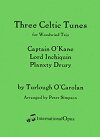 |
WW222: Three Celtic Tunes for Wind Trio (Oboe or Flute, Clarinet and Bassoon) by Turlough O'Carolan arranged by Peter Simpson. InternationalOpus, 2003, SS. Includes the score and parts. Turlough O'Carolan (1670-1738) was an Irish musician and composer of hundreds of tunes about 200 of which survive. The three tunes are Captain O'Kane (Moderately slow), Lord Inchinquin (9/8 in one at about mm=60), and Planxty Drury (Moderately Fast). Suitable for adult (amateur) trios who may find this of most interest. There are clarinet parts for both B-flat and A instruments (the A will be easier for the second and third pieces) and the bassoon part has some tenor clef. |
29.95
|
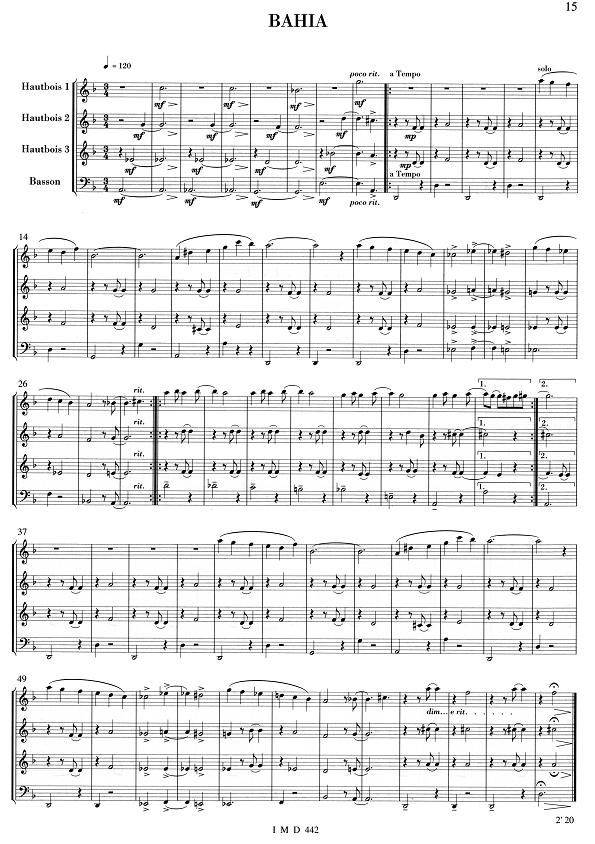 |
WW078: Les Carnets de Route (A Travel Journal) for Oboe and Bassoon Volume 1 by Alexandre Ouzounoff. International Music Diffusion, 1998, SS, includes parts and score. The 10 short pieces in this collection were inspired by music from around the world. They are for various combinations of double reed instruments. Most have either 3 or 4 parts. They are not technically difficult but tend to have relatively fast tempos which range from mm 108 to 152. Contents: Thulé (4 Ob), Maputo (3 Ob), Shangai (3 Ob or 2 Ob & Bs), Atlantide (2 Ob or Ob & Bs), Bobo Dioulasso (3 Ob or 2 Ob & Bs), Harlem (2 Ob, EH & Bs or 3 Ob & Bs), Montmarte (2 Ob, EH & Bs or 3 Ob & EH), Salzburg (2 Ob, EH & Bs), Bahia (3 Ob & Bs), and Cariacou (2 Ob, EH & Bs). Click on the cover image to view a sample page of the score. |
28.95
|
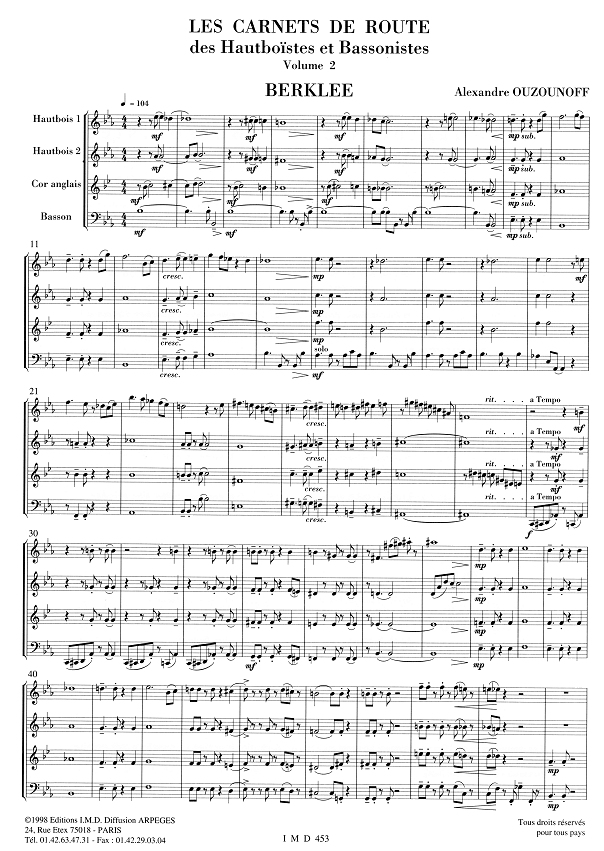 |
WW079: Les Carnets de Route (A Travel Journal) for Oboe and Bassoon Volume 2 by Alexandre Ouzounoff. International Music Diffusion, 1998, SS, includes parts and score. The 9 short pieces in this collection were inspired by music from around the world. They are for various combinations of double reed instruments. Most have either 3 or 4 parts. The contents of volume 2 are somewhat more difficult than volume 1. Includes: Berklee (2 Ob, EH & Bs), Buenos-Aires (2 Ob, EH & Bs or 3 Ob & EH), Manhattan (2 Ob & EH or Ob & 2 Bs), Novogorod (3 Ob & EH), Honfleur (2 Ob & EH), Ronda (2 Ob, EH & Bs or 2 Ob & 2 EH), Plovdiv (3 Ob), Tolède (2 Ob & EH or 2 Ob & Bs), and Kyoto (Ob & Bs). Click on the cover image to view a sample page of the score. |
2928.95
|
 |
WW131: Three Pieces for Flute, Clarinet and Bassoon by Walter Piston. Associated Music Publishers, 1933. Parts only. Walter Piston (1894-1976) was an American composer and music theorist. This piece was written in 1926 and is one of his earliest published works. It is in three movements I. Allegro scherzando/Andante, II. Lento, and III Allegro/Moderato. College level. Duration about 10 minutes. Here is a performance from YouTube. The picture is small but the sound is good and it is the entire piece. (Except other items with free shipping.) |
19.95
|
 |
WW198: Caprice en Trio for Flute, Clarinet and Bassoon by Thomas L. Read. Tunbridge Music, 2008, SS, includes score and parts. Thomas L. Read (1938-) is an American violinist, composer, and music educator. This trio was commissioned by the Vermont Contemporary Music Ensemble and composed in June 2006. It is in one extended (8:17) movement with mixed meter and a number of tempo changes. The composer wrote that it is "fanciful and somewhat mutable in texture and style, setting 'learned' counterpoint against free lyricism, while also encompassing tonal and non-tonal harmonies and conjuring humorous and bizarre episodes." Upper college/professional level. |
39.95
|
 |
WW094: Trio for Clarinet, Horn and Bassoon by Gioachino Rossini edited by Daniel Bourgue. International Music Diffusion, 1996, SS, includes score and parts. The horn part is for a horn in E-flat. The introduction to this music states that Rossini loved the horn and was an expert with this combination of instruments. In three short movements: I. Allegro moderato, II. Adagio (horn tacet), and III. Menuetto. Click on the cover image to view the first page of the score. (Except other items with free shipping.) |
9.50
|
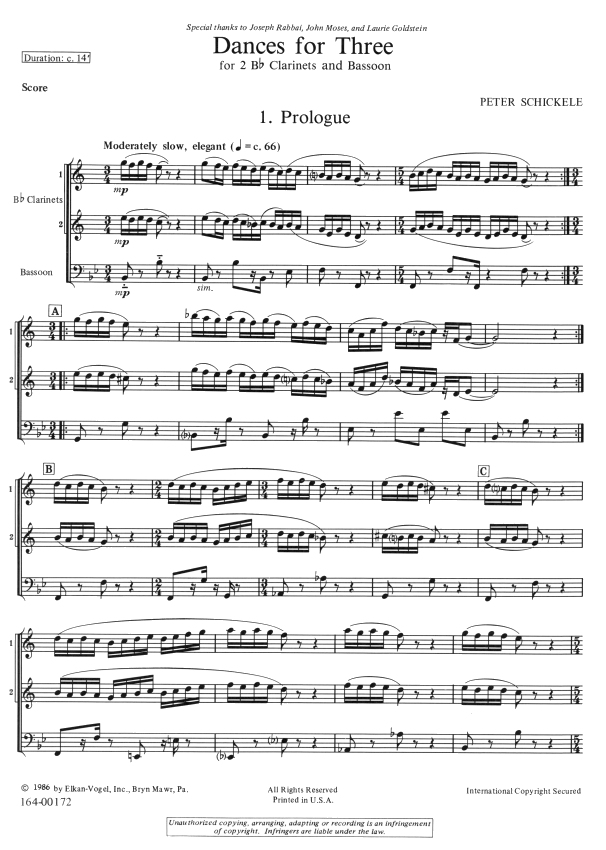 |
WW321: Dances for Three for Two Clarinets and Bassoon by Peter Schickele. Elkan-Vogel, 1986, SS, (includes parts and score). In seven movements: 1. Prologue (Moderately slow, elegant), 2. Minuet (Moderately fast, perky), 3. Tango (Moderate, quiet), 4. Bossa Nova (Moderately fast, light), 5. Gigue (Sprightly), 6. Sarabande (Slow, but with motion), and 7. Finale (Fast, bright). Early college level with a duration of 14 minutes. The bassoon part can be transcribed for a low C bass clarinet as in the recording. Click on the cover image to view the first page of the score.
|
19.95
|
 |
WW115: Liebelei-Walzer for Two Clarinets and Bassoon by Arthur Schnitzler arranged by Wolfgang Danzmayr. Musikverlag Alexander Mayer, 2004, SS, (includes parts and score). Arthur Schnitzler (1862-1931) was an Austrian who trained as a physician and had a deep interest in psychiatry, but is best known as a playwright and writer (he was also an amateur pianist). Liebelie (playing with love or a flirtation) is the name of one of his early plays. He also wrote the novel that was the inspiration for Stanley Kubrick's last film, Eyes Wide Shut. Intermediate level (although the first clarinet part goes up to an altissimo F). (Except other items with free shipping.) |
9.95
|
|
WW039: 18 Trios Vol. 1 by Anton Stadler. International Music Diffusion, 1996. Originally written for basset horns, this edition includes parts so that these trios can be played by 3 basset horns; 3 clarinets; 2 clarinets and bass clarinet or bassoon; oboe or flute, clarinet, and bassoon. Volume 1 has trios 1-5.
WW040: 18 Trios Vol. 2 by Anton Stadler. International Music Diffusion, 1996. Parts are the same as volume 1. Volume 2 has trios 6-18 |
Vol. 1
22.95
Vol. 2 |
 |
WW374: Paris 1987 for Woodwind Trio (Flute, Clarinet and Bassoon) by Stella Sung. Southern Music, 1989, SS, includes parts and score (the parts are 4-5 pages long). Stella Sung is an American composer. This piece is in three movements: I. Moderato, II. Duet (Andante, flute and clarinet only), and III. Allegro con spirito. Click here to listen to audio excerpts of each movement. Click on the cover image to view the first page of the score. |
24.95
|
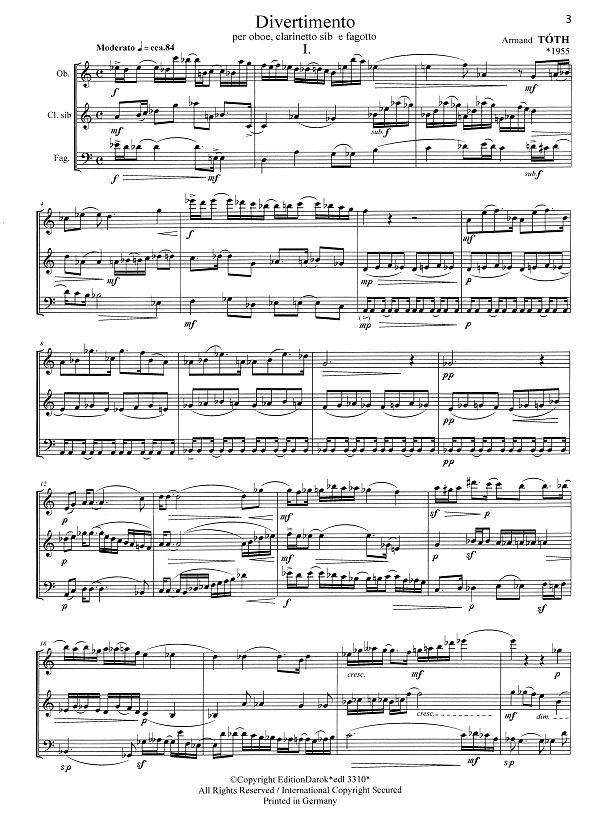 |
WW324: Divertimento for Oboe, Clarinet and Bassoon by Armand Toth. EditionDarok, 2013(?), SS, includes parts and score (the parts are each 6 pages long). Armand Tóth (1955-) is a Hungarian composer, conductor, and flutist. This is a college level piece in three movements: I. Moderato, II. Larghetto, III. Vivace, and IV. Finale (Allegro molto e vivace). Click on the cover image to view the first page of the score. |
20.95
|
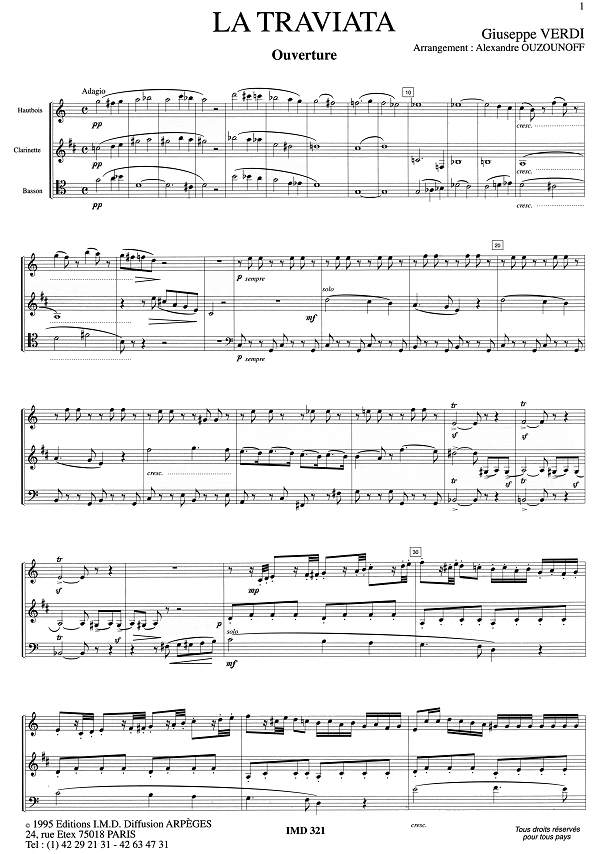 |
WW086: La Traviata for Oboe, Clarinet and Bassoon by Giuseppe Verdi arranged by Alexandre Ouzounoff. International Music Diffusion, 1995, SS, includes parts and score. Includes Ouverture, Un di félice eterea, Ah for'sé lui che l'anima, Pura siccome un angelo, and Libiamo né lietti calici. Early college level/college level. Click on the cover image to view the first page of the score. |
14.50
|
 |
WW155: Verdi Three Arias for Two Clarinets and Bassoon by Giuseppe Verdi arranged by Michael Drapkin. Roncorp, 1983. Arrangements of "La donna è mobile" from Rigoletto, "Un di felice, etera" from La Traviata, and "Parigi, o cara" also from La Traviata. The parts are a neat manuscript and include portions of the other parts when they are helpful to ensure a good ensemble. |
14.95
|
 |
WW164: Trio for oboe, clarinet, and bassoon by Heitor Villa-Lobos. Eschig, 1954. Parts only. This piece was written in 1927. Three movements: I.Anime, II. Languissammente, and III. Vivo. An advanced work with a duration of about 17:30. |
49.95
|
 |
WW173: Caprice on Danish and Russian Airs Op. 79 for flute, oboe, clarinet and piano by Camille Saint-Saëns. International Music Company, 1971. Includes parts and piano score. This caprice was written in 1887 by Saint-Saëns for a trip to St. Petersburg where is was performed by the composer along with Paul Taffanel flute, Ernest Gillet oboe, and Charles Turban clarinet. It is a sectional, college level piece with a duration of about 11:45. |
19.75
|
 |
WW085: Le Trouvère (Il Trovatore, The Troubadour) for Oboe, Clarinet (A and B-flat) and Bassoon by Giuseppe Verde arranged by Alexandre Ouzounoff. International Music Diffusion, 2000, SS, includes parts and piano score. Il Trovatore is an opera by Giuseppe Verdi which was premiered in its original version in 1853. The editor has selected parts of the opera that best suit this instrumentation. It has five movements: I. Allegro, II. Andante mosso, III. Andante mosso, IV. Allegro, and V. Andante assia sostenuto/Allegro agitato. College level. Click on the cover image to view the first page of the score. |
23.95
|
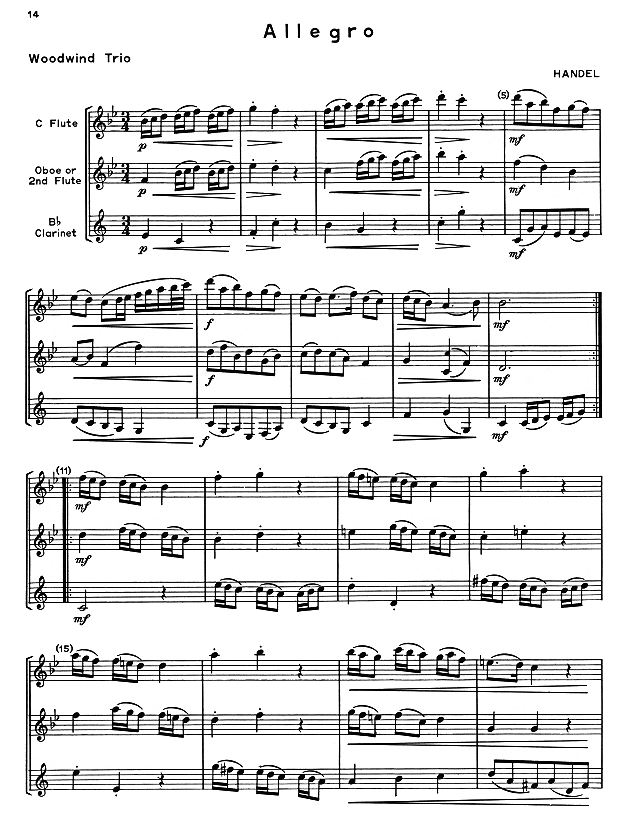
|
WW333: Chamber Music for Three Woodwinds Vol. I (Easy to Medium) by Himie Voxman. Rubank, 1958, SS, 32 pages. Fifteen easy to medium trios for flute, oboe (or a second flute) and clarinet in score form. Suitable for contest, concert or church performance. Includes works by Beethoven, Handel, Haydn, Mozart and others. Click on the cover image to view a sample page. WW334: Chamber Music for Three Woodwinds Vol. II (Easy to Medium) by Himie Voxman. Rubank, 1958, SS, 32 pages. Nineteen easy to medium level woodwind trios for flute (flute), clarinet and bassoon or bass clarinet in score form. While flute is indicated for the first part, oboe can be used instead. Suitable for contest, concert or church performance. Includes works by Bach, Beethoven, Corelli, Couperin, Handel, Haydn, Mozart, Schubert and others. |
Vol. I
6.95
Vol. II |
|
WW220: Prelude and Fugue for Two Clarinets and Bassoon (or Bass Clarinet) by Richard Walthew. Rosewood Publications, 1997, SB. Includes parts and score. Richard Walthew (1872-1951) was a British composer with a special affinity for chamber music. The Prelude is Andante Moderato and the Fugue is Andante espressivo. There are a few low Ds in the bass clarinet part. All of the parts are important and challenging at the early college level. |
17.95
|
|
WW166: Bach Three Quartets for Three Flutes and Alto Flute (or Clarinet) edited by Paul Renzi. International Music, 2008, includes score and all parts. These three quartets for flutes and alto flute (with a clarinet part as an alternative to the alto flute) are from: Aria "Qui tollis peccata mundi" (Gloria) from the Mass in A major s. 234, Aria "Jesu, deine Gnaden blikke" from Cantata Lobet Gott in seinen Reichen S. 11, and Aria "Doch Jesus will auch bei der Strafe" from Cantata Schauet doch und sehet S. 46. All of these works originally had two flutes with voice and other instruments. They are at the upper intermediate level and each work is one and a half to two pages long. |
34.95
|
|
WW408: Classical FlexQuartets for Woodwind arranged Andrew Balent. Almitra/Kendor Music, 2020, parts are printed in score format. This flexible grade 3 collection contains five well-known classical and traditional pieces that can be played by any combination of 4 woodwind instruments. Parts are provided by the key of the instrument: C Instruments - Flute and Oboe; Bb Instruments - Bb Clarinet, Bb Bass Clarinet, Bb Soprano Sax and Bb Tenor Sax; Eb Instruments - Eb Clarinet, Eb Alto Clarinet, Eb Alto Sax and Eb Baritone Sax; and Bass Clef Instruments - Bassoon. Contents: Chaconne (Handel), Morris Dance (German), Sidewinder (Balent), To A Wild Rose (McDowell), and Wayfaring Stranger (traditional). Click on the cover image to see sample pages. |
16.95
|
|
WW111: Trois Pièces Pour Une Musique de Nuit by Eugene Bozza. Alphonse Leduc, 1954. For flute, oboe, clarinet, and bassoon. Includes individual parts and the score. In three movements:: Andantino, Allegro vivo, and Moderato. This is not a difficult work, but frequently appears on professional recitals. |
28.60
|
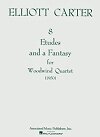
|
WW299: 8 Etudes and a Fantasy for Woodwind Quartet (Flute, Oboe, Clarinet and Bassoon) by Elliot Carter. Associated Music Publishers, 1955/1959, SS, parts only. Elliot Carter (1908-2012) was a distinguished American composer who enjoyed a long and productive career. This work was written in 1950. Notes provide suggestions for performing fewer than all of these etudes in concert. This is an advanced work with a total duration of about 23 minutes. Here is a performance of the first portion on YouTube. WW300: 8 Etudes and a Fantasy for Woodwind Quartet (Score) by Elliot Carter. Associated Music Publishers, 1955/1959, SS, 42 pages. |
Parts Score39.95
24.95
|
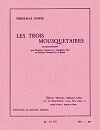
|
WW112: Les Trois Mousquetaires, Divertissement for Oboe, Clarinet, Alto Saxophone (or second Clarinet) and Bassoon by Pierre Max Dubois. Leduc, 1966, includes individual parts and the score. Five movements: Lentement (Recitativo), Allegrement, Allegro, Andante, Andante/Presto. Early college level and could also be played by very good high school ensembles. |
57.80
|
|
WW253: Divertimento for Four Wind Instruments (Oboe, Clarinet, Horn and Bassoon or three Clarinets and Bass Clarinet) by Alan Hovhaness. C.F. Peters, 1958, includes score and all parts. In seven movements: I. Prelude (Andante), II. Fantasy (Andante), III. Canzona (Andante), IV. Canzona (Andante), V. Canon in Four Keys (Allegro vivo), VI. Aria (Andante), and VII. Fugue (Finale) (Allegro). It appears the parts can be mixed between the two versions, using a bass clarinet instead of the bassoon, for example. Better high school musicians and up. |
13.95
|
|
Histories is a very popular set of ten pieces by Ibert. Originally for piano it has been arranged for many instruments with this set of six for an unusual combination. G150. Histories Vol. I for Oboe, Clarinet, Tenor Saxophone, and Bassoon by Jacques Ibert arranged by Jean-Pierre Ballon. Alphonse Leduc, 2006, SS. Volume I has the pieces A Giddy Girl... and Le Cortège de Balkis... College level. G151. Histories Vol. II for Oboe, Clarinet, Alto Saxophone, and Bassoon by Jacques Ibert arranged by Jean-Pierre Ballon. Alphonse Leduc, 2006, SS. Volume II has the pieces La Cage de Cristal... and La Meneuse de Tortues d'Or... College level. G152. Histories Vol. III for Oboe, Clarinet, Soprano Saxophone, and Bassoon by Jacques Ibert arranged by Jean-Pierre Ballon. Alphonse Leduc, 2006, SS. Volume III has the pieces La Marchande d'Eau Fraîche.... and Le Petit Âne Blanc... College level. This volume has parts for both A and B-flat clarinet. |
Vol. I 23.25
Vol. II
25.55 Vol. III 31.45
|
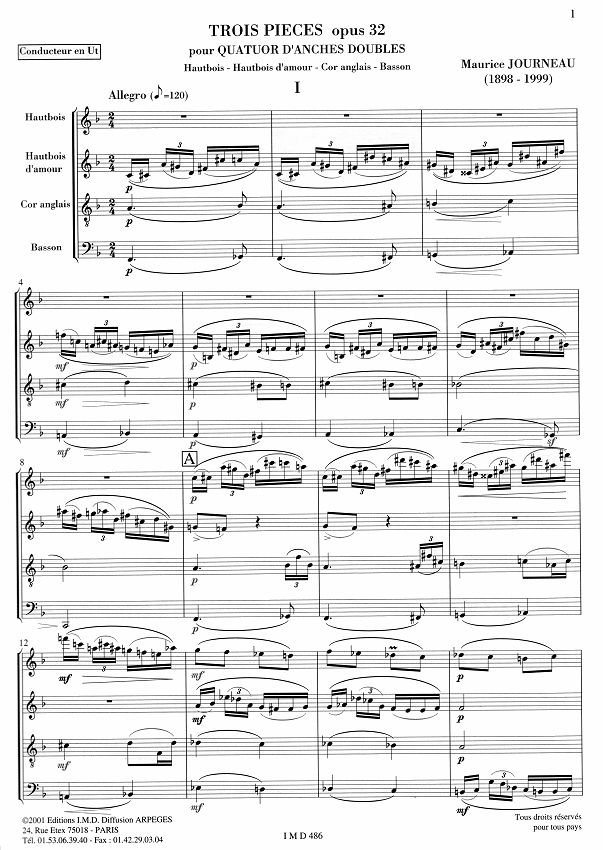
|
WW091: Trois Pieces Opus 32 for Double Reed Quartet by Maurice Journeau. International Music Diffusion, 2001, SS, includes parts and score. Maurice Journeau (1898-1999) was a French composer. This is an original work which was written in 1949. The instrumentation is oboe, oboe d'amour, cor anglais, and bassoon. It is a college level work in three movements: (1) Allegro/chanté, (2) Lent, sans excès, and (3) En s'amusant. Click on the cover image to view the first page of the score. |
29.95
|
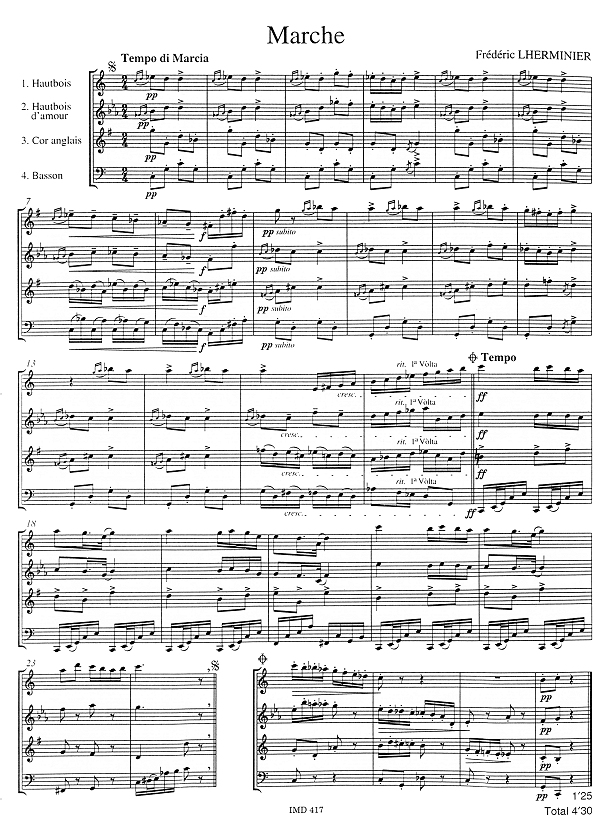
|
WW092: Valse et Marche for Double Reed Quartet by Frederic Lherminier. International Music Diffusion, 1997, SS, includes parts and score. Frederic Lherminier (1970-) is an oboist, composer, and research engineer. These pieces which evoke the "Belle-Epoque" era are at the high school level. The duration is about 4:30. The instrumentation is oboe, oboe d'amour (with an alternate oboe part), cor anglais, and bassoon (with an alternate baritone oboe part). Click on the cover image to view the score of the Marche.
(Except other items with free shipping.) |
11.95
|

|
WW378: Adagio & Allegro K. 594 for Flute, Oboe, Clarinet, and Bassoon by Wolfgang Amadeus Mozart arranged by Milan Munclinger. International Music Co., 1975, SS, includes individual parts and the score. This composition was originally to be played on a mechanical organ clock. In three relatively short movements: Adagio, Allegro, and Adagio. Here is an audio recording. Click on the cover image to view the first page of the score. |
15.95
|
|
WW178: Andante, e Tema con Variazioni for Flute, Clarinet (in C), Horn and Bassoon by Gioachino Rossini edited by Philip Gossett. Baerenreiter, 2008, includes individual parts and the score. This is a new edition of one of seven known chamber works without piano by Rossini (1792-1868). It includes a preface (explaining why there is some doubt that it was written in 1812 as noted by the composer many years later) and notes on the editing. This looks like a lot of fun. The duration is about 10 minutes and it is at the early college level. |
31.50
|
|
WW061: 6 Quartets Vol. 1 Nos. 1-3 for Flute, Clarinet, Horn and Bassoon by Gioachino Rossini edited by Walter Zachert. Schott, 1936, SS, parts only. Very pleasant quartets with Rossini's gift for melody clearly evident. You can here audio samples here. WW062: 6 Quartets Vol. 2 Nos. 4-6 for Flute, Clarinet, Horn and Bassoon by Gioachino Rossini edited by Walter Zachert. Schott, 1936, SS, parts only. The current price is $29.95. |
Vol.1 Vol.227.95
19.95
|

|
WW384: Seven Bagatelles for Woodwind Quartet (Flute, Oboe, Clarinet & Bassoon) by Peter Schickele. Theodore Presser Co., 1962, SS, includes parts and score. The bagatelles are: Three-Legged March, Serenade, Walking Piece, Country Song, Game, City Song, and River. Not too difficult, probably early college level. Click on the cover image to view the first page of the score. |
22.95
|
|
 WW364: Sonatine Sportive for Alto Saxophone and Wind Trio (Oboe, Clarinet & Bassoon) by Alexandre Tcherepnine adapted by Edward Yadzinski. Alphonse Leduc, 1984, SS. Includes all parts and score. We have a description of the original version for alto saxophone and piano here. WW364: Sonatine Sportive for Alto Saxophone and Wind Trio (Oboe, Clarinet & Bassoon) by Alexandre Tcherepnine adapted by Edward Yadzinski. Alphonse Leduc, 1984, SS. Includes all parts and score. We have a description of the original version for alto saxophone and piano here. |
44.70
|
|
WW193: Five Easy Dances for Woodwind Quintet by Denes Agay. Presser, 1956, SS, (includes parts and score). Denes Agay (1912-2007) was born in Hungary and studied in Budapest. He moved to New York in 1939 and became an American citizen. He was a teacher, composer and arranger and conductor. As the title suggests, this is a good work for a high school level quartet. The five dances are: 1. Polka (Bright and happy), 2. Tango (Moderately), 3. Bolero (Animated), 4. Waltz (With steady, gentle motion), and 5. Rumba (Very lively and rhythmically). |
24.95
|
|
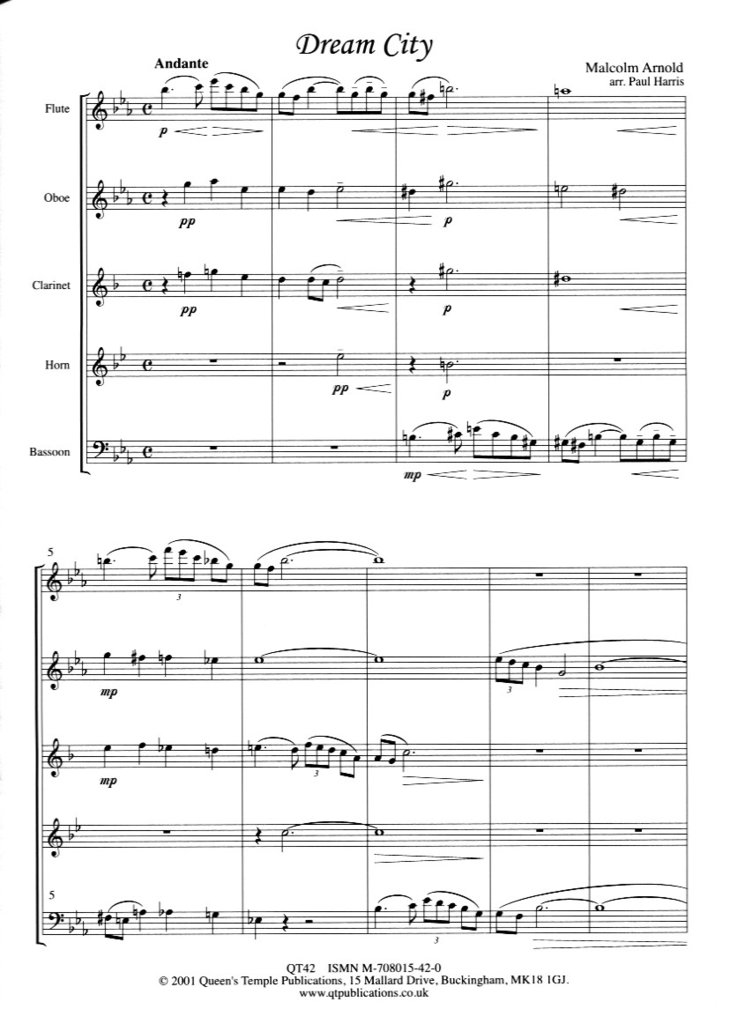
|
WW386: Dream City for Wind Quintet by Malcolm Arnold arranged by Paul Harris. Queen's Temple Publications, 2001, SS, (includes parts and score). This piece, based on an early piano work by Arnold, is perfect for high school level woodwind quintets. Click on the cover image to view the first page of the score. (Except other items with free shipping.) |
7.95
|
|
|
WW280: Three Shanties for Wind Quintet by Malcolm Arnold. Paterson's Publications, 1952, SS, parts only. Three Shanties, which were written in 1943, provide as much fun for the listener as for the players. The bubbling figuration and racy rhythms of the outer movements frame a charming and sensitively scored Allegretto semplice, Boney was a warrior. The last shanty is based on Johnny come down to Hilo. Early college level with a duration of about 7 minutes. WW281: Three Shanties for Wind Quintet by Malcolm Arnold. Paterson's Publications, 1952, SS, 19 pages. Score. |
Parts Score19.95 15.95
|
|
|
WW282: Wind Quintet (Op. 2) by Malcolm Arnold. Queen's Temple Publications, SS, (includes parts and score). An important and significant work, written in London in 1942 and published for the first time 60 years later. The first movement is tuneful and full of those surprises the composer loved to introduce in his music. There is no shortage of jazz inspired ideas, colored always by that Arnold "edge." The second movement is a fiendish scherzo - full of amazing cross rhythms and of immense energy. The final movement is a March which is the most emotionally charged. It includes severe and angry dissonances, mocking fanfares, angular and brutal melodic and rhythmic shapes. Duration about 12 minutes. Click on the following to listen to sample mp3 files from each movement: Allegro, Presto, and Alla marcia. |
44.95
|
|
|
WW203: Scenes from a Comedy for Wind Quintet by Christopher Ball. Emerson Edition, 2007, SS, (includes parts and score). British composer Christopher Ball has used an imaginary comedy as the inspiration for this work which was first performed in 1990 by students from Trinity College of Music. The movements are: 1. Comedy Overture, 2. Hilda Broods and Hatches a Plot, 3. March Past of the Jaunty Boys, 4. Waltzing with Hilda, 5. Clandestine Lovers, and 6. All's well that Ends Well. The flute part includes piccolo. Duration is about 13:00. |
30.95
|
|
|
WW175: Summer Music Op. 31 for Woodwind Quintet by Samuel Barber. G. Schirmer, 1967, SS, (includes parts and score). This work which had its premier in 1956 is in one continuos movement. It is an advanced work which highlights each member of the quintet. Duration about 11 minutes. (I heard this on the radio and thought it was very nice.) |
29.95
|
|
|
WW159: Rhapsody on a Chassidic Tune for Wind Quintet by Samuel Baron. Oxford University Press, 2005, SS, (includes parts and score). This work is by Samuel Baron (1925-1997) a famous flutist and founding member of the New York Woodwind Quintet. It has alternating slow and fast sections with all of the quintet members having at least one solo. College level or adult woodwind quintets. |
37.50
|
|

|
WW382: A Christmas Concert for Wind Quintet arranged by Graham Bastable. International Music Co., 2017, SS, (includes parts and score). This collection has the following five pieces. Hector Berlioz The Shepard's Farewell; Lift Up Your Heads in Joyful Hope; Rise Up, Shepherd, and Follow!; arranged Michael Praetorius In Dulci Jubilo; and Felix Mendelssohn Hark! The Herald Angels Sing. Except for one 8 bar section in the last piece these are very easy arrangements. Click on the cover image to view the most difficult section of the final piece. The portions before and after are typical of the rest of this collection. |
29.95
|
|

|
WW305: Pastorale Op. 151 for Woodwind Quintet by Amy Beach. Hildegard Publishing Company, 1942, SS, (includes parts and score). Amy Beach (1867-1944) was an American woman composer. This piece was written in 1941. It is her next to last published work and the only one for woodwind quintet. It is based on works she wrote in 1921 and is in a conservative, diatonic style unlike many of her later works. This piece is in 6/8 and marked Lento tranquillo. High school quintets and up. Includes notes on the composer and this work. Click on the cover image to view the second page of the score. |
24.95
|
|
|
WW367: Adagio from the Pathetique Sonata for Woodwind Quintet by Ludwig van Beethoven arranged by Gregory Yasinitsky. Almitra Music Co./Kendor Music, 2016, SS, (includes parts and score). This is from Movement II, Piano Sonata No. 8, Op. 13, one of Beethoven's most famous works. It was written in 1798 and first published in 1799. The duration is 3:25. The publisher has marked this as (US) grade 4. A bass clarinet part is included as an alternative to the bassoon. Click on the cover image to view the first two pages of the score. |
12.95
|
|
|
WW283: Allegro From Beethoven's Fifth for Woodwind Quintet by Ludwig van Beethoven arranged by Nicholas J. Contorno. Kendor Music, 2012, SS, (includes parts and score). This is the famous opening section of the fifth symphony. A bass clarinet part is included as an alternative to the bassoon. The publisher rates this as (US) grade 3. The duration is 2:00. Click on the cover image to view the first two pages of the score. |
15.95
|
|
|
WW375: Rondo from the Pathetique Sonata for Woodwind Quintet by Ludwig van Beethoven arranged by Gregory Yasinitsky. Kendor Music, 2016, includes parts and score. A bass clarinet part is included as an alternative to the bassoon. The Rondo movement from Ludwig van Beethoven’s Pathetique Sonata (No. 8, Op. 13) is one of the most beautiful and exciting pieces of all time. This grade 4+ edition, expertly arranged by Gregory Yasinitsky, is ideal for concert and ensemble festival performance. Duration 3:55. Click on the cover image to view pages from the score. |
15.50
|
|
|
WW290: Scherzo from Symphony No. 6 for Woodwind Quintet by Ludwig van Beethoven arranged by Thomas Bourgault. Kendor Music, 2012, SS, (includes parts and score). In this setting of the scherzo movement from Beethoven’s popular Symphony No. 6 (often referred to as the Pastoral Symphony), the wind voices are scored nearly identically to the original piece, showcasing the feeling of a light dance and a pastoral flourish. Instrumentation includes flute, oboe, B-flat clarinet, horn in F, and bassoon (opt. bass clarinet). The publisher rates this as (US) grade 5. The duration is 3:00. Click on the cover image to view the first two pages of the score. |
16.50
|
|
|
WW105: Coriolan Overture Op 62 for Woodwind Quintet by Ludwig van Beethoven arranged by Joachim Linckelmann. Baerenreiter (BA 8601), 2003, SS, (includes parts and score). The Coriolan Overture was composed in 1807 after a tragedy based on the Roman general Coriolanus. For college level or adult woodwind quintets. |
28.50
|
|
|
WW200: Quintet in E-flat for Woodwind Quintet by Ludwig van Beethoven arranged from the Sextet Op 71 by the Philadelphia Woodwind Quintet. Presser, 1964, SS, (includes parts and score). A popular arrangement of this piece. The movements are: I. Adagio/Allegro, II. Adagio, III. Menuetto, and IV. Rondo (Allegro). |
29.95
|
|
|
WW101: Marche Hongroise for Woodwind Quintet by Hector Berlioz arranged by Joachim Linckelmann. Baerenreiter (BA 6877), 1998, (parts only). This familiar piece is based on Berlioz's orchestral arrangement of a military march. Advanced high school/early college level or adult woodwind quintets. The clarinet part is for clarinet in A. |
20.95
|
|
|
WW118: L'Arlésienne Suite No. 1 for Woodwind Quintet by Georges Bizet arranged by Joachim Linckelmann. Baerenreiter (BA8604), 2007, (includes parts and score). A Bizet favorite. The first three movements are for clarinet in B-flat while the fourth and last movement is for clarinet in A. |
40.95
|
|
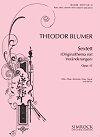
|
WW119: Sextet Op. 45 (Originalthema mit Veränderungen) for Flute, Oboe, Clarinet, Horn, Bassoon and Piano by Theodor Blumer. Simrock, 1922, SS, (includes parts and piano score). The is a theme and variations piece with all of the variations are named. They are: I. Improvisation (piano only). II Capriccio, III. Pastorale, IV. Slavischer Tanz, V. Romanze, VI. Humoreske (5/4 Time), and VII. Finale. College level with a duration of about 18 minutes. |
27.95
|
|
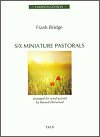
|
WW278: Six Miniature Pastorals arranged for Wind Quintet by Frank Bridge arranged by Russell Denwood. Emerson Edition, 2011, SS, includes parts and score. Frank Bridge (1879-1941) was an English composer and violist who was a student of Stanford and a teacher of Britten. These pieces were written for piano between 1917 and 1921. They work well for wind quintet. The flute switches to piccolo for the third piece. Early college level. |
26.95
|
|
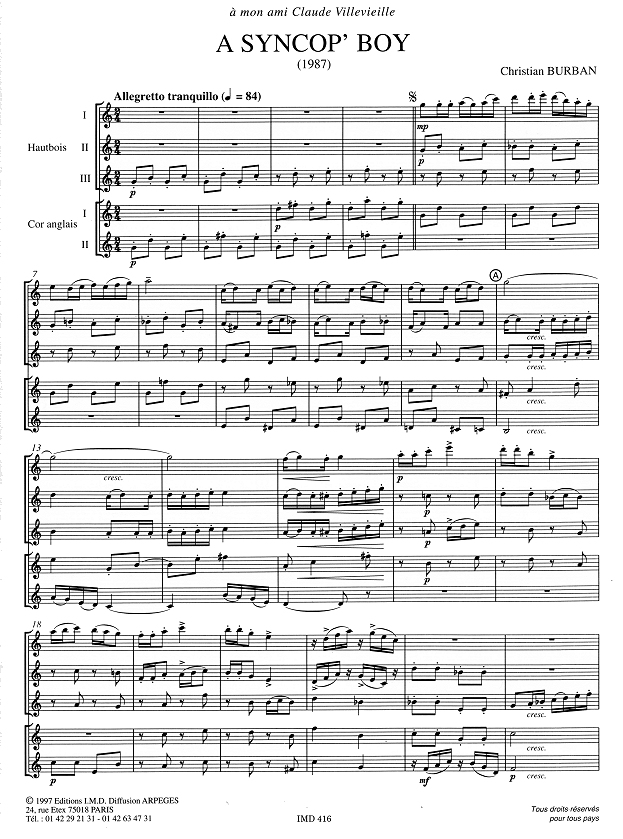
|
WW077: A Syncop' Boy for Double Reed Quintet by Christian Burban. International Music Diffusion, 1997, SS, includes parts and score. Christian Burban (1955-) is a a French performer on the oboe and cor anglais and a composer. This piece is for 3 oboes and 2 cor anglais. One movement at Allegretto tranquillo. Upper intermediate level. Click on the cover image to view the first page of the score. (Except other items with free shipping.) |
11.95
|
|
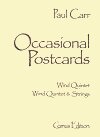
|
WW182: Occasional Postcards for Wind Quintet by Paul Carr. Comus Edition, 1995, SS, includes parts and score. Five colorful and evocative pieces - ‘Through Crowded Streets’, ‘Bicycles in Summer Rain’, ‘Boys on the Beach’, ‘Summer Evening’ and ‘Tuscan Diary’. There is quite a bit of mixed meter (constant eighth notes) and some fast tempos in this work making it appropriate for experienced college and adult quartets. Duration about 14 minutes. Also available from the publisher is accompaniment parts for string orchestra. |
24.95
|
|
|
WW206: A Day in the Forest of Dreams for Woodwind Quintet and Piano by Billy Childs. Southern Music, 2009, (includes parts and piano score). Billy Childs (1957-) is an American composer and jazz pianist who won the 2009 Guggenheim Award for music composition. This work was commissioned by the Dorian Wind Quintet in 1997 and is inspired by the sounds of nature in an enchanted forest. There are two movements: First Glimpses of Sunlight and Afternoon Dance. An advanced piece with a duration of about 21 minuets. |
53.95
|
|
|
WW318: Clearly Classical for Woodwind Quintet (with optional bass clarinet instead of bassoon) arranged by James Christensen. Kendor Music, 2013. Includes parts and score. The title of this medley describes it perfectly since it features short snippets of several famous classics (with the Mozart clarinet concerto leading off). At the same time it showcases the wide range of colorful timbres that are possible in woodwind quintet performance, making it an especially good choice for demonstrating the sound of individual instruments to aspiring musicians. Relatively easy high school level at US grade 3. Duration 1:35. Click on the cover image to view the first two pages of the three page score. (Except other items with free shipping.) |
9.95
|
|
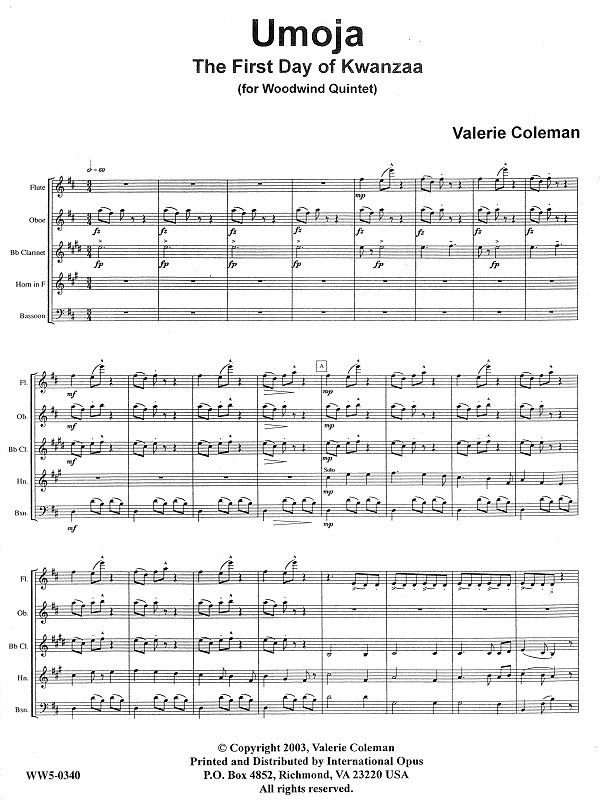
|
WW328: Umoja, The First Day of Kwanzaa for Woodwind Quintet by Valerie Coleman. Composer and flutist Valerie Coleman (1970-) is a distinct voice in a new generation of African-American artists who combine African-American heritage and urban culture to contemporary music. An original “groove-based” composition, Umoja is Swahili for “unity.” For better high school quintets and up with a duration of 5 minutes. Click on the cover image to view the first page of the score. This piece is now sold by the composer at https://www.vcolemanmusic.com/store/c1/Featured_Products.html | ||
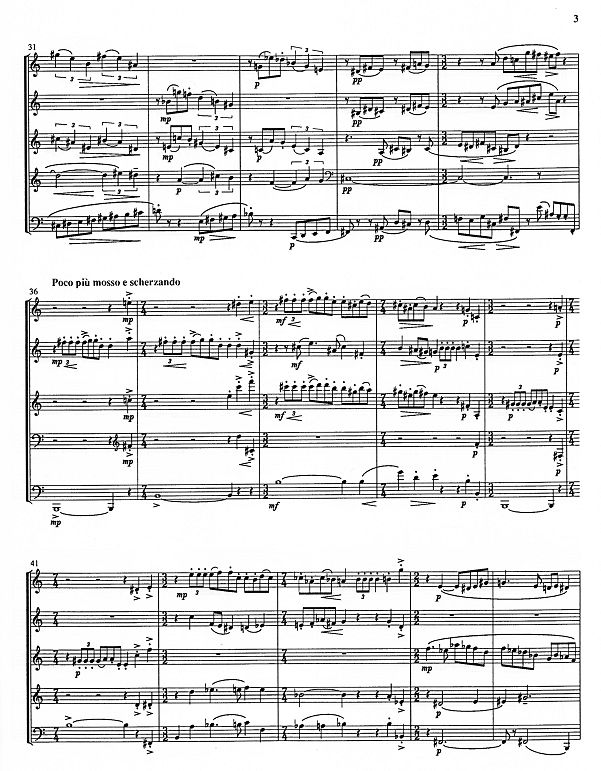
|
WW349: Quintet for Flute, Oboe, Clarinet, Horn, and Bassoon by Philip Cowlin. Emerson Edition, 1994, SS, includes parts and score. Philip Cowlin (1920-2005) is a lesser known British composer. This is one of his most successful works. It is in three movements: I. Allegro assai ma tranquillo, II. Adagio ma non troppo, and III. Vivace. College level. Click on the cover image to view the third page of the score. |
26.95
|
|
|
WW268: A Klezmer Wedding Edition for Woodwind Quintet by Mike Curtis. Advance Music, 1998. Includes parts and score. Fun for the performers and the audience. It begins with a Doina with solos for the flute, oboe and clarinet. This is followed by a Hora, Chusidl, and a Frylach. College level. |
24.95
|
|
|
WW028: Seventeen Variations for Woodwind Quintet Op. 22 by Jean-Michel Damase. Alphonse Leduc, 1952. French title: Dix-Sept Variations pour Quintette à vent. Includes score. |
65.40
|
|
|
WW362: Quintett Op. 68 No. 2 in F major for Woodwind Quintet by Franz Danzi. Edition Kneusslin Basel/Edition Kunzelmann, 1989, SS, parts only. Franz Ignaz Danzi (1763-1826) was a German cellist, composer and conductor. While he composed for all genres he is best known for his woodwind quintets. This piece is in four movements: Allegro, Andante quasi Allegretto, and Menuetto (Allegretto) and Trio, and Allegretto. Duration 7:12. Here is a video of a performance of this piece. |
32.95
|
|
|
WW100: The Children's Corner for Woodwind Quintet by Claude Debussy arranged by Joachim Linckelmann. Baerenreiter (BA 6876), 1997, SS, includes parts and score. This popular piano piece was written between 1906 and 1908 and dedicated to Debussy's daughter. It includes the pieces (which can be performed individually): Doctor Gradus ad Parnassum, Jimbo's Lullaby, Serenade for the Doll, The Snow is Dancing, The Little Shepherd, and Golliwog's Cake Walk. For college level or adult woodwind quintets. Both B-flat and A clarinets are needed to perform this work and the flute part includes piccolo. |
39.95
|
|

|
WW348: Suite Provençale No. 2 for Wind Quintet by Russell Denwood. Emerson Edition, 2006, SS, includes parts and score. Russell Denwood (1950-) is a British composer and music educator from Northern England who also played bassoon professionally for a number of years. In three fast-slow-fast(er) movements. Optional piccolo. An excellent high school quartet could probably handle this but would need proficient players on each part. Duration about 8 minutes. Click on the cover image to view the first page of the score. |
27.95
|
|
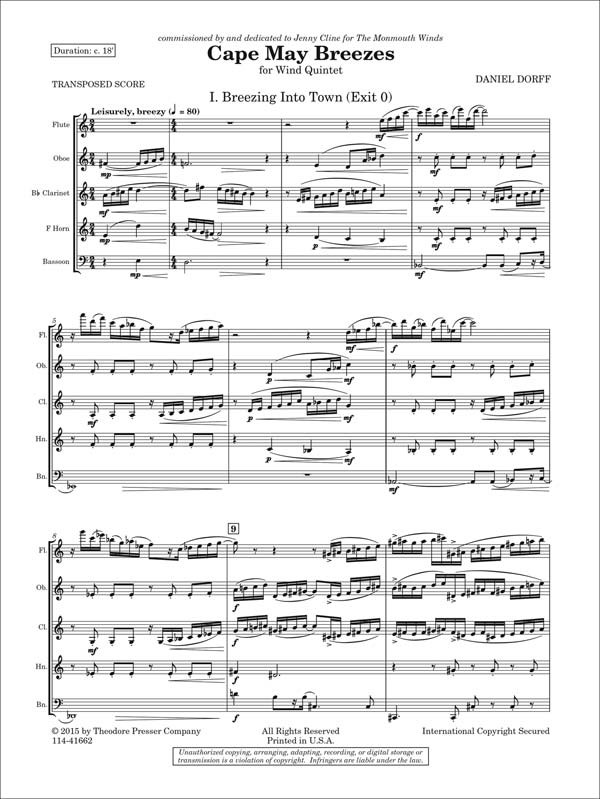
|
WW371: Cape May Breezes for Wind Quintet by Daniel Dorff. Theodore Presser Co., 2015, SS, includes parts and score. Inspired by the quaint beach town at the southern tip of New Jersey, Dorff’s five-movement suite is a natural outgrowth of the composer’s blend of pastoral beauty, bubbling scherzos, and iridescent wind writing. The movement titles depict a day in Cape May: I. Breezing Into Town (Exit 0); II. Autumn Monarch Migration (Fluttering Fields of Orange); III. Victorian Garden Party (Sarabande, Bourrée, Gigue); IV. Dusk at Sunset Beach; and V. Night Breezes on the Boardwalk. Each movement of the 18-minute quintet may also stand alone for shorter programming needs. Here is a performance by the Monmouth Winds. Click on the cover image to view the first page of the score. |
39.95
|
|

|
WW239: Aires Tropicales for Woodwind Quintet by Paquito D'Rivera. InternationalOpus, 1994, SS, includes parts and score. For flute (and piccolo with optional alto flute), oboe (and English horn), clarinet, horn and bassoon. The seven movements are: Alborada, a slow introduction, Son with an ostinato Latin bass line, Habanera, similar to Ravel, Vals Venezolano, a lively Venezuelan waltz, Dizzyness, an homage to Dizzy Gillespie, Contredanza, an upbeat Cuban dance, and Afro, a rhythmic 6/8 dance over an African ostinato. A popular and different quintet with movements that can be played together or individually. For advanced college or professional quintets with a duration of about 24 minutes. |
43.95
|
|
|
WW070: Suite of Folk-Tunes from Transylvania and Banat for Wind Quintet by Roderick Elmer. Rosewood Publications, 1998. For flute, oboe, clarinet in A (with alternate part in B-flat), bassoon, and horn. Roderick (1947-) is a British music educator and composer. This work, which includes 10 mostly Romanian folk songs and dances, was inspired by the work of Bartok and Kodaly and is based on folk tunes collected in Romania in the 1930s. It should be playable by a good high school quintet. |
15.95
|
|
|
WW196: Cascadian Concerto for Woodwind Quintet and Orchestra (Piano Reduction) by Eric Ewazen. Southern Music, 2009, SB/SS, includes parts and piano score. Commissioned and dedicated to the Cascadian Wind Quintet of Seattle, Washington. This is a four-movement concerto grosso in which each movement evokes a musical image of the Pacific Northwest: Sundrenched, Windswept, Snowcapped, and Glistening. An advanced college level quintet or better will be required. |
89.95
|
|
|
WW128: Early Hungarian Dances from the 17th Century for wind quintett by Ferenc Farkas. Editio Musica Budapest, 1959. Includes the score. This quintet is fun for both the performers and the audience. The five dances are Intrada, Slow Dance, Shoulder-Blade Dance, Chorea, and Leaping Dance. Clarinet in B-flat and A. Early college level, adult amateurs, and up. This version has one more dance (Chorea) than either the clarinet quartet or saxophone quartet version. |
22.95
|
|
|
WW244: Quintette No. 1 for Flute, Oboe, Clarinet (in A), Bassoon and Horn by Jean Françaix. Schott, 1990, SS, parts only. In four movements: I. Andante tranquillo/Allegro Assai, II. Presto, III. Tema and (5) Variations, and IV. Tempo di marcia francese. This quintet was written in either 1933 or 1948 depending on the reference. It is college level with a duration of about 20 minutes. You may listen to an audio performance of this work in two parts: Part I and Part II. The score is available separately. Contact us if you need it. |
50.95
|
|
|
WW245: Quintette No. 2 for Wind Instruments by Jean Françaix. Schott, 1987, SS, parts only. In five movements: 1. Preludio, 2. Toccata (Allegro), 3. Scherzando, 4. Andante, and 5. Allegrissimo. This quintet is for clarinet in B-flat. The oboe part changes to Cor Anglais for the fourth movement. A much later work than the first quintet, it was written in 1987. College level with a duration of about 18 minutes. The score is available separately. Contact us if you need it. |
41.95
|
|
|
WW377: The God of Abraham Praise for Woodwind Quintet and Piano by Duane Funderburk. MorningStar Music Publishers, 2016, SS, includes parts and piano score. A beautifully arranged piece of chamber music on the tune Leoni (Yigdal). The composition is appropriate for worship or for use in concert settings. Click here is listen to an audio recording of this piece. Click on the cover image to view sample pages from the score. |
17.95
|
|
|
WW397: Three Sacred Settings for Woodwind Quintet and Piano by Duane Funderburk. MorningStar Music Publishers, 2018, SS, includes parts and piano score. The composer brings his sparkling and creative style to three hymn tunes. These are for accomplished players and the result is impressive. Part of the Duane Sandburg Chamber Music Series. Contents: DIX (For the Beauty of the Earth), WER NUR DEN LIEBEN GOTT/NEUMARK (If You But Trust in God to Guide You), and AURELIA (The Church's One Foundation). Click here to listen to a sample of The Church's One Foundation. Click on the cover image to view sample pages from the score. |
34.95
|
|
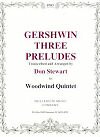
|
WW135: Three Preludes by George Gershwin transcribed and arranged for Woodwind Quintet by Don Stewart. Trillenium Music, 2007, SS, (score and parts). This set of three piano preludes written in 1924 was so popular a few years ago that it may have suffered from overexposure. (I recall hearing a version for electric violin while watching an ice skating competition.) However, it is probably safe to perform this wonderful music again. |
39.95
|
|
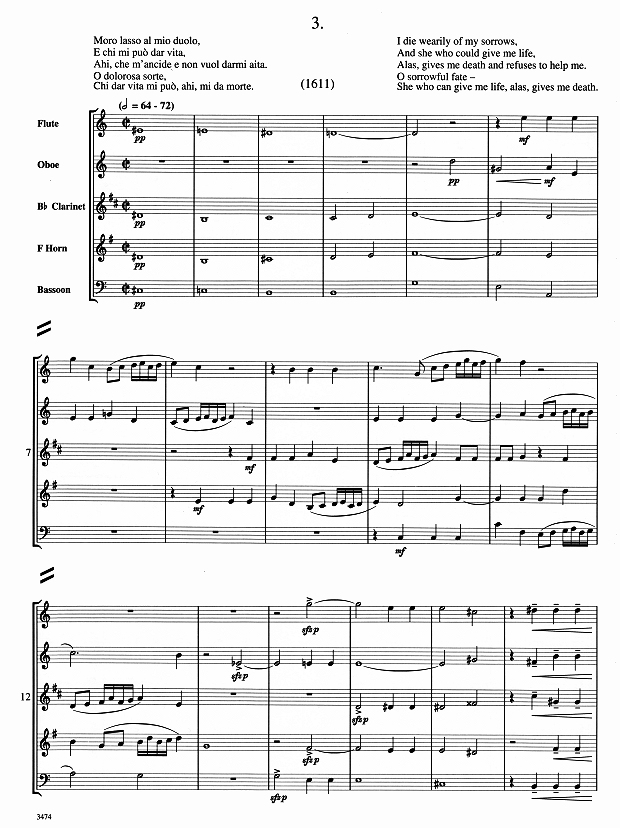
|
WW322: Three Madrigals by Don Carlo Geualdo arranged for woodwind quintet by Graham Bastable. International Music Co., 1999, SS, includes parts and score (each part is 2 pages). Carlo Gesualdo (1560-1613), was an Italian nobleman, lutenist, and composer who had an unusually colorful personal life. He was especially know for his Madrigals. The three in this collection were written between 1596 and 1611. Click on the cover image to view the first page of the score of the third madrigal. |
14.25
|
|
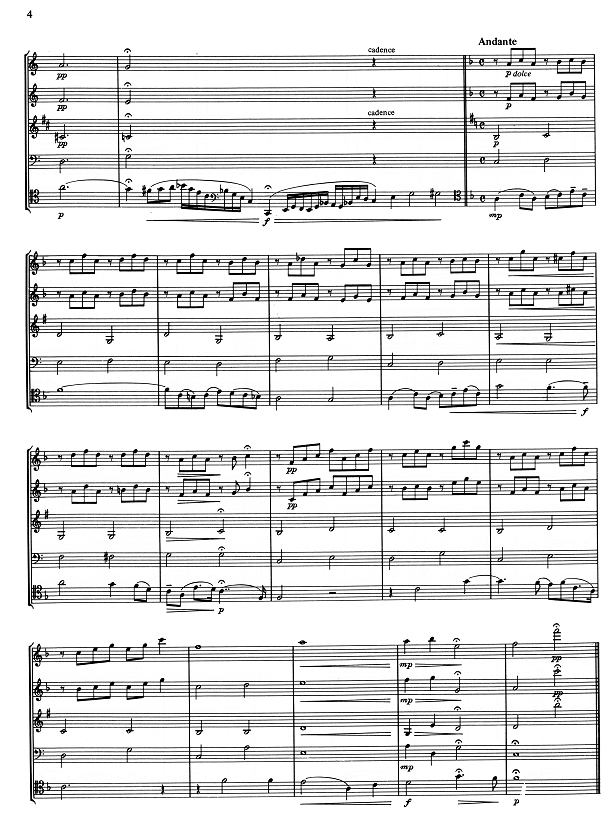
|
WW087: Berceuse de Jocelyn for Woodwind Quintet by Benjamin Godard adapted by Roland Denis. International Music Diffusion, 1991, SS, includes parts and score. This is an unusual wind quintet as it features the bassoon. Except for the bassoon, the parts are at the early high school level. The bassoon part is almost entirely in tenor clef and has a short cadenza. It will require a more advanced player than the other parts. The horn part is in bass clef but it is easy. The tempo alternates between Adantino and Andante. Click on the cover image to view the last page of the score which shows the bassoon cadenza. |
12.50
|
|
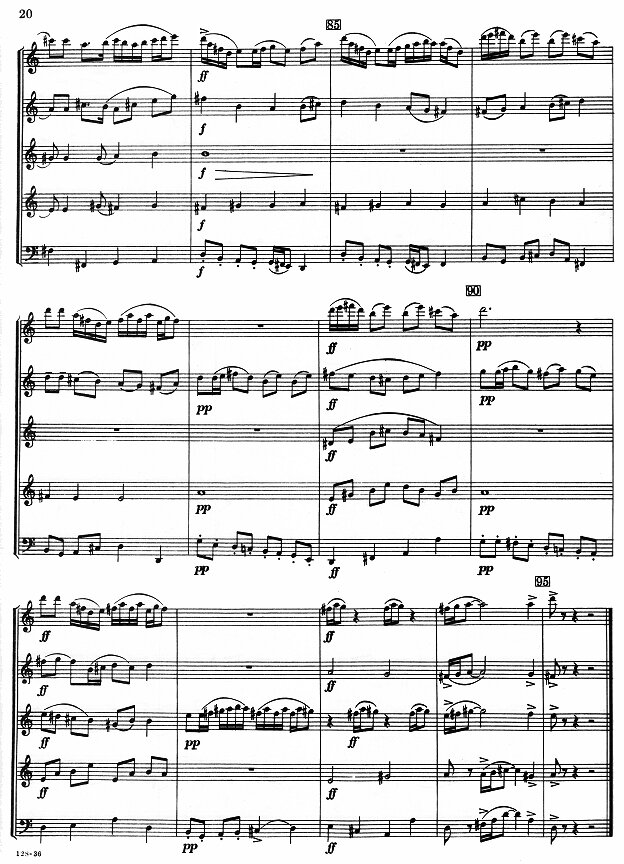
|
WW304: Prairie Songs for Woodwind Quintet by Roger Goeb. Peer International, 1952, SS, includes parts and score. Roger Goeb (1914-1997) was an American composer who studied with Nadia Boulanger and was a music educator as well. This piece was composed in 1947 and also exists in a version for small orchestra. It is in three movements: 1. Evening, 2, Dance, and 3. Morning. Early college level. Click on the cover image to view the last page of the score. (This portion of the music is in cut time with half note = 56.) |
14.95
|
|
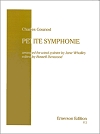
|
WW309: Petite Symphonie arranged for Wind Quintet by Charles Gounod arranged by Jane Whalley edited by Russell Denwood. Emerson Edition, 1994, SS, includes parts and score. Charles Gounod (1818-1893) was a French composer who also lived in England. This piece was written in 1885. It was originally for 9 wind instruments (a double wind quintet minus one flute). This arrangement is in four movements: Adagio/Allegretto, Andante Cantabile, Scherzo, and Finale (Allegretto). Early college level. |
40.95
|
|
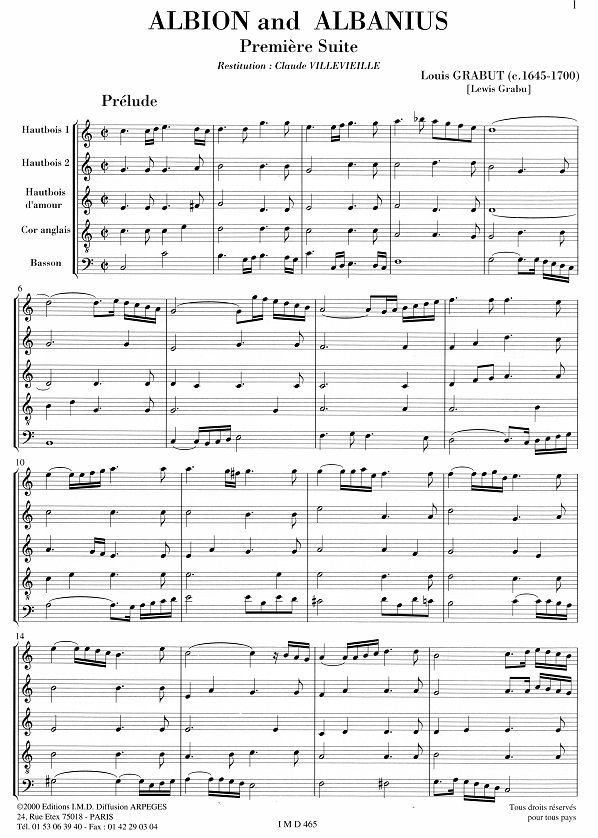
|
WW081: Albion and Albanius 1st Suite for Double Reed Quintet by Louis Grabut arranged by Claude Villevieille. International Music Diffusion, 2000, SS, includes parts and score. Louis Grabut (ca. 1645-1700) was a French composer who spent his entire career in England where he was known as Lewis Grabu. Albion and Albanius is an opera which is attributed to him. These pieces are taken from the Prologue and the First Act. The instrumentation is 2 oboes, oboe d'amour, cor anglais, and bassoon. Early but not especially difficult music. Click on the cover image to view the first page of the score. |
30.95
|
|
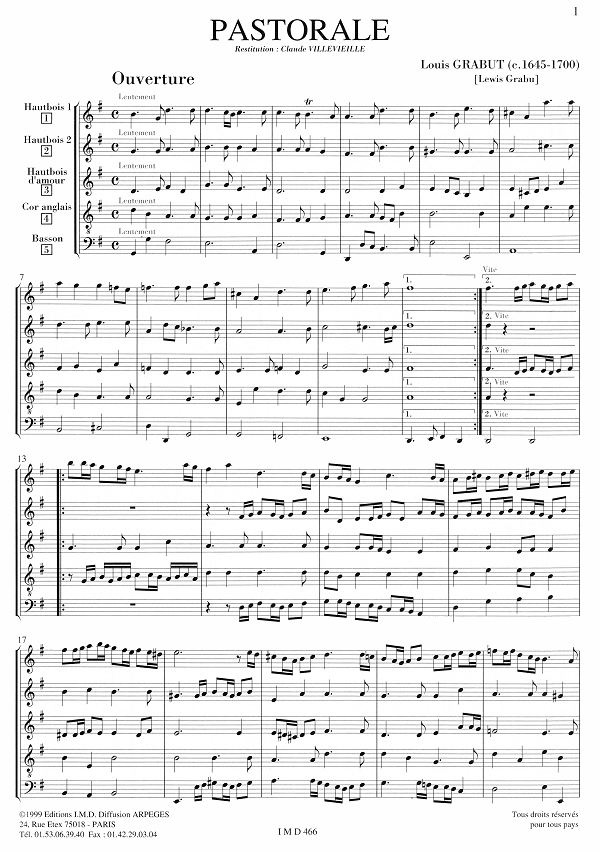
|
WW090: Pastorale et Air pour les Hautbois for Double Reed Quintet by Louis Grabut arranged by Claude Villevieille. International Music Diffusion, 1999, SS, includes parts and score. This piece is from a library at Magdalene College, Cambridge. The Pastorale consists of an Overture, Air des amours, Bourrée and Menuet. The Air pour les Hautbois has an unnamed first piece, Ritounelle, Prelude, Air pour Jupiter, Air pour les satires and Menuet. The text makes some brief suggestions about performance an ornamentation. The instrumentation is 2 oboes, oboe d'amour (with an alternate cor anglais part), cor anglais (with an alternate baritone oboe part), and bassoon (except for the Ritounelle which is for two oboes and bassoon). This is also early but not especially difficult music. Click on the cover image to view the first page of the score. |
33.95
|
|
|
WW284: Anitra's Dance from Peer Gynt Suite for Woodwind Quintet by Edvard Grieg arranged by James Christensen. Kendor Music, 2012, SS, (includes parts and score). This is a much simplified arrangement compared the version of Anitra's Dance in the Baerenreiter edition. There is an easy piccolo part which could be played on flute near the end of the flute part. A bass clarinet part is included as an alternative to the bassoon. The publisher rates this as (US) grade 3. The duration is 1:30. Click on the cover image to view the first two pages of the score. (Except other items with free shipping.) |
9.95
|
|
|
WW107: Peer Gynt Suite No. 1 Op. 46 for Woodwind Quintet by Edvard Grieg arranged by Joachim Linckelmann. Baerenreiter (BA 8603), 2006, SS, (includes parts and score). A very popular suite arranged for college or adult woodwind quintets. Includes the pieces (which can of course be performed individually): Morning Mood, The Death of Åse, Anitra's Dance, and In the Hall of the Mountain King. The clarinet part is for clarinet in A. |
37.95
|
|
|
WW234: Carols for Christmas arranged for Woodwind Quintet (with optional bass clarinet replacing bassoon) by Frank J. Halferty. Almitra Music/Kendor Music, 2010, SS, includes parts and score. The carols are: Joy to the World, Ding Dong Merrily on High, We Three Kings, Deck the Halls, Jingle Bells, Silent Night, and We Wish You a Merry Christmas. Intermediate level which makes in suitable for high school and other quintets that need holiday music that doesn't require much rehearsal. |
25.50
|
|

|
WW388: Classics for Woodwind Quintet arranged by Frank J. Halferty. Kendor Music Inc., 2017, SS. This collection of treasured selections in arrangements for grade 3-3+ woodwind quintets. From Bach to Tschaikowsky, you’ll find it to be a resource for practically any type of performance. Contents: Fantasy On Ode To Joy; In The Hall Of The Mountain King (Grieg); March (from The Nutcracker Suite) (Tschaikowsky); La Rejouissance (Handel); Prelude In E Minor (Chopin); March (from Anna Magdalena’s Notebook) (Bach); Menuets (from Music For The Royal Fireworks) (Handel); Simple Gifts; Sheep May Safely Graze (Bach); Trepak (from The Nutcracker Suite) (Tschaikowsky); Wie Shön Leuchtet Der Morgenstern (Bach); Kind In Einschlummern (Schumann); and Habanera (from Carmen) (Bizet). There is an optional bass clarinet book to replace the bassoon. The set prices are for 5 books. Please specify if you want the bassoon book or bass clarinet book in the comments of your order. If you want all six parts please specify and we will charge you $54.95. Click on the cover image to view the grade of each piece. Available as a complete set or individual books. |
Set of Parts (5) Set (w/score)35.95
48.95
Flute
7.50
Oboe
7.50
Clarinet
7.50
|
Bassoon
7.50
Bass Clarinet
7.50
Horn
7.50
Score
13.95
|
Bindings: HB: Hard Bound, PB: Perfect Bound (paperback with square spine), SS: Saddle Stitch (paper, folded and stapled), SB: Spiral Bound (plastic or metal)