|
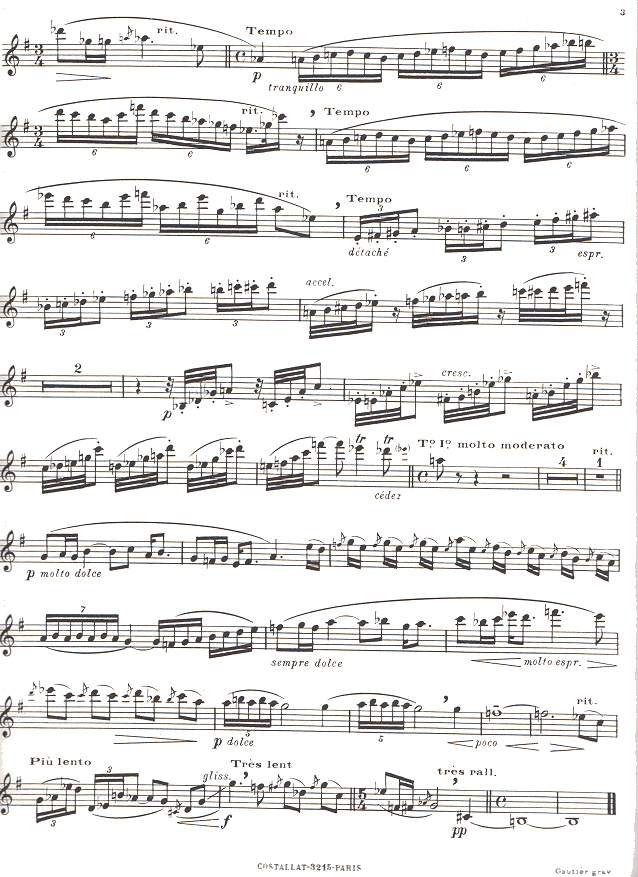
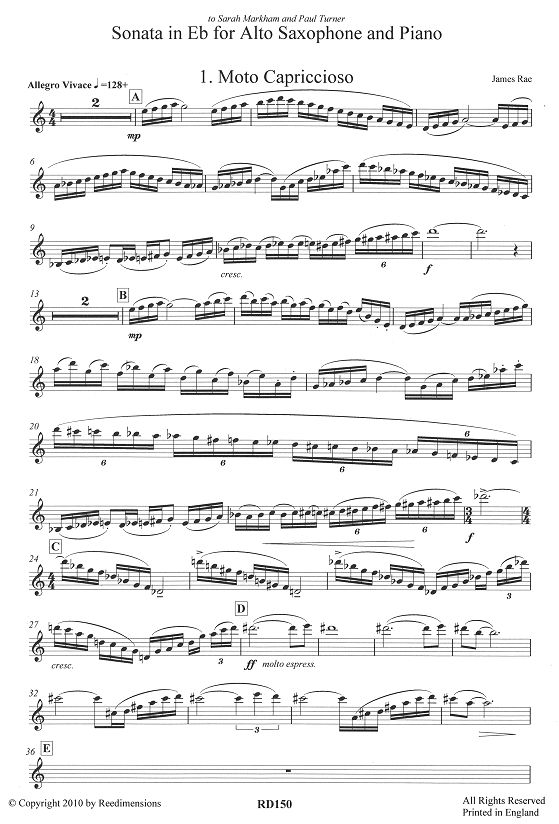
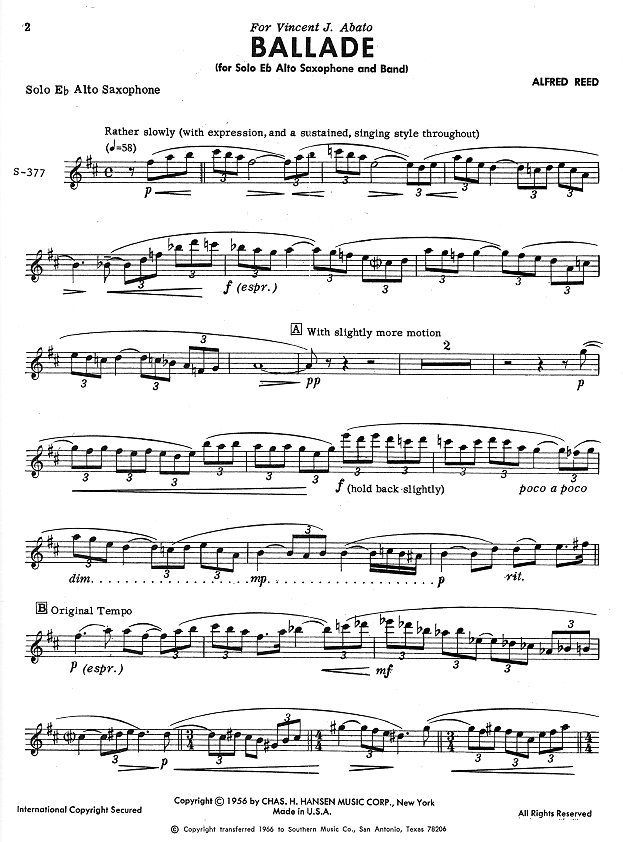
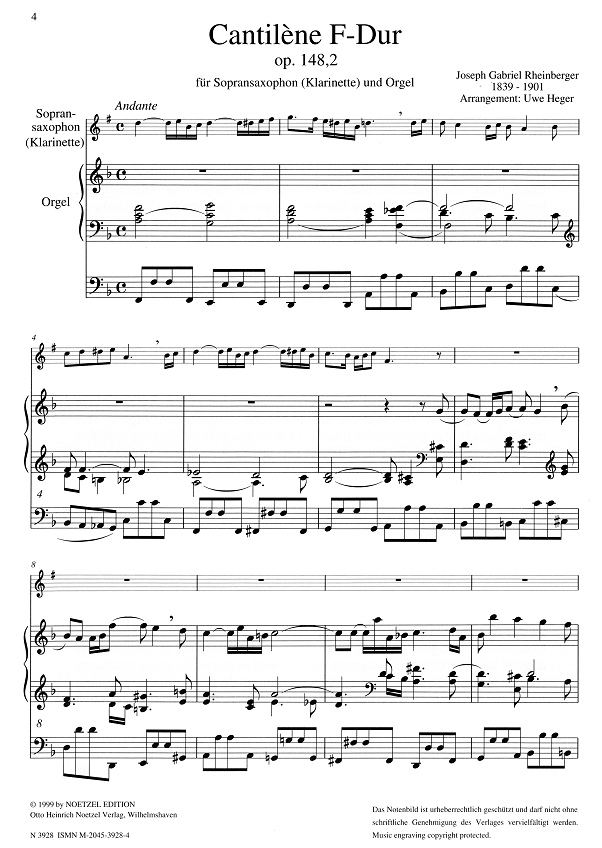
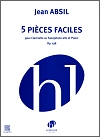
 C1210: Cinq Pièces Faciles Op. 138 (Five Easy Pieces) for clarinet or alto saxophone and piano by Jean Absil. Editions Henry Lemoine, 1969, SS, 10 + 5 pages (includes both clarinet and alto saxophone parts). Jean Absil (1893-1974) was a Belgian composer, organist, and professor at the Brussels Conservatory. This is excellent material for a recital performance by an intermediate student. The pieces are: 1. Badinerie (Allegretto, 2. Chant de marins (Andantino), 3. Parade (Allegro Moderato), 4. Spleen (Andante), and 5. Joyeux départ (Vivo). C1210: Cinq Pièces Faciles Op. 138 (Five Easy Pieces) for clarinet or alto saxophone and piano by Jean Absil. Editions Henry Lemoine, 1969, SS, 10 + 5 pages (includes both clarinet and alto saxophone parts). Jean Absil (1893-1974) was a Belgian composer, organist, and professor at the Brussels Conservatory. This is excellent material for a recital performance by an intermediate student. The pieces are: 1. Badinerie (Allegretto, 2. Chant de marins (Andantino), 3. Parade (Allegro Moderato), 4. Spleen (Andante), and 5. Joyeux départ (Vivo). |
20.95

|
|
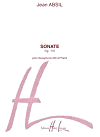
S174: Sonate Op. 115 for Alto Saxophone and Piano by Jean Absil. Editions Henry Lemoine, 1963, SS, 20 + 7 pages. Dedicated to Georges Gourdet. This piece is in three movements: I. Allegro, II. Andantino, and III. Vivo. All movements have cadenzas. Upper college level. |
21.95
|
|
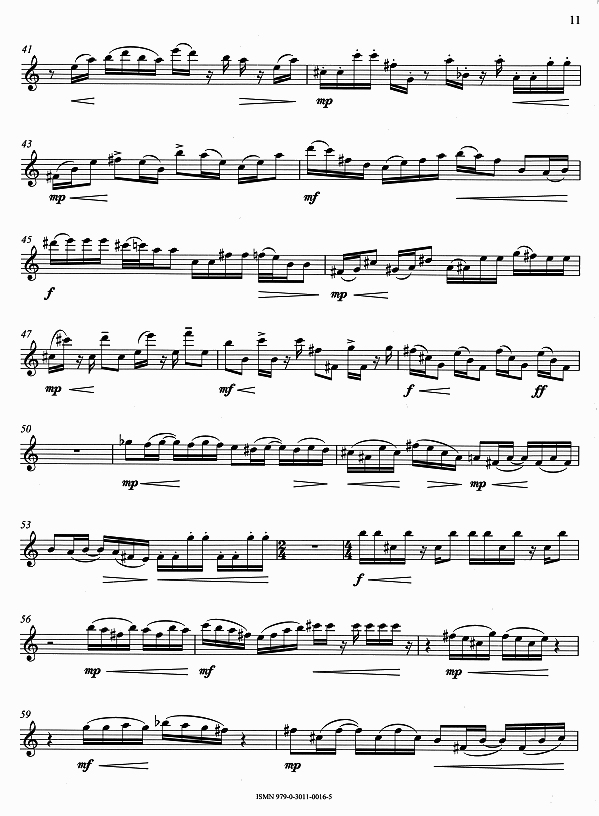
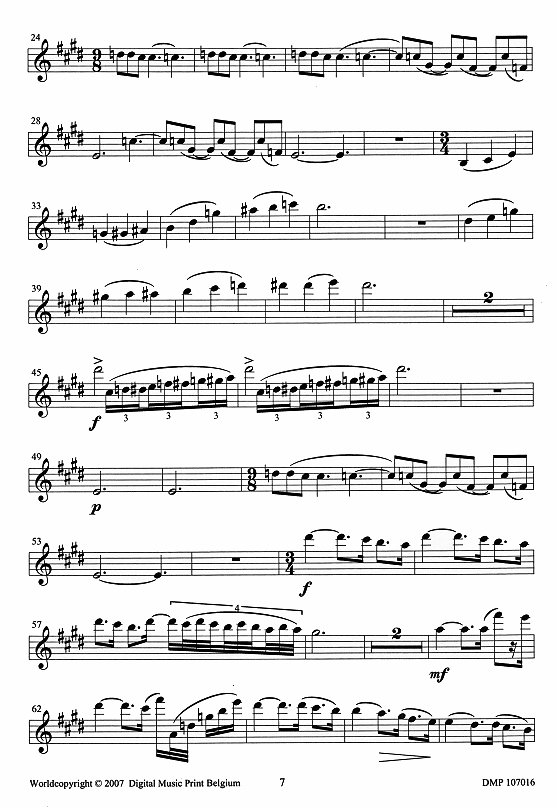
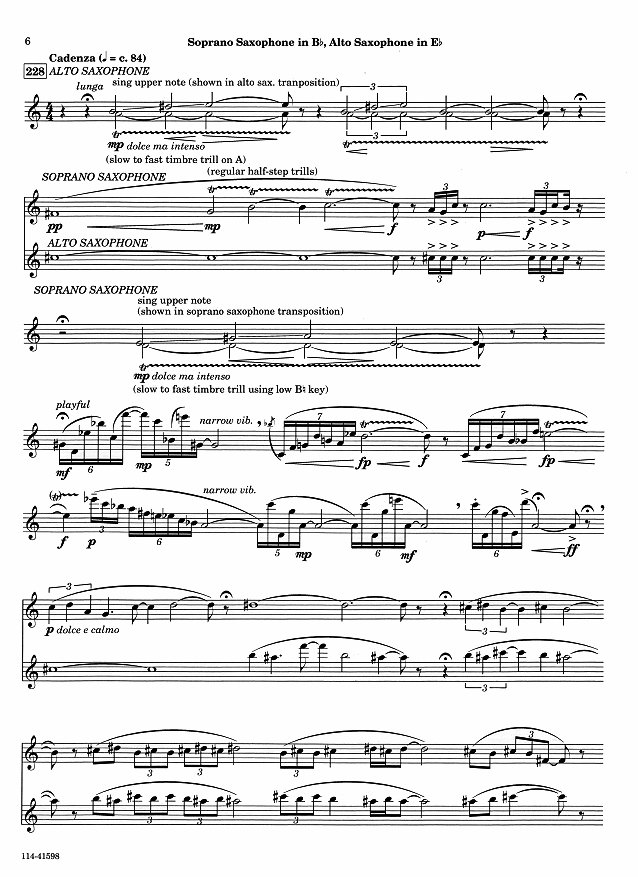
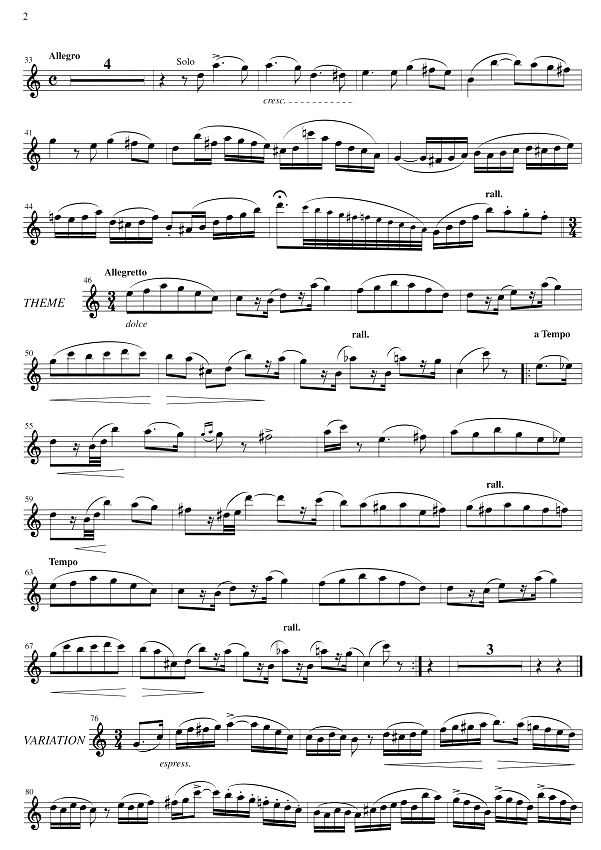
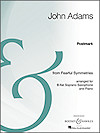
 S1192: Postmark from Fearful Symmetries arranged for Soprano Saxophone and Piano by John Adams arranged by Marilyn Shrude. Boosey & Hawkes, 1989/2009, SS, 6 + 2 pages. Postmark is from Fearful Symmetries which was written immediately after Nixon in China. The original version is for the same orchestra plus a keyboard sampler playing sampled percussion sounds, two horns and a bassoon. Here is an audio recording of this arrangement. Click on the cover image to view the first page of the saxophone part.
Free Media Mail shipping on this music to US, IF ordered with another item. S1192: Postmark from Fearful Symmetries arranged for Soprano Saxophone and Piano by John Adams arranged by Marilyn Shrude. Boosey & Hawkes, 1989/2009, SS, 6 + 2 pages. Postmark is from Fearful Symmetries which was written immediately after Nixon in China. The original version is for the same orchestra plus a keyboard sampler playing sampled percussion sounds, two horns and a bassoon. Here is an audio recording of this arrangement. Click on the cover image to view the first page of the saxophone part.
Free Media Mail shipping on this music to US, IF ordered with another item.
(Except other items with free shipping.)
|
24.95
|
|
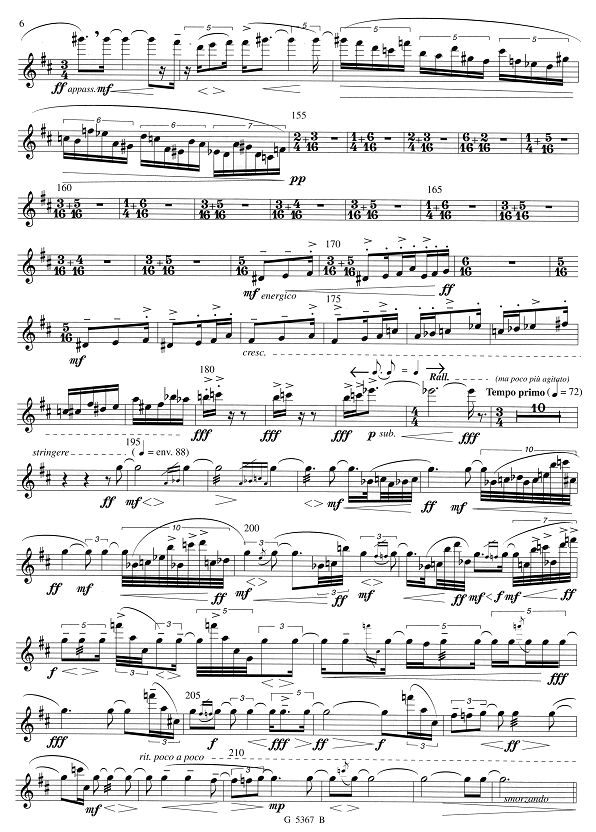
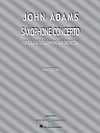
S1164: Saxophone Concerto for Solo Alto Saxophone and Orchestra (Piano Reduction) by John Adams. Boosey & Hawkes, 2013/2015, PB/SS, 58 + 20 pages. Adams' father played alto saxophone in swing bands in the 1930s, and he credits this life-long exposure to the music of the jazz greats with the creation of his saxophone concerto, composed in 2013. Dedicated to Tim McAllister, John Adams’ concerto for alto saxophone and orchestra is a major addition to the instrument’s repertoire. Inspired by classic studio recordings from the fifties and sixties by Charlie Parker, Stan Getz and Cannonball Adderley, the new concerto pushes the limits of the instruments technical and expressive powers. A few altissimo Gs near the end. An advanced work with a duration of 29 minutes. Click here to view a performance with orchestra. |
27.95
|
|
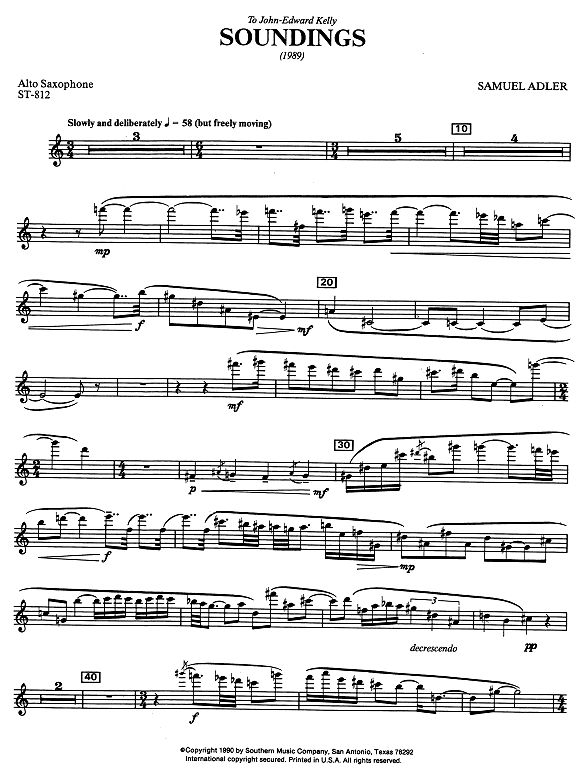
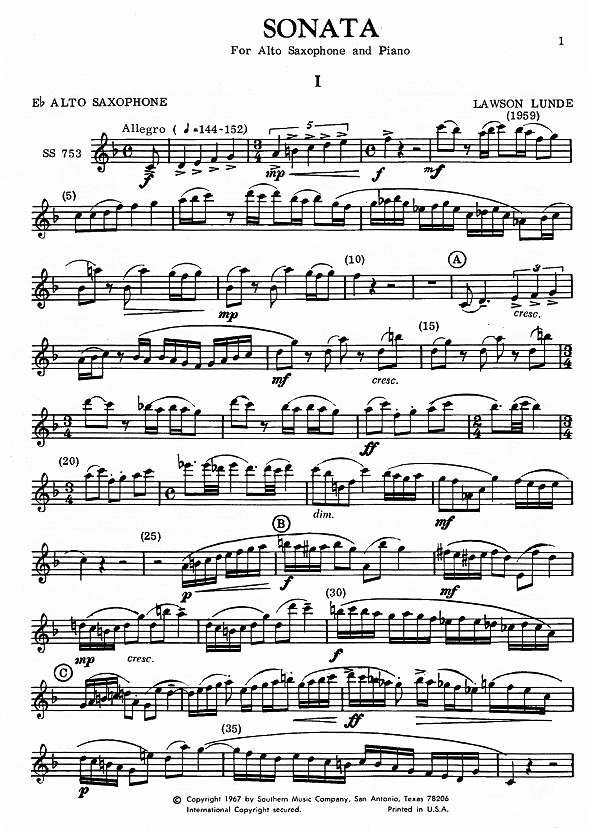
S227: Soundings for Alto Saxophone and Piano by Samuel Adler. Southern Music Co., 1990, SS, 16 + 6 pages. A recent one movement (with slow and fast sections) work which includes high altissimo and some quarter tones. Advanced college level. Click on the cover image to view the first page of the saxophone part. |
24.95
|
|
S751: Tango for Soprano Saxophone and Piano by Isaac Albeniz arranged by Sharon Davis. Western International Music, 1996, SS, 5 + 2 pages. The familiar Albeniz tango arranged for soprano saxophone and piano. Marked Andantino, it is at the intermediate level although it is in the key of E.
Free Media Mail shipping on this music to US, IF ordered with another item.
(Except other items with free shipping.)
|
7.95
|
|
WW248: Concerto in D minor Op. 9 No. 2 for Oboe (or Clarinet or Soprano Saxophone) and Piano by Tomaso Albinoni edited by Ber Joosen. Molenaar, 1966, SS, 18 + 4 pages. Originally for oboe and string orchestra. In three movements: Allegro e non presto, Adagio, and Allegro. Includes both oboe and saxophone/clarinet parts. Duration 12-13 minutes. Advanced high school/early college level.
|
16.95
|
|
S672: Sevilla for Alto Saxophone and Piano by Isaac Albeniz arranged by J. Michael Leonard. Masters Music, 1995, SS, 9 + 3 pages. This is from Suite Espagñole Op. 47 and was written in 1886. Allegretto tempo. With a range to altissimo F sharp this is an advanced high school level piece.
Free Media Mail shipping on this music to US, IF ordered with another item.
(Except other items with free shipping.)
|
5.95
|
|
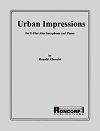
S510: Urban Impressions for Alto Saxophone and Piano by Ronald Albrecht. Roncorp, 2008, SS, 24 + 5 pages. Ronald Albrecht is an American composer, pianist, and music educator. In five movements: Main Street (Allegro Molto), Park Avenue (Casual, somewhat jazzy), After Midnight (Expressive, like the blues), Four Corners (A Jazzy Shuffle), and Traffic (A Driving Allegro). This piece probably rates as early college level but it includes a few altissimo notes up to A-flat.
|
16.00
|
|
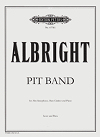
WW257: Pit Band for Alto Saxophone, Bass Clarinet and Piano by William Albright. C.F. Peters, 1996, SS. (includes parts and piano score). This work, with its unusual ensemble of three haphazard instruments—a pick-up band—attemps to digest an evening-long musical comedy in a few minutes (8 to be precise). The program is: Tune-up and Introduction, Overture, Opening Number, Vamps and Screams ("Nessun dorma"), Love Song, Waltz, alla Marcia, Fox-trot and Shimmeys, and Finale. An advanced work with some high altissimo for both instruments, but without the nasty key changes found in most musicals.
|
39.95
|
|
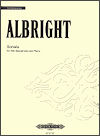
S078: Sonata for Alto Saxophone and Piano by William Albright. C.F. Peters, 1990, 34 +16 pages. This piece was written in 1984 for a consortium of three saxophone/piano duos. It has four movements: I. Two-part Invention, II. La follia nuova: a lament for George Cacioppo, III. Scherzo "Will o' the wisp," and IV. Recitative and Dance. Advanced level and very nicely printed.
|
39.95
|
|
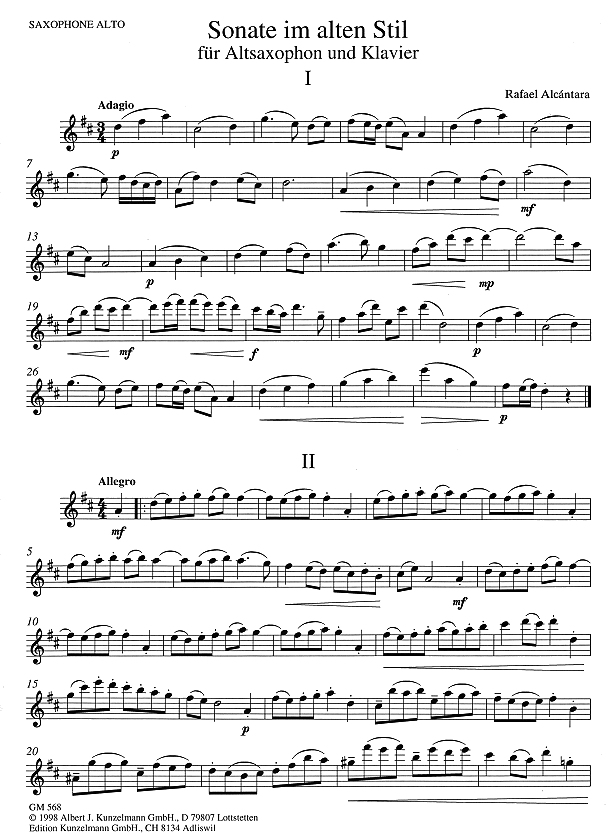
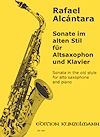
S1074: Sonata in the Old Style (Sonate im alten Stil) for Alto Saxophone and Piano by Rafael Alcántara. Kunzelmann, 1998, SS, 10 + 4 pages. Rafael Alcantara (1975-) is a saxophonist and composer of Peruvian extraction who lives in Munich, Germany. In four movements: I. Adagio, II. Allegro, III. Andante, and IV. Vivo. This piece is suitable for an advanced high school or early college performer. It has a number of high F-sharps. Click on the cover image to view the first page of the saxophone part. |
18.95
|
|
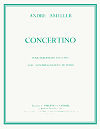
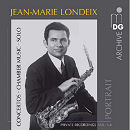
S416: Concertino for Alto Saxophone (Piano Reduction) by André Ameller. Editions Philippo et Combre, 1970, 28 + 10 pages. This work, which is dedicated to Jean-Marie Londeix, was written with string orchestra and flute obbligato accompaniment. It is in three movements: I. Lento/Allegro con fantasia, II. Come un'improvisazione, and III. Vivace. The first and last movements have a cadenza. Upper college level.
|
27.95
|
|
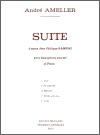
S182: Suite after Rameau for Alto Saxophone and Piano by André Ameller. Editions Musicales Transatlantiques, 1971, 12 + 6 pages. Five movements: 1. Vivo, 2. Sarabande, 3. Menuets, 4. Rondo gracieus, and 5. Final. High school/early college level. |
19.95
|
|
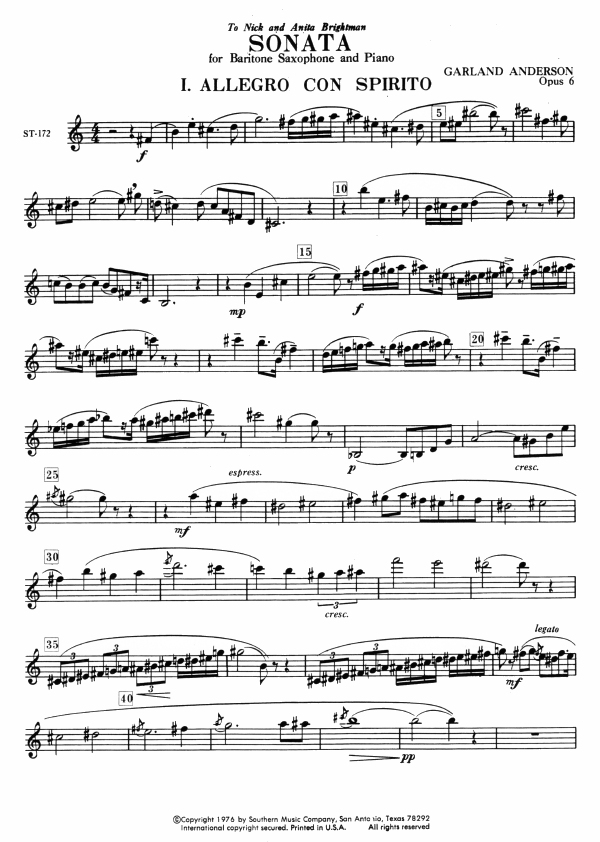
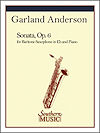
 S820: Sonata Op. 6 for Baritone Saxophone and Piano by Garland Anderson. Southern Music Co., 1976, SS, 24 + 6 pages. Garland Anderson (1933-2001) was an American composer and pianist. Three movements: I. Allegro con spirito, II. Andante sostenuto, and III. Adagio/Allegro.The publisher rates this as (US) grade 5. Click on the cover image to view the first page of the saxophone part. S820: Sonata Op. 6 for Baritone Saxophone and Piano by Garland Anderson. Southern Music Co., 1976, SS, 24 + 6 pages. Garland Anderson (1933-2001) was an American composer and pianist. Three movements: I. Allegro con spirito, II. Andante sostenuto, and III. Adagio/Allegro.The publisher rates this as (US) grade 5. Click on the cover image to view the first page of the saxophone part.
|
19.95
|
|
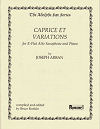
S415: Caprice et Variations for Alto Saxophone and Piano by Joseph Arban edited by Bruce Ronkin. Roncorp, 1987, SS, 12 + 4 pages. This piece by brass virtuoso, teacher, arranger and composer Arban was written in about 1860 and originally published by Adolphe Sax's publishing house. It begins with a 6/8 Andantino, followed by the statement of a theme and three variations. Advanced high school or early college level with a duration of about 6:30 without repeats.
|
15.95
|
|
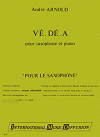
S315: Vé. Dé. A for Alto Saxophone and Piano by André Arnold. International Music Diffusion, 1983, SS, 17 + 5 pages. André Arnold (1910-?) was a French composer and organist who lost his sight in an accident when he was 13. He composed more than 60 works for a variety of instruments. This piece, which had its premier performance in 1971, was dedicated to his granddaughter and the title is based on her initials. In three movements: I. Prelude ( Moderato), II. Berceuse (Andante), and III. Final - Rondo (Allegro). Early college level with a duration of 9 minutes. |
19.95
|
|
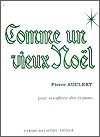
S421: Comme un vieux Noël for Alto Saxophone and Piano by Pierre Auclert. Billaudot, 1969, 2 + 1 pages. A Christmas carol in the old style. Early intermediate level.
Free Media Mail shipping on this music to US, IF ordered with another item.
(Except other items with free shipping.)
|
7.95
|
|
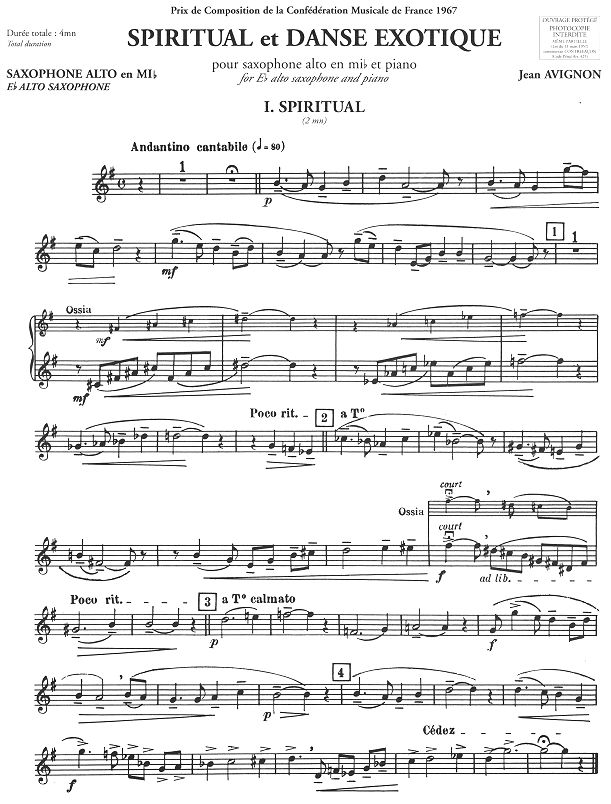
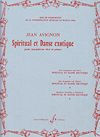
S1306: Spiritual et Danse Exotique for Alto Saxophone and Piano by Jean Avignon. Billaudot, 1967, 6 + 2 pages. The Spiritual is mm=80 Andantino cantabile. The Danse Exotique is Tres rythme (mm=84 in one). Both movements have a duration of about two minutes. This piece is not especially difficult although there are quite a few accidentals in the Spiritual. Here is a student performance, under tempo especially in the Danse Exotique. Here is a more polished performance of the Danse Exotique. Click on the cover image to view the first movement.
Free Media Mail shipping on this music to US, IF ordered with another item.
(Except other items with free shipping.)
|
10.95
|
|

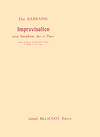
S1337: Improvisation for Alto Saxophone and Piano by Elsa Barraine. Billaudot, 1947, 6 + 3 pages. Elsa Jacqueline Barraine (1910-1999) was a French composer. This was the contest piece at the Conservatoire National in Paris in 1947. The tempo is slow but there are a lot of notes. The highest note is an altissimo F. Click on the cover image to view the last page of the saxophone part.
Free Media Mail shipping on this music to US, IF ordered with another item.
(Except other items with free shipping.)
|
9.95
|
|
S838: Aria de la Suite en Ré Pour Orchestre by Johann Sebastian Bach arranged for Alto Saxophone and Piano by Marcel Mule. Leduc, 1937, SS, 2 + 1 pages. Lento (eighth note = 66). While the tempo is slow, there are lots of 16th notes and some 32nd notes. The piano part is important and the same level of difficulty as the saxophone part. More advanced high school students and up.
Free Media Mail shipping on this music to US, IF ordered with another item.
(Except other items with free shipping.)
|
9.05
|
|
S475: Fourth Sonata by Johann Sebastian Bach arranged for Alto Saxophone and Piano by Marcel Mule. Leduc, 1951, SS, 6 + 3 pages. Originally for flute. Five movements: I. Andante, II. Allegro, III. Adagio, IV. Menuetto 1, and V. Menuetto 2. A good piece for better high school students.
Free Media Mail shipping on this music to US, IF ordered with another item.
(Except other items with free shipping.)
|
9.95
|
|
S826: Partita in A minor BWV 1013 by Johann Sebastian Bach transcribed for saxophone solo by Alain Bouhey. Editions Henry Lemoine, 1994, SS, 6 pages. This partita was written for flute during the period 1722-23. It has four movements: Allemande, Corrente, Sarabande, and Bourrée anglaise. Originally in A minor it has been transposed to (written) B minor. The music goes up to altissimo F sharp and has one optional altissimo B. This is easier than the piece below, although it has the same difficulty grade from the publisher. It includes notes in French by Bouhey.
Free Media Mail shipping on this music to US, IF ordered with another item.
(Except other items with free shipping.)
|
16.95
|
|
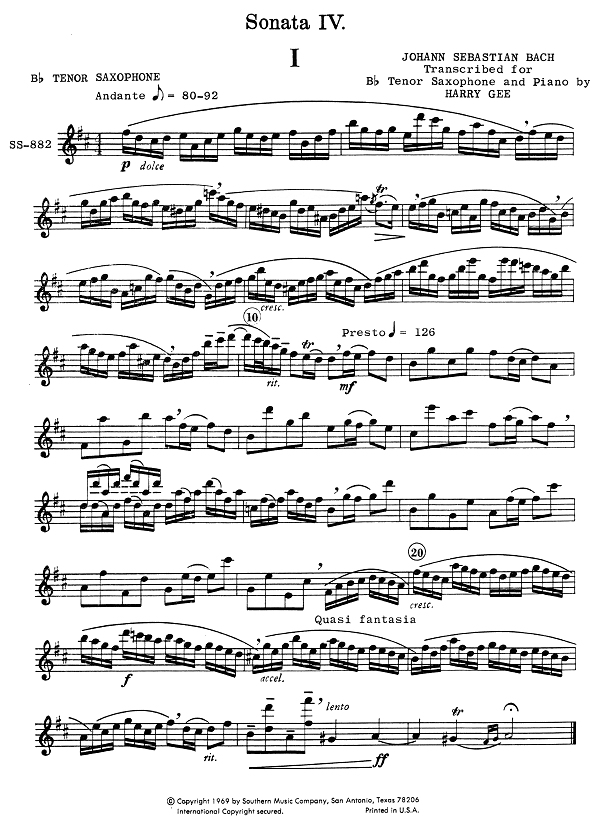
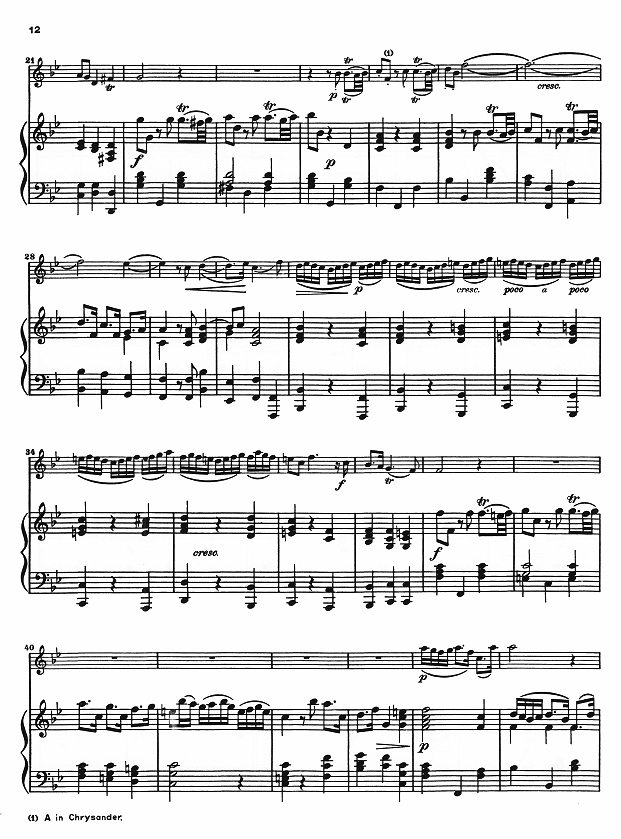
/  S228: Sonata IV by Johann Sebastian Bach transcribed and arranged for Soprano or Tenor Saxophone and Piano by Harry Gee. Southern Music Co., 1969, SS, 10 + 4 pages. Four movements: I. Andante, II. Menuetto I and Menuetto II, III. Adagio, and IV. Allegro. Advanced high school/early college level. Click on the cover image to view the saxophone part for the first movement. S228: Sonata IV by Johann Sebastian Bach transcribed and arranged for Soprano or Tenor Saxophone and Piano by Harry Gee. Southern Music Co., 1969, SS, 10 + 4 pages. Four movements: I. Andante, II. Menuetto I and Menuetto II, III. Adagio, and IV. Allegro. Advanced high school/early college level. Click on the cover image to view the saxophone part for the first movement.
Free Media Mail shipping on this music to US, IF ordered with another item.
(Except other items with free shipping.)
|
9.95
|
|
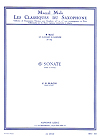
S553: Sixth Sonata by Johann Sebastian Bach arranged for Alto Saxophone and Piano by Marcel Mule. Leduc, 1951, SS, 8 + 4 pages. Originally for flute. This listed as No. 92 in M. Mule Les Classiques du Saxophone. Four movements: I. Adagio, ma non tanto, II. Allegro (ma non troppo), III. Siciliano, and IV. Allegro assai. Early college level.
Free Media Mail shipping on this music to US, IF ordered with another item.
(Except other items with free shipping.)
|
9.95
|
|
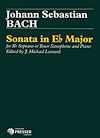
/ S280: Sonata in E-flat Major by Johann Sebastian Bach transcribed and arranged for Soprano or Tenor Saxophone and Piano by J. Michael Leonard. Presser, 1987, SS, 11 + 4 pages. This is BWV 1031 originally for flute and harpsichord. Three movements: I. Allegro moderato, II. Siciliano, and III. Allegro. High school or early college level. |
9.95
|
|
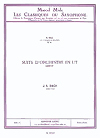
S839: Suite D'Orchestre en Ut by J.S. Bach transcribed for alto saxophone and piano by Marcel Mule. Leduc, 1937, 2 + 1 pages. This piece, originally in C (but here with the saxophone in D), is Allegretto moderato/Poco meno vivo. High school level. Overstock Special while supplies last. Regular price is $10.95.
Free Media Mail shipping on this music to US, IF ordered with another item.
(Except other items with free shipping.)
|
8.75
|
|
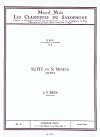
S611: Suite en Si Mineur, Badinerie by J.S. Bach transcribed for alto saxophone and piano by Marcel Mule. Leduc, 1937, 2 + 1 pages. This piece, originally in B minor (but here with the saxophone in A minor), is at an Allegretto tempo. Upper intermediate level.
Free Media Mail shipping on this music to US, IF ordered with another item.
(Except other items with free shipping.)
|
8.75
|
|
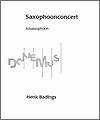
S203: Saxophoonconcert (Saxophone Concerto) for Alto Saxophone and Orchestra (Piano Reduction) by Henk Badings. Donemus, 1951, SB, 23 + 10 pages. Henk Badings (1907-1987) was a Dutch composer. A prolific composer, he had produced over a thousand pieces at the time of his death. Three movements: I. Allegro, II Notturno (Largo), and III. Rondo (Presto). College level. |
40.95
|
|
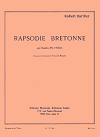
S823: Rapsodie Bretonne for Alto Saxophone and Orchestra (Piano Reduction) by Robert Bariller. Leduc, 1953, SS, 14 + 6 pages. This piece, which is dedicated to Marcel Mule, was written for the Concours du Conservatoire National de Musique. It is sectional and typically alternates between slower and faster sections. Advanced college level with a duration of about 8:30. Here is a video on YouTube.
|
30.15
|
|
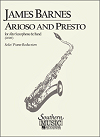
S638: Arioso and Presto Op. 108 for Alto Saxophone and Band (Piano Reduction) by James Barnes. Southern Music Co., 2001, SS, 15 + 4 pages. James Barnes (1949-) is an American composer, music educator and band director. This piece was commissioned by Joliet Junior College and the American Association of Community Colleges and is dedicated to saxophonist Thomas Liley. This piece begins with a brief Adagio - ma non troppo introduction which is followed by a saxophone cadenza leading directly into the Arioso (a tempo primo mm = 66-69). The Presto (mm = 144-152) section is in 2/4 and has a relatively lengthy cadenza near the end. The publisher rates this piece at grade 4 and it is probably at the upper end of that range. Duration is an estimated 6 minutes. The band parts may be rented from the publisher. |
26.95
|
|
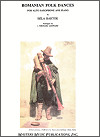
S674: Romanian Folk Dances for Alto Saxophone and Piano by Bela Bartok arranged by J. Michael Leonard. Masters Music, 1999, SS, 12 + 6 pages. These popular dances have been nicely arranged for alto saxophone. The difficulty varies from piece to piece. The first and fourth can probably be played by better high school saxophonists while the last two (both at Allegro mm=152 and in 5 sharps) will probably require a college level performer. The six dances are: I. Jocul cu Bȃtă (Dance with sticks), II. Brȃul (Waistband Dance), III. Pe Loc (Stamping Dance), IV. Buciumeana (Hornpipe Dance), V. Poarcȃ Romȃnescă (Romanian Polka), and VI. Mănuntelul (Quick Dance). |
5.95
|
|
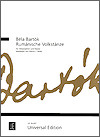
S1181: Romanian Folk Dances (Rumänische Volkstänze) for Alto Saxophone and Piano by Bela Bartok arranged by Martin J. Reiter. Universal Edition, 2016, SS, 12 + 5 pages. These are the same dances as above in a different arrangement. They are in easier keys and registers than the Masters edition. The dance names are in German: 1. Der Tanz mit dem Stabe, 2. Brȃul, 3. Der Stampfer, 4. Tanz aus Butschum, 5. Rumänische Polka, and 6. Schnell-Tanz. Click on the cover image to view the first page of the score. |
19.95
|
|
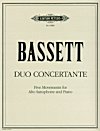
S077: Duo Concertante - Five Movements for Alto Saxophone and Piano by Leslie Bassett. C.F. Peters, 1988, 18 + 9 pages. Lesslie Bassett (1923-2016) was an American composer and music educator. The five movements are: Driving, Lyrical, Unhurried, Ascending, and Dramatic. This piece requires good command of the high altissimo register and while it does not require extended technique, it does use some contemporary notation.
|
24.25
|
|
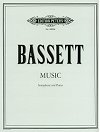
S076: Music for Saxophone and Piano by Leslie Bassett. C.F. Peters, 1969, 17 + 6 pages. For alto saxophone. Optional extended altissimo notes. Requires some extended piano technique ("stopped" notes). Four movements: Fast, Slow, Moderato, and Fast. Skilled performers are required on both parts.
|
28.95
|
|
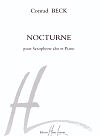
S414: Nocturne for Alto Saxophone and Piano by Conrad Beck. Editions Henry Lemoine, 1969, SS, 4 + 2 pages. This piece was dedicated to Jean-Marie Londeix by Conrad Beck (1901-1989) who was a Swiss composer who studied with studied with Jacques Ibert and was head of the Music Department of Radio Basel for 30 years. This nocturne is marked Très calme (andante sostenuto). Early college level.
Free Media Mail shipping on this music to US, IF ordered with another item.
(Except other items with free shipping.)
|
14.95
|
|
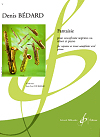
/ S759: Fantaisie for Soprano or Tenor Saxophone and Piano by Denis Bédard. Billaudot, 1995, SS, 13 + 4 pages. Denis Bédard (1950-) is a Canadian composer and keyboardist. This piece alternates between sections that feature both staccato and slurred eighth notes and lyrical sections. The publisher rates this as advanced, but many at the early college level will be able to play it. Duration is about 6:30. Here is an audio file of a performance on tenor saxophone and here is a video of a soprano saxophone performance. |
15.95
|
|
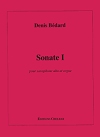
S1119: Sonate I for Alto Saxophone and Organ by Denis Bédard. Editions Cheldar, 1996, SB, 52 + 10 pages. This piece was composed in 1994. It is in three movements: I. Invention (Allegro), II. Barcarolle (Tranquillo) and III. Humoresque (Allegro vivo). It would probably take a college level performer to play the entire work although the first and second movements look easier than the third. Here is a video of a performance of this work. Click on the cover image to view the saxophone part of the first page of each movement. |
23.95
|
|
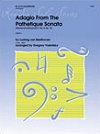
S1171: Adagio from the Pathetique Sonata for Alto Saxophone and Piano by Ludwig van Beethoven arranged by Gregory Yasinitsky. Almitra Music Co./Kendor Music, 2016, SS, 4 + 2 pages. This is from Movement II, Piano Sonata No. 8, Op. 13, one of Beethoven's most famous works. It was written in 1798 and first published in 1799. The duration is 3:25. The publisher has marked this as (US) grade 4, although it is on the easier end of that grade. Click on the cover image to view the first two pages of the score.
Free Media Mail shipping on this music to US, IF ordered with another item.
(Except other items with free shipping.)
|
8.95
|
|
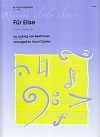
S735: Für Elise for Alto Saxophone and Piano by Ludwig van Beethoven arranged by Lloyd Conley. Almitra Music Co./Kendor Music, 2011, 5 + 2 pages. Ludwig van Beethoven wrote Bagatelle No. 25 in A minor, subtitled Für Elise, in 1810. It features warm, expressive lines that work well on the saxophone. Duration 3:00. Click on the cover image to view the first two pages of the score.
Free Media Mail shipping on this music to US, IF ordered with another item.
(Except other items with free shipping.)
|
7.95
|
|
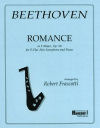
S230: Romance in F Major Op. 50 for Alto Saxophone and Piano by Ludwig van Beethoven arranged by Robert Franscotti. Roncorp, 1980, SS, 12 + 4 pages. This is an arrangement of this popular Beethoven work originally for violin and piano. Marked Adagio cantabile, it will provide the college level saxophonist the opportunity to demonstrate both technical fluency and musical sensitivity.
Free Media Mail shipping on this music to US, IF ordered with another item.
(Except other items with free shipping.)
|
19.95
|
|
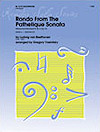
S1187: Rondo from the Pathetique Sonata for Alto Saxophone and Piano by Ludwig van Beethoven arranged by Gregory Yasinitsky. Almitra Music Co./Kendor Music, 2016, 10 + 4 pages. This is from Movement III, Piano Sonata No. 8, Op. 13, one of Beethoven's most famous works. It was written in 1798 and first published in 1799. The duration is 3:55. The publisher has marked this as (US) grade 4+. I would remove the plus sign. Click on the cover image to view the first two pages of the score.
Free Media Mail shipping on this music to US, IF ordered with another item.
(Except other items with free shipping.)
|
9.95
|
|
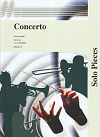
C1695: Concerto for Clarinet or Saxophone (in B-flat) and Piano by Vincenzo Bellini arranged by Ber Joosen. Moelnaar, 1963, SS, 11+ 2 pages. This piece was composed for oboe circa 1819-25. Two main sections: Larghetto cantabile and Allegro (alla polonese). Advanced high school or early college level. The original concert key has been preserved so the solo part could be used with the existing orchestral parts.
Free Media Mail shipping on this music to US, IF ordered with another item.
(Except other items with free shipping.)
|
16.95
|
|
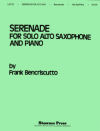
S760: Serenade for Solo Alto Saxophone and Piano by Frank Bencriscutto. Shawnee Press, 1976, SS, 8 + 3 pages. Frank Bencriscutto (1928-1997) was an American composer, saxophonist, and university music educator. The piece has two main themes: first a dance-like section using a long flowing lyric theme and then a serene ballad. The composition closes with the return of first theme. There is a print on demand edition for saxophone and band that can be ordered ($60). Here is a video of the version with piano and here with band.
Free Media Mail shipping on this music to US, IF ordered with another item.
(Except other items with free shipping.)
|
12.95
|

|
C644: Three Songs without Words for Clarinet or Tenor Saxophone and Piano by Paul Ben-Haim. Israel Music Institute, 1953, SS, 12 + 3 pages. Conceived as vocalises for high voice and piano it occurred to the composer that the songs lent themselves to instrumental performance as well. Consequently he arranged them for several instruments, with the clarinet or tenor saxophone edition presented here. The three songs are Arioso (Molto moderato), Ballad (Allegretto), and Sephardic Melody (Largamente rubato e molto appassionato).
Free Media Mail shipping on this music to US, IF ordered with another item.
(Except other items with free shipping.)
|
11.95
|
|
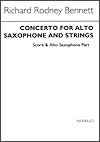
S1330: Concerto for Alto Saxophone and Strings (Piano Reduction) by Richard Rodney Bennett. Novello, 1998, SS, 37 + 15 pages. Commissioned by Leslie Bishop for John Harle and London Music (1988) and dedicated to John Harle. In three movements: I. Molto vivo, II. Andante (Interlude), III. Allegro. Neat Manuscript. The highest altissimo note is B-flat but there is little altissimo above G. Duration 16 minutes. Here is a recording of the first and second movements, the third movement is also on YouTube.
|
39.95
|
|
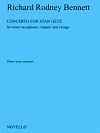
S325: Concerto for Stan Getz for tenor saxophone, timpani and strings (Piano reduction) by Richard Rodney Bennett. Novello, 2000, SS, 50 + 19 pages. The Concerto for Stan Getz is a thoroughly celebratory tribute to the possibilities of using jazz harmonies in conjunction with Bennett's own free flowing serial technique. In three movements: I. Con fuoco, II. Elegy, and III. Con brio. There are numerous sections in this extended work where improvisation over chord changes is required. The duration is about 24 minuets.
|
33.95
|
|
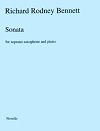
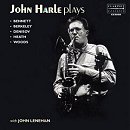
S324: Sonata for soprano saxophone and piano by Richard Rodney Bennett. Novello, 1994, SS, 32 + 9 pages. This piece was commissioned and is dedicated to John Harle. In four movements: I. Poco allegro, II. Scherzando, III. Andante (In memory of Harold Arlen), and IV. Vivo. An advanced work with a duration of 18:30.
|
33.95
|
|
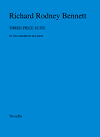
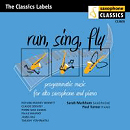
S742: Three Piece Suite for alto saxophone and piano by Richard Rodney Bennett. Novello, 1998, SS, 22 + 7 pages. Three Piece Suite is a transcription made by the composer of three movements of his Four Piece Suite for two pianos of 1974. It was first perform by John Harle. The three movements are: 1. Samba Triste (Gentle and rhythmic), 2. Ragtime Waltz (Homage to Scott Joplin) (Moderato), and 3. Finale (Lively). The duration is 10 minutes. The difficulty is college level (but on the easier side of that standard). There are some performance of the first movement on YouTube but the CD we have is much better (and has all three).
|
25.95
|
|
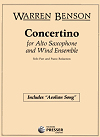
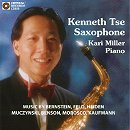
S176: Concertino for Alto Saxophone and Wind Ensemble (Piano Reduction) by Warren Benson. Presser, 1971, SS, 22 + 8 pages. Dedicated to Sigurd Rascher. The piano reduction is by the composer. In three movements: I. Very slowly-subdued, II. Aeolian Song (Slowly-peacefully), and III. Lively-buoyantly. The second movement "Aeolian Song" is often performed by itself (both CDs only have this movement). College level. Duration 12 minutes.
|
16.95
|
|
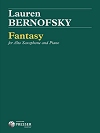
S1165: Fantasy for Alto Saxophone and Piano by Lauren Bernofsky. Theodore Presser, 2016, SS, 13 + 4 pages. Featuring dramatic cadenzas both at the beginning and in the middle of the work, Lauren Bernofsky's aptly-named Fantasy for Alto Saxophone and Piano is a 12-minute odyssey, at once lyrical and soaring through intricate passage work and exotic harmonies. Fantasy stays within the saxophone's natural top register, while projecting a tremendous spectrum of instrumental color. College level with mixed meter. Click on the cover image to view the first page of the score. |
19.95
|
|
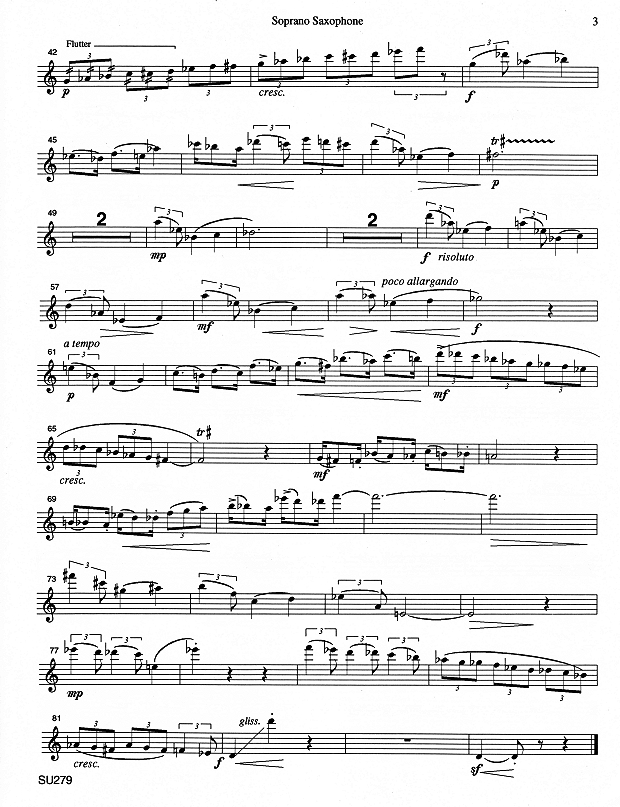
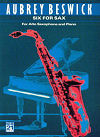
S279: Six for Sax for Alto Saxophone and Piano by Aubrey Beswick. Universal Edition, 1986, 14 + 5 pages. This is at the intermediate level making it one of the easier pieces in our catalog. Most of the pieces have animal related titles (Farewell for a Fox, Waltz for a Wallaby, etc.) and all except Tango for a Turtle are on the fast side.
 (Farewell for a Fox) (Farewell for a Fox)
|
20.95
|
|
S715: Concerto for Alto Saxophone and Orchestra Piano Reduction by Ronald Binge. Josef Weinberger Ltd., 1969, SS, 24 + 7 pages. Ronald Binge (1910-1979) was a British composer and arranger primarily known for "light music" (for Montovani). During the latter part of his life he focused on composing original music. This piece was written in 1956. In three movements: I. Allegro spiritoso, II. Romance (Andante espressivo), and III. Rondo (Allegro giocoso). Advanced high school/early college level with a duration of 13 minutes. Here is a video of a sixteen year old student playing the first movement.
|
26.95
|
|
S1062: The Toreador Song for Alto Saxophone and Piano by Georges Bizet arranged by Frank J. Halferty. Kendor Music Inc, 2014, 7 + 3 pages. This familiar piece is from the opera Carmen. The publisher rates this a (US) grade 5 but I believe grade 4 would be more accurate. Two minutes in duration. Click on the cover image to view the first two pages of the score.
Free Media Mail shipping on this music to US, IF ordered with another item.
(Except other items with free shipping.)
|
9.50
|
|
/ C1696: Sonatine for Clarinet (or Soprano/Tenor Saxophone) and Piano by Michel Blavet arranged by Ber Joosen. Molenaar, 1963, SS, 7 + 3 pages. Michel Blavet (1700-1768) was a French flute virtuoso. In three movements: Allegro moderato, Lento, and Allegro vivace. Better high school players.
Free Media Mail shipping on this music to US, IF ordered with another item.
(Except other items with free shipping.)
|
15.95
|
|
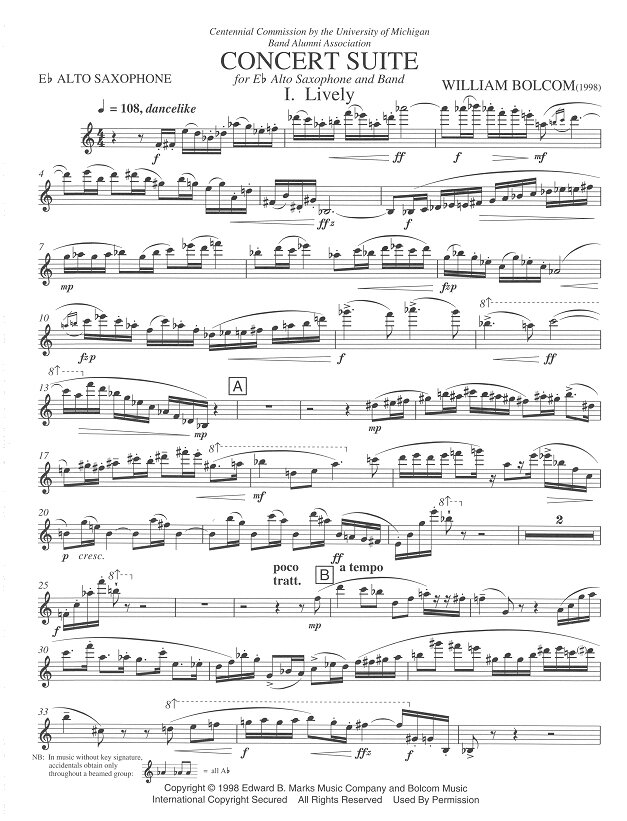
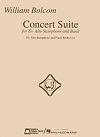
S726: Concert Suite for Alto Saxophone and Band (Piano Reduction) by William Bolcom. Marks Music, 1998, SS, 28 + 11 pages. This was a centennial commission by the University of Michigan Band Alumni Association. The premiere performance was by Donald Sinta and the University of Michigan Symphony band in 1999. In four movements: I. Lively, II. Like an Old Folksong, III. Scherzando, and IV. Introduction and Jump. An advanced work with some high altissimo. Band parts are a rental. Duration about 14 minutes. Click on the cover image to view the first page of the music. |
19.95
|
|
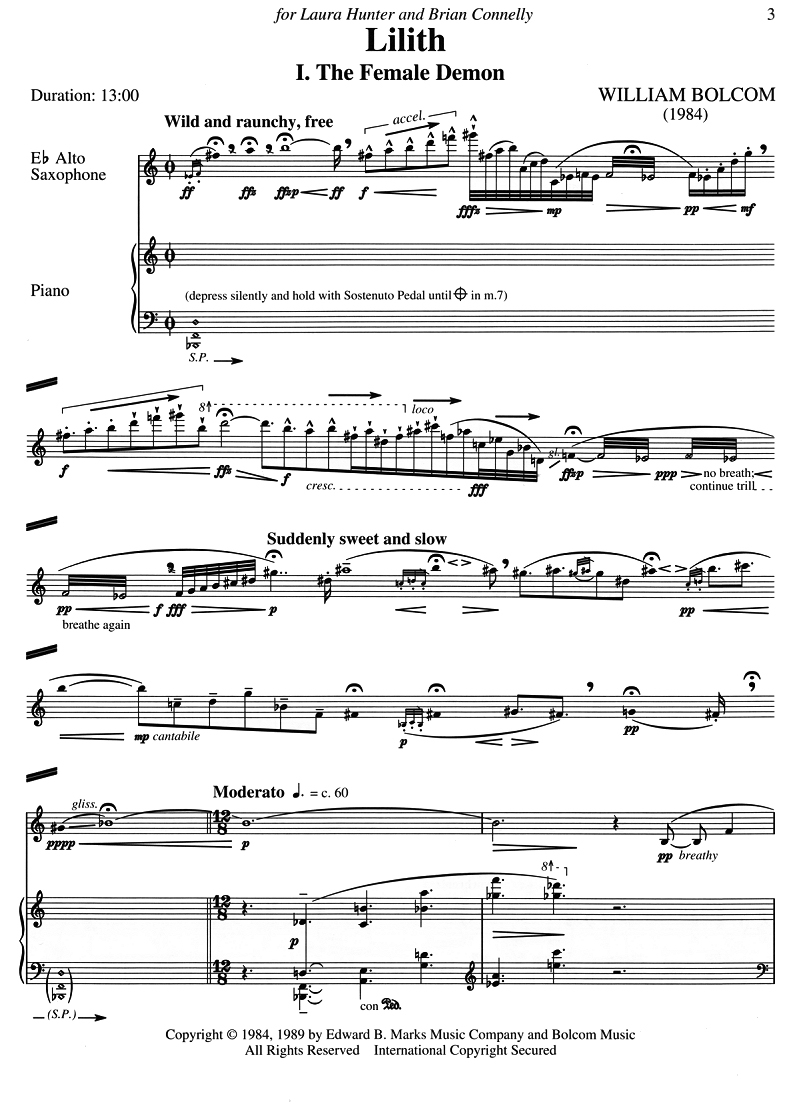
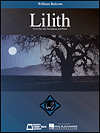
S787: Lilith for Alto Saxophone and Piano by William Bolcom. Marks Music, 1984/1989, SS, 22 + 11 pages. Lilith is a female demon, dating from ancient times, a child-stealing witch of worldwide folklore. This five-movement virtuoso show piece is among the most ambitious music ever written for alto saxophone. Now in print some years after composition, it has already become a near legendary challenge in university classical saxophone circles. The five movements are: I. The Female Demon, II. Succuba, III. Will-O'-the-Wisp, IV. Child-Stealer, and V. The Night Dance. Includes multiphonics and other extended techniques. Duration about 13 minutes. Click on the cover image to view the first page of the music. |
19.95
|
|
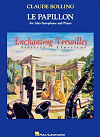
S298: Le Papillon for Alto Saxophone and Piano by Claude Bolling. Hal Leonard, 1994, 20 + 8 pages. Claude Bolling (1930-) is a renowned French jazz pianist, composer (for films in particular), and arranger. This sectional piece is from the recording "Enchanting Versailles – Strictly Classical." College level.
|
9.95
|
|
S589: Largo and Allegro for Tenor Saxophone and Piano by Pietro Boni transcribed by Himie Voxman. Rubank, 1949, 5 + 2 pages. Pietro Gaetano Boni (ca.1686-1741) was an Italian composer. This two movement piece at the intermediate (easier high school) level is frequently used for solo and ensemble festivals. The range is from the first line E to the C above the staff.
Free Media Mail shipping on this music to US, IF ordered with another item.
(Except other items with free shipping.)
|
4.95
|
|
S143: Concerto for Alto Saxophone and Orchestra Piano Reduction by Paul Bonneau. Leduc, 1944, SS, 34 + 8 pages. Dedicated to Marcel Mule. French composer Paul Bonneau (1918-1995) studied at the Paris Conservatory where he won a First Prize for composition. He worked as a conductor and composer and was particularly known for music for films. This Concerto is in three movements: I. Allegro/Più Lento, II. Andante, III. Allegro. An upper level college work. |
56.15
|
|
S287: Pièce Concertante dans l'Esprit "Jazz" for Alto Saxophone and Orchestra (Piano Reduction) by Paul Bonneau. Leduc, 1944, SS, 27 + 8 pages. Dedicated to Marcel Mule. A fairly long piece (about 11 minutes) with many sections. College level. |
43.40
|
|
S150: Suite for Alto Saxophone and Piano by Paul Bonneau. Leduc, 1944, SS, 13 + 5 pages. Dedicated to Marcel Mule. This suite has four short pieces: I. Improvistaion, II. Danse des Démons, III. Plainte, and IV. Espiéglerie. College level. |
28.60
|
|
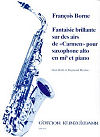
S246: Fantaisie Brillante sur des airs de Carmen for Alto Saxophone and Piano by François Borne arranged by Ewan Roth and Raymond Meylan. Kunzelmann, 1993, SS, 20 + 7 pages. This popular flute showpiece based on themes from Bizet's opera Carmen also works very well on saxophone.
|
30.25
|
|
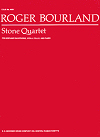
S585: Stone Quartet for Soprano Saxophone (or Clarinet), Viola, Cello and Piano by Roger Bourland. E.C. Schirmer, 1989, SS, includes parts and piano score. This two movement piece was written in 1982 and was name for the saxophonist the premiered the work, Richard Paul Stone. The first movement is The Strange Juggler which was inspired by a painting by Odilon Redon. The tempo is presto. The second movement is Dark Chaconne. It has some mixed meter and in the second part of the piece the strings play 32nd note arpeggios. College level with a duration of 9 minutes. This piece won awards as the Best New Music of 1982 in Boston. There are some samples here which do not necessarily start from the beginning of the piece. |
25.20
|
|
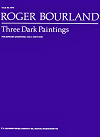
S586: Three Dark Paintings for Soprano Saxophone (or Clarinet), Viola and Cello by Roger Bourland. E.C. Schirmer, 1989, 3 copies of the music in score format. This piece was written 1981. The movements are: I. Spanish Black (Doloroso). II. Eyes in the Heat II (Rapidly), III Red Black Widow. This is a challenging piece, especially the second movement which has many rapid figures. Duration 12 minutes. There are some samples here which do not necessarily start from the beginning of the piece. |
17.35
|
|
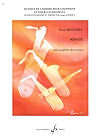
S761: Sonate Op. 18 for Alto Saxophone and Piano by Yvon Bourrel. Billaudot, 1967, SS, 23 + 8 pages. Yvon Bourrel (1932-) is a French composer and music educator. This piece will present some challenges to the college level performer with its frequent tempo changes and many accidentals (it is written without a key signature). Endurance may also be an issue in the first and last of its four movements. There is an online dissertation which focuses on this piece. You may listen to it on YouTube starting here.
|
19.95
|
|
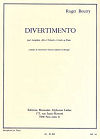
S165: Divertimento for Alto Saxophone and String Orchestra (Piano Reduction) by Roger Boutry. Leduc, 1964, SS, 13 + 6 pages. Dedicated to Marcel Mule and a contest piece for the French National Conservatoire. Bounty (1932-) a French composer, conductor, and pianist who unites numerous and diverse modern aesthetic trends in his work. In three movements: I. Allegro ma non troppo, II. Andante, and III. Presto. The second movement concludes with a long cadenza that leads to the third movement. Upper college level.
|
22.95
|
|
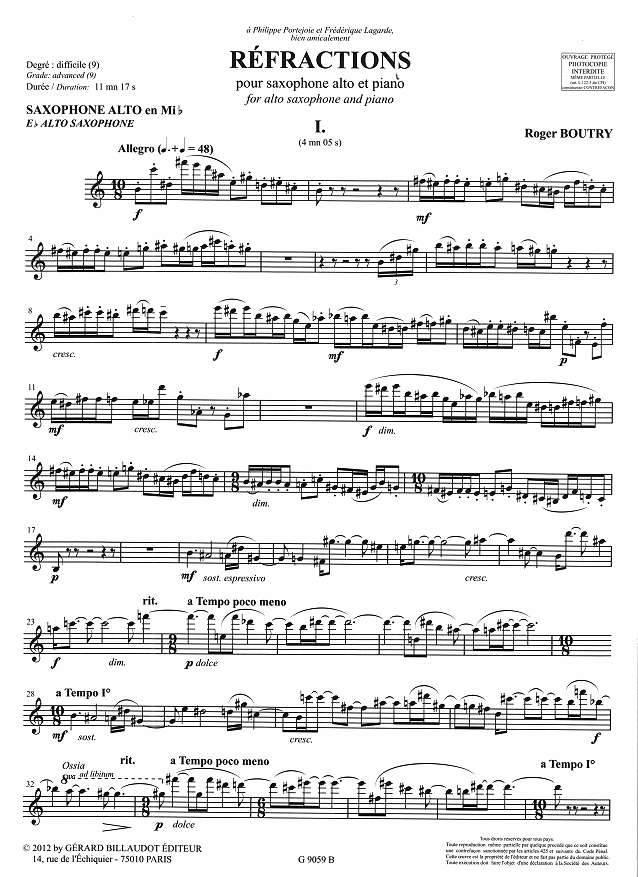
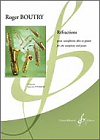
S899: Réfractions for Alto Saxophone and Piano by Roger Boutry. Billaudot, 2012, SS, 21 + 8 pages. A new work from Boutry. In three movements: I. Allegro, II. Andante, III. Allegro. Altissimo to B with Ossia for passages above F-sharp. Mixed meter also noted. This is rated a 9 on the publisher's 9 point difficulty scale. The duration is 11:17. Click on the cover image to view the first page of the saxophone part.
|
19.95
|
|
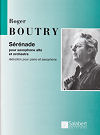
S434: Sérénade for Alto Saxophone and Orchestra (Piano Reduction) by Roger Boutry. Salabert, 1961, SS, 27 + 10 pages. Dedicated to Marcel Mule. In four movements: Introduction (Allegro moderato/Vivo), Divertissement (Allegro), Sérénade (Andante), and Final (Vivace). There is a long cadenza in the first movement and short ones throughout. Upper college level. |
31.95
|
|
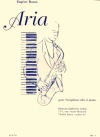
S144: Aria for Alto Saxophone and Piano by Eugène Bozza. Leduc, 1936, SS, 3 + 1 pages. Dedicated to Marcel Mule. A brief work Andante ma non troppo in 3/8. Early college level. Here is a recording on YouTube.
Free Media Mail shipping on this music to US, IF ordered with another item.
(Except other items with free shipping.)
|
14.95
|
|
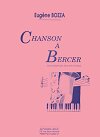
S824: Chanson A Bercer for Alto Saxophone and Piano by Eugène Bozza. Leduc, 1964, SS, 3 + 1 pages. A lyrical lullaby in 6/8 and marked Allegretto. Duration about 3:15. Probably late second year or early third year level. Here is a performance on YouTube.
Free Media Mail shipping on this music to US, IF ordered with another item.
(Except other items with free shipping.)
|
14.05
|
|
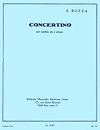
S160: Concertino for Alto Saxophone and Orchestra (Piano Reduction) by Eugène Bozza. Leduc, 1939, SS, 26 + 8 pages. Dedicated to Marcel Mule. An extended work in three movements: I. Fantasque et Léger, II. Andantino, and III. Tarentelle. The last movement has a written out cadenza. College level.
|
36.25
|
|
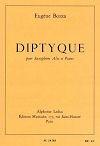
S145: Diptyque for Alto Saxophone and Piano by Eugène Bozza. Leduc, 1970, SS, 12 + 5 pages. Two movements, I - Andante and II - Final, both of which alternate between slower legato and rapid animated sections. College level. |
28.60
|
|
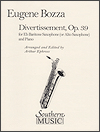
S819: Divertissement Op. 39 for Baritone Saxophone and Piano by Eugène Bozza arranged and edited by Arthur Ephross. Southern Music Company, 1939/1992, SS, 7 + 2 pages. This piece was originally written in 1939 for English horn or alto saxophone. Sectional: Lento, Moderato, Andantino and Allegretto scherzando. College level.
Free Media Mail shipping on this music to US, IF ordered with another item.
(Except other items with free shipping.)
|
6.95
|
|
S635: Fantaisie Italienne for Alto Saxophone and Piano by Eugene Bozza. Alphonse Leduc, 1946, SS, 8 + 3 pages. A sectional, one-movement work, beginning with a cadenza, followed by a quiet 6/8 section, and ending with a brilliant Allegro. An excellent piece for a college recital. |
22.95
|
|
S634: Fantaisie Italienne for Soprano Saxophone and Piano by Eugene Bozza transcribed by Gregoire Nicole. Alphonse Leduc, 1953/2006, SS, 10 + 4 pages. A sectional, one-movement work, beginning with a cadenza, followed by a quiet 6/8 section, and ending with a brilliant Allegro. An excellent piece for a college recital. |
19.95
|
|
S168: Impromptu et Danse for Alto Saxophone and Piano by Eugène Bozza. Leduc, 1954, SS, 7 + 3 pages. The Impromptu begins with a cadenza followed by an Andantino section and closes with another cadenza. The Danse is Allegro vivo in 2/8. College level.
Free Media Mail shipping on this music to US, IF ordered with another item.
(Except other items with free shipping.)
|
20.55
|
|
S608: Petite Gavotte for Alto Saxophone and Piano by Eugene Bozza. Leduc, 1964, SS, 3 + 1 pages. A short piece. The tempo is Andantino and it is at the intermediate level.
Free Media Mail shipping on this music to US, IF ordered with another item.
(Except other items with free shipping.)
|
13.50
|
|
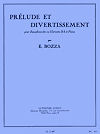
WW074: Prélude et Divertissement for Alto Saxophone or Clarinet and Piano by Eugene Bozza. Alphonse Leduc, 1960, SS, 5 + 2 pages (includes both alto saxophone and clarinet parts). The Prélude is at a tempo of Modéré (avec une grande tendresse) while the Divertissement is Allegro giocoso. College level. |
20.55
|
|
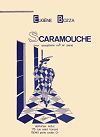
S520: Scaramouche for Alto Saxophone and Piano by Eugene Bozza. Alphonse Leduc, 1944, SS, 7 + 2 pages. This relatively short but challenging piece is dedicated to Marcel Mule. Allegro and in 6 sharps. |
20.55
|
|
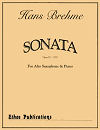
S378: Sonata Op. 25 for Alto Saxophone and Piano by Hans Brehme. Ethos Publications, 2006 SS, 36 + 10 pages. Hans Brehme (1904-1957) was a German composer and pianist who wrote this work at the request of Sigurd Rascher in 1932. He was one of the first composers to make extensive use of the altissimo register. This is the first publication of this work which performed by Rascher from the original and then a copied manuscript throughout his career. This is a scholarly edition with notes on the editing and definitions of the German language terms that appear in the score. The work is in three movements: I. Allegro con moto, II. Adagio, and III. Allegro. Advanced level.
|
29.95
|
|
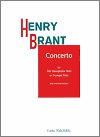
S153: Concerto for Alto Saxophone Solo or Trumpet Solo with nine instruments by Henry Brant. Carl Fischer, 1996, PB, 149 pages. Brant won the 2002 Pulitzer Prize in Music. This is a manuscript style score to this piece which was originally composed in 1941 with several revisions with the last in 1973. The saxophone and trumpet solos are not identical but have differences to suit the character of each instrument. In three movements: I. Prelude, II. Idyll, and III. Caprice. The accompanying instruments are flute, four B-flat clarinets, alto clarinet (bass clarinet alternate), bass clarinet, tuba, and one percussion. Parts are a rental.
|
39.95
|
|
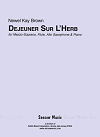
V058: Dejeuner Sur L'Herb for Mezzo-Soprano, Flute, Alto Saxophone and Piano by Newel Kay Brown. Seesaw Music, 1986, SS, includes instrumental parts and vocal-piano score. Newel Kay Brown (1932-) is a native of Salt Lake City, Utah where he first studied composition with Leroy Robertson at the University of Utah. Graduate degrees were undertaken at the University of California at Berkeley and Eastman School of Music where he completed his Ph.D. in Composition & Theory under Bernard Rogers, Howard Hanson, and Wayne Barlow. The vocal range is from the D just above middle C to B-flat above the staff. The instrumental parts are very important, with the flute part especially challenging. The saxophone part reaches altissimo G-sharp. College level with a duration of about 14 minutes.
|
29.95
|
|
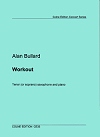
/ S572: Workout for Tenor (or Soprano) Saxophone and Piano by Alan Bullard. Colne Edition, 1997/2009, SS, 16 + 5 pages. Alan Bullard (1947-) was born in London and studied with Herbert Howells at the RCM and Arnold Whittall at Nottingham University. Workout, a single-movement work, is both a musical and technical "workout" and it was written for Alan's son, a professional saxophonist. College level with a duration of about 8:00. |
19.95
|
|
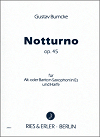
/ S916: Notturno Op. 45 for Alto or Baritone Saxophone in E-flat and Harp (Piano) by Gustav Bumcke. Ries & Erler, 1992, SS, 18 + 2 pages. Gustav Bumcke (1876-1963) was a German composer, conductor, and music educator who became very interested in the saxophone after meeting the son of Adolphe Sax in 1902. After a serious study of the instrument he established the first saxophone studio in Germany. This is at an Andante tempo with some tempo changes. It is not too difficult although it is in the key of E. A look at the score indicates that harp is clearly preferred to piano. Duration of about 6 minutes. Here is a performance with alto saxophone and here with baritone saxophone. Click on the cover image to view a sample page from the score. |
27.95
|
|
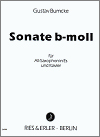
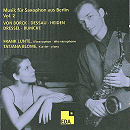
S441: Sonate b-moll (Sonata in B-flat minor) Op. 68 for Alto Saxophone and Piano by Gustav Bumcke. Ries & Erler, 1994, SS, 38 + 10 pages. This work was written in 1938 (by which time Bumcke was no longer permitted to teach saxophone) and is in a late-Romantic style and in the traditional sonata form. In three movements: I. Allegro appasionato, II. Sostento, III. Allegro molto. College level with a duration of about 16:45.
|
22.75
|
|
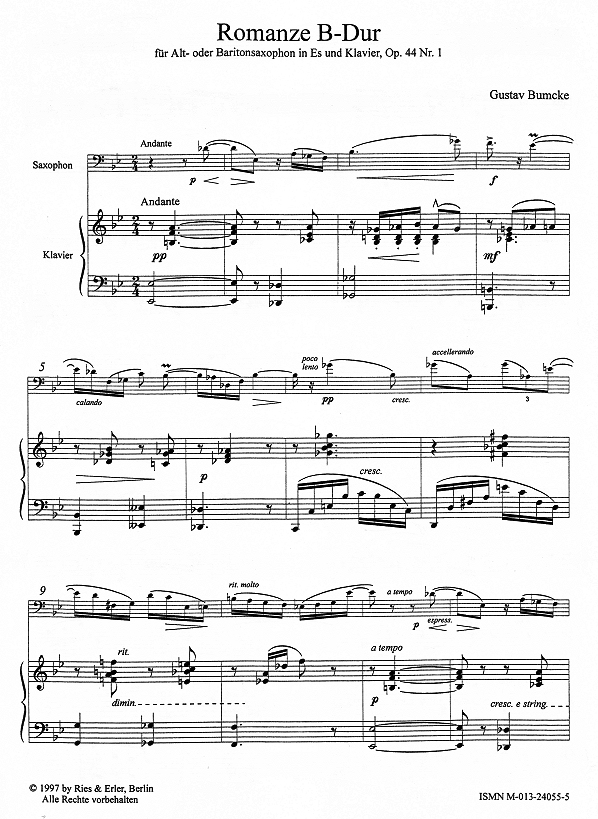
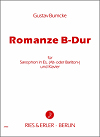
/ S917: Romanze B-Dur (B-flat major) Op. 44 No. 1 for Saxophone in E-flat and Piano by Gustav Bumcke. Ries & Erler, 1977, SS, 5 + 2 pages. This piece is marked Andante and has many small tempo changes. It is mostly in the upper register of the saxophone with a range to altissimo F-sharp. Click on the cover image to view the first page of the score.
Free Media Mail shipping on this music to US, IF ordered with another item.
(Except other items with free shipping.)
|
11.95
|
|
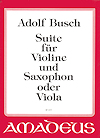
S1327: Suite for Violin and Saxophone or Viola for Alto Saxophone and Violin or Viola by Adolf Busch. Amadeus, 1988, SS. Adolf Busch (1891-1952) was a German violinist and conductor. A protégé of Max Reger, he became concertmaster of the Vienna Konzertverein at 20 and founded the legendary Busch Quartet after World War I. Although he was not Jewish, he was firmly opposed to Nazism and lived in Switzerland and finally the United States. This piece includes two copies or the score for violin and viola, and parts for both alto saxophone and clarinet. It is in four movements Praeludium, Sarabande, Gavotte, and Gigue. It is generally at the upper intermediate level, although the last movement is more difficult. Here is a recording.
|
20.95
|
|
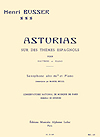
S1174: Asturias sur des Thèmes Espagnols for Alto Saxophone and Piano by Henri Busser transcribed by Marcel Mule. Alphonse Leduc, 1946, SS, 7 + 3 pages. This piece was originally for oboe and piano. It is sectional with two cadenzas. It utilizes most of the normal range of the saxophone. Here is one of several performances on YouTube.
Free Media Mail shipping on this music to US, IF ordered with another item.
(Except other items with free shipping.)
|
20.55
|
|
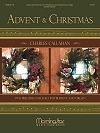
/ G282: Advent & Christmas: Two Preludes for Solo Instrument and Organ by Charles Callahan. MorningStar Music Publishers, 2014, SS, 10 + 4 pages. For solo treble instrument and organ, An Advent Prelude includes the tunes Veni Emmanuel and Conditor Alme Siderum. A Christmas Prelude includes the tunes Adeste Fideles, Stille Nacht, The First Noel, Divinum Mysterium, Es Ist Ein Ros, and Mendelssohn. Parts are included for both C (oboe or flute) and B-flat instruments (clarinet, soprano saxophone or possibly tenor saxophone.). Charles Callahan has written harmonically interesting music yet the solo parts are relatively easy (except for the key signatures which range up to six flats and five sharps). Click here to listen to an audio sample. Click on the cover image to view the score. |
11.95
|
|
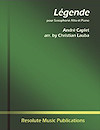
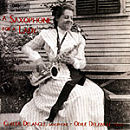
S563: Légende for Alto Saxophone and Piano by André Caplet arranged by Christian Lauba. Resolute Music Publications, 2013, SS, 23 + 8 pages. André Caplet (1878-1925) was a French composer and conductor now known primarily through his orchestrations of works by Claude Debussy, his friend and colleague. This work was commissioned by the American amateur saxophonist Elise Hall (1853-1924) who gave the first performance in 1905. After only one other performance it was not played again until rediscovered by Jean-Marie Londeix in the late 1980s. It is in one continuous movement with many tempo changes. High school or early college level with a duration of 12:00-13:30. Here is a performance.
|
27.50
|
|
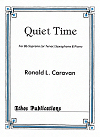
/ S609: Quite Time for Soprano (or Tenor) Saxophone and Piano by Ronald L. Caravan. Ethos Publications, 1980, SS, 3 + 2 pages. Ronald Caravan (1946-) is an American clarinetist, saxophonist, teacher, composer, and arranger. This is a slow, lyrical piece involving modal melodic material and some easy mixed meter. A highly expressive short work, appropriate for use in church music. Includes a saxophone cadenza before the DC. Intermediate level and up with a duration of about 4 minutes. |
11.25
|
|
/ S333: Soliloquy & Celebration for Soprano (or Tenor) Saxophone and Piano by Ronald L. Caravan. Ethos Publications, 1996, SS, 16 + 5 pages. This is subtitled "A tribute to the classic jazz saxophonist Paul Desmond (1925-1977). The Soliloquy at a tempo of quarter note = 66-72 is quite straight forward even though it is in 5/4. The Celebration is much more challenhging as it is mostly in 8/8 with a 3+3+2 pattern at a tempo of a dotted quarter note = 72-76. There is a cadenza in the middle of this movement. |
16.95
|
|
S816: Sonata for Soprano Saxophone and Piano by Ronald L. Caravan. Ethos Publications, 1984, SS, 22 + 7 pages. In four movements: I. Prologue (Declamatory, freely), II. Allegro, III. Song, and IV. Dance-Finale. The first movement is without bar lines with the piano playing background chords. The second movement has a cadenza with range to altissimo A (optional), The final movements are straight forward. Early college level with a duration of 12 minutes. From the composer's website: "This piece has become one of the most popular contemporary sonatas for soprano saxophone. Cast in four movements, the work exhibits a fresh approach to writing in the Dorian mode. Moderate difficulty, appropriate for advanced students." |
17.50
|
|
S836: Sonata for Tenor Saxophone and Piano by Ronald L. Caravan. Ethos Publications, 2007, SS, 23 + 7 pages. The Sonata for Tenor Saxophone is the fourth of the composer's melodically and harmonically conservative sonatas for members of the saxophone family. Like the others, its materials are predominantly modal with mild harmonic dissonance in the piano texture. The three movement work opens with a brief "recitative" introduction followed by the first movement allegro in 3/4. The middle movement is titled "Sentimental Song" and is dedicated to composer Walter S. Hartley. The third movement is a Rondo Giocoso in 6/8 meter. Altissimo spots are optional, and the piece is appropriate for advanced high school or college level students. Moderate difficulty; approx. 12 min. (From the composer's web site.)
|
16.50
|
|
S515: Latin American Dances for Alto Saxophone and Piano by John Carmichael. Emerson Edition, 2005, SS, 23 + 7 pages. John Carmichael (1930-) is an Australian born composer who studied in Paris and London. This piece stems from his seven years as director of a Spanish dance company. The four dances that comprise the suite are the Joropo from Venezuela and Colombia; Obsession - Habañera, a habañera from Havana; Bahama Rhumba from the Caribbean; Jongo a Brazilian dance. The piano part is vigorous, supportive and idiomatic. College level.
|
20.95
|
|
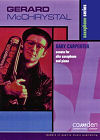
S278: Sonata for Alto Saxophone and Piano by Gary Carpenter. Camden Music, 1994, SS, 26 + 13 pages. This is a professional level piece written for and first performed by Gerard McChrystal by British composer Carpenter (1951-). In three movements I. Caprice (this starts slowly but doesn't take long to get moving), II. Chanson san Paroles (marked "Slow and dreamy - with a gentle 'swing' feel"), and III. Danse Macabre (marked "Tempo di Tango" and described as the dark side of a Chorino previously written by the composer).
|
34.95
|
|
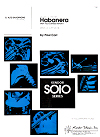
S529: Habanera (from "Four Comedy Dances") for Alto Saxophone and Piano by Paul Carr. Kendor Music, 2001, 12 + 2 pages. Paul Carr (1961-) is a British composer who has written extensively for wind instruments. "Seductively playful is an apt description, and the dialog between soloist and pianist is captivating. Perfect for contest or recital." This piece is rated by the publisher as (US) grade 5 and has a duration of about 3:40.
Free Media Mail shipping on this music to US, IF ordered with another item.
(Except other items with free shipping.)
|
9.50
|
|
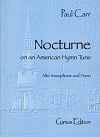
S623: Nocturne on an American Hymn Tune for Alto Saxophone and Piano by Paul Carr. Comus Edition, 1997, 2 + 1 pages. A short blues piece based on the hymn "Shall We Gather at the River"’ by Robert Lowry (1826-1899), the American Baptist minister and writer of gospel songs and hymns. Marked "Relaxed, and with a blues feeling" this piece will be enjoyed by better high school saxophonists and up.
Free Media Mail shipping on this music to US, IF ordered with another item.
(Except other items with free shipping.)
|
8.95
|
|
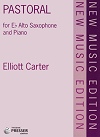
S856: Pastoral for Alto Saxophone and Piano by Elliot Carter. Merion Music, 1945/1982, SS, 14 + 4 pages. This piece by American composer Carter is sectional: Allegretto (5/8), Giocoso (2/4), Tempo I (5/8), Giocoso (2/4, mostly), and finally it goes back into 5/8 and accelerates almost to the end. College level with a duration of 12 minutes.
|
19.95
|
|
/ G258: Meditation for Solo Instrument and Organ by Cécile Chaminade arranged by Charles Callahan. MorningStar Music Publishers, 2008, SS, 7 + 2 pages. Cécile Chaminade (1857-1944) was a pioneering French woman composer. While she wrote mostly salon songs and character pieces for piano, she is probably best known today for her flute concertino. This piece was originally for piano (Op. 76, No. 6). Parts are included for Flute, Oboe, Violin, Viola and instruments in B-flat (clarinet, soprano saxophone or possibly tenor saxophone.) Here is a YouTube video of this arrangement being performed with flute and organ.
Free Media Mail shipping on this music to US, IF ordered with another item.
(Except other items with free shipping.)
|
10.95
|
|
S166: Gavambodi 2 for Alto Saxophone and Piano by Jacques Charpentier. Leduc, 1969, SS, 10 + 3 pages. Chapentier (1933-) studied Indian music (in Indian) before attending the Paris Conservatoire where he studied composition with Aubin and Messiaen. This piece is based on the Indian Carnatic mode number 43.
|
22.95
|
|

S1291: Six Preludes for Alto Saxophone and Piano by Stephen Chatman. GalaxyMusic, 2018, SS, 21 + 9 pages. Stephen Chatman (1950-) is an American born Canadian composer. The six preludes are entitled: I. Moonlight, II. Labyrinth, III. Crimson, IV. Joy, V. Silence, and VI. Frenzy. The even numbered preludes are slow while the odd numbered movements are quite fast and challenging. The overall duration is about 8:30. Click on the cover image to view sample pages from the score. |
17.95
|
|
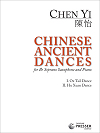
S685: Chinese Ancient Dances for Soprano Saxophone and Piano by Chen Yi. Theodore Presser, 2006/2011, SS, 12 + 4 pages. Chen Yi (1953-) was born in China and educated there and in the United States (DMA from Columbia University). This work was originally for clarinet, but with a few octave adjustments it will work nicely for saxophone. There are two dances: I Ox Tail Dance (which has a slow tempo but many 5,6,7, and 9-tuplets) and II. Hu Xuan Dance (Lively). An advanced work for both performers. Duration about 8 minutes.
Free Media Mail shipping on this music to US, IF ordered with another item.
(Except other items with free shipping.)
|
15.95
|
|
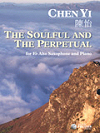
S944: The Soulful and the Perpetual for Alto Saxophone and Piano by Chen Yi. Theodore Presser, 2013, SS, 18 + 6 pages. A commission by Jessica Heller Knopf resulted in the new Chen Yi concert work for alto saxophone in two diametrically opposed movements. “The Soulful” is lyrical with moving and gripping melodies, while “The Perpetual” uses perpetual motion to symbolize consistence and perseverance. Knopf gave the premiere at the 2012 World Saxophone Congress and the performance is available on YouTube. Altissimo to B. For advanced performers with a duration of about 9:30. Click on the cover image to view the first pages of the score. |
14.95
|
|
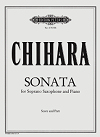
S692: Sonata for Soprano Saxophone and Piano by Paul Chihara. C.F. Peters, 1996, SS, 27 + 13 pages. Paul Chihara (1938-) is an American composer who has written for a wide range of genres including film and television. In two movements: I. Allegro Amabile, II. Senza Tempo (con fantasia) with many tempo changes within each movement. The saxophone part has been edited by Harvey Pittel. College level with a duration of about 12 minutes. |
26.25
|
|
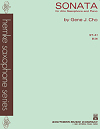
S791: Sonata for Alto Saxophone and Piano by Gene J. Cho. Southern Music Co., 1973, SS, 11 + 4 pages. Gene J. Cho is a professor of music theory and ethnomusicology who was educated in Taiwan and the United States. This piece has seven movements (some are very brief): Largo, Allegretto, Presto, Andantino, Adagio, and Molto Allegro, and Allegro. College level (US grade 6).
Free Media Mail shipping on this music to US, IF ordered with another item.
(Except other items with free shipping.)
|
5.00
|
|
S356: Largo Op. 65 by Frederic Chopin transcribed for Alto Saxophone and Piano by Eugene Rousseau. Etoile Music/MMB Music, 1969, 3 + 1 pages. This brief (1:30) piece is from a cello sonata. It is at the intermediate level with some written out turns and a range to altissimo E.
Free Media Mail shipping on this music to US, IF ordered with another item.
(Except other items with free shipping.)
|
9.95
|
|
S683: Concertante for Alto Saxophone and Orchestra (Piano Reduction) by Marius Constant. Ricordi, 1977, SS, 30 + 13 pages. Marius Constant (1925-2004) was a Romanian born French composer and conductor known primarily for his television soundtracks. This is an advanced piece using many extended techniques including fractional tones, multiphonics, harmonics, and others. Includes three pages of performances suggestions by Jean-Marie Londeix. In three movements: 1. Raga, 2. Tempo di Cake-walk, and 3. Passacaglia.
|
27.95
|
|
S785: Musique de Concert for Alto Saxophone and Orchestra (Piano Reduction) by Marius Constant. Leduc, 1954, SS, 15 + 4 pages. Dedicated to Marcel Mule, this was a Concours du Conservatoire National de Musique piece. It is an advanced work in five movements: I. Toccata (Lento/Vivo), II. Aria (Largo), III. Ostinato (Allegro molto), IV. Intermezzo (Allegro moderato), and V. Variazioni (Deciso). Unlike the more recent piece above, this work does not use any extended techniques and has a range to altissimo F-sharp. Duration of about 9 minutes. Here is an audio recording in two parts: I-III and IV-V.
|
27.20
|
|
S1206: Three Latin Sketches for Alto Saxophone and Piano by Mike Cornick. Universal Edition, 2016, SS, 12 + 4 pages. A concert work of decidedly Latin flavor, Cornick's Three Latin Sketches has three-movements in which the up-tempo outer movements (Allegro vigoroso with a Latin feel and Allegro) embrace a sultry tango (Moderato) middle movement. Suggested for better high school/early college level performers. Dedicatee Mark Walton has provided YouTube performances of each movement (1, 2, and 3). Click on the cover image to view the saxophone part for the first movement. |
22.95
|
|
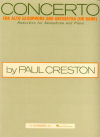
S189: Concerto Op. 26 for Alto Saxophone and Orchestra (or Band) Piano Reduction by Paul Creston. G. Schirmer, 1966, 42 + 12 pages. Paul Creston (born Giuseppe Guttoveggio; 1906-1985) was an Italian American composer. In three movements: I. Energetic, II. Meditative, and III. Rhythmic. Advanced college level.
|
19.95
|
|
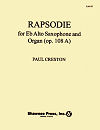
S425: Rapsodie for E-flat Alto Saxophone and Organ Op. 108A by Paul Creston. Shawnee Press, 1978, 24 + 6 pages. This is the original version of this piece which was commissioned, and premiered by Jean-Marie Londeix at the World Saxophone Congress of 1976 in London. An advanced work with a duration of about 10 minutes. Here is a video of this version.
|
15.95
|
|
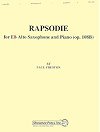
S095: Rapsodie for E-flat Alto Saxophone and Piano Op. 108B by Paul Creston. Shawnee Press, 1978, 18 + 6 pages. Commissioned, and premiered by Jean-Marie Londeix at the World Saxophone Congress of 1976 in London as a work for saxophone and organ. This is the version with piano. An advanced work with a duration of about 10 minutes. |
14.95
|
|
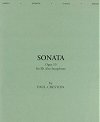
S080: Sonata Op. 19 for E-flat Alto Saxophone and Piano by Paul Creston. Shawnee Press, 1945, 35 + 11 pages. In three movements: With vigor, With tranquility, and With gaiety.
|
21.95
|
|
S767: Trigon Op. 31 for Tenor Saxophone and Piano by Michael Cunningham. Lauren Keiser Music Publishing, 1970, SS, 14 + 4 pages. Dedicated to James Houlik. A college level work in three movements: I. Constant Driving Rhythm, II. Quiet and Calm, and III. Quite Fast. A printed manuscript with the music a bit on the small side. We found this video which has some balance issues.
|
29.95
|
|
S122: Concerto for Alto Saxophone and Wind Ensemble (1949/1953) Piano Reduction by Ingolf Dahl edited by Harvey Pittel. European American Music, 1979, 34 + 14 pages. One of the most famous pieces in the saxophone repertoire. It was intended by the composer that this piano reduction could be used for performance as well as preparation for playing the Concerto with a wind ensemble. Many notes by the editor to aid in performance. We also have the book The Original 1949 Saxophone Concerto of Ingolf Dahl by Paul M. Cohen.
|
22.95
|
|
S270: Kleine Suite for Alto Saxophone and Piano by Fridolin Dallinger. Doblinger, 1990, SS, 8 + 2 pages. Fridolin Dallinger (1933-) is an Austrian composer, pianist, music educator and critic. This is a an intermediate level work in three movements: I. Marsch, II. Langsamer Walzer, and III. Polka. Duration is about 4 minuets and the piano part is not difficult.
Free Media Mail shipping on this music to US, IF ordered with another item.
(Except other items with free shipping.)
|
12.95
|
|
S613: Aria et Valse Jazz for Alto Saxophone and Piano by François Daneels. Schott, 1986, SS, 4 + 2 pages. François Daneels (1921-) is a Belgian saxophonist, composer and music educator. The Aria is at a Moderato tempo. The Jazz Waltz is in 3/8 with a rapid tempo of mm=176 to the bar and many sixteenth notes. The piano is in an accompanying role. Total duration of about 3:15.
Free Media Mail shipping on this music to US, IF ordered with another item.
(Except other items with free shipping.)
|
11.95
|
|
S776: Rêverie Interrompue for Alto Saxophone and Piano by Marcel Dautremer. Leduc, 1954, SS, 4 + 1 pages. Marcel Dautremer (1906-1978) was a French composer (a student of Dukas) and conductor. This is a brief (4 minute) piece which begins Lent et paisible, speeds up a bit in the middle (undoubtedly the interrupted reverie of the title) and returns to the original tempo before the end. Better high school level performers and up.
Free Media Mail shipping on this music to US, IF ordered with another item.
(Except other items with free shipping.)
|
13.50
|
|
S777: Tango et Tarentelle for Alto Saxophone and Piano by Marcel Dautremer. Leduc, 1946, SS, 15 + 6 pages. Dedicated to Marcel Mule, this was a Concours du Conservatoire National de Musique de Paris piece. The tango is at a Calme et nostalgique tempo and ends with a cadenza. It is immediately followed by the Tarentelle which has a slower section in the middle. An advanced work.
|
32.30
|
|
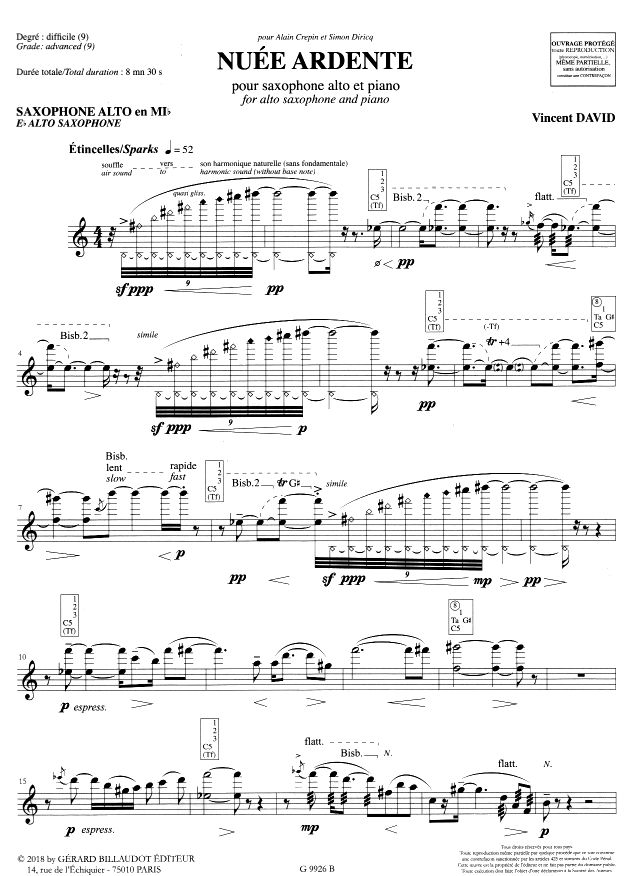
S1280: Nuée Ardente for Alto Saxophone and Piano by Vincent David. Billaudot, 2018, SS, 22 + 11 pages. This is an advanced contemporary piece featuring high altissimo, multiphonics, double-tonguing, flutter-tonguing and other techniques. It has a duration of 8:30. It is a compulsory work for the first round of the 7th International Adolphe Sax Competition, Dinant - 2019 (Belgium). A nuée ardente is a turbulent, fast moving cloud of hot gas and ash erupted from a volcano. Click on the cover image to view the first page of the saxophone part. |
28.95
|

|
S896: Beau Soir (Beautiful Evening) for Tenor Saxophone and Piano by Claude Debussy arranged by Eugene Rousseau. Etoile Music/Keiser Classical, 1980, SS, 3 + 1 pages. This work was written for voice and piano around 1883. It is nearly all in the upper register (to altissimo E). While it is not at all difficult, the video shows how effective it can be in the hands of a professional. Here is a video performance by Eugene Rousseau.
Free Media Mail shipping on this music to US, IF ordered with another item.
(Except other items with free shipping.)
|
15.95
|
|
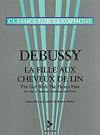
/ S1229: La Fille aux Cheveux de Lin by Claude Debussy arranged for Alto or Baritone Saxophone and Piano by Ramon Ricker. Advance Music, 1996, SS, 2 + 1 pages. This beautiful piece, also known as The Girl with the Flaxen Hair, has been arranged for alto or baritone saxophone. Click on the cover image to view the first page of the score.
Free Media Mail shipping on this music to US, IF ordered with another item.
(Except other items with free shipping.)
|
13.95
|
|
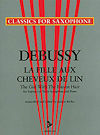
/ S1228: La Fille aux Cheveux de Lin by Claude Debussy arranged for Soprano or Tenor Saxophone and Piano by Ramon Ricker. Advance Music, 1996, SS, 2 + 1 pages. This beautiful piece, also known as The Girl with the Flaxen Hair, has been arranged for soprano or tenor saxophone. Here is a performance on soprano which sounds like this arrangement. Click on the cover image to view the first page of the score.
Free Media Mail shipping on this music to US, IF ordered with another item.
(Except other items with free shipping.)
|
12.95
|
|
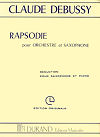
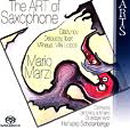
S190: Rapsodie for Orchestra and (Alto) Saxophone Piano Reduction by Claude Debussy. Durand, 1919, SS, 15 + 3 pages. Debussy composed this piece in accordance with wishes of Elise Hall (president of the Orchestral Club of Boston) to whom the work is dedicated and completed it in January 1904. Early college level. About 10 minutes in length. We can get the orchestral parts and score for this piece. Contact us for details.
|
16.95
|
|
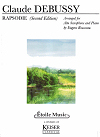
S355: Rapsodie for Saxophone by Claude Debussy arranged for saxophone and piano by Eugene Rousseau. Etoile Music/MMB Music, 1975, SS, 23 + 4 pages. Since the original version of this piece was not written for a saxophone virtuoso, Rousseau has turned this work into more of a showpiece by assigning solos written for other instruments to the saxophone. It can be used with the original orchestral parts, provided that the conductor designates the orchestral part be tacet when appropriate. College level. We can get the orchestral parts and score for this piece. Contact us for details.
|
19.95
|
|
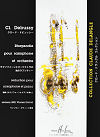
S409: Rapsodie for Saxophone and Orchestra (Piano Reduction) by Claude Debussy edited by Vincent David. Editions Henry Lemoine, 1998, SS, 24 + 7 pages. This edition is similar in concept (but not identical) to the Rousseau edition above. The saxophone part is larger and easier to read. College level. We can get orchestral parts and the score for this piece. Contact us for details. |
21.95
|
|
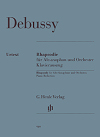
S713: Rhapsody for Saxophone and Orchestra (Piano Reduction) by Claude Debussy edited by Ernst-Günter Heinemann, piano reduction by Jang Eun Bae with supplementary arranged alto saxophone part by Daniel Gauthier. Henle, 2010, SS. A new edition which includes a preface and comments. Two solo parts are supplied with the edition: one version which follows the instrumental instructions of the autograph, and another one in which the saxophone also adopts material from parts assigned to other instruments (similar to the two editions above). College level. |
26.95
|
|
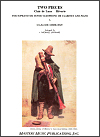
/ C1244: Two Pieces: Clair de Lune and Rêverie for Soprano or Tenor Saxophone or Clarinet and Piano by Claude Debussy arranged by J. Michael Leonard. Masters Music, 2008, 12 + 3 pages. Two popular Debussy pieces arranged for clarinet or saxophone and piano.
|
6.95
|
|
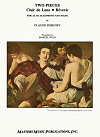
S443: Two Pieces: Clair de Lune and Rêverie for Alto Saxophone and Piano by Claude Debussy transcribed by Marcel Mule. Masters Music, SS, 12 + 2 pages. Two popular Debussy pieces transcribed for alto saxophone and piano. (This appears to be a copy of a Leduc printing.)
Free Media Mail shipping on this music to US, IF ordered with another item.
(Except other items with free shipping.)
|
5.95
|
|
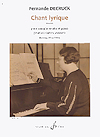
S1349: Chant Lyrique for Alto Saxophone and Piano by Frenande Decruck revised by Marcel Mule. Billaudot, 2019, SS, 11 + 4 pages. Chant Lyrique Op. 69 for saxophone and piano was finished on February 6, 1932. It was composed for François Combelle, solo saxophonist of the Garde Républicaine. Chant Lyrique was so popular, that Decruck created multiple versions. The work was significant as it marked the first time a female composer’s composition entered into the repertoire of the Garde Républicaine. Chant Lyrique was used for many years as an audition piece for the Garde Républicaine. It was such a successful piece that Decruck orchestrated it for Marcel Mule. Here is a video.
|
14.95
|
|
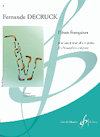
S1351: Pièces Françaises for Alto Saxophone and Piano by Frenande Decruck. Billaudot, 2043, SS, 44 + 14 pages. This piece includes 8 pieces. Tambourin, Vieux calvaire, Villageoise, Forlane, L'horloge, Rondel, Rigaudon and Toccata. It is rated advanced (7-8) on the publisher's 9 point scale.
|
29.95
|
|
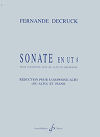
S366: Sonate in C Sharp for Saxophone (or Viola) and Orchestra Piano Reduction by Frenande Decruck. Billaudot, SS, 28 + 9 pages (includes viola part). Dedicate to Marcel Mule and written around 1943. In four movements: 1. Très modéré, expressif, 2. Andante, 3. Fileuse (Lègèrement animè) and 4. Nocturne et Final (Calme, très modéré). This is an excellent work for the college level and professional performer, perhaps not as well known as it should be. Duration of about 13:30. The first movement of this piece was required for the semifinals of the North American Saxophone Alliance 2012 Classical Saxophone Competition.
|
27.95
|
|
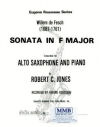
S358: Sonata in F Major by Willem De Fesch transcribed for Alto Saxophone and piano by Robert C. Jones. Etoile Music/MMB Music, 1970, SS, 11 + 4 pages. Willem De Fesch (1687-1761) was a Dutch virtuoso violinist and composer. This piece is in four movements: Preludio (Largo), Allemanda (Allegro), Sarabanda (Largo), and Minuetto (Con grazia). Upper intermediate level.
Free Media Mail shipping on this music to US, IF ordered with another item.
(Except other items with free shipping.)
|
9.95
|
|
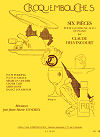
S394: Croquembouches for Alto Saxophone and Piano by Claude Delvincourt edited by Jean Marie Londeix. Alphonse Leduc, 1946, SS, 23 + 10 pages. Music about food, mostly deserts! Claude Delvincourt (1888-1954) was a French composer who was director of the Paris Conservatoire from 1941-1954. There are six pieces, generally at the upper intermediate level: Plum Pudding (Allegro moderato), Puits D'Amour (Lent sans excès), Nègre en Chemise (Andante non troppo lento), Linzer Tart (Allegro non troppo - movement de valse), Grenadine (Allegretto - mouvement de habanera), and Rahat Loukhoum (Très tranquillment).
|
44.70
|
|
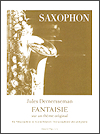
S1308: Fantaisie sur un Theme Original for Alto Saxophone and Piano by Jules Demersseman arranged by Iwan Roth. Hug & Co., 1988 revised 2010, SS, 14 + 5. This is one of a number of pieces the composer wrote for Adolphe Sax's new instrument.
|
27.95
|
|
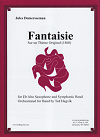
S490a: Fantaisie sur un Theme Original for Alto Saxophone and Symphonic Band by Jules Demersseman orchestrated by Ted Hegvik. Et Cetera Productions, 2009, includes all parts (including the solo part) and score + CD. Here is a version for soloist and concert band. It should be playable by an excellent high school band or a strong community band as well as college bands. Instrumentation is generally standard but calls for three trumpets (no cornets), three horns, and a harp. There are enough copies of each individual part for most organizations. Includes a CD of a performance of this arrangement by Ted Hegvik with band. Here is a video of a performance of Ted Hegvik performing this piece with the New Holland Band. We have one last copy of this arrangement for band.
|
109.95
|
|
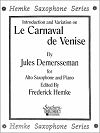
S373: Introduction and Variations of Le Carnaval de Venise for Alto Saxophone and Piano by Jules Demersseman edited by Frederick Hemke. Southern Music, 1986, SS, 12 + 7 pages. This is a showpiece of the first order complete with a final variation to be played as fast as possible. A band accompaniment is available from the publishers as a rental. |
14.95
|
|
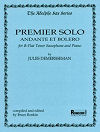
S233: Premier Solo Andante et Bolero for Tenor Saxophone and Piano by Jules Demersseman edited by Bruce Ronkin. Roncorp, 1987, SS, 8 + 3 pages. This piece by flute virtuoso and composer Demersseman was originally published by Adolphe Sax's publishing house in 1866 when it was used as a Paris Conservatory contest piece. College level. Duration about 4 minutes.
Free Media Mail shipping on this music to US, IF ordered with another item.
(Except other items with free shipping.)
|
15.95
|
|
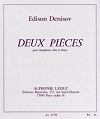
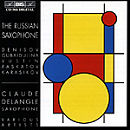
S161: Deux Pièces (Two Pieces) for Alto Saxophone and Piano by Edison Denisov. Leduc, 1978, SS, 9 + 3 pages. The first piece uses extended techniques (quarter tones in particular) and has no bar lines while the second piece is all about variations in the 16th note rhythm. |
22.95
|
|
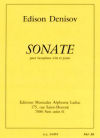
S155: Sonate for Alto Saxophone and Piano by Edison Denisov. Leduc, 1973, SS, 34 + 13 pages. Dedicated to Jean-Marie Londeix. The Siberian born composer Edison Denisov (1929-1996) was one of the most innovative Russian composers of his generation. Much of his woodwind music employs extended techniques as does the second movement of this sonata. This is an advanced work in three movements: I. Allegro, II. Lento, and III. Allegro moderato.
|
64.30
|

|
S147: Prelude, Cadence et Finale for Alto Saxophone and Piano by Alfred Desenclos. Leduc, 1956, SS, 15 + 6 pages. Dedicated to Marcel Mule and a contest piece at the National Conservatory. A wonderful composition from Desenclos (1912-1971) who wrote very little music because he thought his music wasn't good enough. As Mule wrote, this piece proves the contrary. It opens with the Prelude which is dark and jazz influenced. The Cadence is built primarily on rapid arpeggios and is followed by a transitional piano section leading into the Finale which begins rapidly but alternates between sections similar to the beginning before accelerating again to the conclusion. The piano part is very important and requires a skilled player. Advanced level. This piece is required for the preliminary round of the North American Saxophone Alliance 2012 Classical Saxophone Competition.
|
34.95
|
|
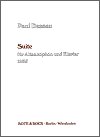
S442: Suite for Alto Saxophone and Piano by Paul Dessau. Bote & Bock, 1989, SS, 13 + 4 pages. Paul Dessau (1894-1979) was a German composer and conductor who lived in France in the mid-1930s (when this piece was written in 1935) and then the United States returning to Germany after the war. In three movements: I. Petite Ouverture (Allegro non troppo). II. Air (Andante un poco mosso), and III. Serenade (Allegretto mosso). College level with a duration of about 7:15.
|
22.95
|
|
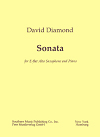
S783: Sonata for Alto Saxophone and Piano by David Diamond. Peer Music (originally Southern Music Co.), 1993, SS, 22 + 7 pages. David Diamond (1915-2005) was an American composer of classical music. This work dates from 1984. It is an advanced piece in three movements: I. Allegro vivo; II. Andante molto, quasi adagio; and III. Allegro vivo. The primary challenges are mixed meter and (even with the Ossias for some difficult passages) altissimo to at least B-flat.
|
15.95
|
|
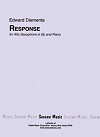
S774: Response for Alto Saxophone and Piano by Edward Diemente. Seesaw Music/Subito Music Corp., 1970, SS, 14 + 3 pages. Edward Diemente (1923-) is an American composer who taught at the Hartt School of Music for many years. It has been printed from a manuscript. It is in two sections Very Slowly (begins in 7/4 then 4/4) and Fast (mostly in 5/4). The piece has some contemporary notation but no extended technique. College level.
Free Media Mail shipping on this music to US, IF ordered with another item.
(Except other items with free shipping.)
|
17.95
|
|
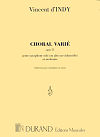
S191: Choral Varié Op. 55 for Alto Saxophone and Orchestra Piano Reduction by Vincent d'Indy. Durand, 1903, SS, 11 + 3 pages. This piece was commissioned by Elise Hall who premiered it in 1904. The solo part is not difficult.
Free Media Mail shipping on this music to US, IF ordered with another item.
(Except other items with free shipping.)
|
17.95
|
|
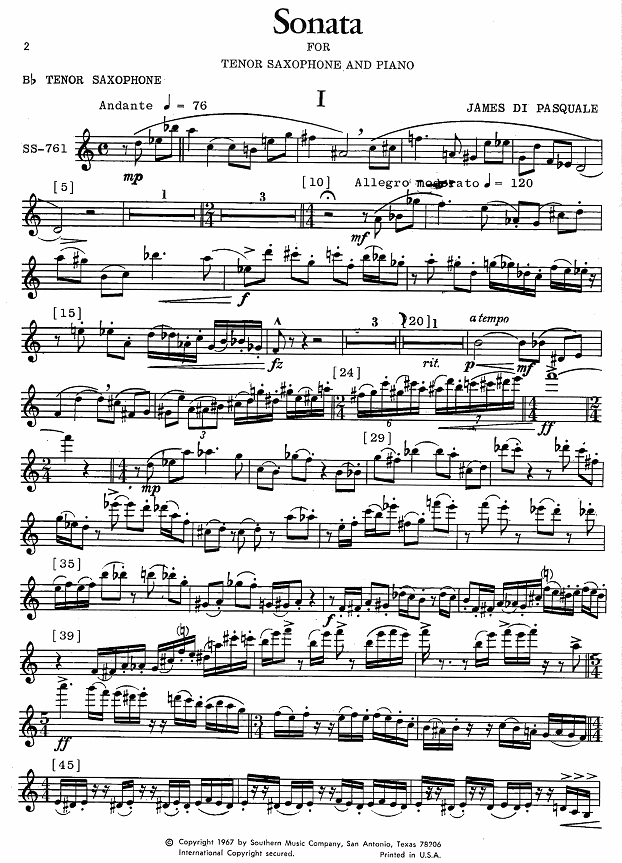
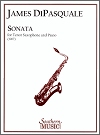
S220: Sonata for Tenor Saxophone and Piano by James Di Pasquale. Southern Music Co. 1967, SS, 17 + 7 pages. James Di Pasquale (1941-) is an American musician and composer who has written contemporary classical music and for television and film. This is one of his better known compositions which has been recorded several times. It is in three movements: I. Andante/Allegro moderato, II Adagio non troppo, and III. Allegro con brio. Advanced college level with once instance of altissimo A and G. Here is a performance on YouTube. Click on the cover image to see the first page of the saxophone part. |
16.95
|
|
/ S801: Sonata for Soprano or Tenor Saxophone and Piano by Bill Dobbins. Advance Music, 1991, SS, 32 + 8 pages. Composer Bill Dobbins is Professor of Jazz Studies and Contemporary Media at Eastman. This is a jazz concerto in a classical format that will requite both jazz chops and classical skills from both performers. Each perfomer has improvised solos from chord symbols in each of the three movements. Includes notes on the piece and improvisation strategy suggestions. Here is a link to an audio file of the first movement played on soprano sax on YouTube (the other movements are there, too). Click on the cover image to see the first page of the saxophone part (some of the written out parts are more difficult than this page).
|
21.95
|
|
S908: Polka Party for Alto Saxophone and Piano by Donald Draganski. Ally Publications, 2012, SS, 19 + 7 pages. Donald Draganski (1936-) is from Chicago where he worked for many years as a university music librarian in addition to being a composer and a bassoonist. This little suite of polkas was written as a result of the composer attending countless Polish weddings as a kid. A very humorous collection of some very charming polkas. In three movements: I. Polka Galop (Allegro moderato), II. Polka Elegante (Moderato/Piu mosso), and III. Polka Schnell (Lively). Early college level with a duration of 10 minutes. |
18.95
|
|
S360: Hungarian Dances from Transylvania for Alto Saxophone and Piano by László Draskóczy. EditionDarok, 1992, SS, 8 + 3 pages. This is a Verbunk, the recruiting dance performed by men. It opens with a cadenza followed by a 4/4 Verbunk and a 2/4 Vivace. While the notes and rhythms are not difficult the rapid tempo necessary for an authentic performance makes this an advanced piece.
Free Media Mail shipping on this music to US, IF ordered with another item.
(Except other items with free shipping.)
|
21.95
|
|
S438: Bagatellen for Alto Saxophone and Piano by Erwin Dressel. Ries & Erler, 1938, SS, 10 + 4 pages. Erwin Dressel (1909-1972) was a German composer. This piece is in four movements: Elegie, Scherzo, Aria, and Gigue. Early college level work with a duration of about 12 minutes.
Free Media Mail shipping on this music to US, IF ordered with another item.
(Except other items with free shipping.)
|
12.95
|
|
S440: Partita for Alto Saxophone and Piano by Erwin Dressel. Ries & Erler, 1965, SS, 19 + 7 pages. This piece is dedicated to Sigurd Rascher. In four movements: I. Prélude-Allemande (Moderator con moto), II. Canzone (Lento), III. Courante (Allegro), IV. Pavane (Sostenuto), and V. Gigue (Vivo e leggiero). A college level work with some high altissimo. The duration is about 18:30.
|
22.95
|
|
S439: Sonate Op. 26 for Alto Saxophone and Piano by Erwin Dressel. Ries & Erler, 1997, SS, 45 + 14 pages. This piece was written in 1932 and is reported to have been dedicated to Sigurd Rascher. In four movements: I. Moderato e contabile, II. Intermezzo (Alla marcia, con grazio), III. Adagio ma non troppo and IV. Allegro molto spirituoso. A college level work with a duration of about 14:15.
|
26.50
|
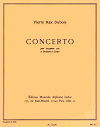
|
S148: Concerto for Alto Saxophone and String Orchestra (Piano Reduction) by Pierre Max Dubois. Leduc, 1959, SS, 22 + 11 pages. Dedicated to Jean-Marie Londeix. In three movements: I. Lento espressivo/Allegro, II. Sarabande (Lento nostalgico), and III. Rondo (Allegretto). The first movement includes a long (and written out) cadenza between the two sections. Advanced playing skills and endurance required. Click on the cover image to view the first page of the score.
|
44.70
|
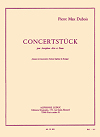
|
S645: Concertstück for Alto Saxophone and Piano by Pierre Max Dubois. Leduc, 1955, SS, 13 + 4 pages. In two movements: I. Aria (Andante) and II. Allegro vigoroso e marcato. The opening movement is in three parts (slow, faster, slow) and is polytonal in character. The final movement features rapid ascending and descending figures. The notes on the CD describe it as "a play of colors in a relaxed atmosphere." This would probably be good material for an upper division college recital. About 9 minutes.
|
28.60
|
|
S152: Divertissement for Alto Saxophone and Orchestra (Piano Reduction) by Pierre Max Dubois. Leduc, 1953, SS, 19 + 4 pages. Dedicated to Marcel Mule. In three movements: I. Allegro vivo, II. Lent et doux, and III. Scherzando. Upper college level.
|
31.65
|
|
S169: Dix Figures a Danser for Alto Saxophone and Piano by Pierre Max Dubois. Leduc, 1962, SS, 12 + 5 pages. Ten short dances. High school level but should be enjoyable to more advanced players as well.
|
28.30
|
|
S422: Les Écureuils for Alto Saxophone and Piano by Pierre Max Dubois. Durand, 2 + 1 pages. The Squirrels, a bright reel. Early college level (depending on tempo). About 1 minute long.
Free Media Mail shipping on this music to US, IF ordered with another item.
(Except other items with free shipping.)
|
8.95
|
|
S455: A L'Espagnole (#1 from Pieces caracteristiques en forme de suite) for Alto Saxophone and Piano by Pierre Max Dubois. Alphonse Leduc, 1962, SS, 7 + 3 pages. This is the first in a suite of five pieces with geographical connections. Early college level with a middle section in 7/8. Duration about 3:30.
Free Media Mail shipping on this music to US, IF ordered with another item.
(Except other items with free shipping.)
|
20.55
|
|
S792: A La Russe (#2 from Pieces caracteristiques en forme de suite) for Alto Saxophone and Piano by Pierre Max Dubois. Alphonse Leduc, 1962, SS, 3 + 1 pages. This piece alternates between Pesante and Allegro molto vivo. Early college level with a duration about 2:30.
Free Media Mail shipping on this music to US, IF ordered with another item.
(Except other items with free shipping.)
|
14.20
|
|
S793: A La Française (#3 from Pieces caracteristiques en forme de suite) for Alto Saxophone and Piano by Pierre Max Dubois. Alphonse Leduc, 1962, SS, 5 + 2 pages. This piece is marked Andante simplice. Better high school saxophonists and up. Not very difficult although there is some mixed meter (including 5/8) and a range to altissimo F. Duration of about 4:15.
Free Media Mail shipping on this music to US, IF ordered with another item.
(Except other items with free shipping.)
|
16.20
|
|
S794: A La Hongroise (#4 from Pieces caracteristiques en forme de suite) for Alto Saxophone and Piano by Pierre Max Dubois. Alphonse Leduc, 1962, SS, 6 + 3 pages. The tempos in this piece are Molto vivace/Lento/Molto vivace (Tempo 1). College level with a duration of 2:30.
Free Media Mail shipping on this music to US, IF ordered with another item.
(Except other items with free shipping.)
|
20.55
|
|
S795: A La Parisienne (#5 from Pieces caracteristiques en forme de suite) for Alto Saxophone and Piano by Pierre Max Dubois. Alphonse Leduc, 1962, SS, 7 + 3 pages. This piece starts out Prestissimo and speeds up twice until near the end where it returns to the original tempo. College level with a duration of 3:00.
Free Media Mail shipping on this music to US, IF ordered with another item.
(Except other items with free shipping.)
|
20.55
|
|
S420: Le Lièvre et la Tortue Impromptu for Alto Saxophone and Piano by Pierre Max Dubois. Alphonse Leduc, 1957, SS, 9 + 3 pages. This is The Hare and the Tortoise and as the title suggests it has contrasting sections (but appears to be mostly about the hare). College level with a duration of 5-7 minutes.
|
22.70
|
|
S151: Sonate for Alto Saxophone and Piano by Pierre Max Dubois. Leduc, 1956, SS, 21 + 8 pages. Dedicated to Daniel Deffayet. Four movements: I. Allegro vivo, II. Andante, III. Tempo di Gavotto, and IV. Rondo (Giocoso). College level.
|
38.55
|
|
S646: Sonatine for Alto Saxophone and Piano by Pierre Max Dubois. Leduc, 1966, SS, 12 + 7 pages. Dedicated to François Daneels, this was written for the Concours du Conservatoire Royal de Musique de Bruxelles. The movements are: I. Allegro vivo, II. Andante, III. Allegretto/Prestissimo. The first movement begins with a recitatif section with alternating slow and fast phrases before the Allegro vivo. College level with a duration of about 8 minutes.
|
28.30
|
|
S370: Alla Gitana for Alto Saxophone and Piano by Paul Dukas transcribed by Marcel Mule. Masters Music, SS, 6 + 2 pages. In two sections, starting Andantino, un poco capriccio and then doubling the tempo in the middle (check the piano score as this isn't marked on the saxophone part).
Free Media Mail shipping on this music to US, IF ordered with another item.
(Except other items with free shipping.)
|
5.95
|
|
G284: Cantilène for Oboe/Flute/Violin/Clarinet/Soprano Saxophone and Organ by Marcel Dupré edited and arranged by Charles Callahan. MoringStar Music Publishers, 2016, SS, 7 + 2 pages. This is the second piece of Three Pieces for Cello and Piano by Marcel Dupré (1886-1971) which was composed in 1916 and first published in 1920. It is in the concert key of A minor. The tempo is Andante moderato (mm=66). The part for C instruments is included in this edition. The B-flat part can be downloaded from the publisher's website. Click on the cover image to view sample pages from the score.
Free Media Mail shipping on this music to US, IF ordered with another item.
(Except other items with free shipping.)
|
9.95
|
|
S154: Sonata for Alto Saxophone and Piano by Henri Eccles arranged by Sigurd M. Rascher. Elkan-Vogel, 1958, SS, 8 + 3 pages. Henri Eccles (1670-1742) lived and worked in London and Paris. This Sonata is taken from his twelve Sonatas for Gamba and Figured Bass which was published in 1732. Four movements: I. Largo, II. Courante, III. Adagio, and IV. Presto. High school level but may be useful for more experienced students who want to study music of this period. This piece is on many college audition lists.
Free Media Mail shipping on this music to US, IF ordered with another item.
(Except other items with free shipping.)
|
10.95
|

|
S486: Concerto for E-flat Alto Saxophone and Band (Piano Reduction) by Frank Erickson. Bourne Co., 1966, SS, 30 + 9 pages. Frank Erickson (1923-1996) studied with Mario Castelnuovo-Tedesco, and with Halsey Stevens and Clarence Sawhill after enrolling at USC. He was a composer, conductor, arranger, and was particularly known for his music for band. This is a sectional work that opens with a brief Adagio followed by Allegro, Adagio, Doppio movimento, Adagio, Presto, Adagio, Andante con moto, and concludes with a saxophone cadenza. College level with a duration of about 13 minutes. The band parts are available as a rental from the publisher. |
12.95
|
|
S901: Le Chant des Ténèbres for Soprano Saxophone or Clarinet and Strings (Piano Reduction) by Thierry Escaich. Billaudot, 1996, SS, 29 + 10 pages. Thierry Escaich (1965-) is a French organist (and pianist) and composer. He has written a number of works for saxophone. This is an extended (15 minutes) and advanced work. While it does not include multiphonics or extended articulation techniques it does have very high altissimo to B. Here is a video of the version with strings (a rental). There is also an edition with a 12 piece saxophone ensemble that we can order (estimated price $51.95). Click on the cover image to view a sample page of the saxophone part. |
26.95
|
|
S913: Sax Trip, Concertino for Alto Saxophone and Youth Orchestra (Piano Reduction) by Thierry Escaich with piano reduction by Thibault Perrine. Billaudot, 2010, SS, 11 + 4 pages. In three movements: I. Allegro molto, II. Andante, and III. Vivace. This is an (early) college level work but could possibly be played by an exceptional younger player. The range is to high F. The only advanced technique is some flutter tonguing at the very beginning. The piano reduction is about 6 minutes long while the orchestral version (a string orchestra), which is a rental, is slightly longer. Here is a performance of the piano reduction. Here is the orchestral version. Click on the cover image to view the first page of the score.
Free Media Mail shipping on this music to US, IF ordered with another item.
(Except other items with free shipping.)
|
14.95
|
|
S1004: Classical Concerto for Tenor Saxophone and Orchestra (Piano Reduction) by Eric Ewazen. Theodore Presser, 2013/2014, SS, 33 + 12 pages. The concerto and recital repertoire for saxophone is centered around alto sax literature, making this 23 minute tenor concerto by Eric Ewazen a striking landmark. Commissioned by celebrated tenor saxophonist James Houlik, Ewazen’s Classical Concerto earns its title through the use of traditional musical forms, and neoclassical approaches to lyricism. In three movements: I. Allegro energico, II. Andante appassionato con rubato, and III. Lento con rubato/Vivace. Orchestral materials are available on rental. For advanced performers (range to altissimo B) with a duration of about 23 minutes. Click on the cover image to view an extended sample of the piano score.
|
19.95
|
|
S709: Fantasia for Alto Saxophone and Band (Piano Reduction) by Eric Ewazen. Theodore Presser, 2011, SS, 23 + 8 pages. Eric Ewazen has only composed one solo work for alto sax, the Fantasia for alto saxophone and band. Composed for saxophonist Randy Smith and the Truman State University Wind Ensemble, this edition of the Fantasia is published as a solo with piano reduction, with the band set available separately on rental. Ewazen has written a work which he says celebrates that “the saxophone is one of the closest instruments to the human voice, with its incredible dynamic range boldly dramatic.” For advanced players with range to altissomo G and optional C. Duration of 11 minutes. Click on the cover image to view the final page of the saxophone part.
|
19.95
|
|
S1060: Trois Peintures du Musée d'Orsay for Piccolo Trumpet or Soprano Saxophone and Piano by Eric Ewazen. Theodore Presser, 2011, SS, 26 + 7 pages. This work was inspired by three paintings at the Musée d'Orsay in Paris. I. Bal du Moulin de la Galette (by Renoir) Allegretto; II. La neige à Louveciennes (by Sisle) Andante con moto; and III. Le gouffre, paysage (by Huet) Allegro con fuoco. College level but not especially difficult. Click on the cover image to view the first page of the third movement. Click here to view pages from the score.
|
30.95
|
|
S418: Cantilène et Danse Trio for violin, alto saxophone and piano by Marc Eychenne. Billaudot, 1967, SS, (includes parts and piano score). Marc Eychenne (1933-) is a French composer who has written a number of works for saxophone. The Cantilène is marked Très librement. It starts at a slow tempo and increases in speed in the middle before returning to the original tempo. The Danse is primarily in 7/4 and 5/4 at quarter note = 200, Très rythmé. A challenging piece (although the saxophone part looks the easiest of the three).
|
26.95
|
|
S389: Sonate for Alto Saxophone and Piano by Marc Eychenne. Billaudot, 1967, SS, 28 + 8 pages. This is a three movement work: I Allegro (with many tempo changes), II. Andante, and III. Rondo. College level. Here is the first movement on YouTube.
|
44.45
|
|
S262: Sonata for Alto Saxophone and Piano (originally for Bassoon or Cello) by Johann Friedrich Fasch edited by Brian Klitz with saxophone part edited by Sigurd Rascher. McGinnis & Marx, 1963/1965, SS, 14 + 7 pages. Johann Friedrich Fasch (1688-1758) was a German violinist, composer and Kapellmeister. While much of his work has been lost he is considered an important link between the Baroque and Classical periods. In four movements: I. Largo, II. Allegro, III. Andante, and IV. Allegro assai. College level.
|
14.95
|
|
S518: Pièce (also known as Vocalise) for Alto Saxophone and Piano by Gabriel Fauré transcribed by Th. Doney. Alphonse Leduc, 1920, SS, 3 + 1 pages. A brief piece marked Adagio, molto tranquillo (mm=60) which has been transcribed for alto saxophone and many other instruments. Upper intermediate level.
|
11.25
|
|
S098: Sonate for Alto Saxophone and Piano by Jindřich Feld. Leduc, 1993, SS, 43 + 17 pages. Jindřich Feld (1925-2007) was a Czech composer who taught composition in Australia and the United States as well as other countries. He wrote more than 200 works. This Sonata was written in 1989-90 and is dedicated to Eugene Rousseau. It is in three movements: I. Allegro ritmico, II. Bells of Liberty (Adagio), and III. Scherzo (Allegro vivo), and IV. Allegro con fuoco This work uses extended techniques such as multiphonics, quarter tones, key noises, and slap tonguing without sounding a tone. For advanced performers. One copy left at this price.
|
54.10
|
|
S099: Sonate for Soprano Saxophone in B-flat and Piano by Jindřich Feld. Leduc, 1989, SS, 26 + 8 pages. This Sonata is in three movements: I. Molto moderato/Piu mosso, II. Scherzo (Allegro assai), and III. Finale (Allegro con brio/Molto moderato). This is a college level work with a range to altissimo G and a total duration of 15:30. Here is an audio recording of the first movement with the other movements available as well. Click on the cover image to view the first page of the saxophone part.
|
44.70
|
|
S075: Sonata in A minor for Alto Saxophone and Piano by Ross Lee Finney transcribed by Laura Hunter. C.F. Peters, 1971, SS, 27 + 9 pages. Originally for viola and piano. In three movements: Allegro moderato con moto, Largo Sostenuto, Allegretto con spirito. An advanced college level piece.
|
24.95
|
|
& S345: Two Studies for Saxophones (Soprano and Alto) and Piano by Ross Lee Finney. C.F. Peters, 1984, SB, 17 + 11 pages. An advanced work with some extended techniques for both the saxophonist and the pianist who are equal partners. There are numerous changes between alto and soprano. Duration of about 10 minutes.
|
28.95
|
|
S1203: Aria and Rondo for Tenor Saxophone and Piano by J.H. Fiocco transcribed by Arthur Frackenpohl. Kendor Music, 1980, 6 + 2 pages. Joseph-Hector Fiocco (1703-1741) was a Flemish (Belgian) composer and violinist. Faithfully transcribed by Arthur Frackenpohl, the lyrical Aria and energetic Rondo are sterling examples of 18th century music at its very best. Ossia passages and detailed suggestions for executing authentic ornaments are provided. Rated as (US) grade 4+. Click on the cover image to view the Aria.
|
8.95
|
|
S275: Concerto for Tenor Saxophone and Piano by J.H. Fiocco transcribed by Jean-Marie Londeix. Schott Frères, 1934, SS, 18 + 6 pages. This work is in four movements: I. Allègre, II. Modéré et gracieux, III. Lent et très expressif, and IV. Très animé. |
34.95
|
|
S1223: Jeanie with the Light Brown Hair for Alto Saxophone and Piano by Stephen Foster arranged by Bela Kovacs. EditionDarok, SS, 8 + 4 pages. This familiar tune by Stephen Foster has been arranged as a Theme and Variations. After the Andante theme the variations are I. Poco piu mosso, II. L'stesso tempo, III. Lento, maestoso and IV. Allegro molto. The final variation includes a cadenza. Advanced high school level.
Free Media Mail shipping on this music to US, IF ordered with another item.
(Except other items with free shipping.)
|
19.95
|
|
|
S528: Air for Alto for Alto Saxophone and Piano by Arthur Frackenpohl. Kendor Music, 1980, 7 + 2 pages. Arthur Frackenpohl (1924-) is an American composer and Professor Emeritus at the Crane School of Music. This is a three part piece at a leisurely tempo which features long flowing lines and the opportunity for contrasts in tone color. This piece is rated by the publisher as (US) grade 4 and has a duration of about 5:10.
Free Media Mail shipping on this music to US, IF ordered with another item.
(Except other items with free shipping.)
|
7.95
|
|
S105: Cinq Danses Exotiques for Alto Saxophone and Piano by Jean Françaix. Schott, 1962, SS, 15 + 9 pages. Dedicated to Marcel Mule. Five movements: Pambiche, Baiao, Mambo, Samba lenta, and Meregue. Early college level.
|
22.95
|
|
S593: L'Horloge de Flore (Flower-Clock) for Soprano Saxophone and Orchestra (Piano Reduction) by Jean Françaix. Editions Musicalses Transatlantiques, Schott, 1964, SS, 20 + 10 pages. The Swedish botanist Linnaeus suggested a clock based on a series of flowers according to the hour when each one blooms. This piece was inspired by this concept. 3 hours Galant de Jour (Un poco Maestoso), 5 hours Cupidon Bleu (Doppio più vivo), 10 hours Cierge à grandes fleurs (Andantino), 12 hours Nyctanthe du Malabar (Allegro), 17 hours Belle de Nuit (Andantino), 19 hours Géranium triste (Allegrissino giùsto) and 21 hours Silène noctiflore (Poco meno vivo). While there is a significant variation in the difficulty of the movements, overall this is college level. This piece was originally for oboe. OVERSTOCK SPECIAL! Sale Price: $15.95. List price is 18.95
|
15.95
|
|
S1247: Sonate en La Majeur for Alto Saxophone and Piano by César Franck arranged by Jean-Yves Fourmeau. Billaudot, 2008, SS, 46 + 11 pages. This piece was originally for violin and piano. It is rated as a 9 (most difficult) on the publisher's 9 point scale. It is in four movements with a duration of 28 minutes. It is in keys to 6 sharps and 5 flats. The upper range extends to altissimo B. Here is a performance of the fourth movement with the 8va sections not taken up a octave. Click on the cover image to view the first page of the saxophone part for the fourth movement. |
35.95
|
|
S671: Canzona for Baritone Saxophone and Piano by Carl Frangkiser. Belwin/Alfred, 1939, 4 + 2 pages. A piece suitable for better high school level saxophonists for solo and ensemble festivals. Sectional with tempos of Andante Moderato, Allegro Moderato, and Allegro. It has a cadenza prior to the Allegro section. Here is an audio file of this piece being played without the piano part.
|
5.95
|
|
S276: Suite Op. 102b for Alto Saxophone in E-flat and Piano by Hans Gal. Simrock, 1973, SS, 29 + 9 pages. Hans Gál (1890-1987) was born near Vienna. Following considerable success in the 1920s, he was appointed Director of the Conservatory in Mainz in 1929 where he served until he was forced to leave Germany in 1933. He emigrated to Britain in 1938 and settled in Edinburgh, where he remained active until his death. In four movements: I. Cantabile (Largo), II. Furioso (Allegro con fuoco), III. Con grazia (Tempo di Menuetto lento), and IV. Burla (Allegro vivace). This work was written around 1949-50 and also has versions for viola and with orchestra. College level with a duration of about 20 minutes. This page has some very nicely played audio samples from the beginning of each movement. |
20.95
|
|
S267: Sonata IV for Tenor Saxophone and Piano by Johann Ernst Galliard arranged by Sigurd Rascher. McGinnis & Marx, 1958, 9 + 4 pages. Johann Ernst Galliard (1687–1749) was a German composer and oboist. The work was originally for bassoon and continuo. In four movements: 1. Adagio/Allegro e staccato/Adagio, 2. Allemanda (A tempo giusto), 3. Corrente (Spiritoso), and 4. Tempo di Menuet (Moderato). New York State (NYSSMA) rates this at (US) grade 5 which appears to be appropriate. The tenor sax part is in the written key of C-sharp minor. |
9.95
|
|
S288: Six Pieces Musicales d'Etude for Alto Saxophone and Piano by Raymond Gallois Montbrun. Leduc, 1954, SS, 19 + 7 pages. Raymond Gallois-Montbrun (1918-1994) was a French violinist and composer. He studied violin and composition at the Conservatoire de Paris, and won the Prix de Rome in 1944. These six pieces emphasize specific aspects of technique. They are: Ballade (La Souplesse), Intermezzo (Les Trilles), Ronde (Le Staccato), Lied (La Sonorité), Valse (Le Chromatisme), and Finale (La Vélocité). |
37.00
|
|
S1245: Tango for Alto Saxophone and Piano by Carlos Gardel arranged by Bela Kovacs. EditionDarok, 2017, SS, 6 + 2 pages. The actual title of this piece is Por una Cabesa although that isn't printed anywhere on this version. Carlos Gardel (1890-1935), who grew up in Argentina, was a singer, songwriter and actor, and is one of the most prominent figures in the history of tango. This piece was written in 1935, refers to the Spanish horse-racing phrase meaning "by a head", which refers to a horse winning a race by the length of one head. The lyrics speak of a compulsive horse-track gambler who compares his addiction to horses with his attraction to women. This edition begins with a molto rubato cadenza before getting into the melody which is Tempo di Habenera. Click on the cover image to view the first page of the clarinet part.
Free Media Mail shipping on this music to US, IF ordered with another item.
(Except other items with free shipping.)
|
13.95
|
|
S359: Solo de Concours Op. 13 for Alto Saxophone and Piano by Paul Agricole Génin. Billaudot, SS, 12 + 4 pages. Paul Agricole Génin (1832-1904) was a French composer and friend of Adolphe Sax to whom this 1874 composition is dedicated. Somewhat unusual in form, it is in three sections with the first Andante/Allegro/ Allegretto, followed by a Variation (Allegretto), and Finale (Allegretto Vivo/Piu presto). The printing is bit light with some phantom bar lines.
|
15.95
|
|
S918: Rhapsodie for Baritone Saxophone and Piano by Harald Genzmer. Ries & Erler, 1988, SS, 16 + 5 pages. Harald Genzmer (1909-2007) was a German composer and music educator who studied with Hindemith. Two extended movements: 1. Tranquillo/Vivo and 2. Presto. There is quite a bit of altissimo in this piece. To altissimo B is written and with sections marked 8va. that extend the range to the D above that. College level. Click on the cover image to view the first page of the saxophone part. |
19.95
|
|
S225: Introduction and Dance for Alto Saxophone and Piano by Thom Ritter George. Southern Music Co., 1976, SS, 6 + 3 pages. Thom Ritter George (1942-) is an American composer and conductor who has written many works for wind instruments. The Introduction is Andante and the Dance is Allegro. High school/early college level.
Free Media Mail shipping on this music to US, IF ordered with another item.
(Except other items with free shipping.)
|
5.95
|
|
S548: Second Prelude for Alto Saxophone and Piano by George Gershwin transcribed by Sigurd M. Rascher. Alfred, 1955, 3 + 2 pages. This is from Gershwin's very popular Three Preludes for piano. This is the slowest of the three (Andante con moto e poco rubato). While not technically difficult this arrangement is mostly in 5 flats and uses the full range of the saxophone (and then some) from low B-flat to altissimo B-flat (with alternatives for the altissimo notes).
Free Media Mail shipping on this music to US, IF ordered with another item.
(Except other items with free shipping.)
|
5.95
|
|
S1316: Three Preludes for Alto Saxophone and Piano by George Gershwin arranged by Wolfgang Birtel. Schott, 2014, SS, 10 + 3 pages. This publication has all three of the excellent Gershwin preludes which may be performed individually or together. 1. Allegro ben ritmato e deciso, 2. Andante con moto e poco rubato, and 3. Allegro ben ritmato e deciso. The keys of these preludes have been changed in this arrangement. Includes some optional flutter tonging and a brief section in the last movement that can be played an octave higher. |
18.95
|
|
S1113: Three Preludes for Tenor Saxophone and Piano by George Gershwin arranged by Wolfgang Birtel. Schott, 2014, SS, 10 + 3 pages. This publication has all three of the wonderful Gershwin preludes which may be performed individually or together. 1. Allegro ben ritmato e deciso, 2. Andante con moto e poco rubato, and 3. Allegro ben ritmato e deciso. The keys of these preludes have been changed in this arrangement. Includes some optional flutter tonging and altissimo F-sharps. Click on the cover image to view the first page of the tenor sax part. |
18.95
|
|
S1009: Fantasy for Alto Saxophone and Piano by Armando Ghidoni. Leduc, 2005, SS, 23 + 9 pages. Born in Italy but choosing to live in France Ghidoni is a virtuoso saxophone player and composer. This is a sectional piece with some mixed meter and small amount of extended techniques. The highest note in full sized notation is an altissimo F-sharp but there are a few optional higher notes. The sections are: Adagio, Allegro, Lentamente, Vivace, and stringendo. A college level work with a duration of about 10 minutes. Here is a performance on YouTube.
|
44.70
|
|
S1335 Facades arranged for soprano saxophone and piano by Philip Glass. Dunvagen, 2010, 7 + 2 pages. The music was originally intended for the Koyaanisqatsi film. The visual montage it accompanied consisted of scenes from New York’s Wall Street on a Sunday morning. It was originally written for 2 soprano saxes, viola, cello and synthesizer doubling the viola and cello. It is not specially difficult but is a workout for the pianist.
Free Media Mail shipping on this music to US, IF ordered with another item.
(Except other items with free shipping.)
|
10.95
|
|
S085: Concerto in E-flat for Alto Saxophone (Piano Reduction) by Alexander Glazounov (Glazunov). Alphonse Leduc, 1936, SS, 19 + 6 pages. One of the most popular and frequently performed saxophone concertos. Written for, and premiered by Sigurd M. Rascher. One extended movement with frequent key and tempo changes. We can get the orchestral parts (all string) and score for this piece. Contact us for details.
|
29.95
|
|
S879: Concerto in E-flat for Alto Saxophone Saxophone Part Only by Alexander Glazunov (Glazounov). Kalmus, SS, 7 pages. The Kalmus Orchestra Library solo saxophone part for this piece which appears to have been reproduced from the Leduc edition. We can get the orchestral parts (all string) and score for this piece. Contact us for details.
Free Media Mail shipping on this music to US, IF ordered with another item.
(Except other items with free shipping.)
|
5.00
|
|
S607: Concerto in E-flat for Alto Saxophone and String Orchestra (Piano Reduction) by Alexander Glazunov (Glazounov) edited by Regina Back and Douglas Woodfull-Harris with an urtext solo part and a solo part prepared by Carina Raschèr, piano reduction by Martin Schelhaas. Baerenreiter (BA 8732a), 2010, SS, 22 + 9 (+ 9) pages. The Concerto for Alto Saxophone and Orchestra is Alexander Glazunov’s last work. Since its first performance in 1934 it has become part of the standard saxophone repertoire. The sole surviving autograph manuscript is the hand-written dedication score given by Glazunov to Sigurd Raschèr. This score contains the original version of the work without the alterations which were made in the proofs to the orchestral score as well as the full version of the composer's cadenza which was later shortened. The autograph manuscript also contains some performance markings by Raschèr. The correspondence between Raschèr and Glazunov documents the composer's thoughts on the work and his recommendations about the size of the accompanying string orchestra. Evidence from this correspondence has been integrated into this edition. This first scholarly-critical edition of a work by Glazunov contains an informative introduction on German and English with commentaries about the history of its composition, facsimiles and a critical commentary. The solo parts (urtext and parts prepared by Carina Raschèr) include both the complete and the shortened version of the cadenza as well as a cadenza by Raschèr. We can order the score ($29.95) and the matching string parts ($5.95 each).
|
29.95
|
|
S120: Brillance for Alto Saxophone and Piano by Ida Gotkovsky. Billaudot, 1974, SS, 22 + 11 pages. Ida Gotkovsky (1933-) is a French composer who studied with Nöel Gallon, Oliver Messiaen, Tony Aubin and Nadia Boulanger. She has won many prizes for her compositions. In four movements: I. Déclamé (Largo), II. Desinvolte (Avec humour), III. Dolcissimo (molto dolce), IV. Final (Prestissimo). A challenging upper level college work

|
22.95
|
|
S592: Concerto for Alto Saxophone and Orchestra (Piano Reduction) by Ida Gotkovsky. Editions Musicales Transatlantiques, 1966, SS, 43 + 13 pages. This piece is dedicated to Marcel Mule and was the Concours du Conseratiore National supérieur de Musique de Paris for 1966. It is a substantial three movement work: 1. Allegro con fuoco, 2. Andante cantabile, and 3. Presto. Here is a recording of the third movement with piano. You may be able to find the other movements on YouTube.
|
28.95
|
|
S1111: Incandescence for Tenor Saxophone and Piano by Ida Gotkovsky. Resolute Music Publications, 2014, SS, 28 + 10 pages. Incandescence is a landmark new composition for tenor saxophone and piano. Approximately 15 minutes in length, this new publication is the first and only tenor saxophone solo by Madame Gotkovsky. Although accompanied by piano, the piece opens with an extended cadenza and includes some extended techniques - altissimo and multiphonics (three notes in the first movement). The third movement is a brilliant tour de force, which demonstrates the technical capabilities of the tenor saxophone. This piece will be a welcome addition to the repertoire and provide a great sonority for recital programs. An advanced work. Click on the cover image to view the first page of the saxophone part. |
37.50
|
|
S461: Trio Lyrique for Violin, Alto Saxophone and Piano by Ida Gotkovsky. Billaudot, 2003, SS, (includes parts and piano score). A recent, challenging work for this combination. In three movements: I. Molto dolce legato sostenuto, II. Prestissimo, and III. Final (Molto agitato con fuoco tumultuoso). The total duration is about 33 minutes. |
91.95
|
|
S177: Variations Pathétiques for Alto Saxophone and Piano by Ida Gotkovsky. Billaudot, 1980, SS, 43 + 16 pages. This was the contest piece of the Paris Conservatoire in 1980. There are six pieces in a variety of styles. Advanced college level.
|
35.95
|
|
S380: On the River the Shadowy Group for Baritone Saxophone and Piano by Matthew Greenbaum. Tunbridge Music, 1998, SS, 15 + 4 pages. Mathew Greenbaum (1950-) is an American composer much of whose music focuses on New York City. This composition has two movements based on poems by Whitman (Crossing Brooklyn Ferry) Distant, singing poco rubato Calmo and Garcia Lorca (Landscape of the Vomiting Multitudes) Very fast; swaggering; like jazz. Advanced college level.
|
19.95
|
|
C801: Prelude - Montuno fugato for Clarinet or Soprano Saxophone and Piano by François Grosborne. International Music Diffusion, 2000, SS, 15 + 5 pages (includes CD). In two sections (obviously). The term "montuno" comes from Cuban dance music. The Montuno Fugato section is very fast (mm=200). College level. The included CD has versions with clarinet and piano and with piano alone. Click on the cover image to view the first page of the clarinet/saxophone part.
|
25.95
|
|
C762: Rivages I, II, III for clarinet or soprano saxophone and piano by François Grosborne. International Music Diffusion, 2000, SS, 15 + 4 pages (includes CD). Three relatively short related works at the college level. The first is mostly in 5/8 and the last mostly in 7/8 but they are quite accessible and rhythmic. The included CD has versions with clarinet and piano and with piano alone (played by the composer). |
29.95
|
|
S388: Sarabande et Allegro for Alto Saxophone and Piano by Gabriel Grovlez. Alphonse Leduc, 1962, SS, 8 + 3 pages. Early college or advanced high school level. Duration about 6 minutes. |
22.95
|
|
S291: Concertante for Alto Saxophone and Piano by Clare Grundman. Boosey & Hawkes, 1973, SS, 19 + 6 pages. Dedicated to Dale Underwood. In several sections: Slowly, Rather bright, Slowly Freely, and an acceleration to the faster tempo. Includes an optional ending with a cadenza. College level (although this is often performed by advanced high school students) with some optional high altissimo. There is a a very nice performance of this on YouTube by a 16 year old saxophone player with concert band.
|
19.95
|
|
S206: Concerto in E minor Op. 102 for Alto Saxophone with Piano Accompaniment by Jascha Gurewich. Rubank, 1926, SS, 28 + 8 pages. Jascha Gurewich (1896-1938) was an American saxophonist (who played with Sousa) and composer. This is a showpiece work, typical of the era. In three movements. The first alternates between Maestoso and Andante sections, the second is Andante sostenuto, while the third is Presto.
|
8.95
|
|
S1288: Harlem Nocturne for Alto Saxophone and Piano by Earle Hagen with piano accompaniment arranged by Robert C. Haring. Shapiro, Bernstein & Co., 1940/1961, SS, 4 + 2 pages. The saxophone part for this piece is the original, ending in an altissimo A.
Free Media Mail shipping on this music to US, IF ordered with another item.
(Except other items with free shipping.)
|
4.95
|
|
S1293: Soliloquy for Alto Saxophone and Piano by Frank J. Halferty. Almitra Music Co./Kendor Music, 2018, 6 + 3 pages. This grade 4 original is an ideal selection for contest or recital performances. Its expressive and lyrical while the faster moving sections employ fluid legato and extended chord arpeggios. The brief cadenza allows soloists that extra dimension to their performances. Duration about 4:30. Click on the cover image to view the first two pages of the score.
Free Media Mail shipping on this music to US, IF ordered with another item.
(Except other items with free shipping.)
|
8.50
|
|
S1016: Orpheus Singing, 5 Songs for Alto Saxophone and Piano by Juliana Hall. Juliana Hall Music, 2010, SS, 33 + 12 pages. Juliana Hall (1958-) is an American composer and pianist. Based on sonnets (1922) by Rainer Maria Rilke this piece was first performed in May 2011 by dedicatee Carrie Koffman, with the composer at the piano. This is a college level work with a duration of 18 minutes. The five movements are 1. Dance (Playful), 2. Orpheus Singing (Dark and Quiet), 3. Rider (Light and Quick), 4. Song (Very Lyrical), and 5. Machine (Machine-Like). Click on the cover image view the next to last page from the final movement of the saxophone part (tempo quarter note = 120).
|
24.95
|
|
S546: Adagio and Allegro for Alto Saxophone and Piano by George Frideric Handel transcribed by Eugene Rousseau. Wingert-Jones Publications, 1967, SS, 5 + 2 pages. A popular transcription of a work originally for oboe. Includes performance notes by Rousseau. Duration about 3:45.
Free Media Mail shipping on this music to US, IF ordered with another item.
(Except other items with free shipping.)
|
9.95
|
|
S953: Concerto in G Minor for Tenor Saxophone and Piano by George Frideric Handel transcribed by Himie Voxman. Rubank, 1965, 13 + 3 pages. This work was originally for oboe, strings and continuo (it is a different work than S546, above). In four movements: Grave, Allegro, Sarabande and Allegro. This piece is often used for high school Solo and Ensemble Festivals. Here is one of the several performances (in this case of the first 3 movements) on YouTube. Click on the cover image to view a page of the score from the final allegro.
Free Media Mail shipping on this music to US, IF ordered with another item.
(Except other items with free shipping.)
|
6.95
|
|
S386: George Frideric Handel Favorite Pieces (Pièces Célèbres) for Alto Saxophone and Piano Book 1 transcribed and adapted by Marcel Mule. Alphonse Leduc, 1996, SS, 24 + 10 pages. Book 1 contains: Adagio, Larghetto et Final form the 4th Sonate for violin and piano; Allegro from the 3rd Sonate for Flute and Piano; Allegro Largo et Final from the 3rd Sonate for violin and piano; Sicilienne et Gigue from the 5th Sonate for Flute and Piano; plus two short Gavottes and a Largo. Intermediate to upper high school level.
S387: George Frideric Handel Favorite Pieces (Pièces Célèbres) for Alto Saxophone and Piano Book 2 transcribed and adapted by Marcel Mule. Alphonse Leduc, 1996, SS, 31 + 13 pages. Book 2 has complete works transcribed for alto saxophone. They are: 1st Sonate for flute and piano, 2nd Sonate for violin and piano, 4th Sonate for violin and piano, and the 6th Sonate for violin and piano. Upper high school to early college level. |
Book 1
16.05
Book 2
22.15
|
|
S996: Largo by George Frideric Handel (Haendel) arranged for Alto Saxophone and Piano by Marcel Mule. Alphonse Leduc, 1939, 2 + 1 pages. This is the famous opening aria from the opera Xerxes. The saxophone takes the vocal line. It is an easy piece.
Free Media Mail shipping on this music to US, IF ordered with another item.
(Except other items with free shipping.)
|
9.05
|
|
S354: Sonata No. 2 by George Frideric Handel (Haendel) arranged for Alto Saxophone and Piano by Marcel Mule. Alphonse Leduc, 1951, SS, 6 + 2 pages. Originally for violin and piano. In four movements with contrasting slow and fast movements: Andante, Allegro, Adagio, and Allegretto. Upper intermediate level.
Free Media Mail shipping on this music to US, IF ordered with another item.
(Except other items with free shipping.)
|
20.55
|
|
S340: Sonata No. 3 by George Frideric Handel arranged for Alto Saxophone and Piano by Sigurd Rascher. Hal Leonard, 1938, SS, 9 + 4 pages. In four movements: Adagio, Allegro, Largo, and Allegro. Upper intermediate level.
Free Media Mail shipping on this music to US, IF ordered with another item.
(Except other items with free shipping.)
|
4.95
|
|
S840: Sonata No. 4 (Quatrième Sonate) by George Frideric Handel (Haendel) arranged for Alto Saxophone and Piano by Marcel Mule. Alphonse Leduc, 1951, SS, 10 + 4 pages. Originally for flute and piano. Five movements: Larghetto, Allegro, Larghetto, Allegro, and Tempo di Gavotte. Upper intermediate level. |
16.20
|
|
S841: Sonata No. 6 by George Frideric Handel (Haendel) arranged for Alto Saxophone and Piano by Marcel Mule. Alphonse Leduc, 1951, SS, 6 + 2 pages. Originally for violin and piano. Four movements: Adagio, Allegro, Largo and Allegro non troppo.Upper intermediate level.
Free Media Mail shipping on this music to US, IF ordered with another item.
(Except other items with free shipping.)
|
15.40
|
|
/ S867: Sonate en sol mineur (Sonata in G minor) by George Frideric Handel (Haendel) arranged for Saxophone in B-flat and Piano by Jean-Marie Londeix. Alphonse Leduc, 1974, SS, 7 + 3 pages. Four movements: Larghetto, Allegro, Adagio and Allegro. Upper intermediate level.
Free Media Mail shipping on this music to US, IF ordered with another item.
(Except other items with free shipping.)
|
14.95
|
|
S192: San Antonio (Sonata for Alto Saxophone and Piano) by John Harbison. Associated Music Publishers, 1977, SS, 26 + 10 pages. This sonata is based on the composers memories (possibily a bit hazzy) of the sounds he heard on a visit to San Antonio the year before. In three movements: 1. The Summons (a little fiesta on a very hot day), 2. Line Dance, and 3. Couples' Dance. An upper level college level piece.
|
19.95
|
|
S178: Concerto for Alto Saxophone and Band (Piano Reduction) by Walter S. Hartley. Tenuto Publications, 1967, SS, 24 + 8 pages. Walter S. Hartley (1927-2016) studied at the Eastman School of Music, receiving his Ph.D. in composition in 1953. He has about 200 published works including many for saxophone. Dedicated to Don Sinta and the Ithaca College Concert Band this piece has three movements: Adagio/Allegro molto feroce/Adagio, Andante (in 7/8), and Allegro scherzando. The third movement has a cadenza. There is some optional high altissimo in each movement. Advanced college level. About 12 minutes in duration. |
19.95
|
|
S573: Dance Suite for Violin, Alto Saxophone and Piano by Walter S. Hartley. Ethos Publications, 1991, SS, (includes parts and piano score). This piece was written in 1985 and is dedicated to Lawrence and Gail Gwozdz. It is in three movements: 1. Polonaise brillante: Allegretto (mm=120), Valse Lente (in one at mm=56), and Polka Fantasque: Allegro deciso (mm=138). The violin and saxophone parts appear to be relatively challenging with multiples stops in the violin part and a few places with high altissimo in the saxophone part. Duration about 6:30.
|
19.95
|
|
S179: Duo for Alto Saxophone and Piano by Walter S. Hartley. Tenuto Publications, 1965, SS, 19 + 4 pages. Dedicated to Don Sinta. A one movement piece with Allegro and Lento sections. Has some optional high altissimo. Upper college level. About 4 1/2 minutes. |
16.95
|
|
S260: Poem for Tenor Saxophone and Piano by Walter S. Hartley. Tenuto Publications, 1968, SS, 3 + 1 pages. Dedicated to James Houlik. This piece is one of the most popular in the college repertoire for tenor saxophone. It is marked Andante molto and is about 3 1/2 minutes.
Free Media Mail shipping on this music to US, IF ordered with another item.
(Except other items with free shipping.)
|
7.95
|
|
C827: Soliloquy & Scherzo for E-Flat Sopranino Saxophone or E-Flat Clarinet and Piano by Walter S. Hartley. Ethos Publications, 2001, 7 + 3 pages. The Soliloquy is marked Adagio. The Scherzo is in three sections; 2/4 Allegro, 6/8 Vivace, and a final 2/4 Presto. Early college level (with proficiency on the instrument probably a bigger issue than the notes). Duration of about 4:00.
Free Media Mail shipping on this music to US, IF ordered with another item.
(Except other items with free shipping.)
|
11.95
|
|
S790: Concertino for Tenor Saxophone and Strings (PR) by Pierre Hasquenoph. Eschig, 1983, SS, 14 + 4 pages. Pierre Hasquenoph (1922-1982) was a French composer. While not rejecting old or new music, Hasquenoph always claimed a freedom of language independent of any school. This piece includes flutter tonging, some contemporary notation, and some (optional) high altissimo. Both parts are in a neat (but rather small) manuscript. There are three movements with a total duration of about 12 minues. Here is a recording with piano of the first two movements on YouTube, the third movement is here.
|
29.95
|
|
C1694: Concerto for Clarinet or Soprano Saxophone and Piano by Franz Joseph Haydn arranged by Willem Meijns. Molenaar Edition, SS, 26 + 7 pages. An arrangement for clarinet or soprano saxophone of the Haydn oboe concerto, which is generally regarded as not being by Haydn. In three movements: 1. Allegro spirituoso, 2. Andante and 3. Rondo (Allegretto). Suggested for better high school performers and up.
|
16.95
|
|
S258: Diversion for Alto Saxophone and Band Piano Reduction by Bernhard Heiden revised edition by R. Mark Rogers. Etoile Music/Lauren Keiser Music Publishering, 1984/2015, SS, 12 + 4 pages. Born in Germany, Heiden (1910-2000), settled in the United States in 1935. This piece was composed in 1943 when he was a member of an US Army band. This piece is sectional but without breaks between movements: Moderato, Andante, and Allegro molto. This is the least difficult of Heiden's works for solo saxophone. Click here to listen to a performance with band. Note: for more information see: A Performer's Guide to the Saxophone Music of Bernhard Heiden by Thomas Walsh.
Free Media Mail shipping on this music to US, IF ordered with another item.
(Except other items with free shipping.)
|
14.95
|
|
S101: Solo for Alto Saxophone and Piano by Bernhard Heiden. Associated Music Publishers, 1973, SS, 12 + 3 pages. Written in 1969 and dedicated to Eugene Rousseau, this is one of a number of works for saxophone by Heiden. This work shows the influence of Hindemith who was one of Heiden's teachers. It is in four sections; Lento, Allegro, Tempo I, and Allegro molto then finishes with a brief Vivace flourish. College level.
|
12.95
|
|
S103: Sonata for E flat Saxophone and Piano by Bernhard Heiden. Schott, 1943, SS, 32 + 9 pages. Written in 1937 for Larry Teal who premiered it the same year. In three movements: Allegro, Vivace, and Adagio/Presto/Adagio/Presto molto vivace. While this is generally considered a mid-college level work, it is also frequently used for college auditions.
|
20.95
|
|
S957: Quintet Op. 21 for Saxophone and String Quartet by Kevin Hill. Comus Edition, 2000, SS, includes parts and score. Kevin Hill (1962-) is a British violist, conductor and composer. This is a piece abounding in rhythmic vitality and sparkling ideas. In three movements: 1. Allegro, 2. Tranquillo, and 3. Giocoso. Range to altissimo G sharp. An advanced work with a duration of 29 minutes. Read a review here. Click on the cover image to view the first page of the score.
|
42.95
|
|
S106: Sonate for Alto Horn in E flat and Piano or French Horn or Alto Saxophone by Paul Hindemith. Schott, 1956, SS. Written in 1943, this work has three movements: Ruhig bewegt, Lebhaft, sehr langsam, and Lebhaft. This edition includes a "supplementary suggestion" by Jean-Maria Londeix that moves the melody line from the first half of the last movement from the piano (which is playing alone) to the saxophone. This results in a much more virtuoso character appropriate for a saxophone sonata.
|
19.95
|
|
S817: Trio Op. 47 for Viola, Heckelphone or Tenor Saxophone, and Piano by Paul Hindemith. Schott, 1929, SS. Includes all parts and piano score. The piece is in two movements. The first has three sections: a piano solo, an arioso for heckelphone (tenor saxophone) and piano, and a heckelphone-viola duet with piano accompaniment. The second movement, entitled Potpourri, is divided into four independent sections: Schnelle Halbe (in fast half notes), Lebhaft (lively), Schnelle Halbe, and Prestissimo all fast tempi. The first two sections use strict thematic counterpoint, while the last two are in a free toccata-like style. College level with a duration of about 15 minutes. Here are two different ensembles performing this work with saxophone: first movement and second movement. |
34.95
|
|
& S584: Psalm for Tenor & Soprano Saxophone and Organ by C. René Hirschfeld. Hofmeister, 2004, SS, 20 + 4 pages. C. René Hirschfeld (1965-) is a German composer, musician, and musical director. This is a contemporary piece for saxophone and organ. It includes flutter tonguing, and multiphonics (fingerings given). The soprano saxophone part is at the end of the piece. This can optionally be played in the extended altissimo range on the tenor saxophone. While the tempo is not fast (mm=66-76), the contemporary techniques called for make this an advanced piece. |
19.95
|
|
/ WW247: English Sonata (Engelse Sonate) for Oboe (or Clarinet or Soprano/Tenor Saxophone) and Piano by James Hook edited by Ber Joosen. Molenaar, SS, 10 + 2 pages. James Hook (1746-1827) was an English composer and musician who enjoyed many years of success beginning at age 6. In three movements: Allegro non troppo, Moderato, and Giocoso. Includes parts in B-flat and C. Better high school players.
Free Media Mail shipping on this music to US, IF ordered with another item.
(Except other items with free shipping.)
|
15.95
|
|
S883: Ayres (based on songs by John Dowland) for Soprano Saxophone and Piano by Katherine Hoover. Papagena Press, 2011, SS, 16 + 4 pages. After she heard the soprano saxophone played in a cathedral and was struck by its beautiful vocal quality, Katherine Hoover chose to arrange three Elizabethan lute songs by English Renaissance composer John Dowland. From the composer: “I have treated [these songs] in somewhat varying ways; counterpoint in the first, some variations in the second, and rhythmic play in the last, always being informed by the original song and/or words. These songs were commonly called Airs, or ‘Ayres,’ in the spelling of the time.” The songs are “Can She Excuse My Wrongs,” “Weep No More Sad Fountains,” and “Fine Knacks for Ladies.” The main challenge is the mixed meter in all pieces. The last note is an altissimo G. College level players who are comfortable with the frequent meter changes will enjoy these. Click on the cover image to view the first page of the score. |
17.95
|
|
S229: Two Lyric Pieces for Tenor Saxophone and Piano arranged by James Houlik. Southern Music Co., 1974, SS, 8 + 2 pages. The pieces are Beau Soir by Claude Debussy and Largo by Frederic Chopin. High school level.
Free Media Mail shipping on this music to US, IF ordered with another item.
(Except other items with free shipping.)
|
13.95
|
|
S194: Concerto for Alto Saxophone and Concert Band Piano Reduction by Karel Husa. Associated Music Publishers, 1972, SS, 36 + 12 pages. Karel Husa (1921-2106) was a Czech born composer and conductor, trained in Prague and Paris, who taught at Cornell for many years. This piece was commissioned by the Cornell Wind Ensemble who premiered it in 1967 with Sigurd Rascher as the soloist and the composer conducting. The piano reduction is by the composer who writes that it may be used for recitals. Three movements: 1. Prologue, II. Ostnato, and III. Epilogue. Advanced college/professional level. |
22.95
|
|
S149: Élégie et Rondeau for Alto Saxophone and Orchestra (Piano Reduction) by Karel Husa. Alphonse Leduc, 1961, SS, 15 + 7 pages. This piece is dedicated to Sigurd M. Rascher. The brief Élégie is marked Quasi improvisando. The extended Rondeau is marked Allegretto and starts in 6/8 changing to 2/4 after the first quarter of the piece. Upper college level.
|
30.15
|
|
S424: L'Age d'or for Alto Saxophone and Piano by Jacques Ibert. Alphonse Leduc, 1956, SS, 4 + 2 pages. Marked Calmo ed espressiv (quarter note = 63), this piece begins with a short lyrical section which is followed by rising and falling sixteenth note phrases at the same tempo until almost the end of the piece. Early college level with a duration of about 4:50.
Free Media Mail shipping on this music to US, IF ordered with another item.
(Except other items with free shipping.)
|
16.20
|
|
S087: Concertino da Camera for Alto Saxophone and Eleven Instruments (Piano Reduction) by Jacques Ibert. Alphonse Leduc, 1935, SS, 23 + 6 pages. An important piece in the saxophone repertoire. Two movements: Allegro con moto and Larghetto (which changes to Animato molto after 54 measures).
|
41.30
|
|
S170: Histoires by Jacques Ibert arranged for Alto Saxophone and Piano by Marcel Mule. Alphonse Leduc, 1939, SS, 23 + 8 pages. Marcel Mule has taken eight of the ten pieces Ibert wrote for piano as Histoires and arranged them for alto saxophone and piano. Early college level. The first CD has four of the pieces while the second has all eight.
|
41.30
|
|
S1120: Rhapsody on Japanese Folk Songs for Alto Saxophone and Piano by Ryota Ishikawa. Zen-On Music, 2014, SS, 28 + 12 pages. Ryota Ishikawa (1983-) is a Japanese composer. While this work is based on Japanese folk songs the composer attempted (quite successfully, I think) to develop them in the style of Western music which makes the work more entertaining and understandable to a wide range of people. Altissimo to (very) high D. Advanced college level with a duration of about 13 minutes. Click here to listen to a very nice performance.
|
30.95
|
|
S408: Concerto for Alto Saxophone and Orchestra (Piano Reduction) by Yasudhide Ito. Editions Henry Lemoine, 1992, 20 pages. There is one copy of the saxophone part and the piano reduction included. It includes a great deal of cross cuing. Yasudhide Ito (1960-) is a Japanese composer, conductor, and pianist. This is a challenging contemporary piece in two movements. The first is marked Allegro Molto. The second begins Lento but has many changes in tempo ending Molto allegro. |
19.95
|
|
/ S410: Suite Hellénique for Soprano or Alto Saxophone and Piano by Pedro Iturralde. Editions Henry Lemoine, 2001, SS, 15 + 5 pages, (includes parts for both soprano and alto). An interesting work with Greek style music surrounding two jazz style pieces. The pieces are: Kalmatianos (in 7/8), Funky (with an invitation to improvise in the mixolydian), Valse which ends with a Coda (Kritis/Kalamtianos). Here is an example of it being performed (not exactly as written) on the soprano saxophone on YouTube.
|
21.95
|
|
/ S595: Three Songs by Charles Ives for Alto or Tenor Saxophone and Piano arranged by James Boatman. Alry Publications, 2001, SS, 8 + 2 pages, (includes parts for both alto saxophone and tenor saxophone). The three songs are In Summer Fields (1898), from "Night of Frost in May" (1899), and Two Little Flowers (1921). While the solo parts are at the intermediate level, the piano part for the third song is primarily a repeating 7/8 phrase (the kind of thing we expect from Ives) which will add some challenge to the ensemble. |
15.95
|
|
S336: Miscellanies Seven Pieces for Alto Saxophone and Wind Orchestra (Piano Reduction) by Gordon Jacob. Emerson Edition, 1976, SS, 26 + 10 pages. This piece was suggested by and dedicated to Paul Harvey who premiered it at the World Saxophone Congress of 1976. The seven pieces are: 1. Scalic Prelude (Allegro giocoso), 2. Folk Song (Moderato con moto), 3. Moto Perpetuo (Allegro molto, quasi presto), 4. Interlude (Andante), 5. Gavotte (Tempo di Gavotta), 6. Dirge (Largo), and 7. Quick March (Vivace alla marcia). Early college level.
|
19.95
|
|
Ob204: Rhapsody for Cor Anglais (or Alto Saxophone) and Strings (Piano Reduction) by Gordon Jacob arranged by John Addison (piano reduction). Stainer & Bell, 1950, SS, 11 + 2 pages (includes both cor anglais and alto saxophone parts). This work with a duration of 9 minutes is sectional with alternating slow and fast segments. Better high school players and up. |
16.50
|
|
S487: Sonata for Alto Saxophone and Piano by Wolfgang Jacobi. Bourne Co., 1965, SS, 21 + 8 pages. Wolfgang Jacobi (1894-1972) was a German composer and music professor. He considered himself to be a neo-classical composer and this piece, which was written in 1930, is in that mold. Dedicated to Sigurd Rascher, it is in three movements: I. Allegro, ma non troppo, II. Sarabande, and III. Allegro. Upper college level with a duration of about 10 minutes.
|
12.95
|
|
S302: Sonata for Alto Saxophone and Piano by Karel Janovický. Rosewood, 2000, SS, 30 + 10 pages. Karel Janovický (1930-) is a Czech born composer who has lived and worked in Britain since age 20. This Sonata was written for the alto saxophonist of the Bohemian Saxophone Quartet, Roman Fojtíček who gave the first performance in Prague in 1999. The composer wrote, "I drew inspiration for the form of the first movement from the poetic device of terza rima (or terzina) which allows the music to both move on and return in a 'rhyming' fashion. The second movement I called Arie (songs) which is simply all it is. And the Finale is a lively, fast Rondo." An advanced level piece.
|
12.95
|
|
S636: Nightsong for Alto Saxophone and Piano by Allen Johnson. G. Schirmer, 1996, SS, 4 + 2 pages. A very pleasant composition. Saxophonist Kenneth Radnofsky (CD listed below) writes in his liner notes, "Composer Allen Johnson heals from Knoxville, Tennessee, and while his 'Nightsong' in many respects resembles Samuel Barber's own famous composition 'Knoxville Summer 1915,' it has a cosmopolitan influence evoking the same emotions as some of the most beautiful works of Ravel and Debussy." Not too difficult, probably early college level at most, but expression is what matters most in this piece. Duration about 5 minutes.
|
10.95
|
|
S156: Fantaisie - Impromptu for Alto Saxophone and Piano by André Jolivet. Alphonse Leduc, 1953, SS, 4 + 2 pages. French composer André Jolivet (1905-1974) was a contemporary of Olivier Messiaen who wrote widely in many forms and for a variety of ensembles. This short piece starts with a 5/4 Adagio, increases speed slightly and then goes into a 3/4 Allegro for most of the rest of the piece. College level with a duration of about 3:40. Here is a video.
|
15.95
|
|
S157: Cantilène et Danse for Alto Saxophone and Piano by Denis Joly. Alphonse Leduc, 1949, SS, 7 + 2 pages. The Cantilène is Andantino cantabile and in 3/4 while the Danse is Allegro scherzando and predominantly in 6/8. Early college level.
Free Media Mail shipping on this music to US, IF ordered with another item.
(Except other items with free shipping.)
|
18.75
|
|
S599: The Entertainer for Tenor Saxophone and Piano by Scott Joplin arranged by Frank J. Halferty. Kendor Music, 2010, 6 + 2 pages. The famous Scott Joplin tune arranged for tenor saxophone and piano. The publisher rates it as (US) grade 4 but it probably isn't that difficult. Duration 3:40.
Free Media Mail shipping on this music to US, IF ordered with another item.
(Except other items with free shipping.)
|
7.95
|
|
V063: If I Give Up The Saxophone for Voice, Soprano Saxophone, Tuba (Optional) and Piano by Irving Kahal and William Raskin arranged by George Wolfe. Roncorp, 1929/1990, SS. This is a novelty tune which asks the musical question: "If I give up the saxophone will you come back to me?" It is a chance to include some levity into vocal recitals where at least one of more serious saxophone and voice pieces is being performed. The score says it is for mezzo soprano, alto or baritone voice. The written vocal range is from the F below middle C to A-flat in the treble clef staff. The 8 bar piano introduction is to be played in cocktail-piano style. The score has only chords but there is another page with this section written out. US grade 4. Click on the cover image to view the first page of the score.
Free Media Mail shipping on this music to US, IF ordered with another item.
(Except other items with free shipping.)
|
16.00
|
|
S1273: Duet for Alto Saxophone and Violoncello Op. 99 by Nikolai Kapustin. Schott, 2015, SS, 20 pages (2 copies in score format). Nikolai Kapustin (1937-) is a Russian composer and pianist. This challenging work was written in 1999. It is in three movements: I. Allegretto (mm=184), II. Grave (mm=40), and III. Sonatina (Animato, mm=112). The audio examples we have found use jazz phrasing on the fast movements. Here is a performance of the third movement. Click on the cover image to view the first page of the score. |
22.95
|
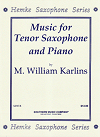
|
S221: Music for Tenor Saxophone and Piano by M. William Karlins. Southern Music Co., 1990, SS, 16 + 16 pages. Two copies of score with both parts are included. In three movements with the second dedicated to the memory of Coleman Hawkins. Includes performance notes. While actual extended technique is minimal, contemporary notation and improvisational sections are found throughout. Advanced level. |
12.95
|
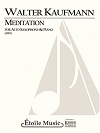
|
S357: Meditation for Alto Saxophone and Piano by Walter Kaufmann. MMB Music, 1988, SS, 6 + 1 pages. Walter Kaufmann (1907-1984) was a Czech born composer, conductor, musicologist, and educator who lived in the United States from 1957. This piece was dedicated to Eugene Rousseau on his 50th birthday (1982) and has been edited by Rousseau. It is in one movement (Moderato cantabile) but has three sections. Prior to coming to the United States, Kaufmann lived in India and that influence can be heard in the first section of this piece.
 Free Media Mail shipping on this music to US, IF ordered with another item.
(Except other items with free shipping.)
|
14.95
|
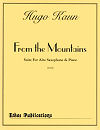
|
S379: From the Mountains Suite for Alto Saxophone and Piano by Hugo Kaun. Ethos Publications, 2006, SS, 21 + 7 pages. Hugo Kaun (1863-1932) was a German composer in the Romantic style who lived in the United States (Milwaukee) from 1886-1902. This is a programmatic work create for the young saxophonist Sigurd Rascher in 1932 which depicts the composer's musical impressions of a trip to the Tyrolean Alps. It is in three movements: 1. Sunset - Glowing Alps (Sehr ruhig, und ausdrucksvoll), 2. The Mountains Awaken - Night (Lebhaft), and 3. Daybreak - New Life (Ruhig, ausdrucksvoll). This is a scholarly edition with notes on the editing and definitions of the German language terms that appear in the score. Early college level.
|
17.95
|
|
S723: Fantasia Op. 198 for Alto Saxophone and Piano by Gábor Kerek. EditionDarok, 2011, SS, 18 + 6 pages. Gábor Kerek (1971-) is a Hungarian composer. This work begins Allegro and is in a fast/slow/fast/slow format. Some mixed meter to challenge the college level saxophonist. The duration is listed as 8:43. Click on the cover image to view the first page of the saxophone part, which is representative of the fast sections of this piece. |
29.95
|
|
S1034: Saxophon Concerto for Alto Saxophone and String Orchestra (Piano Reduction) by Erland von Koch. PeerMusic, 1965, SS, 31 + 11 pages. This piece was written in 1958 and is dedicated to Sigurd Rascher. It is in three movements: I. Allegro moderato, II. Andante sostenuto, and III. Allegro vivace. The first movement has a cadenza. The part has and upper range to written altissimo G and 8va to the F above that. An advanced work with a duration of about 17 minutes. Here is part 1 of an audio recording with orchestra by Rascher. Here is a video of the first movement of this edition. Click on the cover image to view the first page of the saxophone part. |
28.95
|
|
& S706: 7 Pieces Op. 180 for Saxophone and Piano by Charles Koechlin edited by Federico Mondelci. Billaudot, 2006, SS, 33 + 13 pages. Charles Koechlin (1867-1950) was a French composer. While he wrote in many styles, much of his music was influenced by Fauré who was one of his teachers. This work was originally for horn and piano but has been transcribed for saxophone. The first and sixth pieces are for alto sax and the rest are for tenor. 1. Andante presque adagio, 2. Piece No. 5 (Adagio), 3. Piece No. 7 (Andante), 4. Piece No. 4 (Andante), 5. Piece No. 12 (Adagio), 6. Piece No. 14 (Andante con moto), and 7. Piece no. 15 (Presque Adagio). Generally these are at the intermediate level although number 3 is in the key of F sharp and an altissimo F sharp was noted in number 7. Total duration is 27 minutes. |
34.95
|
|
WW276: Épitaphe de Jean Harlow Op. 164 Romance for Flute, Alto Saxophone and Piano (or Harp) by Charles Koechlin. Eschig, 1970, SS. Includes parts and piano score. Koechlin was fascinated by the movies this is one of many pieces he composed that is film related. In one movement marked Andantino, sans traîner. Duration about 3:00. Here is a video of an excellent performance. |
31.95
|
|
S966: Armenian Lament and Dance for alto saxophone and piano by Béla Kovács. EditionDarok, 2013, SS, 9 + 4 pages. This begins with three short sections: Moderato, Andante (mostly a cadenza) and Allegro, then concludes with an Allegro molto section which is about 2 1/2 of the 4 pages of the saxophone part. Optional altissimo to A. College level with a duration of 2:40.
Free Media Mail shipping on this music to US, IF ordered with another item.
(Except other items with free shipping.)
|
20.95
|
|
S1278: Hungarian Verbunk Music from Pannonia for soprano saxophone and piano compiled by Béla Kovács. EditionDarok, 2018, SS, 14 + 4 pages. A Verbunk is a recruiting dance performed by men. Pannonia was a province of the Roman Empire, corresponding to present-day western Hungary and parts of eastern Austria, as well as portions of several Balkan states, primarily Slovenia, Croatia, and Serbia. This is a sectional piece at a variety of tempos but generally accelerating as it proceeds. It is dedicated to László Gy. Kiss, master of the tárogató. Click on the cover image to view a sample page from the saxophone part.
Free Media Mail shipping on this music to US, IF ordered with another item.
(Except other items with free shipping.)
|
25.95
|
|
S1279: Un Petit Voyage dans les Balkans for soprano saxophone, piano and string quartet by Béla Kovács. EditionDarok, 2017, SS, includes all parts and score. This piece is for an interesting combination. The much of the piece is in 5/8 or 7/8. The piano and string parts are quite easy although there is a short section near the end where the first violin has a similar line as the saxophone. Click on the cover image to view the last page from the saxophone part (the Allegretto is missing what should be a 2/4 time signature). |
31.95
|
|
S207: Fable for Baritone Saxophone and Piano by Jan Krzywicki. Tenuto Publications, 2006, SS, 20 + 8 pages. Jan Krzywicki (1948-) is an American composer, conductor, and music educator. The composer wrote, "Fable unfolds like an allegorical narrative, similar to many a fable by Aesop. The work begins 'once upon a time' and moves through a series of events that include conflicts, reflections, contests, and chases. The narrative consists of a series of rondo-like events in which two ides predominate—an aggressive, assertive music, a pulsing yet lyrical event. The interaction of these two primary events leads to the climax and eventually to the story's elegiac 'moral.'" Upper college level with a duration of about 11 minutes.
|
19.95
|
|
/ S782: Pièce Concertante for alto or tenor saxophone and orchestra of 13 instruments (piano reduction) by Guy Lacour. Billaudot, 1977, 19 + 5 pages (includes both alto and tenor parts). Guy Lacour (1932-) is a French composer and saxophonist. This is in two movements. The first is marked Largo. It includes many odd meters and has a cadenza near the conclusion. The second movement is marked Presto. It begins and ends in 6/8 but has a middle section in 2/4. The tenor part is generally in the upper range but the highest note is altissimo F-sharp. Much of the alto part is the same sounding pitch as the tenor, but there are places with options to take it high into the altissimo.
|
27.45
|
|
S377: I Never Saw Another Butterfly for soprano voice and alto saxophone. Music by Lori Laitman and texts by children of the Holocaust. Arsis Press, 1998, SS. Includes two parts in score format. (Originally written for voice and saxophone, the composer has also created editions for clarinet and bassoon.) Based on poetry by children from the Terezin concentration camp and written in 1996, the six songs of the cycle use varied imagery and musical styles. The composer writes: "One cannot help but be touched by the hope and innocence that these children put into their poetry, despite their terrible surroundings. The accompaniment of the saxophone is intended to be haunting and soulful, with echoes of Klezmer music." The song titles are: The Butterfly, Yes—That's the Way Things Are, Birdsong, Man Proposes, God Disposes, and The Old House. The first performance was at John Hopkins University in 1996 with soprano Lauren Wagner and saxophonist Gary Louie, for whom the piece was written.
|
19.95
|
|
V036: Living in the Body for soprano voice and alto saxophone. Music by Lori Laitman to six poems of Joyce Sutphen. Enchanted Nickers Music, 2002, SS, 21 pages. Includes two copies both in score format, one for the vocalist with saxophone part in concert key and the other for the saxophonist with the part transposed. There are six songs: 1. Burning the Woods of My Childhood, 2. Living in the Body, 3. Not for Burning, 4. Lost at Table, 5. Bring on the Rain, 6. Crossroads. College level with a few high altissimo notes in some songs.
|
19.95
|
|
S158: Sicilienne for Alto Saxophone and Piano by Pierre Lantier. Alphonse Leduc, 1944, SS, 6 + 2 pages. Pierre Lantier (1910-1998) was a French composer who won the Prix de Rome in 1937. This piece starts in E-flat moves to A and then back to the original key with plenty of accidentals to challenge the better high school or early college performer. (We have copies of this piece on sale here for $9.95)
Free Media Mail shipping on this music to US, IF ordered with another item.
(Except other items with free shipping.)
|
20.55
|
|
S135: Holy Roller for Alto Saxophone and Piano by Libby Larsen. Oxford University Press, 1998, SS, 27 + 10 pages. Holy Roller was inspired by classic revival preaching and is a revival sermon captured in the sounds of the alto saxophone and piano. A substantial work for skilled performers.
|
21.50
|
|
S068: Concerto for Saxophone and String Orchestra Op. 14 by Lars-Erik Larsson. Gehrmans, 1952, SS, 38 + 12 pages. Piano Reduction. A virtuoso concerto for alto saxophone dedicated to Sigurd M. Rascher. Three movements Allegro molto moderato, Adagio, and Allegro scherzando. The first and third movements have extended cadenzas.
|
36.95
|
|
S452: Dies irae for Soprano Saxophone and Organ by Christian Lauba. Baerenreiter (BA 7479), 1997, 20 + 10 pages. French composer Christian Lauba (1952-) is a leading composer of contemporary music for saxophone. He teaches at the National Conservatory of Bordeaux. This is a challenging work dedicated to Jean-Marie Londeix. For advanced performers with a duration of about 16:20.
|
32.95
|
|
S931: Sud for Alto Saxophone and Piano by Christian Lauba. Resolute Music Publications, (2012?), 27 + 7 pages. First performed in 1989. This is an advanced works with contemporary techniques and notation for both the saxophone and the piano. There is a page of explanation. Click on the cover image to view what is probably the most complex page from the saxophone part.
|
36.95
|
|
S925: Intimate Echoes for Tenor Saxophone and Piano by Robert Lemay. Resolute Music Publications, 2011, SS, 24 + 8 pages. Commissioned by Dr. Jeffrey E. Vickers in 2010. Lemay's style of incorporating advanced saxophone techniques produces an 'echo-like' effect in this composition. The saxophone produces numerous slap-tongues at loud dynamics, which fade instantly — leaving a very soft chordal 'echo' in the piano. Lemay's modern language and scales present a worthwhile challenge for any saxophonist. Composed with piano accompaniment, Intimate Echoes would be appropriate for any recital setting. In keeping with his approach, Lemay also uses other extended techniques such as bisbigliandi, multiphonics (fingerings are provided on a separate sheet), and high altissimo. Click on the cover image to view the first page of the saxophone part.
|
32.50
|
|
S1182: Oran for Alto Saxophone and Piano by Robert Lemay. Resolute Music Publications, 2015, SS, 24 + 8 pages. Oran is a solo of moderate difficulty by Robert Lemay. More classical in nature than many of his other compositions, it is a solo with consistent meter and rhythm throughout. This solo would be highly effective in introducing students to a few modern techniques and contemporary sounds. Extended techniques within Oran include flutter tonguing, a few quarter tones, bisbigliando and high altissimo. Approximate duration is 12:45. Here is a video of a performance of this piece (which begins after about 15 seconds).
|
32.50
|
|
V061: Mitsu no kisetsu for Alto or Mezzo Voice and Baritone Saxophone by Robert Lemay. Editions Jobert, SS, 10 pages (score format). This is 3 short pieces on Haiku by Matsuo Basho (1644-1694). This is a relatively challenging work but the the vocal text in Japanese shouldn't be a problem. The vocal range is from the A below middle C to the C an octave above middle C (There are glissandos that go higher and lower marked to sing as high or low as the singer can if they can't reach the written notes). The baritone saxophone part goes up to altissimo G. Click on the cover image to view a sample page from the second movement (mm=96-112).
Free Media Mail shipping on this music to US, IF ordered with another item.
(Except other items with free shipping.)
|
31.95
|
|
S512: Phonie Douce for Oboe, Alto Saxophone, and Cello by Philippe Leroux. Billaudot, 1991, SS, (includes score and parts). Philippe Leroux (1959-) he has written pieces which encompass several genres: symphonic, electro-acoustic, electronic and chamber music. This piece for an unusual combination of instruments is dedicated to Claude and Odile Delangle. It employs flutter tonguing, some fractional pitches, some contemporary notation, and is in one continuous movement. For advanced players with a duration of about 12 minutes.
|
29.95
|
|
S511: SPP for Soprano Saxophone and Piano by Philippe Leroux. Billaudot, 2001, SS, 29 + 9 pages. An advanced contemporary piece that includes a variety of techniques including flutter tonguing and other articulation styles, altissimo to A, and one multiphonic with fingering given. Duration about 12 minutes.
|
33.95
|
|
C2391: Rio De Los Sueños (River of Dreams) for Bass Clarinet or Tenor Saxophone and Piano by Mike Lewis. LudwigMasters Publications, 2015, SS, 4 + 1 pages. Mike Lewis (1938-) has been a freelance arranger/composer for many years. Starting with the Jackie Gleason TV Variety Show as a staff arranger, he became heavily involved in the pop music field, arranging hit records for some of the top pop artists. This is a light "Latin" ballad performed at a slow tempo. While not difficult the range is to altissimo E and very last phrase would need to be played an octave higher on the saxophone. Click on the cover image to view the first page of the score.
Free Media Mail shipping on this music to US, IF ordered with another item.
Except other items with free shipping.)
|
5.95
|
|
S1121: Sérénade Populaire for Alto Saxophone and Piano by Paul Lewis. Schott, 2014, SS, 9 + 3 pages. Paul Lewis (1943-) is a British composer who is best known for his music for television. This is an effective piece ranging between romantic and jazz which, in places, is reminiscent of circus music! Originally composed for harmonica, this popular little work has been arranged for alto saxophone by the composer. Click on the cover image to view the first page of the saxophone part. |
18.95
|
|
& S1259: Imaginary Folksongs for Alto and Soprano Saxophones (one player) and Piano by Stephen Lias. Alias Press, 2011, SS, 30 + 14 pages. Imaginary Folksongs presents six diverse movements, three each for alto and soprano saxophone, which "run the gamut from virtuosic to melancholy to humorous," says the composer. For advanced performers, Imaginary Folksongs uses some of the easier extended techniques. This audience-pleaser utilizes both alto and soprano saxophone, and a few of the easier extended techniques as well as high altissimo (to double high D). You can watch a YouTube performance here. Click on the cover image to view the second page of the saxophone part. |
26.95
|
|
S1260: Range of Light for Alto Saxophone and Piano by Stephen Lias. Alias Press, 2014, SS, 38 + 17 pages. Written in 2014 for saxophonist Nathan Nabb, this sonata is a tour de force for the advanced saxophonist. Each of the four movements is based on selected photographs of Yosemite National Park by Ansel Adams. They are Winter Sunrise, Vernal Falls, Jeffrey Pine, and Clearing Winter Storm. Includes some mixed meter and high altissimo (to C). Duration about 25 minutes. You can listen to excerpts here. Click on the cover image to view the second page of the saxophone part. |
30.95
|
|
S1044: Sonate for Alto Saxophone and Piano by Erik Lotichius. Digital Music Print, 2007, SS, 29 + 9 pages. Erik Lotichius (1929-) is a Belgian composer and music educator who is inspired by jazz and light music. This piece is in three movements: I. Allegro, II. Andante con moto, and III. Allegro. College level with a range to altissimo F-sharp. Click on the cover image to view a page of the saxophone part from the second movement. |
29.95
|

|
S223: Sonata for Alto Saxophone and Piano by Lawson Lunde. Southern Music Co. 1967, SS, 30 + 11 pages. Lawson Lunde (1935-) is a Chicago based composer and pianist whose numerous compositions for saxophone are noted for their lyricism and rhythmic energy. This Sonata has three movements: I. Allegro, II. Andantino cantabile, and III. Allegro vivace. College level. Here is a video of the first movement. You should be able to find the other movements on YouTube as well. Click on the cover image to view the first page of the saxophone part. |
16.95
|
|
S825: Blue Shift for Alto Saxophone and Piano by Joseph Lyszczarz. Joseph Lyszczarz Music, 2010, SB, 16 + 8 pages. Joseph Lyszczarz is an American composer and flutist. This is a sectional piece with a duration of about 9 minutes. The main sections are Frenetic, Somewhat more relaxed, Meno Mosso, A tempo tumultuous, and Tempo Primo. It includes some growling and slap tonguing, mixed meter and altissimo to B at the end of the piece. Click on the cover image to view the first two pages of the score. |
19.95
|
|
S667: Sonata for Alto Saxophone and Piano Op. 95 by Trygve Madsen. Musikk-Husets Forlag A/S, 1995, SS, 33 + 10 pages. Trygve Madsen (1940-) is a Norwegian composer who also studied in Vienna. He has been influenced by many of the great classical composer from Bach to Shostakovich, but also plays Jazz piano. This piece is dedicated to Philippe Portejoie and Frederique Lagarde. In three movements: I. Theme and Variations (Andante), II. Air (Moderato), and III. Finale (Allegro). College level (but of average difficulty). |
32.95
|
|
S669: Sonata for Baritone Saxophone and Piano Op. 105 by Trygve Madsen. Musikk-Huset Forlag A/S, 2000, SS, 29 + 11 pages. This piece is dedicated to Jean and Odile Ledieu. In three movements: I. Adagio, II. Allegretto, and III. Quasi Habenera. The first and third movements have a number of tempos. College level (but of average difficulty). |
33.95
|
|
S668: Sonata for Soprano Saxophone and Piano Op. 107 by Trygve Madsen. Musikk-Huset Forlag A/S, 1998, SS, 28 + 10 pages. This piece is dedicated to Philippe Portejoie and Frederique Lagarde. In three movements: I. Allegro Moderato, II. Andante Cantabile, and III. Rondo: Allegro. The first and last movements have many tempo changes. College level (but of average difficulty). |
32.95
|
|
S670: Sonata for Tenor Saxophone and Piano Op. 117 by Trygve Madsen. Musikk-Huset Forlag A/S, 2000, SS, 38 + 12 pages. This piece is dedicated to Philippe Portejoie and Frederique Lagarde. In three movements: I. Andante con moto, II. Vivace, III. Moderato. The first and last movements have many tempo changes. College level (but of average difficulty). |
32.95
|
|
S1014: Where you end and i begin for Soprano Saxophone and Piano by Robert Maggio. Theodore Presser Co., 2014, SS, 26 + 10 pages. This is a five movement work which consists of a single continuous thread woven throughout. The opening theme is a Sicilian lullaby, from which all of the musical idea in the piece are offshoots. The movements are: 1 folk-like—stately, 2. vigorous—light and playful, 3. stately—flowing gently, 4, light and playfull—folk-like, and 5. flowing gently—vigorous. For advanced performers with a duration of 13 minutes. Click on the cover image to view a selection of pages from the piano score.
|
18.95
|
|
S822: A Ruckert Song Alto Saxophone and Piano by Gustav Mahler arranged by Fred Hemke. Southern Music Co., 1987, SS, 5 + 1 pages. This is from a song cycle of five Lieder for voice and orchestra or piano by Gustav Mahler, based on poems written by Friedrich Rückert. This is Ich bin der Welt abhanden gekommen (I am lost to the world). This is not a difficult piece (publishers US grade 3), but has some features that will be useful to the student as much of it is pianissimo and piano with only a few spots with brief swells in volume. It is also on the high side from A in the staff to E above it.
Free Media Mail shipping on this music to US, IF ordered with another item.
(Except other items with free shipping.)
|
8.95
|
|
S412: L'Incandescence de la bruine for Soprano Saxophone and Piano by Bruno Mantovani. Editions Henry Lemoine, 2000, SS, 20 + 8 pages. Bruno Mantovani (1974-) is a French composer who won many first prizes at the Paris Conservatory. This is a challenging piece that employs a bit of contemporary notation, a few quarter tones, bisbigliando, and slap and flutter tonguing. This piece was used in the second round of the 2nd International Jean-Marie Londeix Saxophone Competition held in Bangkok, Thailand, in January 2008. |
23.95
|
|
S591: Andante and Allegro from Sonata in G for Baritone Saxophone and Piano by Benedetto Marcello transcribed by Himie Voxman. Rubank, 1946, 4 + 2 pages. (See brief composer information on the next piece.) This two movement work at the high school level is frequently used for solo and ensemble festivals.
Free Media Mail shipping on this music to US, IF ordered with another item.
(Except other items with free shipping.)
|
6.95
|
|
S517: Concerto in C minor for Soprano Saxophone and Piano by Alessandro Marcello (attributed to Benedetto Marcello) transcribed by Harvey Pittel. Southern Music Co., 1966, SS, 11 + 6 pages. Alessandro Marcello (1673-1747) was Italian nobleman and composer. This work was previously attributed to his younger brother Benedetto who was better known as a composer. This work was originally for oboe, but works very well on soprano saxophone. In three movements: I. Allegro moderato, II. Adagio, III. Allegro. For the final movement, the editor provides some ornamentation for the repeat of the first half of the movement. At the tempos listed this is early college level. Duration about 11 minutes. You can watch a performance which appears to be from this edition on YouTube. |
13.95
|
|
S1019: Concerto in C minor for Soprano Saxophone and Piano by Benedetto Marcello arranged by Daniel Gremelle. Billaudot, 2014, SS, 15 + 4 pages. This edition of this piece is very similar to the one above. While the saxophone part is smaller, there is more white space which may make it easier to read for some. It does not have the added ornamentation in the last movement. Click on the cover image to view the first page of the saxophone part. |
14.95
|
|
S594: Cadence et Danses for Alto Saxophone and Piano by Alain Margoni. Editions Françaises de Musique, 1974, SS, 20 + 6 pages. Alain Margoni (1934-) is a French composer, conductor and music educator. A relatively recent test piece for the Conservatoire National Supérieur de Musique de Paris. It begins with a cadenza followed by several short dances. Some of the dances include mixed meter. College level. |
26.95
|
|
V068: Quatre Chants Vénitiens for Voice, Tenor Saxophone (or Bass Clarinet, Bassoon or Horn) and Piano by Alain Margoni. Editions Combre, 2005, SS, includes piano score with vocal part and individual instrumental parts. The four songs are I. Chant d'Amour, II. Chant de Prison, III. Chant d'espérance, and IV. Chant sur l'eau. This is intended for a female vocal performer. The range is from the A below middle C to the G just above the staff. College level. Here is an audio recording of the first song with tenor saxophone (the other songs are also available). Click on the cover page to view a sample page which is also from the first song.
|
43.95
|
|
/ S316: Corollaire d'un Songe for Soprano or Tenor Saxophone and Piano by Pierrette Mari. International Music Diffusion, 1983, SS, 9 + 3 pages. Pierrette Mari (1929-) studied in Nice and Paris and in addition to her composing is a musicologist, author and music critique. This piece (Corollary to a dream) has many tempo and meter changes and a cadenza near the end. College level.
Free Media Mail shipping on this music to US, IF ordered with another item.
(Except other items with free shipping.)
|
14.95
|
|
S419: Complainte et Danse for Alto Saxophone and Piano by Yvan Markovitch. Alphonse Leduc, 1966, SS, 9 + 2 pages. The first section (Complainte which translates to English as Lament) is in slow Lent tempo (mm=40). This is followed by a short transitional section, Modéré, at double the previous tempo before the Danse (Vif) at mm=144. The publisher lists this with a difficulty of 6 on their scale with a range to 9.
|
18.60
|

|
S181: Ballade for Saxophone and Orchestra Piano Reduction by Frank Martin. Universal Edition, 1966, SS, 30 + 8 pages. Frank Martin (1890-1974) was a Swiss composer who created a synthesis of the chromatic and twelve-tone techniques without, however, abandoning tonality. Ballades were a specialty and he wrote them for a number of instruments. This piece was written for Sigurd Rascher. It is sectional with many tempo changes. Upper college level.
|
34.95
|
|
S292: Ballade for Trombone or Tenor Saxophone and Piano by Frank Martin. Universal Edition, 1941, SS, 19 + 7 pages. Includes both trombone and saxophone part. This is a sectional piece with many changes in tempo. It does not appear to be very difficult. Duration about 7:30. |
28.95
|
|
S890: Concerto for Alto Saxophone and Wind Ensemble Piano Reduction by David Maslanka. Carl Fischer, 1999, SS, 65 + 23 pages. David Maslanka (1943-) is an American composer who studied with Joseph Wood at the Oberlin College Conservatory and H. Owen Reed at Michigan State. He is especially known for his works for winds and percussion. In five sections: I. Song: "Fire in the Earth," II. Interlude: "Bright Window, Your Night is Full of Stars," III. Song: "Dear Jesus, what have you DONE?!," IV. Interlude: "Starry Night," and V. Song: "Mortal, have you seen this?" This is an advanced work with a duration of about 40 minutes. There are video and audio files on YouTube.
|
29.95
|
|
S1130: Heaven to clear when day did close (Fantasy on a theme of Barney Childs) for Tenor Saxophone and String Quartet by David Maslanka. Maslanka Press, SB/SS, includes parts and score. The composer wrote: "Barney Childs was my mentor and then friend from the early 1970’s until his death in the late 90’s. His music is fragmentary, elliptical, enigmatic. I always found something to like in his work – ideas that had a quality of compression and real potential. Such is the case with the “thematic” fragment that I borrowed from his solo piano piece 'Heaven to Clear When Day Did Close.' In my fantasy the theme explodes into a virtuoso tenor sax extravaganza. This is 'Classical' music but with strong reference to bebop. The string quartet parts are demanding and require a seasoned and committed ensemble." Includes high altissimo for the tenor saxophone. The composer's website has an audio file of a performance and a complete .pdf file of the score. Click on the cover image to view a page from the tenor sax part (mm=184).
|
88.95
|
|
S473: Sonata for Alto Saxophone and Piano by David Maslanka. Maslanka Press, 1989/2013, SS, 52 + 19 pages.This piece was commissioned by the North American Saxophone Alliance Commissioning Fund and Private Contributors for the 1989 NASA Young Artist Competition at the National Meeting and Navy Band Symposium. In three movements, a huge and extremely demanding piece; its musical roots are quite varied: Liszt, Gesualdo, Pettersson. Duration about 30 minutes.
|
58.95
|
|
S1129: Sonata for Soprano Saxophone and Piano by David Maslanka. Maslanka Press, 1992/2012, SS, 36 + 14 pages. In three movements, all at a moderate tempo. The score in a neat manuscript (which appears to be relatively challenging for the pianist) can be viewed here. The saxophone part is typeset. You can listen to it here. Click on the cover image to view the first page of the saxophone part.
|
33.95
|
|
S885: Tone Studies for Alto Saxophone and Piano by David Maslanka. Maslanka Press, 2010, SB/SS, 25 + 10 pages. Commissioned by Joseph and Janet Lulloff for their son Jordan. In six movements: 1. "Jordan;" 2. Credo in unum Deum; 3. Watch the Night With Me (Part 1); 4. Watch the Night With Me (Part 2); 5. Wie bist du, Seele; 6. Whale Story (O Sacred Head Now Wounded). Each study is a small and passionate essay - a "short story" without words (although Whale Story has text to be read before it is performed). Four of the movements are based on melodies by J.S. Bach.
|
33.95
|
|
S796: Canzone Da Sonar for Alto Saxophone and Piano by Thom David Mason. Southern Music Co., 1974, SS, 15 pages (2 copies in score format). Thom David Mason is a composer, professor of jazz studies at the University of Southern California as well as a performer on the clarinet, saxophone and flute. This is an advanced contemporary works that includes extended techniques for the saxophone, with fingerings given for the multiphonic, tone clusters on the piano and spatial notation in both parts. |
5.00
|
|
S459: Meditation from Thaïs for Soprano Saxophone and Piano by Jules Massenet arranged by Sharon Davis. Western International Music, 1995, SS, 8 + 2 pages. Upper intermediate level. |
6.95
|
|
S1256: Contact for Alto Saxophone and Piano by James Matheson. Theodore Presser Co., 2010/2017, SS, 34 + 11 pages. James Matheson (1970-) is an American composer. This 14-minute work was co-commissioned by a consortium of 19 saxophone/piano duos. Matheson cites the irony that humans throughout time find new ways to connect with each other, while distancing themselves in other ways. We reach out across great distances and time, yet supplant the magical, physical presence of another living being. Contact is an exploration of this impulse to connect, and of the paradoxes inherent in our efforts to make the world smaller. Contact is lyrical then severe, gentle then brutal - a microcosm of our interactions with others. For advanced performers. Duration of about 13 minutes. Here is an audio recording of excerpts from this piece. Click on the cover image to view the final page of the saxophone part. |
19.95
|
|
S891: Pull for Alto Saxophone and Piano by James Matheson. Theodore Presser Co., 2012, SS, 15 + 5 pages. Composer James Matheson describes this light, hot, and virtuosic work as a brief but intense struggle between two groups of musical material, tugging at each other and vying for dominance as a push and pull of contrary yet complimentary forces. Pull was composed (in 1995 but published in 2012) for saxophonist Samuel Lorber and features a solo part that soars and glitters. Sectional: Forcefully, Allegro, and Subito Tempo I. This is an advanced work with mixed (and odd) meter. The duration is about 6 minutes. Here is an audio recording of this piece. Click on the cover image to view the first 4 pages of the score. |
12.95
|
|
S745: Au bonheur des dames for Alto Saxophone and Piano by Jean Matitia. Billaudot, 2003, SS, 16 + 6 pages. Jean Matitia is actually French composer Christian Lauba (1952-), a leading composer of contemporary music for saxophone. Not certain of the story behind this piece. Au bonheur des dames is a silent French film from 1930. The composer wrote music for nine musicians related to the film (to accompany it or inspired by it?) and this is an arrangement for alto saxophone and piano created for Arno Bornkamp. It is in the style of Rudy Wiedoeft. The publisher lists it as a 3 on their 5 point scale but it appears to be more difficult than that and has altissimo to G sharp. Duration about 10 minutes. Here is a video. There are others on YouTube. Overstock Special while supplies last. Regular price is $16.95. |
13.50
|
|
or / S746: Crazy Rag for E-flat or B-flat Saxophone and Piano by Jean Matitia. Billadot, 2000, SS, 10 + 2 pages. At mm=146 this piece is faster than a traditional rag. The E-flat part extends to altissimo A while the B-flat reaches altissimo B. This occurs in different places in the music. The B-flat part could probably be played an octave lower. Here is a video of a performance on alto saxophone (some of which is played higher than what is written). Click on the cover image to view the first page of the saxophone part.
Free Media Mail shipping on this music to US, IF ordered with another item.
(Except other items with free shipping.)
|
15.95
|
|
S744: The Devil's Rag for Alto Saxophone and Piano by Jean Matitia. Billadot, 1997, SS, 12 + 4 pages. While this piece follows the traditional rag format it is marked Tres vif, faster than usual for a rag. Range to altissimo F sharp. Here is a video with Arno Bornkamp. |
20.95
|
|
or S1220: A Matitia Songbook Four songs for alto or soprano saxophone and piano by Jean Matitia. Resolute Music Publications, 2017, SS, 27 + 10 (x2). From the publisher's website: "Four light-hearted, lyrical songs (without words!) for alto or soprano saxophone with piano accompaniment. Dedicated to French saxophonist Richard Ducros, these beautiful melodies are perfect for younger students or interludes. The Songbook contains three waltzes and a bossa nova. Parts for both soprano and alto saxophone are included." We believe that at least the first piece is more is more difficult then this suggests (see sample). The alto sax part reaches an altissimo G sharp, while the soprano part dips to a low B. Click on the cover image to view the one of the more difficult pages of the alto saxophone part (at quarter note = 220).
|
34.95
|
|
S952: Tango Suave for Cello or Alto Saxophone and Piano by Jean Matitia. Billadot, 2012, SS, 15 + 5 pages. Includes both cello and saxophone parts. Most of this work should not be a problem for a college level player, however there is a section of about 25 measures with odd meters such as 10/16, 9/16, 7/16, etc. It has a small amount flutter tonguing. Duration is 7:40. Here is a video of the first half with Richard Ducros to whom the piece is dedicated. Here is an audio recording. Click on the cover image to view the first of the saxophone part. |
22.95
|
|
S138: Tableaux de Provence for Saxophone and Piano by Paule Maurice. Editions Henry Lemoine, 1990, SS, 32 + 12 pages. Paule Maurice (1910-67) was a French music educator and composer. This suite of five pieces for alto saxophone were inspired by her holidays in Provence and are dedicated to Marcel Mule. It was premiered in 1958 by Jean-Marie Londeix with the Orchestre Symphonique Brestois under the direction of her husband and fellow composer, Pierre Lantier. The pieces are Farandole des Jeunes Filles, Chanson pour ma Mie, La Bohemienne, Des Alyscamps l'Ame Soupire, and Le Cabridanese. College level. An orchestral accompaniment is also available as a rental. If you contact us we will direct you to the agency that rents it.
|
28.95
|
|
S1300: Amendment for Alto Saxophone and Piano by Luke Mayernik. E. C. Schirmer, 2019, 11 + 3 pages. Luke Mayernik (1981-) is an American composer and organist. Written as a melodic vehicle for the alto saxophone, Amendment offers flowing lines ornamented with grace notes reminiscent of the Impressionists. The piece begins with a songlike adagio theme that mixes both B major and B minor modalities. The center section of the work begins with rapid triplets in the piano before the saxophone enters with a rhythmically charged variation upon the initial theme. Following a climax on F-sharp major, the motion settles into a restatement of the lovely B major/minor theme before ending on a sweet-sounding B major triad. Duration: 3:00. Click here to hear this piece (click on .mp3 preview). Click on the cover image to view pages from the score.
Free Media Mail shipping on this music to US, IF ordered with another item.
(Except other items with free shipping.)
|
11.95
|
|
S1202: Rêverie, Hommage à Francis Poulenc for Alto Saxophone and Organ by Luke Mayernik. E. C. Schirmer, 2016, 16 + 4 pages. The composer wrote: With the contrasting and complimentary ingredients of both piety and playfulness thoughtfully put in place, it is the intent of Rêverie to conjure the heart of Poulenc's musical form. Rêverie is a work that combines harmonic inventiveness, melodic poignancy and rhythms sprinkled with mischievous pulses. While the work does pay homage to the master with reverence, it simultaneously summons a fresh, new perspective of these old, familiar forms—these 'ships' of our pasts." Click here to hear this piece (click on .mp3 preview). Click on the cover image to view pages from the score.
|
10.95
|
|
S937: In Steel for Alto Saxophone and Percussion by Robert McClure. Resolute Music Publications, 2012, SS, 16 pages (score) + 7 pages (alto saxophone) + 9 pages (percussion). A rhythmically-advanced new duo for alto saxophone and percussion. Commissioned by Becky Morris and Joshua Priest, in Steel presents a great opportunity in an evolving medium. One percussionist is required to perform on vibraphone as well as a multi-percussion set of bass drum, wood block, splash cymbal, nipple gong, triangle and crotales. Performance time is about 10 minutes. Click here to hear this piece. Click on the cover image to view the first page of the saxophone part.
|
31.95
|
|
S909: For Hope for Baritone Saxophone and Piano by Catherine McMichael. Alry Publications, 2012, SS, 14 + 5 pages. The piece is in one movement, divided into three main sections: driving and aggressive in a minor tonality with changing meters, then melodic and soaring in a sweeping 6/4 meter, and a return to the fast first themes, with emphasis on major tonality. The pulse in the outer sections is strong and focused, while the rhythmic writing in the middle section is intended to convey a sense of improvisation and freedom. A welcome addition to the baritone saxophone repertoire.
|
17.95
|
|
S326: Fantasia Op. 37 for Alto Saxophone and Piano by Boris Mersson. Kunzelmann, 1981, SS, 20 + 6 pages. Boris Mersson (1921-) is a Swiss composer of Russian ancestry as well as a pianist and conductor. This work is in three sections: Andantino cantabile, Allegretto con moto, and Allegro. College level.
|
17.50
|
|
S912: Brilliant Blue for Alto Saxophone and Piano by Till MacIvor Meyn. Alry Publications, 2012, SS, 36 + 13 pages. Till MacIvor Meyn is an American composer and music educator. In three movements. College level with a duration of 14 minutes. "As with many of my works, the title helped me visualize the music as I composed it. To me, Brilliant Blue presented an image of vitality, yet with the implications of both jazz and of quieter moods that blue brings with it." - Till Meyn. Includes a small amount of improvisation and has altissimo to G. You can listen to a performance here. Click on the cover image to view the first page of the saxophone part for each movement. |
19.95
|
|
S768: Chant Premier, Sonata for Saxophone in B-flat and Piano by Marcel Mihalovici. Heugel, 1974, SS, 25 + 11 6 pages. Marcel Mihalovici (1898-1985) was a French composer born in Romania. He was discovered by George Enescu in Bucharest and moved to Paris in 1919 to study with Vincent d'Indy. The music does not say tenor but based on the score and other references that appears to be the intention. This is an advanced work with some extended articulation techniques (flutter tonguing and slap tonguing) and glissandos. It is 13-14 minutes long with many sections. This video cuts off before the last two pages of the saxophone part but is representative.
|
50.70
|
|
S1003: Scaramouche Suite for saxophone and Orchestra (Piano Reduction) by Darius Milhaud. Editions Salabert, 1939/2013, SS, 19 + 7 pages. For alto saxophone. This is a new edition. It has been reset and is clearer than the previous edition. It now has measure numbers on each line instead of rehearsal numbers. It also has the story of the piece in French and English. Lively first (Allegro) and third (Brazileira) movements surround the middle (Moderato) movement which alternates between melancholy and lighter phrases. A very entertaining piece in either the piano reduction or orchestral versions.
|
19.95
|
|
S1067: Elegy for Soprano Saxophone or Clarinet and Organ by Henry Mollicone. Ione Press/ECS Publishing, 2014, SS, 10 + 3 pages. Henry Mollicone (1946-) is an American composer. Elegy was commissioned by organist Douglas Cleveland. It is a one-movement work in a lyrical, meditative style. Its harmonic language is French-influenced, but the composer considers the piece primarily melodic. Although Elegy is not a programmatic work, it is based on musical materials that are varied throughout, and suggested to the composer a restful, pastoral setting. Better high school level performers and up.The duration is about 3:30. Click on the cover image to view several pages of the score.
Free Media Mail shipping on this music to US, IF ordered with another item.
(Except other items with free shipping.)
|
10.50
|
|
S612: Csardas (Czardas) for Alto Saxophone and Piano by Vittorio Monti transcribed by Ken Ichiro Muto. Editions Henry Lemoine, 2004, SS, 8 + 3 pages. A popular showpiece transcribed for alto saxophone. It begins with an emotive largo and then launches into Allegro vivo which has a contrasting Molto meno before returning to a fast tempo (Allegro vivace) and concluding Molto piu vivo. Duration about 5:15. |
18.95
|
|
S965: Czardas for Alto Saxophone and Piano by Vittorio Monti arranged by Béla Kovács. EditionDarok, 2006, SS, 6 + 2 pages. In this arrangement by Kovács, the familiar Czardas (originally for violin or mandolin and piano) becomes a showpiece at the early college level. This version is in the same key as S612. There are two phrases near the beginning which are down an octave. The faster sections have articulation and grace note markings that are not in the Lemoine edition.
Free Media Mail shipping on this music to US, IF ordered with another item.
(Except other items with free shipping.)
|
23.95
|
|
S837: Ballet des Petis Riens: Gavotte Sentimental by Wolfgang Amadeus Mozart arranged for alto saxophone and piano by Marcel Mule. Alphonse Leduc, 1937, 2 + 1 pages. This piece from Mozart's only ballet is at a Poco andantino tempo. High school level with an easy piano part.
Free Media Mail shipping on this music to US, IF ordered with another item.
(Except other items with free shipping.)
|
12.90
|
|
S100: Sonata for Alto Saxophone and Piano Op. 29 by Robert Muczynski. G. Schirmer, 1972, SS, 15 + 7 pages. Dedicated to Trent Kynaston. In two movements: the lyrical Andante maestoso first movement is followed by the rhythmic drive of the Allegro energico second. Advanced college level.
|
12.95
|
|
S294: In a Hall of Mirrors for Alto Saxophone and Piano by Dominic Muldowney. Universal Edition, 1988, SS, 12 + 3 pages. This piece was written in 1979 and is dedicated to John Harle who was the first to perform it. It is the form of a short theme with 12 variations. The first four bars contain the musical material from which the entire piece is derived. These bars are elongated, contracted and distorted in an economic yet colorful walk through a Hall of Mirrors. An advanced work that includes one recurring multiphonic note.
Free Media Mail shipping on this music to US, IF ordered with another item.
(Except other items with free shipping.)
|
19.95
|
|
S374: Danza Capriccio for Saxophone (piano reduction) by Ron Nelson. Ludwig Masters, 1990, SS, 51 + 16 pages. In one extended movement with a slower section in the middle. Includes high altissimo, a few measures of improvisation (ignored on the recording), and double tonguing might be helpful as well. An advanced piece with a duration of about 12:30. A band accompaniment is available as a rental but the recording below is with piano.
|
24.95
|
|
S462: Two Hues of Blues for Alto Saxophone and Piano by Lennie Niehaus. Kendor, 2001, 10 + 4 pages. Two blues in swing style which the publisher has rated as Grade 4+. The first is a Moderate Blues (mm 125-132) while the second is a Moderately Fast Blues (mm 160-168). The duration is 6 minutes.
Free Media Mail shipping on this music to US, IF ordered with another item.
(Except other items with free shipping.)
|
9.50
|
|
V048: Le Chant du Veilleur for Mezzo-Soprano, Violin or Alto Saxophone and Piano by Joaquin Nin. Eschig, 1937, (includes piano score and all parts, including a separate vocal part). Joaquin Nin (1879-1949) was a Spanish-Cuban pianist and composer. This is a wonderful piece for the low female voice and alto saxophone. It would be an excellent choice to add some variety to a college vocal recital. The vocal text is in Dutch or French. Here is a performance on YouTube.
|
18.95
|
|
S731: Alto Voltango for Alto Saxophone and Vibraphone by Luis Naón. Editions Henry Lemoine, 2002, SS, includes parts and score. Luis Naón (1961-) is an Argentinean composer, he studied there and in France where he has professor of composition at the Conservatoire de Paris since 1991. This a challenging piece for both performers. The saxophone part includes fractional tones and high altissimo. Five movements: I. Alto Voltango, II. Parque Lezama, III. Plaza Moreno, IV. Parque Güell, and V. Volta al tango. We found all of the movements on YouTube: I., II., III., IV., and V. |
29.95
|
|
S1122: La Valse F for Alto Saxophone and Piano by Tokuhide Niimi. Zen-On Music, 2014, SS, 40 + 15 pages. Tokuhide Niimi (1947-) is a Japanese composer and music educator. This is a challenging contemporary composition which features high altissimo (to the D way above the staff). It is in three movements. There is a small amount of contemporary notation and multiphonics of the performer's choice (see sample). The stated duration is 16:30. Some comments from the composer: "I designed this piece as dance music. . . I dreamed of writing music which sounds like a burning life, an intense waltz to which life and death dance together hand in hand . . ." Click on the cover image to view the sample pages from the saxophone part including the first page of each movement. |
19.95
|
|
S1116: Jazz Suite for Alto Saxophone (or Clarinet) and Piano by Jeremy Norris. Schott, 2014, SS, 42 + 15 pages (includes both clarinet and sax parts). After his popular Jazz Suite for Flute and Piano, this Jazz Suite ventures still further into the realms of jazz idiom and many passages even resemble Bebop improvisations. The underlying formal structures, however, are firmly rooted in the classical tradition. An alternative clarinet part has been included as this instrument shares a similar range to the alto saxophone and is likewise equally at home in both concert halls and jazz clubs. In five movements: 1. Homage to Bolling (Allegretto/Moderato - Swing), 2. Day dream (Moderato - Swing), 3. Nocturne (Moderato con espressione), 4. Chiaroscuro (Moderato - Swing), and 5. Variations (Moderato - Swing/Allegretto - Swing, etc.). The alto sax part extends to altissimo A in several spots. All of the movements are on YouTube: Homage to Bolling (audio only) and Day dream (the only video), etc. Click on the cover image to view the first page of the sax part for Day dream. |
28.95
|
|
S305: Shaping the Curve for Soprano Saxophone and Piano by Michael Nyman. Chester Music, 1995, SS, 22 + 10 pages. Michael Nyman (1944-) is a British composer, arranger, critic, performer, author and lecturer. He has written chamber, orchestral, film, opera, vocal and chamber music. Shaping the Curve was composed for John Harle in 1990 and is based strictly on a sequence of four chords. It includes mixed meter and a bit of contemporary notation. Duration is about 11 minutes. |
27.95
|
|
S693: Can Can (from Orpheus in the Underworld) by Jacques Offenbach arranged for alto saxophone and piano by Gregory Yasinitsky. Almitra/Kendor, 2011, 7 + 2 pages. The publisher rates this as (US) grade 4 but that may be one grade too high (the piano part is also easy). Here are samples pages from the publisher's web site.
Free shipping on this music to the US IF ordered with another item.
(Except other items with free shipping.)
|
8.95
|
|
S779: Quattro Liriche Brevi Op. 61 for Alto Saxophone and Piano by Juan Orrego-Salas. Peer Music Classical, 1971, SS, 23 + 7 pages. Juan Orrego Salas (1919- ) is a Chilean musicologist and composer of contemporary classical music who studied with Randall Thompson and Aaron Copland. This piece was written for Eugene Rousseau. It is in four short movements: 1. Elegiaca, 2. Rapsodica, 3. Semplice, and 4. Appassionata. A detailed description of this work can be found here. College level. While this work was originally written for saxophone and piano the composer also created an orchestrated version which is available as a rental.
|
17.95
|
|
S875: Pachelbel Canon arranged for Alto Saxophone and Piano by Johann Pachelbel arranged by Daniel Dorff. Theodore Presser Co., 1990/1993, 4 + 2 pages. An arrangement of the familiar Pachelbel canon. Moderato tempo. Easy intermediate level.
Free shipping on this music to the US IF ordered with another item.
(Except other items with free shipping.)
|
5.95
|
|
S758: La Campanella Op. 7 arranged for Alto Saxophone and Piano by Nicolò Paganini arranged by Raaf Hekkema. Schott, 2011, SS, 10 + 5 pages. Paganini on the saxophone specialist Hekkema has created another arrangement (see music collections for more) to show of the potential of the alto saxophone to play the master violinist's works. It features high altissimo, some multiphonics to play double stops (no fingerings), and one spot marked cantaré which presumably means to sing along with two measures where the part is in octaves.
|
13.95
|
|
S435: Concertante transcribed for Alto Saxophone and Piano by Émile Paladilhe transcribed by Himie Voxman. Rubank, 1959, 7 + 2 pages. Émile Paladilhe (1844-1926) was a French conductor and pianist who began his studies at the Conservatoire de Paris at age 10. This piece which was written for oboe in 1898 is one of the few by Paladilhe still performed today. In two sections: Andante, assai moderato and Allegro non troppo. Advanced high school or early college level and a good length (4:30) for a festival piece. When I listened to a performance of the original version on YouTube I thought it would sound good (better even) on saxophone. Himie Voxman must have thought the same thing!
Free shipping on this music to the US IF ordered with another item.
(Except other items with free shipping.)
|
4.95
|
|
S1249: Duo for Alto Saxophone and Bass Trombone by Carter Pann. Theodore Presser Co., 2011/2017, SS, 11 pages (2 copies in score format). Carter Pann (1972-) is an American composer who studied composition and piano at Eastman and the University of Michigan. This advanced works has two pieces: I. Lyrical Lois (With sweet serenity) and II. Chopper's Rag (Mean!). The first movement is slow. The second movement is faster. There are two good performances of Chopper's Rag on the internet here and here (this one is faster). Click on the cover image to view the first page of the score. |
14.95
|
|
S1231: Sonata for Alto Saxophone and Piano by Carter Pann. Theodore Presser Co., 2017, SS, 35 + 12 pages. Composed in 2016 on commission from Joe Lulloff, Pann’s Sonata is a 23-minute monument in 4 movements. The work was inspired by both the saxophone music of late composer William Albright and by Joe’s particular blend of finesse and brutality accompanied by an unparalleled command of the instrument. The movements are titled, I. This Black Cat, II. Three Songs Without Words, III. Cuppa Joe, IV. Epilogue: Lacrimosa in memory of Joel Hastings. The duration is about 22 minutes. Click on the cover image to view the first page of the saxophone part. |
19.95
|
|
S1162: Concerto for Alto Saxophone and Orchestra (Piano Reduction) by Claude Pascal. Editions Combre, Durand, 2006, SS, 26 + 7 pages. Claude Pascal (1921-2017) was a French composer, singer, music educator and critic. This piece is in three movements: I. Moderato/Un poco animato, II. Lento, and III. Allegro. There are tempo changes in each movement and mixed meter. While the range is to altissimo C sharp, that is the exception as nearly all of the piece is in the the normal range. College level with a duration of 15:30. Here is a video of the first movement (with piano) that is so dark it might as well be an audio recording. The other two movements are also on YouTube. Click on the cover image to view the first page of the saxophone part. |
27.95
|
|
S195: Sonatine for Alto Saxophone and Piano by Claude Pascal. Durand, 1948, SS, 16 + 7 pages. This was the Concourse du Conservatoire National de Musique de Paris piece for 1948. It is in one extended one movement with several sections. Upper college level with a duration of about 8 minutes. Here is an audio recording of a 1958 performance by Marcel Mule.
|
19.95
|
|
S954: Estilian Caprice for Tenor Saxophone and Piano by Gene Paul. Rubank, 1927, 6 + 2 pages. In three movements: Tempo de Valse (with a faster section in the middle) and Moderato, and Presto. There are short cadenzas near the end of the first and last movements and an optional ending to the piece on altissimo F-sharp and G. Often performed at Solo and Ensemble Festivals. Here is one of several performances on YouTube. Click on the cover image to view the last page of the score.
Free Media Mail shipping on this music to US, IF ordered with another item.
(Except other items with free shipping.)
|
7.95
|
|
/ / S1138: Serenade for Alto Saxophone (or Saxophone in B-flat or Clarinet) and Piano by Maurice Pauwels. Andel, 1975(?), SS, 10 + 2 pages. Maurice Pauwels (1929-) is a Belgian composer, music educator, conductor, oboist, guitarist and accordionist. This piece is primarily in 6/8 but with some sections in 3/8 and 5/8. There are frequent variations in tempo. Advanced high school/early college level. Click on the cover image to view the first page of the part for E-flat saxophone. Click here to view the first page of the part for B-flat instruments. |
13.95
|
|
S1329: Snow, Moon & Flowers for Alto Saxophone, Violoncello and Pianoby Camille Pepin. Jobert, 2017, SS, includes all parts and score. Born in 1990, Camille Pepin (French) is one of the most successful rising young composers of her generation. She was composer of the year 2020 at the Victoires de la Musique Classique. This piece, with a duration of 12 minutes, has 10 sections. Here is a video.
|
49.95
|
|
S1310: Poème for Alto Saxophone and Piano by Marcel Perrin. Alphonse Leduc, 1955, SS, 4 + 1 pages. This piece is rhapsodic with frequent tempo changes. Click on the cover image to view the first page of the score.
Free Media Mail shipping on this music to US, IF ordered with another item.
(Except other items with free shipping.)
|
14.20
|
|
S139: Histoire du Tango for Soprano Saxophone and Piano by Astor Piazzolla transcribed by Ken-ichiro Isoda and Nabuya Sugawa. Editions Henry Lemoine, 1998, SS, 36 + 12 pages. This is a wonderful and challenging piece which has been transcribed for a variety of instruments and combinations of instruments. The four scenes portrayed are: Bordel 1900, Café 1930, Night-club 1960, and Concert d'auhourd'hui (Modern Day Concert).
|
28.95
|
|
WW044: Tango-Etudes for Alto Saxophone and Piano (or Clarinet and Piano) by Astor Piazzolla. Editions Henry Lemoine, 2003, SS. Includes both Saxophone and clarinet parts. This is a relatively new edition of this music (originally published in 1989), adding piano accompaniment written by Piazzolla, but which required much painstaking work on the manuscript before it could be published. This is an advanced work with most of the six etudes ending high in the saxophone altissimo.
(#6 only and without piano)
|
34.95
|
|
S281: Canzonetta Op. 19 by Gabriel Pierné transcribed for Alto Saxophone and Piano by Marcel Mule. Leduc, 1936, SS, 5 + 2 pages. In this context a canzonetta is a song like instrumental piece. This one is in 6/8 and marked Andantino moderato. Advanced high school/early college level.
Free Media Mail shipping on this music to US, IF ordered with another item.
(Except other items with free shipping.)
|
16.20
|
|
/ S429: Canzonetta Op. 19 by Gabriel Pierné arranged for Tenor or Soprano Saxophone and Piano by Harry Gee. Southern Music Co., 1973, SS, 7 + 2 pages. In 6/8 and marked Andantino moderato. Advanced high school/early college level.
Free Media Mail shipping on this music to US, IF ordered with another item.
(Except other items with free shipping.)
|
9.95
|
|
S289: Prélude et Saltarelle for Alto Saxophone and Piano by Robert Planel. Leduc, 1957, SS, 7 + 4 pages. Robert Planel (1908-1994) was a French violinist, composer, and music educator. This piece is really in three parts as the Prelude is followed by a short cadenza, which is followed by a very long cadenza. The piece concludes with a Saltarelle, an Italian dance in 6/8. College level. |
22.70
|
|
Suite Romantique is a set of six pieces for alto saxophone and piano which are published individually. All of these pieces have frequent variations in the original tempo. Advanced high school/early college level. Numbers 1-3 have free Media Mail shipping if ordered with another item. Minimum shipping charges apply. Note: We are selling these for the prices when we purchased them. 1-5 are now $16.20 and number 6 is $20.55.
S327: 1. Sérénade Italienne for Alto Saxophone and Piano by Robert Planel. Leduc, 1944, SS, 5 + 2 pages. This piece begins with a brief Recitativo section which is followed by the Serenade which is marked quarter note=160 in 3/4. Overstock special. This piece only, $2.45 Off.
S328: 2. Danseuses for Alto Saxophone and Piano by Robert Planel. Leduc, 1944, SS, 4 + 2 pages. Léger et animé at quarter note=96 in 2/4.
S329: 3. Chanson Triste for Alto Saxophone and Piano by Robert Planel. Leduc, 1944, SS, 4 + 2 pages. A sad song, marked Large et très calme (quarter note=80) in 3/4.
S330: 4. Valse Sentimentale for Alto Saxophone and Piano by Robert Planel. Leduc, 1944, SS, 5 + 2 pages. Mouvt de Valse modéré at quarter note mm=160.
S331: 5. Conte de Noël for Alto Saxophone and Piano by Robert Planel. Leduc, 1944, SS, 5 + 2 pages. Modéré et calme de Valse modéré at dotted quartet note=76 in 6/8.
S332: 6. Chanson du Muletier for Alto Saxophone and Piano by Robert Planel. Leduc, 1944, SS, 6 + 2 pages. Assez animé at quarter note=126 in 2/4.
|
1. 9.95
2. 12.40
3. 12.40
4. 12.40
5. 12.40
6. 15.60
|
|
/ S763: Sonata in G Major by Giovanni Platti arranged for Soprano or Tenor Saxophone and Piano by Eugene Rousseau. Etoile Music, 1969, SS, 12 + 4 pages. Giovanni Platti (~1690-1763) was an Italian composer who spent most of his working life in Würzburg which is in Northern Bavaria. This work was originally for oboe. It is in four movements: I. Grave, II. Allegro, III. Adagio, and IV. Allegro Molto. College level. Duration about 8:30-11 minutes depending on tempos and repeats. Two performances from YouTube: the first is the first two movements while the second is complete. |
19.95
|
|
S266: Sinfonia for Tenor Saxophone and Piano by Nicola Porpora transcribed and edited by Sirgurd Rascher. McGinnis & Marx, 1965, SS, 6 + 3 pages. Nicola Porpora (1686 -1768) was an Italian composer of the Baroque period known primary for his operas. This work is from a book of pieces that were originally for recorder, flute, oboe or violin. It is in four relatively brief movements: 1. Adagio, 2. Allegro, 3. Adagio, and 4. Allegro. Advanced high school level and on a number of college audition lists.
Free Media Mail shipping on this music to US, IF ordered with another item.
(Except other items with free shipping.)
|
13.95
|
|
& S988: Maha Mantras Concerto for Soprano/Alto Saxophone and Orchestra (Piano Reduction) by Narong Prangcharoen. Theodore Presser Co, 2013, SS, 26 + 8 pages. Narong Prangcharoen is a Thai composer who has studied and taught in the United States. He was the winner of the 2013 Barlow Prize by the Barlow Endowment for Music Composition at Brigham Young University. This is an advanced contemporary piece for one player which requires the performer to play both instruments simultaneously during a cadenza in the middle of the piece as well as vocalize while playing several times. It is a profound synthesis of Prangcharoen's native Thai soundworld and Western symphonic tradition, Maha Mantras is based on pentatonic themes tinged with highly ornate and chromatic shadings. The work's title indicates a magnification and development of the composer's earlier work Mantras, both compositions inspired by the creation of music as a healing force. Duration of about 17 minutes. Click on the cover image to view the page that has most of the music with both saxophones being played. Click here to view the first 10 pages of the paino score which includes some notes. Brief notes on playing this piece from Daniel Dorff are here.
|
19.95
|
|
S079: Lyrical Concerto for Baritone Saxophone and Orchestra (Piano Reduction) by Simon Proctor. Southern Music Company, 2004, SS, 32 + 7 pages. The piece is for baritone saxophone with low A. Also includes an optional part for Medieval Cupped Bells which can also be played on Tubular Bells (Chimes) or Bells (Glockenspiel). Originally written for the serpent, this cheerful and melodious piece is especially well-suited for performance on other instruments that occupy the same tonal region including the baritone saxophone.
|
17.50
|
|
S940: Big Sur Triptych for Soprano Saxophone and Piano by Deon Nielsen Price. Southern Music Co., 1996, SS, 18 + 6 pages. Deon Nielsen Price (1934-) is a pianist, commissioned composer, choral and orchestra conductor, recording artist, veteran educator and published author. It is in three movements: I. Sea Otters (Playfully, bouncy). II. Redwoods (Serenely), and III. Crags (Majestically). It includes flutter tonguing, glissando, and range to altissimo F sharp. A review quoted on the inside cover describes it as "pops-flavored." The duration is about 8 minutes. Click on the cover image to view the second page of the saxophone part. |
17.95
|
|
/ / S1007: Un long voyage for Alto (or Soprano or Tenor) Saxophone and Piano by Pascal Proust. Billaudot, 2014, SS, 6 + 2 pages. Pascal Proust (1959-) is a French composer and hornist. This is a sectional piece in two keys and many tempos. It includes a short cadenza. It is is suitable for festival use and is rated as grade 3 on the publishers 9 point scale. Parts for both E-flat and B-flat saxophones are included. The duration is about 4:30. Click on the cover image to view the second page of the score part (the tempo is Allegro moderato at this point).
Free Media Mail shipping on this music to US, IF ordered with another item.
(Except other items with free shipping.)
|
12.95
|
|
S868: Three Famous Puccini Arias for Alto Saxophone and Piano by Giacomo Puccini arranged by Arthur Frackenpohl. Kendor Music, 2012, SS, 9 + 3 pages. The three arias are Musetta's waltz (Quando Me'n Vo' from "la Boheme), O Mio Babbino Caro (from Gianni Schicchi), and Nessun Dorma (from Turandot). The first two have a duration of about 2 minutes and the last of 2:30. The publisher has rated this as (US) grade 3. Click on the cover image to view the first two pages of the score.
Free Media Mail shipping on this music to US, IF ordered with another item.
(Except other items with free shipping.)
|
8.95
|
|
S282: Laguna Madre for Soprano Saxophone and Piano by Amy Quate. Leduc, 2006, SS, 4 + 1 pages. The notes on the cover say it was written in 1988 but this edition has just been released. This is a short (3:35) work for soprano saxophone with the piano decidedly in an acompaning role. It moves through a variety of tempos and includes a cadenza. Advanced high school/early college level.
Free Media Mail shipping on this music to US, IF ordered with another item.
(Except other items with free shipping.)
|
13.50
|
|
S283: Light of Sothis for Alto Saxophone and Piano by Amy Quate. Leduc, 1987, SS, 9 + 3 pages. This work by American composer Quate was written for Debra Richtmeyer in 1982. "Sothis, now called Sirius, is the brightest start in heaven. The ancient Egyptian calendar, called to Sothic Year, was based on the heliacal rising of the lovely, shining star. Sothis is also the start aspect of the great goddess Isis, whose light circumscribes the cycles of nature that bring beauty, prosperity, and life." In three movements: I. Grace, II. Passion, and III. Faith. Early college level. About 10 minutes duration.
|
22.95
|
|
/ S110: Vocalise Op. 34 No. 14 for Soprano or Tenor Saxophone and Piano by Sergei Rachmaninoff arranged by Ronald L. Caravan. Ethos Publications, SS. The genesis of this arrangement was preparation for a recording session where Dr. Caravan was to record this piece on soprano saxophone. His accompanist insisted he should try the piece in the original concert key (C sharp minor) instead of the available transcriptions which are a half step lower or higher. After trying it in this key they decided it was much more effective and this arrangement is the result. While E-flat minor (six flats) may seem like a difficult key, this piece moves slowly and it should not be a problem for any player at intermediate or above level.
Free Media Mail shipping on this music to US, IF ordered with another item.
(Except other items with free shipping.)
|
9.50
|
|
S621: Vocalise Op. 34 No. 14 for Alto Saxophone and Piano by Serge Rachmaninoff edited by Eric Finney. International Music Co., 1990, SS, 4 + 1 page. Originally for voice and piano this edition is in the concert key of C minor.
Free Media Mail shipping on this music to US, IF ordered with another item.
(Except other items with free shipping.)
|
9.75
|
|
S1302: Sonata for Alto Saxophone and Piano by James Rae. Reedimensions, 2010, SS, 25 + 7 pages. James Rae (1957-) was born in the UK and is a prolific composer. This work is in three movements: 1. Moto Capriccioso (Allegro Vivace), 2. Cirrus (Freely), and 3. Eurostar (Allegro energico). College level. This work is also know as the Sonata in E-flat for Alto Saxophone and Piano. Click on the cover image to view the first page of the saxophone part. |
25.95
|
|
S789: Concertino Op. 71 for Alto Saxophone and small orchestra (Piano Reduction) by Günter Raphael. Breitkopf & Härtel, 1952/1980, SS, 32 + 10 pages. Günter Raphael (1903-1960) was a German composer and music editor. This work is in four movements: I. Allegro, II. Andante, and III. Presto. The first movement is mostly in 5/8 and there is a cadenza in the Presto. College level.
|
35.95
|
|
/ / S371: Pavane pour une Infante defunte for Saxophone (Soprano, Alto or Tenor) or Clarinet and Piano by Maurice Ravel edited and arranged by J. Michael Leonard. Masters Music, 1995, SS, 9 + 2 pages. Includes parts for both B-flat and E-flat instruments. Not a difficult piece (although the alto saxophone part ranges from low B to altissimo F sharp), but expression is conveyed through both tempo and dynamic changes.
|
5.95
|
|
S478: Pièce en Forme de Habanera for Alto Saxophone and Piano by Maurice Ravel transcribed by Jules Viard. Leduc, 1926, SS, 4 + 1 pages. Early college level.
Free Media Mail shipping on this music to US, IF ordered with another item.
(Except other items with free shipping.)
|
14.20
|
|
S479: Pièce en Forme de Habanera for Soprano Saxophone and Piano by Maurice Ravel transcribed by Jules Viard. Leduc, 1926, SS, 4 + 1 pages. Early college level.
Free Media Mail shipping on this music to US, IF ordered with another item.
(Except other items with free shipping.)
|
14.20
|
|
S1328: Ballade for Alto Saxophone and Piano by Alfred Reed. Southern Music, 1956/1966/1967, SS, 5 + 2 pages. Alfred Reed (1921-2005) was an American conductor and prolific composer especially known for his works for band. This piece was written for Vincent J. "Jimmy" Abato and was first performed in 1958. It follows the typical ballad pattern with a single main theme accompanied by two smaller motifs. The solo part is at the high school/early college level. Here is a performance. Click on the cover image to view the first page of the saxophone part.
Free Media Mail shipping on this music to US, IF ordered with another item.
(Except other items with free shipping.)
|
9.95
|
|
S991: Children's Suite for Alto Saxophone and Piano by Alfred Reed. Masters Music Publications, 2001, SS, 11 + 3 pages. Alfred Reed (1921-2005) was an American conductor and prolific composer especially known for his works for band. This piece which was originally for solo saxophone and winds is in two movements: I. Kiyoko's Lullaby (Komori-uta) Andante teneramente and II. Kiyoko's Playtime (Den-Den Taiko) Allegretto scherzando. The solo part at the advanced high school/early college level and the duration is about 9:00. Here is a video of a performance with band. Here are movement I and movement II with piano. The band parts are US grade 3 and can be ordered ($75.00). Click on the cover image to view the first page of the saxophone part. Not currently available.
|
7.95
|
|
S805: Romanze for Alto Saxophone and Piano (or Organ) by Max Reger transcribed by Trent Kynaston. Advance Music, 2002, SS, 2 + 1 pages. Reger (1873-1916) was a German composer, conductor, pianist, organist, and pedagog. This piece has been transcribed from the original work 1905 work for violin and piano. A good piece for an intermediate level student. (However, the transcriber has marked much of the piece as optional 8va, which, with a range to altissimo A, make it much more challenging.) Click on the cover image to view the first page of the score. The saxophone part is transposed to the concert key.
Free Media Mail shipping on this music to US, IF ordered with another item.
(Except other items with free shipping.)
|
13.95
|
|
S196: Pièce Concertante for Alto Saxophone and Piano by Hermann Reutter. Schott, 1970, SS, 16 + 4 pages. Hermann Reutter (1900-1985) was a German composer and music educator who was active in many musical fields during his long life. This piece was written in 1968 and is dedicated to Jean-Marie Londeix. It is in three movements: I. Exposition (Tempo giusto), II. Berceuse (Tranquillo), and III Combination (Allegro). College level.
|
20.95
|
|
S1078: Cantilene in F-Major for Soprano Saxophone or Clarinet and Organ by Joseph Rheinberger arranged by Uwe Heger. Noetzel Edition, 1999, SS, 22 + 5 pages. Joseph Rheinberger (1839-1901) was a German (actually born in Liechtenstein) organist, composer and pedagogue. He composed works for orchestra, operas, 12 masses, many solo organ works and chamber music. His style is in the tradition of the late Romantic period. This work was originally written for organ in 1887 but has been arranged for solo with organ. Better high school level and up. Click on the cover image to view the first page of the score.
Free Media Mail shipping on this music to US, IF ordered with another item.
(Except other items with free shipping.)
|
11.75
|
|
S284: Three Pieces Op. 22 for Alto Saxophone and Piano by Alan Richardson. Emerson Edition, 1979, SS, 22 + 5 pages. Alan Richardson (1904-1978) was born in Scotland. He was a performer (piano) as well as a composer and was particularly known for his gift for melody. This work was originally for oboe with a version for clarinet. The oboist Paul Arden Taylor who also plays saxophone persuaded the composer to allow him to make a version for alto saxophone. The three pieces are: I. Prelude (Allegro ma non troppo), II. Elegy (Lento espressivo), and III. Alla Burlesca (Vivace: tempo giusto). Early college level. |
17.95
|
|
S1039: Concertino for Alto Saxophone and Strings (Piano Reduction) by Alan Ridout. Emerson Edition, 1988, SS, 9 + 8 pages. Alan Ridout (1934-1996) was an English composer who showed a strong interest in composing at an early age. He completed six years of professional music study at age 20 with Gordon Jacob and Herbert Howells as his last teachers. This piece is in two movements: I. Grave and II. Vivace. It was intended by the composer to be at a moderate dificulty level making it suitable for advancing players to perform it in their first appearnce as a solo artist. The duration is about 5:30. We can order the string parts and score. The price would be about $35.95. Click on the cover image to view the first page of the saxophone part. |
12.95
|
|
S185: Cadenza for Alto Saxophone and Piano by Lucie Robert. Billaudot, 1974, SS, 23 + 7 pages. Lucie Robert-Diessel (1936-) has composed many works for saxophone. She studied at the Paris Conservatory winning seven first prizes and was a professor there from 1972-2001. This is a one movement work, technically demanding and upper college level.
|
19.95
|
|
S468: Concertino for Alto Saxophone and Piano by Jean Rivier. Salabert, 1947, SS, 23 + 8 pages. Jean Rivier (1896-1987) was a French composer of classical music who wrote works for orchestra, chamber groups, chorus, piano, and solo instrument. He is especially remembered for his flute music. This piece is in 3 movements: I. Allegretto quasi pastorella, II. Adagio molto cantando, III,Allegro vivace e leggiero. The solo part extends to altissino F-sharp with alternatives provided. It is in 5 sharps in the first and last movements. Click on the cover image to view the first page of the saxophone part. |
18.95
|
|
S363: Adieu Tristesse for Alto Saxophone and Piano by Rolf Römer. EditionDarok, 1996, SS, 3 + 1 pages. The title means "Good-bye Sadness." A brief lyrical piece, Andante in 3/4. Intermediate level.
Free Media Mail shipping on this music to US, IF ordered with another item.
(Except other items with free shipping.)
|
8.95
|
|
S197: Picnic on the Marne for Alto Saxophone and Piano by Ned Rorem. Boosey & Hawkes, 1984, SS, 27 + 12 pages. Seven pieces (all waltzes) by American composer Ned Rorem (1923-) which were commissioned and premiered by John Harle. This music recalls a visit to the southeastern suburbs of paris in 1956. The pieces are: 1. Driving from Paris, 2. A Bend in the River, 3. Bal Musette, 4. Vermouth, 5. A Tense Discussion, 6. Making Up, and 7. The Ride Back to Town. An upper level college piece with a duration of about 16 1/2 minutes.
|
24.95
|
|
S063: Journey into the Light for Alto Saxophone and Piano by Elaine M. Ross. Southern Music Co., 2004, SS, 28 + 7 pages. Journey Into the Light is a four movement work that outlines the stages one passes through during the maturing process and search for inner peace. The movements are: Rollicking, Restlessness, Confusion, and Serenity. A college or professional level piece. |
24.95
|
|
S1033: Allegro danzante for Alto Saxophone and Piano by Nino Rota. Schott, 2013, SS, 8 + 3 pages. Nino Rota (1911-1979) was an Italian composer best remembered today for his film music (especially The Godfather part I and II and many Fellini films). He also wrote opera, ballets, and much instrumental music. This piece was originally written for clarinet. It bears witness to his inventiveness and musical verve. It is in three parts reflecting the personality of the composer and his sense of harmony and tonal coloring. Aside from one altissimo G, this is a work for high school level students in a mix of 3/2 and 2/2 meter. It has a duration of 4 minutes. Click on the cover image to view the first page of the saxophone part. |
13.95
|
|
/ / S1198: Vocalise for Saxophone in E-flat or B-flat and Piano by Albert Roussel. Editions Henry Lemoine, 1973, 3 + 1 pages (includes parts for both E-flat and B-flat saxophone). Albert Roussel (1869-1937) was a French composer. His early works were strongly influenced by the impressionism of Debussy and Ravel, while he later turned toward neoclassicism. This piece opens in 5/8 (eighth note = 152) and shifts to 2/4 before returning to the original time signature near the end. For most of the piece the eighth note remains the same. Click on the cover image to view the first page of the score.
Free Media Mail shipping on this music to US, IF ordered with another item.
(Except other items with free shipping.)
|
16.95
|
|
S864: Melodie Op. 3/1 for Saxophone in E-flat and Piano by Anton Rubenstein arranged by Wolfgang Birtel. Schott, 2007, SS, 5 + 2 pages. Anton Rubenstein (1829-1894) was a Russian virtuoso pianist, composer and conductor. This is a familiar piece, originally for the piano, and often called Melody in F. It would probably be suitable for festival or recital use for a young second year student who is making good progress.
Free Media Mail shipping on this music to US, IF ordered with another item.
(Except other items with free shipping.)
|
4.95
|
|
S159: Chanson et Passepied Op. 16 for Alto Saxophone and Piano by Jeanine Rueff. Alphonse Leduc, 1951, SS, 5 + 2 pages. Jeanine Rueff, (1922-1999) was one of the most gifted female composers of the twentieth century. She wrote extensively for saxophone and other wind instruments and won the Prix de Rome in 1948. The Chanson is marked Andantino while the Passepied is Allegretto and is in its traditional 3/8 time signature. For the better high school or early college level performer.
Free Media Mail shipping on this music to US, IF ordered with another item.
(Except other items with free shipping.)
|
15.95
|
|
S992: Concertino for Alto Saxophone and Orchestra (Piano Reduction) by Jeanine Rueff. Alphonse Leduc, 1951, SS, 18 + 8 pages. Dedicated to Marcel Mule. In three movements: I. Allegro molto, II. Lent, and III. Vif et bien rythmé. An advanced work but one which should be accessible to most audiences. The highest notes are two altissimo F sharps with an alternative of E. The duration is about 15 minutes. Here is an audio recording by Jean-Yves Fourmeau with orchestra. Click of the cover image to view the first page of the saxophone part. |
37.35
|
|
S1020: Recurrences for Alto Saxophone and Piano by Elena Ruehr. Subito, [1985], SS, 24 + 8 pages. Elena Ruehr (1963-) is an American composer who was educated at the University of Michigan and Juilliard and who teaches at MIT. This is an advanced work in three movements: I. Evanescence, II. Melancholy, and III. Jubilation. It includes mixed meter and altissimo to B-flat. Duration is about 9 minutes. Click of the cover image to view the first page of the saxophone part.
|
17.50
|
|
S753: Particles for Alto Saxophone and Piano by Armand Russell. Bourne Co., 1967, SS, 11 + 3 pages. Armand Russell (1932-) earned a DMA at Eastman, played the double bass in a variety of settings, and taught music theory and composition at the University of Hawaii from 1961-1994. This is a contemporary piece suitable for advance high school or early college students. Challenging aspects are rhythms, dynamics, angular melodies, and range (one altissimo G, that could probably be played down an octave). It is in five movements: 1. Allegro (mm = ca. 120), 2. Lento, 3. Allegro moderato and barbaro (mm = ca. 100), 4. Andante, and 5. Allegro (in 6/8, dotted-quarter note = ca. 84). Duration about 7:15.
Free Media Mail shipping on this music to US, IF ordered with another item.
(Except other items with free shipping.)
|
8.25
|
|
S926: Sonata Op. 166 for Soprano Saxophone and Piano by Camille Saint-Saëns arranged by Jeffrey E. Vickers. Resolute Music Publications, 2012, SS, 20 + 7 pages. This is the oboe sonata, one of Saint-Saëns last works. The saxophone part has been transposed so it sounds in the original concert key. It is in three movements: Andantino, Allegretto, and Molto allegro. The range extends to altissimo A on a single note, which is optional as it is in the original. |
24.50
|
|
S247: The Swan for Alto Saxophone and Piano by Camille Saint-Saëns arranged by Eugene Rousseau. Belwin, 1978, SS, 4 + 1 pages. A popular piece arranged for alto saxophone. Early intermediate level.
Free Media Mail shipping on this music to US, IF ordered with another item.
(Except other items with free shipping.)
|
4.95
|
|
S828: Variations on Taki's "Kojo No Tsuki" for Alto Saxophone and Piano by Takefusa Sasamori. Peer Music, 1963, SS, 7 + 3 pages. Takefusa Sasamori (1928-) is Japanese composer and music educator who studied in Japan and the United States. In 1961, while studying under Henry Cowell at the Manhattan Conservatory, Sasamori was decided to compose this piece for Sigurd Rascher and his skill in the altissimo. The resulting work is a set of Variations on a popular Japanese folksong composed in 1901 by pianist and songwriter Rentaro Taki. "Kojo No Tsuki" which means "Moon over the Ruins of a Castle." Sasamori sets Taki's characteristically Japanese melody in a Western compositional style through an exploration of polyphony and chromaticism. Contrary to traditional form, the theme appears climactically after the third (of five) variations in the altissimo range of the saxophone. The theme which is slow and could probably be played down an octave is the only section with altissimo above F-sharp.
Free Media Mail shipping on this music to US, IF ordered with another item.
(Except other items with free shipping.)
|
15.95
|
|
S102: Cafe Music for Alto Saxophone and Piano by Eric Satie arranged by James Boatman. Alry Publications, 1998, SS, 9 + 4 pages. There are three pieces: "La Diva de l'Empre," "Je te veux," and "Le Piccadilly." While generally at an intermediate level, the four and five sharps in the first piece increases the difficulty. |
18.95
|
|
S1059: Gymnopédie No. 1 for Alto Saxophone and Piano by Eric Satie arranged by Wolfgang Birtel. Schott, 2014, SS, 2 + 1 pages. A familiar and popular piece originally for piano. Not difficult except the saxophone part is in the key of B (5 sharps). Click on the cover image to view the first page of the score.
Free Media Mail shipping on this music to US, IF ordered with another item.
(Except other items with free shipping.)
|
6.95
|
|
S232: Fantaisie sur des motif du Freischütz by Weber for Alto Saxophone and Piano by Jérôme Savari edited by Bruce Ronkin. Roncorp, 1991, SS, 12 + 4 pages. Somewhat longer than many of the pieces in this series, this was originally published in 1855. Early college level.
Free Media Mail shipping on this music to US, IF ordered with another item.
(Except other items with free shipping.)
|
16.00
|
|
S458: Concerto for Tenor Saxophone and Symphonic Winds (Piano Reduction) by William Schmidt transcribed for tenor saxophone and piano by Sharon Davis. Western International Music, 1981, SS, 47 + 10 pages. William Schmidt (1926-2009) was an American composer who was a student of Ingolf Dahl at the University of Southern California. This piece is dedicated to Roger Greenberg. In one continuos movement with meter and some tempo changes. Advanced college level.
|
18.95
|
|
S457: Sonata for Baritone Saxophone and Piano by William Schmidt. Western International Music, 1980, SS, 30 + 10 pages. This piece is dedicated to Roger Greenberg who gave the premier performance in 1980. In three movements. College level.
|
18.95
|
|
S818: Sonata for Tenor Saxophone and Piano by William Schmidt. Western International Music, 1985, SS, 39 + 12 pages. This piece is dedicated to James Houlik. In three movements: 1. Lyrical, 2. Improvisational, and 3. Rhythmic. The second movement includes alternating sections where one instrument plays as fast as possible while the other sustains. The third movement has mixed meter (3/4, 7/8, 5/8, 3/8, etc.). The publisher rates this at (US) grade 5. Duration about 16 minutes.
|
19.95
|
|
S456: Sonatina for Tenor Saxophone and Piano by William Schmidt. Western International Music, 1967, SS, 18 + 7 pages. In three movements: 1. March, 2. Sinfonia, and 3. Rondoletto. A recommended college level piece for tenor saxophone.
|
16.95
|
|
S198: Legende Op. 66 for Alto Saxophone and Piano by Florent Schmitt. Durand, 1919, SS, 17 + 6 pages. A challenging college level piece originally for violin or alto saxophone and orchestra with this piano reduction by the composer. In one continuous movement with many changes in tempo.
|
12.95
|
|
/ S423: Songe de Coppélius Op. 30 No. 11 for Tenor or Soprano Saxophone and Piano by Florent Schmitt. Editions Henry Lemoine, 1973, SS, 4 + 1 pages. Florent Schmitt (1870-1958) was a French composer who wrote in the impressionist style, which you can clearly hear in this short work that was inspired by a vocalise. Duration about 3:14.
Free Media Mail shipping on this music to US, IF ordered with another item.
(Except other items with free shipping.)
|
18.95
|
|
S1148: Nightsong for Alto Saxophone and Piano by Gary Schocker. Theodore Presser Co., 2015, 3 + 1 pages. Gary Schocker is a well known flutist and composer. In Nightsong for alto saxophone, Schocker offers a singing, sultry line with a touch of jazz in a fresh, new performance piece. Intermediate level with a duration of 4:30. Click on the cover image to view the first page of the score.
Free Media Mail shipping on this music to US, IF ordered with another item.
(Except other items with free shipping.)
|
7.95
|
|
S1212: Sonata for Alto Saxophone and Piano by Gary Schocker. Theodore Presser Co., 2001, 35 + 10 pages. In four movements: I. Allegro moderato, II. Scherzo, III. Andante, and IV. Allegro, vivo, raucous. Early college level with a duration of about 15 minutes. Click here to view a performance on YouTube. Click on the cover image to view the first page of the saxophone part. |
18.95
|
|
S1243: Allegro Moderato from Arpeggione Sonata for Tenor Saxophone and Piano by Franz Schubert arranged by Christopher Kelton. Roncorp, 2004, SS, 11 + 4 pages. The arpeggione was an instrument similar to guitar but played with a bow that enjoyed a very brief period of popularity in the early 1820s. This is the first movement from the sonata. Duration 9+ minutes. Click on the cover image to view the first page of the saxophone part.
Free Media Mail shipping on this music to US, IF ordered with another item.
(Except other items with free shipping.)
|
15.95
|
|
S295: Hot-Sonate for Alto Saxophone and Piano by Erwin Schulhoff. Schott, 1930, SS, 23 + 7 pages. Ervin Schulhoff (1894 -1942) came from a Prague Jewish-German family. He wrote in a variety of styles during his career, many influenced by jazz. This is an upper college level/advanced work in four movements.
|
24.95
|
|
S1257: Adagio and Allegro in C major Op. 70 for Alto Saxophone and Piano by Robert Schumann transcribed and edited by Peter Saiano. International Music Co., 1996, SS, 14 + 3 pages. This piece was written in 1849, originally for horn, but has been also been published in editions for violin, viola and cello. It is in three main sections: Langsam, mit innigem Ausdruck (Adagio); Rasch und feurig (Allegro con brio); and Etwas ruhiger (Poco tranquillo) with a brief faster section (Schneller) at the end. The main difficulty is the high altissimo (to C) in the first section. Click on the cover image to view the first page of the saxophone part. |
10.50
|
|
S219: Three Romances by Robert Schumann transcribed for Alto Saxophone and Piano by Frederick Hemke. Southern Music Co., 1973, SS, 16 + 7 pages. This is Op. 94 (for oboe, violin, or clarinet) transcribed for alto saxophone. In three parts: I. Not fast (mm=100); II. Simple, heartfelt (mm=104)/ Somewhat livelier; and III.Not fast (mm=100). Here is a video of a performance. |
13.95
|
|
S1037: Three Romances by Robert Schumann arranged for Soprano Saxophone and Piano by Erwan Fagant. Billaudot, 2013, SS, 15 + 6 pages. This is Trois romances Op. 94 (for oboe, violin, or clarinet) arranged for soprano saxophone. The publisher rates the difficulty as a 7 on their 9 point scale and lists a duration of 11:45. |
17.95
|
|
S821: Allegro Spiritoso for Baritone Saxphone and Piano by Jean Baptiste Senaille arranged by Harry Gee. Southern Music Co., 1941, SS, 6 + 2 pages. Jean Baptiste Senaillé (1687-1730) was a French Baroque composer and violin virtuoso. This piece has been transcribed for a number of instruments from one of his many violin sonatas. It begins with a brief Adagio non troppo section. This is followed by the rest of the piece which is marked Allegro spiritoso with the suggested tempo of quarter note = 120. The publisher has this graded as a (US) 4. Suggested for better high school saxophonists.
Free Media Mail shipping on this music to US, IF ordered with another item.
(Except other items with free shipping.)
|
10.95
|
|
S1071: Nocturne for Tenor Saxophone or Bass Clarinet and Piano by Ivan Shekov. Kunzelmann, 1996, SS, 6 + 2 pages. Ivan Shekov (1942-) is a Bulgarian composer and pianist who has lived in Germany since 1980. This piece has a slow-fast-slow format with rhapsodic slower sections. Early college level. Click on the cover image to view the first page of the instrumental part.
Free Media Mail shipping on this music to US, IF ordered with another item.
(Except other items with free shipping.)
|
14.75
|
|
C2741: Verdiana for clarinet or alto saxophone and piano by Alexey Shor. Breitkopf and Hartel, 2022, SS, 24 + 8 pages. This is a fantasy on themes by Giuseppe Verdi. This piece has three sections: 1. Il Sambatore--Samba, Allegro, Allegro guisto, and Allegro, 2. Un bossa in maschera--Moderato and Bossa, 3. Don Tangoletto--Allegro guiso, Tango, Piu mosso, Mosso agitato, Presto (Klezmer), Poco piu mosso, and poco accel. al fine. There are brief notes to identify the original source of the music. |
29.95
|
|
S554: Lacrimosa for alto saxophone and piano by Marilyn Shrude. C.F. Peters, 2007, SS, 13 + 6 pages. This advanced contemporary piece was commissioned by Sigma Alpha International Music Fraternity and premiered by saxophonist John Sampen and the composer in 2006. The composition was written in memory of music students from Bowling Green State University and Indiana University who were killed in a plane crash in 2006. The title, ‘Lacrimosa,’ is Latin for tears and weeping. It reflects the many moods that such an event might evoke. This 10 minute piece uses extended techniques including flutter tonguing, fractional pitches, and multiphonics (fingerings given). |
25.50
|
|
S411: Renewing the Myth for alto saxophone and piano by Marilyn Shrude, saxophone part edited by John Sampen. Editions Henry Lemoine, 1998, SS, 18 + 7 pages. This piece was written for John Sampen in 1988 by Marilyn Shrude who is Distinguished Artist Professor of Music at Bowling Green State College. It exploits both the theme and the legend of Paganini's 24th Caprice for violin. Germinal motives from the Caprice are introduced in both the saxophone and piano and become increasingly complex in a mildly atonal framework. The cadenza incorporates not only the Paganini, but fragments of famous saxophone literature. As the piece unfolds, the increasing technical difficulty recalls the myth - that Paganini sold his soul for his virtuosity. It was a required work for the participants of the International Adolphe Sax Competition in 2002.
|
21.95
|
|
S261: Adagio et Rondo Op. 63 for Tenor Saxophone and Piano by Jean Baptiste Singelée edited by Bruce Ronkin. Roncorp, 1988, SS, 8 + 2 pages. This work by Belgian violinist and composer Jean Baptiste Singelée (1812-1875) was originally published by Adolphe Sax's publishing house in 1861 when it was used as a Paris Conservatory contest piece. It beings with an Adagio that concludes with a short cadenza for the saxophone. This is followed by a brief Allegro section which concludes the first movement. The Rondo is a 2/4 Allegretto with the second half featuring 16th note triplet figures. The duration is 3:15 minutes.
  Free Media Mail shipping on this music to US, IF ordered with another item.
(Except other items with free shipping.)
|
16.00
|
|
S350: Caprice Op. 80 for Soprano Saxophone and Piano by Jean Baptiste Singelée edited by Bruce Ronkin. Roncorp, 1988, SS, 8 + 3 pages. Caprice was used as a Paris Conservatory contest piece in 1862. It is in two sections: Allegro Moderato and Moderato. Many high school students will be able to play this piece. Duration about 4:20.
Free Media Mail shipping on this music to US, IF ordered with another item.
(Except other items with free shipping.)
|
15.95
|
|
S353: Caprice Op. 80, Fantaisie Op. 89, & Fantaisie Op. 102 for Soprano Saxophone and Piano by Jean Baptiste Singelée edited by Fabien Chouraki. Editions Henry Lemoine, 2002, SS, 27 + 11 pages. From Collection Claude Delangle. A very nice edition which combines these three Paris Conservatory contest pieces.
|
28.95
|
|
S566: Concertino Op. 78 for Alto Saxophone and Piano by Jean Baptiste Singelée. Fuzeau, 1994, SS, 6 + 3 pages. This was the test piece for the Paris Conservatory in 1861. The tempo is Allegro moderato. A college level piece with a duration of about 3:20. This is sold out and the publisher has no plans to reprint it.
Free Media Mail shipping on this music to US, IF ordered with another item.
(Except other items with free shipping.)
|
|
|
S351: Fantaisie Op. 89 for Soprano Saxophone and Piano by Jean Baptiste Singelée edited by Bruce Ronkin. Roncorp, 1987, SS, 8 + 4 pages. This piece was composed in 1863 and used as a Paris Conservatory contest piece the same year. It is in three sections: Allegro, Andante, and Allegro. The initial Allegro is recitative with the piano mostly playing tremolos. The following sections both include short cadenzas. Early college level. Duration is about 4:15.
Free Media Mail shipping on this music to US, IF ordered with another item.
(Except other items with free shipping.)
|
16.00
|
|
S231: Fantaisie Op. 102 for Soprano Saxophone and Piano by Jean Baptiste Singelée edited by Bruce Ronkin. Roncorp, 1998, SS, 8 + 4 pages. Originally published by Adolphe Sax's publishing house in 1864 when it was used as a Paris Conservatory contest piece. This piece is in the introduction, theme and variations format with a cadenza at the end of the saxophone portion of the introduction. Early college level. The duration is 3 1/2 to 4 minutes.
Free Media Mail shipping on this music to US, IF ordered with another item.
(Except other items with free shipping.)
|
15.95
|
|
S643: Fantasie Pastorale Op. 56 for Tenor Saxophone and Piano by Jean Baptiste Singelée edited by Fabien Chouraki. Editions Henry Lemoine, 2003, SS, 12 + 5 pages. From Collection Claude Delangle. Introduction (Andantino/Allegro), Theme (Allegretto), and Variations. Click on the cover image to view the second page of the saxophone part.
|
23.95
|

|
S597: Fourth Solo de Concert Op. 84, Sixth Solo de Concert Op. 92, Fantaisie Brilliante Op. 75, & Concerto Op. 57 for Tenor Saxophone and Piano by Jean Baptiste Singelée. Editions Henry Lemoine, 1995, SS, 29 + 10 pages. From Collection Claude Delangle. A very nice edition which combines these four pieces by Singelée for tenor saxophone.
Op. 84, Op. 92 & Op. 75 Op. 57 All  Op. 57 Op. 57
|
26.95
|
|
S236: Septième Solo de Concert Op. 93 for Baritone Saxophone and Piano by Jean Baptiste Singelée edited by Bruce Ronkin. Roncorp, 1987, SS, 8 + 2 pages. Originally published by Adolphe Sax's publishing house in 1863 when it was used as a Paris Conservatory contest piece. College level. Duration about 3 minutes.
 Free Media Mail shipping on this music to US, IF ordered with another item.
(Except other items with free shipping.)
|
16.00
|
|
S234: Sixième Solo de Concert Op. 92 for Tenor Saxophone and Piano by Jean Baptiste Singelée edited by Bruce Ronkin. Roncorp, 1998, SS, 8 + 2 pages. Dedicated to Hyacinthe Klose, it was used as a Paris Conservatory contest piece in 1863. The piece is in two main sections beginning in Allegro and following a short cadenza in the middle the second section is Allegretto in 6/8. Advanced intermediate level. Duration about 3 1/2 minutes.
Free Media Mail shipping on this music to US, IF ordered with another item.
(Except other items with free shipping.)
|
16.00
|
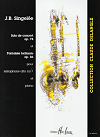
|
S575: Solo de Concert Op. 74 and Fantaisie Brillante Op. 86 for Alto Saxophone and Piano by Jean Baptiste Singelée. Editions Henry Lemoine, 1995, SS, 13 + 5 pages. From Collection Claude Delangle. Op. 74 is also known as the First Solo de Concert and Op. 86 is also known as Fantaisia Brilliante sur un theme original. Early college level.
Both Op. 86
|
21.95
|
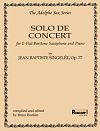
|
S235: Solo de Concert Op. 77 for Baritone Saxophone and Piano by Jean Baptiste Singelée edited by Bruce Ronkin. Roncorp, 1998, SS, 8 + 2 pages. This was a Paris Conservatory contest piece in 1861. It opens with an Andante section followed by an brief Allegro for the piano alone and concludes at Allegro moderato. Upper intermediate level and with a duration of about 3:15.
Free Media Mail shipping on this music to US, IF ordered with another item.
(Except other items with free shipping.)
|
16.00
|
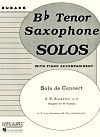
|
S341: Solo de Concert Op. 83 for Tenor Saxophone and Piano by Jean Baptiste Singelée adapted by Himie Voxman. Rubank, 1941, SS, 8 + 3 pages. This was Singelée's third Paris Conservatory contest piece (1862) and was originally for bassoon. In one movement (Allegro Moderato), with several sections and a cadenza in the middle. Upper intermediate level.
Free Media Mail shipping on this music to US, IF ordered with another item.
(Except other items with free shipping.)
|
5.95
|
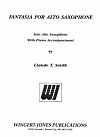
|
S319: Fantasia for Alto Saxophone Solo Alto Saxophone with Piano Accompaniment by Claude T. Smith. Wingert-Jones Publications, 1983, SS, 15 + 5 pages. Claude T. Smith (1932-1987) was one of the leading American composers for concert band, with many commissions from the armed forces bands. Appropriately, this piece is dedicated to Dale Underwood, who was a soloist with the United States Navy Band. It is in three sections: Allegro vivo, Lento rubato, and Allegro. College level. (There is also a band accompaniment available.)
|
15.95
|

|
S224: Seven Epigrams for Alto Saxophone and Piano by Randall Snyder. Southern Music Co., 1973, SS, 8 + 3 pages. Dedicated to Fred Hemke. Seven short pieces. College level.
Free Media Mail shipping on this music to US, IF ordered with another item.
(Except other items with free shipping.)
|
5.00
|
|
S187: Sonata for Alto Saxophone and Piano by Randall Snyder. Tenuto Publications, 1971, SS, 24 + 9 pages. This piece was written in 1967 when the composer was in graduate school. It won a first prize in the 1967 Phi Mu Alpha composition contest for Wisconsin composers. In three movements: I. Moderately fast, II. Slowly, and III. Quickly. College level with a duration of about 16:30. |
18.95
|
|
S764: Sonata for Tenor Saxophone and Piano by Leon Stein. Southern Music Co., 1979, SS, 28 + 8 pages. Leon Stein (1910-2002) was an American composer, music analyst and educator. This three movement work was written in 1967. I. Allegro vivace, II. Adagio, and III. Allegro. College level (US grade 5). |
13.50
|
|
S259: Romance for Alto Saxophone and Piano by William Grant Still. International Music Co., 1966, SS, 6 + 2 pages. William Grant Still (1895-1978) an African American composer, arranger, conductor, and musician was successful despite tremendous obstacles. This beautiful piece is not difficult but requires sensitivity from both performers. Duration about 4:45.
Free Media Mail shipping on this music to US, IF ordered with another item.
(Except other items with free shipping.)
|
10.50
|
|
S955: The Rite of Spring for Alto Saxophone and Piano by Igor Stravinsky arranged by David Dutkanicz. Carl Fischer, 2013, SS, 15 + 5 pages. This edition is presented in honor of the centennial of the ballet's premiere, and is intended to give soloists and accompanists a chance to perform two movements (I. Introduction - A Kiss of the Earth and II. Dance of the Young Maidens) from this monumental work. The movements can be performed separately, and the first movement can be played as a solo without piano accompaniment. Surprisingly, for a work that was released for several instruments at the same time, this is an advanced work that will required college level skill. Includes some flutter tonguing. Click on the cover image to view the first page of the piano score.
|
12.95
|
|
S1207: Scherzino for Alto Saxophone and Piano by Steven Stucky. Merion Music/Theodore Presser, 2016, SS, 5 + 2 pages. Steven Stucky (1949-1916) was a Pulitzer Prize winning American composer. This is a compact dazzler lasting only a few minutes, it was composed for John Sampen and Marilyn Shrude's "Modern Postcard" series. The aptly-named work stays extends to altissimo G. The publication includes John Sampen's performance suggestions. Click on the cover image to view the first page of the saxophone part. |
11.95
|
|
S1344: Sur la memoire for Soprano Saxophone (or Clarinet) and Piano Reduction by Stella Sung. Edition Henry Lemoine, 1998, SS, 14 + 4 pages. Stella Sung is an American composer who teaches at the University of Central Florida. This piece, which is marked Adagio misterioso, has some mixed meter and ocasionally reaches high into the altissimo (high B). Click on the cover image to view the first page of the saxophone part.
|
23.95
|
|
S1068: The Days for Soprano Saxophone and Piano Reduction by Pietro Tagliaferri and Massimo Berzolla. Edizioni Eufonia, SS, 10 + 2 pages. Pietro Tagliaferri is an Italian saxophonist and clarinetist, composer, media consultant and producer. This is an original work for saxophone and string orchestra. In three sections, mm=66 then mm=132 returning to the original tempo near the end. College level (but not difficult) with a duration of about 6 minutes. The original version with strings follows. Click on the cover image to view the first page of the saxophone part.
Free Media Mail shipping on this music to US, IF ordered with another item.
(Except other items with free shipping.)
|
19.95
|
|
|
S1068A: The Days for Soprano Saxophone and Strings by Pietro Tagliaferri and Massimo Berzolla. Edizioni Eufonia, SS, includes all parts and score. This is the original version with strings. It includes the saxophone part. The distribution of the string parts is 4-4-3-2-1. Here is a performance on YouTube.Click on the cover image to view the score. |
64.95
|
|
S631: When ... for Soprano Saxophone and Strings (Piano Reduction) by Pietro Tagliaferri and Massimo Berzolla. Edizioni Eufonia, SS, 8 + 2 pages. This is an original work for saxophone and string orchestra. While entirely at a tempo of mm=84 (in 3/4), it begins and ends with lyrical sections, while the middle is sixteenth notes based. The publisher's web site says there are jazz influences, but they appear to be subtle. We can get the string parts which would be about $75. Click on the cover image to view the first page of the saxophone part.
Free Media Mail shipping on this music to US, IF ordered with another item.
(Except other items with free shipping.)
|
20.95
|
|
S682: Pénombres VI for Alto Saxophone and Piano by Yoshihisa Taira. Editions Musicales Transatlantiques, 1997, 10 loose sheets with both saxophone and piano parts (2 copies). Yoshihisa Taira (1937-2005) was a Japanese born composer who arrived in Paris to study in 1966 and resided in France for the rest of his life. Pénombres VI uses contemporary notation and extended techniques such as multiphonics, high altissimo and flutter tonguing. An advanced work. This piece was on the list for the second round of the 2nd International Jean-Marie Londeix Saxophone Competition in 2008.
|
31.95
|
|
S274: Two Fantastics Op. 88 for Alto Saxophone and Piano by Jenö Takács. Doblinger, 1972, SS, 25 + 13 pages. Jenö Takács (1902-2005!) was an Austrian composer and pianist of Hungarian descent. He taught in a wide range of places including Cairo and Manila before World War II, Hungary during the war period, and in Cincinnati afterwards. His music was influenced by Bartok and some of the exotic places he had lived and worked. These two pieces can be performed separately. I. Tempo rubato (Andante, molto rubato) duration 5 minutes. II. Tempo giusto (Allegro vivace/Meno mosso/Andante, molto rubato), includes cadenzas for saxophone and piano, duration 6-7 minutes. Skilled players are required.
|
40.95
|
|
S757: Recuerdos de la Alhambra arranged for Alto Saxophone and Piano by Francisco Tárrega arranged by Wolfgang Birtel. Schott, 2010, SS, 6 + 1 pages. This piece which was written in 1896 and is a very popular piece for guitar. The arranger has given the melody to the saxophone and the background to the piano. It is in 3/4 at an Andante tempo and the saxophone part is relatively easy. Click on the cover image to view the first page of the score.
Free Media Mail shipping on this music to US, IF ordered with another item.
(Except other items with free shipping.)
|
5.95
|
|
S162: Sonatine Sportive for Alto Saxophone and Piano by Alexandre Tcherepnine. Alphonse Leduc, 1943, SS, 10 + 4 pages. This piece is unusual in that it has a sports theme. The first movement (Lutte) is a boxing match between the saxophone and the piano (with the audience to decide the winner). The second movement (Mi-temps) is a rest the two players are taking in the midst of the competition. The third movement (Course) is a race in the form of canon with the saxophone in the lead and the piano trying to catch up. This college level piece should be very entertaining. Here is a video. [We have another sports related piece, Yellow Jersey, for two clarinets.]
WW364: Sonatine Sportive for Alto Saxophone and Wind Trio (Oboe, Clarinet & Bassoon) by Alexandre Tcherepnine adapted by Edward Yadzinski. Alphonse Leduc, 1984, SS. Includes all parts and score.
|
S162
24.95
WW364
44.70
|
|
S590: Sonata in C minor for Tenor Saxophone and Piano by Georg Philipp Telemann edited by Himie Voxman with continuo realization by Richard Hervig. Rubank, 1968, SS, 12 + 6 pages. This is the fourth of a set of twelve Methodische Sonaten published in 1732 for flute and figured bass. In four movements: Allegro, Adagio, Allegro assai, Ondeggiando ma non adagio, and Allegro. The second movement includes both the original music and Telemann's own elaboration of the simpler version. A good piece for high school festivals and college auditions. Could also be played on the soprano saxophone. |
7.95
|
|
S342: Sonate for Alto Saxophone and Piano by Georg Philipp Telemann arranged by Jean-Marie Londeix. Alphonse Leduc, 1972, SS, 7 + 4 pages. In four movements: Siciliana (Andante), Spirtuoso, Andante, and Vivace. Often played at the college level but also used as a high school festival piece (grade 5 in Florida, for example).
Free Media Mail shipping on this music to US, IF ordered with another item.
(Except other items with free shipping.)
|
15.95
|
|
S343: Sonate for Soprano Saxophone and Piano by Georg Philipp Telemann arranged by Jean-Marie Londeix. Alphonse Leduc, 1982, SS, 7 + 4 pages. In four movements: Siciliana (Andante), Spirtuoso, Andante, and Vivace. Exactly the same piece as above, transposed for soprano saxophone (and sounding an octave higher).
Free Media Mail shipping on this music to US, IF ordered with another item.
(Except other items with free shipping.)
|
18.10
|
|
S629: Elegie for Tenor Saxophone or Clarinet and Piano by Alec Templeton. Emerson Edition, SS, 6 + 2 pages. Alec Templeton (1909-1963) was born in Wales and although blind from birth, studied piano and composition at the Royal College of Music in London. He moved to the United States in 1935 and was very successful as a pianist and entertainer. This piece was written in 1939. It has been described as displaying an enfolding calm and as a gentle lyrical piece. Marked Maestoso (mm=60), it has some rhapsodic elements and two short passages marked quasi cadenza. It should work fine on soprano saxophone as well. Duration about 5:50.
Free Media Mail shipping on this music to US, IF ordered with another item.
(Except other items with free shipping.)
|
13.95
|
|
S1264: Der Hölle Nachklang I for Alto Saxophone and Piano by Dimitri Terzakis. Edition Gravis, 1994, SS, 16 + 5 pages. Dimitri Terzakis (1938-) is a Greek composer. Literally translated the title is Hell Reverberation I. This piece which has a duration of about 10 minutes, uses some fractional tones and high altissimo to D-sharp. Here is an audio recording of the piece. |
19.95
|
|
S163: Ballade for Alto Saxophone and Piano by Henri Tomasi. Alphonse Leduc, 1939, SS, 28 + 8 pages. French composer Henri Tomasi (1901-1971) was a conductor and composer who wrote for the theatre (ballets and operas) and instrumental music, especially for wind instruments. Ballade is in one extended movement with many sections in a variety of tempos and meters. College level.
|
50.20
|
|
S865: Chant for Alto Saxophone and Piano by Augusta Read Thomas arranged for alto saxophone by Frederick L. Hemke. G. Schirmer, 2002/2005, 11 + 4 pages. Augusta Read Thomas (1964-) is an American composer currently teaching at the University of Chicago. This work was originally for cello. While generally at the slower tempos suggested by the title, this piece has many changes in tempo. Range to altissimo F-sharp. College level with a duration of 11 minutes (or 9:30 if the last segment is omitted). Here is the composer's description of the piece. |
14.95
|
|
S164: Concerto for Alto Saxophone and Orchestra (Piano Reduction) by Henri Tomasi. Alphonse Leduc, 1949, SS, 25 + 7 pages. Dedicated to Marcel Mule. In two movements: I. Andante et Allegro and II. Final (Giration). The first movement has a long cadenza. Advanced college level.
|
44.70
|
|
S362: Sonatina for Soprano Saxophone and Piano by Angelo Tonoli. EditionDarok, 1995, SS, 8 + 2 pages. A sectional piece beginning with Libero recitativo, and followed by Moderato, Adagio, and concluding with Presto. This piece is one of the options for the ABRSM Grade 6 exam.
Free Media Mail shipping on this music to US, IF ordered with another item.
(Except other items with free shipping.)
|
19.95
|
|
S516: Sonata for Alto Saxophone (or Viola) and Piano by Eduard Tubin. AB Nordiska Musikförlaget, 1993, SS, 29 + 9 pages (includes viola part in addition to the alto saxophone part). Eduard Tubin (1905-1982) was an Estonian composer and conductor who relocated to Sweden in 1944. This work was written in 1951 but apparently not published until 1993. In three movements: I. Allegro, II Troubadour Song from XIII century (Adagio), and III. Allegro vivace. This should appeal to those who like the more traditional, tonal pieces in the saxophone repertoire, but are looking for a piece which isn't well known. Early college level. |
19.95
|
|
S201: Sarabande and Gigue for Alto Saxophone and Piano by Fisher Tull. Boosey & Hawkes, 1979, SS, 11 + 4 pages. Written for and dedicated to Kenneth Deans who premiered the work at the World Saxophone Congress in 1976. The Saraband is straight forward, but the Gigue employs mixed meters (7/8, 6/8, 9/8, 3/4, 4/4, etc.), slap tonguing, and a few measures of high altissimo (up to a C sharp).
Free Media Mail shipping on this music to US, IF ordered with another item.
(Except other items with free shipping.)
|
22.95
|
|
S277: Sarabande for Soprano Saxophone and Piano by Mark-Anthony Turnage. Schott, 1997, SS, 4 + 2 pages. British composer Mark-Anthony Turnage (1960-) is one of the most admired and widely performed composers of his generation. His highly inventive compositional style—which incorporates his love of jazz and themes inspired by a wide range of interests and concerns, including literature, the arts, politics, and everyday life-results in works with a dramatic musical language that is distinctly his own. This piece for soprano saxophone and piano (plus optional large desk bells for each performer!) includes the unusual instruction that the saxophonist and the piano should be as far apart from each other as possible. Upper college level with a duration of about 4 minutes.
Free Media Mail shipping on this music to US, IF ordered with another item.
(Except other items with free shipping.)
|
9.95
|
|
S296: Two Elegies Framing a Shout for Soprano Saxophone and Piano by Mark-Anthony Turnage. Schott, 1997, SS, 16 + 12 pages. This is one of the composers most frequently performed works. Elegy 1 (With movement - molto rubato) is for saxophone alone. The piano joins the saxophone for the Shout which has been described as "violent and brusque" and "a quirky, frantic dance." In the final Elegy the saxophone and piano proceed at a leisurely mm = 66 pace with quite a bit of mixed meter. An advanced work. |
23.95
|
|
S846: Sonata Op. 56 for Tenor Saxophone and Piano by Burnet Tuthill. Southern Music Co., 1970, SS, 24 + 7 pages. In three movements: In three movements: I. Allegro, II. Andante, and III. Fast. The publisher has the rated as a US grade 5 piece. It is probably on the easier side of that grade. |
26.95
|
|
S285: Sonata Op. 20 for Alto Saxophone and Piano by Burnet Tuthill. Southern Music Co., 1966, SS, 24 + 7 pages. In three movements: I. Allegro giocoso, II. Andante, and III. Presto, molto vivace. The publisher rates this a level 5 (of 7) which is roughly advance high school/early college level.
|
12.95
|
|
S644: Sonata for Alto Saxophone and Piano by Matt Van Brink. Tenuto Publications, 2010, SS, 24 + 11 pages. The sparklingly fun-yet-deep composer Matt Van Brink presents a stunning new sonata for alto saxophone and piano, full of Van Brink's teasing wit, rhythms inspired by neo-classicism and neo-minimalism, and soaring lyricism that is very gratifying for saxophonists and pianists. In four movements with some mixed meter. Upper college level with a duration of 12 minutes. Here is a page with an audio sample (click on the right arrow) from the composer's web site of the entire first movement. |
18.95
|
|
S762: Sonatina for Alto Saxophone and Piano by Lex van Delden. Muziekgroup Nederland (Donemus), 1952. SB, 12 + 4 pages. Lex van Delden (1919-1988) was a Dutch composer. In three movements: I. Allegro, II. Aria, and III. Rondo a la Polka. College level with a duration of about 8:30. Here is a link to an audio recording of the first movement. The other two movements are there also.
|
99.95
|
|
S919: Sonata à la manière de Francis Poulenc for Alto Saxophone and Piano by Wijnand van Klaveren. Resolute Music Publications, 2012, SS, 12 + 6 pages. Wijnand van Klaveren (1975-) is a Dutch composer and pianist who has written music for saxophone(s) and other instruments. This piece in the style of Francis Poulenc is in three movements: I. Allegro, II. Interlude (Très calme et irréël), and III. Rondeau à la française (Très animé). Early college level with a range to altissimo G and a duration of about 9:30. You can listen to audio recordings and view a portion of the saxophone part here on the publisher's website.
|
37.50
|
|
S657: Six Studies in English Folk Songs for Alto Saxophone and Piano by Ralph Vaughan Williams arranged by Robert Stanton. Galaxy Music Corp., 1982, SS, 12 + 4 pages. A transcription of this well known work originally for cello and piano. While these pieces are relatively easy, the keys range from 2 to 4 sharps and it is mostly in the higher portion of the alto saxophone range. This is a new edition which has parts for cello, clarinet, and tuba(!) but requires the player to download the saxophone part. There are also downloadable parts for violin, viola, English horn, and bassoon. Here is the link for the saxophone part.
|
14.95
|
|
S778: Concerto Op. 65 for Alto Saxophone and Piano by Pierre Vellones. Editions Henry Lemoine, 1961, 44 + 11 pages. Pierre Vellones (1889-1939) was a French composer and a medical doctor. This piece was dedicated to Marcel Mule. It is in three movements: I. Introduction et Allegro, II. Alla Marcia et Andante Sostenuto, and III. Final. There are frequent tempo changes in each movement. This is a college level work.
|
34.95
|
|
S941: Tres Danses / Danzas for Alto Saxophone and Piano by Adolfo Ventas. Editorial de Música Boileau, 2005, SS, 21 + 8 pages. The three dances are: I. Exótica (starts and ends in 5/8), II. Tarantela and III. Oriental. Advanced high school/early college level. Click on the cover image to view the first page of the score. |
23.95
|
|
S450: À feu (With Fire) for Tenor Saxophone, Bandonéon, Piano, and Double Bass by Julio M. Viera. Editions Henry Lemoine, 2003, SS, (includes a score and individual parts for all instrutments). A contemporary tango.
|
20.95
|
|
/ S241: Fantasia for Soprano or Tenor Saxophone and Chamber Orchestra (Piano Reduction) by Heitor Villa-Lobos. Peer Music, 1963/2011, SS, 20 + 6 pages. Heitor Villa-Lobos (1887-1959) was a Brazilian who is regarded as the most significant Latin American composer.Written in Rio in 1948 and dedicated to Marcel Mule, this is a very popular piece which is often used for college auditions (although it is a college level work). It was originally written in concert F but that put the highest notes above the normal saxophone range so before the 1951 premier is was transposed to concert E-flat. This edition which was first published in 2013 incorporates corrections to the transposition and a revised piano reduction based on the composer's own work. Three movements: I. Animé, II. Lent/Lentemente, and III. Très Animé. Click on the cover image to view the second page of the saxophone part.
|
18.95
|
|
S1244: Chaconne en sol mineur Alto Saxophone and Piano by Tommaso Vitali arranged by Gerald Venturi. Lemoine, 2001, SS, 22 + 9 pages. Tomaso Vitali (1663-1745) was an Italian composer and violinist from Bologna. This piece which was originally for violin is probably his best known work today. The initial tempo is Adagio but there are many tempo changes in this work. While the publisher rates the difficulty of this piece as a 3 (moderate) on their 5 point scale, there are notes in the extended altissimo range to B. Click on the cover image to view a sample page from the saxophone part. |
28.95
|
|
S264: Sonata No. 6 in G Minor Alto Saxophone and Piano by Antonio Vivaldi edited by Josef Marx. McGinnis & Marx, 1964, SS, 17 + 5 pages. While many instruments were give on the original title page of this work first published in 1737, the editor believes this music was intended primary for the flute, oboe or violin. In four movements: 1. Vivace, 2. Alla breve Fuga da capella, 3. Allegro ma non presto, and 4. Largo. Advanced high school level. |
16.95
|
|
S265: Sonata No. 6 in G Minor Tenor Saxophone and Piano by Antonio Vivaldi transcribed by Sigurd Rascher. McGinnis & Marx, 1964, SS, 17 + 5 pages. While many instruments were give on the original title page of this work first published in 1737, the editor believes this music was intended primary for the flute, oboe or violin. In four movements: 1. Vivace, 2. Alla breve Fuga da capella, 3. Allegro ma non presto, and 4. Largo. Advanced high school level. |
16.95
|
|
S1246: Enchantress, Valse de Concert Alto Saxophone and Piano by Felix Vivier. Carl Fischer, 1925, 5 + 2 pages. Vivier Felix's Enchantress opens with an elaborate and decorative cadenza. Following the cadenza this piece features a simple Waltz tempo with a pleasant melody. Click on the cover image to view the first page of the saxophone part. Here is video performance by a 15 year-old student. Click on the cover image to view the first page of the saxophone part. |
9.95
|
|
S372: Souvenir: Toccata for Soprano Saxophone and Piano by Robert Walker. Maecenas, (written in) 1994, SS, 16 + 3 pages. The composer wrote: "Two friends, who happen also to be a saxophone and piano duo, were visiting me in my adopted home of Bali. . . I wrote them this, literally as a souvenir of their stay in Bali. It is a joyful piece, with no deeper meaning than to portray a little of the country, incorporating some Balinese rhythms and modes." It appears that most of the Balinese flavor is found in the piano part which has some tricky although frequently repeated rhythms. The saxophone part is straight forward and early college level at most. Duration about 4 minutes.
Free Media Mail shipping on this music to US, IF ordered with another item.
(Except other items with free shipping.)
|
19.95
|
|
S1191: Andante and Scherzo for Tenor Saxophone and Piano by David L. Walters. Southern Music, 1982, SS, 11 + 4 pages. David L. Walters (1923-2015) was an American music educator and band director. The music department at Jackson State (Alabama) is named for him. This piece is suitable for a mid-level high school performer. The music is in four sections: Andante Moderato, Scherzo, Andante Moderato (short), and Scherzo. Click on the cover image to view the first page of the saxophone part.
|
16.95
|
|
S226: An Abstract for Alto Saxophone and Piano by David Ward. Southern Music Co., 1963, SS, 4 + 2 pages. A short high school level piece in three sections Slowly/Allegro/Tempo I. Click on the cover image to view the first page of the saxophone part.
Free Media Mail shipping on this music to US, IF ordered with another item.
(Except other items with free shipping.)
|
10.95
|
|
S1104: Concerto for Tenor Saxophone and Piano by Robert Ward. Highgate Press/ECS Publishing, 1989, SS, 30 + 13 pages. Robert Ward (1917-2013) was an American composer who studied at Eastman and Julliard, where he joined the faculty in 1946. His style has been described as "largely from Hindemith, but also shows the considerable influence of Gershwin." This piece was written for James Houlik. It was premiered with orchestra in 1984. It is in two movements. College level with a duration of about 14 minutes. The score and orchestral parts are available as a rental. On YouTube can find videos of the first and second movement of this version and an audio recording with orchestra of the second movement by James Houlik. Click on the cover image to view several pages from the score. |
33.60
|
|
S878: After Hours Alto Saxophone and Piano by Pam Wedgwood. Faber Music, 2004, SS, 22 + 8 pages + CD. This book has 8 original tunes by Wedgwood. About half the music qualifies as jazz. Contents: Call It a Day (Slow blues), Sliding Doors (With a strong rhythmic feel), The Friends (Peacefully), Remember When (Relaxed, dinner-jazz style), Summer Nights (Tranquillo), Come Dance with Me (Slow and courtly/Fast boogie woogie), Falling (Gently), and Survivor (Swing Tempo). High school level. The CD has backing tracks and a full performance (which is with a variety of instruments). |
14.95
|
|
S361: Dance of the Fox Alto Saxophone and Piano by Leo Weiner transcribed by Lajos Darok. EditionDarok, 1941/1992, SS, 4 + 3 pages. An Eastern European dance in a Vivace 2/4. You may not recognize it from the title but this is a familiar piece, originally for piano. Upper intermediate level.
Free Media Mail shipping on this music to US, IF ordered with another item.
(Except other items with free shipping.)
|
10.50
|
|
S488: 2 Rudy Wiedoeft Classics for Alto Saxophone and Piano by Rudy Wiedoeft edited by Ted Hegvik. Et Cetera Productions, 1996. This set includes Valse Mazanetta and Saxema. Valse Mazanetta was written in 1924 and is in a lyric opera style that reflects Wiedoeft's work with singers and his year as a clarinetist with the Chicago Grand Opera Company. Saxema was first recorded in 1920 and along with Saxophobia was one of Wiedoeft's signature rags.
|
14.95
|
|
S375: Concert Pieces (Valse Erica, Sax-O-Phun, Saxophobia) Alto Saxophone and Piano by Rudy Wiedoeft transcribed by Nobuya Sugawa and Susumu Kusakabe. Zen-On Music, 2003, SS, 26 + 12 pages. Three popular Wiedoeft alto saxophone pieces which appear to have been transcribed from recordings.
|
18.95
|
|
S549: Valse Vanité for Alto Saxophone and Piano by Rudy Wiedoeft. Hunt Edition, 1954, SS, 7 + 2 pages. One of Wiedoeft popular waltzes, Valse Vanité was originally published in 1923.
Free Media Mail shipping on this music to US, IF ordered with another item.
(Except other items with free shipping.)
|
14.95
|
|
S484: Introduction and Samba Alto Saxophone and Piano by Maurice C. Whitney edited by Sigurd Rascher. Bourne Co., 1951, 7 + 4 pages. Maurice Whitney (1909-1984) received degrees from Ithaca College, and NYU. He was a performer, conductor, and an arranger of music for theater, and dance companies and wrote theory and band texts, and scores for small instrumental ensembles, band, and choir. This is an upper college level piece with altissimo to high A and optionally to the D above high D.
Free Media Mail shipping on this music to US, IF ordered with another item.
(Except other items with free shipping.)
|
6.95
|
|
S485: Rumba Alto Saxophone and Piano by Maurice C. Whitney. Bourne Co., 1949, 5 + 2 pages. Dedicated to Sigurd M. Rascher. Advanced high school/early college level. We have a play along CD available (M4115).
Free Media Mail shipping on this music to US, IF ordered with another item.
(Except other items with free shipping.)
|
6.50
|
|
S337: Sonata for Alto Saxophone and Piano by Alec Wilder with the saxophone part edited by Don Sinta. Margun Music, 1970, SS, 21 + 8 pages. Alec Wilder (1907-1980) was an American who composed for theater, radio, films and various Hollywood personalities including Benny Goodman. He composed short operas, chamber music, works for orchestra and many songs. This sonata is in four movements. A popular college level piece. |
14.95
|
|
S1140: Carol of the Bells for Alto Saxophone and Piano by Peter Wilhousky arranged by Larry Clark. Carl Fischer, 1936/2015, 2 + 1 pages. Holiday favorite Carol of the Bells has been arranged for easy instrumental solo to facilitate performance by any level or age of player (although it is most suitable for a near beginner). This carol is in 3/4 marked mm = 68 in one. The range is from middle of the staff B to the B an octave above it. Complete with piano accompaniment, this new solo arrangement is perfect for recital or your next holiday gathering. Click on the cover image to view the first page of the score with the solo in concert key.
Free Media Mail shipping on this music to US, IF ordered with another item.
(Except other items with free shipping.)
|
4.95
|
|
S1141: Carol of the Bells for Tenor Saxophone and Piano by Peter Wilhousky arranged by Larry Clark. Carl Fischer, 1936/2015, 2 + 1 pages. Holiday favorite Carol of the Bells has been arranged for easy instrumental solo to facilitate performance by any level or age of player (although it is most suitable for a near beginner). This carol is in 3/4 marked mm = 68 in one. The range is from The E at the bottom of the staff to the A above the staff. Complete with piano accompaniment, this new solo arrangement is perfect for recital or your next holiday gathering. Click on the cover image to view the first page of the score with the solo in concert key.
Free Media Mail shipping on this music to US, IF ordered with another item.
(Except other items with free shipping.)
|
4.95
|
|
S1142: Carol of the Bells for Baritone Saxophone and Piano by Peter Wilhousky arranged by Larry Clark. Carl Fischer, 1936/2015, 2 + 1 pages. Holiday favorite Carol of the Bells has been arranged for easy instrumental solo to facilitate performance by any level or age of player (although it is most suitable for a near beginner). This carol is in 3/4 marked mm = 68 in one. The range is from middle of the staff B to the B an octave above it. Complete with piano accompaniment, this new solo arrangement is perfect for recital or your next holiday gathering. Click on the cover image to view the first page of the score with the solo in concert key.
Free Media Mail shipping on this music to US, IF ordered with another item.
(Except other items with free shipping.)
|
4.95
|
|
S202: Escapades for Alto Saxophone and Orchestra, Piano Reduction by John Williams. Cherry Lane Music, 2002, SS, 27 + 14 pages. This very cool but challenging piece is from the film Catch Me If You Can. This is a suite of 3 pieces: 1. Closing In, 2. Reflections, and 3. Joy Ride. There is also a concert band accompaniment that works quite well.
 (Closing In only) (Closing In only)  (with orchestra) (with orchestra)
|
21.95
|
|
S347: Between Categories for Alto Saxophone and Piano by Arthur Woodbury. C.F. Peters, 1989, SS, 24 + 5 pages. The composer writes, "Between Categories is a very nostalgic piece for me. The two major musical styles in my life have been jazz and classical music. In the past, out of necessity, I have had to keep them separated. This piece is an attempt on my part to integrate these styles. I do not consider this piece 'third stream' but something of itself. It should not played for its jazz elements, or for that matter, for its classical elements, but as something in between— hence the title." An advanced piece with a duration of about 7 minutes. The piano part appears to be the more challenging of the two.
|
4.25
|
|
S530: Sonata for Alto Saxophone and Piano by Phil Woods. Advance Music, 1997, SS, 28 + 10 pages. This piece was composed for and dedicated to Victor Morosco and was (according to information found on the internet) was originally known as Four Moods. There is a strong jazz influence and the notated sections (which make up the bulk of the piece) are interspersed with chord changes for improvisation. There is also a full page of performance notes by Victor Morosco. An advanced work with a duration of about 16:30.
|
23.95
|
|
S1325: Claremont Concerto for Alto Saxophone and Piano Reduction by John C. Worley, piano reduction by Walter S. Hartley. Theodore Presser, 2001, SS, 47 + 15 pages. John C. Worley (1919-1999) was an American college professor, saxophonist, and a composer of classical and contemporary music particularly for saxophone. Composed in 1962, it is in three movements: 1. Moderato (molto allegro), 2. Adagio, and 3. Molto allegro. Neat manuscript. Altissimo to triple high (?) G. This is a challenging work but there are no contemporary features aside from the high altissimo. |
79.95
|
|
S754: Sonata for Alto Saxophone and Piano by John C. Worley, solo part edited by Sigurd Rascher. Carl Fischer, 1979, SS, 26 + 10 pages. This is a very nice contemporary work. In three movements: I. Andante moderato, "with intensity;" II. Adagio, dolce espressivo, "with contemplation;" and III. Freely, "with exhilaration." College level with some high altissimo to B-flat. Here is the first movement on YouTube, the rest should be easy to find.
|
17.95
|
|
S346: Divertimento Alto Saxophone and Piano by Charles Wuorinen. C.F. Peters, 1983, SB, 22 + 6 pages (large format). Charles Wuorinen (1938-) is an American who was the youngest composer to win the Pulitzer Prize for music. This work has been described as "vividly lyrical" and "full of intricate counterpoint." This is an advanced college level/ professional piece with lots of mixed meter and range to altissimo C. Duration is about 11:30.  Here is a video performance. Here is a dissertation about this work. The current list price of this work is $29.95. Here is a video performance. Here is a dissertation about this work. The current list price of this work is $29.95.
|
24.50
|

|
S339: Fuzzy Bird Sonata for Alto Saxophone and Piano by Takashi Yoshimatsu. Billaudot, 1995, SB, 28 + 8 pages. Takashi Yoshimatsu (1953-) is a contemporary Japanese composer. This piece has three movements: 1. Run, bird (Allegro vivace), 2. Sing, bird (Largo), and 3. Fly, bird. This piece uses some contemporary notation and extended techniques. An advanced work.
|
22.95
|

|
S596: Intermezzo for Soprano Saxophone and Piano by Emmett Yoshioka. Southern Music Co., 1996, SS, 9 + 3 pages. Emmett Yoshioka (1944-) is an American composer from Hawaii who was educated at the University of California. This piece is suitable for advanced high school and early college saxophonist and is found on some solo and ensemble festival lists.
|
14.95
|

|
S430: Concerto for Alto Saxophone and Wind Ensemble (Piano Reduction) by Charles Rochester Young. Southern Music Co., 2008, SS, 26 + 7 pages. Charles Rochester Young (1965-) is an American composer and music educator. This piece was commissioned by Donald Sinta and the University of Michigan Symphony Band and was premiered in 2003. An advanced work in three movements: I. Celebratory, II. Anguished, and III. Lively. The first movement has a cadenza and the third movement features mixed meter (7/8, 6/8, 5/8). The wind ensemble parts are available as a rental. |
12.50
|

|
S834: Divertimento for Marimba and Alto Saxophone by Akira Yuyama. Ongaku No Tomo Edition, 1971/1976, SS, 18 pages (two copies in score format). Born in 1932 in Kanagawa Prefecture, Akira Yuyama was one of the new generation of Japanese composers who came to prominence in the 1950s, particularly for instrumental solo works, choral music, and music for children. This 1968 piece was an early example of marimba music in Japan. It is written in a Western style as a set of variations in a rondo form. The piece gives equal attention to both instruments, calling for skilled playing. In one short section the marimba player uses six mallets at the same time. Here is a performance on YouTube.
|
73.95
|

|
/ S1098: Contrastes for Alto Saxophone or Baritone Saxophone and Piano by Javier Zalba. Advance Music, 2014, SS, 9 + 3 pages. Javier Zalba (1955-) is a Cuban clarinetist, saxophonist, and flutist as well as a composer. As the name suggests, this piece has a variety of tempos and styles. It also includes a brief optional improvised section. Early college level/college level. Click on the cover image to view the first page of the saxophone part. |
21.95
|
|
S859: Suite "Exposiciones" for Soprano Saxophone (opt. Alto Saxophone) and Piano by Javier Zalba. Advance Music, 2011, SS, 23 + 9 pages + CD. Dedicated to Paquito D’Rivera, this piece is a fusion of jazz and classical elements in four movements: Allegro Moderato, Lento, Allegretto, and Allegro con Fuoco. There are improvised sections in the first and last movement with suggested solos provided on separate sheets. The CD has the complete work performed by the composer and a piano only version for play along. Click on the cover image to view the first page of the score (although it doesn't really give much of a preview of the scope of the piece). |
25.95
|

|
S453: Quintet for Alto Saxophone and String Quartet by Ellen Taaffe Zwilich. Presser, 2008, SS, 26 + 8 pages (this is the solo part and score). Pulitzer prize-winning composer Ellen Taaffe Zwilich gives us a beautiful quintet for alto saxophone and string quartet, perfect for serious saxophonists looking to expand their recital repertoire. Advanced players are needed on all parts of this 20 minute piece.
S454: Quintet for Alto Saxophone and String Quartet by Ellen Taaffe Zwilich. Merion Music, 2008, SS. String parts.
|
Solo Part
19.95
String Parts
42.95
|