Music for Clarinet with Strings
(with or without piano)



Music marked "New!" in gold type is a new publication. Music marked "New!" in teal type is new to our stock. The music is in alphabetical order by composer except the first item.
|
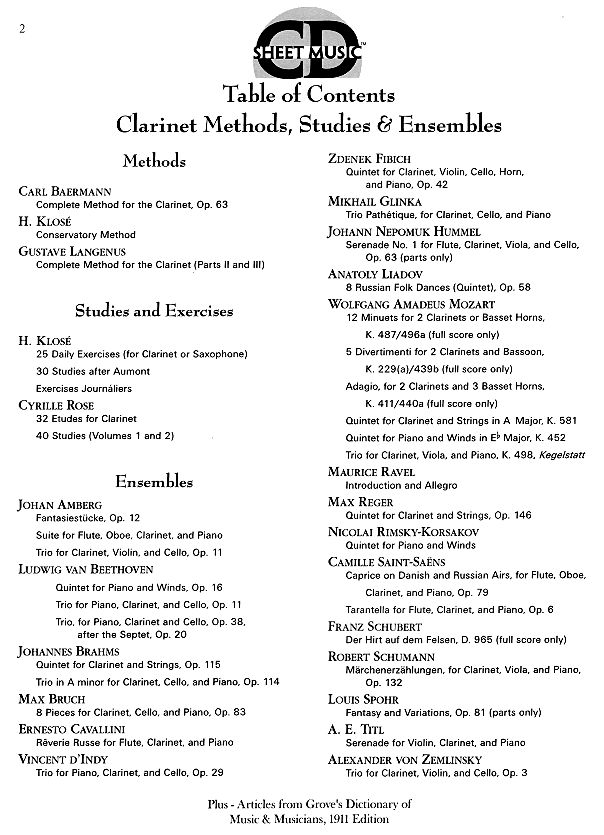
C1574: Clarinet Methods, Studies & Ensembles. CD Sheet Music LLC, 2010, 2100+ pages. This collection makes available eight essential clarinet methods, studies and exercises, as well as over 30 works for clarinet with instruments including duos, trios and quartets by 20 familiar and lesser known composers from the 18th, 19th and early 20th centuries. Scores and parts are included for many ensemble works. Methods, Studies & Exercises include: Baermann (Complete Method for Clarinet, Op. 63); Klosé (Conservatory Method, 25 Daily Exercises, 30 Studies after Augmont); Langenus (Complete Method for Clarinet); Rose (32 Etudes for Clarinet). Ensembles include: Amberg (Fantasiestücke, Suite for Flute, Oboe, Clarinet & Piano); Beethoven (Quintet for Piano and Winds); Brahms (Quintet for Clarinet & Strings, Trio for Clarinet, Cello & Piano); Bruch (8 Piece for Clarinet, Cello & Piano); Cavallini (Rêverie Russe for Flute, Clarinet, and Piano); d'Indy (Trio for Piano, Clarinet, and Cello); Fibich (Quintet for Clarinet, Violin, Cello, Horn, & Piano); Glinka (Trio Pathétique, for Clarinet, Cello, & Piano); Hummel (Serenade No. 1 for Flute, Clarinet, Viola, & Cello); Liadov (8 Russian Folk Dances); Mozart (Twelve Minuets for 2 Clarinets or Basset Horns, Five Divertimenti for 2 Clarinets & Bassoon, Quintet for Clarinet & Strings, Quintet for Piano & Winds, Trio for Clarinet, Viola & Piano); Ravel (Introduction & Allegro); Reger (Quintet for Clarinet & Strings); Rimsky-Korsakov (Quintet for Piano & Winds); Saint-Saëns (Tarantella for Flute, Clarinet & Piano); Schubert (Der Hirt auf dem Felsen); Schumann (Märchenerzählungen, for Clarinet, Viola & Piano); Spohr (Fantasy & Variations); Titl (Serenade for Violin, Clarinet & Piano); Zemlinsky (Trio for Clarinet, Violin & Cello). Also includes composer biographies and relevant articles from the 1911 edition of Grove's Dictionary of Music and Musicians. Click on the image cover to view the complete Table of Contents. (Except other items with free shipping.) |
19.95

|
|
C1147: Suite for Trio (Violin, Clarinet and Piano) by Alexander Arutiunian. Zen-on Music, 1994, SS, includes piano score and parts. Alexander Arutiunian (1920-) is an Armenian born composer and pianist. This work was commissioned by the Verdehr Trio in 1992. It is in three movements: I. Introduction (Lento), II. Scherzo (Allegretto), III. Dialog (Adagio), and IV. Final (Allegro non troppo). The second movement was originally written for clarinet in A and that part is also included. College level with a duration of about 14 minutes.
|
36.95
|
|
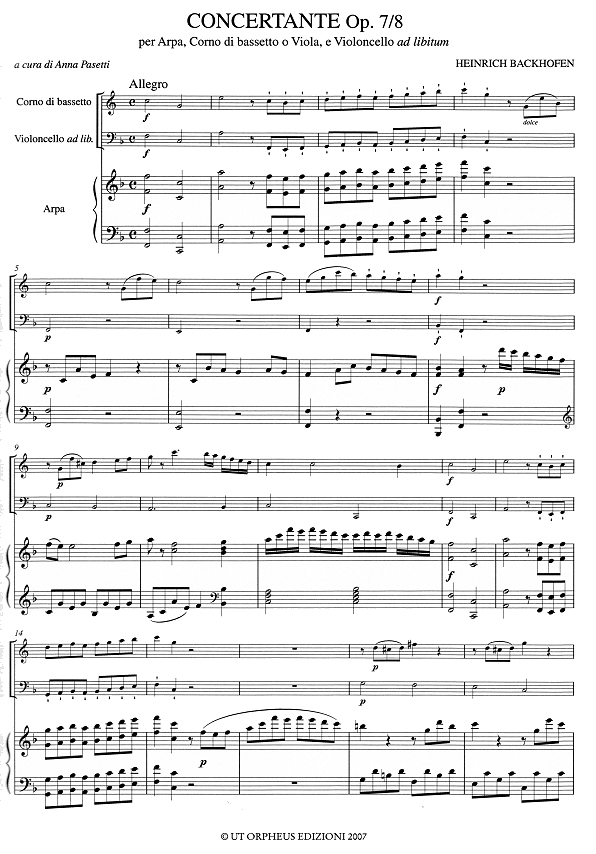
C2245: Concertante Op. 7/8 Suite for Harp, Basset Horn (or Viola), and Violoncello ad libitum by Heinrich Backofen edited by Anna Pasetti. Ut Orpheus Edizioni, 2007, SS. includes parts and harp score. Heinrich Backofen (1768-1839) was a German composer, harpist and clarinetist. This piece was written for the hook harp (photo) which employed hooks to adjust the pitch of a string. The pedal harp existed at the same time but some players thought the hook harp was superior. The music is in two parts: Allegro and Theme and (6) Variations. The cello part is mostly reinforcement for the harp but is not exactly the same. Here is an audio recording without the cello but with the some added ornamentation and articulation. Click on the cover image to view the first page of the score. |
29.95
|
|
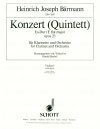
C378: Baermann Concerto (Quintet) for Clarinet in E-flat major Op. 23 String parts by Heinrich Baermann edited by Harald Strebel. Schott, 1986, SS. These are the string quartet parts for the Baermann Concerto (Quartet). In three movements: Allegro non troppo, Adagio, and Rondo. The matching clarinet part is in the piano reduction. Parts (strings and two optional horns in E-flat) and a score for the orchestral version are also available. Contact us for details.  
|
52.95
|
|
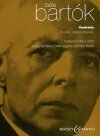
C515: Contrasts for violin, clarinet, and piano by Béla Bartók edited by Nelson Dellamaggiore and Peter Bartók. Boosey & Hawkes, 1942 (corrected edition 2002), SS. Includes parts and piano score. Written for and dedicated to Benny Goodman and Joseph Szigeti who premiered and recorded the work with the composer. Calls for clarinets in A and B-flat. Three movements: Verbunkos, Pihenö, and Sebes. It is one of best works in the repertoire for this combination of instruments and requires a high degree of virtuosity. Musically, the work has a very strong Hungarian flavor. The edition includes a preface by Peter Bartók and notes on the editing in English, German, and French.   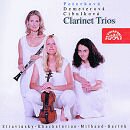 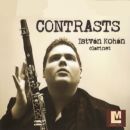 C515a: Contrasts for violin, clarinet, and piano Miniature Score by Béla Bartók edited by Nelson Dellamaggiore and Peter Bartók. Boosey & Hawkes, 2002, SS, 38 pages. Includes editorial notes in English, German, and French. |
Parts 49.95
Min. Score
22.95
|
|
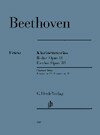
C334: Beethoven Clarinet Trios Op. 11 and Op. 38 by Ludwig van Beethoven. Henle, 1981, PB. Includes performance parts for clarinet in B-flat, the alternate violin part, the violoncello part, and the piano part which includes the other parts in the score. Op. 11 was written in 1798 and Op 38 (which was based on the septet Op. 20) was completed in 1802/03.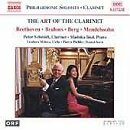 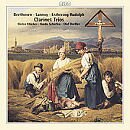 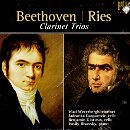
|
53.95
|
|
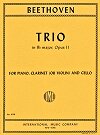
C1383: Beethoven Clarinet Trio in B-flat Major Op. 11 by Ludwig van Beethoven edited by Isidor Philipp. International Music, 1952, SS. Includes performance parts for clarinet in B-flat, the alternate violin part, the violoncello part, and piano score.
|
20.75
|
|
C1384: Beethoven Clarinet Trio in E-flat Major Op. 38 by Ludwig van Beethoven. International Music, SS. Includes performance parts for clarinet in B-flat, the alternate violin part, the violoncello part, and piano score. This piece was transcribed by the composer from his Septet Op. 20. |
23.95
|
|
C858: Clarinet Quintet by Richard Rodney Bennett. Novello, 1992, SS, parts only. Richard Rodney Bennett (1936-2012) was one of the leading English composers of recent times. This work. written for the Warwick Festival in 1992, is in four movements: I. Con moto, II. Presto, III. Romanza (Adagio), and IV. Vivo e ritmico. Upper college level with a duration of about 17 minutes. You can read a full description of the quintet here. |
59.95
|
 |
C2261: Blue Monkey for clarinet and violin by Lauren Bernofsky. Theodore Presser Co., 2015, 3 pages (score format). Lauren Bernofsky (1967-) is an American composer. This is a short (~2:30), jaunty duo, perfect for concert/recital programming. The main riff in swing eighths is repeated throughout, ensuring that it sticks in the mind of the audience.We also sell versions for two clarinets (or clarinet and bass clarinet) and clarinet and flute. Here is a video of this piece with the composer playing violin. (Except other items with free shipping.) |
6.95
|
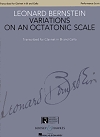 |
C2059: Variations on an Octatonic Scale for clarinet and cello by Leonard Bernstein. Boosey & Hawkes, 2013, SS, 10 pages (score format). Previously unpublished, Bernstein's Variations on an Octatonic Scale was originally composed for recorder and cello in 1988-89 in Key West. This is a transcription for clarinet in B-flat and cello. There is a theme, four variations, and a coda. Early college level with a duration of 6 minutes. |
9.95
|
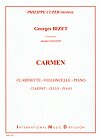 |
C1814: Carmen arranged for clarinet, cello and piano by Georges Bizet arranged by Alexandre Ouzounoff. International Music Diffusion, 2010, SS, includes parts and piano score. This arrangement includes the Ouverture, Act 1 Marche et choeur degamins, Act 1 Chanson et duo, Act 2 Couplets, Habanera, Entr'acte No. 3, and Act 2 Chanson gitane. Includes parts for both A and B-flat clarinet (I suggest using both). Early college level. |
38.95
|
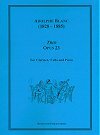 |
C672: Trio Op 23 for clarinet, cello and piano by Adolphe Blanc. Rosewood, 1999. With alternate parts for violin in place of clarinet and bass clarinet, basset horn or viola in place of cello. Adolphe Blanc (1828-1885) was a French composer who was an especially prolific composer of chamber music. It is in three movements: I. Allegro ma non troppo, II. Scherzo (Vivace), and III. Andante/Moderato. |
25.95
|
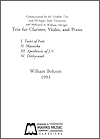 |
 C2552: Trio for clarinet, violin and piano by William Bolcom. Edward B. Marks Music, 1993, clarinet and violin parts only. This piece was commissioned byt the Verdehr Trio and Michigan State University and dedicated with William Albright. It is in four movements: I. Twist of Fate, II. Mazurka, III. Apotheosis of J.V. and Dithyramb. This is an advanced work. Duration about 15:30. Here is a video performance.C2556: Trio for clarinet, violin and piano by William Bolcom. Edward B. Marks Music, 1993, piano score. C2552: Trio for clarinet, violin and piano by William Bolcom. Edward B. Marks Music, 1993, clarinet and violin parts only. This piece was commissioned byt the Verdehr Trio and Michigan State University and dedicated with William Albright. It is in four movements: I. Twist of Fate, II. Mazurka, III. Apotheosis of J.V. and Dithyramb. This is an advanced work. Duration about 15:30. Here is a video performance.C2556: Trio for clarinet, violin and piano by William Bolcom. Edward B. Marks Music, 1993, piano score. |
Parts
30.95
Score
47.95
|
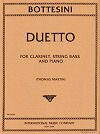 |
C1069: Duetto for Clarinet, String Bass and Piano by Giovanni Bottesini edited by Thomas Martin. International Music Co., 1999, SS (includes parts and piano score). Giovanni Bottesini (1821-1889) was an Italian musician and composer who was known as "the Paganini of the Double Bass." His father was a clarinetist. This is a virtuoso piece for clarinet and double bass. The piano is in an accompanying role and the part is not difficult. In two movements: I. Allegro/Adagio/Andante and II. Allegro. |
17.25
|
|
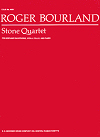
S585: Stone Quartet for Soprano Saxophone (or Clarinet), Viola, Cello and Piano by Roger Bourland. E.C. Schirmer, 1989, SS, includes parts and piano score. This two movement piece was written in 1982 and was name for the saxophonist the premiered the work, Richard Paul Stone. The first movement is The Strange Juggler which was inspired by a painting by Odilon Redon. The tempo is presto. The second movement is Dark Chaconne. It has some mixed meter and in the second part of the piece the strings play 32nd note arpeggios. College level with a duration of 9 minutes. This piece won awards as the Best New Music of 1982 in Boston. There are some samples here which do not necessarily start from the beginning of the piece. |
25.20
|
|
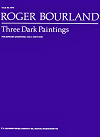
S586: Three Dark Paintings for Soprano Saxophone (or Clarinet), Viola and Cello by Roger Bourland. E.C. Schirmer, 1989, 3 copies of the music in score format. This piece was written 1981. The movements are: I. Spanish Black (Doloroso). II. Eyes in the Heat II (Rapidly), III Red Black Widow. This is a challenging piece, especially the second movement which has many rapid figures. Duration 12 minutes. There are some samples here which do not necessarily start from the beginning of the piece. |
17.35
|
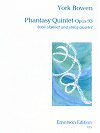 |
C599: Phantasy Quintet Op. 93 for bass clarinet and string quartet by York Bowen. Emerson Edition, 1954. Bowen (1884-1961) was an English composer and professor of piano at the Royal Academy of Music. This piece was written sometime between 1933 and 1936 as an entry in a competition. It is in three movements: Allegro moderato (with many tempo changes); Allegro con spirito, non troppo; and Allegro moderato ma più tranquillo. Low E is the lowest bass clarinet note. Includes a score and parts. This is an advanced college or professional work. Duration about 14 minutes. |
54.95
|
|
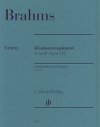
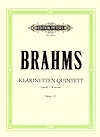
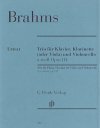
C329: Brahms Clarinet Quintet in B minor Op. 115 (Parts) by Johannes Brahms edited by Andrea Massimo Grassi. Henle, 2000, SS. Performance parts for clarinet in A and string quartet. This outstanding edition includes an informative preface and detailed comments on the editing including the sources and musical examples. All text is in German, English and French. We also have a version arranged for clarinet and piano here.     C1399: Brahms Clarinet Quintet in B minor Op. 115 (Score) by Johannes Brahms edited by Kathrin Kirsch. Henle, 2000, SS, 65 pages. Since the edition of the parts shown above does not include the score, we have the Henle Study Score for those that want it. It also includes the preface and notes. |
Parts
69.95
Score 34.95
|
|
C2119: Brahms Clarinet Quintet in B minor Op. 115 by Johannes Brahms edited by the Gewandhaus-Quartet. C.F. Peters, SS. Performance parts for clarinet in A and string quartet.
|
34.25
|
|
C360: Brahms Trio for Piano, Clarinet (or Viola) and Violoncello in A minor Op. 114 by Johannes Brahms edited by Monika Steegmann with piano fingering by Hans-Martin Theopold. Henle, 1979, PB. Performance parts for clarinet in A (plus alternate viola part), violoncello, and piano (score). Includes a preface and comments on the editing. All text is in German, English and French.  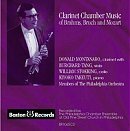 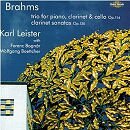 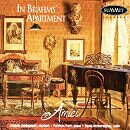  
|
35.95
|
|
C1810: Brahms Trio for Piano, Clarinet (Violin or Viola) and Violoncello in A minor Op. 114 by Johannes Brahms edited by Georg Schumann. C.F. Peters, SS. Performance parts for clarinet in A (plus alternate violin and viola parts), violoncello, and piano (score).
|
26.75
|
|
C1825: Brahms Trio for Piano, Clarinet (Violin or Viola) and Cello in A minor Op. 114 by Johannes Brahms. International Music Co., SS. Performance parts for clarinet in A (plus alternate violin and viola parts), cello, and piano (score).
|
23.50
|
|
C2028: Brahms Trio for Piano, Clarinet (or Viola) and Violoncello in A minor Op. 114 by Johannes Brahms edited by Christopher Hogwood. Baerenreiter, 2012, SS. A new edition with performance parts for clarinet in A (plus alternate viola part), violoncello, and piano (score). Bärenreiter’s scholarly-critical edition, prepared by Christopher Hogwood, offers a foreword on the trio’s compositional process with comments on performance practice, as well as a comprehensive critical commentary and facsimile excerpts of the manuscript. The text is in English and German.
|
31.95
|
 |
WW069: Trio in D minor for Oboe (Clarinet), Bassoon (Viola/Bass Clarinet/Basset Horn) and Piano by Alexander Brent-Smith. Rosewood, 2003, (includes piano score and all parts). Alexander Brent-Smith (1889-1950) was a British composer, author, and teacher. This work was first performed in 1943. It is in three movements I. Allegro Moderato, II. Andante, and III. Allegretto. It should be playable by those at the early college level (and adult amateurs). |
23.95
|
 |
C986: Klezmer Music for Clarinet, Viola and Piano by Elissa Brill. Arsis Press, 1994, (includes piano score and parts). Klezmer Music is not a traditional Klezmer piece, but was inspired by and owes much of its structure to this Yiddish folk form. In one movement with alternating slow and fast sections and includes a cadenza played independently and simultaneously by all players. An advanced work with a duration of about 9 minutes. |
11.95
|
|
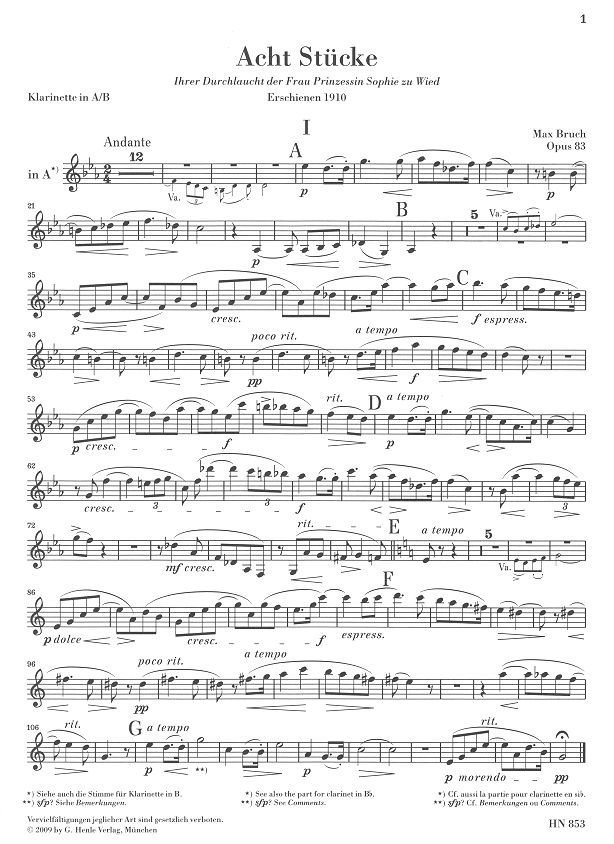
C2650: Acht Stücke Op. 83 (Eight Pieces) for Clarinet (Violin), Viola (Violoncello) and Piano by Max Bruch edited by Annette Oppermann. Henle, 2009, PB/SS, includes piano score and all parts. Max Bruch composed these eight, highly romantic pieces for his son Max Felix, a talented clarinetist. In order to enable the work to be played more widely, Bruch arranged the clarinet part for violin and the viola part for cello. This edition contains two complete clarinet parts (1-3 and 8 include A clarinet) and plus a transposed version for clarinet in B-flat, thus allowing it to be played by those who own only B-flat instruments. In addition, all of the eight pieces are presented here in an Urtext edition for the first time and in one volume. Includes a Preface in German, English and French and Notes on the editing in German and English. Click on the cover image to view the first page of the clarinet part. 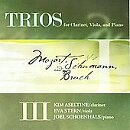
|
70.95
|
|
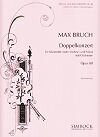
C1026: Double Concerto Op. 88 for Clarinet (or Violin), Viola and Piano by Max Bruch. Simrock, 1977. This is a piano reduction of this very popular Bruch work for clarinet in A, viola and orchestra. In three movements: I. Andante con moto, II. Allegro moderato, III. Allegro molto. The violin part is included.  
|
30.95
|
|
C707: Eight Pieces Op 83 Vol. 1 for Clarinet, Viola and Piano (or Violin, Violoncello and Piano) by Max Bruch. Masters Music, SS. This volume contains the first four pieces: I. Andante, II. Allegro con moto, III Andante con moto/Andante, and IV.Allegro agitato. The first three are for clarinet in A and the fourth for clarinet in B-flat. Includes parts for all instruments including alternates. This edition is currently not available. We suggest you purchase C2650 or C1574.
|
16.95
|
|
C708: Eight Pieces Op 83 Vol. 2 for Clarinet, Viola and Piano (or Violin, Violoncello and Piano) by Max Bruch. Masters Music, SS. This volume contains the second four pieces: V. Rumänische Melodi (Andante), VI. Nachgesang (Andante con moto), VII. Allegro vivace, ma non troppo and VIII. Moderato. Number VII is for A clarinet and the rest are for B-flat clarinet. Includes parts for all instruments including alternates. This edition is currently not available. We suggest you purchase C2650 or C1574.
|
15.95
|
|
 S1327: Suite for Violin and Saxophone (Clarinet) or Viola for Alto Saxophone and Violin or Viola by Adolf Busch. Amadeus, 1988, SS. Adolf Busch (1891-1952) was a German violinist and conductor. A protégé of Max Reger, he became concertmaster of the Vienna Konzertverein at 20 and founded the legendary Busch Quartet after World War I. Although he was not Jewish, he was firmly opposed to Nazism and lived in Switzerland and finally the United States. This piece includes two copies or the score for violin and viola, and parts for both alto saxophone and clarinet. It is in four movements Praeludium, Sarabande, Gavotte, and Gigue. Since the clarinet part is a transposition of the saxophone part it is mostly within the lower two octaves of the clarinet range. It is generally at the upper intermediate level, although the last movement is more difficult. Here is a recording. S1327: Suite for Violin and Saxophone (Clarinet) or Viola for Alto Saxophone and Violin or Viola by Adolf Busch. Amadeus, 1988, SS. Adolf Busch (1891-1952) was a German violinist and conductor. A protégé of Max Reger, he became concertmaster of the Vienna Konzertverein at 20 and founded the legendary Busch Quartet after World War I. Although he was not Jewish, he was firmly opposed to Nazism and lived in Switzerland and finally the United States. This piece includes two copies or the score for violin and viola, and parts for both alto saxophone and clarinet. It is in four movements Praeludium, Sarabande, Gavotte, and Gigue. Since the clarinet part is a transposition of the saxophone part it is mostly within the lower two octaves of the clarinet range. It is generally at the upper intermediate level, although the last movement is more difficult. Here is a recording. |
20.95
|
 |
C598: Carnovale for clarinet in A and string quartet by Ernesto Cavallini edited by Pamela Weston. Emerson Edition, 2002. This very short (16 bar) clarinet quintet which is the statement of the theme of "O mamma, mamma cara!" from Il Carnevale di Venezia is suggested as a brief encore after performing one of the major clarinet quintets such as the Mozart or Brahms. It is based on a manuscript by Cavallini that may have been prepared as a memento prior to the publication of his Carnival of Venice variations. (Except other items with free shipping.) |
6.95
|
 |
C939: Quintet for Clarinet in A and String Quartet by Friedrich Cerha. Doblinger, 2005, (parts only). Friedrich Cerha (1926-) is a leading Austrian composer and conductor. This is one of Cerha's most recent compositions and been described as a work that is accessible from the first hearing and highly expressive. In four movements: I. Stürmisch, II. Sehr ruhig, III. Intermezzo, and IV. Energico. An advanced work. C940: Quintet for Clarinet in A and String Quartet by Friedrich Cerha. Doblinger, 2005, 40 pages. Score. |
Parts Score45.95 39.95
|
 |
C660: Prelude, Allegro, and Pastoral for B-flat Clarinet and Viola by Rebecca Clarke. Oxford University Press, 2000, SS, 16 pages. Clarke who was born in England in 1886 and died in New York 1979, was one of the finest viola players of her day and also an excellent composer who studied with Stanford. This piece was composed in 1941 and this is the first publication. It is in score format. College level. (Except other items with free shipping.) |
24.95
|
 |
C1950: Suite, Op. 72, Entre Dos Mundos (Between Two Worlds) for Clarinet in A and Guitar by James Cohn. XLNT Music, 1994, SB, includes score which is typeset and manuscript clarinet and guitar parts. In five movements: I. Crepúsculo (Twilight) (Andante moderato), II. Canción (de Martin) y Danza (Andante cantabile), III. El Torbellino (The Whirlwind) (Allegretto marcato), IV. Canto de Liberación (Song of Deliverance) (Andante ma con Fuoco), and V. Recuerdos de las Americas (Memories) (Andante con moto). College level. |
27.95
|
 |
C1949: Three Dances Op. 87 for Clarinet (in A and B-flat) and Guitar by James Cohn. XLNT Music, 2005, SB, includes parts and score. Dedicated to Raphael Sanders Jr. and David Galvez. The three movements are 1. Handkerchief Dance (Allegretto con fuoco), 2. Old Mountaineer's Dance (Fast Waltz Tempo), and 3. Viva Mexico! (Allegro vivace). College level. |
19.95
|
 |
C2612: Trio for Clarinet, Cello and Piano by James Cohn. XLNT Music, 2013, SB, includes parts and piano score. This piece is in 4/4 (mm = 152) and is marked Allegreto fluendo. The piano is a full participant in this trio and is primarily a single treble and bass line. College level but not especially difficult. (Except other items with free shipping.) |
19.95
|
 |
C2613: Variations on a Boogie for Clarinet (in A), Cello and Piano by James Cohn. XLNT Music, 2016, SB, includes parts (including a piano part) and score. This fun boogie is in 12/8 and the beat is mm=132. The piano part is primarily a single treble and bass line. |
24.95
|
 |
C673: Quintet in F-sharp minor Op. 10 for Clarinet in A and String Quartet by Samuel Coleridge-Taylor. Breitkopf, 1974, SS, (parts only). Samuel Coleridge-Taylor (1875-1912) was an Afro-British composer, conductor, and professor of music. In four movements: I. Allegro energico, II. Larghetto affettuoso, III. Scherzo, IV. Finale (Allegro agitato).While this was an early work of Coleridge-Taylor, it is well regarded and will be a good addition to the repertoire of college level performers. Click here to see the first movement on YouTube. The other movements are there as well. |
36.95
|
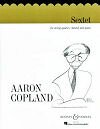 |
C853: Sextet for string quartet, clarinet and piano by Aaron Copland. Boosey & Hawkes, 1948, SS, includes piano score and parts. Three movements: Allegro Vivace, Lento, and Finale. The style is similar to the Clarinet Concerto with the strong jazz influence. All parts require good players and the rhythm plays an important part in setting the mood of the fast movements. |
64.95
|
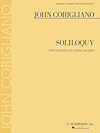 |
C2693: Soliloquy for Clarinet and String Quartet by John Corigliano. G. Schirmer Inc., 1978/1995, SS, includes parts and score. From the composer: "Soliloquy was written in memory of my father, who died on September 1, 1975. He had been a concertmaster of the New York Philharmonic for 23 years, and I still find it hard to think of that orchestra without him sitting in the first chair. So the idea of an extended dialogue for clarinet and violin seemed not only natural but inevitable. The Soliloquy begins with a long, unaccompanied line for the violin. The other strings enter, and a mood of sustained lyricism introduces the clarinet. The prevailing feeling is that of desolation. I deliberately avoided an emotional climax in the Soliloquy, feeling that sustaining the same mood throughout the music would achieve a heightened intensity. Structurally, this movement alternates two melodic ideas. The first is introduced by the violin (in B), while the second (in B-flat) is represented by the clarinet. A three-note motto (C-sharp, B, B-flat) grows from the alternation of the two tonalities and provides a third major element. The movement ends as it began, with the same long violin line, this time joined by the clarinet." Duration is about 10 minutes. As this piece is at an Adagio tempo it can probably be performed by an advanced high school ensemble. 
|
29.95
|
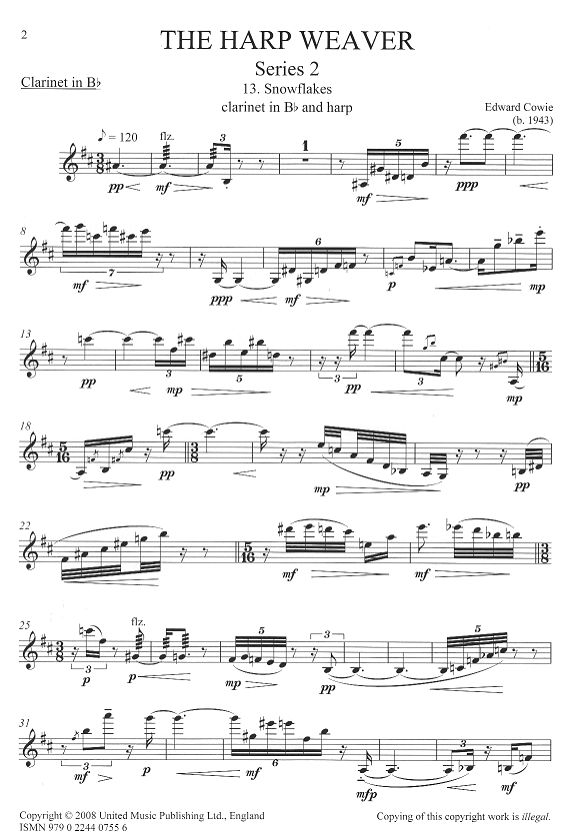 |
C2618: Snowflakes for Clarinet and Harp by Edward Cowie. United Music Publishing Ltd., 2008, SS, 6 + 3 pages. Edward Cowie (1943-) is an English composer, author, natural scientist, and painter. He spent most of his early life in the rural countryside. This first-hand experience of nature has a profound influence on his life and work. Most of this piece is in 3/8 but there are some 5/16 bars and a few that are 2/8. The tempo is eighth note = 120 at the beginning and the end with a section in the middle that is eighth note = 88. College level with some flutter tonguing. Click on the cover image to view the first page of the clarinet part.
(Except other items with free shipping.) |
15.95
|
 |
C380: Quartet Op. 2 No. 1 for Clarinet, Violin, Viola, and Violoncello by Bernhard Henrik Crusell. Kunzelmann, 1960, SS. Four movements: Poco Adagio-Allegro, Romanze (Cantabile), Menuetto (Allegro), and Rondo (Allegro vivace). Prof. Heim wrote that this is music is of high value. The string parts are not as difficult as clarinet part with the strings primarily in an accompaniment role. This is good recital literature for college level performer.  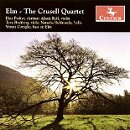
|
16.95
|
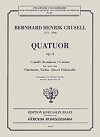 |
C1849: Quartet Op. 4 in C minor for Clarinet, Violin, Viola, and Violoncello by Bernhard Henrik Crusell edited by Fritz Kneusslin. Kunzelmann, 1970, SS. Four movements: Allegro molto agitato, Menuetto-Trio, Pastorale (un poco Allegro), and Rondo (Allegro vivace). Early college level. (Our CDs all list this as Quartet No. 2, but it isn't on the music.)
|
28.95
|
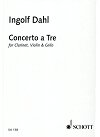 |
C1566: Concerto a Tre for Clarinet, Violin, & Cello by Ingolf Dahl. Schott, 1952, SS, includes parts and score. This piece was written in 1947 and was first performed by Benny Goodman. It is in the neoclassical style. It is a sectional piece with a variety of tempos and time signatures and has a clarinet cadenza in the middle. For advanced college and professional performers with a duration of about 18 minutes.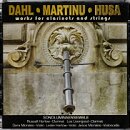
|
58.95
|
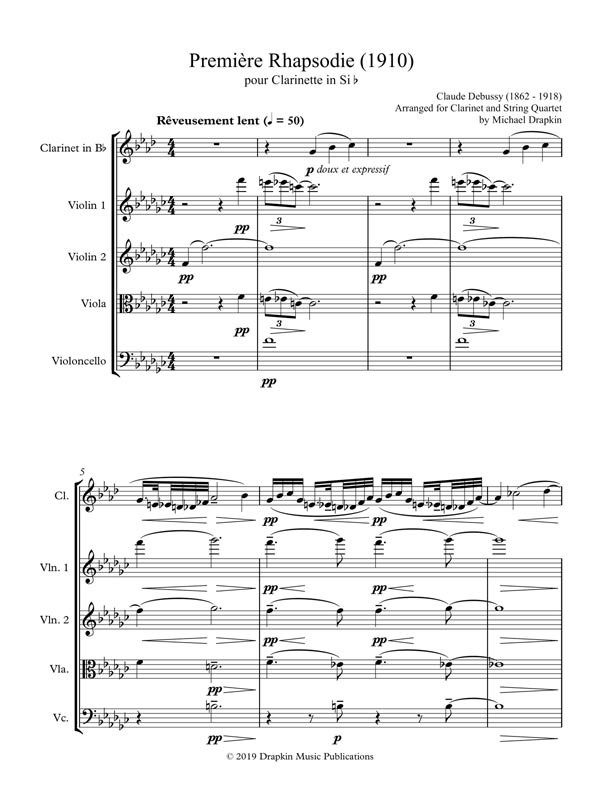 |
 C2661: Premiere Rhapsodie for Clarinet and String Quartet by Claude Debussy arranged by Michael Drapkin. Drapkin Music Publications, 2019, SS, includes score and parts. A serious clarinetist probably plays, at some point in their career, the famous Debussy Rhapsodie. More often than not, they will play with the piano accompaniment, as Debussy first wrote it. The fortunate few will perform with an orchestra. Drapkin now makes the Rhapsodie accessible for a soloist with string quartet. The solo line is faithful to the original, while the strings handle the accompaniment. Click on the cover image to view the first page of the score. C2661: Premiere Rhapsodie for Clarinet and String Quartet by Claude Debussy arranged by Michael Drapkin. Drapkin Music Publications, 2019, SS, includes score and parts. A serious clarinetist probably plays, at some point in their career, the famous Debussy Rhapsodie. More often than not, they will play with the piano accompaniment, as Debussy first wrote it. The fortunate few will perform with an orchestra. Drapkin now makes the Rhapsodie accessible for a soloist with string quartet. The solo line is faithful to the original, while the strings handle the accompaniment. Click on the cover image to view the first page of the score. |
44.95
|
 |
G170: Notturno aus "Abendunterhaltungen" for Flute (Violin) or Clarinet and Guitar by Anton Diabelli. Philomele Editions (PE 2007), SS. Anton Diabelli (1781-1858) was an Austrian music publisher, editor and composer. The six pieces that make up this edition were originally published (1818/19) in two volumes that included works of other composers. The clarinet parts were originally for an obsolete type of recorder known as a csakan which was usually in the key of A. The six pieces are 1. Andante con moto, 2. Menuetto (Moderato assia e cantabile), 3. Marcia (Allegro), 4. Original Thema und Variationen (Andante grazioso), 5. Polonaise, and 6. Marcia (Allegro). Several of these pieces should be playable by better high school wind players while the rest are more difficult. Includes parts for flute (violin), clarinet, guitar, and a score. While the music calls for an A clarinet, a capo can be used on the guitar to raise the pitch so a B-flat clarinet can be used. |
33.95
|
 |
C2304: Celebration Trio for Violin, Clarinet and Piano by Peter Dickinson. Novello, 2009, SS, includes parts and piano score. Peter Dickinson (1934-) is an English composer, musicologist, and pianist. This work inspired by the story called The Unicorns was commissioned by the Verdehr Trio. It is in three movements I. Fugue. II. Lullaby (Tranquillo), and III. Dance. It is not that difficult although there are high portions for both the clarinet (to altissimo B-flat) and violin part. The duration is about 10 minutes. |
39.95
|
 |
C1558: Trio in B-flat major Op. 29 for Clarinet (or Violin), Cello and Piano by Vincent d'Indy. International Music Company, SS, includes parts and score. Vincent d'Indy (1851-1931) was a French composer and teacher. While his main instrument was piano, he was also able to play clarinet and cello which contributes to the success of this work which was written in 1887. In three movements: I. Overture (Modéré). II. Divertissement (Vif et animé), III. Chant Elegiaque (Lent), and IV. Finale (Animé). College level. Here is a not very well balanced recording of a performance. |
28.75
|
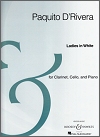 |
C2303: Ladies in White for Clarinet, Cello and Piano by Paquito D'Rivera. Boosey & Hawkes, 2010, SS, 24 + 6 + 6 pages. This work was commissioned by the Graduate Center of CUNY (City University of New York), and premiered there with D'Rivera on clarinet, Alex Brown on piano and cellist Dana Leong in May of 2010. It is a tribute to those brave women and their families who have protested the violent crackdown in Cuba in 2003 on political speech and writing. College level. Includes a section open for solos with the chord changes on all parts. Here is a performance by the composer. |
24.95
|
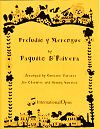 |
C1103: Preludio y Merengue by Paquito D'Rivera arranged for clarinet and string quartet by Gustavo Tavares. International Opus, 2003. Includes parts and score. A memorable recital work and excellent example of Paquito’s unique mix of Latin and modal jazz styles. The colorful and episodic Preludio is followed by an energetic, lilting Merengue in five-eight time. Includes improvised solos for the clarinet. |
41.95
|
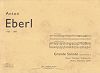 |
C2244: Grande Sonate Op. 10 No. 2 for Piano, Clarinet and Cello by Anton Eberl. Van Sambeek Edities, 2009, SS, 59 + 11 + 9 pages. Anton Eberl (1765-1807) was an Austrian composer, teacher and pianist. This piece is in three movements: Allegro spiritoso, Romance (Andante espressivo), and Rondo (Allegretto). The clarinet part and the piano part are at the early college level. The cello part is not at all difficult. The piano part has a horizontal orientation while the clarinet and cello parts are vertical. Notes on the sources and the editing are included. |
46.95
|
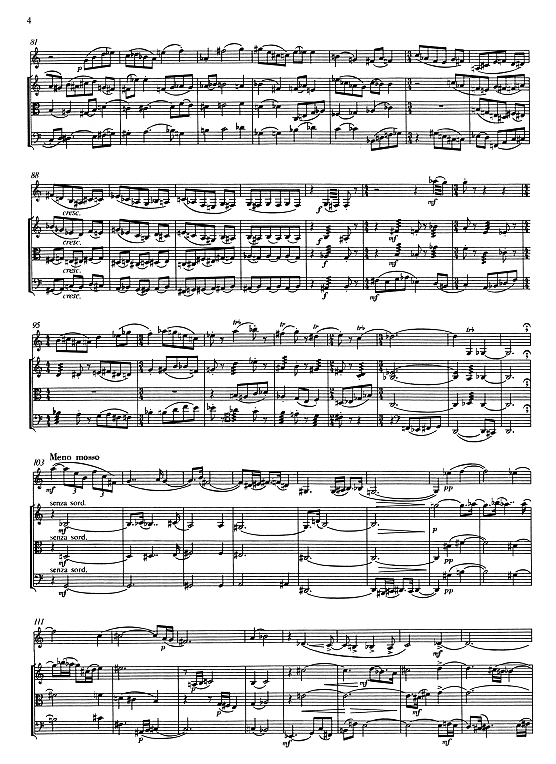 |
C2118: Ricordanze for Clarinet (A), Violin, Viola, and Violoncello by Ferenc Farkas. EMB, 1987, SS, includes parts and score. Ferenc Farkas (1905-2000) was a Hungarian composer and music educator who composed a number of popular pieces for woodwinds. The title comes from Italian and means memories, remembrances, or recollections. The initial Andante moderato in this work is followed by alternating faster and slower sections. The parts are two pages long. Click on the cover image to view a sample page from the score.
(Except other items with free shipping.) |
22.95
|
 |
C1403: Trio in E-flat major Op. 44 for Clarinet, Violoncello and Piano by Louise Farrenc edited by John P. Newhill. Breitkopf/Music Rara, 2000, SS. (includes parts and piano score). Jeanne-Louise Farrenc (1804-1875) was a French composer (she studied with Anton Riecha) and was professor of piano at the Paris Conservatoire for 30 years. This work was composed in 1861. It is in four movements: Andante/Allegro moderato, Adagio, Minuetto (Allegro), and Finale (Allegro). This trio has been reported to contain both Romantic and Classical influences. The piano part appears to be the most difficult of the parts. I believe a college level trio (with a good pianist) could probably put this together fairly quickly. |
41.95
|
 |
C2590: Clarinetten-Liederkreis for clarinet and string quartet by Michael Finnissy. Verlag Neue Musik, 2017, SS, includes all parts and score. Michael Finnissy (1946-) is an English composer and pianist. This piece has 5 movements I. Poco Allegretto, II. Largo Appassionato, III. Folkolorico: quasi parlando, IV. Vigoroso, and V. A Capriccio. Movement III. is for solo clarinet and Movement V. is two measures repeated for a total of 15 times. This is an advanced work. The string parts are important and far more than just accompaniment. Click here to listen to each movement. |
45.95
|
 |
C2102: Five Bagatelles Op. 23 by Gerald Finzi arranged for Clarinet and String Quartet by Christian Alexander. Boosey & Hawkes, 1945/2000, SS, string parts only. This arrangement was made several years ago but has only been published recently. You will need to provide your own clarinet part. |
42.95
|
 |
C2504: Quintette for Clarinet and String Quartet by Jean Françaix (Parts only). Schott, 1977, SS. Dedicated to Eduard Brunner. In four movements: Adagio, Allegro, Grave, and Rondo. These parts are typeset. This is an advanced work with a duration of about 26 minutes. Click here to watch a performance on YouTube. C2503: Quintette for Clarinet and String Quartet by Jean Françaix (Score only). Schott, 1977, SS, 51 pages. Score for above in a very neat manuscript. |
Parts
62.95
Score
34.95
|
 |
C2444: Trio for Clarinet, Viola and Piano by Jean Françaix. Schott, 1993, SS, includes parts and piano score. In three movements: I. Preludio (Largo), II. Allegrissimo, III. Scherzando, IV. Largo, and V. Presto. Here is a video of the first movement with Julie DeRaoche playing the clarinet part. The other movements are also on YouTube. |
53.95
|
 |
C1541: Trio in A minor Op. 40 for Clarinet in A (Basset Horn/Violin), Cello and Piano by Carl Frühling. Rosewood, 2019, SB/SS, includes parts and piano score. Carl Frühling (1868-1937) was an Austrian composer and music teacher. The date of composition is unknown, but it is thought to have been around 1900. In three movements I. Mäßig schnell, II. Anmutig bewegt, III. Andante, and IV. Allegro vivace. College level with a duration of about 26:30. This is a very pleasant piece. This is a new edition which has been completely reset. You can listen to excerpts here. |
64.95
|
 |
C2088: Trio in D Major for Clarinet (in A), Viola and Violoncello by Johann Nepomuk Fuchs edited by Otto Biba. Amadeus, 1979, SS, parts only. Johann Nepomuk Fuchs (1766-1839) was a deputy to Haydn at Esterhazy. This piece is dated 1808. It is a four movement work: I. Allegro non molto, II. Romanze. Adagio, III. Menuetto. Allegro & Trio and IV. Finale. Allegretto grazioso. The parts are 6-7 pages long with fairly large print. Early college level at most. Adult amateur ensembles should have no problem with this piece. Click on the cover image to view the first page of the clarinet part. |
19.95
|
 |
C2745: Blues from Un americono a Parigi (an American in Paris) for Clarinet and String Quartet by George Gershwin arranged by Michele Mangani with elaborations to the clarinet solo by Henghel Gualdi. Edition Eufonia, 2019, SS, includes a (optional) part for drum-set. Except for the clarinet solo part, this is not difficult. |
77.95
|
 |
WW049: Trio Pathétique for Clarinet, Bassoon (Violoncello) and Piano by Michail Glinka. Music Rara, 1957, SS. In four movements: Allegro Moderato, Scherzo, Largo and Allegro con spirito. This is a major work that brings out the best qualities of each instrument. The clarinet and bassoon/cello parts are not especially difficult but it requires an excellent pianist. |
26.95
|
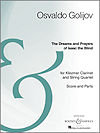 |
C2500: The Dreams and Prayers of Isaac the Blind for Clarinet and String Quartet by Osvaldo Golijov. Boosey & Hawkes, 2000, SB/SS, includes score and parts. This piece was originally written for Giora Feidman and first performed in 1994. Issac the Blind was, about 800 years ago, the greatest Kabbalist rabbi of Provence. After the composer completed this work he realized that the three movements (Prelude, II, and III. K'vakarat) represent the three languages spoken in 6,000 years of Jewish history (Aramaic, Yiddish, and Hebrew). For clarinet in A, B-flat and Bass Clarinet (one performer). This is a challenging piece, especially for the clarinet, first violin and the viola. There are quite a view videos of performances on YouTube. |
49.95
|
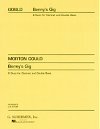 |
C503: Benny's Gig, 8 Duos for Clarinet and Double Bass by Morton Gould. G. Schirmer, 1980, SS, 20 pages. These eight duos were written for Benny Goodman by the composer. The first is marked (1962) Celebrating Benny's 1962 Russian Tour while the last is for Benny's 70th Birthday May 1979. Larry Comb's recording is recommended.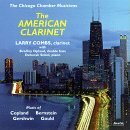
|
17.95
|
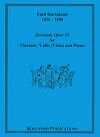 |
G102: Serenade Op. 24 for Clarinet in A and B-flat (Violin), Cello (Viola/Basset Horn) and Piano by Emil Hartmann. Rosewood, 1998, SB, (includes all parts and piano score). Hartmann (1836-1898) was a Danish church musician, conductor, and composer of German descent. Three movements: 1. Idylle (Andante), 2. Romance (Andante/Allegretto Scherzando), and 3. Rondo-Finale (Allegro). This is a fairly long work with the parts running 9 pages and the piano score 50. Probably early college level in difficulty. |
27.95
|
 |
C1121: Quartet No. 1 in B-flat for Clarinet and String Trio (Violin, Viola, & Cello) by Franz Joseph Haydn arranged by Vincenzo Gambaro edited by John P. Newhill. Musica Rara, 1992, SS, (includes parts only). This is the first of three clarinet and string trios arranged from Haydn string quartets by the Italian composer Vincenzo Gambaro. It was published in 1810. The movements are from several quartets: Allegro spirito (Op. 76 No. 4 and Op. 74 No. 3), Andante (Op. 50 No. 4), Menuetto (Op. 50 No. 1) and Vivace (Op. 50 No. 1). College level. |
25.95
|
 |
C1459: Three Trios Hob. IV: Es 1; Es 2; B1 for Clarinet, Violin and Cello (or Bassoon) by Joseph Haydn edited by Klaus Burmeister. C.F. Peters, 1977, SS, (includes parts and score). These trios are little known but are worth some attention. Notes at the end of the score give information on what is known about them and describe the editing. Advanced high school level and up. |
40.25
|
 |
C1122: Musikalisches Blumengärtlein und Leyptziger Allerley (Musical Flower Garden with Leyptziger Assortment) for Clarinet and Double Bass (or Cello) by Paul Hindemith. Schott, 1995, SS, 12 pages (in score format). Hindemith, an excellent clarinetist, composed this work in January 1927 for himself and his wife Getrude who was trained as an actress, singer and cellist, and who could also play double bass. The private nature of these compositions is underlined by the fact that all the dynamic and tempi markings are missing. There are nine short pieces: 1. Untitled, 2. Priere d'une vierge dans la Tonart mixolydique (A virgin's prayer in the mixolydian mode), 3. Untitled, 4. Kanon zum Schiessen (Canon for shooting), 5. Broken melody, 6. Marsch der Lowenreichswehr - Oberst W. gewidmet (March of the Lion King's artillery dedicated to Colonel W.), 7. Lied (song), 8. Die Gebetsmuhle im Schwarzwald, Charakterstuck (Prayer wheel in the Black Forest, character piece), 9. Ein Tanzlein (A little dance). Duration about 10 minutes. |
19.95
|
 |
C630: Quartett by Paul Hindemith. Schott, 1939, SS. Written in 1938, Hindemith's Quartett for clarinet, violin, violoncello and piano had its first performancein New York City in 1939 with Victor Polatschek as clarinetist. It is in three long movements: Mässig bewegt, Sehr langsam, and Mässig bewegt. The second movement has intricate rhythms while the third movement is extended, with several sections and tempo changes. The instrumental parts are musically demanding, and the piano part is especially difficult.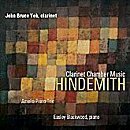 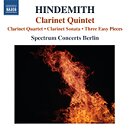
|
58.95
|
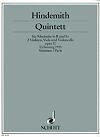 |
C854: Quintett Op. 30 for Clarinet in B-flat and E-flat and String Quartet by Paul Hindemith. Schott, 1986, SS, (parts only). Written in 1923, the quintet has five movements: Sehr Lebhaft, Ruhig, Schneller Ländler, Arioso, and Sehr lebhaft. The third movement is for clarinet in E-flat. The first movement is contrapuntal; the second begins with a beautiful viola solo, joined by the cello; the third is a Ländler, a dance movement; the fourth is very short and the fifth is related to the first movement. The clarinet is part of the ensemble, rather than solo with accompaniment, except in the first and last movements. This is a fine work requiring excellent string players. A score for this piece has been published recently. We can order it for you. The price is $32.95.
|
55.95
|
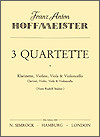 |
C2343: 3 Quartette Clarinet, Violin, Viola and Violoncello by Franz Anton Hoffmeister revised by Hans Rudolf Stalder. Simrock, 1982, SS, parts only. Franz Anton Hoffmeister (1754-1812) was a German composer and music publisher. The first two of the three quartets are for clarinet in B-flat while the third is for clarinet in A. Early college level. |
29.95
|
|
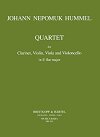
C1897: Quartet in E-flat major for Clarinet, Violin, Viola and Violoncello by Johann Nepomuk Hummel edited by Kurt Janetzky. Music Rara/Breitkopf, 1958/2000, SS, includes parts and score. Johann Nepomuk Hummel (1778-1837) was an Austrian composer and virtuoso pianist. This work is from 1808. This was written while he was musical director at Esterhazy (1804-1811) as a successor of Haydn. It is in four movements: Allegro moderato, La Seccatura (Allegro molto), Andante, and Rondo (Allegretto). College level but on the easier side with the violin part appearing to be the most challenging. Duration about 30 minutes. |
49.95
|
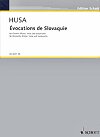 |
C1567: Évocations de Slovaquie for Clarinet in A (Flute), Viola and Violoncello by Karel Husa. Schott, 1970, SS, includes parts and score. Karel Husa (1921-2016) was a Czech born composer and conductor, trained in Prague and Paris, who taught at Cornell for many years. An advanced work in three movements: I. La Montagne (Exaltando), II. La Nuit (Tranquillo possibile), and III. La Danse (Ritmico). Duration about 15 minutes. |
58.95
|
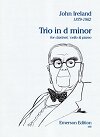 |
C1385: Trio in D minor for Clarinet, 'Cello & Piano by John Ireland edited and reconstructed by Stephen Fox. Emerson Edition, 2006, SS. This is a substantial work which was performed at most twice (in 1914 or 1915) during the composer's lifetime. In three movements: I Allegro non troppo, II Scherzo, and III. Lento/Con moto. The last movement requires an A clarinet. Duration about 26 minutes. |
42.95
|
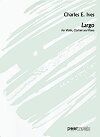 |
C1751: Largo for Violin, Clarinet and Piano by Charles E. Ives. PeerMusic (the music itself says Southern Music Co.), 1953, SS, (includes parts and piano score). A one movement piece with a number of tempo changes and a duration of about 5 minutes. Some mixed meter. College level. Here is a performance on video. 
(Except other items with free shipping.) |
9.95
|
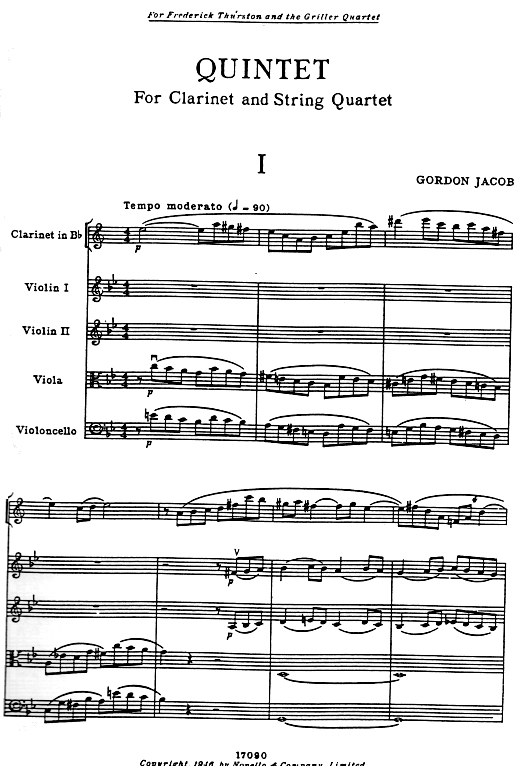 |
C2306: Quintet for Clarinet and Strings by Gordon Jacob. Music Sales America, 1946, SS, (parts only). In four movements: I. Moderato, II. Scherzo (Allegro con brio), III. Rhapsody (Poco lento), and IV. Introduction, Theme and Variations (Poco lento) . There are five variations in the final movement. This piece was written in 1940 and first performed by Frederick Thurston and the Griller Quartet in 1943.This piece should be considered one highlight of Jacob's compositions, and as a scholar wrote, "is of major significance in its contribution to the chamber music repertoire for clarinet and strings." Here is a video of the final movement. Click on the cover image to view the first page of the score. C2307: Quintet for Clarinet and Strings by Gordon Jacob. Music Sales America, 1946, SS, 71 pages (score only). |
Parts
55.95
Score
41.95
|
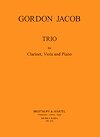 |
C1544: Trio for Clarinet, Viola and Piano by Gordon Jacob. Breitkopf & Härtel (Musica Rara), 1970/2000, SS, (includes parts and piano score). In four movements: Adagio molto, Menuetto, Adagio molto, and Presto. Early college level although the clarinet part goes up to an altissimo A. There are some nice duets for the clarinet and viola. Duration about 17:30. |
19.95
|
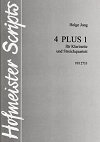 |
C1363: 4 Plus 1 for Clarinet and String Quartet by Helge Jung. Hofmeister, 1999, SS, (includes parts and score). Helge Jung (1943-) is a (male) German composer and conductor. This advanced contemporary work, written in 1996, is in five movements: In Certo Qual Modo Raccontando, Misterioso, Corso Forzoso, Il Mistero Raddoppiato, and Ritorno Al Inizio Dei Racconti. Duration about 18:15. |
28.95
|
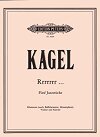 |
C1811: Rrrrrrr ... Five Jazz Pieces for Clarinet (Bass Clarinet, Alto Saxophone) Violin and Piano by Mauricio Kagel. C.F. Peters, 1992, SS, includes parts and piano score. Mauricio Kagel (1931-2008) was born in Argentina into a Russian-Jewish family. He moved to Germany in 1957. This was written in 1981/82. Rrrrrrr ... consists of 41 pieces (all beginning with the letter "R"). This is the cycle of 5 jazz pieces: 1. Rackett, very fast, inspired by the Baroque instrument of that name (BsCl and Pn); 2. Rrrrrrr - Bop, A slow swing (Cl, Vn and Pn); 3. Reeds, fast, (ASx & Pn); 4. Rrrrrrr: Old/New Freely (Vn or Cl); 5. Riff, slow rubato (BsCl, Vn & Pn). A low C bass clarinet is called for. College level with a duration of about 8:20. |
50.50
|
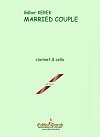 |
C1753: Married Couple for Clarinet and Cello by Gábor Kerek. EditionDarok, 2011, SS, (includes parts and score). Gábor Kerek (1971-) is a Hungarian composer. This is a five movement work: 1. Angry Exchange (Allegro), 2. Tenderness (Adagio), 3. In the Kitchen (Moderato), 4. Dream (Andante), and 5. Don't Get Impatient! (Allegro). College level. |
29.95
|
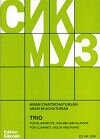 |
C622: Trio for Clarinet, Violin, and Piano by Aram Khachaturian. Sikorski, 1957, SS. A very good three movement trio with a Russian flavor. Requires advanced performers. Duration of about 15 minutes. Here is an audio recording on YouTube.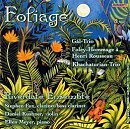
|
34.95
|
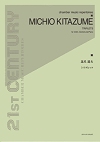 |
C2305: Triplets for Violin, Clarinet and Piano by Michio Kitazume. Zen-On Music, 2014, SS, (score only). Michio Kitazume (1948-) is a Japanese composer and conductor. The concept of this piece is that the three players are to some extent imitating what the other members are playing but imperfectly because each as a different mechanism for producing sound. First performed in 1999 and with a duration of about 6:30. (This is only available as a score, I checked. For performance copies will probably need to be made of the clarinet and violin parts.) (Except other items with free shipping.) |
11.95
|
|
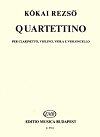
C1917: Quartettino for Clarinet, Violin, Viola and Cello by Kokai Rezso. Editio Musica Budapest, 1972, SS, (includes parts and score). KÓKAI Rezső (1906-1962) was a Hungarian composer and musicologist. This four movement work was written in 1952. This work reflects the folk influences of the verbunkos, the czardas and other folk dances. The movements are: I. Sonatina (Allegro moderato), II Scherzino (Allegro assai), III. Canzonetta (Andante moderato, sempre molto rubato), and IV. Finaletto (Presto). This college level work with a duration of about 10 minutes is popular for this ensemble of instruments. Here is a video of the final two movements (you can find performances of the other movements on YouTube).
|
25.45
|
|
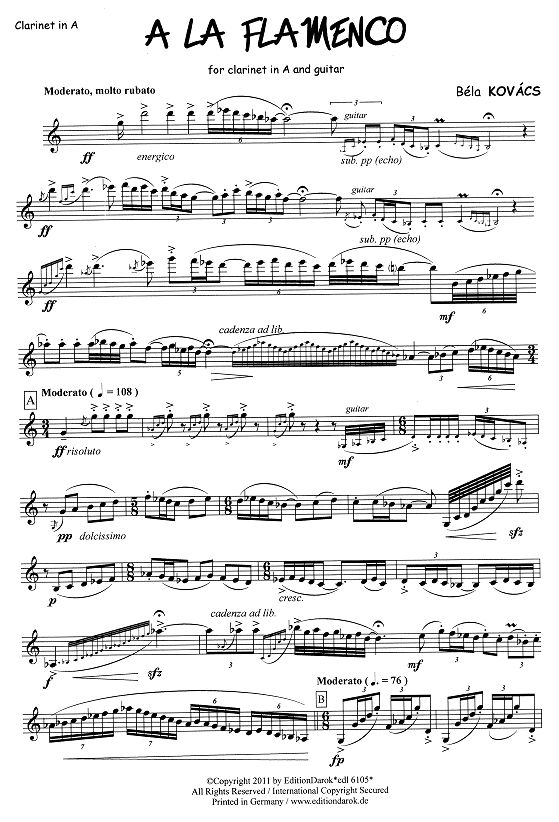
C2516: A La Flamenco for clarinet in A and guitar by Béla Kovács. EditionDarok, 2011, 6 + 3 pages. An original composition in the flamenco style which is very similar to the clarinet and piano version (C1867). This piece opens with an unbarred Moderato, molto rubato recitative/cadenza. The middle of the piece is at a moderato tempo (but with plenty of notes) in mixed meter (3/4, 6/8, 5/8, 8/8). Near the end, a portion of the Moderato, molto rubato returns followed by a Presto conclusion. The composer has moved a few bits of the melody from the clarinet to the guitar and added to the guitar part in places. College level. Click on the cover image to view the first page from the clarinet part.
(Except other items with free shipping.) |
24.95
|
|
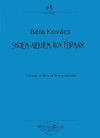
C2501: Sholem-alekhem, rov Feidman! for clarinet and string quintet by Béla Kovács. EditionDarok, SS, (includes parts and score). Here Béla Kovács' tribute to the klezmer style of Giora Feidman (originally for clarinet and piano) has been arranged for clarinet with a string quintet (2 violins, viola, cello and double bass). The clarinet has the solo part and the strings are in an accompanying role. |
31.95
|
|
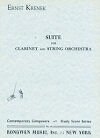
C701: Suite for Clarinet and String Orchestra by Ernst Krenek. Broude International Editions, 1957, SS. This Suite by Vienna born Krenek (1900-1991) has four short movements: Andante Sostenuto, Allegro moderato, Andante, and Vivace. This is the score and the string parts (4,4,3,2,2). The string parts do not appear to be difficult. The clarinet part is in the edition for Clarinet and Piano. |
72.50
|
|
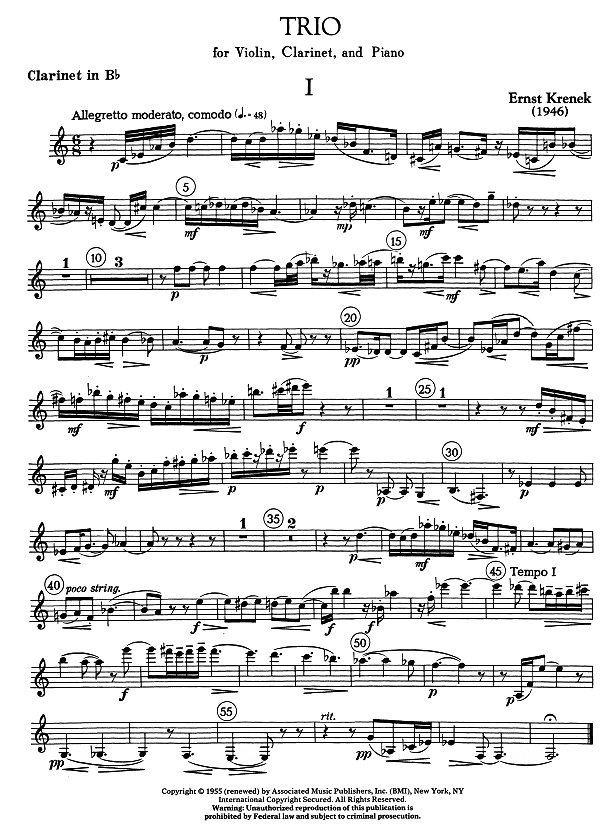
C1752: Trio for Violin, Clarinet and Piano Op. 108 by Ernst Krenek. Associated Music Publishers, 1955, SS, includes piano score and parts. Originally published in 1946, this is an excellent work for this combination. It is in two movements. Here is a video. Click on the cover image to view the first page of the clarinet part. |
14.95
|
|
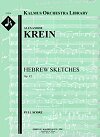
C1276: Hebrew Sketches (No. 1) Op. 12 for Clarinet and Strings by Alexander Krein. Kalmus, SS. Alexander Krein (1883-1951) was a Russian-Jewish composer whose output included a number of works on Jewish themes. This 1909 work is in three movements: 1. Lento, 2. Andante con anima/Allegretto grazioso, and 3. Allegro moderato. The strings parts are supplied in the quantities 4, 4, 3, 3, however, this work can be performed with clarinet and string quartet. A very nice college level piece with a duration of about 11:30.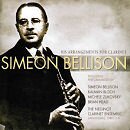 
|
Parts 54.95
Score 14.95
|
|
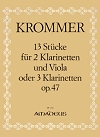
C2427: 13 Pieces for 2 Clarinets and Viola or 3 Clarinets Op. 47 by Franz Krommer edited by Dieter Kühr. Amadeus Verlag, 1996, SS, parts only. Beginning with piece 8 all clarinet parts switch from B-flat clarinet to A clarinet. However, if three clarinets are used there is no reason to switch unless desired. The notes with this edition say the 13 pieces were written for musical entertainment during social occasions and for music making at home. They were first published around 1804. |
22.95
|
|
C1519: String Connection with Clarinet for clarinet and string quartet by Rolf Kühn. Advance Music, 2008, SS, (includes parts and score). This is a new version of Clarinet Connection for four B-flat clarinets and bass clarinet which was written for Sabine Meyer and Eddie Daniels and is featured on the CD Blues for Sabine. In this version the two solo parts have been combined and a string quartet provides the accompaniment. It is in three movements: I. Connection, II. Contacts, and III. Encounter. The clarinet part has improvised solos from chord symbols. An advanced work with a duration of about 13 minutes. |
35.95
|
 |
C658: Black Birds, Red Hills for B-flat Clarinet, Viola, and Piano by Libby Larsen. Oxford University Press/Goodmusic, 2005, SS. This piece was inspired by six Georgia O'Keeffe paintings of the red hills of New Mexico. It is in four movements with a brief epilogue. They are: 1. Pedernal Hills (extremely legato), 2. Black Rock (deliberately), 3. Red Hills and Sky (gently), 4. A Black Bird with Snow-Covered Red Hills, and 5. Looking. Includes full score with piano part and individual clarinet and viola parts. College level. |
21.50
|
 |
WW066: Blue Third Pieces for Flute or Clarinet and Guitar by Libby Larsen. Oxford University Press, 2000, SS. This is a little homage to the interval of the third and its place in the blues. The first piece, "Deep Blue," is quite and lyrical. The second piece is "Salt Peanuts" and was inspired by the Dizzy Gillespie and Kenny Clark jazz piece of the same name. The clarinet part is a direct transposition of the flute part so the clarinetist needs to be comfortable in the altissimo. |
28.50
|
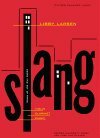 |
C661: Slang for Clarinet in B-flat, Violin, and Piano by Libby Larsen. Oxford University Press/Goodmusic, 1998, SS. This piece was commissioned by the Verdehr Trio. "Slang is a one movement work in three sections. The title refers to the use of both jazz and boogie slang and twentieth century 'new music' slang throughout the composition." A work for advanced performers. Includes full score with piano part and individual clarinet and violin parts. |
40.95
|
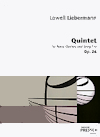 |
C2746: Quintet Op. 26 for Piano, Clarinet and String Trio by Lowell Liebermann. Theodore Presser Co. 1988/2002, SS. This piece was premiered by the Chelsea Chamber Ensemble in 1988. The revised version was first performed in 2002 with John Manasse on clarinet and the composer on piano. Three movements: Moderato, Meno mosso, and Allegro which run with out a break. There are tempo changes within each movement. |
144.95
|
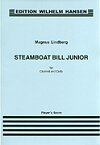 |
C1707: Steamboat Bill Junior for Clarinet and Cello by Magnus Lindberg. Edition Wilhlem Hansen, 1990(?), SB, 11 pages (2 copies in score format). Buster Keaton was one of the first stars of the silver screen and appears in the 1928 motion picture, Steamboat Bill Junior, one of the undoubted final highlights of silent film. Swedish composer Magnus Lindberg was so affected by the stunning film, with its ambitious and iconic stunts, that in 1990 he wrote this terrific piece for Clarinet and Cello called Steamboat Bill Junior. It is a colorful, four movement work of spectral music, which hints at minimalism yet attempts to express the action and plot of the film in its eight minute duration. This is an advanced piece with quite a bit of mixed meter (although most of it is of the 2/4, 3/4, 4/4, 6/4 variety). Here is a performance on YouTube. |
34.95
|

|
C2418: Rhapsody for Clarinet, Viola and Piano by Ursula Mamlok. Edition Peters, 1992, SS, includes parts and piano score. Ursula Mamlok (1923-2016) was a German-born American composer and teacher. While she was regarded as an avant garde composer and often employed the techniques of serial music, her music was often less atonal than that of other avant-gardists. Critics praised its deliberate, economical spareness; its light, almost pointillist aspect; its sense of wit and play; and its almost palpable emotional clarity. This is an advanced work although the tempo is never faster then mm = 72 (it includes 32nd notes). The duration is about 8:30. Here is an audio recording with Charles Neidich playing the clarinet part. Click on the cover image to view the first page of the score. |
18.50
|
|
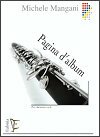
C1879: Pagina d'album for Clarinet and String Orchestra by Michele Mangani. Edizioni Musicali Eufonia, SS. This edition is for clarinet and string orchestra. It includes the solo clarinet part, score and the string parts in these quantites: 4/4/3/2/1. This is a lyrical piece marked Moderatamente cantabile. Intermediate/upper intermediate level with a duration of about 3:25-4:00. Here is a video of Sergio Bosi playing this piece. There are also at least two professional performances on YouTube. We also have the edition for clarinet and piano listed here. |
69.95
|
|
C2723: Romanza for Clarinet and String Orchestra by Michele Mangani. Edizioni Musicali Eufonia, SS. This edition is for clarinet and string orchestra. It includes the solo clarinet part, score and the string parts in these quantites: 4/4/3/2/2. This is a lyrical piece marked Andante cantabile. Intermediate/upper intermediate level with a duration of about 4:30. Here is a video of this piece. We also have the edition for clarinet and piano listed here. |
99.95
|
|
C1968: Images from "The Old Gringo" Eleven Little Pieces for Violin, Clarinet and Piano by David Maslanka. Maslanka Press, 2010, SB/SS, (includes parts and piano score). Carlos Fuentes’ novel “The Old Gringo” provided dozens of stunning emotional pictures, eleven of which prompted the little sound pictures of this piece. |
48.95
|
 |
G206: Notturno aus Op. 18 ("Kurze Musikstücke") for Clarinet, Horn and Guitar by Wenzeslaus Matiegka. Philomele Editions (PE 2056), SS, (includes parts and score). Wenzeslaus Matiegka (1773-1830) was a Bohemian guitar player and composer of the early Viennese guitar period. The horn part is for E-flat horn. In four movements: I. Tema und Variationen (4 variations), II. Menuetto (Allegro), III. Zingara (Andante), and IV. Marcia (Maestoso). This is one of only two works known to the publisher for this combination. The parts look interesting. Early college level. |
20.95
|
 |
C1139: Trio for Violin, Clarinet and Piano by Gian Carlo Menotti. G. Schirmer, 1996/2001, SS. This piece was commissioned by the Verdehr Trio (and Michigan State University) and they edited it for publication. Gian Carlo Menotti (1911-2007) was an Italian-born American composer primarily known for his operas. Three movements: I. Capriccio (Allegro), II. Romanza (Andante espressivo), and III. Envoi (Allegro). Inclues parts and piano score. Duration about 12 minutes. |
29.95
|
 |
G093: Quartet for the End of Time (Quatuor pour la Fin du Temps) for Clarinet in B-flat, Violin, Cello and Piano by Olivier Messiaen. Durand, 1942, PB. This is the full performing edition with individual parts for the clarinet and strings and piano score. Included in the clarinet part is the solo Abîme des oiseaux (Abyss of the Birds). We have two books about this piece: Messiaen - Quatour pour la fin du Temps which is primarily about the music and For the End of Time, The Story of the Messiaen Quartet which focuses on the creation of the composition and the historical context. |
64.95
|
|
C235: Meyerbeer Quintet for Clarinet and String Quartet edited by Dieter Klöcker. Baerenreiter (BA 8731), 2001, SS. Includes score and performance parts. This quartet was found in the papers of the great-granddaughter of Heinrich Baermann. While not an autograph, the copy was inscribed in the hand of Carl Baermann that it had been composed by Giacomo Meyerbeer for his father. Editing is noted in the score or in a "Critical Report" which follows. |
30.95
|
|
C1232: Phantasy Quintet Op. 33 for Clarinet and String Quartet by Robin Milford edited by Paul Harris. Queen's Temple Publications, 2002, SS, (includes score and parts). Robin Milford (1903-1959) was an English composer whose style was entirely his own although it lies on a continuum between the work of his close friend Gerald Finzi and that of Vaughan Williams. The Quintet is full of wonderful tunes as well as robust and characteristic writing for both the clarinet and strings. This piece is sectional shifting primarily between Adagio and Allegro. Early college level. |
22.95
|
|
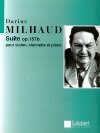
C576: Suite Op. 157b for Violin, Clarinet and Piano by Darius Milhaud. Salabert, 1937. In four movements: I. Overture (Vif et gai), II. Divertissement (Animé), III. Jeu (Vif), and IV. Introduction et Final (Modéré/Vif). College level.
|
22.95
|
|
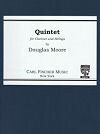
C1154: Quintet for Clarinet and Strings by Douglas Moore. Carl Fischer, 1952, SB/SS. Includes score (?) and performance parts. Douglas Moore (1893-1969) was an American composer, educator, and author who wrote for music the theater, film, ballet and orchestra. The Juilliard School of Music commissioned this piece in 1946. It is in four movements: I. Allegro risoluto, II. Andante comodo, III. Adagio recitativo, and IV. Allegro ritmico. All parts are important in this very nice ensemble work. College level with a duration of about 19 minutes. This is print on demand. The last copy I had was complete but the parts and score are now listed separately on the Carl Fischer website. Contact us if you are interested and we will check on the current situation.  C1093: Quintet for Clarinet and Strings by Douglas Moore. Carl Fischer, 1952, SB, 46 pages. Score only. |
Complete (?) Score58.95 26.95
|
|
C2721: Morricone's Movies for Clarinet(A) and Guitar by Ennio Morricone transcribed by Michele Mangani. Edition Eufonia, SS, includes Clarinet part and score, 13 + 7 pages. This book includes six of Morricone's tunes from his movies. They are C'Ere Una Volta Il West (Once Upon a Time in the West), Cockey's Song, Gabriel's Oboe, Per Un Pugno Di Dollari (Fistful of Dollars) Playing Love, L'Estasi Dell 'Oro (The Good, the Bad, and the Ugly). The score includes the clarinet part and the guitar part. All of the pieces in the clarinet part are for A clarinet but the score has the clarinet part for L'Estasi Dell 'Oro in B-flat. |
27.95
|
|
C1733: Mozart Allegro in B-flat for Clarinet and String Quartet K. Anh 91 (516c) completed and edited by Robert D. Levin. Nagels Verlag Kassel, 1970, SS, includes parts and score. This is a completion of the fragment of a clarinet quintet which was probably written about 1787. The first four pages (98 measures) have survived with indications that more of the movement had been written and possibly finished. This completion is by distinguished Mozart scholar Robert D. Levin and done at the very beginning of his career. You can hear a sample on this page (next to last piece on the third CD listed) from near the beginning of the movement. The duration is about 4:15. |
25.95
|
|
C233: Mozart Trio in E-flat major for Clarinet, Viola and Piano KV 498 (Kegelstatt Trio) edited by Wofgang Plath and Wofgang Rehm. Baerenreiter (BA5325), 1966 revised 1987, SS. From the Neue Mozart-Ausgabe with a preface and editorial note in Germany and English. Includes a violin part as an alternate to the clarinet. 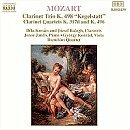 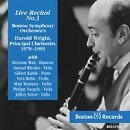
|
22.95
|
|
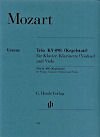
C640: Mozart Trio in E-flat major for Clarinet, Viola and Piano KV 498 (Kegelstatt Trio) edited by Günter Lorenz. Henle, 1981. Includes brief introductory notes. Includes a violin part as an alternate to the clarinet.
|
22.95
|
|
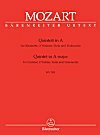
C234: Mozart Quintet in A major for Clarinet and String Quartet KV 581 Performance Parts edited by Ernst Fritz Schmid. Baerenreiter (BA 4711), 1958, parts only. Urtext edition from the Neue Mozart-Ausgabe.    
|
24.95
|
|
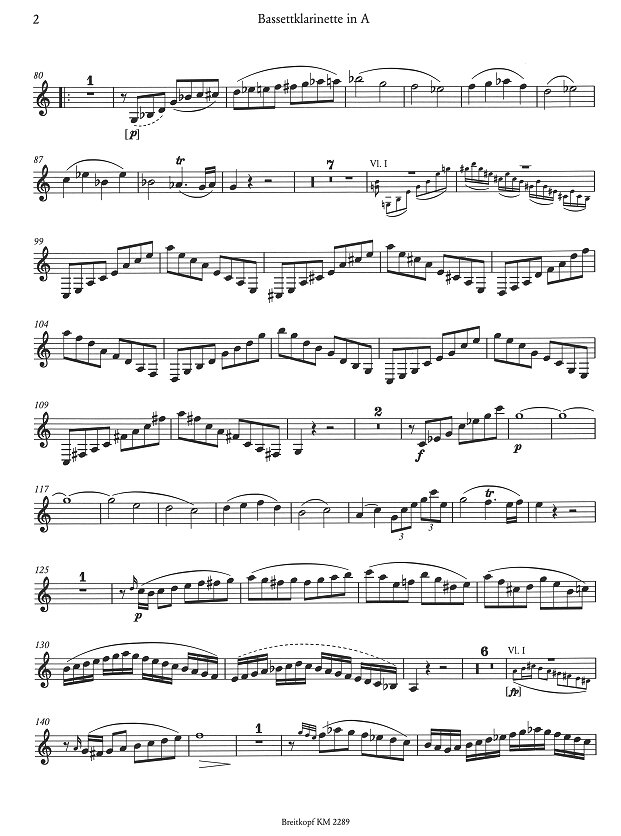
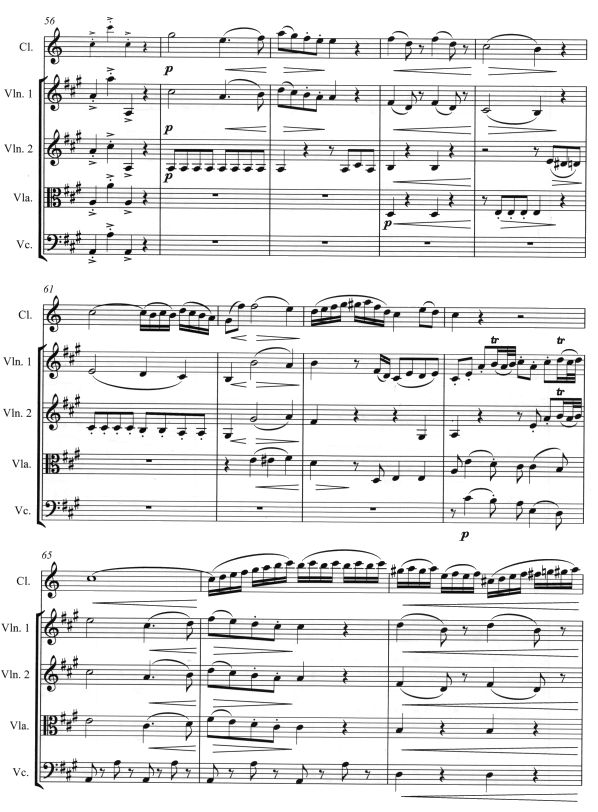
C1791: Mozart Quintet in A major for Clarinet (Basset Clarinet) and String Quartet KV 581 edited by Warner Breig. Breitkopf, 2005, SS, includes all parts and score. The edition includes a part for basset clarinet and for the regular A clarinet. Includes notes on the history of the piece and the reconstruction of the basset clarinet part. Click on the cover image to view page 2 of the basset clarinet part. 
|
29.95
|
|
C563: Mozart Quintet in A major for Clarinet and String Quartet KV 581 Performance Parts edited by Henrik Wiese. Henle, 2004, parts only. This is a new edition of this work. It includes two pages of notes (in German, English, and French) explaining what little is known of this work, how this edition was created from earliest known edition, and the problems involved. There are also comments on specific issues in the parts. This edition also includes the fragment Allegro (KV Anh. 91) for basset clarinet in B-flat and string quartet. Only the first 93 measures have survived (this is about a page in each part). The editor has provided alternatives for the basset passages.
|
23.95
|
|
C2366: Mozart Quintet in A major for Clarinet and String Quartet KV 581. C.F. Peters, SS, parts only.
|
23.25
|
|
C2708: Mozart Clarinet Concerto KV 622 for Clarinet and String Quartet arranged by Michael Drapkin. Drapkin Music Publications, 2019, includes parts and score. Long an orchestral clarinetist and soloist, Drapkin knows the major repertoire for his instrument. The Mozart Concerto is de rigueur for advancing clarinetists, although few are fortunate enough to perform with full orchestra. Drapkin's arrangement with string quartet expands performance opportunities while remaining faithful to the original. For A clarinet. Click on the cover image to view a sample page from the score. |
44.95
|
|
G087: Fantasy Trio Op. 26 for clarinet (in B-flat), violoncello, and piano by Robert Muczynski. Theodore Presser, 1971, SS. Four movements: Allegro energico, Anadnate con espressione, Allegro decisio, Introduction and Finale: (Andate molto e sostenuto and Allegro). College level with a duration of 12 minutes. |
24.95
|
|
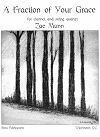
C1002: A Fraction of Your Grace for clarinet and string quartet by Zae Munn. Sisra (Arsis Press), 1999, SS. This piece was written for composer David Lipak in 1997 and was inspired by his wonderful grace as he faced the impending death of his wife. There is an alternation of sections based on quartal chords and sections based on open fifths. Motives derived from the quartal and quintal structures provide most of the melodic material. While not technically difficult at the mm=54 tempo, the parts move independently in most of this piece. Early college level with a duration of about 8:40. |
24.95
|
|
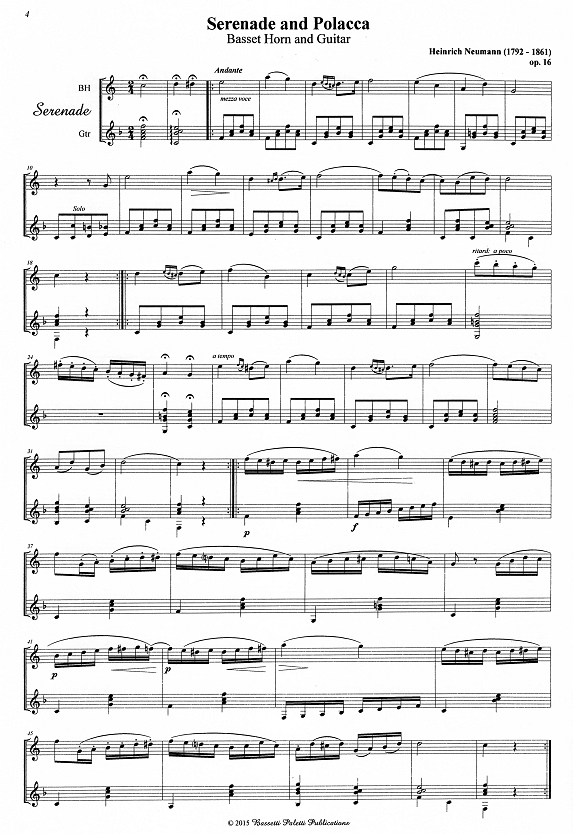
C2328: Serenade and Polacca Op. 16 for Basset Horn and Guitar by Heinrich Neumann edited by David Glenn. Bassetti Paletti Publications, 2015, SS, includes parts and score. This is one of six works by Neumann (1792-1861) for clarinet or basset horn and guitar. It includes notes on the editing. The editor says the basset horn part is demanding in spots. The duration is about 9:30. Click on the cover image to view the first page of the score. (This shows the guitar line in the original notation. It has been modernized in the actual guitar part.) (Except other items with free shipping.) |
14.95
|
|
C680: Serenata Svizzera Op. 29 for clarinet (in C or B-flat) and guitar by Heinrich Neumann edited by J. Gaitzsch. Berben, SS. This piece was first published in 1835. Includes notes in Italian and English on the composer and the piece. The C clarinet part can also be used by oboe, flute, or violin. (Except other items with free shipping.) |
21.95
|
|
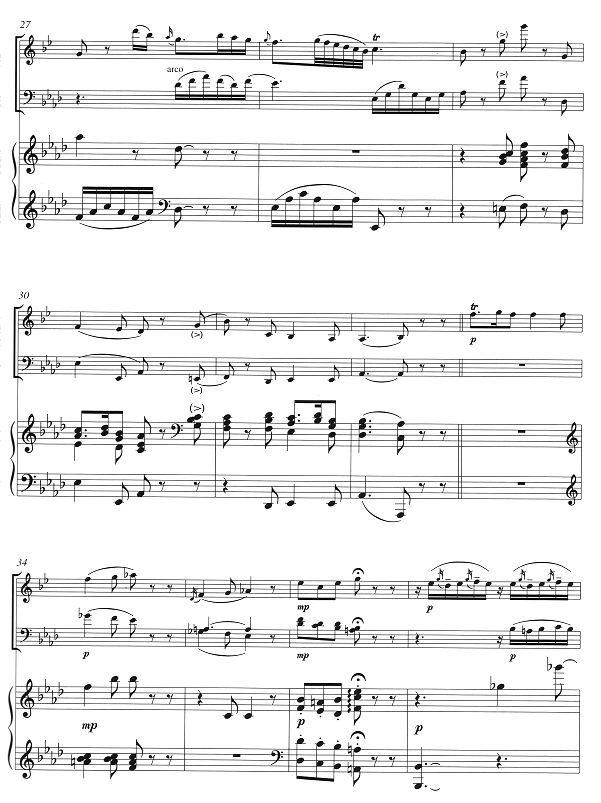
C2663: Mozart-Adagio for clarinet, cello, and piano by Arvo Pärt. Universal Edition 1992/2005, SS, 7 + 4 + 4 pages. This Pärt piano trio was written as a memorial to a violinist friend who had a special affinity for Mozart's works. Pärt chose the deeply expressive Adagio movement from Mozart's Piano Sonata K.280 and layered string voices throughout in a sublime pairing of 18th and 20th century voices. This edition substitutes a clarinet for the violin part (and because of this there are a few notes in the high altission range). There are two copies of the clarinet/VC part. Here is an audio recording of this work. Click on the cover image to view a sample page from the score. |
29.95
|
|
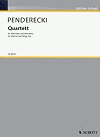
C1727: Quartet for Clarinet and String Trio by Krzysztof Penderecki. Schott, 1993, SS, (includes parts and score). Krzysztof Penderecki (1933-2020) was a Polish conductor and composer. This piece calls for both B-flat and A clarinets. In four movements: I. Notturno (Adagio), II. Scherzo (Vivacissimo), III Serenade (Temp di Valse), and IV. Abschied (Larghetto). Advanced college level with a duration of about 20 minutes. Here is Sharon Kam playing movement II on YouTube and here is Martin Fröst playing the same. You can probably find some other movements from these artists on YouTube as well. |
35.95
|
|
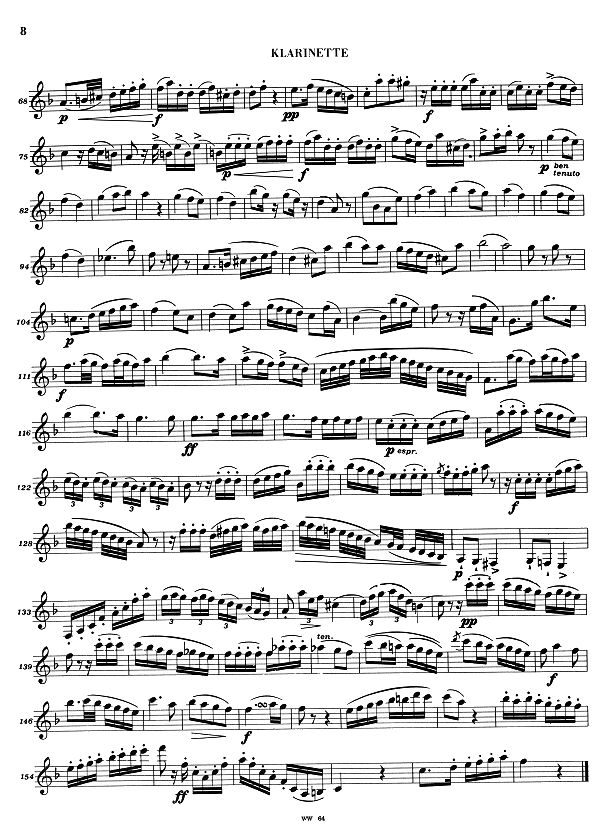
C2087: Trio Op. 4 for Clarinet, Viola and Violoncello by Antonio Polzelli. Verlag Walter Wollenweber, 1982, SS, (parts only). Alois Anton (Antonio) Polzelli (1783-1855) was born in Esterhazy of Italian parents (there are more details in the music). He was a violinist, conductor and composer. This piece is in four movements: Adagio sostenuto/Allegro moderato, Adagio molto e sostenuto, Tempo di Menuetto/Trio alla Pastorale, and Finale (Allegro). Click on the cover image to view the final page of the clarinet part which is the second half of the Finale. |
44.95
|
|
C2401: Paole e Virginia for Clarinet, Violin and Piano by Amilcare Ponchielli. TLA Music, 2016, SS, includes parts and piano score. Amilcare Ponchielli (1834-1886) was an Italian composer, mainly of operas. This piece was probably written around 1857. It was inspired by the novel Paul et Virginie by Jacques-Henri Bernardin de Saint-Pierre which was published in 1788. It is sectional with a duration of about 9:45. College level. Here is a video of a performance. |
24.95
|
|
C494: Overture on Hebrew Themes Op. 34 for clarinet in B-flat, piano and string quartet by Serge Prokofieff. Boosey & Hawkes, 1922. An excellent work written in 1919 at the request of Simeon Bellison while Prokofieff was living in the United States. |
54.95
|
|
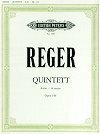
C632: Quintett in A major Op. 146 for clarinet in A and string quartet by Max Reger. C.F. Peters, 1916, SS. Four movements: Moderato ed amabile, Vivace, Largo, and Poco allegretto. Professor Norman Heim described this quintet as a beautiful piece of music for clarinet in A and strings and notes that each movement is in a major form and could stand by itself.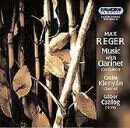 |
36.50
|
|
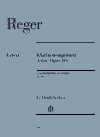
C2265: Clarinet Quintet in A major Op. 146 for clarinet in A and string quartet by Max Reger edited by Michael Kube. Henle, 2014, SS, parts only (a study score is available). The Clarinet Quintet was the last completed work of Max Reger (1873-1916). While Reger's early chamber work was inspired by Brahms (according the notes that are included with this edition in German, English and French), his later works were focused on the style of Mozart. Four movements: Moderato ed amabile, Vivace, Largo, and Poco allegretto. In addition to the notes this edition also includes comments on the editing. |
64.95
|
|
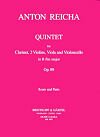
C671: Quintet in B-flat major Op. 89 for clarinet and string quartet by Anton Reicha edited by Kurt Janetzky. Breitkopf, 1962, SS, (includes parts and score). Anton Reicha (1770-1836) was a contemporary of Beethoven and is particularly know for his many woodwind quintets. This is a major work in four movements: Allegro, Andante, Menuetto, and Finale (Allegretto). The first and last movements of major proportion and in sonata form. It has a challenging, virtuoso clarinet part with string parts primarily in an accompanying role.
|
49.95
|
|
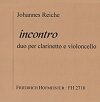
C1371: Incontro duet for clarinet and cello by Johannes Reiche. Hofmeister, 1998, SB, 7 pages in score format. Johannes Reiche (1955-) is a German composer, conductor, teacher and clarinetist and a proponent of New Music. This piece might be a good choice for a senior or graduate recital where a piece of new music is needed. It uses contemporary notation (but not extended techniques) and much is without bar lines. The introductory section is marked impetuso and it is followed by 14 mostly short variations.
(Except other items with free shipping.) |
18.95
|
|
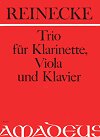
C1531: Trio for Clarinet, Viola and Piano Op. 264 by Carl Reinecke edited by Bernhard Päuler. Amadeus Verlag, 1985, SS, includes parts and piano score. Carl Reinecke (1824-1910) was a renowned German pianist and composer who wrote prolifically in all forms and for most instrumental and vocal combinations. This edition includes a forward in German and English which gives a brief biography of Reinecke and describes this piece which was written in 1903 as the work of a classically oriented Romantic. The clarinet part is for A clarinet. In four movements. 1. Moderato/Allegro, 2. Intermezzo (Moderato), 3. Legende (Andante), and 4. Finale (Allegro moderato). College level (although not especially difficult) with a duration of 28 minutes.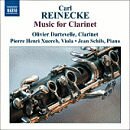 |
26.95
|
|
C1780: Trio for Clarinet, Viola and Piano Op. 264 by Carl Reinecke. International Music Co., SS, includes parts and piano score. The clarinet part is for A clarinet. In four movements. 1. Moderato/Allegro, 2. Intermezzo (Moderato), 3. Legende (Andante), and 4. Finale (Allegro moderato). College level with a duration of 28 minutes. This appears to be a copy of the Amadeus edition. The printing as not quite as sharp but is very acceptable. |
23.25
|
|
C856: Museum Pieces for Clarinet and String Quartet (Parts) by Phillip Rhodes. C.F. Peters, 1978, SS. Phillip Rhodes (1940-) is an American composer and music educator. This piece was commissioned by the J.B. Speed Art Museum of Louisville for the dedication of the Hattie Bishop Speed Music Room. The movements in this work are based on works of art in the museum (there are pictures in the score). They are: I. Equestrian Bronze (Furioso), II. The "Pierrot" Music Box (Waltz tempo), III. Landscape-Seurat (Miniature), IV. Station of the Cross-Chassériau (Rondo with Chorale Variations), V. Le Bouquet-Picasso (Fast), and VI. A Bacchanal (Giocoso). The parts have been made from the score but are completely readable. An advanced work with a duration of 17:30. You can listen to samples on the composer's web site. C855: Museum Pieces for Clarinet and String Quartet (Score) by Phillip Rhodes. C.F. Peters, 1978, SS, 58 pages. |
Parts Score38.50 27.50
|
|
C1600: Trio Sonata for Viola, Bass Clarinet and Piano by Alan Richardson edited by John White. Comus Edition, 2000, SS, (includes parts and piano score). Alan Richardson (1904-1978) was a Scottish born composer and pianist who studied at Royal College of Music and was a professor of piano there from 1960 until his death. This piece was completed in June 1973 and was premiered by the Stadler Trio in 1974. Described by the publisher as "A short three movement work with some interesting sonorities." The three movements are: 1. Allegro energico, 2. Andante con moto, 3. Vivace. College level with a duration of 11 minutes. |
19.95
|
|
C1333: Trio for Clarinet, Violoncello and Piano Op. 28 by Ferdinand Ries edited by Dieter Klöcker and Walter Genuit. Breitkopf (Musica Rara), 1969, SS, (includes parts and piano score). Ferdinand Ries (1784-1838) who was pupil of Beethoven in Vienna was a German composer, conductor and a celebrated piano virtuoso. This trio is in four movements: Allegro; Scherzo, Allegro vivace; Adagio; and Rondo, Allegro ma non troppo. The clarinet and cello parts are probably early college level while the piano part appears to be more difficult. |
29.95
|
|
C1556: Trio for Clarinet, Violoncello and Piano by Nino Rota. Schott, 2002, SS, (includes parts and piano score). Nino Rota (1911-1979) was a renowned Italian composer best known for his film scores. In three movements: I. Allegro, II. Andante, and III Allegrissimo. A very nice piece at the college level. The duration listed on the music is 11 minutes but the videos last about 14:30 in all. You can watch each movement on YouTube: Allegro, Andante, and Allegrissimo.
|
58.95
|
|
C1117: Trio in E-flat Major for Clarinet, Violoncello, and Piano by Archduke Rudolph of Austria edited by Dieter Klöcker. Breitkopf (Musica Rara), 1969, SS, (includes parts and piano score). Archduke Rudolph (1788-1831); who was a patron, friend, and composition student of Beethoven; left a number of fine works. This trio is in three movements (a Rondo was incomplete): Allegro moderato, Scherzo allegretto, and Larghetto (which has five variations). Duration about 22 minutes.
|
29.95
|
|
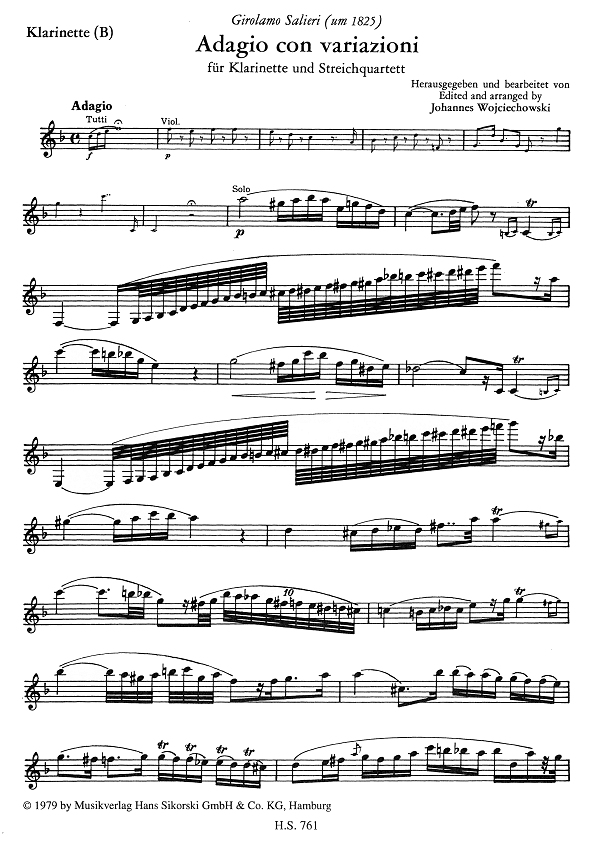
C2269: Adagio con variazioni for Clarinet and String Quartet by Girolamo Salieri edited by Johannes Wojciechowski. Sikorski, 1979, SS, includes parts score. Girolamo Salieri (1794-1838 ca.) was an Italian clarinet virtuoso and composer. He was the nephew of the Antonio Salieri with whom he studied. All of his surviving compositions are for clarinet. This piece was composed in 1825 and is about 10 minutes in length. It begins with an opening Adagio, which is followed by the Theme (Allegretto) and four variations. The string quartet is mostly in an accompanying role. The clarinet part is college level. Click on the cover image to view the first page of the clarinet part. |
28.95
|
|
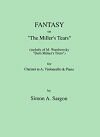
C1287: Fantasy on "The Miller's Tears" for Clarinet (in A), Violoncello and Piano by Simon A. Sargon. Simon A. Sargon, 2007, SB/SS, (includes parts and piano score). This piece was inspired by the song "Dem Milner's Trern," one of about 50 songs written by Mark Warshawsky (1840-1907) a well-know Yiddish composer, poet, and performer. The composer writes that although this piece has elements of both a Theme and Variations and program music, it cannot be put into any formal category. College level with a duration of about 13:30. |
24.95
|
|
C2108: Autumn Trio for Clarinet (in A), Violoncello, and Piano by Peter Schickele. Theodore Presser, 2011, SS, (includes parts and piano score). Inspired by his son’s cello lessons while studying composition at Bard College, Peter Schickele’s Autumn Trio consists of three movements: Mosaic, Intermezzo, and Tarantella (La vache qui rit). The playful finale is based on the image of a dancing cow, laughing and flinging herself around the pasture. An advanced work with a duration of about 14 minutes. Click on the cover image to view an extended sample from the score. |
29.95
|
|
G153: Quartet for Clarinet (in A), Violin, Violoncello, and Piano by Peter Schickele. Elkan-Vogel, 1984, SS, (includes parts and piano score). In four movements: I. Moderate, flowing, II. Fast, driving, III. Slow, elegiac, and IV. Quite fast, dancing. An advanced work with a duration of about 20 minutes. |
49.95
|
|
C2512: Serenade for Three for Clarinet, Violin, and Piano (Parts and Score) by Peter Schickele. Elkan-Vogel/Theodore Presser, 1996, SB/SS, (includes parts and piano score). Commissioned by the Verdehr Trio. In three movements: I. Dances (Joyful, boistrous), II. Songs (Slow, serene), and III. Variations (Fast, rowdy). Advanced college level with a duration of about 13 minutes. Here is an audio recording from YouTube (the other movements are there also, as well as other videos of this piece) . C2512a: Serenade for Three for Clarinet, Violin, and Piano (Piano Score) by Peter Schickele. Elkan-Vogel/Theodore Presser, 1996, SB. C2623: Serenade for Three for Clarinet, Violin, and Piano (Parts Only) by Peter Schickele. Elkan-Vogel/Theodore Presser, 1996, SS. |
Parts & Score
74.95
Score
44.95
Parts
39.95
|
|
C1095: Love Letters for Clarinet and Cello by Ruth Schonthal. Sisra (Arsis Press), 1988, SS, 16 pages (score format). Ruth Schonthal (1924-2006) was born in Germany and lived in Sweden, USSR, Mexico, and finally in the US where she studied with Hindemith at Yale graduating in 1948. This work was written in 1979 and contains nine pieces. Excellent for college and professional recitals. For Clarinet in A. Duration about 11:30. |
8.95
|
|
C704: Märchenerzählungen (Fairy Tales) Four Pieces Op. 132 for clarinet (or violin), viola and piano by Robert Schumann edited by Joachim Draheim. Breitkopf, 1988, SS, (includes all parts and piano score). Four short movements: I. Lebhaft, nich zu schnell, II. Lebhaft und sehr markiert, III. Ruhiges Tempo, mit zartem Ausdruck, and IV. Lebhaft, sehr markiert. This is beautiful writing for all three instruments in a style similar to the Fantasy Pieces, with flowing melody and accompaniment in other instruments. A nice recital piece for college and professional level performers. Includes notes by the editior.
|
25.95
|
|
C1393: Clarinet Quintet (Clarinet and String Quartet) by Cyril Scott. Edition Peters, 1961/2008, SS, (includes parts and score). Cyril Scott (1879-1970) a composer, author and poet was described by Eugene Goossens as "the father of modern British music." It was composed in 1951 and premiered the same year by Gervase De Peyer. This work is in two sections. A college level work. This is the first edition available for sale. |
30.75
|
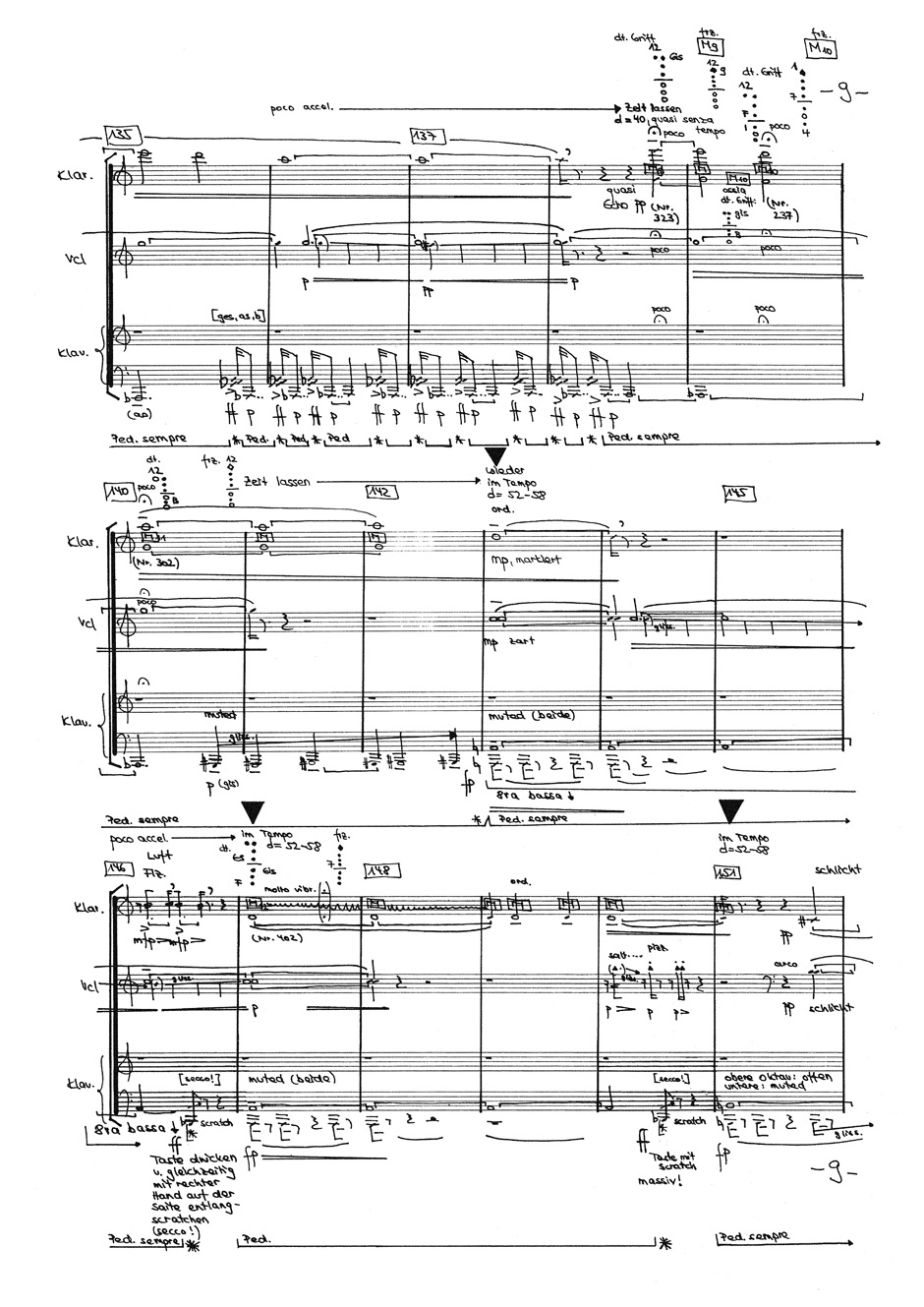
|
C2351: Far from distance for Clarinet, Violoncello and Piano by Charlotte Seither. Barenteiter, 2012, SS, score only on 16 oversize pages. Charlotte Seither (1965-) is a German composer, pianist and music educator. This is a contemporary work which includes some multiphonics in the clarinet part. Most of the instructions are in German. Click on the cover image to view the second page of the score. |
25.95
|
|
C761: Concertino for Clarinet and String Quartet by Bright Sheng. G. Schirmer, 1997, SS, (includes parts and score). This piece was commissioned and written for The Chamber Music Society of Lincoln Center and its Artistic Director, David Shifrin. The materials of this work are drawn from fragments of folk tunes the composer heard while living in the northwest part of China. Unlike most Chinese folk music this music has a seven-note scale similar to the mixolydian mode. In four movements: I. Andante, II. Prestissimo, and III. Largo. Both B-flat and A clarinets are needed. This is a professional level work with a duration about 17 minutes.
|
34.95
|
|
C736: Tibetan Dance for clarinet in B-flat, violin and piano by Bright Sheng. G. Schirmer, 2006, SS. Tibetan Dance was written for the Verdehr Trio in 2000 by Chinese born composer Bright Sheng (1955-) who lived near the Tibetan border during his teenage years. It is in three movements: I. Prelude, II. Song (Melanconico, and the piano is tacet), and III. Tibetan Dance. The composer wrote "the work is anchored on the last movement, the longest of the three. The first two movements are reminiscent, as if one is hearing songs from a distant memory, and the music becomes real in the last movement." Duration about 15 minutes. 
|
39.95
|
|
C900: Cabaret Music for Clarinet, Violin, Cello & Piano by Allen Shawn. Galaxy Music, 1986, SS. Allen Shawn (1948-) is an American composer who teaches at Bennington College in Vermont. The work is in three movements. It is a college level work, primarily due to the mixed meter in the first and third movements. |
18.30
|
 |
C1153: Prelude, Blues and Finale for Two Clarinets in A (or Clarinet in A and Viola) and Piano by Elie Siegmeister. Carl Fischer, SS. Elie Siegmeister (1909-1991) was an American composer, educator and author. This is a challenging and exciting piece that was composed for Stanley and Naomi Drucker and Blanche Abram and premiered by them in 1984. This edition was copied from a manuscript which appears to have had a number of corrections (cut and paste) especially in the first few pages. It is supplied with a piano score, and a part with the first and second clarinet part and another with the first clarinet and viola part, so when played by two clarinets they each have their own part. Duration about 16 minutes. |
72.75
|
|
C917: Tres Fantasias for clarinet, cello & piano by Roberto Sierra. Subito Music, 1994, SS. The first movement is Muntuno and is based in part on that popular Afro-Caribbean rhythm. The second movement (Coral) is based on Bach's Choral "Es ist genung" (which is heard midway through in the first movement as well). The third movement (Doce) is a free exploration of the 12-tone row that Schoenberg used in his Suite for Piano Op. 25. An advanced work with a duration of about 11 minutes. |
28.50
|
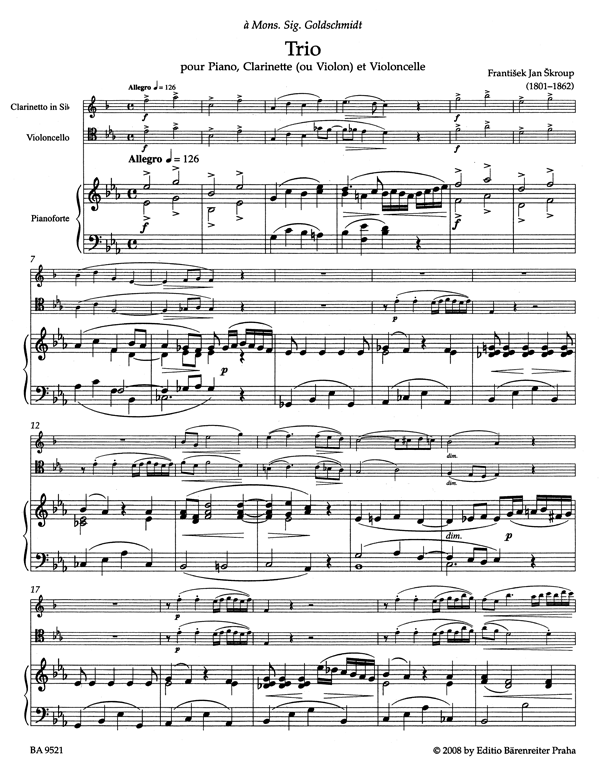
|
C1293: Trio in E-flat major Op. 27 for Piano, Clarinet (or Violin) and Violoncello by Frantisek Skroup edited by Martin Harlow. Baerenreiter (BA 9521), 2008, SS, (includes all parts and piano score). František Jan Škroup (1801-1862) was a Czech composer and conductor who was an important musician of the national revival movement. His primary compositional output was music for the theatre but he also wrote some chamber music including this clarinet trio (ca. 1845) which is one a very few between Beethoven and Brahms. In four movements: I. Allegro, II. Andante grazioso, III. Scherzo (Allegretto), and IV. Finale (Allegro). This edition includes historical notes and a critical commentary on the editing. A college level work. Click on the cover image to see a copy of the first page. |
26.95
|
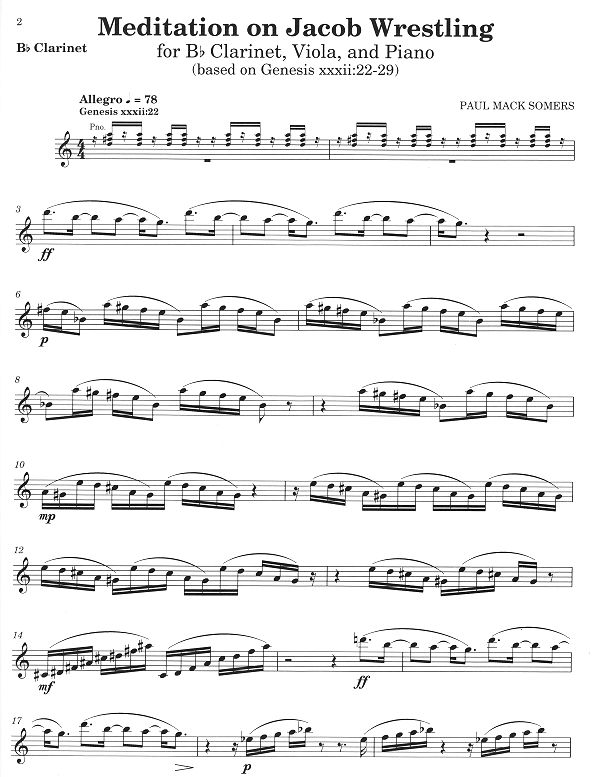
|
C2709: Meditation on Jacob Wrestling for Clarinet, Viola and Piano by Paul Mack Somers. Maurice River Press, 2019, SS, includes parts and piano score. On a mission to develop an example of minimalism, Somers found himself wandering into an imagining of a particular Biblical scene, that of Jacob wrestling with a stranger. This brought to mind a hymn tune adaptation by an old friend, which in turn became the underpinnings for Somers' own Meditation. The appropriate verses from the Book of Genesis are noted within the score as the tale unfolds. This piece includes program notes. Click on the cover image to see the first page of the clarinet part. |
32.95
|
|
C681: Clarinet Quintet for clarinet in A and string quartet by Arthur Somervell. Emerson Edition, 2004, SS. Arthur Somervell (1863-1937) was an English composer of a conservative style. Despite the title both A and B-flat clarinets are required for this piece. Four movements: 1.. Sostenunto/Allegretto (quasi andante) grazioso, 2. Intermezzo (Allegretto), 3. Lament (Adagio non troppo), and 4. Finale (Allegro vivace). The inner two movements are for B-flat clarinet. |
31.95
|
|
C1972: Quintet for Clarinet in A and Strings (String Quartet) by Rick Sowash. Rick Sowash Publishing Co., 1995, SS, includes parts and score. Paraphrasing the composer: This work was written in 1995, specifically for the for the French clarinetist Lucien Aubert. The work was the my attempt to express something of what I have felt as I wandered amidst the beautiful, grand and ancient forms of Europe. Similarly, imagine how the Sonata-Allegro from looks! How is an American of my sensibilities to respond to such grand structures. You can find the answer to that question in the first movement. In the other movements, I do my best to come to terms with other classical forms--specifically the scherzo, the toccata, and the Hungarian Dance. The results a piece of music that "sounds" American even while it lovingly and respectively evokes the great musical forms of Europe. They loved it in Paris! Duration 25 minutes. |
35.95
|
|
C1974: Trio # 9, Five Women for clarinet, cello and piano by Rick Sowash. Rick Sowash Publishing Co., 2003, SS, includes parts and piano score. Portraits of five women who have been important for the composer - in F major. I. Bernice: merry and mystical, II. Claire: in the process of becoming, III. Jo: mother of our children, IV. Diane: beautiful and sad, and V. The Vitality of Emilie. College level. |
24.50
|
|
C1973: Trio con brio for violin, clarinet, and cello by Rick Sowash. Rick Sowash Publishing Co., 1999, SS, includes parts and score. I. Intrada (Allegro con brio), II. Lincolnesque (Andante), III. Song of Samwise (Allegro con brio), IV. Lullabye (Moderato), and V. Finale (Vivo, con brio). College level with a duration of about 18 minutes. |
24.95
|
|
C487: Fantasia and Variations on a Theme of Danzi Op. 81 for clarinet and string quartet by Louis Spohr edited by Himie Voxman. Musica Rara, 1977, SS. This piece was written in 1814 and premiered in January 1815 by Johann Simon Hermstedt. In one movement with tempos alternating between Allegro molto and Andantino. The clarinet part is primarily based on arpeggio patterns and requires strong technique. The strings are mostly in an accompanying role. We also stock the Clarinet and Piano Reduction edition. 
|
21.95
|
|
C1731: Quartet in E-flat major Op. 8 No. 4 for Clarinet (Oboe), Violin, Viola and Violoncello by Carl Stamitz. Breitkopf (Musica Rara), 1958/2000, (includes all parts, but no score). This quartet was first published in 1785 and was written while Stamitz was in Paris. In three movements: Allegro, Andante, Allegro and relatively short (the parts are mostly three pages long). Suitable for advanced high school, early college and adult amateurs. |
15.95
|
|
C1730: Quartet in E-flat major Op. 19 No. 1 for Clarinet, Violin, Viola and Violoncello by Carl Stamitz. Breitkopf (Musica Rara), 1966, SS, (includes parts only). In three movements: Allegro, Largo/Allemande (Vivace), Andante moderato/Vivace. This piece is quite a bit longer than Op. 8 No. 4 and may be slightly more difficult. |
18.95
|
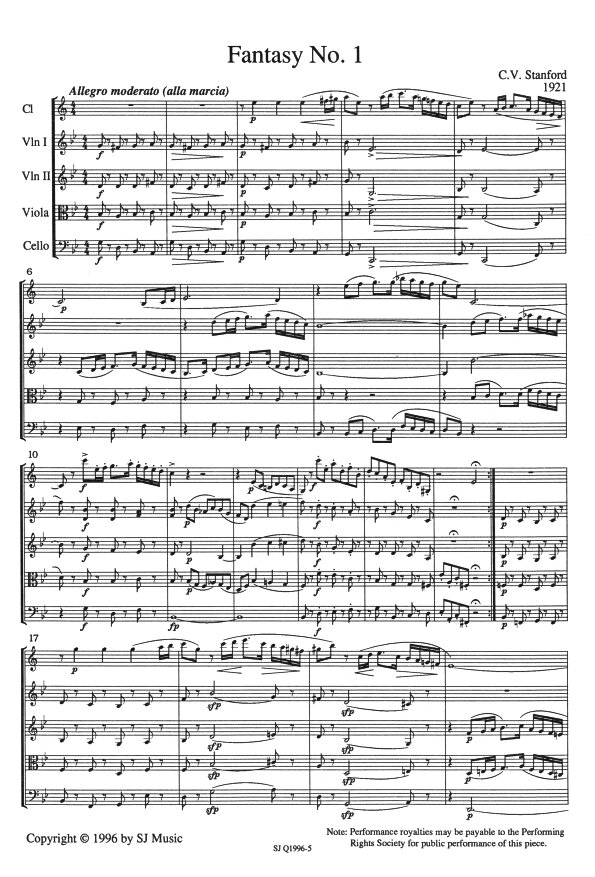
|
C1943: Fantasy No. 1 for Clarinet and String Quartet by Charles Villiers Stanford. SJ Music, 1996, SS, (includes parts and score). Charles Villiers Stanford (1852-1924), who was born in Ireland, was a composer, teacher and conductor. In 1882, he was one of founding professors of the Royal College of Music where he taught composition for the rest of his life. This work was written in 1921 and this is the first time it has been published. Thea King who wrote the notes was responsible for the editing. It is in three movements: Allegro moderato (alla marcia), Andante, and Allegro. Click here to listen to an audio recording. Click on the cover image to view the first page of the score. |
26.95
|

|
C2558: Fantasy No. 2 for Clarinet and String Quartet by Charles Villiers Stanford. SJ Music, 1996, SS, (includes parts and score). This work was written in 1922 and this is the first time it has been published. Thea King who wrote the notes was responsible for the editing. It is in three continous movements: Allegretto piacevole, Adagio, and Quasi Presto. Click here to listen to an audio recording. Click on the cover image to view the first page of the score. |
26.95
|
|
C1375: Man lebt nur einal!, Walzer im Ländlerstyle Op. 167 by Johann Strauss II arranged for clarinet and string quartet by Peter Totzauer. Hofmeister, 1994, SS, includes score and parts. Wrtten in 1855, the title means "You Only Live Once" and it is to be performed in the style of the landler, an Austrian folk dance. The bass line of the score calls for a double bass with the cello as an alternate. The clarinet and the first violin have the melody with the other strings in an accompanying role. Advanced high school level and up. |
21.95
|
|
G149: Suite from L'Historie du Soldat for Clarinet, Violin and Piano by Igor Stravinsky (arranged by the composer). Chester, 1920/1989, SS. This suite has the pieces: 1. Marche du Soldat, 2. Le Violon du Soldat, 3. Petit Concert, 4. Tango-Valse-Rag, and 5. La Danse du Diable. Both A and B-flat clarinets are needed. Duration about 15 minutes.
|
31.95
|
|
G148: Suite from L'Historie du Soldat for Clarinet, Violin and Piano by Igor Stravinsky (arranged by the composer). International Music Co. SS. This suite has the pieces: 1. Marche du Soldat, 2. Le Violon du Soldat, 3. Petit Concert, 4. Tango-Valse-Rag, and 5. La Danse du Diable. Both A and B-flat clarinets are needed. Duration about 15 minutes.
|
28.75
|
|
C1289: 7 Balkan Dances for Clarinet, Violoncello and Piano by Marko Tajcevic arranged by Alojz Srebotnjak. Schott, 1973, (includes parts and piano score). Marko Tajčević (1900-1984) was a Serbian composer and musician. He studied in Zagreb, Prague, and Vienna and was a music educator, composer, and choral conductor. This piece was originally for piano and is very popular in that format. The dances do not have names. They are marked: I. Con moto, II. Rustico, III. Vivo, IV. Sostenuto e cantabile, V. Allegro ritmico, VI. Allegretto, and VII. Allegro quasi pesante. College level with a duration of about 10 minutes. |
19.95
|
|
C2429: Dancing Helix Rituals for Violin, Clarinet, and Piano by Augusta Read Thomas. G. Schirmer, 207/2015, SS, (includes parts and piano score). Augusta Read Thomas (1964-) is an American composer. While this work was composed a decade ago is has just recently been published. It was commissioned and is dedicated to the the Verdehr Trio. It is an advanced piece with a duration of 7:30. The score notes that it should be performed with dancers when possible. There are both audio and video recordings of the piece on this page. |
19.95
|
|
C1539: Cortège for Chris for Clarinet, Cello and Piano by Mark-Anthony Turnage. Schott, 2007, SS, (includes parts and piano score). British composer Mark-Anthony Turnage (1960-) is one of the most admired and widely performed composers of his generation. This piece was written as a memorial to Chris van Kampen a fellow musician and a friend of the composer. Marked sweet and mournful, it has a duration of 3 minutes. College level. |
16.95
|
|
C1096: Passages 111 Trio for Clarinet, Violoncello and Piano by Mary Jeanne van Appledorn. Sisra Publications (Arsis Press), 2003, SS, (includes parts and piano score). Mary Jeanne van Appledorn (1927-) is an American composer of contemporary classical music. Passages III is a trio for clarinet, cello and piano that was commissioned in 2003 by Trio Montecino. The piece continues the composer's concept of creating movements based on the colors of a specific musical scale or motive. In six movements: I. Allegro (contains octatonic and modal scale constructions), II. Moderato (features energetic bi-chordal structures), III. Presto (octatonic melodic and vertical structures), IV. Fugato (a short four-voice fugue based on a Lydian tetrachordal subject), V. Mesmeric Moment (founded on pentatonic structures in the D Dorian scale), and VI. Marcato (features minor ninth chords alternating with quartal structures performed at sforzando dynamics throughout). College level. |
14.95
|
|
C2264: Trio in E-flat Op. 20 No. 5 for Clarinet, Violin and Piano by Jan Vanhal edited by Pamela Weston and Walter Bergman. Schott, 1965, SS, 18 + 3 (Cl) + 4 (Vn) pages. Also includes an optional continuo part for cello or bassoon which is exactly the same as the piano left hand part. Johann Baptist Wanhal (1739-1813) was an important Czech composer. In three movements: Allegro, Grazioso, and Allegretto. The duration is about 10 minutes. Here is a recording of this piece. |
41.95
|
|
C1105: Six Studies in English Folk-Song (arranged for Clarinet and String Quartet) by Ralph Vaughan Williams arranged by Adam Lesnick. International Opus, 1994, SS, (includes parts and score). This popular piece (originally for cello and piano) was arranged by the composer for clarinet and piano. This version for clarinet and string quartet should be playable by better high school level players. |
19.95
|
|
C1638: Quartet in C major for Clarinet, Violin, Viola and Cello by Adam Valentin Volckmar edited by Bernhard Päuler. Amadeus, 2004, SS, includes parts (which are 6 pages long) and score. Adam Valentin Volckmar (1770-1851) was a German organist, composer and school music teacher. He studied with a former student of CPE Bach. This edition includes parts for both B-flat and C clarinet. In four movements: Allegro, Mineutto (Allegro), Andante con moto espressivo, and Finale (Allegro poco molto). Early college level.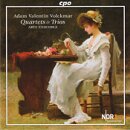 |
29.95
|
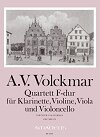
|
C1637: Quartet in F major for Clarinet, Violin, Viola and Cello by Adam Valentin Volckmar edited by Bernhard Päuler. Amadeus, 2004, SS, includes parts (which are 6 pages long) and score. In five movements: Allegro non molto. Adagio un poco Andante. Minuetto/Allego spirituoso, Andante con Variationi (four variations), and Polacca/Poco Allegretto scherzando. College level. |
30.95
|
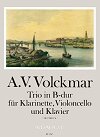
|
C1639: Trio in B-flat major for Clarinet, Cello and Piano by Adam Valentin Volckmar edited by Bernhard Päuler. Amadeus, 2005, SS, includes parts and score. In three movements: Andante con moto/Allegro poco vivace, Poco Adagio, and Finale (Allegro). The clarinet and cello parts are early college level. The piano part which is important, may be a bit more difficult.
|
36.95
|
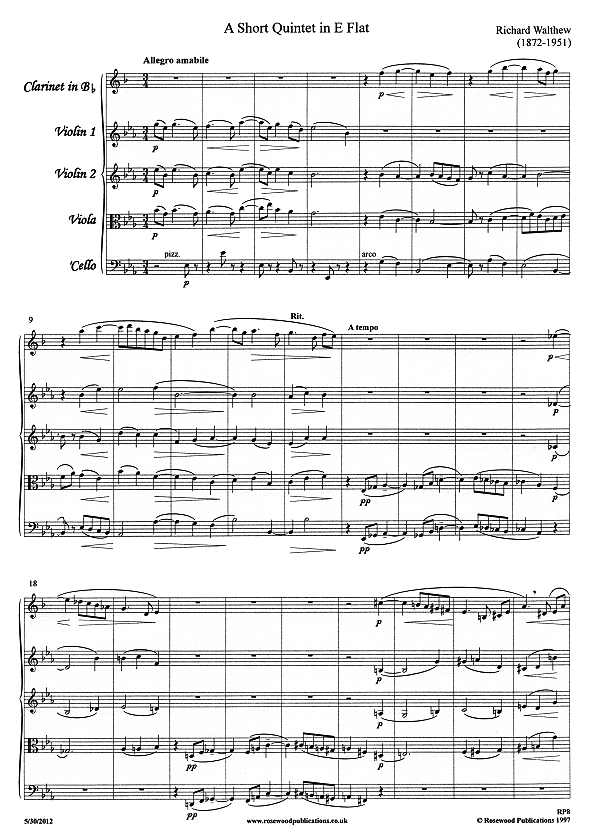
|
C2076: A Short Quintet in E-flat for Clarinet and String Quartet by Richard Walthew. Rosewood, 1997/2012, SS, includes parts and score. Richard Walthew (1872-1951) was a British composer with a special affinity for chamber music. This piece was was written in 1917 and was commissioned by the well known amateur clarinetist Oscar W. Street Esq. While it is written as one continuos movement there are fermatas and one grand pause between sections. Having been lost for many years after last known performance in 1937, the manuscript parts were found in the 1980s and have finally been typeset. Early college level with an estimated duration of around 15 minutes. Here is a low quality recording of the first modern performance in 1986 which includes a spoken introduction. Click on the cover image to view the first page of the score. |
34.95
|
|
G101: Trio in D for clarinet in A (violin), horn (viola/bassoon/basset horn/bass clarinet) and piano by Richard Walthew. Rosewood, 2000.This piece is of intermediate length and in three movements: I. Allegro Moderato, II. Allegretto, and III. Lento/Allegro non troppo. Early college level. |
21.20
|
|
C1370: Gestural Variations Op. 43a for Clarinet, Violoncello and Piano by Graham Waterhouse. Hofmeister, 1998, SS. Includes parts and piano score. Graham Waterhouse (1962-) is an English born and educated composer and a cellist who is based in Germany. Originally written for bassoon, oboe and piano, the work was rescored by the composer for this combination. Each variation evokes a different movement or gesture, such as those made by a mime or ballet dancer. College level with a duration of 13 minutes. |
18.95
|
|
C2703: Weber Concerto No. 1 in F Minor Op. 73 by Carl Maria von Weber arranged for Clarinet and String Quartet by Michael Drapkin. Drapkin Music Publications, 2019, SS, includes parts and score. This edition enables the concerto which is for clarinet and orchestra to be played by a small ensemble. |
44.95
|
|
C556: Weber Introduction, Theme and Variations for Clarinet and String Quartet by Carl Maria von Weber edited by Leonard Kohl. Bote & Bock, 1962/1998. This work begins with a Adagio introduction, then the theme (Allegretto), followed by six variations. It concludes with a 6/8 Allegro assai and ends in a final Vivo. Parts only (no score). We also have an edition for clarinet and piano.
|
27.75
|
|
C554: Weber Quintet for Clarinet in B-flat Major Op. 34 for clarinet and string quartet by Carl Maria von Weber. Robert Lienau. Four movements: Allegro, Adagio ma non troppo, Minuet, and Rondo. The first and third movements are weak; however, the Adagio and Rondo show Weber at his best. The string parts are not difficult helping to make this an excellent college level work. We also have an edition from the same publisher for clarinet and piano.
|
18.95
|
|
C886: Weber Quintet for Clarinet in B-flat Major Op. 34 for clarinet and string quartet by Carl Maria von Weber edited by Günter Haußwald revised by Wolfgang Meyer and Christoph Poppen. Breitkopf, 1989. This edition includes a Preface (in English and German) that provides the background and history of the works and remarks on the editing, Notes on the Revision, and a Critical Commentary that lists the individual edits. Four movements: Allegro, Adagio ma non troppo, Minuet, and Rondo. .
|
32.95
|
|
C887: Weber Quintet for Clarinet in B-flat Major Op. 34 for clarinet and string quartet by Carl Maria von Weber edited by Stanley Drucker. International Music Co., 1958, SS. Four movements: Allegro, Adagio ma non troppo, Minuet, and Rondo.
|
20.75
|
|
C1579: Quintet for Clarinet and Strings by Dan Welcher. Elkan-Vogel/Presser, 1984, SS, includes parts and score. For clarinet in A and string quartet. I. Furioso, II. Intermezzo (Gracioso), and III. Song with Variations (Amabile). A substantial and challenging work. The clarinet has the leading role but the string parts are also important and interesting. Duration about 28:30. |
29.95
|
|
C1358: Air and Simple Gifts for Violin, Cello, Clarinet and Piano by John Williams. Hal Leonard, 2009, SS. Written especially for the Inaugural Ceremony of President Barack Obama on January 20, 2009. It is based on the on the familiar nineteenth century Shaker hymn Simple Gifts by Joseph Brackett. Duration is about 4:30. This edition has individual parts (including one for the piano) and a full score. |
39.95
|
|
C2017: From Here on Farther for Violin, Clarinet, Bass Clarinet and Piano by Stephen Wolpe. Peer-Southern Concert Music, 1984/1993, SS, includes parts and piano score. Stefan Wolpe (1902-1972) was born, studied and began his career in Germany, but moved to Palestine in 1934 and to the United States in 1938. This work was written in 1969. This work is in three sections, each of which begins with the same material. The score includes notes on the piece and the editing. This an advanced work with a duration of about 6 minutes. Here is a link to a recording. |
17.95
|
|
C908: Trio in D Minor Op. 3 for clarinet (or violin), cello, and piano by Alexander von Zemlinsky. Simrock, 1897, SS. Alexander von Zemlinsky (1871-1942) was an Austrian composer, conductor, and teacher. This is one of Zemlinsky earlier works and was published by Simrock at the recommendation of Brahms. The clarinet part requires both B-flat and A clarinets. In three movements: Allegro ma non troppo, Andante, and Allegro. This is an extended work with a duration of about 28 minutes. Here is a video of a performance. |
29.95
|
Bindings: HB: Hard Bound, PB: Perfect Bound (paperback with square spine), SS: Saddle Stitch (paper, folded and stapled), SB: Spiral Bound (plastic or metal)