Flute and Recorder Music

This section is organized in categories. Click on a button below to jump to that category. Items are in alphabetical order by title in each category except the music category where they are listed by composer. The recorder music is at the very bottom of the page.


You may search for a composer, title, or any other text on this page by using the
Edit menu Find command (shortcut Ctrl+F or Mac Command+F).
      
|
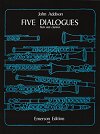 |
WW258: Five Dialogues for Flute and Clarinet by John Addison. Emerson Edition, 1992, SS, 13 pages in score format. John Addison (1920-1998) was a British composer (who studied both oboe and clarinet) best known for his film scores. This piece was part of a project by the publisher to commission works for these two instruments from composers whose writing for wind instruments was particularly skillful and imaginative. The dialogs are: I. Prelude al scherzo (Allegretto), II. Air (Andante), III. Caprice (Allegro moderato/Andante), IV. Entracte (Moderato), and V. Valse (Tempo di Valse). College level (although the slower movements are easier).
(Except other items with free shipping.) |
15.95

|
|
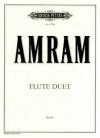
F254: Flute Duet by David Amram. Peters, 2006, 2 pages in score format. American David Amram (1930-) is a composer, conductor, musician and writer. This short duet (which is really more of a flute solo with a very easy flute accompaniment) was premiered in 1991 by Julius Baker and the composer but not published until now. Marked ben cantare, mm=56. Duration about 2:28.
(Except other items with free shipping.) |
4.95
|
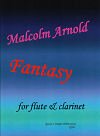 |
WW171: Fantasy for flute and clarinet by Malcolm Arnold. Queen's Temple Publications, 2003, SS, 2 pages (score format). A miniature (duration 1:30) Arnold wrote for his children to play together. Opens and closes with the flute playing a melody over arpeggios in the clarinet and has a contrasting interlude in between. Some pleasing dissonance in spots. Early high school level. (Except other items with free shipping.) |
7.95
|
|
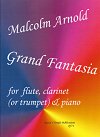
WW255: Grand Fantasia for Flute, Clarinet (or Trumpet) and Piano by Malcolm Arnold. Queen's Temple Publications, 2004, SS, (includes parts and piano score). This piece was written in 1940 for flute, trumpet (played by the composer) and piano. It is not surprising that the clarinet is now listed first on the cover as the part would be more difficult on the trumpet than the clarinet. A sectional piece including a czardas, tango, blues, waltz and other elements. Early college level with a duration of 10 minutes. |
25.95
|
|
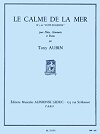
WW125: Le Calme de la Mer Trio for Flute, Clarinet and Piano by Tony Aubin. Alphonse Leduc, 1964, SS, (includes parts and piano score). A suggested piece for this combination. It is at an unhurried tempo (Lento, ma non troppo) and should be playable by many high school students although the flute part goes up to C7. |
20.55
|

|
 F414: Concerto in D minor for Flute, Strings and Harpsichord (Piano Reduction) by Carl Philipp Emanuel Bach edited by Janos Malina. Kunzelmann, 1980, SS, 34 + 9 pages. This piece is a transcription of the Harpsichord Concerto in D minor. In three movements: Allegro, Un poco Andante, and Allegro di molto. College level. We can order the string parts and the score which includes the harpsichord part. F414: Concerto in D minor for Flute, Strings and Harpsichord (Piano Reduction) by Carl Philipp Emanuel Bach edited by Janos Malina. Kunzelmann, 1980, SS, 34 + 9 pages. This piece is a transcription of the Harpsichord Concerto in D minor. In three movements: Allegro, Un poco Andante, and Allegro di molto. College level. We can order the string parts and the score which includes the harpsichord part. |
27.95
|
|
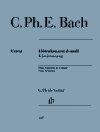
F422: Concerto in D minor for Flute Piano Reduction by Carl Philipp Emanuel Bach edited by András Adorján with piano reduction by Jan Philip Schulze. Henle, 2015, SS, 30 + 11 pages. Includes a preface and comments on the editing. An in-depth study of all sources suggests that Bach composed the flute version before the harpsichord version. Editor András Adorján presents a musical text in which many errors have been eliminated. In three movements: Allegro, Un poco Andante, and Allegro di molto. College level. Sale Price. The regular price is $24.95. |
18.95
|
|
F370: Sonata in A minor for Flute Solo Wq 132 by Carl Philipp Emanuel Bach edited by Manfred Harras. Baerenriter (BA 6820), 1986, SS, 6 pages. This piece was first published in 1763. This is considered one of the most important works for solo flute from the eighteenth century. In three movements: Poco adagio, Allegro, and Allegro. Early college level with a duration of about 15 minutes (with repeats). (Except other items with free shipping.) |
12.95
|
|
F252: C.P.E. Bach Sonata for Violin or Flute and Harpsichord in G minor edited by Anne Marlene Gurgel. C.F. Peters, 1981, parts for violin, flute, cello (for the continuo) and harpsichord plus a play-along CD of the accompaniment. In three movements: Allegro, Adagio, and Allegro. |
26.95
|
|
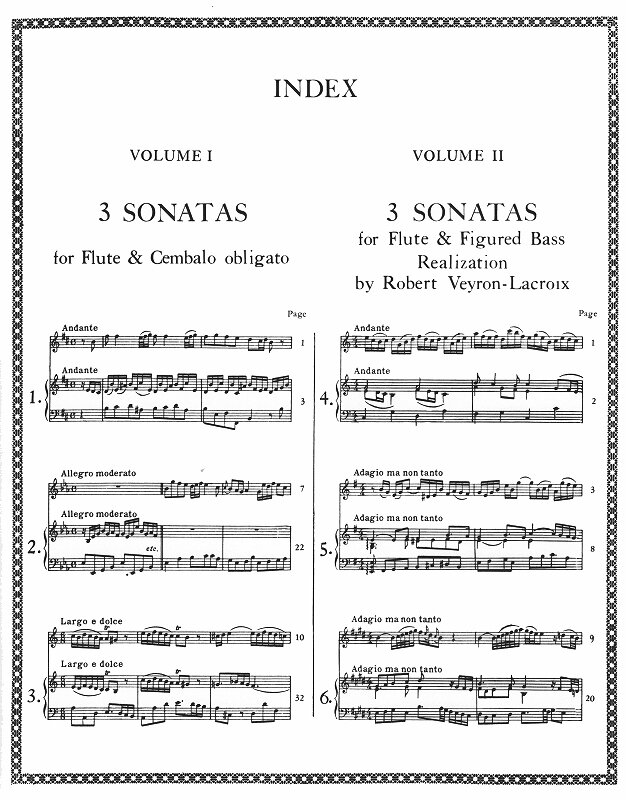
F401: Bach 6 Sonatas Volume I for Flute and Piano edited by Jean-Pierre Rampal. International Music Co., 1962, SS, 39 + 12 pages. This volume contains the first 3 of the 6 sonatas which were originally for flute and harpsichord. They are: Sonata No. 1 in A major S. 1030, Sonata No. 2 in E-flat major S. 1031, and Sonata No. 3 in A major S. 1032. College level. Click on the cover image to see the "index" page for both volumes which shows the beginning of each sonata. |
19.75
|
|
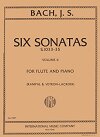
F402: Bach 6 Sonatas Volume II for Flute and Piano edited by Jean-Pierre Rampal with realization of the figured bass by Robert Veyron-Lacroix. International Music Co., 1962, SS, 26 + 12 pages. This volume contains the last 3 of the 6 sonatas which were originally for flute and figured bass. They are: Sonata No. 4 in C major S. 1033, Sonata No. 5 in E minor S. 1034, and Sonata No. 6 in E major S. 1035. College level. |
14.25
|
|
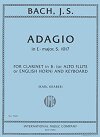
C1280: Adagio in E-flat major S. 1017 by Johann Sebastian Bach arranged for Clarinet (or Alto Flute or English Horn) and Keyboard by Karl Kraber. International Music Co., 2008, 3 + 1 pages. This is from the Sonata No. 4 in C minor for violin and harpsichord. Intermediate level. (Except other items with free shipping.) |
12.95
|
|
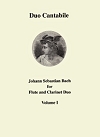
WW314: Johann Sebastian Bach for Flute and Clarinet Duo Volume I arranged by Joe Armstrong and Liz Leehey. Van Cott Information Services Inc., 2013, SB, 16 + 6 + 6 pages (includes score and parts). This volume has three duos. Adagio from Concerto in C minor BWV 1060: Originally for oboe and violin, this Adagio is an example of Bach’s marvelous interweaving of exquisite lines. In this transcription the clarinet takes the oboe line while the flute takes the violin line. Frohe Hirten, eilt, ach eilet! from The Christmas Oratorio BWV 248: Bach’s delightful tenor aria Frohe Hirten, eilt, ach eilet! (Joyous Shepherds Hasten!), transcribed for flute and clarinet duo with the clarinet taking the vocal line. The two parts interweave and then join in running roulades that challenge both fingers and breath. Ich will leiden, ich will schweigen from Cantata BWV 87: A tenor aria (translated as I would suffer, I would keep silent) transcribed for flute and clarinet duo. The clarinet takes the vocal line while the flute takes the violin line, in this poignant, pastorale-like aria that embraces both sorrow and comforting. Click on the cover image to view the score of the first page of each duo. |
19.95
|
|
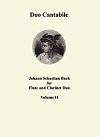
WW317: Johann Sebastian Bach for Flute and Clarinet Duo Volume II arranged by Joe Armstrong and Liz Leehey. Van Cott Information Services Inc., 2013, SB, 16 + 7 + 8 pages (includes score and parts). This volume has three duos. Schweigt, ihr Flöten, schweigt ihr Töne! from Cantata BWV 210: The clarinet takes the soprano vocal part. This is the second aria from Bach's wedding cantata O holder Tag, erwünschte Zeit! There is an alternate part for this piece for clarinet in A. Valet will ich dir gerben from Cantata BWV 95: Originally for solo soprano chorale with oboe d'amore obbligato, it has been transcribed for flute and clarinet duo. Was willst du dich mein Geist entsetzen? from Cantata BWV: This is the tenor aria from Cantata Liebster Gott. The flute takes the tenor line while the clarinet takes the oboe d'amore line. Click on the cover image to view the score of the first page of each duo. |
19.95
|
|
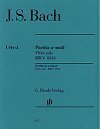
F166: Bach Partita in A minor Flute Solo BWV 1013 by Johann Sebastian Bach edited by Hans Eppstein. Henle, 1990, SS. In four movements: Allemande, Corrente, Sarabande, and Bourrée Angloise. Includes notes on the piece and the editing. (Except other items with free shipping.) |
8.95
|
|
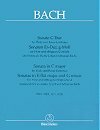
F164: Bach Sonatas in C major, E-flat major, and G minor for Flute edited by Alfred Dürr. Baerenreiter (BA5220), 1975. This is an edition of the music attributed to Bach, but of which there is some doubt: Sonata in C major for Flute and Basso continuo (BWV 1033), Sonatas in E-flat Major (BWV 10310) and G minor (BWV 1020) for Flute and Obbligato Harpsichord. This edition includes scores with the Basso continuo realization, Basso continuo parts, flute parts, and a preface (in English and German) on the questions surrounding these pieces. |
28.95
|
|
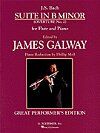
F230: Bach Suite in B minor (Overture No. 2) for flute and piano edited by James Galway. G. Schirmer, 1990, SS, 22 + 9 pages. This popular work by J.S. Bach was originally for strings, continuo, and solo flute. In seven movements: I. Overture, II. Rondeau, III. Sarabande, IV. Bourrée I and II, V. Polonaise, VI. Menuet, and VII. Badinerie. Upper intermedate level and perhaps a bit beyond in some of the faster movements. The current price of this piece is $12.95. |
9.95
|
|
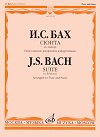
F352: Bach Suite in B minor arranged for flute and piano by N. Platonov. Moscow Muzyka, 2008, 24 + 6 pages. This popular work by J.S. Bach was originally for strings, continuo, and solo flute. In seven movements: I. Overture (Grave/Allegro/Lento), II. Rondeau (Allegro, ma non troppo), III. Sarabande (Andante), IV. Bourrée 1 and 2 (Allegro), V. Polonaise (Moderato), VI. Menuet (Allegretto), and VII. Badinerie (Allegro). Upper intermedate level and perhaps a bit beyond in some of the faster movements. |
12.95
|
|
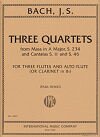
WW166: Bach Three Quartets for Three Flutes and Alto Flute (or Clarinet) edited by Paul Renzi. International Music, 2008, includes score and all parts. These three quartets for flutes and alto flute (with a clarinet part as an alternative to the alto flute) are from: Aria "Qui tollis peccata mundi" (Gloria) from the Mass in A major s. 234, Aria "Jesu, deine Gnaden blikke" from Cantata Lobet Gott in seinen Reichen S. 11, and Aria "Doch Jesus will auch bei der Strafe" from Cantata Schauet doch und sehet S. 46. All of these works originally had two flutes with voice and other instruments. They are at the upper intermediate level and each work is one and a half to two pages long. |
34.95
|
|
F246: Bach Trio Sonata from "Musikalischen Opfer" (1747) for Flute (or Violin), Violin, and Continuo (cello & harpsichord) edited by Friedirich Hermann. C.F. Peters. Includes a play-along CD of the accompaniment to the solo part. A very nicely prepared edition. |
31.95
|
|
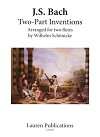
F363: Bach Two-Part Inventions arranged for two flutes by Wilhelm Schönicke. Lauren Publications, SS, two individual parts 15 pages each. Reprinted from the 1902 Zimmermann edition. There are 15 pieces and some notes on ornamentation. Advanced high school/early college level. |
14.95
|
|
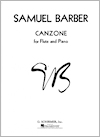
F420: Canzone for Flute and Piano by Samuel Barber. G. Schirmer, 1962, SS, 4 + 1 pages. This work was transcribed by the composer from the second movement of his piano concerto, Op. 38. The tempo is Moderato with a duration of about 3:45. Here is a performance by Mimi Stillman on YouTube.
(Except other items with free shipping.) |
5.95
|
|
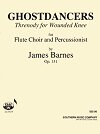
F388: Ghostdancers, Threnody for Wounded Knee Op. 131 for Flute Choir and Percussionist by James Barnes. Southern Music Co., 2010, SS, includes parts and score. This piece is for a flute choir of 6 C flutes (second flute doubling on optional ocarina), alto flute, bass flute and percussionist. The percussionist will need metal wind chimes, suspended cymbal, Native American drum (or tom-tom), and sleigh bells. Early college level with some contemporary notation and extended articulation techniques (they shouldn't be a problem for performers at this level). Includes notes on the inspiration for the piece and the composer. |
19.95
|
|
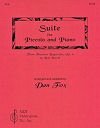
F190: Suite for Piccolo and Piano by Bela Bartok adapted by Dan Fox. Alry, 1983, SS, 16 + 6 pages. Three pieces (I. Allegro giocoso, II. Rubato sostenuto accelerando, III. Valse [Presto]) drawn from Fourteen Bagatelles Op. 6. The arranger was fascinated with the many possibilities for recasting these pieces that feature bitonality, octaveless scales, incisive rhythms, and folk melodies in dissonant settings for other instrumental settings. This suite, inspired by Larry Trott's brilliant piccolo playing, is one result. (Except other items with free shipping.) |
17.95
|
|
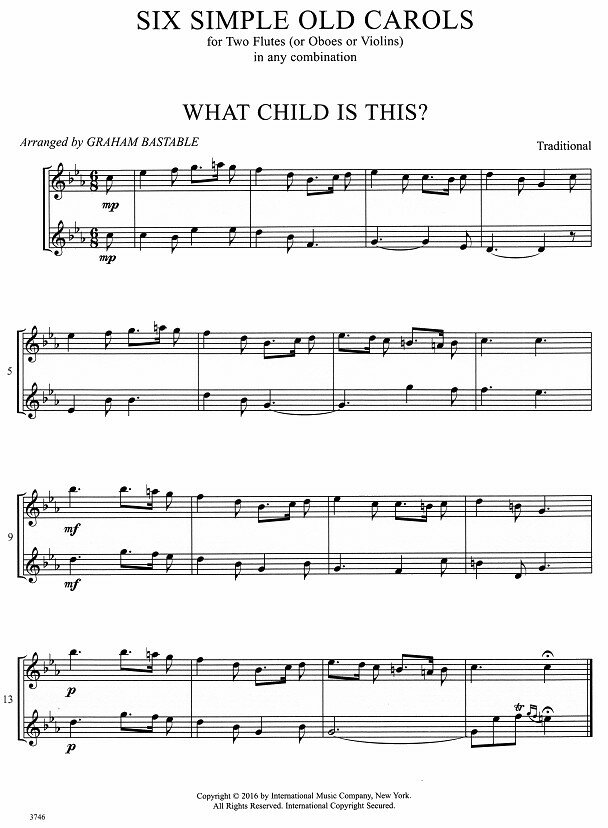
G292: Six Simple Old Carols for Two Flutes (or Violins or Oboes) in Any Combination arranged by Graham Bastable. International Music Co., 2016, SS, 6 pages in score format. These pieces would work just as well for like saxophones as well. They are at an easy intermediate level. Contents: What Child Is This?, Laudemus Cum Armonia, The Seven Joys of Mary, Personent Hodie, Sweet Was the Song the Virgin Sung, and Angelus ad Virginem. Click on the cover image to view a page of the score.
(Except other items with free shipping.) |
12.75
|
|
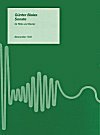
F165: Sonate for Flute and Piano by Günter Bialas. Baerenreiter, 1946, SS, 16 + 6 pages. In four movements: Allegro, Andante con espressione, Vivace, and Finale (Frei, Allegro molto, Presto). |
22.95
|
|
V020: Four Poems by Emily Dickinson for Soprano Voice, Flute and Clarinet in A by Allan Blank. International Opus, 1998, SS, 14 pages. Three copies in score format. This is a challenging contemporary work. The four poems are: How Happy is the Little Stone, In This Short Life, Surgeons Must be Very Careful, and Nature is What We See. The second piece is for flute and voice and the third is for clarinet and voice (first and last are for all). Duration about 12 minutes. |
24.95
|
|
WW030: Beethoven Trio for Piano, Flute and Bassoon WoO 37 by Ludwig van Beethoven edited by Friedhelm Klugman with piano fingerings by Hans-Martin Theopold. Henle, 1981, SS. Includes performance parts for flute, bassoon, and piano (which includes the other parts in the score). This trio was written between 1786-90. |
24.95
|
 |
WW350: Blue Monkey for flute and clarinet by Lauren Bernofsky. Theodore Presser Co., 2015, 3 pages (score format). Lauren Bernofsky (1967-) is an American composer. This is a short (~2:30), jaunty duo, perfect for concert/recital programming. The main riff in swing eighths is repeated throughout, ensuring that it sticks in the mind of the audience. We also sell versions for clarinet and violin and 2 clarinets. Here is a video of the clarinet and violin version that will give you an idea how it goes. (Except other items with free shipping.) |
6.95
|
|
WW195: Lluna for flute, clarinet and piano by Daniel Bimbi. Emerson Edition, 2008, SS, (includes parts and piano score). Daniel Bimbi (1971-) was born in Carcassonne in Southern France. He studied clarinet with Guy Deplus and more recently has been studying composition with Jan Van der Roost. Lluna was originally intended to be the theme of a Children's Opera based upon "The Child and the Moon." The themes are very sultry and nostalgic in a Latin, Mediterranean style, finished with a brilliant pyrotechnical finale, both humorous and exciting. College level with a duration of about 7 minutes. |
21.95
|

|
F435: Pierrot Solo for Flute by Rainer Bischof. Doblinger, 2011, SS, 4 pages plus fingerings for trills and multiphonics. Rainer Bischof (1947-) is an Austrian composer, orchestra manager and music educator. As a composer, he is considered a "grandchild" of the second Vienna school and has composed orchestral and instrumental works, chamber music, one opera and songs. This is a contemporary work featuring flutter tonguing, unusual trills, multiphonics and other contemporary techniques. There are two pieces: Pierrot I - Apfelbrotbaum and Pierrot II. Click on the cover image to view the first page. (Except other items with free shipping.) |
11.95
|
|
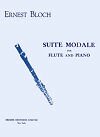
F292: Suite Modal for Flute and Piano by Ernest Bloch. Broude Brothers Ltd., 1958, SS, 14 + 6 pages. Ernest Bloch (1880-1959) was born in Switzerland and after 1916 lived primarily in the United States. His Jewish heritage influenced much of his music although it is less apparent in this piece, one of his last works (1956). In four movements: I. Moderato, II. L’istesso tempo, III. Allegro giocoso, and IV. Adagio/Allegro deciso. A popular and frequently recorded part of the flute repertoire. Early college level. String orchestra parts are available as a rental. |
14.95
|
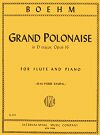 |
F325: Grand Polonaise in D major Op. 16 for Flute and Piano by Theobald Boehm edited by Jean-Pierre Rampal. International Music Co., 1977, 14 + 6 pages. This piece begins with Introduzione (Allegro maestoso) followed by the Polonaise which concludes with a Presto. There are many cadenza and cadenza like passages throughout both movements. A showpiece. Upper college level. |
11.95
|
|
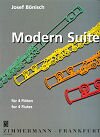
F265: Modern Suite for 4 Flutes by Josef Bönisch. Zimmermann, 2006, SS, (includes score and parts). Five original pieces make up this intermediate level flute quartet by German composer and flutist Bönisch (1935-). They are titled Fascination, Waltz, Barocco in Blue, Mexico, and Little Boy. The parts are relatively equal although the first part has the melody and some solos. |
22.95
|
|
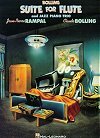
F188: Suite for Flute and Jazz Piano Trio by Claude Bolling. Hal Leonard, 1973. This is a large scale work for the classical flutist and a jazz piano trio (although it can be performed without the drums and bass). The piece is designed to highlight the difference in styles, even humorously at times. It is in seven parts: Baroque and Blue, Sentimetale, Javanaise, Fugace, Irlandaise, Versatile (the first half calls for bass flute), and Veloce. Includes performance parts for flute, piano, drums and bass. We have a DVD (with Jean-Pierre Rampal and the composer) and a play along CD. 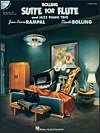 |
47.50
|
|
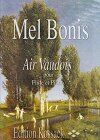
F361: Air Vaudois for Flute and Piano by Mel Bonis. Edition Kossack, 1999, SS, 9 + 3 pages. Mélanie Bonis (1858-1937) was a French composer who fought against many obstacles to pursue her art. She wrote about twenty pieces of chamber music, including three sonatas (flute, violin, and cello). This piece was written in 1916 and probably refers to the Swiss canton of Vaud. In one Allegro moderato movement, it changes keys and time signatures several times. Advanced high school/early college level. (Except other items with free shipping.) |
19.95
|
|
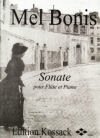
F317: Sonate for Flute and Piano by Mel Bonis. Edition Kossack, 1999, SS, 32 + 8 pages. This piece was written in 1904 and dedicated to Louis Fleury. While classical in form (Andantino con moto, Scherzo-Vivace, Adagio/Allegro ma non troppo/Allegretto/Adagio, and Finale-Moderato), it conveys a variety of exotic atmospheres, from pastoral to oriental, and the emotions of tenderness, joy and passion. College level with a duration about about 16 minutes. |
31.95
|
|
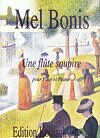
F318: Une flûte soupire for Flute and Piano by Mel Bonis. Edition Kossack, 1999, SS, 3 + 1 pages. This piece was written in 1936, near the end of Mel Bonis' life when she was too weak to hear her music performed. This short piece reflects the impressionistic style of much of her music (the title means "A flute sighs"). (Except other items with free shipping.) |
11.95
|
|
F260: Fantaisie Brillante sur L'Africaine for Flute and Piano by François Borne edited by Henrik Wiese. Zimmermann, 2006, SS, 21 + 9 pages. François Borne (1840?-1920?) about whom there is limited information, wrote several other fantasies. Originally published in 1885, this work is based on passages from Meyerbeer's opera L'Africaine which, in a change from the original concept, is set in India rather than Africa. This edition contains notes on the composition and the editing in German, English, and French. |
24.95
|
|
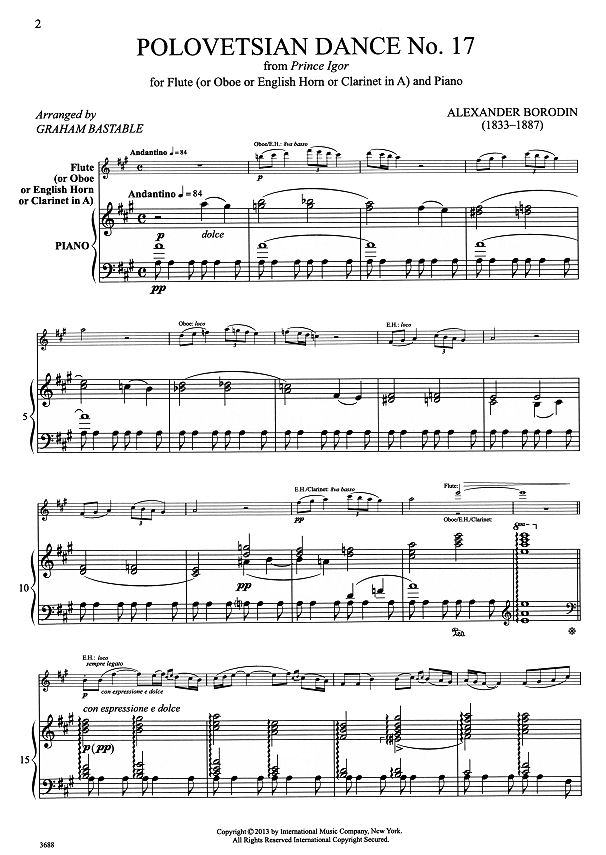
WW306: Polovetsian Dance No. 17 for Flute or Oboe or English Horn or Clarinet (in A) and Piano by Alexander Borodin arranged by Graham Bastable. International Music Co., 2013, SS, 3 + 1 pages. Also called Gliding Dance of the Maidens the melody from Prince Igor inspired the song Stranger in Paradise. High school level. Click on the cover image to view the first page of the score. (Except other items with free shipping.) |
8.95
|

|
F459: Deux Morceaux, Nocturne and Cortege for Flute and Piano by Lili Boulanger (1893-1918) (Marie-Juliette Olga "Lili" Boulanger) arranged by Graham Bastable. International Music Co., 2022, SS, 10 + 4 pages. Lili was the younger sister of Nadia Boulanger. These two pieces were composed at different times; Nocturne in 1911 and Cortege in 1914. Both were originally for violin and piano.
(Except other items with free shipping.) |
30.50
|
|
WW042: Trois Mouvements (Three Movements) for Flute and Clarinet in B-flat by Eugene Bozza. Alphonse Leduc, 1974. Includes two copies of the parts in score format. The three movements are Allegretto; Moderato, espressivo; and Allegro giocoso. Suitable for college or professional recitals. |
32.60
|
|
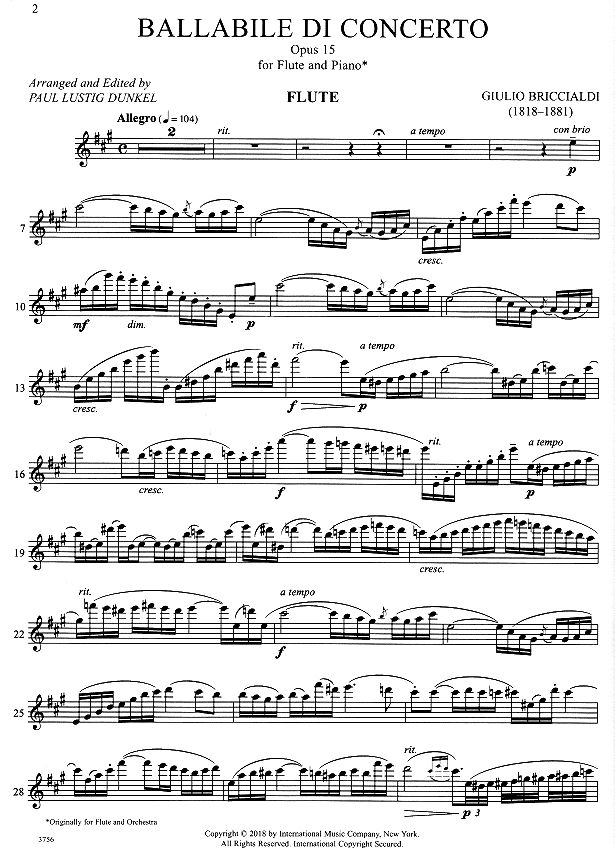
 F441: Ballabile Di Concerto Op. 15 for Flute and Piano by Giulo Briccialdi arranged and edited by Paul Lustig Denkel. International Music Co., 2018, SS 22 + 9 pages. Giulio Briccialdi (1818-1881) was an Italian virtuoso flautist and composer, a technical innovator on his instrument and a professor of music. This work which was originally for flute and orchestra is a showpiece in four movements: Allegro, Adagio, Allegro scherzoso, and Tempo primo. Sale priced. The regular price is $25.95. Click on the cover image to see a sample page. F441: Ballabile Di Concerto Op. 15 for Flute and Piano by Giulo Briccialdi arranged and edited by Paul Lustig Denkel. International Music Co., 2018, SS 22 + 9 pages. Giulio Briccialdi (1818-1881) was an Italian virtuoso flautist and composer, a technical innovator on his instrument and a professor of music. This work which was originally for flute and orchestra is a showpiece in four movements: Allegro, Adagio, Allegro scherzoso, and Tempo primo. Sale priced. The regular price is $25.95. Click on the cover image to see a sample page. |
21.95
|
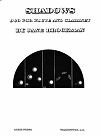 |
WW132: Shadows Duo for Flute and Clarinet by Jane Brockman. Arsis Press, 1985, SS, 7 pages (score format). The tradition of imitation which has historically inspired two-voice music can be likened to an object and its shadow, continually evident in this composition. At times, the instrumental identities become obscured, and one is not certain which instrument is playing which line. Also, the musical language of Richard Wagner still has much relevance for this composer. It is his shadow which is 'felt' throughout the work as the leitmotiv of Kundry (from Parsifal) is employed melodically, but without its characteristic rhythm--and in a new context. A college level work with a duration of about 6 minutes. |
6.95
|
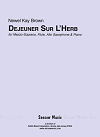 |
V058: Dejeuner Sur L'Herb for Mezzo-Soprano, Flute, Alto Saxophone and Piano by Newel Kay Brown. Seesaw Music, 1986, SS, includes instrumental parts and vocal-piano score. Newel Kay Brown (1932-) is a native of Salt Lake City, Utah where he first studied composition with Leroy Robertson at the University of Utah. Graduate degrees were undertaken at the University of California at Berkeley and Eastman School of Music where he completed his Ph.D. in Composition & Theory under Bernard Rogers, Howard Hanson, and Wayne Barlow. The vocal range is from the D just above middle C to B-flat above the staff. The instrumental parts are very important, with the flute part especially challenging. The saxophone part reaches altissimo G-sharp. College level with a duration of about 14 minutes. |
29.95
|
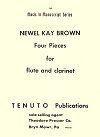 |
WW143: Four Pieces for Flute and Clarinet by Newel Kay Brown. Tenuto Publications, 1968, SS, two copies in score format each 7 pages. The four pieces are: I. Adagio, II. Allegretto, III. Adagietto, and IV. Allegro con brio. Better high school level and up. Duration 5:35. (Except other items with free shipping.) |
8.95
|
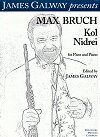 |
F354: Kol Nidrei for Flute and Piano by Max Bruch edited by James Galway. Theodore Presser, 2004, SS, 8 + 2 pages. The Kol Nidrei begins the evening service at the start of Yom Kippur. In the 16th century, a Cantor in Germany composed a melody for this prayer which Bruch used as the basis for his Adagio on Hebrew Melodies for Violoncello and Orchestra. This edition includes performance suggestions from Sir James Galway. Early college level with a duration of about 7 minutes. (Except other items with free shipping.) |
8.95
|
|
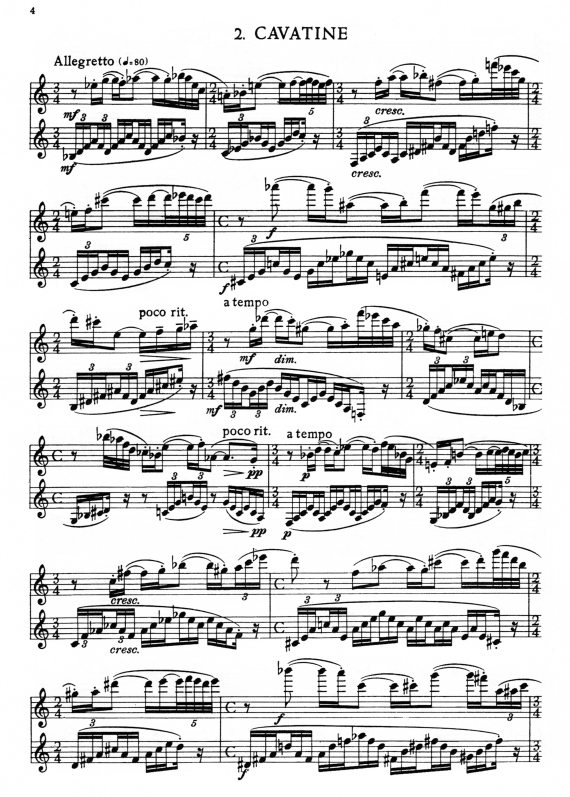
WW360: Serenade for Flute and Clarinet by Willy Burkhard. Baerenreiter, 1954, SS, 11 pages (score format). Willy Burkhard (1900-1955) was a Swiss composer, music educator and conductor. While he wrote orchestral and instrumental music he was especially known for his church music for voice. This piece is in four movements: 1. Dialog, 2. Cavatine, 3. Elegie, 4. Perpetuum Mobile, and 5. Marsch. Click on the cover image to view a sample page.
(Except other items with free shipping.) |
17.95
|
 |
F417: Sonatina for Flute and Piano by Eldin Burton. Carl Fischer, 1949, SS, 23 + 9 pages. Eldin Burton (1913-1979) was an American pianist who had ambitions as a composer, and took the first steps by enrolling on a composition course at the Juilliard School in New York. Dedicated to Samuel Baron, this was the prize winning composition of the New York Flute Club Contest of 1949 and is Burton's best known work. In four movements: I. Allegretto grazioso, II. Andantino Sognando, and III. Allegro giocoso (quasi fandango). College level with a duration of 10 minutes (according to the score, the YouTube performances are faster). There are many performances on YouTube, here is one. |
16.95
|
|
G282: Advent & Christmas: Two Preludes for Solo Instrument and Organ by Charles Callahan. MorningStar Music Publishers, 2014, SS, 10 + 4 pages. For solo treble instrument and organ, An Advent Prelude includes the tunes Veni Emmanuel and Conditor Alme Siderum. A Christmas Prelude includes the tunes Adeste Fideles, Stille Nacht, The First Noel, Divinum Mysterium, Es Ist Ein Ros, and Mendelssohn. Parts are included for both C (oboe or flute) and B-flat instruments (clarinet, soprano saxophone or possibly tenor saxophone.). Charles Callahan has written harmonically interesting music yet the solo parts are relatively easy (except for the key signatures which range up to six flats and five sharps). Click here to listen to an audio sample. Click on the cover image to view the score. |
11.95
|
 |
F194: Fantasy Sonata for Flute and Piano by John Carmichael edited by Roger Armstrong. Southern Music Co., 2005, SS, 32 + 8 pages. Carmichael (born 1930) is an Australian composer who settled in Britain in 1954. The composer wrote: ". . . in the first movement, there are two main themes: the first, a short motif, is stated at the very opening: the second theme is more lyrical, with a characteristic falling interval of a minor sixth. These two motifs appear and reappear in different guises until the they quietly confront each other, unaccompanied, just before the recapitulation. . . In the slow movement, the piano with its rising motif constantly threatens to overwhelm the flute, but it is the latter's persuasive eloquence which finally wins the day in a hushed conclusion. The last movement has a play of different moods, ranging from jauntiness to mock innocence. A short cadenza for the flute leads to a race between the flute and piano to be first at the double bar." For advanced performers. |
14.95
|
 |
WW157: Three Bagatelles for Flute or Clarinet and Piano by Paul Carr. Cramer Music, 1883, SS, 12 + 4 pages. Paul Carr (born 1961) is an English composer whose early interested focused wind chamber music like this, but is now composing primarily for film and TV. The Three Bagatelles are I. Moderato, II. Andante, and III. Allegro. They include quite a bit of mixed meter but it is of the easier 6/8, 2/4, 3/4 variety. Advanced high school/early college level. |
9.95
|
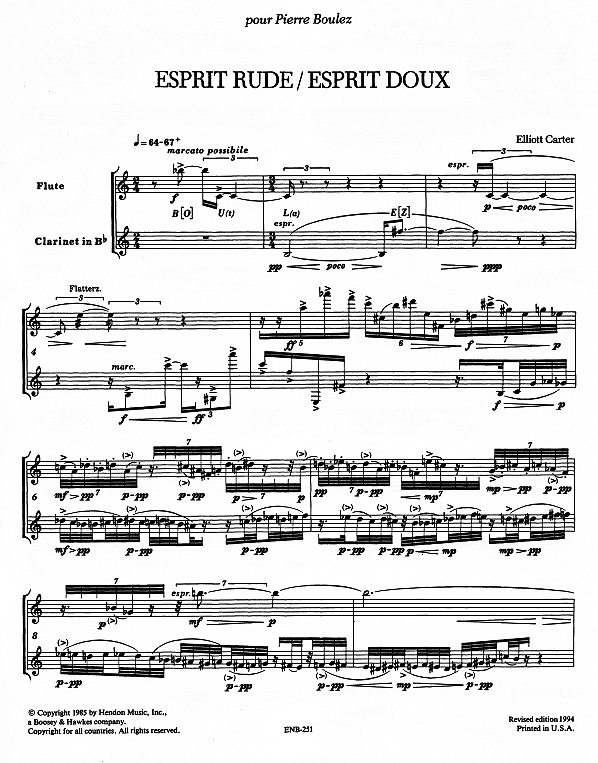 |
WW335: Esprit Rude/Esprit Doux for Flute and Clarinet by Elliot Carter. Boosey & Hawkes, 1985, SS, 8 pages in score format. The title means Rough Breathing/Smooth Breathing. It was composed for Pierre Boulez's 60th birthday in 1985. The title refers to the pronunciation of classical Greek words beginning with a vowel or an R. There is an explanation of how this applies to the music in English, French and German. Advanced college level. Click on the cover image to view the first page. (Except other items with free shipping.) |
15.95
|
 |
WW379: Rêverie Russe, Grand Duo for Flute, Clarinet and Piano by Ernesto Cavallini edited by Stephanie Jutt (flute part) and Alan Kay (clarinet part). International Music Company, 2017, SS, includes parts and piano score. Ernesto Cavallini (1807-1874) was an Italian clarinetist and composer who spent 15 years working in Russia. The piece consists of a gentle introduction followed by a simple theme, five variations, and a jaunty finale, after which the opening material returns briefly bringing this piece to its quiet finish. This is a relatively advanced work. There are some videos of this piece on YouTube but they predate this edition. |
28.95
|
|
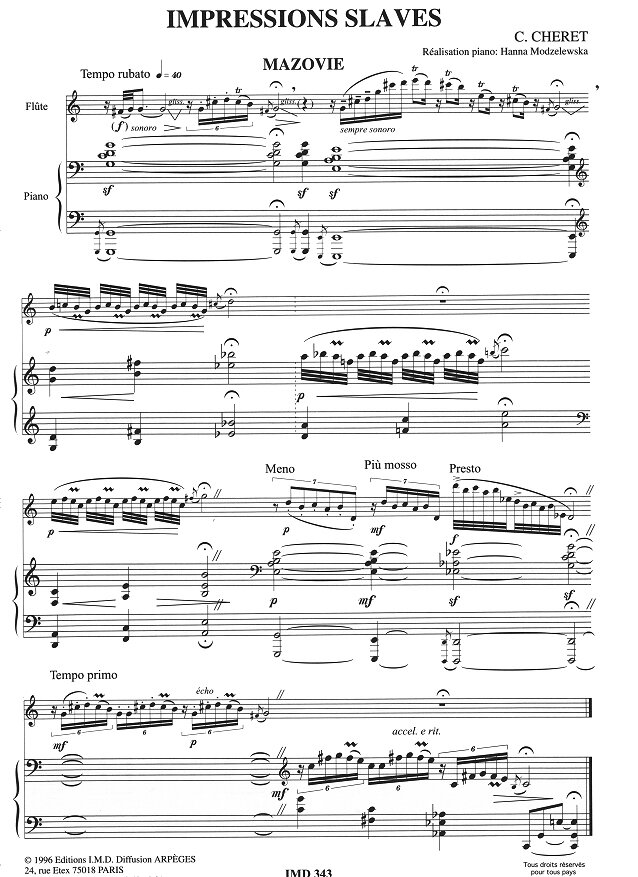
F279: Impressions Slaves (Slavic Impressions) for Flute and Piano by Christian Chéret with piano part by Hanna Modzelewska. International Music Diffusion, 1996, SS, 8 + 4 pages. Christian Chéret (1849-1907) is a French flutist and music educator. Poland is considered to be the land of the East Slavs and the titles of the movements of this piece refer to that country. Mazovie (Tempo rubato) is a region in central Poland while Tatras (Allegro vivo) is a mountain range which forms the natural southern border of Poland. The second movement has some harmonics and flutter tonguing. Click on the cover image to view the first page of the score. |
10.95
|
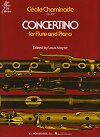 |
F381: Concertino Op. 107 for Flute and Piano by Cécile Chaminade edited by Louis Moyse. G. Schirmer, 1967, SS, 10 + 4 pages. Cecile Chaminade (1857-1944) was a pioneering French composer and pianist. She wrote mostly character pieces for piano, and salon songs, almost all of which were published. This flute concertino which was written for the 1902 Paris Conservatory Concours is her most popular piece today. It is sectional with many opportunities for the flutist to display virtuosity. |
8.95
|
|
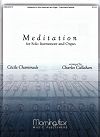
G258: Meditation for Solo Instrument and Organ by Cécile Chaminade arranged by Charles Callahan. MorningStar Music Publishers, 2008, SS, 7 + 2 pages. This piece was originally for piano (Op. 76, No. 6). Parts are included for Flute, Oboe, Violin, Viola and instruments in B-flat (clarinet, soprano saxophone or possibly tenor saxophone.) Here is a YouTube video of this arrangement being performed with flute and organ. (Except other items with free shipping.) |
10.95
|
 |
F442: Three Pieces: Sérénade aux étoiles (Opus 142), Mignonne, Thème varié for Flute and Piano by Cécile Chaminade edited by Graham Bastable. International Music Co., 2018, SS, 22 + 8 pages. The three works in this edition are drawn from her chamber music, and are representative of her overall style: lyrical, with clear elegant textures and touches of chromaticism characteristic of French Romantic music. The first piece, Sérénade aux étoiles, was published in 1911 and was written for flute and piano. Mignonne (1892 or earlier) was originally a song. Thème varié was originally for solo piano and is a set of variation on a 6/8 tune. These pieces can be played by an advanced high school level flutist and above. Click on the cover image to view the first page of the flute part. Sale Price. The regular price is $20.50. |
17.95
|
|
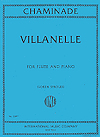
F461: Villanelle for Flute and Piano by Cécile Chaminade arranged by Loren Stroud. International Music Company. 2022, SS, 6 + 2 pages. This piece was originally a vocal piece. It is grade 2-3 with the highest notes D above the staff. A joyous song of a rustic village festival. (Except other items with free shipping.) |
14.95
|
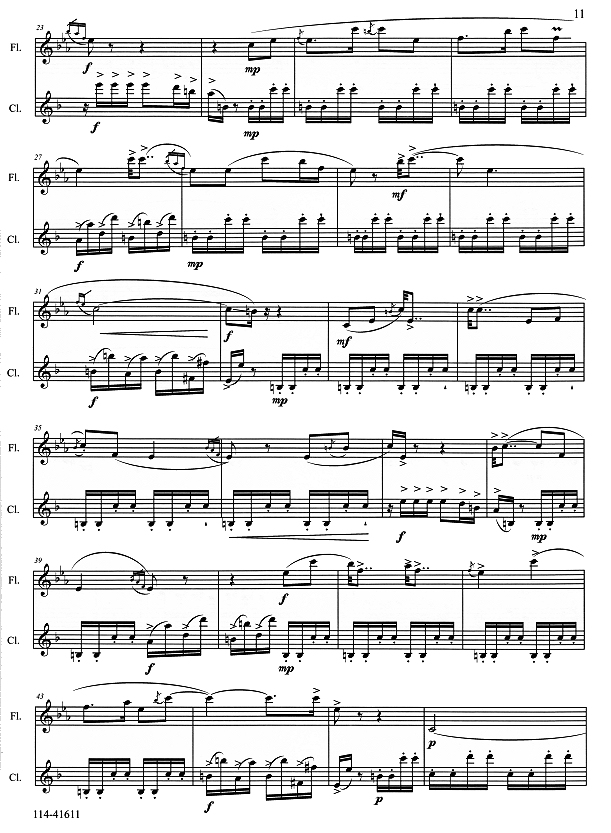 |
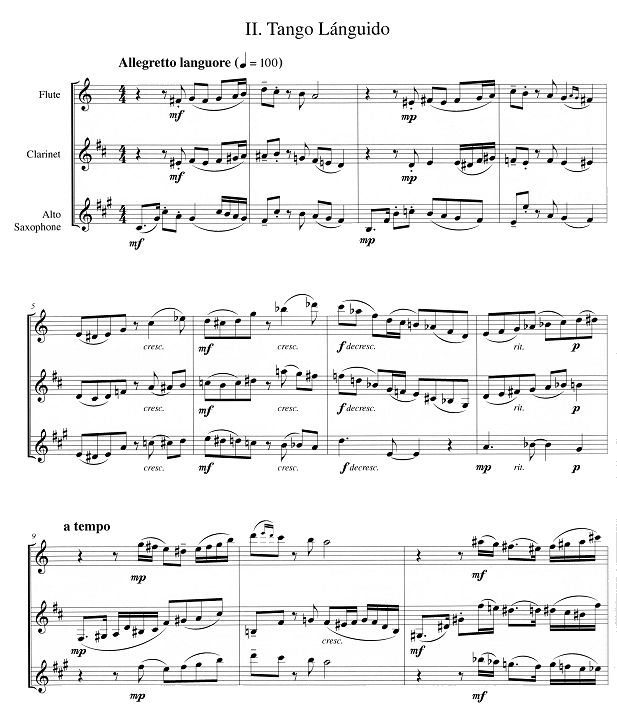
WW326: Three Bagatelles from China West Duet for Flute and Clarinet by Chen Yi. Theodore Presser Co., 2009/2014, SS, 10 pages in score format. This piece was originally written for flute and piano but seven additional versions have been created. The three bagatelles are I. Shan Ge (Lightly), II. Nai Guo Hou (Lively) and III. Dou Duo (Simply). As befits a piece originally for solo flute, the flute is the star and the clarinet is mostly in an accompanying role. In the first movement the flute is playing the melody (freely) while the clarinet has short rhythmic statements. In the second movement, the clarinet plays the melody. The flute enters after bar 23 with an obbligato part while the clarinet repeats the melody. In the third movement (which is the source of our example) the flute plays a melody while the clarinet plays a rhythmic accompaniment of 16th notes. College level. Click on the cover image to view a sample page from the third movement. (Except other items with free shipping.) |
19.95
|
 |
F257: Five Sonatas for Flute (or Oboe) and Guitar Volume 1 by Domenico Cimarosa arranged by Carstin Linck. Zimmermann, 2005, SS, 35 + 14 pages. Domenico Cimarosa (1749-1801) was born near Naples but also lived and worked in St. Petersburg and Vienna. Most of his work was operas and liturgical works but these arrangements are from his Sonatas for Harpsichord which the arranger thinks are ideally suited for playing on a wind instrument with guitar accompaniment. This volume has Sonata 1 in G major and Sonata 2 in A minor. F294: Five Sonatas for Flute (or Oboe) and Guitar Volume 2 by Domenico Cimarosa arranged by Carstin Linck. Zimmermann, 2005, SS, 39 + 14 pages. This volume has Sonata 3 in A major, Sonata 4 in D major, and Sonata 5 in C major. |
Vol. 1 39.95
Vol. 2 41.95
|
|
WW370: Techno-Parade for Flute, Clarinet and Piano by Guillaume Connesson. Billaudot, 2010, SS, includes parts and piano score. Guillaume Connesson (1970-) is a French composer who has written for a wide variety of ensembles. This is an advanced work which also exists in a version for 2 soprano saxophones and piano (it is here). The score contains some instructions for the pianist for manipulating the strings of the piano. The duration is 5 minutes. Here is a video of this version which is being played faster than the marked duration indicates.
|
31.95
|
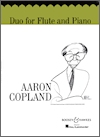 |
F418: Duo for Flute and Piano by Aaron Copland. Boosey & Hawkes, 1971, SS, 21 + 8 pages. The Duo for Flute and Piano was composed on a commission from a group of pupils and friends of the late William Kincaid, for many years solo flutist of the Philadelphia Orchestra. It is in three movements: I. Flowing, II. Poetic, somewhat mournful, and III. Lively, with bounce. College level with a duration of about 14 minutes. Here is a link to the first movement on YouTube. The second and third movements are there, too. |
14.95
|
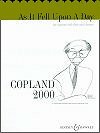 |
V010: As it Fell Upon A Day by Aaron Copland. Boosey & Hawkes, 1929, SS. For soprano voice, flute, and clarinet. The words are from Richard Barnefield (1574-1627). This is a one-movement sectional piece. It features an interesting dialogue between the flute and clarinet which adds to the texture with independent material when playing with voice. It is a very nice recital piece for college level and professional performers. |
19.95
|
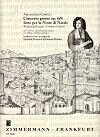 |
F331: Concerto Grosso Op. 6/8 (Christmas Concerto) for 3 flutes or flute orchestra by Arcangelo Corelli arranged by Elisabeth Weinzierl and Edmund Wächter. Zimmermann, 2007, SS, (includes score and parts). This is an arrangement of this famous concerto gross that can be played by a trio (including a bass or alto flute) or better by a seven part flute choir (2 C flutes, alto flute, and bass flute). There is also a cello part that can be used instead of the bass flute part in the trio. Playable by good high school or adult groups and above. Includes notes in German, English, and French. |
41.95
|
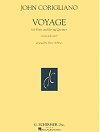 |
F195: Voyage for Flute and String Quintet by John Corigliano arranged by Clare Hoffman. G. Schirmer, 1998. Voyage is an instrumental version of a 1971 a cappella choral work that was a setting of a translation of Baudelaire's famous poem "L'Invitation au voyage." A version for flute and string orchestra has been recorded by James Galway. The string and flute parts are not difficult and can be played by good high school musicians. Includes score and parts. |
19.95
|
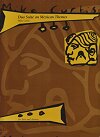 |
WW197: Duo Suite on Mexican Themes for Flute and Clarinet by Mike Curtis. Advance Music, 1997, SS, 15 pages in score format. There are six pieces: I. Plaza del Baratillo, II. El Burro Viejo, III. La Banda del Estado, IV. Dulcinea, V. Sancho Danza, and VI. La Rana Loca. Better high school players and up. |
14.95
|
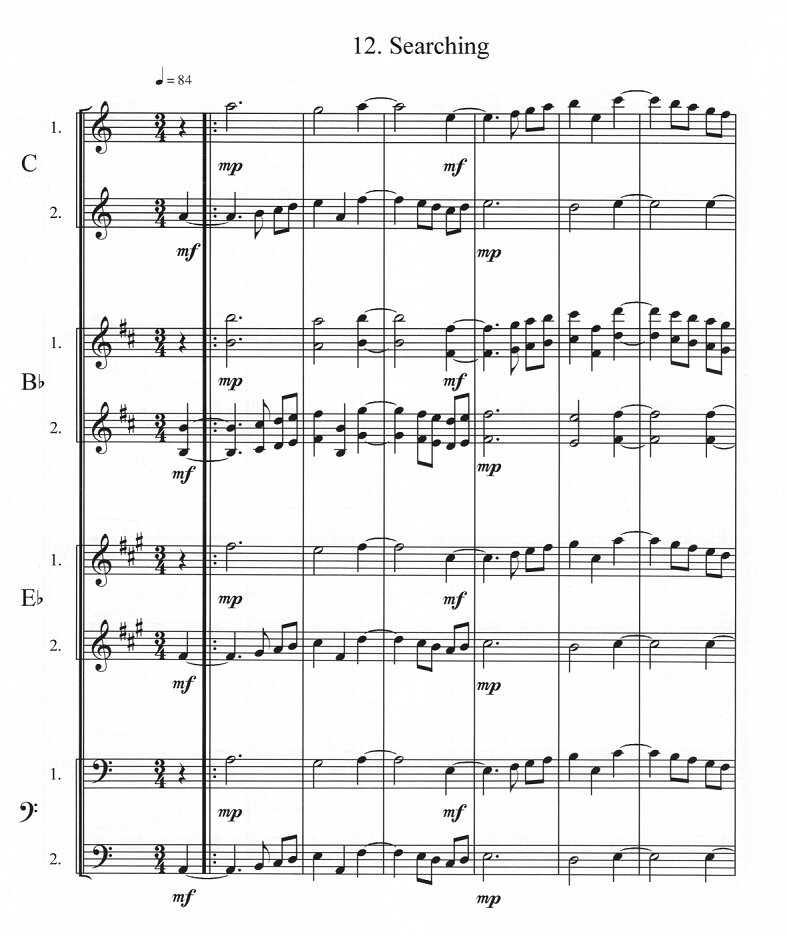 |
WW227: Woodwind Friends, 25 Intermediate Duets by Mike Curtis. MSS Publishing, 2010, SB, 73 pages in score format. This book has 25 intermediate duets with parts in C, B-flat, E-flat, and bass clef. The composer has computed that there are more than 50 possible combinations of woodwind instruments that can play them. These duets are progressive. They gradually build the student's experience of time signatures, articulations, tempi, dynamics, keys, styles and rhythmic complexity. They were written to be short and fun. Click on the cover image to see a sample page. Use your browser's Back button to return. |
14.95
|
 |
WW031: Sinfonia Concertante for Flute, Clarinet and Orchestra Op. 41 by Franz Danzi edited by John P. Newhill. Music Rara, 1982, PB, 57 + 9 + 10 pages. Piano reduction. In three movements: Allegro Moderato, Larghetto, and Allegretto polonaise. Includes extensive notes by the editor. |
46.95
|
 |
F351: Debussy Three Pieces arranged for flute and piano by T. Smirnova. Muzyka Moscow, 2008, SS, 8 + 3 pages. These Debussy pieces have been arranged from his works for voice and piano. They are Romance, Faun ("Le Faune"), and Wonderful Evening ("Beau Soir" usually rendered as Beautiful Evening in English). These are short pieces at the upper intermediate level. (Except other items with free shipping.) |
8.95
|
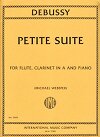 |
WW204: Petite Suite arranged for Flute, Clarinet in A and Piano by Claude Debussy arranged by Michael Webster. International Music, 2009, SS. A wonderful arrangement of a wonderful piece (originally for piano four hands). Four movements: I. En Bateau, II. Cortège, III. Menuet, and IV. Ballet. Generally college level. The duration is about 12:30.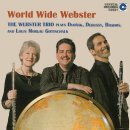 |
29.50
|
|
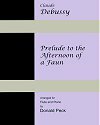
F183: Prelude to the Afternoon of a Faun by Claude Debussy arranged for flute and piano by Donald Peck. Progress Press, 2004, SS, 11 + 5 pages. For advanced performers. |
12.95
|
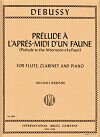 |
WW138: Prélude à l'après-midi d'un faune (Prelude to the Afternoon of a Faun) arranged for Flute, Clarinet and Piano by Claude Debussy arranged by Michael Webster. International Music, 1994, SS. This piece is one of the most popular flute solos in the repertoire, but as the arranger writes, adapting it for flute and piano has not been very successful because there is too much music to be covered by two instruments. Adding the clarinet produces a more satisfactory result. Both A and B-flat clarinet parts are included. The duration is about 9:20. |
13.95
|
|
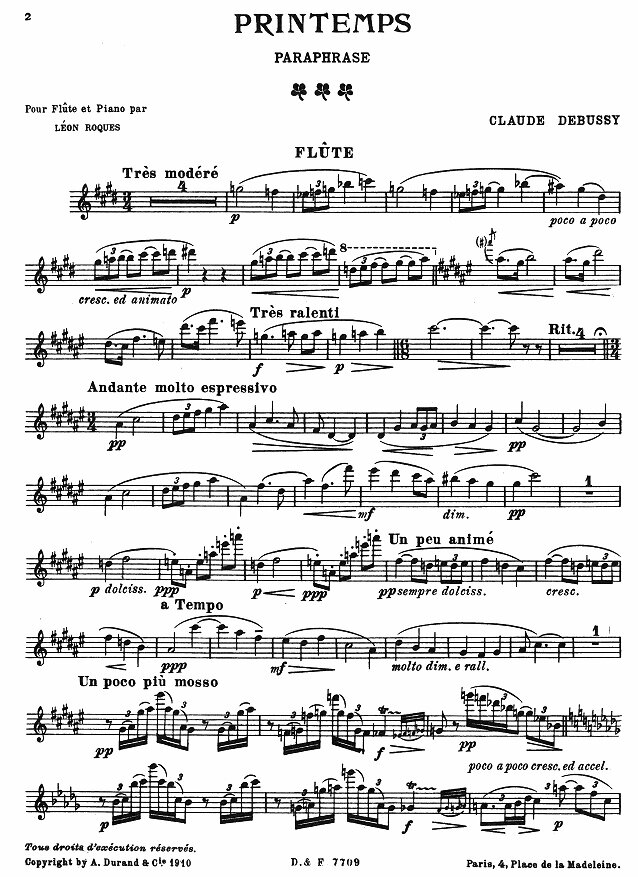
F362: Printemps by Claude Debussy arranged for Flute and Piano by Leon Roques. Lauren Publications, SS, 8 + 2 pages. This is a reproduction of the 1910 Durand edition. This is a paraphrase of the original work. Typical Debussy with many tempo changes. College level. Click on the cover image to view the first page of the flute part. |
9.95
|
|
F167: Syrinx for Flute Solo by Claude Debussy edited by Ernst-Günter Heinemann. Henle, 1994, SS, 4 pages. This edition was prepared from the first edition and includes a page of notes in French, English, and German.
(Except other items with free shipping.) |
8.95
|
|
F171: Syrinx for Flute Solo by Claude Debussy edited by Erich List. C.F. Peters, 1969, SS, 4 pages. Brief notes in French, English, and German and a trilingual translation of the French markings.
(Except other items with free shipping.) |
8.75
|
 |
F231: Sonate Op. 24 for Flute and Piano by Jules Demersseman edited by Henner Eppel. Zimmermann, 2005, SS, 30 + 8 pages. Jules Demerssman (1833-1866) was virtuoso flutist who was born in the Netherlands but won the first prize at the Paris Conservatory at the age of 12. This work which was published in 1862, is "given over entirely to melody and in which the composer dispenses with virtuoso superficiality and treats the two instruments as equals. The four movements are 1. Andante, 2. Romance (Andante quasi allegretto), 3. Scherzo (Allegro), and 4. Final (Andante introduction/Allegro in poco vivo). College level. |
21.95
|
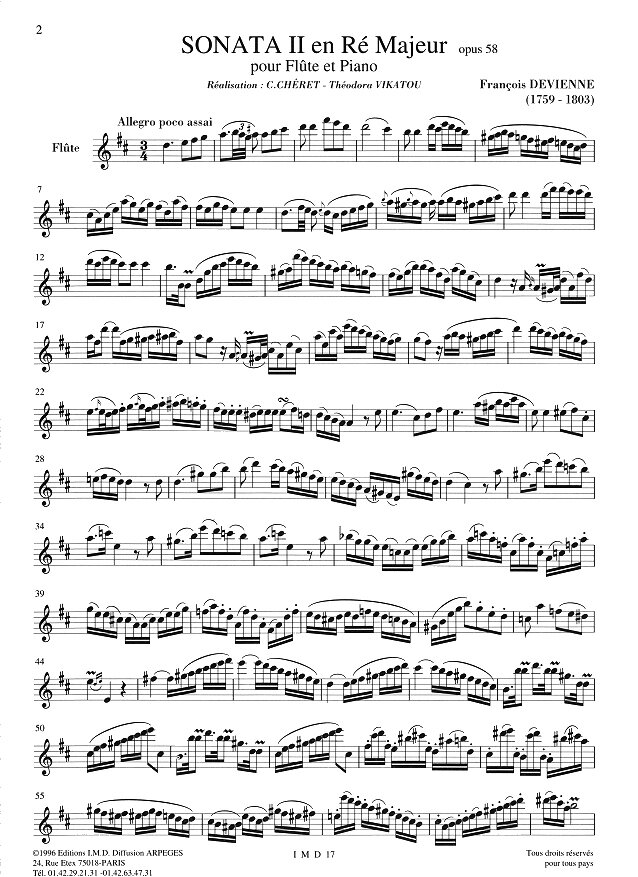 |
F285: Sonata II Op. 58 in D major for Flute and Piano by François Devienne with piano realization by Christian Chéret and Hanna Modzelewska. International Music Diffussion, 1996, SS, 14 + 7 pages. François Devienne (1759-1803) was a French composer and professor of flute at the Paris Conservatory. In three movements: 1. Allegro poco assai, 2. Largo, and 3. Andantino con variazione (with 5 variations). Click on the cover image to see the first page of the flute part. |
14.50
|
 |
F438: Cavatina from Rossini's The Barber of Seville for Flute and Piano by Anton Diabelli edited by Paul Lustig Dunkel. International Music Company, 2017, SS, 10 + 3 pages. Anton Diabelli (1781-1858) was an Austrian music publisher, editor and composer. This composition of was one the earliest examples of a showpiece based on a familiar work, in this case an opera. It is in two sections Andante (mm=66) and Moderato (mm=112) there are two brief "a piacere" sections and many short tempo changes in the moderato section. With the modern flute it may be played by an advanced high school student or a flutist at the early college level. Sale priced. The regular price is $15.25. Click on the cover image to view the first page of the score. (Except other items with free shipping.) |
12.95
|
 |
G170: Notturno aus "Abendunterhaltungen" for Flute (Violin) or Clarinet and Guitar by Anton Diabelli. Philomele Editions (PE 2007), SS. The six pieces that make up this edition were originally published (1818/19) in two volumes that included works of other composers. The clarinet parts were originally for an obsolete type of recorder known as a csakan which was usually in the key of A. The six pieces are 1. Andante con moto, 2. Menuetto (Moderato assia e cantabile), 3. Marcia (Allegro), 4. Original Thema und Variationen (Andante grazioso), 5. Polonaise, and 6. Marcia (Allegro). Several of these pieces should be playable by better high school wind players while the rest are more difficult. Includes parts for flute (violin), clarinet, guitar, and a score. |
33.95
|
 |
F392: Quintet for Flute, String Trio and Piano by David Diamond. Peer Music, SS, 1942, includes parts and piano score. David Diamond (1915- 2005) was an American composer who studied with Bernard Rogers at Eastman, Roger Sessions in New York City and Nadia Boulanger in Paris. He was a faculty member for many years at Julliard and trained many notable composers. This piece which is dedicated to Aaron Copland was written as a commission in 1937. It won The Society of the Publication of American Music Award for the the 1941-42 season. In Three movements: 1. Allegro deciso e molto ritmico, II. Romanza (Lento, molto cantabile), and III Finale (Allegro veloce). Advanced college level with a duration of about 13 minutes. |
22.50
|
 |
WW141: Four Little Duos for Flute and Clarinet by Robert Dickow. Manduca Music, 1997, SS, 8 pages. In score format with two copies. Robert Dickow (1949-) is an American composer who teaches horn, composition, and theory at the University of Idaho. These four duets are at the advanced college level and feature mixed meter. The publisher describes them as Really nice recital material for good players. Stravinskyesque technique and textures." The duration is 8:30. |
11.95
|
 |
F439: Duettino on American National Songs, Op. 37 for Flute, Violin and Piano by Franz Doppler edited by Stephanie Jutt and Carmit Zori. International Music Company, 2017, SS, 14 + 4 + 4 pages. Franz Doppler (1821-1883), was a flute virtuoso and a composer best known for his flute music. This work was written in 1879 and includes some songs that wouldn't be chosen today. It has Hail Columbia, The Star-Spangled Banner, Boatman Dance, and Yankee Doodle. College level. Sale priced. The regular price is $26.25. Click on the cover image to view the first page of the score. |
22.95
|
 |
WW145: Andante Con Variazioni for Flute and Clarinet by Daniel Dorff. Tenuto Publications, 1986, SS, two copies in score format each 7 pages. The Andante is followed by five variations. The odd meters (7/16 and 5/8)in variation II make this an early college level piece. Duration about 4:30. (Except other items with free shipping.) |
8.95
|
 |
WW144: Dances and Canons for Flute and Clarinet by Daniel Dorff. Tenuto Publications, 1988/2010, SS, two copies in score format each 7 pages. There are nine short pieces which are: 1. Waltz (Tempo di valse), 2. Canon (Allegro), 3. Ballad (Andante cantabile), 4. Canon (Presto), 5. Invention (Maestoso), 6. Dance (Con spirito), 7. Nocturne (Largo amorosa), 8. Canon, (Leggiero), and 9. Dance (Allegro con brio). For better high school students and up. The duration is about 7 minutes. Here is an audio file of the first movement on YouTube. You can listen to several other movements but let me know if you need help to find them. |
12.95
|
 |
WW232: Old New Borrowed Blue, A collection of fun duets for Flute and B-flat Clarinet by Daniel Dorff. Tenuto Publications, 2010, SS, 23 pages. In score format. The duets are in three groups: Dances and Canons which has 9 pieces and a duration of 7 minutes, Three Little Waltzes with a duration of 6 minutes, and finally, Andante con Variazioni which has a short Andante and five variations with a total duration of 4:30. Most of these pieces are at the advanced intermediate level and will probably be of most interest to better high school students and adult amateurs. |
14.95
|
 |
WW355: Three Little Waltzes for Flute and B-flat Clarinet by Daniel Dorff. Tenuto Publications, 2010/2015, SS, 10 pages. In score format with two copies. This is a quirky set of surprises composed for flutist Cindy Anne Broz. The first and third waltz are both shorter than a minute and serve as a prelude and postlude for the large middle movement which is over 5 minutes. Composed in 2010, the first and third movements are freely based on rhythmically-challenging waltzes that the composer wrote in high school (1974), frequently teasing between a waltz-like accompaniment and various ways of contradicting any sense of regularity, thereby providing a happy sense of arrival whenever the rhythms get back in sync. The central second movement is a sort of backwards-constructed set of variations, in which fragments are built together and tease at congealing throughout the movement, finally climaxing in a full statement of the theme for the grand finale that reveals the full theme. These pieces have minor updates from the versions in Old New Borrowed Blue (above). Here is an audio file of the end of Waltze No. 2. |
12.95
|
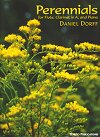 |
WW274: Perennials for Flute, Clarinet in A and Piano by Daniel Dorff. Tenuto Publications, 2012, SS, includes parts and piano score. This piece was commissioned by Walfrid and Sherry Kujala in celebration of the retirement of Helen and Richard Shanley from Baylor University. It was premiered by Sherry Kujala, Larry Combs and Nolan Pearson in October 2011. There are five movements (non-programatic): I. Joyous Overture, II. Romanza, III. Scherzo, IV. Winter Prayer, and V. Spring Awakening. Accessible college level music with a duration of about 21 minutes. Click on the cover image to view the first page of each movement. |
24.95
|
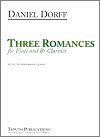 |
WW124: Three Romances for Flute and B-flat Clarinet by Daniel Dorff. Tenuto Publications, 2007, SS, 8 pages. In score format with two copies. The three romances are: 1. Languid (Allegro pastorale), 2. Sultry (Tango drammatico), and 3. Frisky (Brisk allegro). The music is lyrical, tonal, and rhythmic. It will be premeried by flutist Gary Schocker with the composer on clarinet at the 2007 National Flute Association's annual convention. Early college level. Duration about 8 minutes. |
14.95
|
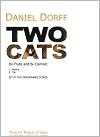 |
WW158: Two Cats for Flute and B-flat Clarinet by Daniel Dorff. Tenuto Publications, 2008, SS, 8 pages. In score format with two copies. Close on the heels (paws?) of his already popular Three Romances, composer Daniel Dorff has presented us with another flute and clarinet duet. The composer's program notes are as follows: "Being quite fond of my flutist-partner's two cats, I chose this opportunity to make musical portraits of Hootie, a handsome and elegant 20-pound tuxedo cat, and Tiki, a petite bengal princess. Hootie's music is generally in a slow pulse with lyrical 16ths flowing, just as Hootie is pensive and outwardly still, while clearly being very busy inside. The final phrase is marked snoozendo poco a poco. The final measures of the Hootie movement are identical to the beginning of the Tiki movement, just as in reality one cat's end is sometimes notably close to the other's beginning. After a 'peacefully lurking' introduction, Tiki's remarkable showcat grace and playful lightness are set as an effervescent scherzo, including some double-tonguing (after all, her name is ti-ki), a bit of fluttertonguing as Tiki can sound herself, and with a regally strutted circus march in the middle of the scherzo." College level with a duration of about 8:15. |
14.95
|
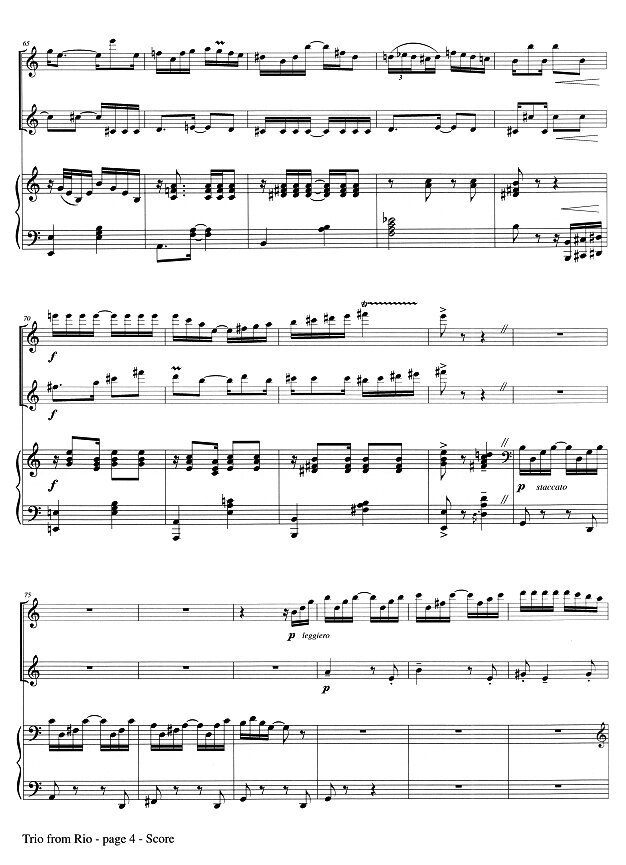 |
WW295: Trio from Rio, Three movements on Brazilian motives for Flute, Clarinet and Piano by Donald Draganski. Alry Publications, 2012, SS, includes parts and piano score. Donald Draganski (1936-) is from Chicago where he worked for many years as a university music librarian in addition to being a composer and a bassoonist. Three movements based on Brazilian motives and dance styles, originally written for the Pilgrim Chamber Players in 1999. I. Allegro energico, II. Andante, and III. Allegro moderato. College level with a duration of about 14.30. Click on the cover image to view the a page of the score from the first movement. |
24.95
|
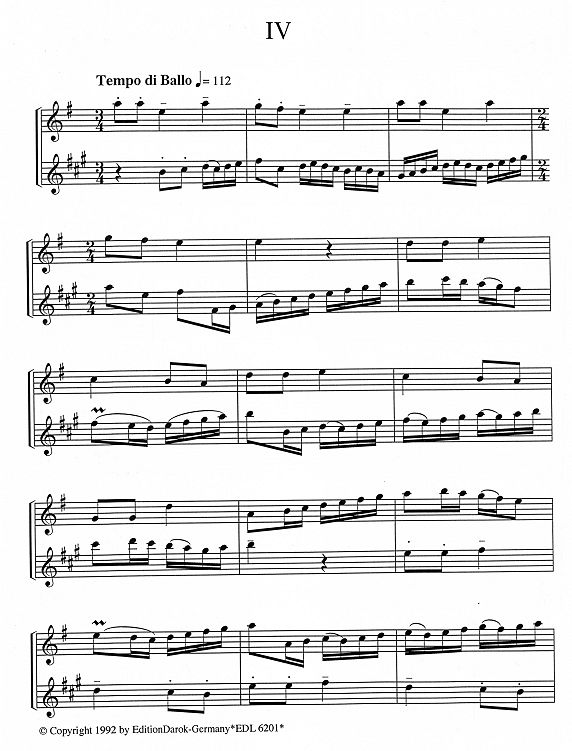 |
WW344: 4 Hungarian Folk Songs for Flute and Clarinet by László Draskóczy. EditionDarok, 1992, SS, 6 pages (score format). László Draskóczy (1905-1967) was a Hungarian composer and music educator. Four pieces: I. Allegro, II Andante, III. Allegro, and IV. Tempo di Ballo. There isn't any indication if these are original works in a folksong style or actual folksongs. The music has a range of difficulties at the intermediate level. Total duration of about 5 minutes. Click on the cover image to view a sample page. (Except other items with free shipping.) |
14.95
|
 |
WW336: Trio for Flute, Oboe and Piano by Madeleine Dring. Josef Wienberger Ltd., 1970, SS, (includes parts and piano score). Madeleine Dring (1923-1977) was an English composer and actress. Her biographical information on Wikipedia is worth reading. In three movements: I. Allegro con brio, II. Andante semplice, and III. Allegro giocoso. College level with frequent meter changes in the first movement. Duration of about 10:45. Here is a performance on YouTube. |
26.95
|
|
G284: Cantilène for Oboe/Flute/Violin/Clarinet/Soprano Saxophone and Organ by Marcel Dupré edited and arranged by Charles Callahan. MoringStar Music Publishers, 2016, SS, 7 + 2 pages. This is the second piece of Three Pieces for Cello and Piano by Marcel Dupré (1886-1971) which was composed in 1916 and first published in 1920. It is in the concert key of A minor. The tempo is Andante moderato (mm=66). The part for C instruments is included in this edition. The B-flat part can be downloaded from the publisher's website. Click on the cover image to view sample pages from the score.
(Except other items with free shipping.) |
9.95
|
 |
F450: Quartet No. 12 in F major Op. 96 (American) Flute, Violin, Viola and Cello by Antonin Dvorak arranged by Stephanie Jutt and the Paganini Quartet. International Music Co., 2019, SS, parts only. This is an arrangement of the American String Quartet with the flute replacing the first violin. Click on the cover image to see the first page of the flute part. SALE Price! |
18.95
|
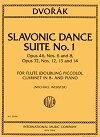 |
WW289: Slavonic Dance Suite No. 1 arranged for Flute, Clarinet and Piano by Antonin Dvorak arranged by Michael Webster. International Music, 2012, SS, (includes parts and piano score). Flute doubles piccolo on the first movement. Clarinet in B-flat only. The dances in this suite are: I. No. 8 Op. 46 (Presto), II. No. 14 Op. 72 (Moderato, quasi Menuetto), III. No 13. Op. 72 (Poco Adagio), IV. No. 12 Op. 72 (Allegretto grazioso), and V. No. 6 Op. 46 (Poco Allegro). They may be performed individually or together. College level with a duration of about 18:50. |
45.25
|
|
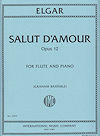
F443: Salut D'Amour Op. 12 for Flute and Piano by Edgar Elgar arranged by Graham Bastable. International Music Co., 2018, SS, 4 + 1 pages. Edgar Elgar (1857-1934) was a well-known English composer. This piece was originally for violin and piano. It should be playable by most high school level flutists and up. SALE: $2.30 off the list price. |
7.95
|
|
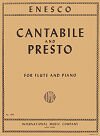
F326: Cantabile and Presto for Flute and Piano by Georges Enesco. International Music Co., SS, 11 + 3 pages. Georges Enesco (1881-1955) was a Romanian born composer, violinist, pianist, conductor and teacher. This piece is dedicated to Paul Taffanel. The Cantabile section is marked Andante ma non troppo and has a very short cadenza near the end. College level.
(Except other items with free shipping.) |
9.25
|
|
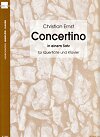
F329: Concertino in einem Satz Op. 19a for Flute and Piano by Christian Ernst. Heinrichshofen, 2007, SS, 11 + 4 pages. Christian Ernst (1967-) is German composer who has won many prizes for his work. The basis of this piece was an early uncompleted composition that the composer came back to in the late 1990s. This six minute works has many tempo changes and is at the early college level. |
20.95
|

|
F272: Variations on a theme from Paganini for Solo Flute by Jean-Pierre Eustache edited by Christian Chéret. International Music Diffusion, 1998, SS, 10 pages. Jean-Pierre Eustache (1930-) is a French flutist and music educator who was the principal flute of the Paris Opera for many years. This is the familiar theme by Paganini rendered in 19 virtuoso variations. (Except other items with free shipping.) |
12.50
|
 |
WW327: Wildflowers A Trio for Piccolo (or Flute), Clarinet and Piano by Eric Ewazen. Theodore Presser Co., 2011/2013, SS, includes all parts and piano score. There are separate parts for piccolo and flute. Some of the flute part is in the same range as the piccolo while other portions are an octave lower. This lively, dance-filled chamber work was composed for piccoloist Jan Gippo and clarinetist Jane Carl. Inspired by the brilliant colors of wildflowers from America’s heartland, Wildflowers opens with the joyful energy of the Dense Blazing Star, followed by the beautiful and poignant ballad, Missouri Primrose, and ends with the exhilarating and celebratory dance depicting the Mexican Hat. For advanced performers. Duration of about 22 minutes. Here is the first movement of the flute version with the composer at the piano. Here is the first movement of the piccolo version. Click on the cover image to view the first page of the score. |
24.95
|
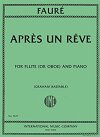 |
F411: Après un Rêve Op. 7, No. 1 for Flute (Oboe) and Piano by Gabriel Fauré arranged by Graham Bastable. International Music, 2013, SS, 3 + 1 pages. This popular piece, which has been arranged for many instruments, was written for voice and piano in the 1870s. Translated as After a Dream, it is at the easy high school level, but will be popular with many more advanced musicians. (Except other items with free shipping.) |
6.25
|
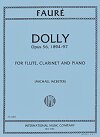 |
WW235: Dolly Op. 56 arranged for Flute, Clarinet in A and B-flat, and Piano by Gabriel Fauré transcribed and edited by Michael Webster. International Music, 1999, SS. The Dolly suite was written for piano four hands between 1894 and 1897 with additional movements added on Dolly's birthdays. Michael Webster writes that the nature of the original composition makes it well suited for this instrumentation. Six movements: I. Berceuse, II. MI-A-OU, III. Le Jardin de Dolly, IV. Ketty - Valse, V. Tendresse, VI. Le Pas Espagnol. For the first and third movements, A clarinet is preferred but alternate parts for B-flat clarinet are provided (the other movements are for B-flat clarinet). College level with a duration of about 15 minutes. |
34.75
|
 |
F434: Fantasy Op. 79 for Flute and Piano by Gabriel Fauré edited by Karl Kraber. International Music Co., 2017, SS, 13 + 6 pages. This piece has two movements, Andantino (which the arranger argues is one of the most beautiful pieces in the repertoire) and Allegro. This piece was written in 1898 and has a duration of about 5 minutes.This was originally a contest piece at the Paris Conservatory. Probably college level although there are probably some excellent high school flutists who can play it. Here is a performance from a different edition. |
19.95
|
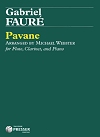 |
WW368: Pavane arranged for Flute, Clarinet in A or B-flat, and Piano by Gabriel Fauré arranged by Michael Webster. Theodore Presser Co., 2016, SS, includes parts and score. Gabriel Fauré (1845-1924) was the leading French composer of his generation. The original version of this piece, composed in 1887, was for small orchestra. Fauré also produced a piano version of this piece. This transcription combines elements of both. There are two versions included. The version for A clarinet is in the original key of F-sharp minor. For B-flat clarinet the concert key is G minor (the clarinet parts are the same with the other parts transposed). |
18.95
|
|
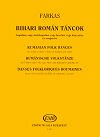
G155: Rumanian Folk Dances for Flute (or Clarinet, Violin, or Viola) and Piano by Ferenc Farkas, Editio Musica Budapest, 1953, SS, 15 + 4 pages. Ferenc Farkas (1905-2000) was a Hungarian composer and music educator who composed a number of popular pieces for woodwinds. Subtitled: from the collection of Béla Bartók of the County Bihar. Characteristic Eastern European folk dances similar to much of Farkas's work. At four pages, this is a relatively extended work for this genre. The tempo is Allegro moderato with brief accelerations and rubato moments. |
16.95
|
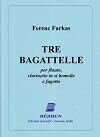 |
WW177: Tre Bagattelle for flute, clarinet and bassoon by Ferenc Farkas. Berben, 1993, SS, (includes score and parts). In three movements: I. Allegretto, II. Andante, and III. Allegro. Suitable for early college level, amateur adult trios, and better high school ensembles. |
11.95
|
|
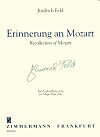
F259: Recollection of Mozart (Erinnerung an Mozart) for Magic Flute Solo by Jindrich Feld. Zimmermann, 2005, SS, 8 pages (including notes). Jindrich Feld (1925-2007) was a Czech composer who was especially active in composing instrumental music. This virtuoso piece was inspired by the march from the second act of The Magic Flute. The flutist (using some special techniques described in the notes) plays all the parts hence the call for a "Magic Flute." The notes are in German, English, and French.
(Except other items with free shipping.) |
9.95
|
|
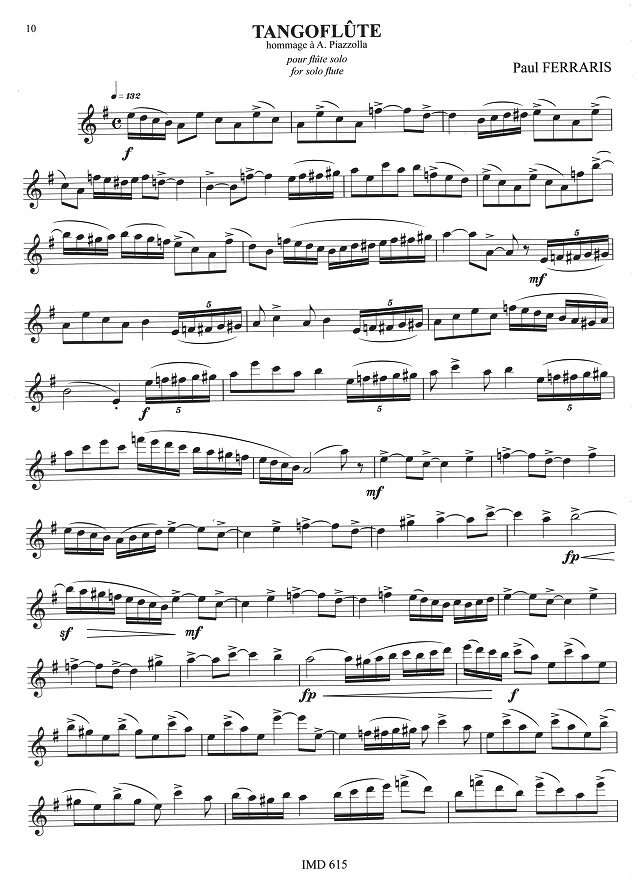
F277: Les Apartés 8 Pieces for Solo Flute or Piccolo by Paul Ferraris. International Music Diffusion, 2003, SS, 15 pages. Eight interesting pieces for solo flute with five marked "or piccolo." They are: Comme un Air Traditionnel, Divertissement, Scherzo Le Kiosque a Musique, Tangoflute (hommage à A. Piazzolla), Galop, Virvoltflute, and Tourbillon. The difficulty ranges from high school to college level. Click on the cover image to see a sample page. (Except other items with free shipping.) |
13.95
|
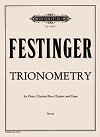 |
WW270: Trionometry for Flute, Clarinet/Bass Clarinet and Piano by Richard Festinger. C.F. Peters, 1996, SS, includes parts and piano score. Richard Festinger (1948-) studied composition at the University of California in Berkeley with Andrew Imbrie. Before turning to composing, he led his own groups as a jazz performer. He has taught at the University of California in Berkeley and Davis, Dartmouth College, and since 1990 at San Francisco State University. Written in 1996. In three movements: I. A la breve/Vivace, II. Andantino, and III. Allegro. An advanced work with a duration of about 15 minutes. The first and last movements are for bass clarinet with some notes in the extended range. "Richard Festinger's Trionometry was simply breathtaking... This technically demanding tour de force begins with a delicate exposition which... eventually explodes into a contrapuntal argument of grandiose proportions... like a multi-stage rocket that - ignoring gravity - traverses the earth's atmosphere. Bravo!" - Twentieth Century Music |
37.50
|
|
F262: Sonate for Flute and Piano (or Pianoforte) by Reinhold Finkbeiner. Zimmermann, 2006, 23 + 8 pages. This piece was written by German composer and organist Finkbeiner (1929-) in 1953 but was not premiered until 2004 and was published in 2006. The work is described as an intense and intricate contrapuntal work, which lends the Sonate a feeling of constant flux, while still allowing the melodic themes and motives to continually shine through. It is in two movements: I. Allegro and II. Arietta, a theme with four variations and a coda. |
26.95
|
 |
WW183: Baroque Dance Suite for Flute and Clarinet by arranged by Robert S. Frost. Kendor Music, 2010, 5 pages in score format. The dances of the Baroque period provide challenging and rewarding repertoire for festival and concert performance. They dances are: Georg Phillip Telemann Bourree, Jean-Philippe Rameau Two Sarabandes, George Frederic Handel Minuet in F minor, Johann Sebastian Bach Gavotte (from French Suite No. 5). The publisher rates this as US grade 3. It is suitable for younger (but progressing) high school students. Total duration 6:00. Click on the cover image to view the first page.
(Except other items with free shipping.) |
7.50
|
|
F313: Sicilienne for Flute and Piano by Philippe Gaubert. Heugel, 1914, SS, 4 + 2 pages. A popular piece in the Sicilienne style (6/8, Allegretto moderato). Upper intermediate level. |
12.75
|
|
F301: Third Sonate for Flute and Piano by Harald Genzmer. Ries & Erler, 2006, 23 + 8 pages. This piece by Harald Genzmer (1909-2007) was written in 2003 and was recently published. The German composer studied with Hindemith and was also a music educator. The Sonate is in three movements: I. Allegro moderato, II. Ruhig fließend, and III. Finale (Vivace, marcato). Early college level. |
19.95
|
 |
WW256: Trio Flute, Oboe and Piano by Harald Genzmer. Edition Peters, 2010, includes parts and piano score. Harald Genzmer (1909-2007) was a German composer and music educator who studied with Hindemith. This work was written in 1993 but was not published until recently. This piece is in Genzmer's typical style while given the instrumentalists the opportunity to cooperate in contrapuntal textures and demonstrate their virtuosic ability. It is in three movements, generally in the fast/slow/fast format but with considerable variations in tempos within each movement. Duration is about 12:20. |
45.95
|
 |
WW303: Duo for Flute and Clarinet (in A) by Alberto Ginastera adapted by Daniel Dorff. Theodore Presser Co., 2013, SS, 12 pages (score format). Ginastera's Duo (1945) is familiar and standard repertoire for most flute and oboe duos. In three movements (Sonata, Pastorale, Fuga), the composer immediately found a welcoming audience in the United States, including Virgil Thomson, who proclaimed, "This is the kind of music which makes one believe and have confidence in the New World." Now, Daniel Dorff retains the original flute part, while transposing the oboe to clarinet in A with an ear for idiomatic accuracy. Duration about 8:30 minutes. Early college level. Click on the cover image to view several pages from this piece. (Except other items with free shipping.) |
12.95
|
|
F378: Five Impressions of a Holiday Op. 7 for Flute (Violin), Cello and Piano by Eugene Goossens. Lauren Publications, SS, includes parts and piano score. This work has been reprinted from a 1916 Chester edition. Eugene Goossens (1893-1962) was an English conductor and composer. 1. In the Hills (Parmi les collines) Moderato/Poco animato/Tempo I, 2. By the Rivers (Le Long des rivières) Tranquillo, 3. The Water Wheel (Le Petit Moulin à eau) Con moto e leggiero, 4. The Village Church (L'Église du village) Andante con moto, and 5. At the Fair (À la vogue) Scherzando. A substantial work with a duration of about 16 minutes. College level (the cello part is probably a bit easier than the piano and flute parts). You can listen to samples of the movements here. |
23.95
|
 |
WW363: Two Pieces Volume I, La Jota Aragonesa and Souvenir de la Havane by Louis Moreau Gottschalk arranged for Flute, Clarinet and Piano by Michael Webster. International Music Co., 2016, SS, includes parts and piano score.. Louis Moreau Gottschalk (1829-1869) was an American composer and pianist, best known as a virtuoso performer of his own romantic piano works. He spent most of his working career outside of the United States. La Jota Aragonesa (Caprice Espagnol, Op. 14) is a famous Spanish tune (also used by other composers) cleverly and virtuosically embellished. Souvenir de la Havane (Grand Caprice de Concert, Op. 39) was written in 1859 in the Antilles. It is the earliest example the arranger has found of a habenera as the form of a concert piece. These pieces are at an advanced college level. |
27.95
|
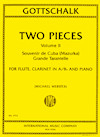 |
WW376: Two Pieces Volume II, Souvenir de Cuba (Mazurka) and Grande Tarantelle by Louis Moreau Gottschalk arranged for Flute, Clarinet (A and B-flat) and Piano by Michael Webster. International Music Co., 2016, SS, includes parts and piano score. Souvenir de Cuba (A clarinet) opens and closes with tropical languor, but is actually a mazurka with remarkable similarities to Chopin's Op. 6 No. 1. Grande Tarantelle (B-flat clarinet) is probably Gottschalk's most famous work for piano. The arranger has taken a few liberties in the spirit of Gottschalk's "no holds barred" virtuosity. |
30.95
|
|
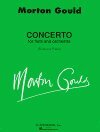
F177: Concerto for Flute and Orchestra (Piano Reduction) by Morton Gould. G. Schirmer, 1985, SS, 79 + 27 pages. Commissioned for Donald Peck, Sir George Solti, and the Chicago Symphony Orchestra and premiered in 1985. Four movements: Rhapsodic, Elegiac Variations, Intermezzo, and Rondo (Finale). Duration is about 34 minutes and the orchestral parts are available as a rental. |
24.95
|
|
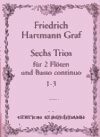
F238: Six Trios for 2 Flutes and Basso continuo Op 3 (1-3) by Friedrich Hartmann Graf edited by Ingo Gronefeld with Basso continuo realized by Friedrich Grünke. Edition Kunzelmann, 2005. The first three of six trios by Graf (1727-1795) which are available in a modern edition for the first time. Includes separate parts for each performer (with no page turn problems!) and a score with the realized BC part. Each trio has two movements and are (in the flute parts) 3-4 pages long. They are D major (Moderato/Grazioso), G major (Allegro moderato/Presto), and C major (Adagio/Allegro ma no tropo). |
29.95
|
|
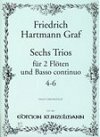
F239: Six Trios for 2 Flutes and Basso continuo Op. 3 4-6 by Friedrich Hartmann Graf edited by Ingo Gronefeld with Basso continuo realized by Friedrich Grünke. Edition Kunzelmann, 2005. The second of six trios by Graf (1727-1795) which are available in a modern edition for the first time. Includes separate parts for each performer (with no page turn problems!) and a score with the realized BC part. Each trio has two movements and are (in the flute parts) 3-4 pages long. They are E minor (Andante/Grazioso), F major (Moderato/Menuetto), and D major (Allegro/Grazioso). |
27.95
|
|
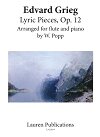
F364: Grieg Lyric Pieces Op. 12 arranged for flute and piano by Wilhelm Popp. Lauren Publications, SS, 16 + 6 pages. Reprinted from the Peters edition. Originally for piano, there are 8 pieces: 1. Arietta, 2. Waltzer, 3. Wächterlied, 4. Elfentanz, 5. Volksweise, 6. Norwegisch, 7. Albumblat, and 8. Vaterländisches Lied. Intermediate level. |
12.95
|
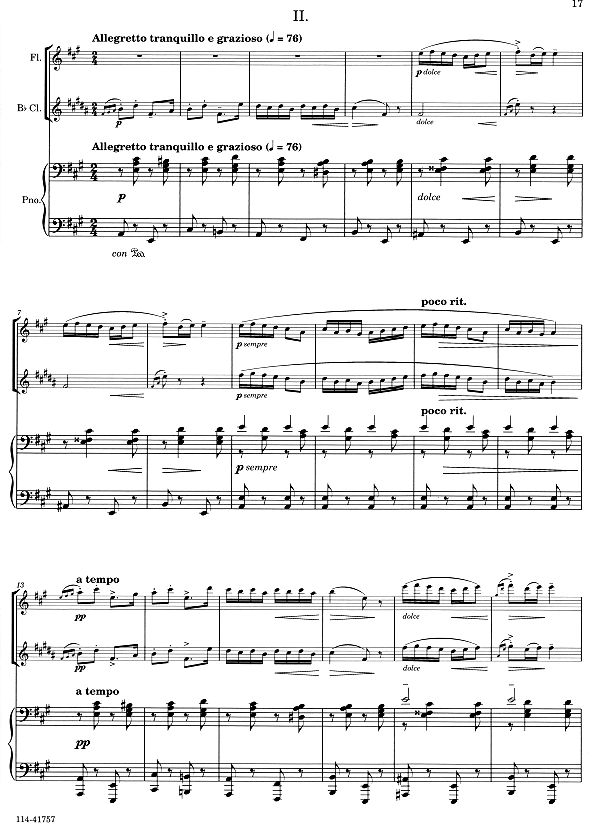 |
WW381: Norwegian Dances Op. 35 by Edvard Grieg arranged for Flute, Clarinet and Piano by Michael Webster. Theodore Presser Co., 2017, SS, includes parts and piano score. The famous set of dances by Norway's greatest composer were written for piano duet. Grieg later created a piano solo version, but refused to orchestrate the set. After some study of Grieg and his music, Michael Webster has arranged the four dances for Flute, Clarinet, and Piano in a faithful setting, using the piano duet version as a guide. This lively Grieg classic will be a welcome new addition to performance programs. For advanced performers (college level) with a duration of about 18 minutes. Click on the cover image to view a sample page from the score. |
28.95
|
|
F344: Six Sonatas Op. 1 for 2 Flutes (or Violins) by Albertus Groneman edited by Gerhard Braun. Heinrichshofen, 2008, SS, 42 pages (score format). Albertus Groneman (1711-1778) was born in Germany but moved to the Netherlands when he was 20. He was an organist as well as a composer. These sonatas, each of which has four movements, were composed in 1738. In accordance with the period, they contain style galant elements and make us of typical expressions such as passing tones, sighs, augmented chords, chromatic embellishment, syncopation, and melody with appogiaturas. The parts are equal and at the upper end of the intermediate difficulty level. |
23.95
|
|
WW075: Waltz and Interlude Duet for Flute and B-flat Clarinet with Piano Accompaniment by Clare Grundman. Boosey & Hawkes, 1964, SS, (includes piano score and individual parts). This is an intermediate duet with an easy piano part. It is in three sections: a waltz (Moderato con moto), then the interlude in 4/4 (Meno), followed by a return to the waltz in the original tempo. The flute part goes to a high G while the clarinet part does not go higher than a B above the staff and is frequently in the lower register. (Except other items with free shipping.) |
15.95
|
|
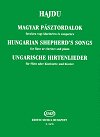
WW181: Hungarian Shepherd's Songs for Flute or Clarinet and Piano by Mihály Hajdu. Editio Musica Budapest, 1954, SS, 14 + 6 pages. Mihály Hajdu (1909-1990) who was a student of Bartok, was a Hungarian composer and music educator. This piece has three movements: I. Allegro, II. Parlando rubato, and III. Giusto. Early college level. |
19.95
|
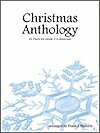 |
WW332: Christmas Anthology Flute and Clarinet Duet arranged by Frank J. Halferty. Almitra Music/Kendor Music, 2014, SS, 28 pages. Subtitled 24 Duets for Grade 3-4 Musicians. This grading is on the US 6 point scale but is on the easier side of that standard. Contents: Adeste Fidelis (O Come, All Ye Faithful); Angels We Have Heard On High; Away In A Manger; Bring A Torch, Jeanette, Isabella; Coventry Carol; Deck The Halls; The First Noel; God Rest Ye Merry, Gentlemen; Good Christian Men Rejoice; Good King Wenceslas; Hark! The Herald Angels Sing; The Holly And The Ivy; In The Bleak Midwinter (Holst); Infant Holy, Infant Lowly; It Came Upon A Midnight Clear; Jingle Bells; Jolly Old St. Nicholas; Joy To The World; O Little Town Of Bethlehem; Silent Night; Up On The Housetop; We Three Kings; We Wish You A Merry Christmas; and What Child Is This? Click on the cover image to view two sample pages. |
11.50
|
|
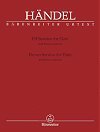
F163: Handel Eleven Sonatas for Flute and Basso continuo edited by Hans-Peter Schmitz with realization of the continuo by Max Schneider. Baerenreiter (BA4225), 1995, 73 + 43 + 45 pages. Baerenreiter urtext editions of seven sonatas for flute (HWV 379, 359b, 363b, 367b, and 374-376 )and four for recorder (HWV 360, 362, 365, 369). Three of the flute sonatas (HWV 374-376) are of doubtful authenticity and appear as an appendix. This edition includes scores with the Basso continuo realization, Basso continuo parts, and flute/recorder parts. There are also several pages of notes (in English and German) on the issues surrounding these pieces. This is a real bargin especially for an import! |
25.95
|
|
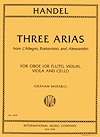
G263: Handel Three Arias for Flute (or Oboe), Violin, Viola and Cello edited Graham Bastable. International Music Co., 2010, SS, includes parts and score (the score is 10 pages; each part is 4 pages). The three arias in these arrangements come from Handel's operas Alessandro and Radamisto and from his setting of John Milton's poem L'Allegro, il Penseroso ed il Moderato. They are presented in this order: Come and Trip It (Menuetto from L'Allegro), Ombra cara (Largo ma non troppo from Radamisto) and Lusinghe piu care (Allegro ma non troppo from Alessandro). Not too difficult, early college level at most. Click on the cover image to view the first page of the score. |
18.50
|
|
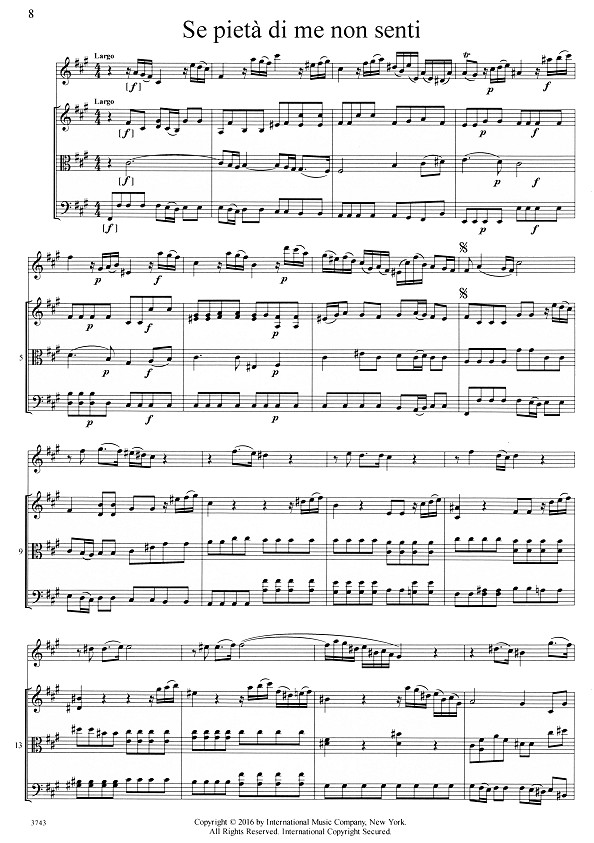
F432: Handel Three Arias from Giulio Cesare for Flute (or Oboe), Violin, Viola and Cello edited Graham Bastable. International Music Co., 2016, SS, includes parts and score (the score is 12 pages; each part is 4 pages). The three arias in these arrangements come from Handel's opera Giulio Cesare (Julius Caesar) of 1724 and are sung by Cleopatra. They are Venere bella, Se pietà di me non senti, and Da tempeste il legno infranto. Not very difficult, early college level at most. Click on the cover image to view a sample page from the score. |
14.95
|
|
F247: Handel Three Sonatas for Flute (or Violin) and Basso continuo edited and realization of the continuo by Waldemar Woehl. C.F. Peters. Includes a play-along CD of the accompaniment to the solo part. This edition includes Sonata in E minor HWV 359b, Sonata in G major HWV 363b, and Sonata in B minor (Fitzwilliam Sonata III) HWV 367b. Parts for the cello (or viola da gamba) and harpsichord (or piano) are included. |
30.95
|
|
F248: Handel Three Halle Sonatas for Flute (or Violin) and Basso continuo edited and realization of the continuo by Waldemar Woehl. C.F. Peters. Includes a play-along CD of the accompaniment to the solo part. This edition includes Sonata in A minor HWV 374, Sonata in E minor HWV 375, and Sonata in B minor HWV 376. Parts for the cello (or viola da gamba) and harpsichord are included. |
26.95
|
|
F263: FdQ-Rag for 2 Flutes, 3 Flutes, or 3 Flutes and Alto Flute by Alexander Hanselmann. Zimmermann, 2005, SS, (includes score and parts). A very flexible piece by Swiss composer and flutist Hanselmann (1956-). This was written in celebration of the organization Freunde der Querflöte (FdQ - Friends of the Flute). A short and striking intro is followed by module-like themes that constantly change from part to part. Upper intermediate level and can also be played by two piccolos. |
17.95
|
|
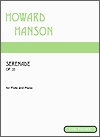
F416: Serenade Op. 35 for Flute and Piano by Howard Hanson. Carl Fischer, 1948, SS, 10 + 4 pages. This work also has been published for flute, harp and string orchestra. In one continuous movement. Marked Andante con moto at the beginning and Appassionato and then Molto tranquillo near the end. College level with a duration of about 6 minutes. Here is a performance of this version on YouTube (there is also a performance of the orchestral version available there). (Except other items with free shipping.) |
14.95
|
|
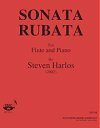
F134: Sonata Rubata for Flute and Piano by Steven Harlos. Southern Music Co., 2004, SS, 35 + 12 pages. Composed over a period of about four years, the title means "stolen sonata," a reference to the numerous quotes that occur along the way. If desired, the opening portion of the second movement may be played on alto flute instead of C flute (both parts are shown) and the final portion of the last movement on piccolo. |
14.95
|
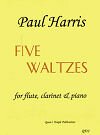 |
WW170: Five Waltzes for Flute, Clarinet and Piano by Paul Harris. Queen's Temple Publications, 1998, SS, 24 + 3 + 3 pages. The five waltzes are: I. Allegro, II Allegro grazioso, III. Moderato, IV. Allegretto, and V. Allegro con moto. High school level and the piano part is easy. |
15.95
|
|
G089: Haydn Six Divertimentos Hob. IV:6-11 for Violin or Flute, Violin and Violoncello by Joseph Haydn edited by Andreas Friesenhagen. Henle, 2005. Haydn's six Divertimentos belong to a group of works that he sold to London publisher William Forster during the first half of the 1780s. They are Haydn's first pieces of chamber music that expressly call for the flute. This new edition is very well printed and contains an explanatory preface and comments on the editing. These trios can be enjoyed by proficient players at the high school level and up. Overstock Special! $20.00 off regular price of $46.95 while supplies last. |
26.95
|
|
F186: Haydn Trios Hob. IV:1-4 for Two Flutes and Violoncello (London Trios) by Joseph Haydn edited by Andreas Friesenhagen. Henle, 2005. Haydn's trios for two flutes and cello were written in 1794 during his second journey to England. There are a total of eight movements of which seven in the hand of the composer have survived. This new edition is very well printed and contains an extended preface with the history of these works and comments on the editing. Proficient players at the high school level and up can enjoy these trios. Overstock Special! $12.00 off regular price of $33.95 while supplies last. |
21.95
|
|
F253: Haydn Londoner Trios Hob. IV: Nr. 1-3 for 2 Flutes (or Violins) and Violoncello edited by Karl-Heinz Köhler. C.F. Peters, 1959/1987, SS. Includes score, parts, and a play-along CD with second and cello parts for both the flute and violin versions. |
41.95
|

|
F430: Americana Three Pieces for Five Flutes by John Hawkins. Comus Edition, 2016, SS, includes parts and score. John Hawkins (1949-) is a British composer. This piece was written for the Brighton based Sussex Flutes ensemble, and scored for 2 flutes, 2 alto flutes and a bass flute. In three movements:Late Nights (Slightly swinging), Big Skies (Tranquillo), and Heading South. Click on the cover image to view the first page of the score. |
21.95
|
|
F379: X Aphorismen for Flute solo and Joloskarande Sonett for Alto Flute solo by Werner Heider. Heinrichshofen, 2009, 7 pages. Werner Heider (1930-) is a German composer, conductor and pianist. Two contemporary pieces which appear to be unrelated. They do not use contemporary techniques (except for flutter tonguing, which the composer appears to be very fond of). X Aphorismen has 10 short pieces and a duration of about 6:45. Joloskarande has a duration of about 3 minutes. College level. |
14.50
|
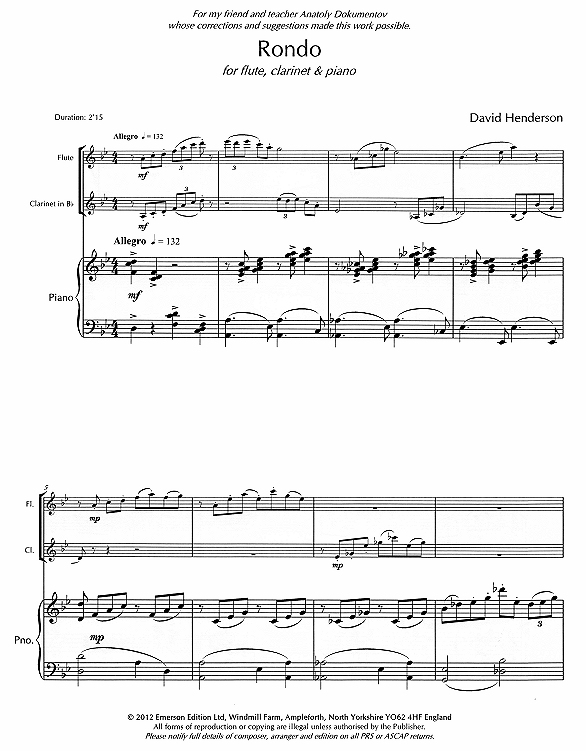
|
WW351: Rondo for Flute, Clarinet and Piano by David Henderson. Emerson Edition, 2012, SS, (includes piano score and individual parts). David Henderson (1942-) is an English composer and musician who emigrated to Australia in 1968. Advanced high school/early college level. It is at an Allegro tempo. Here is a video of this piece. Click on the cover image to view the first page of the score. (Except other items with free shipping.) |
12.95
|
|
F348: Le Coucou Scherzo for Flute and Guitar by Michael Henkel edited by Johann Gaitzsch. Philomele Editions, 2004, SS, (includes parts and score). Michael Henkel (1780-1851) was a contemporary of Schubert who wrote chamber music in addition to his primary output of music for piano and organ. Both the flute and guitar parts are interesting and have been evaluated as (British) Grade 8 for the flutist and a Grade 6 or above for the guitarist. (Except other items with free shipping.) |
12.95
|
|
F405: Sonata for Flute and Piano by Sean Hickey. Muzyka Moscow, 2011, SS, 21 + 7 pages. Sean Hickey (1970-) is an American composer who works in most genres of classical music and is also an arranger for jazz and pop music. This piece was written in 1994. It is in three movements: I. Slowly, freely; II. Playfully; and III. Frenzied. College level. Here are some program notes: "The first movement begins with the piano demonstrating the wide melodic leaps of the principle theme, which later becomes compacted, the flute stating a tuneful stepwise melody that seems both sure and simple. The second movement is a lively divertissement where the flute is able to showcase its melodic capabilities. The midsection is marked by a piano ostinato, over which the flute soars into its higher register. The brisk, final movement is marked by the constant alternation of 2 and 3 meter, where the musicians - except for a contemplative e minor middle - hang on to the rapidly changing patterns for dear life." |
14.95
|
|
F419: 8 Pieces (Acht Stücke) for Solo Flute by Paul Hindemith. Schott, 1958, SS, 6 pages. This work was composed in 1927. The eight pieces are at the (early) college level. Here is a performance on YouTube. This piece is in F106: Music of Paul Hindemith, Paula Robison Flute Masterclass.
(Except other items with free shipping.) |
14.95
|
|
F203: Sonate for Flute and Piano by Paul Hindemith. Schott, 1937, SS, 25 + 7 pages. This work was composed in 1936. It is in four movements (although the Marsch is not numbered): I. Heiter bewegt, II. Sehr langsam, III. Sehr lebhaft. and Marsch. Our catalog number F106: Music of Paul Hindemith, Paula Robison Flute Masterclass includes this piece. |
19.95
|
|
F295: Six Duets Op 16. for Two Flutes by Franz Anton Hoffmeister edited by Henner Eppel. Zimmermann, 2006, PB, 83 pages. Hoffmeister (1754-1812) was a Viennese who was a music publisher as well as a composer. These duets were first published around 1796. They are at the upper intermediate level, in score format, and this edition has been prepared with some attention to page turns. It also includes notes on the composer and the editing. |
44.95
|
|
F324: Kokopeli Solo Flute by Katherine Hoover. Papagena Press, 1990, 2 pages. Kokopeli, the flute player, was a great mahu, or legendary hero of the Hopi, and of other Native Americans living in the Southwestern area of the United States. He is said to have led the migrations through the mountains and deserts, the sound of his flute echoing through the great canyons and cliffs. The composer has tried to capture some of this sense of spaciousness, and of the Hopi's deep kinship with this land. This piece has also been influenced by Native American flute songs and sounds. (Except other items with free shipping.) |
6.95
|
|
F368: Medieval Suite for Flute and Piano by Katherine Hoover. Presser, 1986, SS, 23 + 10 pages. The Medieval Suite was inspired by characters and events described in Barbara Tuchman's A Distant Mirror, a history of fourteenth-century France. The first movement, "Virelai", uses parts of a work in that form by Guillaume de Machaut, a French composer of that era. The "Black Knight" was a valiant, violent British prince, barred from his beloved fighting by a wasting disease. The fourteenth century was a low point for the Catholic Church with warring Popes in Rome and Avignon, and "the Drunken Friar" was apparently a common sight. In this movement I have freely adapted and embroidered a Gregorian chant and quoted a well-known round of the time, "Sumer is acumin in". "Princess Isabelle" describes a daughter of the King of France who was engaged at the age of six, sent to England to live permanently, and wed at twelve - a common fate for royal children. The "Demon's Dance" was a desperate marathon dance done by some in hopes of avoiding the Black Plague. An advanced work with a duration of 19 minutes. Orchestral parts are available as a rental. |
19.95
|
 |
F391: The Spirit of Ink Op. 230 for 3 Flutes by Alan Hovhaness. Edition Peters, 1970, SS, includes parts and score. A college level work in 9 movements, much of it without barlines, with a duration of 19 minutes: 1 Apparition of the Eternal One, 2, Sunrise Birds, 3. Salutation of Dawn, 4. Tree of Birds, 5. Apparition of the a Celestial City, 6. Strange Birds, 7. Angelic Salutation, 8. Birds in a Magic Forest, and 9. Birds Amid Celestial Towers. |
17.95
|
 |
C1567: Évocations de Slovaquie for Clarinet in A (Flute), Viola and Violoncello by Karel Husa. Schott, 1970, SS, includes parts and score. Karel Husa (1921-2016) was a Czech born composer and conductor, trained in Prague and Paris, who taught at Cornell for many years. An advanced work in three movements: I. La Montagne (Exaltando), II. La Nuit (Tranquillo possibile), and III. La Danse (Ritmico). Duration about 15 minutes. |
29.95
|
|
F223: Serenade for Flute Nonette by Lawrence Ink. Southern Music, 2005, SS, includes parts and score. Lawrence Ink (1955-) is an American composer, educator, and flutist. This piece was written for the Flute Society of Washington, D.C. It is for 2 piccolos, 4 flutes, 2 alto flutes and bass flute. It is in three movements: I. Waltz, II Adagio, and III. Allegro con brio. This work should be playable by many amateur groups and by college level flute ensembles without much rehearsal. Overstock Special! $10.05 off regular price of $30.00 while supplies last. |
19.95
|
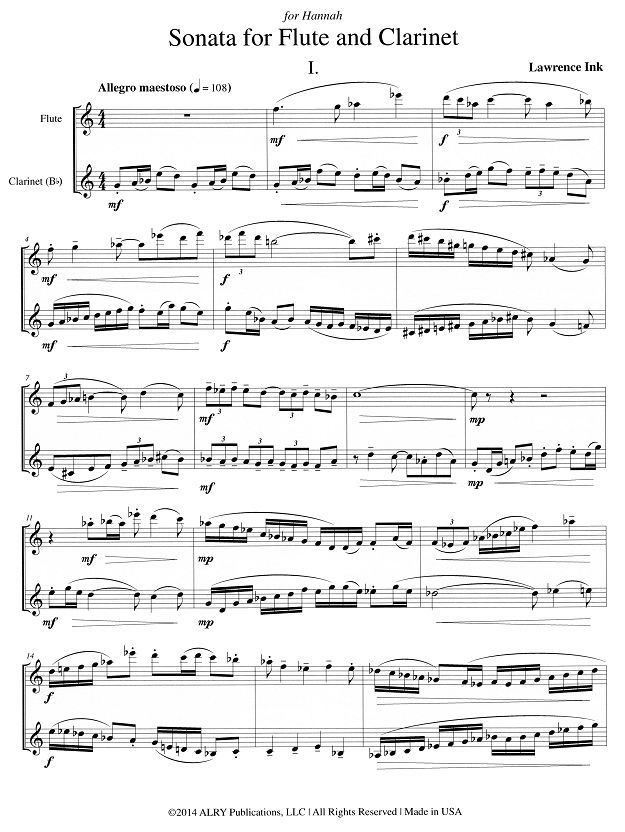 |
WW340: Sonata for Flute and Clarinet by Lawrence Ink. Alry Publications, 2014, SS, 15 + 5 + 6 pages. Lawrence Ink (1955-) is an American flutist and composer. A lyrical and playful work in three movements (Allegro maestoso; Adagio; Allegro) which uses a variety of modes to capture many different moods. Early college level/college level with a duration of about 11 minutes. Click on the cover image to view the first page of the score. |
16.95
|
|
F322: Sonatine for Flute and Piano by Lawrence Ink. Southern Music, 2007, SS, 24 + 6 pages.This piece is dedicated to Mimi Stillman. It begins with an Adagio section that has many rapid passages. This is followed by an Allegro in 7/8 and other meters which extends to the end of the piece. An advanced work with a duration of about 8 minutes. Overstock Special! $2.00 off regular price of $9.95 while supplies last. |
7.95
|
 |
WW215: Introduction and Fugue for Piccolo, Flute, and Alto Flute or Clarinet by Gordon Jacob. Emerson Edition, 1983, SS. Includes the score and parts. The Introduction is Poco Adagio (mm=60) while the Fugue is Allegro (mm=120). Advanced high school level. |
16.95
|
 |
F424: March of the Bluebirds for Piccolo and Piano by Leos Janacek edited by Jiri Zahradka. Henle, 2016, SS, 3 + 1 pages. Leoš Janáček (1854-1928) was a Czech composer, musical theorist, folklorist, publicist and teacher. This piece was written in 1924. Despite its brevity, this piece has received the full Henle treatment with a Preface in German, English, and French explaining the history and context of this work and Comments in German and English on the editing. Better high school level and up. Click here to listen to an audio recording of this work. Sale priced. The regular price is $14.95. (Except other items with free shipping.) |
11.95
|
|
WW402: Six Ragtimes for flute or clarinet or bassoon and piano by Scott Joplin edited by Dieter H. Förster. Kunzelmann, 1979. Six familiar Joplin rags: Original Rags, Elite Synchopations, The Entertainer, The Favorite, The Chrysanthemum, and The Ragtime Dance. The CD is no longer available. |
33.75
|
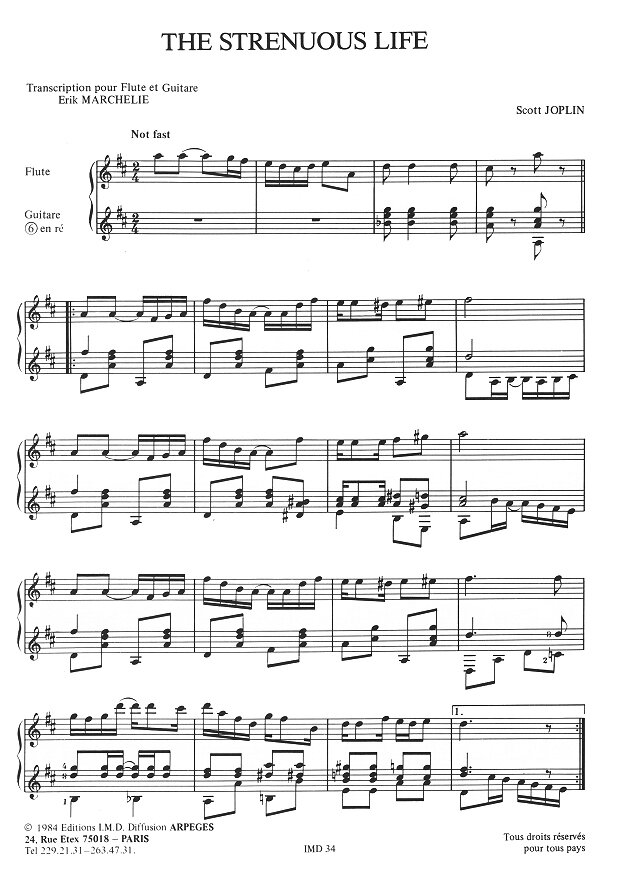
|
F289: The Strenuous Life for flute and guitar by Scott Joplin transcribed by Erik Marchelie. International Music Diffusion, 1984, SS, 4 pages (two copies in score format). This looks like a very nice arrangement of a popular Joplin favorite. Click on the cover image to see the first page of the score. |
5.95
|
|
F456: Paragon Rag for flute and piano by Scott Joplin arranged by Graham Bastable. IMC, 2021, 7 + 2 pages. This piece was published for piano in 1909. Another great piece by the master of the rag. (Except other items with free shipping.) |
10.95
|
|
F323: Night Soliloquy Flute Solo with Piano Accompaniment by Kent Kennan. Carl Fischer, 1940, 5 + 2 pages. This is probably the best known piece by Kent Kennan (1913-2003), American composer, author, and music educator. The piano arrangement is by the composer. Duration of about 4 minutes. (Except other items with free shipping.) |
8.50
|
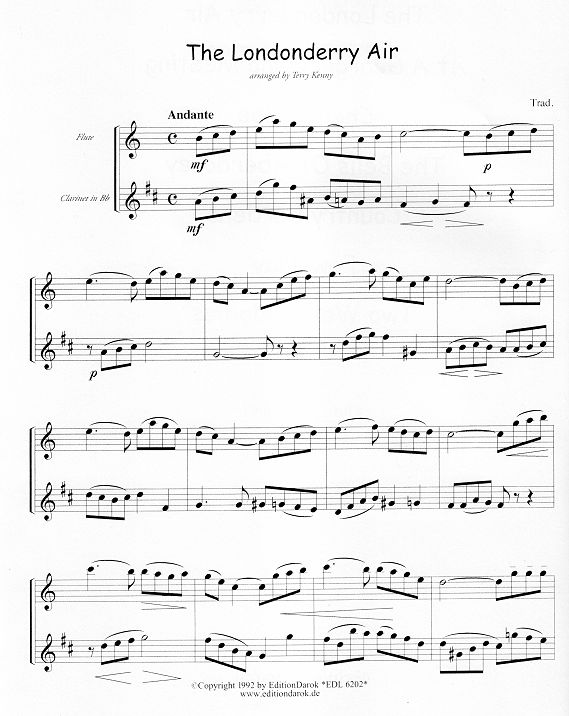 |
WW345: The Londonderry Air, 7 Easy Duets for Flute and Clarinet arranged by Terry Kenny. EditionDarok, 1992, SS, 14 pages (score format). In addition to Londonderry Air, the book includes At a Georgi Camp Meeting, Cherry Ripe (an English folk song), The Bells of Aberdovey (a Welsh folk song), Country Gardens, Fowl Play (Chicken Reel and Turkey in the Straw), and Two Welsh Melodies (All Through the Night and Suo Gân). The music has a range of difficulties at the intermediate level. Click on the cover image to view the first page. (Except other items with free shipping.) |
13.95
|
 |
WW168: Dialogues Op. 158 for Flute and Clarinet by Michael Kibbe. Michael Kibbe, 2006, SB, (includes score and parts). This work is in three movements: I. Allegretto, II. Andante, and III. Vivo. Duration about 8:30 minutes. Early college level. |
19.95
|
|
F198: Monolog 1 Flute by Erland von Koch. Gehrmans, 1997, SS, 5 pages. This piece for solo flute was written in 1975. It is in two parts (which may be played separately). Fantasie is Part I and is marked Andante espressivo, and is made up of short segments with occasional dotted bar lines to indicate the phrasing.. Part II (Caprice) is Molto vivace and alternates between 6/8 and 2/4. Each part includes flutter tonguing. Upper college level. (Except other items with free shipping.) |
14.50
|
 |
WW216: Divertissement Op. 90 for Two Flutes and Alto Flute (or Clarinet) by Charles Koechlin. Masters Music, SS. Includes score and parts. Charles Koechlin (1867-1950) was a French composer. While he wrote in many styles, much of his music was influenced by Fauré who was one of his teachers. The cover of this music says "Bass Flute" but the part is for flute in G (sol) which is an alto flute. This was written in the period 1923-24 and is in three movements. They are I. Très calme (Tranquillo), II. Allegretto quasi Andante (sans lenteur), and III. Final (Allegro, bien décidé). There are many cues in the parts to assist with the ensemble. College level. |
9.95
|
 |
WW276: Épitaphe de Jean Harlow Op. 164 Romance for Flute, Alto Saxophone and Piano (or Harp) by Charles Koechlin. Eschig, 1970, SS. Includes parts and piano score. Koechlin was fascinated by the movies this is one of many pieces he composed that is film related. In one movement marked Andantino, sans traîner. Duration about 3:00. Here is a video of an excellent performance. |
31.95
|
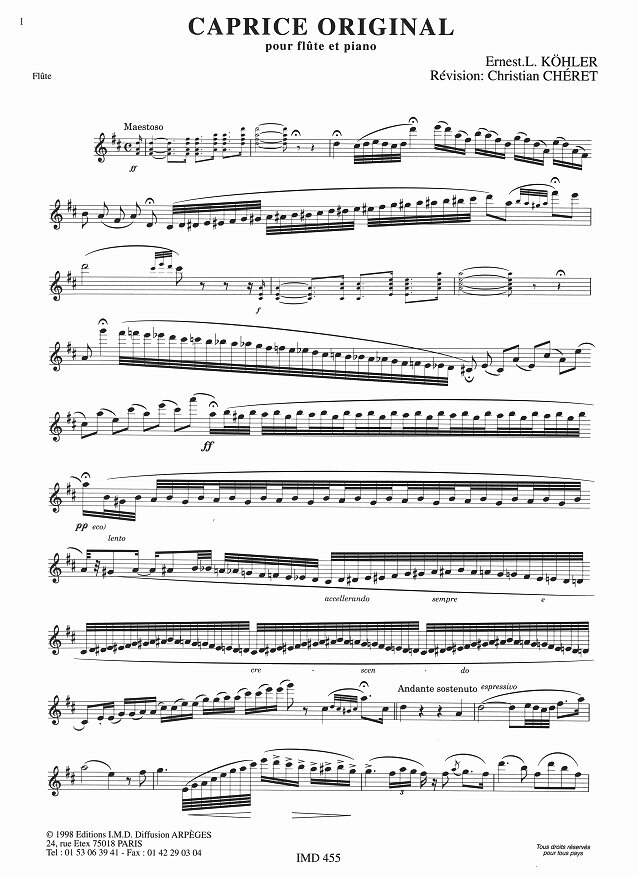
|
F278: Caprice Original for Flute and Piano by Ernest Köhler (Koehler) edited by Christian Chéret. International Music Diffusion, 1998, SS, 7 + 4 pages. Köhler (1849-1907) is, of course, very well known for his instructional works. This is a virtuoso work with a number of cadenzas in the first section (Maestoso/Andante sostenuto/Tempo primo). A brief piano bridge leads to the second half of the piece which is Allegro non troppo. Click on the cover image to view the first page of the flute part. |
12.50
|
|
F255: Three Serenades for Flute and Piano by Ernesto Köhler (Koehler). Zimmermann, 2005, SS, 18 + 7 pages. These serenades (from Op. 59) are typical examples of salon pieces that were extremely popular at the end of the 19th century. They are: Serenade (Morceau de Salon), Orientalische Serenade, and Italienische Serenade. College level. |
21.95
|
 |
WW163: Sonatina for Flute and Clarinet Op. 92/2b by Ernst Krenek. Baerenreiter, 1960, SS, 5 pages (in score format). Ernst Krenek (1900-1991) was an Austrian born composer (of Czech heritage) who lived in the United States from 1938 on. In three movements: I. Allegretto comodo, II. Adagio, and III. Vivace. This piece, which was written in 1942, looks like a good piece for a college recital. The duration is about 8 minutes. (Except other items with free shipping.) |
22.95
|
|
F444: Serenade Op. 4 for Flute, Violin and Piano by Joseph Küffner edited by Stephanie Jutt and Carmit Zori. International Music Co., 2018, SS, 37 + 8 + 7 pages. Joseph Küffner (1776-1856) was a German musician and composer. This serenade was first published in 1819. It is in four movements: Allegro, Andante con moto, Minuetto and Trio (Allegro vivace), and Rondo Scherzando. Küffner was a contemporary of Beethoven and wrote in the classical style. Here is a video of a performance of this piece from YouTube. SALE: $11.00 off the list price. |
25.95
|
|
F261: Trio Op. 34 for 3 Flutes by Joseph Küffner edited by Thomas Richter. Zimmermann, 2005, SS, includes score and parts. An interesting and very well printed trio by Küffner which was originally published in 1815. In four movements: Allegro, Andante, Menuetto, and Polonaise. Includes notes on the performance of the ornaments. The first part is the most difficult, and the third part is much easier, with the second part in between. |
27.95
|
 |
WW052: Barn Dances for Flute, Clarinet and Piano by Libby Larsen. Oxford University Press/Goodmusic, 2004. SS, 24 + 8 + 8 pages. The composer wrote: "Barn Dances is a set of four abstract pieces. . . Each piece draws from the name of a particular dance step used in cowboy dances. Taking the name of the step as a point of departure, my idea was to take a flight of fancy in each movement and to create the musical equivalent of a character drawing." The movements are: Forward Six and Fall Back Eight, Divide the Ring, Varsouvianna (a simple dream waltz), and Rattlesnake Twist. Upper college level. |
23.50
|
 |
WW066: Blue Third Pieces for Flute or Clarinet and Guitar by Libby Larsen. Oxford University Press, 2000, SS. This is a little homage to the interval of the third and its place in the blues. The first piece, "Deep Blue," is quite and lyrical. The second piece is "Salt Peanuts" and was inspired by the Dizzy Gillespie and Kenny Clark jazz piece of the same name. |
28.50
|
|
F428: The Irish Washerwoman for Flute Quartet by Alan Lawson. Alan W. Lawson, 2015, SB, includes parts and score. For 4 C flutes. This melody originally appeared in John Playford's 1651 instructional book The Dancing Master as the tune "The Dargason." Gustave Holst used it in his Second Suite for Band. It has a quotation from the Dance of the Hours by Ponchielli in the middle. Here is a version of this piece played by a string quartet. |
24.95
|
|
F429: Struttin' for Nuttin' for Flute Quartet by Alan Lawson. Alan W. Lawson, 2015, SB, includes parts and score. For 4 C flutes. This toe tapper is a country hoedown for the enjoyment of the listeners and the players. A few technical spots but not too fast at mm=96. Click on the cover image to view the second page of the score. Click here to listen to a performance of this work by a saxophone quartet. |
24.95
|
 |
F280: Un Matin (One Morning) for Flute and Piano by Eric Ledeuil. International Music Diffusion, 1999, SS, 2 + 1 pages. An easy piece suitable for a first year student recital. Click on the cover image to see a page of the score. (Except other items with free shipping.) |
5.95
|
 |
F273: Rahma for Solo Flute by Jean Legoupil. International Music Diffusion, 1997, SS, 3 pages. Jean Legoupil (1945-) is a French composer, conductor, and organist. This piece is conceived as homage to the flute and is intended to exploit its full range of expressions. It is without barlines. For the advanced player. Click on the cover image to see a sample page. (Except other items with free shipping.) |
8.95
|
 |
F330: Schattenland (Shade Country) for Solo Flute by Friedrich Leufgen. Zimmermann, 2007, SS, 6 pages of music plus performance notes. Friedrich Leufgen (1958-) is a German composer and flutist who has written mainly for flute. Unfamiliar sounds, such as flutter-tonguing, simultaneous singing and playing, key-rattling, and harmonics, endow the composition with a great wealth of tone colors. This produces moments of grief, anger, and melancholy. This will be an excellent piece for college students working on extended techniques as it includes two pages of explanation in German and English.
(Except other items with free shipping.) |
16.95
|
 |
WW139: Caribbean Sketches for Flute and Clarinet by Gordon Lewin. Boosey & Hawkes, 1962, SS, (includes parts and score). Gordon Lewin (1921-2008) was a British composer, clarinetist, and saxophonist, who studied at the Royal College of Music and performed on more than 100 film scores. This piece has two movements: 1. Palm Tree Song (1:30) and 2. Cuban Calypso (2:10). The first could probably be performed by many good high school duos, while the second, which is mostly in 5/4 at Allegro giocoso con ritmo (mm=160-168), will require a somewhat higher skill level. (Except other items with free shipping.) |
25.95
|
 |
WW136: Three Latin-American Impressions for Flute and Clarinet by Gordon Lewin. Boosey & Hawkes, 1955, SS, 8 pages in score format. Another Gordon Lewin piece that looks like a lot of fun and has finally been received (in August 2010) after a lengthy wait. The three pieces are: 1. La Chica (Allegro, Valse Creole), 2. El Burro Pequeño (Tempo di Samba), and 3. Bailecito Mexicano (Allegro, Jarabe). Early college level (some high school level musicians will be able to play this) with the first and last pieces easier than the middle one. (Except other items with free shipping.) |
20.95
|
 |
F367: Soliloquy Op. 44 for Solo Flute by Lowell Liebermann. Presser, 1994, 4 pages. A college level solo piece with a variety tempos and without bar lines. It was selected as the best newly published flute work for 1995 by the National Flute Association. The duration is 5 minutes. (Except other items with free shipping.) |
7.95
|
 |
WW130: Duo Flute and Clarinet by David Liptak. MMB Music, 1992, SB, 9 pages. David Liptak (1949-) is an American composer and music educator. This piece was commissioned for the 1979 Rock Mountain Chamber Festival and was first perform by Doriot Anthony Dwyer flute and David Harman clarinet at Fort Collins, Colorado the same year. It was revised by the composer in 1992. It is in four movements: Andante con moto, Con forza, Andante languido, and Presto. It is in score format (11 x 17 size) with a copy for each performer. This is an advanced work with a duration of about 9 minutes.
|
39.95
|
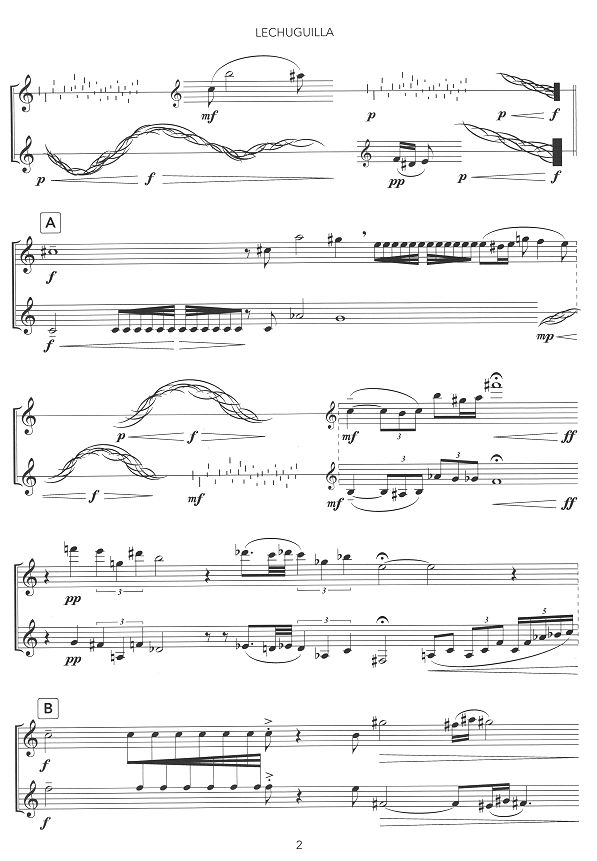 |
WW403: Lechuguilla for Flute and Clarinet by Stephen Lias. Alias Press, 2019, SS, 6 pages in score format. In the Carlsbad Caverns National Park system, Lechuguilla was known as a small historic site with little importance. It wasn't until 1986 that a group of cavers broke through to discover what would eventually become more than 136 miles of mapped passages and caverns, making this the fifth longest cave in the world. Several documentaries have witnessed the exploration of Lechuguilla, and access today is limited to approved scientific researchers, survey and exploration teams. Lias expresses the magnificence and mystery of Lechuguilla in a duo for wind (breath) instruments. This five-minute work for flute and clarinet explores the interrelationships between themes representing air, rock, and water. It combines traditional techniques with extended demands on the players including key clicks (small vertical lines in the score, air blown through instrument-some stopped or started with the tongue, flutter tonging (flute), pitch bending (clarinet) and some contemporary notation. Click on the cover image to view the second page of the score.
(Except other items with free shipping.) |
8.95
|
|
WW089: Holidays on Clarinet/Holidays on Flute by Francis Loriaux. International Music Diffusion, 2000, SS, includes parts for both flute and clarinet and score. For four B-flat clarinets or four flutes. There are two movements I. En Badinant (Modéré) and II. Avec Entrain (Très rythmé). Translations of the movement names are Playfully and With Pep. The second movement has been transposed for clarinets from the original key of F (which makes the highest note in the first part an altissimo A) to D (the highest note is an altissimo F-sharp). Early college level at most. |
16.95
|
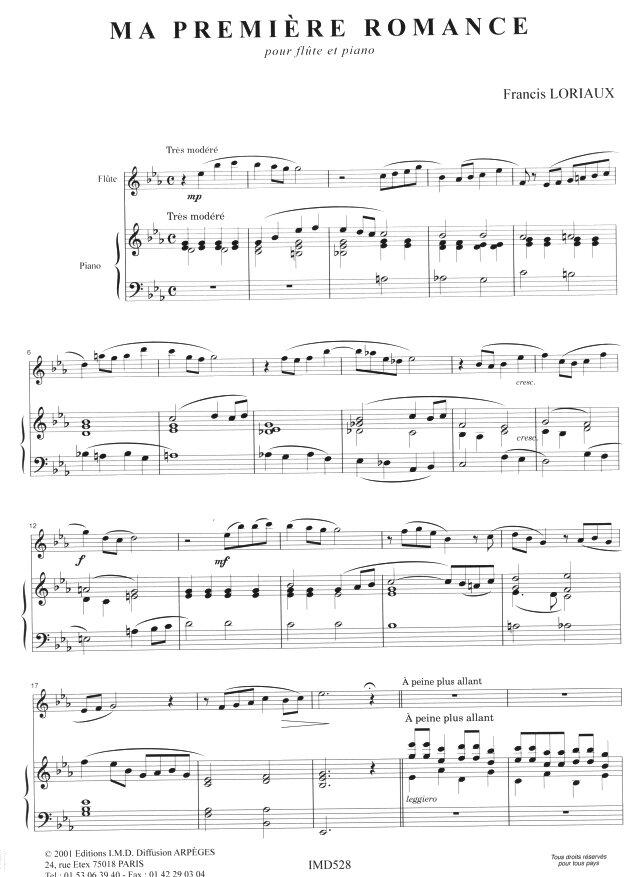 |
F281: Ma Première Romance for Flute and Piano by Francis Loriaux. International Music Diffusion, 2001, 2 + 1 pages. A short solo piece for the second year student. Click on the cover image to see a page of the score. (Except other items with free shipping.) |
5.95
|
 |
F269: Athéna Piccolo Solo by Jean-Pierre Loublier. International Music Diffusion, 2003, 4 pages. Jean-Pierre Loublier is a French composer and pianist. This is a contemporary work for piccolo that using some contemporary techniques (especially flutter tonguing) and a bit of contemporary notation. However, these techniques are used sparingly so it will serve as a good introduction to this type of material. College level (Except other items with free shipping.) |
6.95
|
 |
F346: Suite Butterfly for Flute Quartet or Choir by Phyllis Avidan Louke. Alry Publications, 1999, SS, includes parts and score. There are two versions of Part 4, one for alto flute and another for C flute and/or bass flute. While there are only 4 parts for this piece, there are flute choir instructions for using a piccolo with the first part and an optional contra flute with the fourth part. Three movements: I. Caterpillar, II. Chrysalis and III. Butterfly. Better high school level quartets and up. Duration 7:00. |
18.95
|
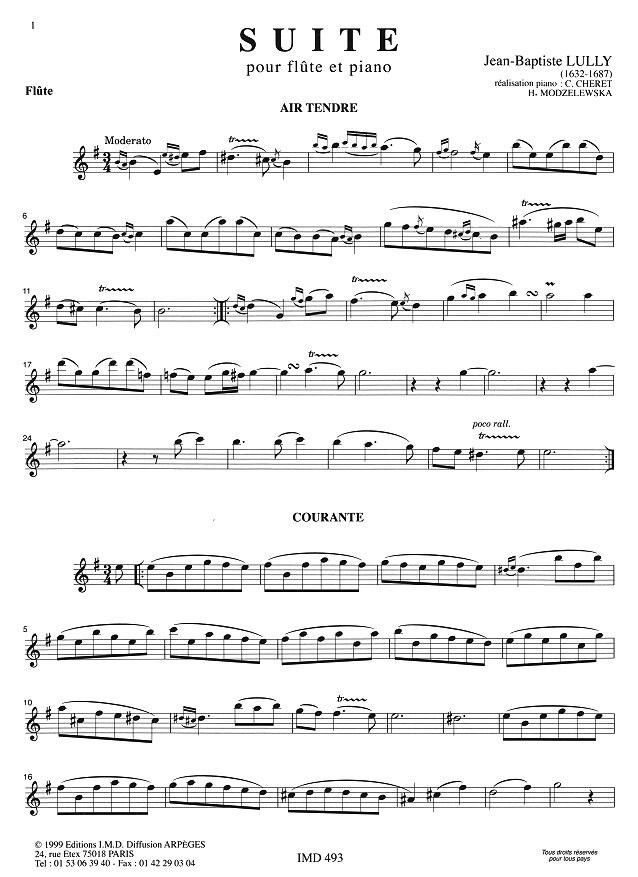 |
F283: Suite for Flute and Piano by Jean-Baptiste Lully with piano realization by Christian Chéret and Hanna Modzelewska. International Music Diffusion, 1999, SS, 11 + 4 pages. Jean-Baptiste Lully (1632-1687) was an Italian-born French composer who spent most of his life working in France and is considered the principal master of the French Baroque style. In four movements: 1. Air Tendre (moderato), 2. Courante, 3. Sarabande, and 4. Gigue (Molto allegro). Suitable for the high school level flutist. Click on the cover image to see the first page of the flute part.
(Except other items with free shipping.) |
13.50
|
 |
WW126: Music for the Middle of the Day for Flute, Clarinet in B-flat, and Piano by Joseph Makholm. Billaudot, 2006, SS. This piece was written for the Webster trio. Michael Webster describes it as "Sophisticated jazz. Joe has written everything out to sound natural, almost improvised at times, with lush chord changes and inventive melodies and rhythms. It is an outstanding example of its genre." In four movements: 1. Late One Afternoon (At a lazy, but regular, pace), 2. Dolores' Kitchen (Up-tempo bossa), 3. December (Molto rubato), and 4. You Think You Know, But You Don't (Up-tempo swing). The first and last movements should be swung. College level with a duration of about 9 minutes. |
43.95
|
 |
F347: Baby Elephant Walk for Flute Choir by Henry Mancini arranged by Amy Rice-Young. Alry Publications, 1961/1985, SS, includes parts and score. A familiar piece, arranged to introduce the various members of the flute family. Suitable for many different combinations of flutes and great for large choirs! Instrumentation: Piccolos (or E-flat Flute) - divisi, 4 players (only splits to four parts in one measure, otherwise, unison); C Flutes - divisi, 4 players (splits to four parts in final measure only, otherwise, mostly one part with occasional 2-part divisi); Alto Flutes (or C Flute) - divisi, 3 players (only splits to three parts in two measures, otherwise, mostly one part with occasional 2-part divisi); Bass Flute and String Bass (or Contrabass Flute). Since a fairly large choir is needed for the full effect this is probably most suited for amateur flute choirs. Duration is 4 minutes. |
18.95
|
 |
F242: Les Folies d'Espagne for Solo Flute by Marin Marais edited by Hans-Peter Schmitz. Baerenreiter (BA33110), 1956, SS, 8 pages. Originally written for gamba by Marin Marais (1656-1728) these 25 variations have become a popular work for flute and other instruments. (Except other items with free shipping.) |
14.95
|
 |
F107: Frank Martin Ballade pour flûte et piano, Paula Robison Masterclass by Paula Robison. Universal Edition, 2002. SS, 21+ 14 pages. A master class on Martin's Ballade pour flûte et piano which was written as the required piece for the 1939 Geneva International Competition. Includes both the flute and piano parts. |
29.95
|
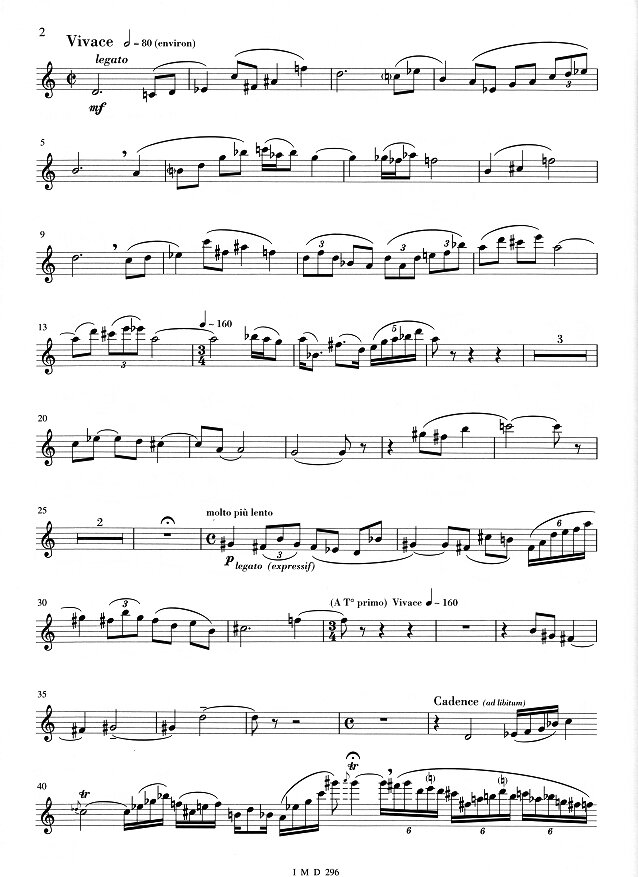 |
F284: Dialogues for Flute and Piano by Dominique Mauguéret. International Music Diffusion, 1996, SS, 7 + 3 pages. Dominique Mauguéret is a contemporary French composer whose beautiful music is always marked by great harmonic finesse. This work has two movements, the first is marked Molto cantabile, Moderato while the second is Vivace and includes a cadenza in the middle. Suggested for the advanced high school or early college level player looking for something besides the standard repertoire. Click on the cover image to see the second page of the flute part. (Except other items with free shipping.) |
8.95
|
 |
F270: Sanaga Flute Solo by Dominique Mauguéret. International Music Diffusion, 2000, SS, 2 pages. This is a two page work in two movements. It uses some contemporary notation and some extended articulation techniques, Probably good introductory material for college students studying this area. (Except other items with free shipping.) |
6.50
|
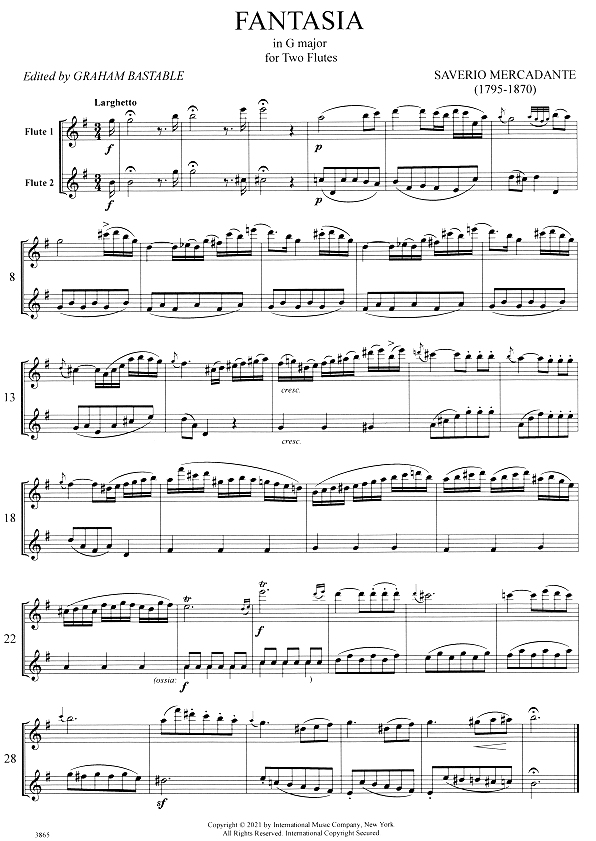 |
F455: Fantasia in G Major for two flutes by Saverio Mercadante edited by Graham Bastable. International Music Company, 2021, SS, 8 + 5 + 4 pages. Saverio Mercadante (1795-1870) was an Italian composer, particularly of operas. This piece was written about 1818. In the original edition the second part (which is considerable easier than the first), was for violin or flute. Here is a recording. Click on the cover image to see the first page of the score. |
13.50
|
 |
F389: Sonata for Alto Recorder or Flute and Piano by Matthias Maute. Heinrichshofen, 2010, SS, 21 + 6 pages. Matthias Maute (1963-) is an internationally recognized recorder player who also performs on the Baroque flute. More than 30 of his compositions have been published. This piece is the result of a commission to compose a piece in the style of the second half of the 18th century. In three movements: Un poco allegro, Un poco andante/Un poco più andante, and Allegro con spirito. Early college level. |
20.95
|
 |
F256: Sénanque for Solo Flute with use of Pars-pro-Toto-playing techniques by Andreas Mazur. Zimmermann, 2005, SS, 15 pages (7 pages of music). This piece uses a variety of extended techniques including tongue and key clicks, wind sounds, multiphonics, harmonics, and especially playing on parts of the flute. Includes an explanation of the techniques required. Sénanque is the name of a Cistercain monastery in the Provence region of France. This piece is the impressions of the monastery on a summer day. (Except other items with free shipping.) |
23.95
|
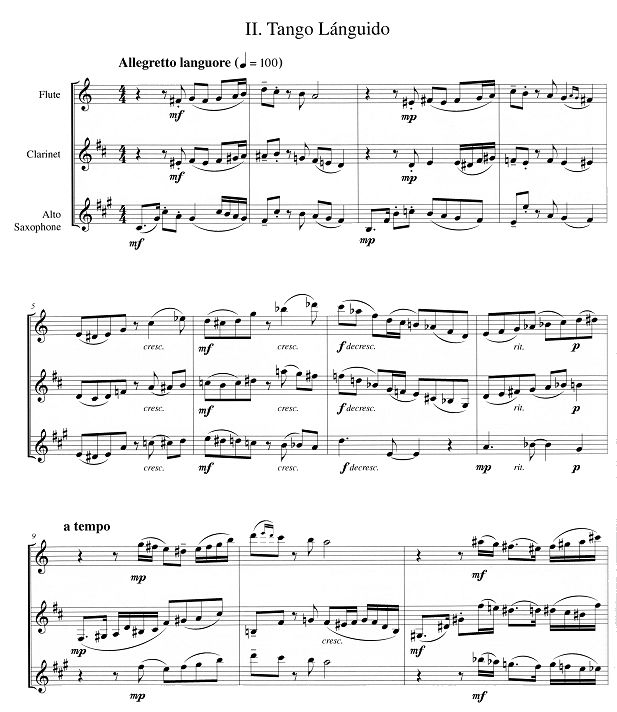 |
WW342: Eclectic Trio for Flute, Clarinet, and Alto Saxophone by Catherine McMichael. Alry Publications, 2004, SS, includes parts and score. This trio of dances for a somewhat unusual combination of instruments is in three movements: I. Sarabande, II. Tango Lánguido, and III. Jitterbug. The clarinet part was originally written for an A clarinet but a B-flat part is also included. This is an early college level/college level piece with a duration of about 5:30. You can listen to all three movements on the publisher's website or watch them on YouTube. Here is Jitterbug. Click on the cover image to see a sample page from the score. |
21.95
|
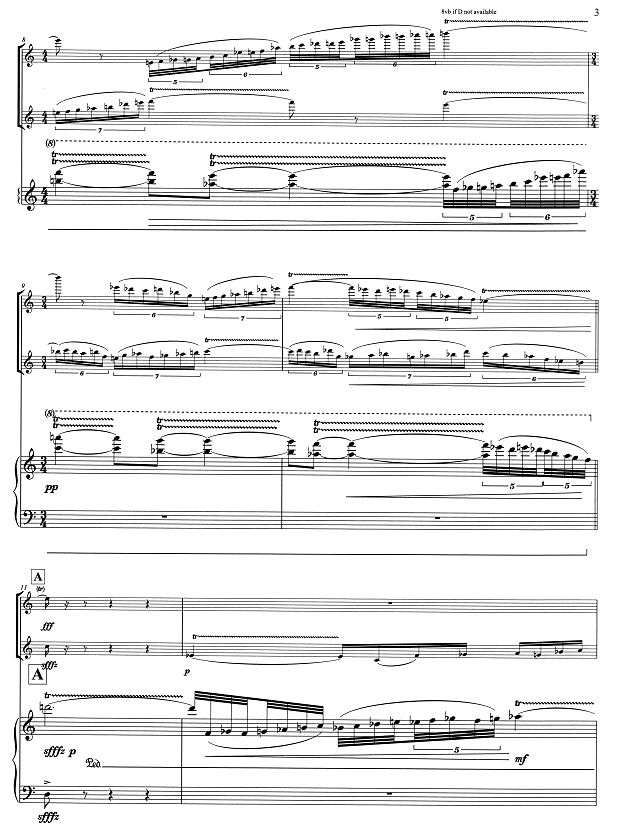 |
WW343: Spectred Light for Flute (doubling Piccolo), Clarinet, and Piano doubling suspended metal Wind Chimes by Paul Mealor. Novello, 2011, SS, includes parts and piano score. Paul Mealor (1975-) is a Welsh composer especially noted for music for chorus. In three movements with a duration of about 7 minutes, this is a virtuosic work. The first movement is Allegro Moderato and is by far the longest. At the end of this movement the pianist briefly plays the wind chimes and then imitates them on the piano and the beginning of the short second movement (Adagio, Molto Express). The third movement is Allegro Moderato and similar to the first movement although it uses piccolo, is slightly faster and is not as long. Click on the cover image to view the second page of the score. |
29.95
|
|
F210: Thirty Easy Duets in All Keys for Two Flutes by Louis Moyse. McGinnis & Marx, 1960, SS, 45 pages, score format. The duets in this book (despite the title) range from the intermediate level to the advanced high school/early college level (especially in the extended keys). In addition, the parts are generally of equal difficulty even though the cover says pupil and teacher. This will be excellent sight reading material and is a great value. One copy left at this price. The new price is $11.95. |
7.95
|
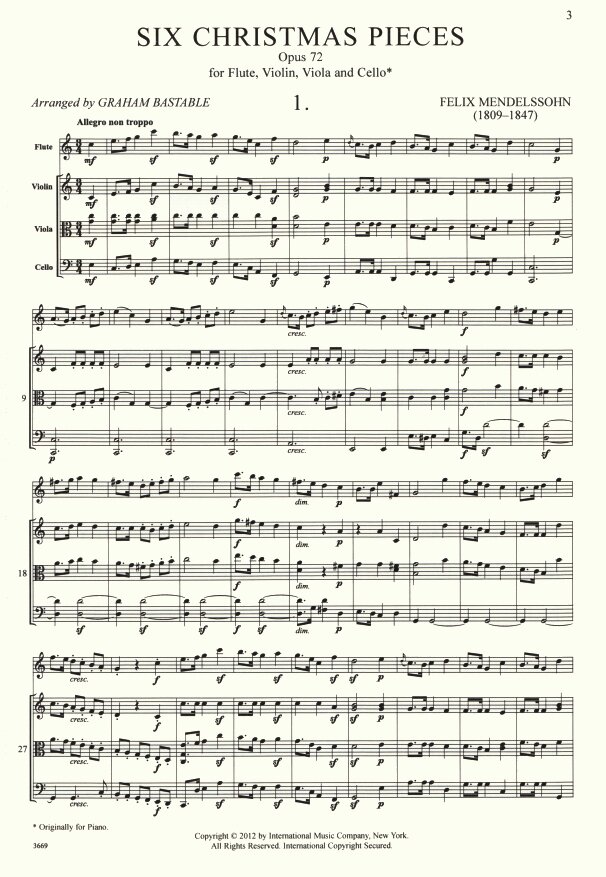
|
F408: Six Christmas Pieces Op. 52 arranged for Flute, Violin, Viola and Cello by Felix Mendelssohn arranged by Graham Bastable. International Music Co., 2012. SS. Six pieces, originally for piano, which Mendelssohn wrote on a visit to England in 1842. Better high school ensembles and up. Includes some brief notes. Click on the cover image to view the first page of the score. |
17.95
|
|
F413: Rondo in E minor for Flute and Piano by Franz Xaver Wolfgang Mozart edited by Karsten Nottelmann. Henle, 2013, SS, 9 + 2 pages. Franz Xaver Wolfgang Mozart (1791-1844) was the son of Wolfgang Amadeus Mozart. Most of his music output was vocal and solo piano works. This is part of his small output of chamber music. It isn't actually a rondo but the first movement of a sonata which was never completed. This is a useful piece for teaching and performing. Suitable for better high school flutists and up. Includes an introduction by the editor in German, English and French. and notes on the editing in German and English. |
17.95
|
|
F266: Mozart Andante and Rondo in G major K. 250 for Flute and Piano transcribed and edited by Robert Stallman. International Music Co., 2006, SS, 24 + 12 pages. K. 250 is the Haffner Serenade which includes a violin concerto within its eight movements. Stallman has taken two of these movements and produced a virtuoso work which is well suited for the flute. |
18.95
|
|
F157: Mozart Concerto for Flute, Harp and Orchestra KV 299 Piano reduction edited by András Adorján with cadenzas by Robert D. Levin. Henle, 2004, PB/SS. The piano part includes both the flute and harp part while the harp part includes the flute part (the flute has a separate part). In three movements: Allegro, Andantino, Rondeau (Allegro). Includes cadenzas for each movement by noted American Mozart scholar Levin. Includes an introduction by the editor in German, English and French. We also have a separate book of suggested cadenzas (immediately below). Overstock special! The regular price is now $31.95. |
23.95
|
|
F376: Cadenzas to Mozart's Concerto for Flute, Harp and Orchestra KV 299 for Flute and Harp by Robert Stallman with the harp part edited by Katerina Englichova. International Music Co., 2010, SS, 10 + 3 pages. Includes part in score format for the harp and a part for the flute.
(Except other items with free shipping.) |
10.75
|
|
F192: Mozart Concerto in G major for Flute and Orchestra KV 313 Piano reduction edited by Franz Giegling. Baerenreiter (BA 4854a), 2003. This publication is based on Giegling's edition as found in the New Mozart Edition (NMA V/14/3). It includes a preface, brief notes on the editing, an easy to play keyboard reduction, and 10 pages of cadenzas and "Eingänge" by Rachel Brown, Konrad Hünteler, and Karl Engel with accompanying notes. |
21.95
|
|
F225: Mozart Concerto in G major for Flute and Orchestra KV 313 Piano reduction edited by András Adorján, Piano Reduction by Siegfried Petrenz, and Cadenzas and Eingänge by Robert D. Levin. Henle, 2000, SS, 34 + 15 pages. It includes a Preface and 5 pages of cadenzas and Eingänge by Mozart scholar Levin. |
24.95
|
|
F350: Mozart Concerto in G major for Flute and Orchestra KV 313 Piano reduction edited and with cadenzas by N. Platonov. Moscow Muzyka, 2008, SS, 28 + 11 pages. A new and inexpensive edition from Russia. This edition has cues for most of the tutti passages. This edition does not have measure or rehearsal numbers which makes it more difficult to rehearse with a pianist. |
10.95
|
|
F193: Mozart Concerto in D major for Flute and Orchestra KV 314 Piano reduction edited by Franz Giegling. Baerenreiter (BA 4855a), 2005. This publication is based on Giegling's edition as found in the New Mozart Edition (NMA V/14/3). This new edition includes a preface, brief notes on the editing, an easy to play keyboard reduction, a reference score for comparing the flute and oboe versions of this work, and 10 pages of cadenzas and "Eingänge" by Rachel Brown and Konrad Hünteler with accompanying notes. |
23.95
|
|
F226: Mozart Concerto in D major for Flute and Orchestra KV 314 Piano reduction edited by András Adorján, Piano Reduction by Siegfried Petrenz, and Cadenzas and Eingänge by Robert D. Levin. Henle, 2000, SS, 28 + 17 pages. It includes a Preface and 6 pages of cadenzas and Eingänge by Mozart scholar Levin. |
24.95
|
|
WW229: Mozart Fantasia for a Musical Clock for Flute, Oboe, and Piano arranged by Maximilian Schwedler. Lauren Publications, SS, includes parts and piano score. Reprinted from the 1919 Zimmermann edition. The second part can be played by a violin or a second flute. This piece was written for the Flötenuhr or Spielühr, a mechanical organ or clock. It is sectional: Allegro, Andante, and Tempo I. College level. |
12.50
|
|
F314: Mozart Quartet in D Major K 311 for Flute (or Violin), Violin, Viola, and Cello edited by Robert Stallman. International Music Co., 2008, SS, includes parts and score. This edition was arranged from the piano sonata. In three movements: I. Allegro con spirito, II. Andante con espressione, and III. Rondo (Allegro). |
27.95
|
|
F119: Mozart Quartets for Flute Performance Parts edited by Jaroslav Pohanka. Baerenreiter (BA4405), 2002. Baerenreiter urtext editions of four quartets for flute, violin, viola, and cello. Included are Quartet in D KV 285, Quartet in G KV 285a, Quartet in C KV Anh. 171 (285b), and Quartet in A KV 298. |
20.95
|
|
F224: Mozart Flute Quartets Performance Parts edited by Henrik Wiese. Henle, 1998, SS. Four quartets for flute, violin, viola, and cello. Included are Quartet in D KV 285, Quartet in G KV 285a, Quartet in C KV Anh. 171 (285b), and Quartet in A KV 298. Includes a Preface and notes on the editing. SALE: $2.00 off the current list price. |
28.95
|
|
F449: Mozart Sonata No. 18 in G major K. 301/293a arranged for Flute and Piano by Stephanie Jutt. International Music Co. 2019, SS, 14 + 5 pages. This work was originally for violin or flute and piano. This new editon incorporates flute ossias from the original manuscript. Advanced high school/early college level. Click on the cover image to see a sample page. SALE Price! |
14.95
|
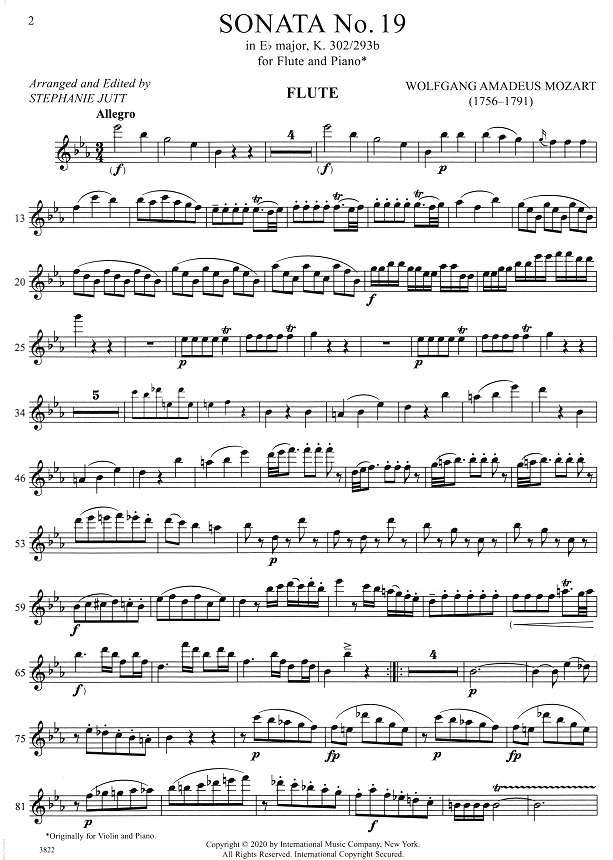
|
F452: Mozart Sonata No. 19 in E-flat major K. 302/293b arranged for Flute and Piano by Stephanie Jutt. International Music Co. 2020, SS, 14 + 4 pages. This work was originally for violin and piano. The solo line is often in support of the piano. In two movements: Allegro and Rondo (Andante grazioso). Advanced high school/early college level. Click on the cover image to see the first page of the flute part. |
18.95
|
|
F448: Mozart Sonata No. 22 in A major K. 305/293d arranged for Flute and Piano by Stephanie Jutt. International Music Co. 2019, SS, 14 + 7 pages. This work was originally for violin and piano. Advanced high school/early college level. Click on the cover image to see a sample page. SALE Price! |
14.95
|

|
F457: Mozart Sonata No. 23 in D Major K 306/3001 for Flute and Piano arranged by Stephanie Jutt. International Music Co., 2021, SS, 28 + 9. This work was originally for piano and violin. In three movements: I. Allegro con spirito, II. Andante cantabile, and III. Allegretto. Click on the cover image to view the first page of the flute part. |
26.50
|
|
F458: Mozart Sonata No. 33 in E-flat K 481 for Flute and Piano arranged by Stephanie Jutt. International Music Co., 2022, SS, 23 + 8. This work was originally for piano and violin. In three movements: I. Molto Allegro, II. Adagio, and III. Allegretto Theme and (6) Variations. The regular price of this piece is $30.50. |
27.95
|
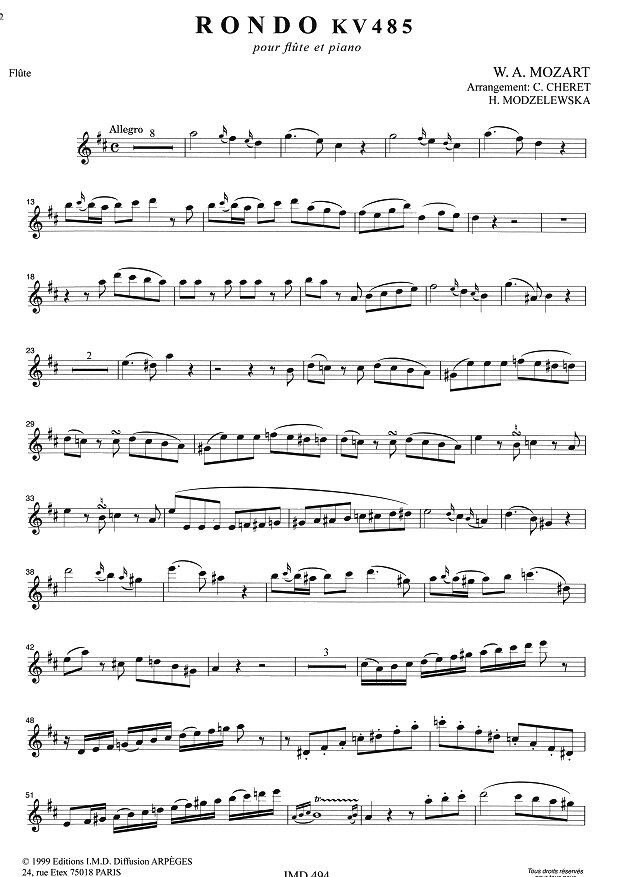
|
F282: Mozart Rondo in D major KV 485 arranged for Flute and Piano by Christian Chéret and Hanna Modzelewska. International Music Diffusion, 1999, SS, 9 + 3 pages. This work was originally for piano. Advanced high school level. Click on the cover image to see a sample page. |
12.95
|
|
WW241: A Treasury of Mozart Duets (7 Familiar Favorites) for Flute and Clarinet arranged by Daniel Dorff. Theodore Presser Co., 2010, SS, 24 pages in score format. Composer and clarinetist Daniel Dorff has further expanded the repertoire for Flute and Clarinet duo with this book featuring Mozart’s best-loved arias and instrumental themes, the works in this collection have been transcribed into complete-sounding idiomatic adaptations, equally suitable for recital use and just-for-fun duet read-throughs. This collection also features a scholarly preface about ornamentation, interpretation, and authentic performance practice. Includes Overture to The Magic Flute (abridged); "Voi, che spete" and "non più andrai" from The Marriage of Figaro;, Adagio from the Clarinet Concerto (abridged);, "Alleluia" from Exsultate, Jubilate; "Bei Männern, welche Liebe" from The Magic Flute; and Twelve Variations on "Ah! Vous dirai-je, Maman" (Twinkle, Twinkle Little Star. Better high school level musicians and up. |
16.95
|
|
WW037: Duos for Flute and Clarinet Op. 24 by Robert Muczynski. G. Schirmer, 1991, SS, 13 pages. Includes two copies of the six duets which are in score format. Probably early college level but might be attempted by younger players if the flutist has good command of the third octave. |
16.95
|
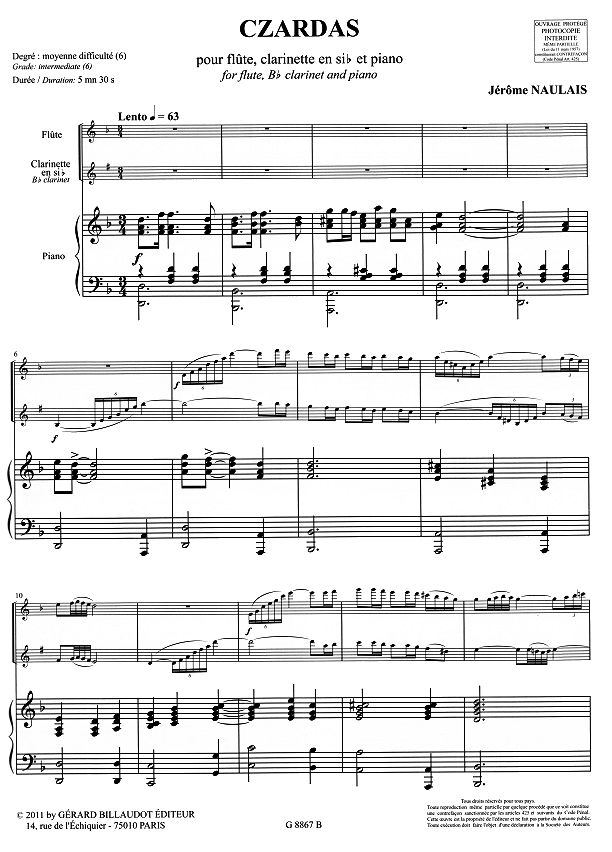 |
WW316: Czardas for Flute, Clarinet in B-flat, and Piano by Jerome Naulais. Billaudot, 2011, SS, includes parts and piano score. This is an original Czardas (a Hungarian folk dance) by French composer Naulais (1951-). It is rated by the publisher as a 6 which is the upper end of intermediate on their 9 level scale. It alternates between slow and fast sections and has a duration of about 5:30. Click on the cover image to view the first page of the score. |
19.95
|
 |
F144: Trio in B minor for two Flutes and Basso continuo by Christoph Nichelmann edited by Ingo Gronefeld. Edition Kunzelmann, 2004, SS. Nichelmann (1717-1762) studied with Wilhelm Friedemann Bach and with Johann Joachim Quantz and was a contemporary and colleague of Carl Philipp Emanuel Bach. This edition has separate parts for each flute and the basso continuo, plus a fully realized basso continuo part for keyboard in the score. |
27.50
|
|
WW260: Two Duos for Piccolo and E-flat Clarinet (or Piccolo and Flute) by Roger Nixon. ECSPublishing/Galaxy Music, 1982, SS, 8 pages (2 copies in score format). Roger Nixon (1921-2009) was an American composer, musician (who had studied the clarinet), and professor of music. Duo I. is Moderato and Duo II. is Allegro moderato. College level. (Except other items with free shipping.) |
11.25
|

|
WW365: Pachelbel Canon for Flute, Clarinet and Piano by Johann Pachelbel arranged by Daniel Dorff. Theodore Presser Co., 2016, includes both wind parts and piano score. Daniel Dorff has arranged the famed Pachelbel Canon in D (in this case in concert F). The ingenious overlapping of this piece creates the intricate sounds when the instruments play off of each other in the world's most beloved canon. For intermediate to advanced performers. Click on the cover image to view a sample page from the score. (Except other items with free shipping.) |
9.95
|
|
F293: Histoire du Tango for Flute and Guitar by Astor Piazzolla transcribed by Pierre-André Valade and Roberto Aussel. Editions Henry Lemoine, 1986. This is a wonderful and challenging piece which has been transcribed for a variety of instruments and combinations of instruments with this being one of the most popular. The four scenes portrayed are: Bordel 1900, Café 1930, Night-club 1960, and Concert d'auhourd'hui (Modern Day Concert). This edition has been prepared with particular attention to page turns. Click on the cover image to see a .pdf of the first page of the score. |
24.95
|
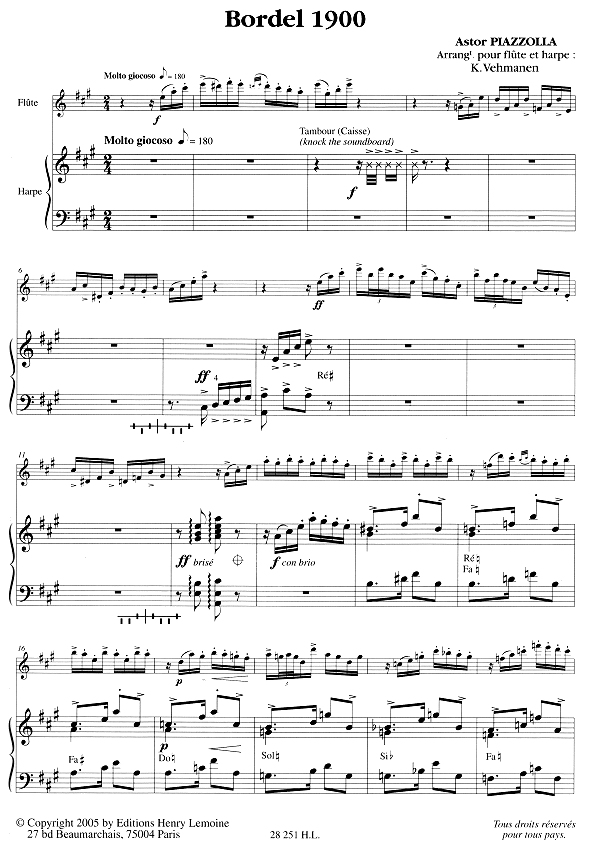
|
F437: Histoire du Tango for Flute and Harp by Astor Piazzolla arranged by Kari Vehmanen. Editions Henry Lemoine, 2005, SS, 31 + 31 pages (harp score and flute part). This is a wonderful and challenging piece which has been transcribed for a variety of instruments and combinations of instruments. The four scenes portrayed are: Bordel 1900, Café 1930, Night-club 1960, and Concert d'auhourd'hui (Modern Day Concert). The flute part of this edition has been prepared with particular attention to page turns. Click on the cover image to view the first page of the score. SALE PRICE! $10 off the regular price. |
18.95
|
 |
F214: Libertango for flute and guitar by Astor Piazzolla edited by Klaus Jäckle. Edition Margaux, 1974, SS. "Libertango stands for the freedom which I allow for my musicians. Their limits are defined solely by the extent of their own capabilities and not through any external pressure."Piazzolla wrote this piece for his octet which he formed in 1954. It includes two parts in score format. (Except other items with free shipping.) |
9.95
|
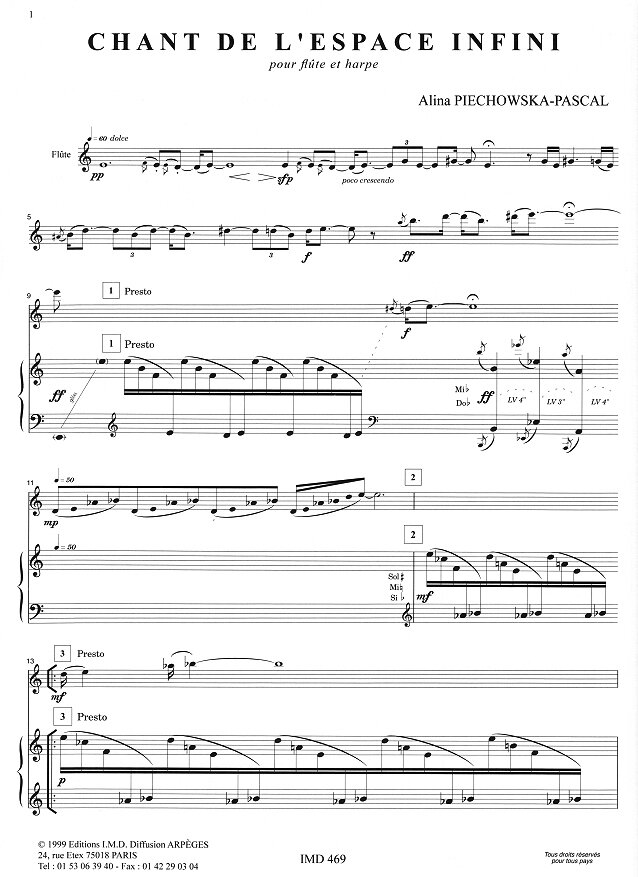 |
F288: Chant de l'Espace Infini for Flute and Harp by Alina Piechowska. International Music Diffusion, 1999, 4 pages (2 copies in score format). Alina Piechowska-Pascal (1958-) is a French composer with Eastern European routes. She has written a number of pieces for flute. Some contemporary notation. The flute is featured at the beginning then the flute and harp trade moving lines until the end of the piece. Click on the cover to view the first page of the music.
(Except other items with free shipping.) |
10.95
|
 |
F271: Trois chansons des Etoiles for Flute Solo by Alina Piechowska. International Music Diffusion, 1999, SS, 2 pages. Marked Mystérieux, avec instensité, these short songs use some contemporary notation but no extended technique. Excellent for the early college level student.
(Except other items with free shipping.) |
7.95
|
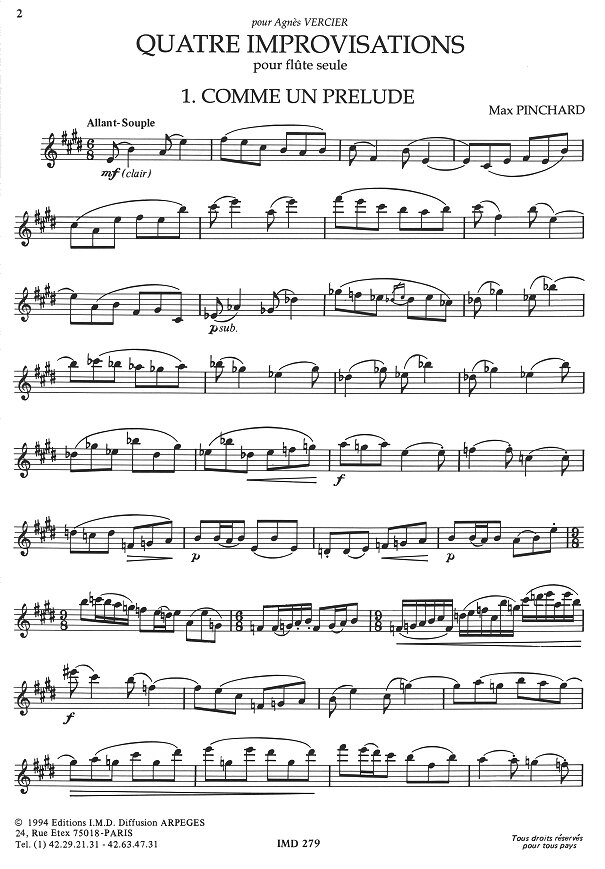 |
F276: Quartre Improvisations for Flute Solo by Max Pinchard. International Music Diffusion, 1994, SS, 6 pages. Max Pinchard (1928-) is a French composer, teacher, music critic, conductor and author. He has written for a wide variety of genres, faithful to his own style which emphasizes melody. This piece is in four movements: 1. Comme un Prelude (Allant-Souple), 2. Comme une Sarabande (Très expressif-Grave), 3. Comme une Danse (Allegre et rythme), and 4. Comme un Alleluia (Très lent). Early college level. Click on the cover to view the first page of the music. (Except other items with free shipping.) |
7.95
|
 |
F297: 12 Sonatas for 2 Flutes by Ignaz Pleyel edited by Gerhard Braun. Heinrichsofen, 2006, SS, 36 pages. Ignace Joseph Pleyel (1757-1831) was an Austrian-born composer who relocated to France in 1795 and resided there for the rest of his life. These duos (based on violin pieces) enjoyed considerable popularity in their time because of their easy melodic writing and formal simplicity. They are at the middle and upper intermediate level. |
24.95
|
 |
G215: Concerto in C major for Cello or Flute or Clarinet and Orchestra (Piano Reduction) by Ignaz Pleyel edited by Árpád Pejtsik. Kunzelmann, 1985, , SS, 24 + 11 pages. Pleyel completed this work some time before 1797. This edition includes the flute and cello solo parts but not the clarinet part which is here. (The solo parts for each instrument are quite different). It is in three movements: I. Allegro, II. Adagio, and III. Rondo: Allegro molto. The Preface contains information about the composer and the editing. The orchestral parts are available from public domain sources. Here is an audio recording. |
29.95
|
 |
F377: Trio Concertante No. 1 in G major for Flute, Viola and Cello by Ignaz Pleyel edited by Marlaena Kessick. International Music Co., 2010, SS, (includes parts and score). A relatively brief (the parts are 5 pages long) work in two movements: I Allegro and II. Rondo. Early college level. |
21.95
|
|
F337: Concertino Op. 55 for Flute (Domra) Strings and Harpsichord (Piano Reduction) by Efrem Podgaits. Muzyka Moscow, 2008, SS, 29 + 11 pages. Efrem Podgaits (1949-) is a Russian composer who has written 12 operas, 3 symphonies, and 23 concertos for different instruments. In four movements: Meditation (Con moto), Arietta (Cantabile), Joke (Allegretto), and Rondo (Vivo). The Joke movement calls for piccolo. College level with a duration of about 12 minutes. |
23.95
|
|
F300: Album for Flute and Piano by Wilhelm Popp edited by Wolfgang Kossack. Edition Kossack, 2001, 18 + 7 pages. Wilhelm Popp (1828-1902) was a German composer of nearly 600 pieces, mostly for flute and piano. This book has three pieces: Spanischer Tanz, Spanische Serenade, and Nachtigallenserenade. The Spanischer Tanz is an intermediate level piece while the other two are somewhat more difficult. |
18.50
|
|
F306: Blumenstück, Romance for Flute and Piano Op. 383 by Wilhelm Popp edited by Ute Widdermann. Edition Kossack, 2001, 8 + 2 pages. A shorter piece than some many Popp featured here. It is in 6/8 time and marked Andante molto espressivo. College level. (Except other items with free shipping.) |
14.50
|
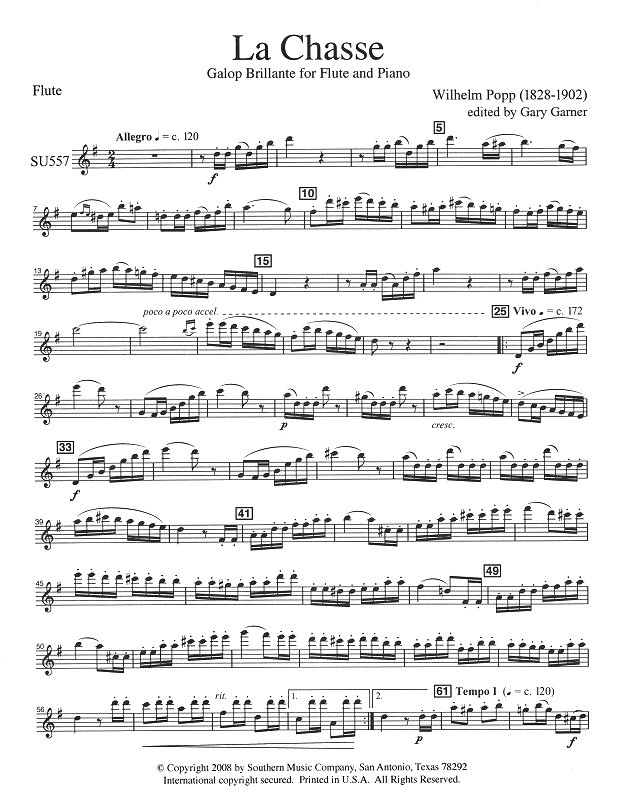
|
F335: La Chasse Galop Brillante Op 250 No. 6 for Flute and Piano by Wilhelm Popp edited by Gary Garner. Southern Music Co. (SU557), 2008, SS, 10 + 3 pages. This is one of Popp's more popular pieces. It begins with an Allegro tempo, then Vivo, Allegro again, then back to Vivo and accelerates more near the end. College level. There is also an edition of this piece for flute solo with concert band. Click on the cover image to view the first page of the flute part. Overstock Special! $2.00 off regular price of $9.95 while supplies last.
(Except other items with free shipping.) |
7.95
|
|
F307: Kleines Flötenkonzert Op. 438 for Flute and Piano by Wilhelm Popp edited by Ute Widdermann. Edition Kossack, 2001, 11 + 3 pages. A sectional piece which begins (in 4/4) with an Allegro maestoso introduction followed by an expressive Andante. A short Allegro non troppo section leads to Allegretto scherzando (2/4) which increases in speed midway to the bravuroso conclusion. Early college level. (Except other items with free shipping.) |
17.95
|

|
F308: Schwedisches Konzert Op. 266 for Flute and Piano by Wilhelm Popp edited by Ute Widdermann. Edition Kossack, 2002, 22 + 11 pages. The Swedish Concerto is sectional with piano interludes between some sections. The tempo marking are: Allegro assai, Allegro maestoso, Adagio, and Allegro vivo (which includes a long cadenza). College level. |
23.50
|
|
F299: 6 Sonatinen Op. 388 Vol. 1 for Flute and Piano by Wilhelm Popp edited by Ute Widdermann. Edition Kossack, 2002, 26 + 12 pages. This book contains the first three of six sonatas from Op. 388. Advanced intermediate/early college level. F309: 6 Sonatinen Op. 388 Vol. 2 for Flute and Piano by Wilhelm Popp edited by Ute Widdermann. Edition Kossack, 2002, 26 + 8 pages. This book contains the second three of six sonatas from Op. 388. Advanced intermediate/early college level. |
Vol. 1 19.9519.95 Vol. 2
|
|
F304: Tonbilder Vol. 1 for Flute and Piano by Wilhelm Popp edited by Ute Widdermann. Edition Kossack, 2001, 12 + 7 pages. This book contains the first three pieces that are somewhat easier than some of Popp's other works here but are still at least in the mid range of the intermediate level. The pieces are Grossmütterchen erzählt (Ballade/Moderato con garbo), Schwarzwaldblümchen (Idylle/Moderato pastorale), and Mädchenlied (Melodie/Un poco Allegro). F305: Tonbilder Vol. 2 for Flute and Piano by Wilhelm Popp edited by Ute Widdermann. Edition Kossack, 2001, 16 + 8 pages. Three more pieces at the about the same level as volume 1. They are: Singvöglein (Capriccio/Moderato grazioso), Mückentanz (Mosquito dance) (Scherzo/Presto in 6/8), and Ball-Erinnerrung which is a series of short dances (Polonsaise, Waltz, Polka, Mazurka, etc.) |
Vol. 1 17.9517.95 Vol. 2
|

|
F298: Ungarische Tänze Op. 308 for Flute and Piano by Wilhelm Popp edited by Ute Widdermann. Edition Kossack, 2001, 15 + 7 pages. This book has three Hungarian dances which are each two pages long in the flute part. Upper intermediate level. |
19.50
|
|
F169: Sonata for Flute and Piano by Francis Poulenc, edited by Carl B. Schmidt, consulting editor (1994) Patricia Harper. Chester Music, 1994, 23 + 8 pages. In three movements: Allegretto malincolico, Cantilena, and Presto giocoso. The Poulenc Sonata for Flute and Piano has become one of the most frequently performed and best loved sonatas in the flute repertoire. In preparing this editions the editors hoped not only to clarify many textual issues but also to supply sufficient documentation for those who wish to know more about the background of the work and the significant problems involved in editing it. This edition includes about 10 pages of notes in English followed by French and German translations. |
17.95
|
|
F204: Trio in D minor Op. 1 No. 1 for three flutes by Bernardo Porta edited by Hugo Ruf. Heinrchshofen, 2003, SS. Porta (1758-1829) was born in Rome and lived in Paris after 1785. He was a conductor and composer who wrote operas and cantatas in his early career but after 1800 composed primarily instrumental works. This three movement work (Allegro, Andante con espressione, and Allegro) was published around 1790. It is at the upper intermediate level with equal parts on the first movement and somewhat easier second and third parts on the others. Includes a score and individual parts. |
24.95
|
|
WW277: A Treasury of Puccini Duets, 8 Favorite Arias for Flute and Clarinet in B-flat arranged by Daniel Dorff, edited and annotated by Cindy Anne Broz. Theodore Presser Co., 2012, SS, 20 pages. Score format. Oh! Mio Babbino Caro from Gianni Schicchi; Musetta's Waltz from La Bohème; Butterfly's Entrance, Flower Duet, and Un Bel Di from Madama Butterfly; Donna Non Vidi Mai from Manon Lescaut; Vissi d'Arte from Tosca; and Ave Maria from Suor Angelica. Includes translations and scene descriptions. In addition, notes and suggestions for applying operatic lyricism through instrumental expression are provided by flutist-pedagogue Cindy Anne Broz. Upper intermediate level. Click on the cover image to see sample pages. |
16.95
|
|
F360: Sonatina for Flute and Piano by Blaz Pucihar. Edition Kossack, 2005, SS 19 + 6 pages. Blaž Pucihar (1977-) studied at the Conservatory of Music in Ljubljana, Slovenia, and is a pianist, composer, and arranger. This work is in three movements: Vivo, Aria, and Vivace. College level. Here is an audio file from the beginning of the third movement. |
29.95
|
|
F311: Quantz Concerto in G major QV 5:174 for Flute and Piano (reduction) by Johann Joachim Quantz edited by Klaus Burmeister with cadenzas by Mirjam Nastasi. C.F. Peters, 1993, SS, 27 + 10 pages, plus CD of orchestral accompaniment. The original version of this piece is for flute, strings, and basso continuo. This concerto is one of the best know works of Johann Joachim Quantz (1697-1773) although its modern place in the concert repertoire dates from its rediscovery in 1877. In three movements: I. Allegro assia, II. Arioso e mesto, and III. Presto. Includes a sample eingang for the first movement and cadenzas for the first and second movement. This edition includes an informative Afterword and the play along CD. College level. |
33.50
|
|
F398: Quantz Six Duets for Two Flutes Op. 2 by Johann Joachim Quantz edited by Milton Wittgenstein. G. Schirmer Inc., 1953, SS, 2 individual parts 23 pages long each. These six duets were written in 1759. Generally (but not always) in a fast/slow/fast format and in a variety of styles and tempos. Better high school/early college level.
|
7.95
|
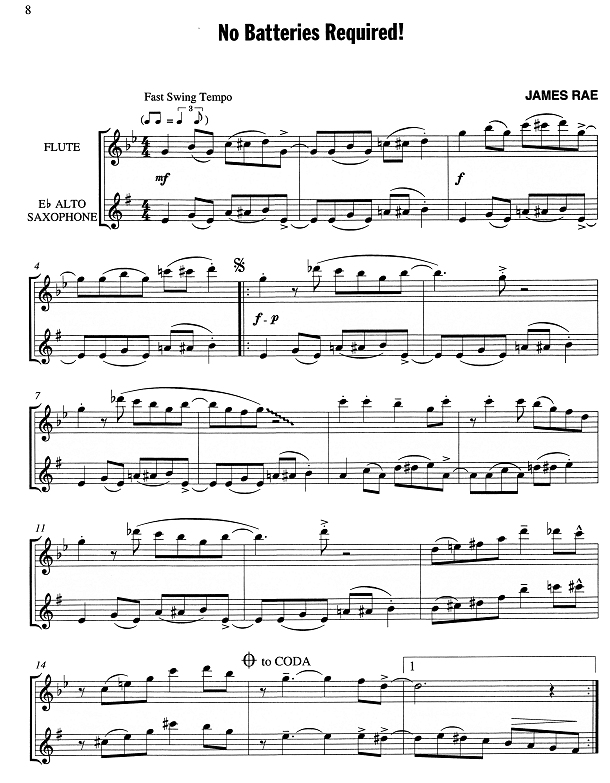
|
WW250: Blue Flute and Saxophone Duets for Flute and Alto or Tenor Saxophone by James Rae. Universal Edition, 1999, SS, includes flute and alto saxophone parts in score format and a separate tenor saxophone part. Five original duets at various tempos. All are swung. They include chord symbols in concert pitch. Intermediate/upper intermediate level. Click on the cover image to see a sample page. |
14.95
|
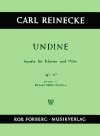
|
F384: Undine Sonate for Flute and Piano Op. 167 by Carl Reinecke edited by Richard Müller-Dombois. Rob. Forberg Musikverlag, 1968, SS, 31 + 7 pages. In four movements: Allegro, Intermezzo (Allegretto vivace/Piu lento, quasi Andante), Intermezzo (Allegretto vivace/Andante tranquillo/Molto vivace), and Finale (Allegro molto agitato ed appassionato, quasi Presto). This is an excellent Romantic style work which will challenge college level students. Current retail price is $25.00 |
19.25
|
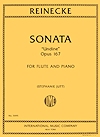
|
F415: Sonata "Undine" Op. 167 for Flute and Piano by Carl Reinecke edited by Stephanie Jutt. International Music Co., 2014, SS, 30 + 10 pages. This is a new edition of this piece base on the two earliest existing editions (no manuscript exists) with primary emphasis of the edition in the British Library rather than the Forberg edtion. This edition has been newly set and is very easy to read. There are less dynamic markings than the Forberg and it the flute part has been printed with attention to page turns. In sections: Allegro; Intermezzo, Allegretto vivace; Piu lento, quasi Andante; Allegretto vivace; Andante tranquillo/Molto vivace/Tempo I; and Finale, Allegro molto. An excellent Romantic style work which will challenge college level students. |
13.75
|
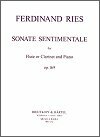
|
WW184: Sonate Sentimentale Op. 169 for Flute or Clarinet and Piano by Ferdinand Ries. Musica Rara/Breitkopf, 1971/2000, SS, 33 + 7/7 pages. Ferdinand Ries (1784-1838) is perhaps best remembered today as a student and friend of Beethoven but he was a successful pianist and composer in his own right. This piece is from a transitional period and includes romantic elements within its classical form. The separate flute and clarinet parts have been written to take advantage of the flute's high register and the lower range of the clarinet. It is in three movements: 1. Allegro moderato, 2. Adagio con moto, and 3. Rondo Allegro. Early college level. |
29.95
|
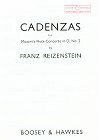 |
F146: Cadenzas for Mozart's Flute Concerto in D, No. 2 by Franz Reizenstein. Boosey & Hawkes, 1957, 4 pages. This is an Authorized Custom Print from Boosey & Hawkes.
(Except other items with free shipping.) |
12.95
|

|
WW252: Danny Boy - Meditation on "Londonderry Air" for Oboe (Clarinet or Flute) and Piano (or Organ) by William James Ross. C.F. Peters, 2003, SS, 4 + 2 pages (includes parts for both oboe/flute and clarinet). This familiar melody is presented twice, the first time is straight and the second time more freely as if improving. While the second section has some mixed meter of the 2/4, 3/4, 4/4, and 5/4 variety; this piece is not at all difficult. (Except other items with free shipping.) |
11.75
|
|
C2012: Meditació (Meditación) for Clarinet or Flute and Piano by Josep M. Ruera. Editorial de Música Boileau, 1996, SS, 6 + 2 pages (includes both clarinet and flute parts). Josep M. Ruera (1900-1988) lived his entire life in the Barcelona area of Spain where is studied, played viola and conducted ensembles as well as composing. This is the case of this work, Ruera composed it in 1925, but it did not see the light of day until the 1970s, with the addition of the piece to the Conservatory of Music of Barcelona course programs. The clarinet part is an octave lower than the flute part and there are a few other small differences. Early college level with a duration of about 5 minutes. Click on the cover image to view the first page of the score. |
8.95
|
|
WW051: Three American Miniatures For Flute and Clarinet in B-flat by John Rutter. Oxford, 1981, SS, 8 pages. One of the foremost living composers and conductors of choral music, John Rutter has also written orchestral and instrumental music. This piece for unaccompanied flute and clarinet is in three movements: Fanfare and Proclamation (Vivace), Blues (Andante expressivo), and Rag (Allegretto). Early college level. Score format. (Except other items with free shipping.) |
12.50
|
|
F431: The Swan for Flute and Piano by Camille Saint-Saëns edited by Stephanie Jutt. International Music Co., 2016, SS, 4 + 1 pages. This was originally for cello and is the only piece from Carnival of the Animals which was published during the composer's lifetime. Relatively easy, it includes ossia an octave lower for the high notes at the end. Click here to listed to a similar arrangement. (Except other items with free shipping.) |
11.95
|
|
WW121: Tarentelle Op. 6 for Flute, Clarinet in A and Piano by Camille Saint-Saëns. Kalmus, SS, (includes parts and piano score). Originally with orchestral accompaniment, this is one of Saint-Saëns earlier adult works. While traditional in many respects it includes a surprising Prestissimo conclusion in 2/4. College level with a duration of about 6 minutes.
|
9.95
|
|
WW201: Esquisse D'Espagne for flute (or oboe) and piano by Gustave Samazeuilh. Lauren Publications, SS, 4 + 2 pages. Gustave Samazeuilh (1877-1967) was a French composer, pianist, critic, musicologist, and a translator of musical works. This piece which was written in 1914 and dedicated to Maurice Ravel, has been reprinted from the 1916 Durand edition. It is marked Assez lent et nonchalant (mm=52) and has somewhat faster and slower sections throughout. (Except other items with free shipping.) |
9.95
|
|
F366: Sonatine for flute and piano by Pierre Sancan. Durand, 1946, SS, 19 + 6 pages. Pierre Sancan (1916-2008) was a French pianist, conservatory professor and composer. This piece was written as the contest piece for the National Conservatory in 1946. It is in three sections: Moderato, Andante espressivo, and Tempo anime. The piano part is excellent and challenging. This may be Sancan's most popular work. |
17.95
|
|
F197: Tarantela for Two Flutes and Piano by Simon A. Sargon. 2004, SB. Dedicated to Lisa Van Winkle and Helen Blackburn. A lively tarantella at the advanced high school/early college level. Separate flute parts and a piano score. Two copies left at this price. When they are sold the price will be $19.95. |
14.95
|
|
F296: Concerto for Flute and String Orchestra Piano Reduction by Ole Schmidt. Edition Samfundet. 2007, SB, 20 + 10 (oversize) pages. Ole Schmidt (1928-) is a Danish conductor and composer who wrote this piece in 1985. An advanced work in three movements. Duration about 22 minutes. |
34.95
|
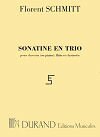
|
WW122: Sonatine en Trio Op. 85 for Flute, Clarinet in A and Harpsichord or Piano by Florent Schmitt. Durand, 1935, SS. This is one of the more popular pieces for this combination. It is in four movements: I. Assez animé, II. Assez vif, III. Très lent, and IV. Animé. The flute and clarinet parts generally move together in harmony. College level with a duration of 8-9 minutes. Here is a video of a performance.
|
41.95
|
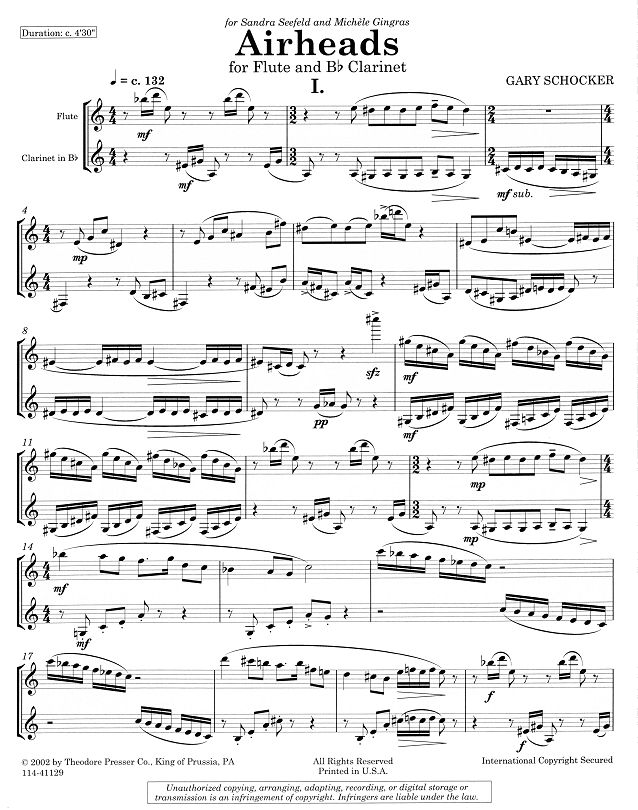 |
WW339: Airheads for Flute and B-flat Clarinet by Gary Schocker. Theodore Press Co., 2002, SS, 6 pages (2 copies in score format). This piece is in three short movements with a total duration of 4:30. College level. Here is a video performance of the entire piece. Click on the cover image to view the first page.
(Except other items with free shipping.) |
12.95
|
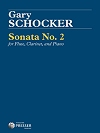
|
WW366: Sonata No. 2 for Flute, Clarinet and Piano by Gary Schocker. Theodore Presser Co., 2016, SS, includes parts and piano score. Commissioned by the Palisades Virtuosi, Gary Schocker’s Sonata No. 2 for Flute, Clarinet, and Piano is a formal work – perfect for recitals. The sonata is a joyous bridge fusing Schocker’s fondness for beauty and wit with all the architecture of traditional sonata construction. The opening movement, Flip, sets the stage with its quick interplay between the three performers, handing melodic elements back and forth among them. The middle movement, Old Flame, is a beautiful melancholic longing, while the finale, Fancypants, is a showcase of dynamic, rhythmic ensemble playing. College level with a duration of about 13 minutes. Click here for a video with highlights from this piece. Click on the cover image to view sample pages from the score. |
19.95
|
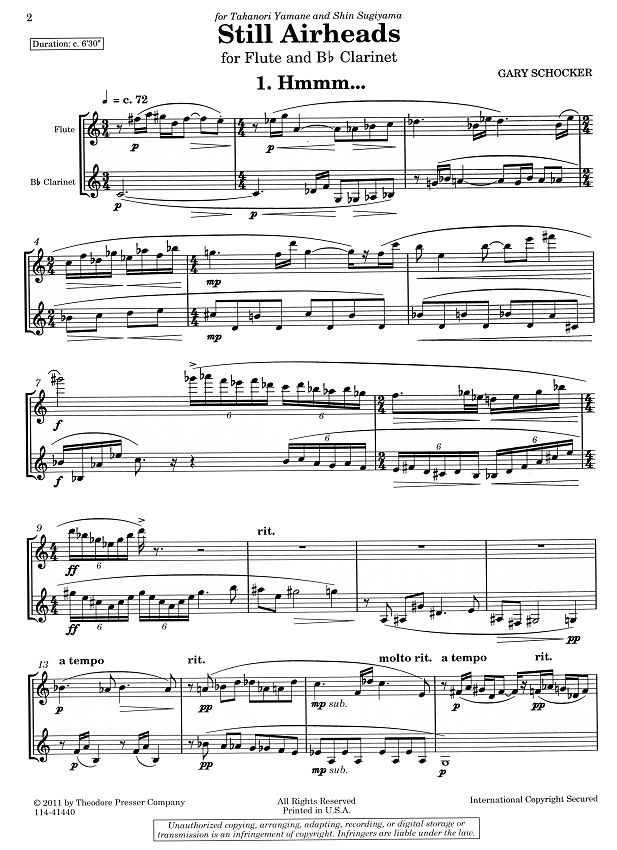 |
WW262: Still Airheads for Flute and B-flat Clarinet by Gary Schocker. Theodore Press Co., 2011, SS, 10 pages (score format). Following the success of the classic Airheads for flute and clarinet, Gary Schocker has provided a sequel, sporting the same lyricism, surprises, grace, and wit; teasing us with five evocatively named movements: “Hmmm...,” “Spritely,” “… While You Work,” “Brooding,” and “Royal Outing.” For advanced players, but the first two pieces are the most difficult. Duration of about 6:30. Click on the cover image to view the first page.
(Except other items with free shipping.) |
11.95
|
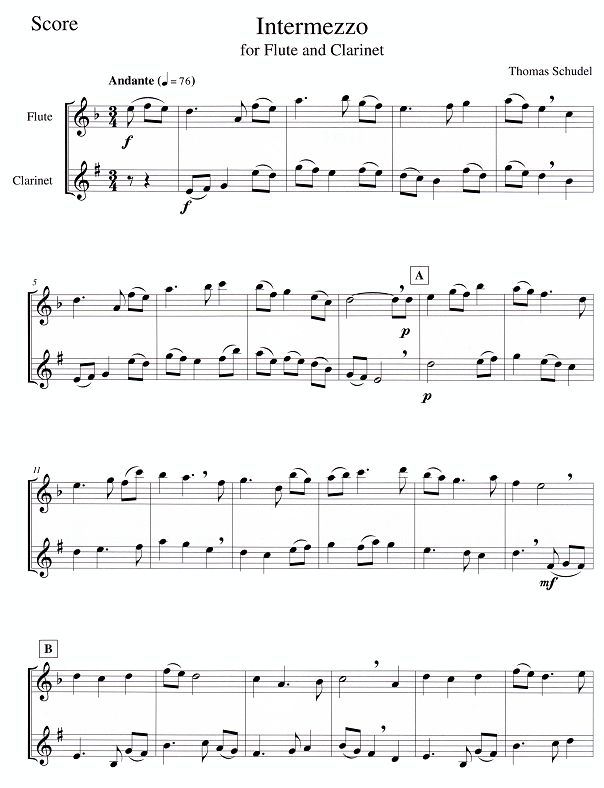 |
WW341: Intermezzo for Flute and Clarinet by Thomas Schudel. Alry Publications, 1988, SS, includes parts and score. This is a short piece at Andante tempo suitable for students at the early intermediate level. It is describe on the publishers website as "A brief conversation between the flute and clarinet with a simple melodic flow. Marvelous for showing contrast in timbre. Suitable for contests." Click on the cover image to view the first page of the two page score.
(Except other items with free shipping.) |
10.95
|
 |
F339: Piccolo Italiano (or me & my gold piccolo) for Piccolo and Piano by Gary Schocker. Presser, 2008, SS, 10 + 6 pages. This is a fun survey of Italian musical styles for the piccolo with piano accompaniment, penned by one of the most active and successful composers in flute music, Gary Schocker.In three movements: Fellini Was Here, Ricordarsi, and Polpettina. This piece is dedicated to Italian flutist and a Galway protégé Raffaele Travisani, whose gold piccolo inspired the piece, and also to Schocker's wife, pianist Paola Girardi. Each movement is challenging yet playful in nature, and piccolo players will be glad to have a chance to experience more of Schocker’s fine work. For advanced high school or early college level players. Duration about 6 minutes |
15.95
|
|
F397: Schubert Six Lieder for flute and piano arranged by Theobald Böhm edited by Georg Meerwein. Universal Edition, 1980, SS, 36 + 11 pages. These six songs were arranged for flute and piano by Böhm around 1870 and may not have all been published until this edition. The edition took Schubert's vocal compositions and made real flute pieces out of them. They are Gute Nacht, Der Lindebaum, Das Fischermädchen, Ständchen, Am Meer, and Die Taubenpost. The performer may benefit from a study of the original songs as well. There is variation in difficulty of these pieces from high school to college level. |
26.95
|
|
V001: The Sheperd on the Rock (Der Hirt auf dem Felsen) by Franz Schubert. G. Schirmer, SS. For high voice and piano with clarinet (flute or violin) obbligato. This edition has the original words and an English translation. |
4.95
|
 |
F349: Sonata in E-flat major D. 568 for Flute and Piano by Franz Schubert transcribed and edited by Robert Stallman. International Music, 2009, SS, 29 + 12 pages. This work has been transcribed from the Piano Sonata in E-flat major. The editor writes that this is "one of Schubert's most radiant and engaging depictions of springtime. With fresh melodic ideas and daring harmonic curiosity, the composer celebrates the season he loves, blending the sounds of nature with waltzes and Hungarian Gypsy music. Aside from a grief-laden Andante, the works reads like a daydream of blissful times." In four movements: I. Allegro moderato, II. Andante molto, III. Menuetto: Allegretto, and IV. Allegro moderato. Early college level. |
26.95
|
 |
F237: Variations on "Trockne Blumen"D. 802 for Flute and Piano by Franz Schubert edited by Klaus Burmeister. C.F. Peters, 2005, SS, 30 + 11 pages. This is a scholarly edition of this piece which was written by Schubert in January 1824 and is based on "Trockne Blumen," piece number 18 from his Die schöne Müllerin. The form is: Introduction, Theme, and Variations 1-7 (a discarded Variation 5 is also included). The publication includes a preface in German and English and notes on the editing in German. |
19.95
|
 |
F232: Winterreise for Flute and Piano by Franz Schubert arranged by Leopold Jansa edited by Elisabeth Weinzierl and Edmund Wächter. Zimmermann, 2005, SS, 46 + 19 pages. Jansa arranged Schubert's song cycle Winterreise D 911 (Op. 89) based on poems by Wilhelm Müller for violin or flute and piano at the same time borrowing from Liszt's arrangement of these songs. Jansa's work was first published around 1842. There are eight pieces which range in difficulty from high school to college level. |
31.95
|
 |
F172: Concerto for Flute (Piccolo) and Orchestra Piano Reduction by Gunther Schuller. Associated Music Publishers, 1998, SS, 34 + 9 pages. In three movements: Allegro, Lento-misterioso-quasi una fantasia, and Quasi presto. The first two movements are on flute. The performer switches to piccolo for the first two thirds of last movement, then back to flute for the rest except the last note which is on piccolo. This piece was composed as a 60th birthday for Walfrid Kujala and was premiered by him. The piece includes allusions to (but not quotations from) famous flute and piccolo passages in the orchestral literature. |
24.95
|
 |
F235: Robert Schumann: Scherzo from Symphony No. 2 in C Major arranged for 5 flutes by Trevor Wye. Zimmermann, 2005, SS, includes parts and score. This is for 3 flutes (2nd flute doubling piccolo), alto flute and bass flute with an optional part for double bass. College level. |
27.95
|
|
F353: Mikrokosmos Op. 90, 5 Pieces for 3 Flutes by Ivan Shekov. Zimmermann, 2008, SS, (includes parts and score). Ivan Shekov (1942-) was born in Bulgaria and studied music there. The first part of his career was as an international concert pianist. Since 1980 he has lived in Germany and worked as a composer, primarily of orchestral, vocal music, chamber music and works for young musicians. This work is from the last genre with the first part the most difficult (advanced intermediate) and the second and third parts less difficult (intermediate). The pieces are: 1. Promenade, 2. Undine, 3. Hektik (Hectic rush), 4. Dudelsack (Bagpipe), and 5. Walzer (Waltz). |
19.95
|
|
WW123: Four Waltzes for Flute, Clarinet, and Piano by Dmitri Shostakovich arranged by Levon Atovmian. Sikorski, 1958, SS, includes parts and piano score. A somewhat unusual arrangement in that the first waltz is for clarinet and piano and the second is for flute and piano with only the last two for all three instruments. The waltzes are I. Spring Waltz, II. Waltz Joke, III, Waltz, and IV. Barrel-Organ Waltz (piccolo instead of flute). Early college level.
|
33.95
|
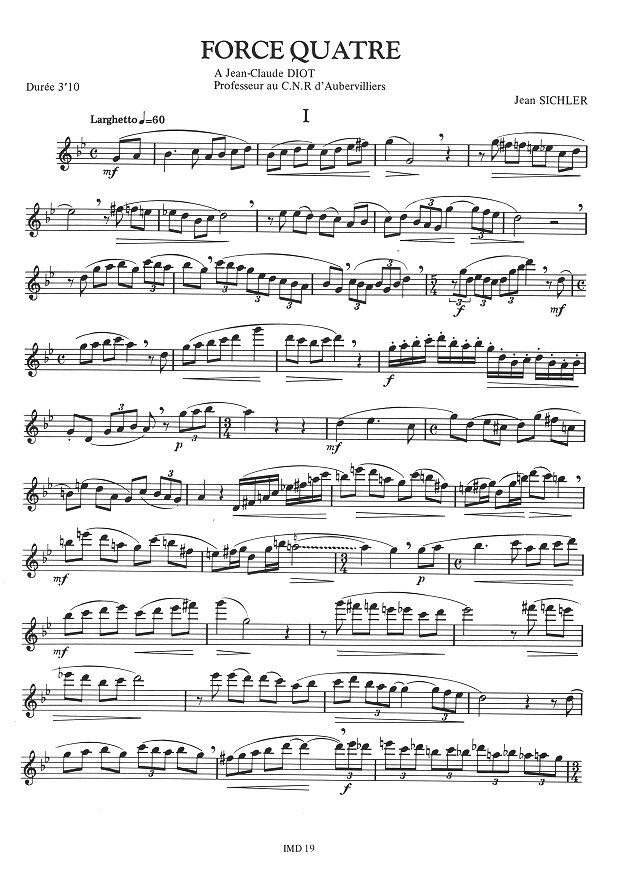
|
F274: Force Quatre for Solo Flute by Jean Sichler. International Music Diffusion, SS. 4 pages. This piece is in four movements (unusual in that it has 3 slow movements) : I. Larghetto, II Larghetto, III. Larghetto, and IV. Allegro. Better high school flutists and up. Overall duration of about 8:30. Click on the cover to see the first page. (Except other items with free shipping.) |
5.95
|
|
F375: Eros for Flute & Piano by Roberto Sierra. Subito, 1996, SS, 4 + 2 pages. This song of love (?) was written by the Puerto Rico-born composer Sierra in 1996. It is in two sections Travieso (mm=88) and Sensual (mm=54). College level.
(Except other items with free shipping.) |
7.95
|
 |
F074: Cadenzas for the Works for Solo Flute and Orchestra by Mozart by John Solum. McGinnis & Marx, 1964, 7 pages. Cadenzas for the Concerto in G Major K.313, the Concerto in D Major K.314, and Andante in C Major K.315. There are seven cadenzas in all.
(Except other items with free shipping.) |
3.50
|
|
F338: Duetto for 2 Flutes by Johann Matthias Sperger edited by Frank Nagel. Henrichshofen, 2008, SS, 10 pages. Johann Matthias Sperger (1750-1812) was an Austrian (born in what is now part of the Czech Republic) composer and double bass player. This duet is in score format. It has equal parts and is at the upper intermediate level. It is in two relatively long movements: Allegro moderato and Rondo, Allegretto.
(Except other items with free shipping.) |
12.95
|
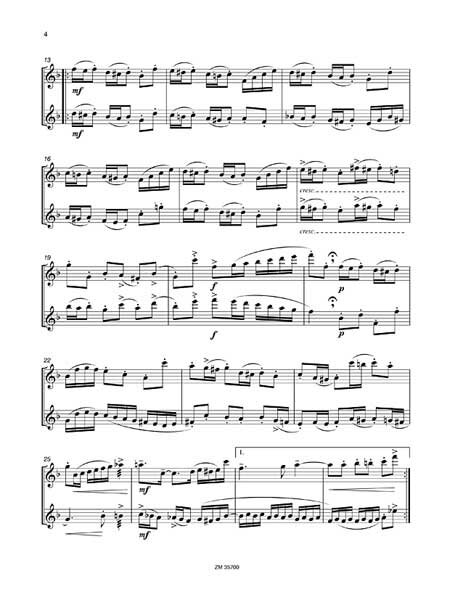 |
F395: Two Take It Easy (Einfach Zweifach) for 2 Flutes (or Piccolos) by Joanna Stepalska-Spix. Zimmermann, 2007, SS, 7 pages (score format). Despite the name these are not so easy and will take very good high school flutists (and up) to perform. The first duet is Duetto Lieto (glad, happy) and is at a Moderato temp. The second is Duetto Carino (pretty, nice). It is in 2/4 at mm=180 with a slower 6/8 section (at eighth note = 170) in the middle. Click on the cover image to view the second page of the music. (Except other items with free shipping.) |
12.95
|
|
WW133: Three Duets for Flute and Clarinet by Don Stewart. Trillenium Music, 1999, SS, 8 pages (two parts in score format). Don Stewart (1935-) is an American composer and woodwind performer. This piece was written in 1959 and is one of his earliest compositions. The first duet is a perfect canon but with contrasting sections. The second which the composer originally regarded as "flamenco" in derivation, alternates an intensive melody with a brittle rhythmic background. The third is short and formally simple but polytonal. Early college level. |
9.95
|
|
WW395: 15 Melodious Duets for Flute and Clarinet arranged by Carl Strommen. Almitra Music Inc./Kendor Music Inc., 2018, SS, 34 pages (score format). Featuring an array of 15 classics for grade 3-4 players, the music has been carefully chosen and edited to ensure that it is idiomatic for each pair of instruments. Therefore, one book will not be compatible with any other in the series. Contents: Scarlatti Capriccio; Swedish folk song Slangpolska; Mozart Rondo, March, and Allegro; Beethoven Bagatelle; Hook Sonatina; Kullak Cradle Song; Joplin The Ragtime Dance; Delibes Pizzicato Polka; Purcell Prelude; Bach Air From Suite No. 3 In D; Saint-Saens Dance; Bizet Selections From Carmen; Irish Double Jig Biddy Maloney. Click on the cover image to view the Table of Contents and a sample page. |
13.50
|
|
WW108: Duo for Flute and Clarinet by Antoni Szalowski. Chester, 1948, SS, 14 pages (now with 2 copies in score format). Szalowski (1907-1973) was a Polish born composer who studied in Warsaw and Paris (with Boulanger). While most of his work was written for strings it is his pieces for winds that are most popular today. He has been described as a neo-classicist, favoring established forms, clear musical content, and contrapuntal writing. This is one of the more popular (advanced college level) flute and clarinet duets. It is in three movements: I. Allegro, II. Andante, and III. Allegro. It is in score format and has been printed without regard for page turns, so some preparation will be required for performance. Duration is about 8 minutes. (Except other items with free shipping.) |
15.95
|
|
F426: Fuvolaverseny Concerto for Flute and Orchestra (Piano Reduction) by Endre Szervánszky. Editio Music Budapest, 1957, SS, 61 + 16 pages. Endre Szervánszky (1911-1977) was a Hungarian composer. Fuvolaverseny can be translated as flute competition. In three movements: I. Allegro, II. Andante sostenuto, and III. Presto. The duration is about 22 minutes. Here is a full performance of this work with piano. Sale Price, the regular price is $34.95. |
24.95
|
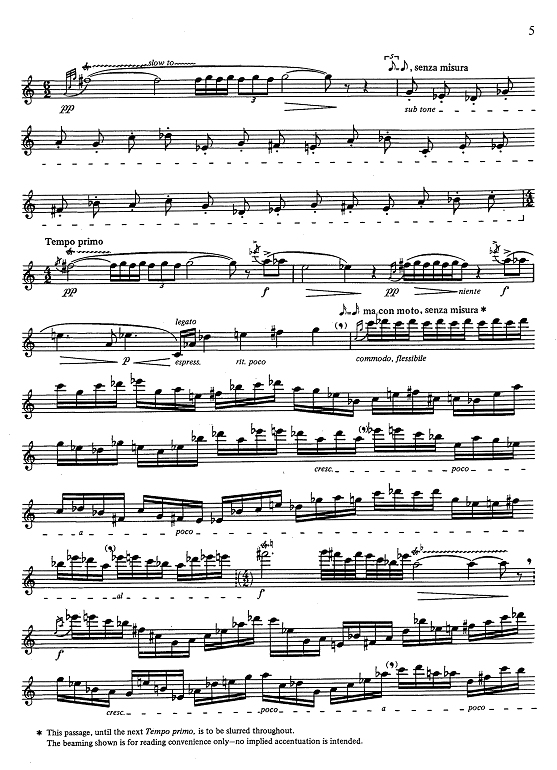
|
S1118: Windhover for solo Soprano Saxophone or Flute by Hilary Tann. Oxford University Press, 1992, SS, 5 pages. Hilary Tann (1947-) is a Welsh composer now based in the United States. This is an advanced, contemporary piece. The duration is about 6-8 minutes. The composer wrote: "Windhover is based on the idea of flight from a falcon’s point of view. Sections of slow soaring, where strength and detailed focus predominate, alternate with swifter sections, where the blurring of the rush of flight takes over." Here is an audio excerpt for flute which starts at the beginning. Click on the cover image to view a sample page. (Except other items with free shipping.) |
10.95
|
 |
F244: Pensamiento for Flute and Piano by Ivan Tcherepnin. M.P. Belaieff, 2005, SS. This brief (3 minute) piece was written in 1996 for Sue-Ellen Hershman-Tcherepmin and pianist David Witten as part of the US State Department's 40th Anniversary Celebration of the Fulbright program in Ecuador. The premier was given that year in Quito. The composer wrote, "Pensamiento is about uniting North and South. My love of the land of Ecuador and its people is reflected in the opening, which is a mini 'Condor Song.' After an encounter with the Eagle and ensuing conflicts and dramas, the Condor peacefully soars away above the high Andean peaks." (Except other items with free shipping.) |
11.95
|
|
F396: Concerto Polonoise D maj (TWV 51:D3) for Flute, 2 Violins, Viola and Basso continuo by Georg Philipp Telemann edited by Arndt Jubal Mehring. Zimmermann, 2009, SS, includes parts and score. The notes on the music say that this is the last unpublished concerto of 8 surviving written for this combination of instruments. The editor believes that it was written in the 1720s and that it was popular in its day as 7 manuscript copies exist. The name comes from the first movement (a tempo guisto) which has polonaise elements. The second movement is Allegro. There is a very brief Adagio which links to the last movement (Vivace). It is at the early college level and historic instruments would add to the performance. Notes on the editing are included. |
27.95
|
|
Ob154: Sonata for Oboe (Flute or Violin) and Basso continuo in E minor by Georg Philipp Telemann edited by Hugo Ruf. Schott, 1968, SS. Also known as Solo XI from "Essercizii Musici." This piece includes a fully realized Basso continuo (keyboard) part and part for cello (bassoon or viola da gamba). It is in four movements: I. Largo, II. Allegro, III. Grave, and IV. Vivace. College level. |
15.95
|
 |
F390: Trois Pastorales for 3 Flutes by Henri Tomasi. Alphonse Luduc, 1964, SS, includes score and parts. The 3 Pastorales are 1. Bolivienne, 2, Crétoise, and 3 Sicilienne. Early college level with a duration of about 8:30. |
22.25
|
 |
F371: Suite in A minor for Flute and Piano by Georg Philipp Telemann transcribed by John Wummer. Southern Music Co., 1951, SS, 23 + 10 pages. Originally for flute and strings. In seven numbered movements: I. Ouverture (Lento/Con moto/Lento), II. Les Plaisirs (Presto), III. Air à l'Italien (Largo/Allegro/Largo), IV Menuet, Menuet 2, V. Réjouissance (Presto), VI. Passepied 1 (Allegro), Passepied 2 (Allegro), VII. Polonaise (Moderato/Lento). The publisher rates this at (US) grade 3. It is certainly on the upper end of that, at least. |
9.95
|
 |
F258: Incandescence for Solo Flute by John Van Buren. Zimmermann, 2006, SS, 12 pages (including notes). John Van Buren (1952-) is an American who completed his musical studies in Germany and has continued to live and work there as a composer and lecturer. This work uses a number of extended techniques which are described in the notes (in German, English, and French). In the Preface, Van Buren writes: "In a figurative definition, the word incandescence connotes a high degree of emotion, intensity, brilliance or the like. The flute pursues this through three sections which are coupled with the three registers of the flute. Beginning in the lowest register the piece progresses ever higher culminating in an "incandescent" coda at the highest range of the instrument. (Except other items with free shipping.) |
14.95
|
|
WW218: Choros No. 2 for Flute and Clarinet in A by Heitor Villa-Lobos. Eschig, 1927, SS, 4 pages (two parts in score format). This is one of 14 numbered choros that Villa-Lobos wrote between 1920 and 1929 for a variety of instruments and combinations of instruments including orchestra. The tempo is Pouco movido (mm=88 with some slower spots). College level with a duration of about 2:30. (Except other items with free shipping.) |
13.95
|
|
F327: Concerto in G major RV 438 for Flute and Piano by Antonio Vivaldi edited by Jean-Pierre Rampal. International Music Co., 1975, SS, 12 + 4 pages. Originally for flute and orchestra. In three movements: Allegro, Andante, and Allegro. Advanced high school/early college level. |
14.75
|
|
Ob146: Sonata for Oboe (Flute, Violin) and Basso continuo in C minor RV 53 by Antonio Vivaldi edited by Helmut Schlövogt. Schott, 1951, SS. Includes fully realized basso continuo part for keyboard and part for cello or bassoon. In four movements: Adagio, Allegro, Andante, and Allegro. |
13.95
|
|
WW251: Waln Duets for Flute and Clarinet arranged by George Waln. Neil A Kjos Music Co., 1954, SS. Parts for flute and clarinet (no score). Sixteen duets from Mozart, Keller, Kummer, Mazas, Ferling, Berbiquier, W.F. Bach. Garibaldi, and Beethoven. A variety of difficulty levels from early to advanced high school. Adult players will also enjoy these duets. |
9.95
|
 |
WW266: Carmen Rhapsody Based on Themes from Bizet's Carmen for Flute, Clarinet in A and B-flat, and Piano by Michael Webster. International Music, 1997, SS. Mostly for A clarinet with a section in the middle for B-flat. Includes Prelude, Habanera, Chorus of the Street Boys, Seguidilla, Entr'acte, Toreador Song, and Gypsy Song (which may be performed as a separate piece). College level. |
37.75
|
 |
WW373: Magic Flute Fantasy, Based on Themes from Mozart's Die Zauberflöte for Flute/Piccolo, Clarinet in B-flat, and Piano by Michael Webster. Theodore Presser Co., 2016, SS, includes parts and piano score. In the spirit of the great 19th-century virtuoso fantasies on famous arias, Michael Webster has created a concert trio on the many great arias from Mozart's The Magic Flute, combining the most exciting and satisfying features of opera medleys and characteristic variations. Webster makes the most of the flute (doubling piccolo) and clarinet as versatile performers equally suited to deliver Mozart's beautiful vocal writing, and to ornament and embroider the themes in elegant Mozartean style. There is a spot for an optional clarinet Eingang for which the composer supplies an example. Duration about 19 minutes. For advanced performers. Here is a brief excerpt. |
29.95
|
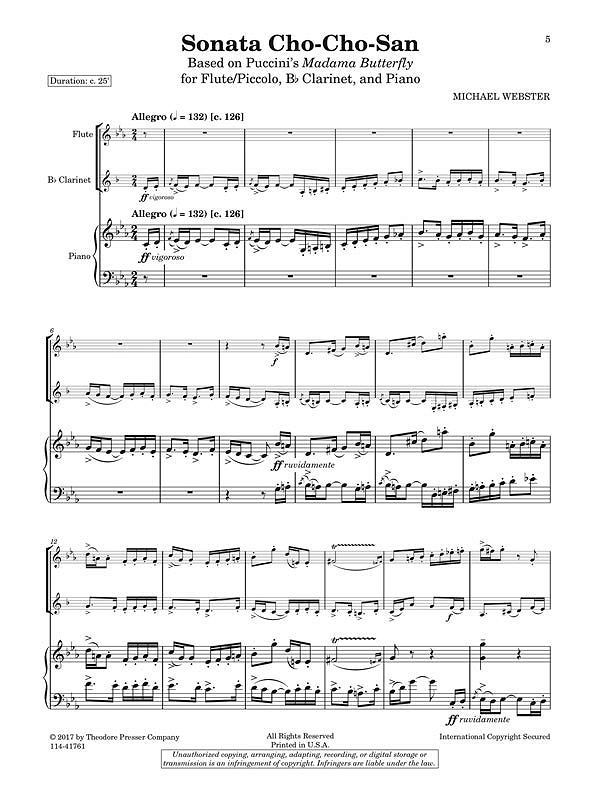 |
WW383: Sonata Cho-Cho-San (Based on Themes from Puccini's Madama Butterfly) for Flute/Piccolo, Clarinet in B-flat, and Piano by Michael Webster. Theodore Presser Co., 2017, SS, includes parts and piano score. Michael Webster has created a concert trio on the many great arias from Puccini's Madama Butterfly. However, as its name implies, Sonata Cho-Cho-San is not the typical virtuosic operatic potpourri. Rather, it follows the plot, resembling a sonata mirroring Puccini's use of recurring and developing themes. Webster makes the most of the winds as versatile performers - equally suited to deliver Puccini's beautiful vocal writing, and to ornament and embroider the poignant themes in symphonic style. For advanced performers. Duration about 24:30. Click on the cover image to view the first page of the score. |
38.95
|
|
WW259: Reversible Jackets (Exercises in Conjugal Counterpoint) for Flute and Clarinet by Dan Welcher. Elkan-Vogel/Presser, 1997, SS, 11 pages in score format. This piece was composed in 1987 for Leone Buyse and Michael Webster as a wedding present. The title refers to the fact that the musical lines are constantly being exchanged, inverted, expanded and contracted by both players. In three movements: 1. Canon (Breezy), 2. Dialogue (Freely; like an improvisation), and Fugue (Suddenly fast). Duration 6:00. (Except other items with free shipping.) |
15.95
|
|
F233: Sonate for Solo Flute Op. 34 by Arthur Willner. Zimmermann, 1926/2005, SS, 6 pages. Arthur Willner (1881-1959) was a Bohemian composer who studied in German. Worked in Germany and Austria and emigrated to England in 1938. This is regarded as an important work for solo flute which is chronologically between works by Karg-Elert and Hindemith. It is in three movements: I Lebhaft, II. Sehr langsam, and III. Schnell. It is an advanced work that was written for Ary van Leeuwen, a flutists with an international career who was from the Netherlands. (Except other items with free shipping.) |
13.95
|
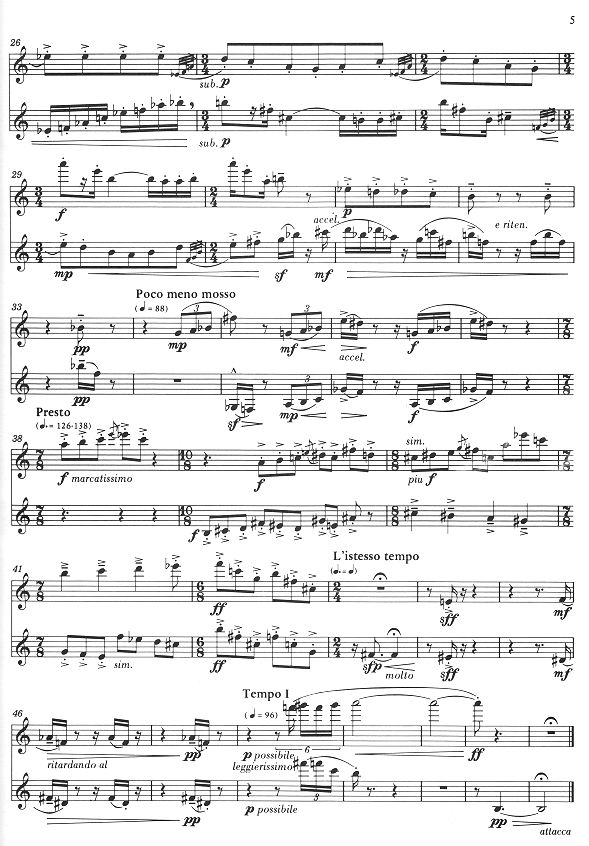
|
WW261: Serenade for Flute and Clarinet in B-flat by Jürg Wyttenbach. Schott, 1980, SS, 12 pages, score format. In four movements: I. Little March (in broken steps), II Duettino (in unequal voices), III. Waltz (in added values and Trio in false unison), and IV. Chase (in slow motion and accelerated). This is a relatively advanced work, suitable for upper division college recitals. Duration about 8 minutes. Click on the cover image to view the second page of the first movement. (The initial tempo on this page is mm=96.) (Except other items with free shipping.) |
18.95
|
|
F406: Simple Gifts for Flute and Piano arranged by Gregory Yasinitsky. Kendor Music, 2011, 3 + 1 pages. The well-known Shaker tune arranged for the early intermediate flutist. Range to E above the staff. The piano part is easy. Click on the cover image to view the first two pages of the score.
(Except other items with free shipping.) |
6.95
|
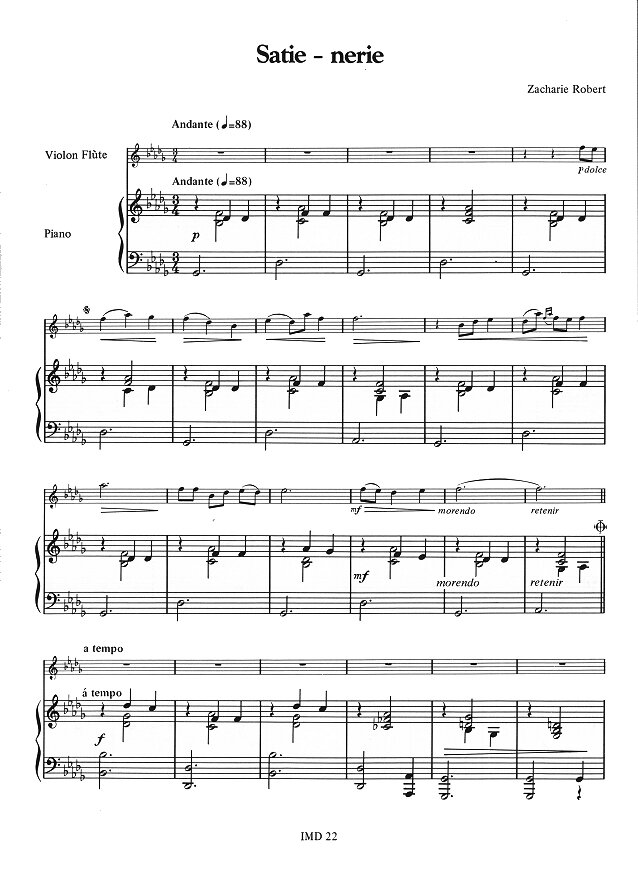
|
F275: Satie Nerie for Violin or Flute and Piano by Robert Zacharie. International Music Diffusion, SS, 4 + 1 pages. A one movement intermediate work at an Andante tempo. Click on the cover image to view the first page of the score.
(Except other items with free shipping.) |
5.95
|
|
F383: Trio con brio for 3 Flutes by Krzysztof Zgraja. Zimmermann, 2006, SS, includes parts and score. The Trio con brio originated from sketches for the 'Symphony for Tolerance' and is based on dance forms of the cante chico, quasi buleria in Flamenco music. This piece may also be used as accompaniment for a Flamenco dance. The meter alternates between 6/8 and 3/4 every bar. College level.
(Except other items with free shipping.) |
19.50
|
|
F393: 5 Songs without Words for Flute Quartet by Felix Mendelssohn Bartholdy arranged by Gottfried Stein. Zimmermann, 2008, SS, includes parts and score. The arranger has selected five of Mendelssohn's songs without words that he believes work best for winds and arranged them for two flutes, alto flute, and bass flute (with an optional cello part as an alternative). The are I. Op. 30 No. 2 Allegro di molto, II. Op. 61 No. 1 Andante espressivo, III. Op. 85 No. 2 Allegro agitato, IV. Op. 67 No. 5 Moderato, and V. Op. 102 No. 3 Presto. Early college level and also suitable for many adult amateur ensembles. |
27.95
|
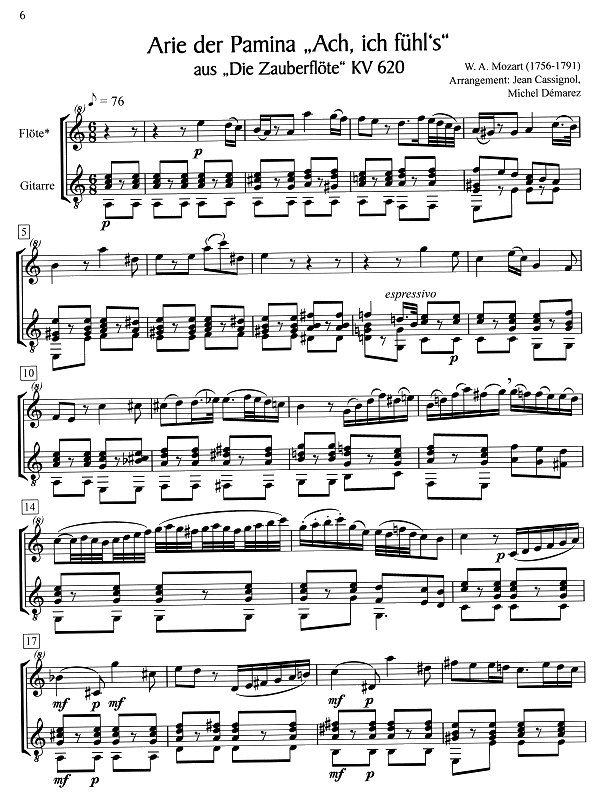
|
F427: 6 Duets from Vivaldi to Elgar for flute (or recorder) and guitar arranged by Jean Cassignol and Michel Demarez. Heinrichshofen & Noetzel, 2015, SS, 14 pages (score format). Finding classical works for flute and guitar is often not easy. Jean Cassignol and Michel Démarez have chosen six works from different eras and adapted them to the playing possibilities of the two instruments. Among them are works by Vivaldi Larghetto aus dem Konzert für Flautino RV 312R, Mozart (Aria of the Pamina "Oh, I feel it"), Schubert Nacht und Träume D 827, Chopin Valse Nr. 17, Fauré (Après un rêve) and Elgar Chanson de Matin Op. 15 Nr. 2. Click on the cover image to view a sample page. (Except other items with free shipping.) |
14.95
|
|
WW406: 12 Duos “Classique” for flute and clarinet edited by Michel Nowak. Andel, SS, 24 pages. Intermediate flute and clarinet duets in score format. Contents: Mozart Mon coeur soupire Extrait des Noces de Figaro, Czibulka Songe D'Amour Apres le Bal - Intermezzo, Johann Strauss Le Beau Danuble Bleu, Schubert March Militaire, traditional Santa Lucia, traditional Le Carnaval de Venise, Schubert La Truite, Chopin Tristesse, Weber Invitation a la Valse, Rameau Tambourin, traditional Schwarze Augen - Les Yeux Noirs (Dark Eyes), and Liszt Rȇve D'Amour. Click on the cover image to view a sample page. |
21.95
|
|
F374: 24 Short Concert Pieces for Flute and Piano edited by Robert Cavally. Southern Music Co., 1941/1969, SS, 96 + 40 pages. Here are 24 solos with piano accompaniment ranging in length from one half to four pages (in the flute parts) with most two or three pages long. There is some range of difficulty but they are generally at the advanced high school/early college level. Joachim Andersen The Mill from Op. 55 No. 4 and Scherzino from Op. 55 No. 6, Johann Sebastian Bach 3 movements from Suite in B Minor, Georges Bizet 2nd Menuet from L'Arlesienne, Rene de Boisdeffre Orientale Op. 31, Leo Delibes Waltz of the Flowers, Johannes Donjon Pan (Pastorale) and Offertoire Op. 12, Gabriel Faure Sicilienne from Pelleas et Melisande, Benjamin Godard Idyl and Allegretto from Op. 116, Christoph Willibald Gluck Minuet and Dance of the Blessed Spirits, Georges Hue Serenade, Victorin Joncieres Hungarian Serenade, Jules Massenet Melodie - Elegie Op. 10, Wilhlm Bernhard Molique Andante from Concerto Concerto in d minor Op. 69, Wolfgang Amadeus Mozart Adagio Religioso (2nd movement of the Clarinet Concerto K. 622), A. Perilhou Ballade, Emile Pessard Andalouse, Johann Joachim Quantz Arioso and Presto, and Franz Schubert Ave Maria. This edition is no longer available because of the closing of Southern Music Co. which is being sold. Check back in mid-June for more information. We also have a book of supplementary Preparatory Etudes to help students prepare these pieces. |
24.95
|
 |
WW017: 78 Duets for Flute and Clarinet Vol. 1 (1-55) Easy-Medium by Himie Voxman. Rubank, 1960, SS, 72 pages. Adapted from the works of the Bachs, the Mozarts, Boismortier, Dietter, Handel and others.
WW018: 78 Duets for Flute and Clarinet Vol. 2 (56-78) Advanced by Himie Voxman. Rubank, 1960, SS, 72 pages. Adapted from the works of Bach, Mozart, Geminiani, Muffat, Quantz, Rameau, and C. Stamitz. |
Vol. 1
9.95
Vol. 2 |
|
F108: The Andersen Collection by Joachim Andersen selected and introduced by Paula Robison. European American Music Corp., 1994. SS, 44 + 23 pages. Pieces for flute and piano by the famed flute virtuoso, composer and conductor. They are Sox Morceaux de Salon Op. 24, Impromptu Op. 7, Elegie Op. 55 No. 1 and Die Blumen Op. 56 No. 2. There is a significant range of difficulty in these pieces with the easiest accessible to second or third year students (with a good range) while the most difficult would require four or more years of study. |
14.95
|
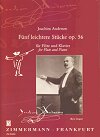
|
F234: Joachim Andersen: Fünf leichtere Stücke (Five Light Pieces) Op. 56 for Flute and Piano edited by Kyle Dzapo. Zimmermann, 2005, SS, 19 + 6 pages. These five pieces by Danish flutist and composer Andersen (1847-1909) were first published in 1894. They are Im Herbst, Die Blumen, Unterm Balkon, Abenlied, and Aus vergangenen Zeiten (Intermezzo). Im Herbst (In Autumn) and Abenlied (Evening Song) are considered two of Andersen's most beautiful simple compositions. The pieces range in difficulty from easy intermediate to advanced intermediate. |
23.95
|
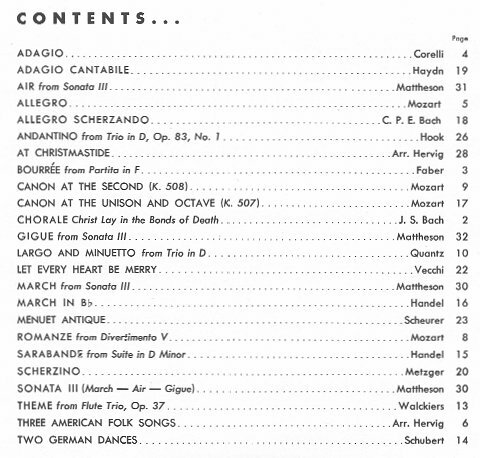
|
F105: Chamber Music for Three Flutes (Easy to Medium) by Himie Voxman. Rubank, 1952, SS, 32 pages. This book contains 24 trios for flute drawn from the work of Corelli, Haydn, Mozart, Bach, Handel, and others. They are probably most suitable for students in their third year of study. With one or two exceptions the parts are of equal difficulty. Click on the cover image to view Table of Contents. |
5.95
|
 |
F409: Christmas Lites for Flute and Piano, 10 Carols Arranged in a Jazz Style arranged by Lennie Niehaus. Kendor Music, 2012, SS, 35 + 10 pages. Featuring 10 Christmas favorites arranged in jazz styles, the selections in this grade 3-4 collection can be played individually or in combination as a jazz suite. The pieces are: Jingle Bells; We Three Kings; It Came Upon A Midnight Clear; Joy To The World; Silent Night; Away In A Manger; O Come, All Ye Faithful; God Rest Ye Merry, Gentlemen; Good King Wenceslas; and Angels We Have Heard On High. Click on the cover image to view the first two pages of the score of Jingle Bells. |
13.50
|
|
F228: Classic Duets for Flute selected and introduced by Mary Karen Clardy. Universal Edition, 1997, SS, 83 pages in score format. This collection of flute duets includes by Handel, Bach, and Haydn (an arrangement) and from the opera repertoire Mozart The Abduction from the Seraglio, The Marriage of Figaro, and the Magic Flute; and from Rossini The Barber of Seville. They are generally at the advanced high school/early college level. SALE: $3.00 off the current list price. |
21.95
|
|
F229: Classic Duets Volume 2 for Flute selected and introduced by Mary Karen Clardy. Universal Edition, 2005, SS, 88 pages in score format. Includes Telemann Sonata I in G Major Op. 5 and Sonata III in D Major Op. 5; Quantz Duetto I in G Major Op. 2 and Duetto II in A Minor Op. 2; W.F. Bach Duetto II in G Major and Duetto IV in F Major; Devienne Grazioso Con Variazione; and Kohler (all from Op. 55) Duet 20 in C Major (after Mozart's "Vivat, Bacchus, Bacchus lebe" from The Abduction from the Seraglio), Duet 24 in Bb major (after Bellini), Duet 3 in Bb Major (after Spohr), and Duet 14 in G Minor. They are generally at the advanced high school/early college level although there are few that are easier that what is in the first volume. SALE: $3.00 off the list price. |
29.95
|
|
WW380: Classical FlexTrios for Woodwinds arranged by Andrew Balent. Almitra Music/Kendor Music, 2017, SS, 10 pages (x 4). This flexible (US) grade 3 collection contains five well-known classical and traditional pieces that can be played by any combination of 3 woodwind instruments. Contents: Trumpet Voluntary (Clark), Turkish March (Beethoven), Greensleeves, March Of The Priests (Mozart) and Hungarian Dance No. 5 (Brahms). In score format for C, B-flat, E-flat and bass clef instruments. Click on the cover image to view the table of contents and a sample page from one book. |
13.50
|
|
G307: Come Down, O Love Divine; Six Pieces for Solo Instrument and Organ by Charles Callahan. MorningStar Music Publishers, 2016, SS, 54 pages (total). Charles Callahan (1951-) is an American composer, organist, choral conductor, pianist, and teacher. A useful collection of settings of six hymns, arranged for organ and solo instrument. The collection includes parts for a variety of instruments including Flute, Oboe, Clarinet, Trumpet, and Violin. Contents: Come Down, O Love Divine; Let Us Break Bread Together; The Lord's my Shepherd; O God, Beyond All Praising; Will You Come and Follow Me; and Remember the Poor. The instrumental parts call for high school level skills and the organ part does not look difficult. Click on the cover image to view sample pages and the Table of Contents which shows the instrumental parts available for each piece. |
24.95
|
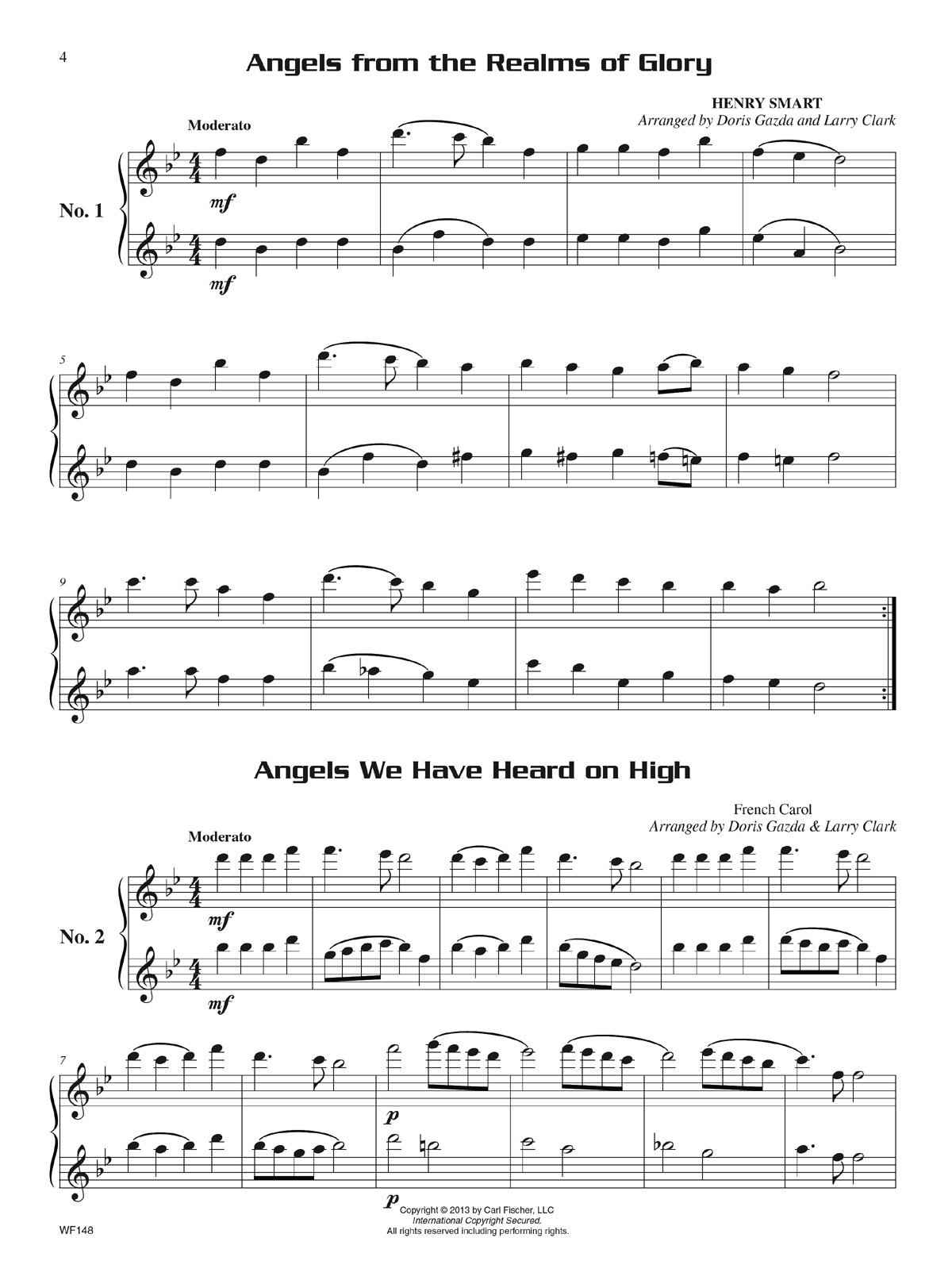
|
G250: Compatible Christmas Duets for Winds for Flute and/or Oboe arranged by Doris Gazda and Larry Clark. Carl Fischer, 2013, SS, 45 pages in score format. The intention of Compatible Christmas Duets is to provide instrument players the opportunity to play fifty popular Christmas carols in arrangements for two instruments. These duets will work with any combination of any two instruments, so you can play carols with your friends no matter what instrument they play. There are endless possibilities for using duet combinations for fun and entertainment around the holidays. You can play for family, friends, or in a concert setting. We have editions for instruments in B-flat, E-flat and bass clef and can order the versions for Horn in F and Tuba if requested. Click on the cover image to view a sample page from this book. |
12.95
|
 |
G314: Compatible Duets for Winds Vol. II for Flute arranged or composed by Larry Clark. Carl Fischer, 2017, SS, 48 pages. Continuing with the success of the popular Compatible series, Compatible Duets for Winds Volume 2 contains 29 duets in a variety of styles that can be played with any combination of two wind instruments. Students can develop their chamber-ensemble skills while playing with their friends, no matter what wind instruments they play. Typical difficulty (US) grade 3. Click on the cover image to view the Table of Contents and a sample page. |
12.95
|
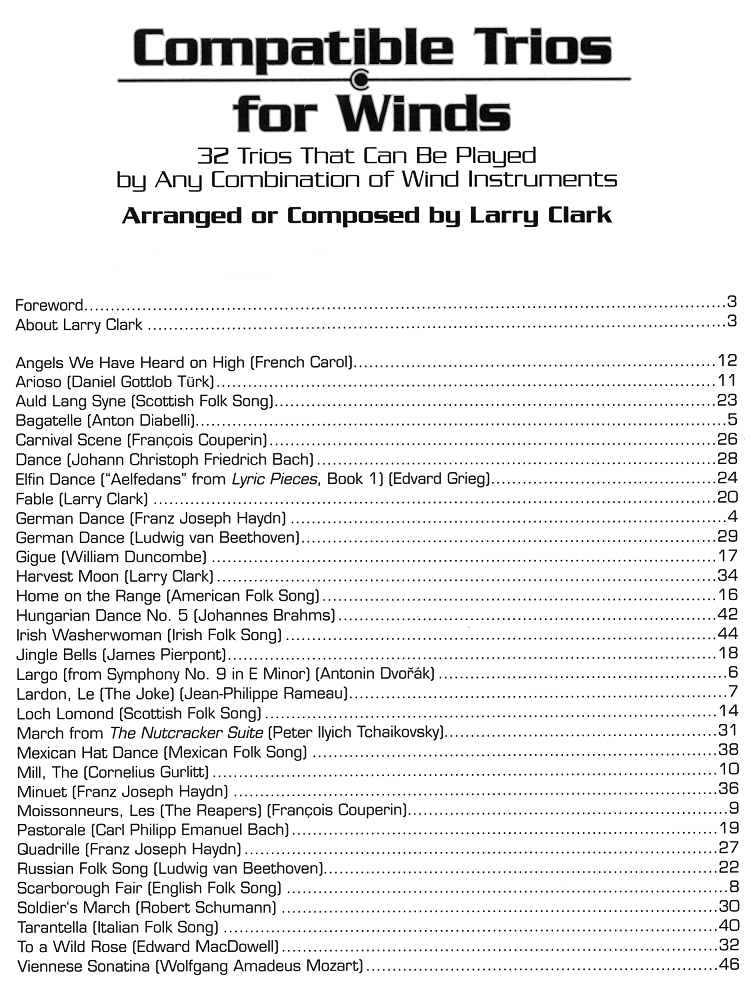
|
WW288: Compatible Trios for Winds for Flute and/or Oboe arranged or composed by Larry Clark. Carl Fischer, 2012, SS, 45 pages in score format. This collection contains 32 trios in a variety of styles from classical to folk, and includes some new original works as well. Each piece is playable by any combination of three wind instruments. Compatible Trios for Winds is especially useful in a school setting. Generally at an early intermediate level. Includes tunes such as The Irish Washerwoman, Brahms’ Hungarian Dance No. 5, MacDowell's To a Wild Rose, and more. Click on the cover image to view the Table of Contents. |
11.95
|
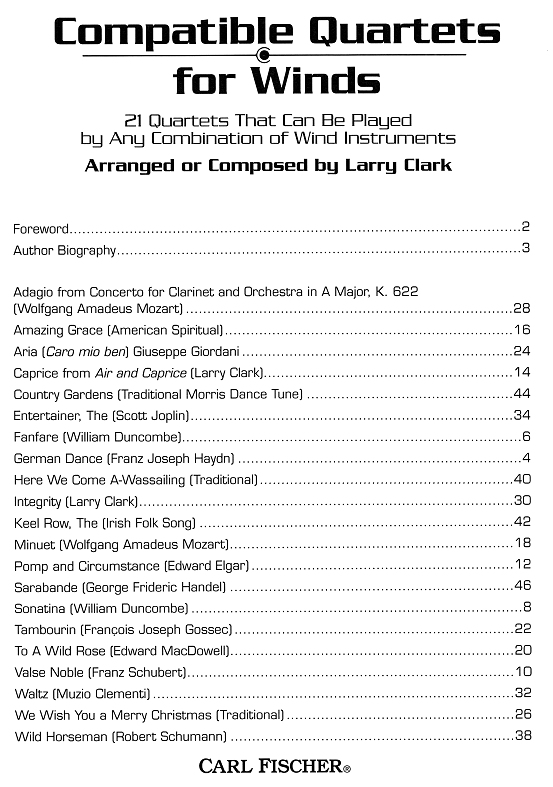
|
G277: Compatible Quartets for Winds for Flute and/or Oboe arranged or composed by Larry Clark. Carl Fischer, 2014, SS, 45 pages in score format. The Compatible Ensemble Series allows chamber groups to play together, no matter the instrumentation or who wants to play melody. This collection contains 21 quartets for wind instruments in a variety of styles from classical, to folk, to original compositions, giving players the opportunity to mix-and-match instrumentation. Includes works by by William Duncombe, Larry Clark, Muzio Clementi, Edward Elgar, Giuseppe Giordani, Francois-Joseph Gossec, George Frideric Handel, Franz Joseph Haydn, Scott Joplin, Edward A. MacDowell, Wolfgang Amadeus Mozart, Franz Schubert, and Robert Schumann. They are presented in order of difficulty from easy to medium level. Click on the cover image to view the Table of Contents. |
16.95
|
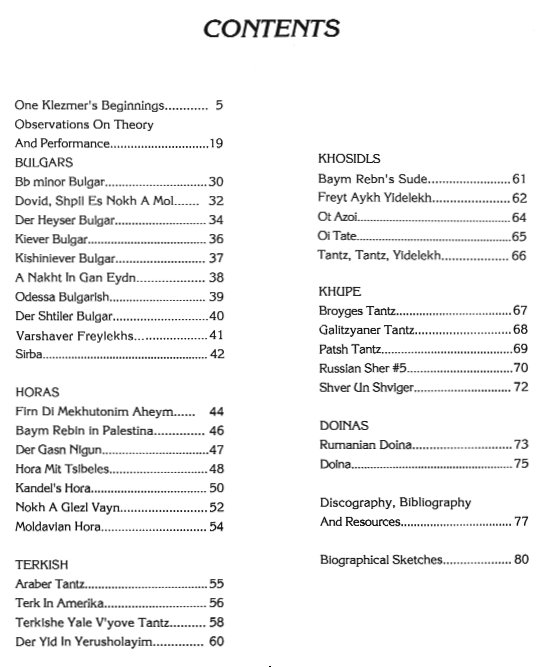
|
G062: The Compleat Klezmer by Henry Sapoznik. Tara Publications, 1987, PB, 80 pages. This book is the definitive Klezmer anthology. It includes a short history of klezmer music, notes and observations on the theory and performance of klezmer music, 33 annotated melodies, a discography and bibliography, resources, and more. Click on the cover image to view the Table of Contents. Use your browser's Back button to return. |
19.95
|
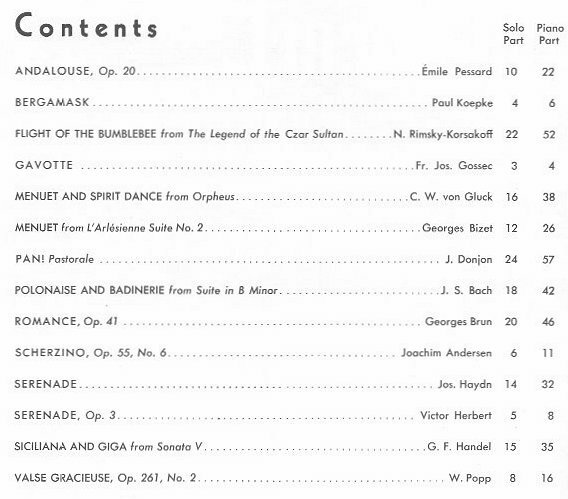
|
F103: Concert and Contest Collection for Flute Flute Part by Himie Voxman. Rubank, 1949, SS, 24 pages. This book contains 14 familiar works for flute and piano. There are pieces here for third and fourth year students and beyond. Click on the cover image to view the Table of Contents. Use your browser's Back button to return. F104: Concert and Contest Collection for Flute Piano Accompaniment by Himie Voxman. Rubank, 1949, SS, 59 pages. Piano accompaniment to F103. |
F103:
4.95
F104: |
 |
WW034: Duos Concertants for Flute or Oboe and Clarinet 1st Series compiled, transcribed, and revised by Albert J. Andraud. Southern Music Company, 1935, SS, 23 pages (one copy). All duets are in score format. This book contains six duets from the works of Bach, three from Handel and three from Mozart. For good high school players or better. WW035: Duos Concertants for Flute or Oboe and Clarinet 2nd Series compiled, transcribed, and revised by Albert J. Andraud. Southern Music Company, 1946, SS, 40 pages (two copies). This book has two duos concertants by G. Kummer (not in score format, all the rest are), and Symphony Concertante by Mozart KV 364 for violin, viola and orchestra or piano (accompaniment not included) transcribed, and shorter works by Bach, Handel, and Krebs. Some of the material in this book is more difficult than the first book. WW036: Duos Concertants for Flute or Oboe and Clarinet 3rd Series compiled, transcribed, and revised by Albert J. Andraud. Southern Music Company, 1946, SS, 40 pages (two copies). This book has three duos concertants by J.B. Gambaro (not in score format, all the rest are), 12 duets for 2 basset horns by Mozart (not transposed), an extended duet by J. Sellner, and shorter works by Bach, Handel, Lacome, and Rameu. A mix of difficulty levels similar to the second book. |
Series 1 12.95
Series 2 Series 329.95 28.95
|
|
F149: Easy Classics for Flute selected and arranged by Peter Spitzer with piano accompaniments by Jannette Spitzer and Laura Spitzer. Mel Bay, SS, 1997, 39 + 31 pages. This book of easy classical pieces may be used solo or duet playing with or without piano accompaniment. There are books for clarinet, flute, alto sax, tenor sax, trumpet, and they may be used together. The level is generally second year and third year with a few pieces that reach F above the staff. Includes arrangements of pieces such as Hungarian Dance #5, Radetzky March, William Tell Overture, Sleeping Beauty Waltz, and 12 more. Click on the cover image to view the Table of Contents. Use your browser's Back button to return. |
7.95
|
 |
G060: Easy Klezmer Tunes by Stacy Phillips. Mel Bay, PB, 2003, 129 pages + CD. This book is for musicians who are new to klezmer but are reasonably proficient. There are 24 tunes (each with a brief explanation) grouped as Khosid'ls and other slowish tunes, Horas, and Freylakhs, Bulgars, and other up-tempo tunes. The book includes melody parts for C instruments (with parts for flute up an octave), b-flat, e-flat, and bass clef instruments. The included CD has each tune played as written and again with some traditional klezmer embellishments. |
24.95
|
 |
F145: Encores for Flute and Piano II by Dieter Förster. Edition Kunzelmann, SS, 2004, 32 + 12 pages. German title: "BIS" Zugaben für Flöte und Klavier II. Eight encores for flute and piano at the intermediate and slightly higher level. Charpentier Prelude from "Te Deum," Bach/Gounod Ave Maria, Bizet Habanera from Carmen, Beethoven für Elise, Boccherini Minuetto, Grieg Sunshine Song (Solvejg's Lied), Mozart Turkish March, and Schumann Reveries (Träumerei). |
24.25
|
|
F112: Expressive Etudes ~ for the Flute compiled and edited by Laura Barron. Carl Fischer, 2003, SS, 39 pages + CD. Laura Baron has selected nineteen gems of substantial musical merit from the thousands of etudes available. She feels that each work lends itself to expressive interpretation and can be studied and performed as concert pieces. The etudes are by Boehm, Karg-Elert, Fürstenau,, Andersen, Soussmann, Altès, Kohler, Demerssman, Prill, and Taffanel. The book includes performance suggestions and the CD has a recording of each etude. Click on the cover image to view the list of works. Use your browser's Back button to return. |
20.95
|
|
F264: Family Festivities at the Hissbooms' (Familienfest bei Zischrumms) Eight Short Pieces Using New Playing Techniques for 1-4 Flutes by Rainer Pezolt. Zimmermann, 2006, SS, 17 pages. These eight short pieces are intended to introduce some easy extended techniques to beginning and intermediate flutists. We suspect some of these would be a big hit at a studio recital.
(Except other items with free shipping.) |
14.95
|
|
F410: Festive Flute Duets (Christmas) arranged by Andrew Balent. Kendor Music, 2012, SS, 16 pages (score format). This collection of ten grade 4 Christmas duets will brighten any holiday program. Contents: Jingle Bells; Hark! The Herald Angels Sing; Angels We Have Heard On High; O Come, All Ye Faithful; The First Noel; What Child Is This?; Joy To The World; It Came Upon The Midnight Clear; Silent Night; and We Wish You A Merry Christmas. Click on the cover image to view the first page. |
10.95
|
|
F328: Folk Songs & Dances from the Balkans Flute Edition by Costel Puscoiu. Mel Bay, 2008, SS, 24 pages + CD. This is a collection of 63 representative well-known and lesser-known beautiful melodies from the Balkans. The carefully chosen the melodies offer a rich, enjoyable and varied book. The arrangements and other adaptations (keys, ornaments, etc.) have been introduced to make this beautiful South-Eastern European music more suitable for performance on the flute. The booklet comes with a CD of a performance of each piece and the piano accompaniment can be downloaded from the publisher's web site. |
14.95
|
|
F155: Flute Methods, Studies and Ensembles. CD Sheet Music, 2006. Version 2.0 including notes from the 1911 Grove's Dictionary on many of the composers. This CD contains more than 1800 pages of methods, studies and ensembles (mostly the latter two). It includes works from the following and more: Altès, W.F. Bach, Andersen, Gariboldi, Hughes, Karg-Elert, Köhler, Reichert, de la Barre, Beethoven, Berbiguier, Boismortier, Bordet, Briccialdi, Chinzer/Bordet, Devienne, Dietter, Finger, Fürstenau, Gariboldi, Hotteterre, Hugot/Wunderlich, Koechlin, Köhler, Kuhlau, Kummer, di Lasso, Legoux/Bordet, Le Loup, Loeillet, Mozart, Müller, Naudot, Quantz, Reicha, Soussmann, Stamitz, Sweelinck, Telemann, Tulou. Click on the cover for a full listing of the contents. Use your browser's Back button to return. |
19.95
|
|
F156: Flute Solos. CD Sheet Music, 2006. Version 2.0 includes biographical information from the 1911 Grove's Dictionary. This CD contains more than 2000 pages of flute solos with piano accompaniment. Composers included are: Adam, Andersen, CPE Bach, JC Bach, JCF Bach, JS Bach, Barrère, Beethoven, Bizet, Blavet, Booth, Boulanger, Briccialdi, Burgmüller, Busoni, Caix d'Hervelois, Catherine, Daquin, Debussy, Donjon, Doppler, Duvernoy, Enesco, Fauré, Foote, Gabriel-Marie, Ganne, Gluck, Godard, Gossec, Graupner, Grétry, Griffes, Hahn, Handel, Hotteterre, Hullmandel, Kirchhoff, Köhler, Krieger, Kuhlau, Kuhnau, Latour, Locatelli, Loeillet, Lully, Maganini, Marais, Marcello, Massenet, Matheson, Mendelssohn, Molique, Moszkowski, Mouquet, Mozart, Müthel, Offenbach, Pergolesi, Pessard, Popp, Quantz, Rameau, Reger, Reinecke, Rheinberger, Rietz, Rimsky-Korsakov, Sacchini, Saint-Saens, A. Scarlatti, Schers, Schubert, Schumann, Taffanel, Telemann, Tosti, Verdi, Vivaldi, and Weber. Second edition with composer biographies and related articles from the 1911 edition of Grove's. Click on the cover for a full listing of the contents. Use your browser's Back button to return. |
19.95
|
|
F215: Flute Solos with Piano Accompaniment Easy Level edited by Himie Voxman and others. Rubank, SS, 30 + 15 pages. This collection includes 13 solos (with accompaniment) from the Rubank solo sheet music library. Handel Bouree & Menuet and Petite Gavotte, Andersen Elegie, Gretchaninoff First Waltz; Gluck Gavotte from Don Juan and Spirit Dance from Orpheus, Hurrell The Lonely Birch Tree, Mozart Menuett Paysanne, Schubert Round Dance, Hauser Song Without Words Op. 37 No. 1, Miaskovsky and Goedicke Two Russian Songs, and Hinkson Valse Petite. This is music for the mid-first year through second year student. |
7.95
|
|
F216: Flute Solos with Piano Accompaniment Intermediate Level edited by Himie Voxman and others. Rubank, SS, 31 + 12 pages. This collection includes 11 solos (with accompaniment) from the Rubank solo sheet music library. Wagner Albumleaf, Bertoni Canzona, Koepke Chanson Pastorale and Villanella, Mozart Eine Kleine Nachtmusik, Prokofieff Gavotta from Classical Symphony, Rameau Menuet from Platee, Borodin Polovetsian Dances fro Prince Igor, Schumann Slumber Song, Rimsky-Korsakov Song of India fro Sadko, and J.S. Bach Two Menuettos from the Flute Sonata in C. For second and third year students. |
7.95
|
 |
G035: The French Noel - With an Anthology of 1725 Arranged for Flute Duet by Betty Bang Mather & Gail Gavin. Indiana University Press, 1996, PB, 120 pages. French noels unite sacred and profane texts, music, and dance as performed from the late Middle Ages through the Baroque. Part I of The French Noel discusses the history and uses of the form, suggests appropriate dance steps, and examines its musical and poetic style. Part II consists of 16 Christmas songs first published in 1725. Betty Bang Mather and Gail Gavin have transcribed these charming pieces with lyrics of the period so that they may be either sung or played. The volume is enhanced by several facsimile pages from the original publication and reproductions of contemporaneous paintings showing noels being performed. |
22.95
|
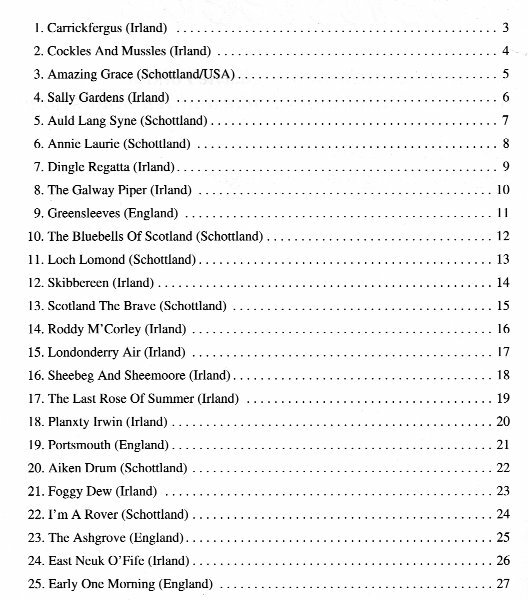
|
F206: Greensleeves for 2 flutes arranged by Sieglinde Heilig and Uwe Heger. Noetzel Edition, 2005, SS 27 pages. These are arrangements of familiar Irish, Scottish, and English folk songs for flute or recorder duet. It includes favorites such as Amazing Grace, Greensleeves, The Bluebells of Scotland, Londonderry Air, and many more. Intermediate level in score format. Click on the cover for a full listing of the contents. Use your browser's Back button to return. |
12.95
|
 |
F106: Music of Paul Hindemith, Paula Robison Flute Masterclass by Paula Robison. Schott, 1996, SS, 76 pages + CD. This maser class includes 8 pieces for Solo Flute, Sonatine in Canon Style, Sonata for Flute and Piano, Echo and Sing on There in the Swamp. The parts have been annotated in red by the author. This book also includes biographical information on Hindemith, photographs, and charming illustrations taken from his drawings. The accompanying CD is a performance of the Sonata for Flute and Piano by Paula Robison with Jong Hwa Park, piano. |
24.95
|
|
G254: Improvising and Soloing In the Pocket for C Instruments by Richie Cannata and Sean J. Kennedy. Carl Fischer, 2013. SS 32 pages + CD. This book contains 9 original play-along leadsheets (in the styles of Rock, Samba, Bossa Nova, Funk, and Ballads) with melodies and chords. It has music theory and background on each tune. The CD includes .wmv video of a discussion of the compositions and play-along tracks in .mp3 format. For upper intermediate through advanced players. |
14.95
|
|
F035: The Irish Flute by Roger Holtmann. Mel Bay Publications, Inc. SS. 63 + 32 pages. Fifty-five delightful flute solos with easy piano accompaniment. Each arrangement includes chords for guitar. In the beginning of the accompaniment book there are examples of guitar strum patterns for the various types of Irish tunes in both pick style and finger style. Titles include: A Visit to Ireland, Ballahaboy Fair, Bridget McBride, Captain O'Neill, Comely Jane Downing, Crossing the Stream, Fare You Well, For Ireland I'd Not Tell Her Name, Garryowen, Green garters, Kelly the Rake, Kiss Your Partner, Kitty of Coleraine, Larry O'Gaff, Mary's Return, Miss Johnson, My Love is Fair and Handsome, Nora O'Neill, O'Donnell Aboo, Shule Aroon, Tady's Wattle, and many more. |
10.95
|
|
F200: James Galway's Christmas Album arranged and edited by David Overton and James Galway. Presser, 2005, SS. This book contains 13 Christmas tunes that have been recorded by Sir James. For flute and piano. This music includes some optional second flute parts and a snare drum part for Il est Né. The pieces included are: Ding Dong Merrily on High (2nd flute), Silent Night(2nd flute), Il est Né, Lo How a Rose E'er Blooming, Pastoral Symphony (from "Messiah"), O Jesulein Süss, O Tannenbaum (2nd flute), O du Fröhliche, Noël Nouvelet, El noi de la Mare, Deck the Halls (2nd flute), Grand Fantasia on "I Saw Three Ships," and In Dulci Jubilo. |
19.95
|
|
F187: Jazzy Duets 2 Flutes by James Rae. Universal Edition, 1991, 11 pages. This book has five original duets in score format. While intended for young players (about third year or fourth year or so), they could also benefit more experience players who haven't been exposed to jazz. |
14.95
|
|
WW046: Jazzy Duets Flute & Clarinet by James Rae. Universal Edition, 1991, 11 pages. This book has five original duets in score format. They are intended for young players (about third or fourth year or so). |
15.95
|
|
WW254: Kalinka & Katiusha and Other Famous Russian Songs for Flute and Clarinet traditional. EditionDarok, 2011, SS, 30 pages (score format). Fifteen Russian folk songs at the intermediate level but with a range of difficulty. Includes: Do Not Scold Me, The Silver Birch, Kalinka, The Light, My Heart, Behind the Walls, Poliushko-Pole, Moscow Nights, Stenka Razin, Snow Flurries & Troika Rushing, Song of the Volga Boatmen, In the Valley & the Slender, Katiusha, Along the Peterskaya Road, and Folk Song. |
16.95
|
|
F189: The Mary Karen Clardy Flute Etudes Book selected and introduced by Mary Karen Clardy. European American Music Corporation, 1995, PB, 90 pages. There are 51 etudes in this book in all keys (major and minor), organized by the circle of fifths. The etudes are from Bach, Karg-Elert, Köhler, Donjon, Andesen, Boehm, Schade, and Fürstenau. The editor has provided some suggestions for the performance of each etude and identified the origin. The book also includes basic scales and arpeggios. This book is being using for the 2015-16 Texas All State auditions for flute and piccolo. |
22.95
|
|
F386: Repertoire Classics for Flute, 36 Repertoire Pieces with Piano Accompaniment compiled and edited by Donald Peck. Carl Fischer, 2010, SS, 48 pages + CD with piano accompaniments as MP3 audio files (playable on a computer or player for MP3 files) and printable PDF files. A collection of some familiar classics in transcription and solos written specifically for the flute at US grades 2 through 4. Johann Sebastian Bach Arioso (Largo from Concerto for Harpsichord and String Orchestra) and Siciliano (from Sonata No. 2 In E flat Major); Ludwig van Beethoven Minuet and Serenade; Georges Bizet Minuet from L'Arlesienne and Entr'acte from Carmen; Carl Bohm Calm as the Night (Still wie die Nacht); Johannes Brahms Waltz; Andre Caplet Petite Valse and Reverie; Arcangelo Corelli Gigue; Claude Debussy Reverie; Joannes Donjon Adagio Nobile and Pan! (Pastorale for Flute); Gabriel Faure Berceuse and Sicilienne (from Pelleas et Melisande); Christoph Willibald Gluck Minuet and Dance of the Blessed Spirits from Orfeo; Benjamin Godard Allegretto; Francois Joseph Gossec Gavotte and Tambourin; Charles Gounod Meditation on Prelude no. 1 of Bach; George Frideric Handel Bourree and Giga from Sonata in F Major; Franz Joseph Haydn Serenade (Andante Cantabile from String Quartet No. 8); Benedetto Marcello Sonata in F Major; Wolfgang Amadeus Mozart Adagio from Flute Quartet; Sergei Rachmaninoff Vocalise; Camille Saint-Saëns Pavane and The Swan (Le Cygne) from Carnival of the Animals; Eric Satie Gymnopedie No. 2 from Trois Gymnopedies; Franz Schubert Musical Moment (from 6 Moments musicaux) and Trockne Blumen (Ihr Blumlein alle) from Die schöne Mullerin; Robert Schumann Romance and Traumerei from Scenes from Childhood; Peter Ilyich Tchaikovsky June (Barcarolle) from The Seasons; and Georg Philipp Telemann Minuet from Suite in A minor. |
12.95
|
|
F343: Melodies of Japan for Flute and Piano arranged by Teruyuki Noda. Zen-On Music, 1978/1990, PB, 82 + 26 pages. This book contains 14 songs (the original versions had lyrics) arranged for flute and piano. They are: Tamezo Narita Hamabe-nouta (Song of the Seashore), Teiichi Okano Oboro-zukiyo, Tadasuke Ono Yoimachigusa, Ryutaro Herota Shikararete, Kosaku Yamada arr. Chūgoku-chihō-no-komori-uta (Lullaby from the Chugoku Area), Haseo Sugiyama Hanayome-ningyō, Tei Yanada Jōgashima-no ame (Rain Falls on Jogashima), Toraji Ohnaka Yashi-no-mi, Minoru Kainuma Sato-no-aki (Autumn in a Village), Kosaku Yamada Aka-tombo (Red Dragonfly), traditional Itsuki-no-komoriuta (Lullaby in the Kyushu District), Nagayo Motoori Akai-kutsu, traditional Tōryanse, and Shin Kusakawa Yūyake-koyake. In the back of the book there is a one or two line description of the meaning of each song. Intermediate to advanced level. You can listen to the beginning of each song on this web site. |
39.95
|
|
F365: Moonlight Album of Popular Pieces for Flute and Piano. Muzyka Moscow, 2009, PB/SS, 51 + 16 pages. This book has 11 classical pieces generally at the upper intermediate level with a few that are a bit more difficult. They are: Gluck Melodie (flute solo from the opera Orphée), Mozart Rondo Alla Turca, Schubert Moment Musical, Chopin Nocturne, Brahms Hungarian Dance (No. 5), Bizet Entr'acte to Act 3 of Carmen, Dvorak Humoresque, Debussy Clair de Lune, Tchaikovsky Song Without Words (Op. 2, No. 3), Rimsky-Korsakov Song on the Indian Guest from the opera Sadko, and Rachmaninov Polka Italienne. |
17.95
|
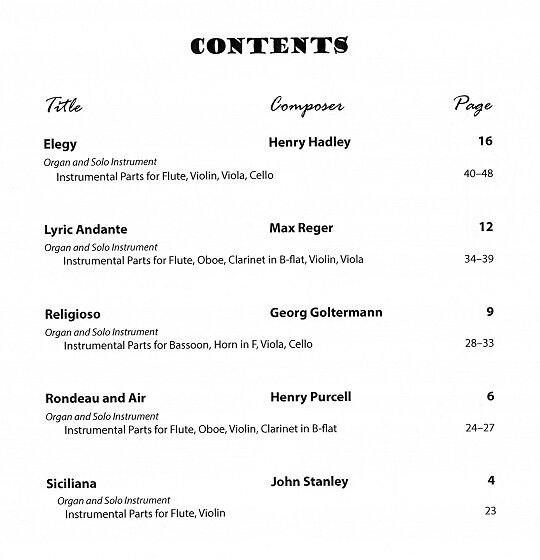
|
G243: Organ Plus! Volume 4, Five Pieces for Organ and One Instrument edited by Charles Callahan. MorningStar Music Publishers, 2013, SS, 45 pages (total). The fourth volume of this popular and practical series contains five pieces for organ and a solo instrument. The pieces with flute parts are marked Fl. Contents: Henry Hadley Elegy [Fl], Max Reger Lyric Andante [Fl], Georg Goltermann Religioso, Henry Purcell Rondeau and Air [Fl], and John Stanley Siciliana [Fl]. The instruments vary throughout and include Flute, Oboe, Violin, Viola, Clarinet, Bassoon, Cello, and Horn. The instrumental parts call for high school level skills and the organ part does not look difficult. Click on the cover image to view the Table of Contents which shows the instrumental parts available for each piece. |
20.95
|
 |
F170: Sacred Solos for Flute with Piano Accompaniment compiled, arranged, and edited by Clair W. Johnson. Rubank, 1960, SS, 48 + 15 pages. Felix Borowski Adoration, Georges Bizet Agnus Dei, Wolfgang A. Mozart Alleluia (from Exultate Jubilate), Bach-Gounod Ave Maria, Franz Schubert Ave Maria, Paul Rodney Calvary, Stephen Adams The Holy City, Felix Mendelssohn If With All Your Hearts (from Elijah), Jules Massenet Meditation, Cesar Franck Panis Angelicus (O Lord Most Holy), Ethelbert Nevin The Rosary, and G. F. Handel Where E'er You Walk (from Semele). |
7.95
|
|
F159: Selected Duets for Flute Vol. 1 Easy-Medium compiled and edited by Himie Voxman. Rubank, 1955, SS. 72 pages. Selected from the work of Devienne, Corrette, Boismortier, Aubert, Kummer, Berbiguier, Handel, Haydn, Purcell, Telemann, Quantz, and many more. Equal parts. F160: Selected Duets for Flute Vol. 2 Advanced compiled and edited by Himie Voxman. Rubank, 19557, SS. 72 pages. Selected from the work of Beethoven, Haydn, Bach, Devieence, Furstenau, Teleman, Mozart and many more. Equal parts. |
Vol. 1
9.95
Vol. 2 |
|
WW72: Six Ragtimes for flute or clarinet or bassoon and piano by Scott Joplin edited by Dieter H. Förster. Kunzelmann, 1979, with play-along CD. Six familiar Joplin rags: Original Rags, Elite Synchopations, The Entertainer, The Favorite, The Chrysanthemum, and The Ragtime Dance. Includes a CD of the piano accompaniment. |
24.95
|
|
F249: The Solo Flute, A Collection Volume I Baroque edited by Mirjam Nastasi. C.F. Peters, 1991, 70 pages. A collection of solo flute music from the Baroque period by Marin Marais, Jacques Hotteterre, Joseph Bodin de Boismortier, Michel Blavet, Jean Daniel Braun, Antoine Mahaut, Georg Philipp Telemann, Johann Sebastian Bach, Sebastian Bodinus, Johann Joachim Quantz, Carl Philipp Emanuel Bach, and Charles Delusse. Click on the cover image to view the Table of Contents. Use your browser's Back button to return. |
29.95
|
|
F250: The Solo Flute, A Collection Volume II Classical edited by Mirjam Nastasi. C.F. Peters, 1992, 83 pages. A collection of solo flute music from the Clasical period by Franz Anton Hoffmeister, Johann Georg Tromlitz, Carl Kreith, Anton Stamitz, Georg Abraham Schneider, Johann Georg Wunderlich, August Eberhard Müller, Franz Weiß, Andre Traeg, Anton Stadler, Anton Heberle, Thomas Lindsay, Raphael Dressler, Friedrich Kuhlau, Charles Keller, Benoit Tr. Berbiguier, Johann Georg Wunderlich, Michel Joseph Gebauer, and Franz Leister. Click on the cover image to view the Table of Contents. Use your browser's Back button to return. |
29.95
|
|
F251: The Solo Flute, A Collection Volume III Romantic edited by Mirjam Nastasi. C.F. Peters, 1993, 81 pages. A collection of solo flute music from the Romantic period Louis Drouet, Jean Louis Tulou, Friedrich Kuhlau, Johann Wilh. Gabrielsky, Charles Keller, Anton B. Fürstenau, Kaspar Kummer, Saverio Mercadante, Giulio Briccialdi, Emanuele Krakamp, Giuseppe Gariboldi, Jean Donjon, and Ernesto Köhler. Click on the cover image to view the Table of Contents. Use your browser's Back button to return. |
29.95
|
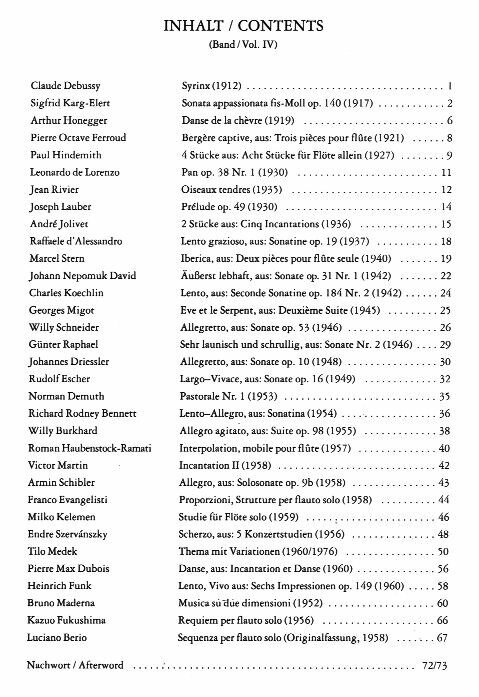
|
F245: The Solo Flute, A Collection Volume IV Modern edited by Mirjam Nastasi. C.F. Peters, 2006, 73 pages. An amazing collection of music for the solo flute from 1912 (Syrinx) to 1960. It includes the Berio Sequenza and many other significant works from many composers (such as Karg-Elert, Honegger, Hindemith, Richard Rodney Bennett, Pierre Max Dubois, etc.) and originally published by a variety of publishers. Click on the cover image to view the Table of Contents. Use your browser's Back button to return. |
31.95
|
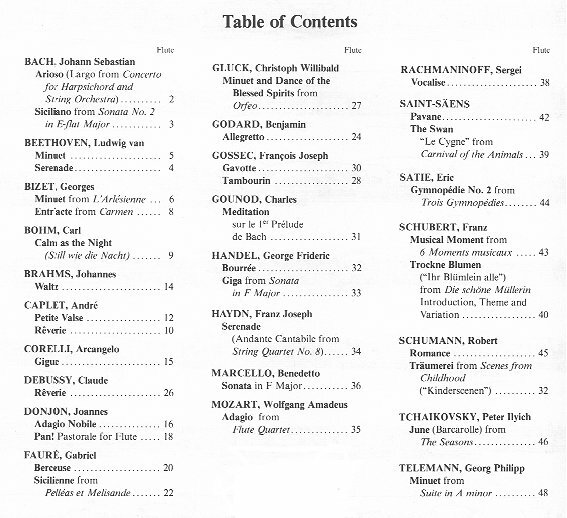
|
F113: Solos for Flute, 36 Repertoire Pieces with Piano Accompaniment compiled and edited by Donald Peck. Carl Fischer, 1984, PB, 135 + 48 pages. This book contains many works for the flute plus transcriptions of familiar classics. It includes pieces by Bach, Beethoven, Bizet, Brahms, Corelli, Debussy, Gluck, Gounod, Handle, Satie, Schumann and many others. Click on the cover image to view the Table of Contents. Use your browser's Back button to return. |
21.95
|
|
F154: Solo Pieces for the Advanced Flutist (with Piano Accompaniment) compiled and arranged by Dona Gillam & Mizzy McCaskill.. Mel Bay, 1995, SS, 48 + 16 pages + CD. A repertoire collection and piano accompaniment CD for the more advanced flutist. Keyboard accompaniment is included to diverse works such as Diversions on a Prelude (a jazz rendition of Bach’s famous Prelude I from The Well Tempered Clavier), Fauré’s Fantaisie for Flute and Piano, and Sonata in E flat (BWV 1031) by J.S. Bach. Also included is the popular Fantasia No. 2 in A minor for solo flute by Telemann. The CD contains the piano accompaniment for all pieces (except the Telemann) for performance and Diversions and Fantaisie have additional subdivided tracks for practice purposes. |
14.95
|
|
F150: Solo Pieces for the Beginning Flutist (with Piano Accompaniment) compiled and arranged by Mizzy McCaskill & Dona Gillam. Mel Bay, 1984, SS, 32 + 16 pages + audio access. Includes familiar pieces by Beethoven, Bach, Correlli, Mozart, and more. Includes access to online audio of the piano accompaniment. Click on the cover image to view Table of Contents. Use your browser's Back button to return. |
14.95
|
|
F151: Solo Pieces for the Intermediate Flutist (with Piano Accompaniment) compiled and arranged by Dona Gillam & Mizzy McCaskill. Mel Bay, 1993, SS, 38 + 16 pages + audio access. Includes fewer, but more extended pieces than the beginning book in this series. Composers include Bizet, Gluck, Handel, Mozart and more. Includes access to online audio of the piano accompaniment. Click on the cover image to view Table of Contents. Use your browser's Back button to return. |
17.95
|
|
F199: Solos for Jazz Flute transcribed by Bob Afifi. Carl Fischer, 1993, SS, 59 pages. In addition to the note for note transcriptions of these famous solos, this book contains examples which highlight the style of each player, a discography, and a three page catalogue of phrases on V-I and II-V-I progressions. The solos are: Buddy Collette Room with Skies, Eric Dolphy South Street Exit, Joe Farrell Spain, Paul Horn Dida', Hubert Laws Airegin, Herbie Mann Beautiful Love, James Moody Feelin' Low, Sam Most The Eyes Have It, James Newton Richmond in Acropolis, Jeremy Steig Oleo, and Dave Valentin Footprints. |
12.50
|
|
F205: Street Music for 2 (Straßenmusik à 2) (Volume 1) by Uwe Heger. Noetzel Edition, 2005, SS, 24 pages. This book is labeled for two flutes or recorders but it could be used by any treble clef instruments in the same key. Original music which captures the sounds that might be heard in a cosmopolitan city in Europe. Includes 22 pieces in klezmer, blues, ragtime, latin and folk styles. Intermediate level in score format. F310: Street Music for 2 (Straßenmusik à 2) Volume 2 by Uwe Heger. Noetzel Edition, 2006, SS, 32 pages. Similar to the first book, this one has 23 pieces and, as the page count indicates, they are somewhat longer. |
Vol 1 12.9512.95 Vol. 2
|
|
F207: Street Music for 3 (Straßenmusik à 3) by Uwe Heger. Noetzel Edition, 2003, SS 52 pages. For three flutes or recorders but it could be used by other treble clef instruments in the same key (some of the first parts range up to F above the staff). Original music which captures the sounds that might be heard in a cosmopolitan city in Europe. Includes 25 pieces in klezmer, blues, ragtime, latin and folk styles. Intermediate level in score format. |
18.75
|
|
F243: Time Pieces for the Flute Volume 1 selected and arranged by Ian Denley. ABRSM, 2006, SS, 31 + 12 pages plus SmartMusic® play along CD. An Associated Board of the Royal Schools of Music Publication. Twenty-three short, easy pieces for beginning students (probably about second year) with piano accompaniment from circa 1500 to 1961. A Rose there bloomed, Thomas Attwood Andante from Sonatina No. 3, Saint-Saëns Aquarium from The Carnival of the Animals, Humperdinck Brother come and dance with me from Hansel und Gretel, Brahms Cradle Song, O’Carolan Dermot O’Dowd, Anthony Hedges Father Time - Chronos from Masquerade, Carl Reinecke Gavotte from Five Serenades for the Young, William Boyce Heart of Oak, Rameau Menuet en rondeau, J. S. Bach Menuet in G, Kabalevsky Prelude, Op. 61 No. 1, Böhm Rigaudon, E Horák Scherzino from Kinder-Klavierschule, Robert Schumann Soldiers’ March from Album for the Young, Walton The Music Lesson from Music for Children, Book 1, The Rakes o’ Mallow, Lehár Vilia from The Merry Widow, Smetana Vltava from Ma Vlast, Franz Schubert Waltz No. 16 from D. 146, H. Purcell With drooping wings from Dido and Aeneas, Lutoslawski Zalotny (Kitten-like) from Popular Melodies. Includes SmartMusic CD-ROM providing intelligent accompaniments for five pieces from the book |
12.95
|
|
F315: Time Pieces for the Flute Volume 2 selected and arranged by Ian Denley. ABRSM, 1998, SS, 29 + 12 pages plus SmartMusic® play along CD. An Associated Board of the Royal Schools of Music Publication. Eighteen early intermediate and intermediate level pieces (ABRSM Grades 2-3) with piano accompaniment from 1547 to 1965. Pierre Attaingnant Que je chatoulle ta fossette from Danseries 2nd series, Claudio Monteverdi Kyrie Eleison, Louis Couperin Menuet, John Barrett The Catherine-A Country Dance, George Frideric Handel Air HWV 425, Wolfgang Amadeus Mozart Allegretto K. 33b and Variation VI from Serenade K. 361, James Hook The Lass of Richmond Hill, Ludwig van Beethoven (attrib.) Moderato from Sonatina in G, Franz Schubert Marche Militaire D. 733 No. 1 and Sentimental Waltz No. 5 D. 779, Hector Berlioz Villanelle from Les Nuits d’Eté, Pyotr Tchaikovsky Song without words Op. 40 No. 6, Emmanuel Chabrier España, Giacomo Puccini Are they gone now? from La Boheme, Jean Sibelius The Peace of Evening from Pelléas et Mélisande, Maurice Ravel Prélude, and Dmitri Shostakovich Hurdy-Gurdy from Dances of the Dolls. Includes SmartMusic CD-ROM providing intelligent accompaniments for four pieces from the book (with the rest available through a discounted subscription). |
12.95
|
|
F316: Time Pieces for the Flute Volume 3 selected and arranged by Ian Denley. ABRSM, 1998, SS, 31 + 11 pages plus SmartMusic® play along CD. An Associated Board of the Royal Schools of Music Publication. Eleven intermediate level pieces (ABRSM Grades 4-5) with piano accompaniment from 1772 to 1945. Johann Sebastian Bach Prelude in E Major BWV 853 from The Well-Tempered Clavier Part I, Jean-Philippe Rameau Tambourin from Pieces de clavecin, Wolfgang Amadeus Mozart Allegro from Sonata No. 3 in A K. 12, Maria Theresia von Paradis Sicilienne, Modest Musorgsky Ein Kinderscherz, Charles Gounod Entrée des jeunes Nubiennes from Faust, Edward Elgar Bavarian Dance Op. 27 No. 1, Serge Prokofiev Gavotte, from the Classical Symphony Op. 25, Igor Stravinsky Sinfonia from Pulcinella, Benjamin Britten Fishing Song from Friday Afternoons Op. 7, and Lennox Berkeley Prelude No. 6 from Six Preludes Op. 23. Includes SmartMusic CD-ROM providing intelligent accompaniments for three pieces from the book (with the rest available through a discounted subscription). |
12.95
|
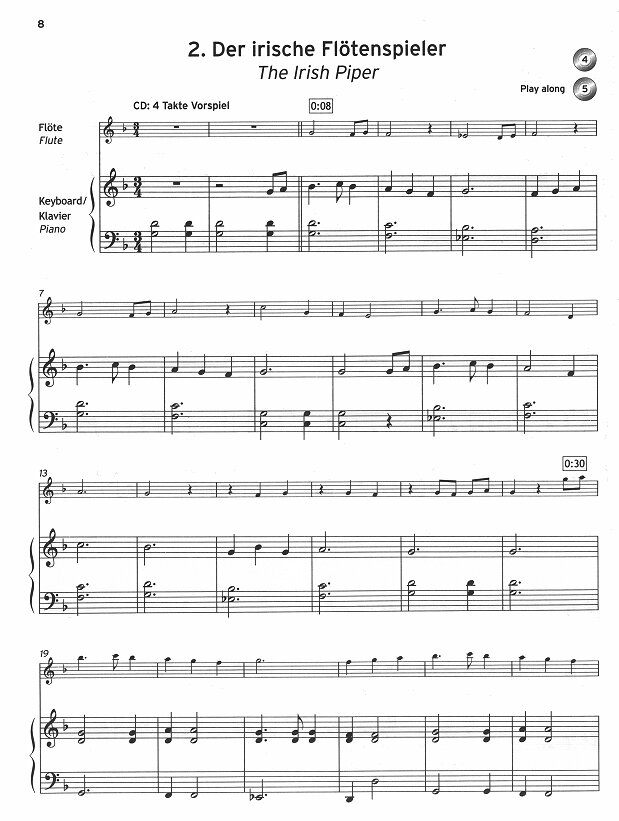
|
F394: Travelling with the Flute (Mit der Flöte unterwegs) for Flute and Piano by Martin Maria Schulte. Zimmermann, 2008, SS, 18 + 6 pages. + CD. This music, which is intended for students (probably from about 6-18 months of study), has pieces based on locations you might visit or how you feel as your travel: 1. Rainy Summerday / Sommerrentag, 2. Der irische Flötenspieler / The Irish Piper, 3. China, 4. Heimweh / Homesick, 5. Paris, 6. Afrika / Africa, 7. Finnisches Wiegenlied / Finnish Lullaby, 8. New Orleans, 9. Western, and 10. Back Again / Heimkehr. The CD has tracks with performances by the composer and background tracks alone. Click on the cover image to view a sample page from the score. |
24.50
|
|
F240: Variations on Well-Known Tunes Book 2 edited by Gerhard Braun. Heinrichshofen, 2005. SS, 40 pages. For solo flute. This is a collection of theme and variations drawn from both opera and folk songs. There are notes on the composers of the variations in German, English, and French. The pieces are: Arietta (Caspar Füstenau), La Biondina (Venetian folksong, variations: Etienne-Francois Gebauer), Duetto "Nel cor più non mi sento" (Giovanni Paisiello, variations: Gottlieb Heinrich Köhler), Arietta "Freut euch des Lebens" (folksong, variations: Gottlieb Heinrich Köhler), O mein lieber Augustin (folksong, variations: Gottlieb Heinrich Köhler), Ein freies Leben führen wir (Gaudeamus igitur) (folksong, variations: Franz Leister), A Favorite Air (folksong, variations: J. W. Gabarielsky), Admiral Benbow (folksong, variations: I. C. Weidner), A Favorite Air (folksong, variations: J. W. Gabrielsky), Rule Britannia (Thomas Augustine Arne/James Thomson, variations: J. W. Gabrielsky), and God Save the King (variations: Louis Drouet). |
13.50
|
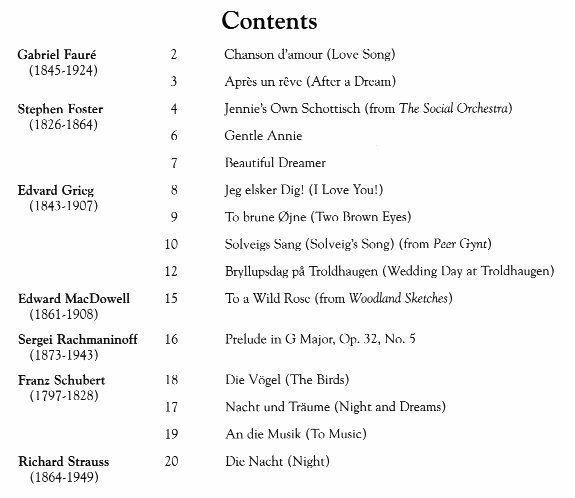
|
F110: To A Wild Rose transcribed by Paula Robison. G. Schirmer, 2003, SS, 56 + 20 pages. 15 romantic pieces for flute and piano. Includes separate flute part. Click on the cover image to view Table of Contents. Use your browser's Back button to return. |
17.95
|
|
F136: The Welsh Flautist by Douglas Townshend and Jeffrey Howard. Kevin Mayhew, 1998, SS, 31 + 14 pages. These ten pieces for the intermediate-level flautist capture the essence of traditional Welsh music. The keys for these pieces rarely go beyond the use of three flats or sharps, keeping this collection well within the reach of average players. The tunes appear with both their original Welsh titles and English translations. Selections include: Ar hyd y nos (All Through The Night), BugeilioOr gwenyth gwyn (Watching the Wheat), Cadair Idris (Idris O Chair), Clychau Aberdyfi (The Bells of Aberdovey), Codiad yr Ohedydd (The Rising of the Lark), Dafydd y garreg wen (David of the White Rock), Llwyn on (The Ash Grove), Migildi magildi (A Nonsense Song), Rhyfelgyrch gwyr Harlech (War March of the Men of Harlech), and Si hei lwli mabi (Lullaby). |
7.95
|
|
WW396: Six Sacred Christmas Duets for Flute and Clarinet with optional Pianoarranged by Keith Young. Kendor Music, 2018, SS, (includes parts and piano score). Written to be enjoyed either with or without the piano accompaniment, these six grade 4 duet settings include ten of the most popular carols in traditional to modern styles, along with a couple swing settings. Contents: Midwinter Lullaby (In The Bleak Midwinter and Away In A Manger), Midnight Still (Still, Still, Still and It Came Upon A Midnight Clear), Two French Carols (Sing We Now Of Christmas with He Is Born), What Child Is This?, Proclaim The Joy (Joy To The World and Go, Tell It On The Mountain), and God Rest Ye Swingin’ Gentlemen. Click on the cover image to see see the first two pages of the piano score. |
16.95
|
|
F053: 6 Grandes Etudes for Flute, Op. 10 by Pierre H. Camus, revised by Robert Cavally. Southern Music Co., SS, 41 pages. This is Melodious and Progressive Studies Book 4B. |
12.50
|
|
F399: 7 Daily Exercises (Seven Daily Exercises) Op. 5 by Mathieu-Andre Reichert. Carl Fischer, SS, 16 pages. Each of the exercises contains many one (and in No. 6 two) line exercises that take a pattern through all major and minor keys. Most of the excercises are scale or arpeggio related. High school level and up. (Except other items with free shipping.) |
7.95
|
|
F055: 8 Difficult Studies, Op. 33, Book III by Ernesto Kohler, revised by Robert Cavally. Southern Music Co., SS, 17 pages.
(Except other items with free shipping.) |
7.50
|
|
F044: 12 Studies, Etudes for Flute, Op.15 by Theobald Boehm, revised and edited by John Wummer. Carl Fischer, SS, 29 pages. Subtitled "For the Perfection of the Fingering in All the Major and Minor Keys." Large clear printing. |
9.50
|
|
F118: 12 Grand Studies Op. 15 by Theobald Boehm presented by James Galway. Theodore Presser, 2003, SS, 38 pages. Includes a preface, general remarks, and notes on each study by Sir James Galway. |
10.95
|
|
F355: 15 Easy Exercises Op. 33 Book 1 by Ernesto Koehler, edition and commentary by James Galway. Theodore Presser, 2006, SS, 16 pages. These exercises provide melodic and tuneful studies in at the intermediate/upper intermediate exercises in keys from 3 flats to 4 sharps. Includes brief notes on each exercise by Sir James Galway.
(Except other items with free shipping.) |
9.95
|
|
F162: 17 Daily Exercises for the Flute by Paul Taffanel and Philippe Gaubert. Leduc, 1928 & 1958, SS, 68 pages. The famous T&G exercises. |
31.80
|
|
F081: 18 Exercises or Etudes for the Flute by Benoit Tranquille Berbiguier, edited by Lamar Stringfield. Carl Fischer, 1979, SS, 23 pages. The editor advises that these studies may be played slowly by intermediate players and more rapidly by advanced players while still retaining their musical value. Alternate key signatures are shown for many of the pieces. |
9.95
|
|
F077: 18 Studies for Flute, Op. 41 by Joachim Andersen, edited by Robert Cavally. Southern Music Co., SS, 16 pages.
(Except other items with free shipping.) |
7.50
|
|
F065: 20 Concert Studies from the Works of J.S. Bach Arranged for Flute by Robert W. Mols. Southern Music Co., SS, 27 pages. These 20 studies are from Partitas 1-3 for violin, Cello Suites 2, 3, 4, and 6, and Preludes No. 3 and No. 6 from Well Tempered Clavichord. They have been transposed to suite the range of the flute and are in diverse keys. |
24.95
|
|
F440: Twenty Little Etudes Op. 132 for Flute by Giuseppe Gariboldi edited by Karl Kraber. International Music Co., 2018, SS, 20 pages. Giuseppe Gariboldi (1833-1905) was an Italian flutist, teacher and composer. This book has etudes in keys from 3 sharps to 4 flats (major and minor). It is somewhat easier than some of the other books of etudes and is probably suitable for a high school level flutist. Sale priced. The regular price is $16.95. Click on the cover image to see a sample page. |
13.95
|
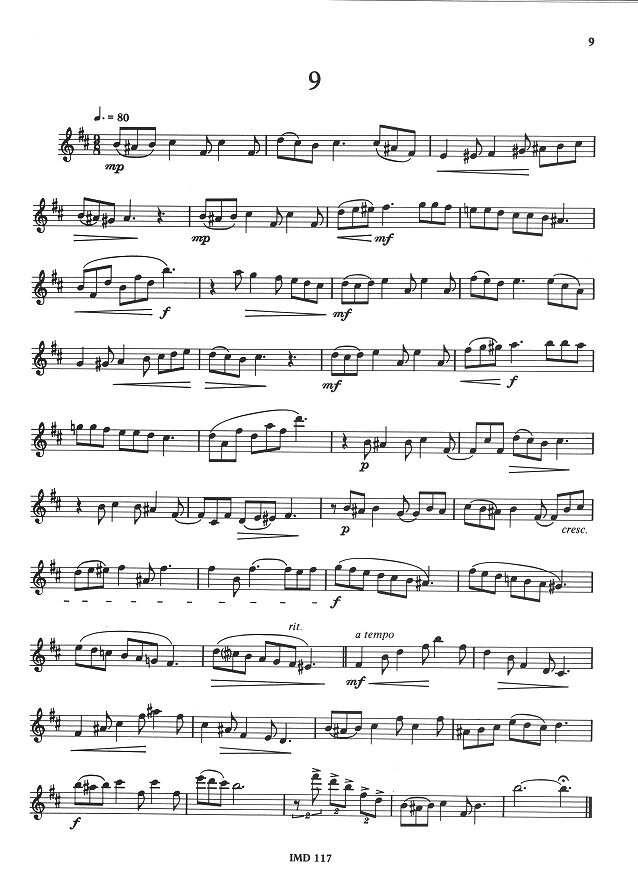
|
F286: 22 Recreation Studies for Flute by Jerome Naulais. International Music Diffusion, 1989, SS, 22 pages. An interesting set of intermediate etudes. Several are dance forms (waltz, tango, Charleston) with many pieces having a contemporary edge. The variety of tempos, meters (5/4, 5/8 etc.), rhythmic figures and keys (to four flats and sharps) should aid in the player's development and would be good sight reading material for more more experienced students. Click on the cover image to see a sample page. |
11.95
|
|
F064: 23 Flute Etudes for Range, Flexibility and Endurance by Jacob Dont, arranged by Arthur Ephross. Southern Music Co., SS, 31 pages. These etudes were adapted from violin studies by Dont. |
8.95
|
|
F063: 24 Artistic Concert Studies by Max Fuhler, edited by Robert Cavally. Southern Music Co., SS, 31 pages. These studies are in a variety of styles, many with descriptive names such as: Song Without Words, Juggler, Lonely Song, Mazurka, Forest Bird, Fantastic Dance, Burlesque, etc. An amazing value. |
3.50
|
|
F062: 24 Artistic Studies for Flute, Op 15 by Joachim Andersen, edited by Alfred E. Fenboque. Southern Music Co., SS, 47 pages. |
14.50
|
|
F045: 24 Caprices for Flute, Op. 26 by Theobald Boehm, revised and edited by John Wummer. Carl Fischer, SS, 37 pages. Subtitled "In Pleasing and Melodious Style." |
9.95
|
|
F451: 24 Etudes Op. 37, Book I (Nos. 1-12) by Theobald Boehm edited by Stephanie Jutt. International Music Company, 2020, SS, 19 pages. Covering the flat keys in a variety of tempos. Skills developed include trills, tonguing, arpeggios, octave leaps, chromatic scales and more. Click on the cover image to view a sample page.F453: 24 Etudes Op. 37, Book II (Nos. 13-24) by Theobald Boehm edited by Stephanie Jutt. International Music Company, 2020, SS, 19 pages. Covering mostly the sharp keys in a variety of tempos. Skills developed include trills, tonguing, arpeggios, octave leaps, chromatic scales and more. |
Book 1
14.95
Book 2
14.95
|
|
F180: 24 Exercises for Flute, Op. 30 by Joachim Andersen edited by Donald Peck. Progress Press, 2004, SS, 37 pages. This new edition of Andersen Op. 30 is by the retired principal flute of the Chicago Symphony. It includes about two pages of comments and suggestions on the exercises. See the Special Discount that includes this book. |
11.95
|
|
F181: 24 Exercises for Flute, Op. 33 by Joachim Andersen edited by Donald Peck. Progress Press, 2004, SS, 28 pages. This new edition of Andersen Op. 33 is by the retired principal flute of the Chicago Symphony. It includes a recommended order of study and about two pages of comments and suggestions on the exercises. See the Special Discount that includes this book. |
11.95
|
|
F060: 24 Flute Concert Studies. Southern Music Co., PB, 160 pages. Studies on Bach, and famous flute solos from works by Mozart, Molique, Langer, Faure, Rimsky Korsakoff, Bizet, Gluck, Chopin, Debussy, Saint-Saiens, Widor, Quantz, and more. |
21.95
|
|
F059: 24 Instructive Studies for Flute, Op. 30 by Joachim Andersen, edited by Robert Cavally. Southern Music Co., SS, 27 pages. |
10.00
|
|
F320: 24 Little Melodic Studies with Variations (Easy) for Flute (24 Petites Etudes Melodiques) by Marcel Moyse. Alphonse Leduc, 1932, 17 pages. The format of this book is to present a melody followed by one or two variations. The first few are easy but the difficulty and the number of sharps or flats in the key signature increases as the book progresses. |
28.30
|
|
F046: 24 Melodious Studies for Flute, Op. 37 by Theobald Boehm, revised and edited by John Wummer. Carl Fischer, SS, 29 pages. Subtitled "To Demonstrate the Various Technical Difficulties of the Flute." |
9.95
|
|
F058: 24 Progressive Studies for Flute, Op. 33 by Joachim Andersen. Southern Music Co., SS, 32 pages. |
9.00
|
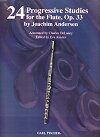
|
F387: 24 Progressive Studies for Flute, Op. 33 by Joachim Andersen annotated by Charles DeLaney, edited by Eva Amsler. Carl Fischer, 2009, SS, 32 pages. Includes performance notes on all of the studies (which have been given names). The print is smaller then the Southern Music edition but somewhat cleaner. |
9.95
|
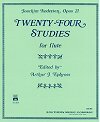
|
F078: 24 Studies for Flute, Op. 21 by Joachim Andersen, edited by Arthur J. Ephross. Southern Music Co., SS, 32 pages. |
10.50
|
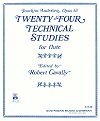
|
F061: 24 Technical Studies for Flute, Op. 63 by Joachim Andersen, edited by Robert Cavally. Southern Music Co., SS, 53 pages. |
15.00
|
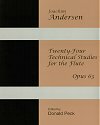
|
F182: 24 Technical Studies for the Flute, Op. 63 by Joachim Andersen edited by Donald Peck. Progress Press, 2004, SS, 61 pages. This new edition of Andersen Op. 63 is by the retired principal flute of the Chicago Symphony. It includes about two pages of comments and suggestions on the studies. See the Special Discount that includes this book. |
13.95
|
|
Special!
F184: The three Andersen books (F180, F181, and F182) edited by Donald Peck at a discount price. |
29.95
|
|
|
F057: 24 Virtuosity Studies for Flute, Op. 60 by Joachim Andersen, edited by Robert Cavally. Southern Music Co., SS, 99 pages. |
9.95
|
|
F056: 26 Preludes – Cadenzas for Flute by A. B. Fürstenau, edited by Robert Cavally. Southern Music Co., SS, 11 pages. These cadenzas are in a variety of styles, tempos, and keys.
(Except other items with free shipping.) |
4.95
|
|
F087: 26 Selected Studies for the Flute by Henry Altès edited by Georges Barrrère. G. Schirmer, 1918, PB, 97 pages. From the Altès Method with a good variety and some duets. |
12.95
|
|
F079: 26 Small Caprices for Flute, Op. 37 by Joachim Andersen, edited by Robert Cavally. Southern Music Co., SS, 27 pages. Three of the pieces in the this book have an extra staff with the ornamentation written out. |
10.95
|
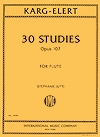
|
F421: 30 Studies Op. 107 for Flute by Sigfrid Karg-Elert edited by Stephanie Jutt. International Music Company, 2014, SS, 22 pages. The more difficult etudes in this book are at the advanced level. |
10.50
|
|
F052: 30 Virtuoso Studies for Flute, Op. 75 by Ernesto Kohler revised by Robert Cavally. Southern Music Co., SS, 79 pages. The studies are in all major and minor keys. This is Melodious and Progressive Studies Book 4A. |
12.50
|
|
F173: 35 Exercises for Flute Op. 33 Book 1, 15 Easy Exercises by Ernesto Kohler. Carl Fischer, SS, 16 pages. These exercises (etudes really) are in keys to four flats or sharps. Despite the name, they are intermediate level studies.
(Except other items with free shipping.) |
7.95
|
|
F174: 35 Exercises for Flute Op. 33 Book 2, 12 Medium Difficult Exercises by Ernesto Kohler. Carl Fischer, 1905, SS, 16 pages. These exercises (etudes really) are in keys to four flats or sharps. Similar to Book 1 but more difficult. |
6.95
|
|
F175: 35 Exercises for Flute Op. 33 Book 3, 8 Difficult Exercises by Ernesto Kohler. Carl Fischer, 1905, SS, 19 pages. These exercises will be a good workout. |
8.95
|
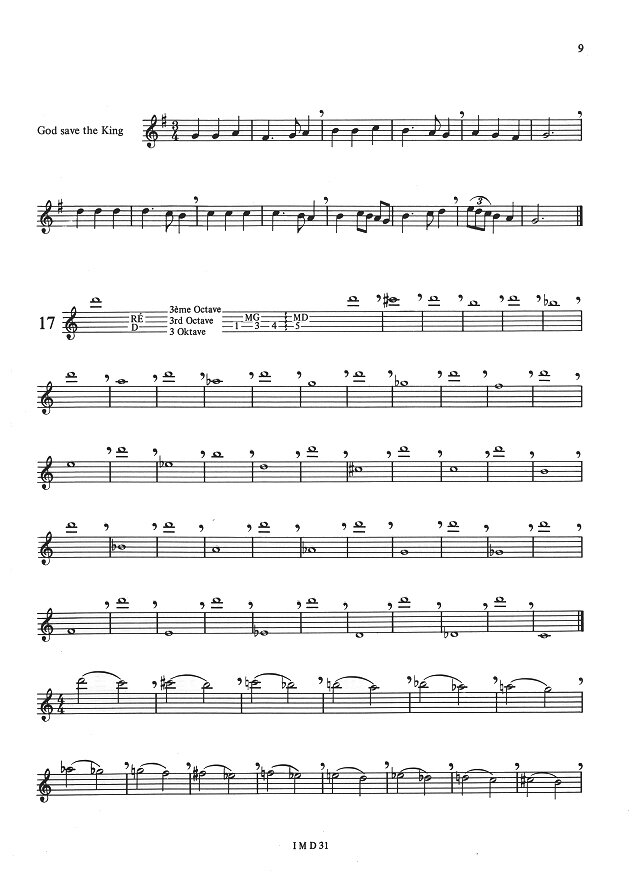
|
F287: 37 Notes for Flute by Maurice Chevry. International Music Diffusion, 1984, SS, 27 pages. This is a somewhat unusual book Starting with notes in the staff it works up and down to cover the the range of the flute to the forth octave C. While there are a couple of short tunes, most of the book is devoted to whole and half note exercises which used be useful for working on control, tone and intonation. Click on the cover image to see a typical page. |
12.95
|
|
F075: 50 Variations of the Allemande of Bach’s Sonata for Flute Alone by Marcel Moyse. McGinnis & Marx, 1964, SS, 79 pages. For the study of articulation, embellishment, trills, groppetti, and grace notes. Introductory notes are in English and French. YES. We have this book in stock! |
17.95
|
|
F047: 60 Rambles for Flute by Leon Lester adapted by Kenton F. Terry. Carl Fischer, SS, 47 pages. One of the best books of supplemental pieces around. The melodic and rhythmic material in Lester's "rambles" will please not only young 2-3 year students, but adult beginners as well. |
10.95
|
|
F312: 100 Classical Studies for Flute edited by Frans Vester. Universal Edition, 1966, PB, 84 pages. One hundred mostly intermediate studies in a large variety of keys. From the period 1700-1900 and selected from the works of: Gariboldi, Tulou, Andersen, Köhler, Demerssemann, Fürstenau, Berbiguier, Frederick the Great, Drouet, Hugot & Wunderlich, and Devienne. Click on the cover image to view Table of Contents. |
19.95
|
|
F091: 117 Melodious and Progressive Studies for Flute compiled by Jay Arnold. Ashley Publications, 1983, PB, 128 pages. Four sets of studies presented in progressive order. They are 44 studies by Giuseppe Gariboldi, 18 Studies Op. 41 by Christian J. Andersen, 15 Studies Op. 33 Book 1 by Ernesto Koehler, and 40 Studies Op 75 by Luigi Hugues. |
9.95
|
|
F267: 125 Easy Studies for Flute edited by Frans Vester. Universal Edition, 1976, SS, 55 pages. A nicely prepared edition of technical and melodic studies chosen from ten classic flute instruction books by famous flutists. The original composers include Devienne, Fürstenau, Gariboldi, Koehler, Popp, Tromlitz, etc. along with short biographies and the names of the original sources. These short studies are at the beginning to intermediate levels (about US grades 2-4). |
22.95
|
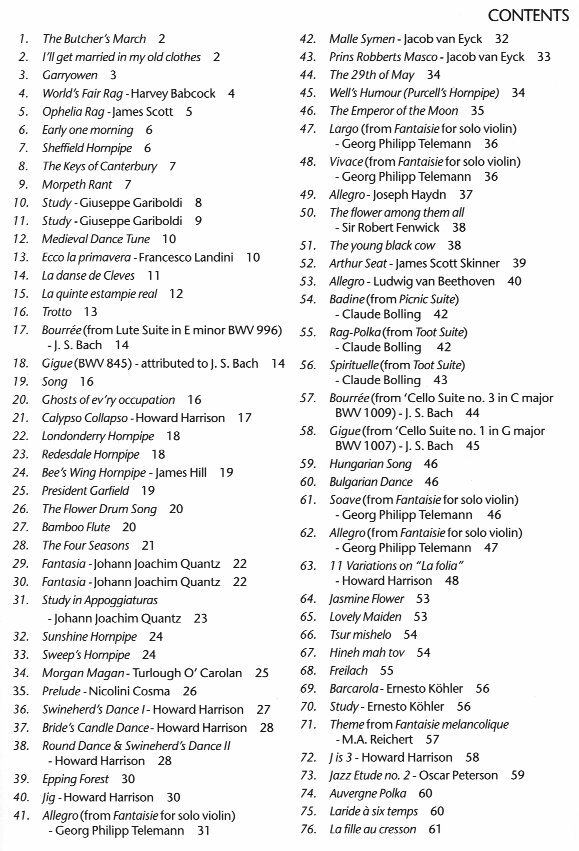
|
F137: Amazing Studies Flute by Howard Harrison. Boosey & Hawkes, 1997, SS, 62 pages. Howard Harrison has collected and arranged 76 pieces for unaccompanied flute. They include material drawn from both classical and folk music, with many dances included. Each piece was selected to develop a specific aspect of technique. There is an index to help you find the right study for each technical problem. This book is at the intermediate level. Click on the cover image to view Table of Contents. |
13.50
|
 |
F121: Complete Daily Exercises for the Flute by Trevor Wye. Novello, 1999, SB, 127 pages plus practice card. Complete is not an understatement for the very large book of exercises for intermediate to advanced flutists. It is based on traditional exercises from the five most popular "French School" study books, some modified in light of present day practice and custom. The book is divided into sections for Tone Exercises, Warm-ups, and Vocalise, Scales and Scale Exercises, Arpeggios, Chromatic Exercises, The Third Octave, and Daily Exercises. One note: the exercises, while very clearly printed with adequate space between notes, is a bit on the small side. |
25.95
|
 |
G061: Complete Method for Rhythmical Articulation by Pasquale Bona translated from the fourth Italian edition by Gustav Saenger. Carl Fischer, SS, 72 pages. This is the treble clef edition. This book is in three parts with the first two intended for vocalists and all three parts for instrumentalists. The exercises and etudes (120 in all) which focus on rhythm (not articulation) are progressively more difficult. Some of the exercises have a few notes below the range of the flute, oboe, and saxophone. |
13.95
|
 |
G068: Contemporary Rhythm & Meter Duets for Treble Clef Instruments by Elliot Del Borgo. Meredith Music Publications, 1996, SS, 31 pages. Based on the concept of Contemporary Rhythm & Meter Studies, these fourteen, two-page duets make extensive use of metric and rhythmic devices, and harmonic and tonal devices commonly found in 20th Century works. They are ideal for any instrument for developing sight-reading skills as well as recital performance, jury exams, and lesson material. |
9.95
|
 |
G066: Contemporary Rhythm & Meter Studies for Treble Clef Instruments by Elliot Del Borgo. Meredith Music Publications, 1996, SS, 31 pages. These 28 etudes make extensive use of metric and rhythmic devices found in 20th century works. Composed as recital/performance pieces, all melodic material is derived from a variety of contemporary patterns including synthetic scales, 12-tone and 7-tone rows, cell-derived patterns, modal scales and traditional major and minor tonalities. |
9.95
|
|
F048: Daily Exercises and Scales for Flute or Piccolo by G. Pares revised by E. Claus. Carl Fischer, SS, 40 pages. |
9.95
|
|
F336: Daily Exercises for the Flute (Ejercicios Diarios para la Flauta) by André Maquarre. G. Schirmer, 1923, SS, 37 pages. The author was the solo flute in the Boston Symphony Orchestra from 1893-1918). This book, which is in both Spanish and English, contains seven scale and interval based exercises in all keys. |
7.95
|
|
F321: Daily Exercises for the Flute (Exercices Journaliers pour la Flûte) by Marcel Moyse. Alphonse Leduc, 1923, SS, 49 pages. This books contains exercises based on scales, chords and arpeggios for study of the entire range of the flute. It includes a practice schedule of exercises covering 26 practice sessions. |
32.30
|
|
|
F112: Expressive Etudes ~ for the Flute compiled and edited by Laura Barron. Carl Fischer, 2003, SS, 39 pages + CD. Laura Baron has selected nineteen gems of substantial musical merit from the thousands of etudes available. She feels that each work lends itself to expressive interpretation and can be studied and performed as concert pieces. The etudes are by Boehm, Karg-Elert, Fürstenau,, Andersen, Soussmann, Altès, Kohler, Demerssman, Prill, and Taffanel. The book includes performance suggestions and the CD has a recording of each etude. Click on the cover image to view the list of work. Use your browser's Back button to return. |
19.95
|
|
F373: Famous Flute Works compiled by Patty Mills and Jan Cole. Southern Music Company, 2010, SS, 64 pages. Subtitled: An Anthology of Studies for Flute, this is a superb collection of thirty-eight of the most well-known flute studies taken from widely used flute practice repertoire. The studies have been group to emphasize technical aspects of flute playing such as tonguing, slurring, leaps, lip slurs and octaves, and ornamentation. This new collection was recently selected as the Texas All-State Flute Audition repertoire collection. |
19.95
|
|
|
F155: Flute Methods, Studies and Ensembles. CD Sheet Music, 2006. Version 2.0 including notes from the 1911 Grove's Dictionary on many of the composers. This CD contains more than 1800 pages of methods, studies and ensembles (mostly the latter two). It includes works from the following and more: Altès, W.F. Bach, Andersen, Gariboldi, Hughes, Karg-Elert, Köhler, Reichert, de la Barre, Beethoven, Berbiguier, Boismortier, Bordet, Briccialdi, Chinzer/Bordet, Devienne, Dietter, Finger, Fürstenau, Gariboldi, Hotteterre, Hugot/Wunderlich, Koechlin, Köhler, Kuhlau, Kummer, di Lasso, Legoux/Bordet, Le Loup, Loeillet, Mozart, Müller, Naudot, Quantz, Reicha, Soussmann, Stamitz, Sweelinck, Telemann, Tulou. Click on the cover for a full listing of the contents. Use your browser's Back button to return. |
19.95
|
|
F089: Flutist's Daily Dozen by B. Allan Duncan. Centerstream Publications, 1988, SS, 77 pages. This book is designed to aid the flutist's development of technique and finger dexterity in all registers and keys. The twelve exercises are based on four measure phrases that are presented in all major and minor keys. |
9.95
|
|
F090: The Flutist’s Formulae by Georges Barrrère. G. Schirmer, 1935, SS, 13 pages. A compendium of daily studies on six basic exercises that are to be played in all keys. |
6.95
|
|
F088: The Flutist's Primer by Louis Moyse. G. Schirmer, 1979, SS, 34 + 27 pages. Easy and melodious exercises based on scales and arpeggios in all keys with optional second flute or piano accompaniment (in separate booklet). |
12.95
|
|
F085: The Flutist's Vade Mecum 2nd Edition by Walfrid Kujala. Progress Press, 2012, HB, 135 pages. This is the new edition of this book which replaces the 1995 first edition. It has been expanded (50 pages longer), hard cover, 10 x 13 smythe sewn pages so that it will rest on the stand in open position without stress on the spine of the book. This more durable format is truly designed for the concept of Vade Mecum ("Go with me"), intended to maintain structural integrity for the span of one's flute playing career. An outstanding book of scales, arpeggios, etudes, trills and fingering technique with many fingering recommendations. A valuable aid to improving technique. Now with a lower price! It was $34.95. |
22.95
|
|
F054: La Grande Velocité by Louis Moyse. Southern Music Co., 32 pages. A progressive work of technique built on scales and arpeggios. |
5.50
|
|
F153: Grouping of Keys (Bouquet des Tons) Op. 125 by A.B. Füstenau edited by Marcel Moyse. Alphonse Leduc, 1952. SS, 45 pages. Twenty-four advanced exercises, caprices and preludes in all major and minor keys. |
57.80
|
|
F093: Indispensable Scales, Exercises and Etudes for the Developing Flutist compiled, arranged and edited by Dona Gilliam and Mizzy McCaskill. Mel Bay Publications, Inc., 1994, SS, 80 pages. This book consists of major, minor (natural, harmonic, and melodic), arpeggios, scales in thirds, triplets, extended and chromatic scales, scale cycles, and patterns. It also has 40 etudes covering major and minor keys. |
19.95
|
|
F212: Leger Domain, 52 Top Register Studies for Flute by Thomas J. Filas. Carl Fischer, 1976, SS, 28 pages. This book contains 58 studies, each one half page in length in all major and minor keys through 6 sharps and 6 flats for developing fluency on the top register of the flute. |
11.95
|
|
F189: The Mary Karen Clardy Flute Etudes Bookselected and introduced by Mary Karen Clardy. European American Music Corporation, 1995, PB, 90 pages. There are 51 etudes in this book in all keys (major and minor), organized by the circle of fifths. The etudes are from Bach, Karg-Elert, Köhler, Donjon, Andesen, Boehm, Schade, and Fürstenau. The editor has provided some suggestions for the performance of each etude and identified the origin. The book also includes basic scales and arpeggios. This book is being using for the 2005-06 Texas All State auditions for flute and piccolo. |
17.95
|

|
F213: Melodic Exercises (Melodische Übungen) by Walter Zachert. Schott, 1954/1982, SS, 51 pages. This book contains 74 exercises which the composer recommends to supplement any flute method. They are progressive in difficulty beginning at the early intermediate level and extending to the advanced intermediate. They include scales, intervals, tone production, rhythm, ornaments, chromatic scales, double and triple tonguing, etc. SALE: This didn't make it to the website when we bought it. The current list price of this book is $19.95! |
8.95
|
|
F176: Melodious Etudes for Flute compiled and edited by Larry Clark and Sean O'Loughlin. Carl Fischer, 2003, SS, 80 pages. These 54 etudes are a bit different from the familiar since they are based on vocalises of Marco Bordogni (1788-1856). The etudes are in a variety of keys (to four flats or sharps) and difficulty levels for third and fourth year students. The etudes are mostly in the second octave and the lower part of the third octave. |
12.95
|
|
F049: Melodious & Progressive Studies Book 1 revised by Robert Cavally. Southern Music Co., SS, 64 pages. Studies from Andersen, Gariboldi, Koehler, and Terschak. |
13.95
|
|
F050: Melodious & Progressive Studies Book 2 revised by Robert Cavally. Southern Music Co., SS, 64 pages. Studies from Andersen, Gariboldi, Koehler, and Terschak |
14.95
|
|
F051: Melodious & Progressive Studies Book 3 revised by Robert Cavally. Southern Music Co., SS, 67 pages. Studies from Boehm, Kronke, Gariboldi, Koehler, and Mollerup. |
10.00
|
|
F068: The Modern Flutist. Southern Music Co., SS, 96 pages. 8 Etudes de Salon by Dont, 30 Caprices by Karg-Elert, and orchestral studies for flute, alto flute, and piccolo from the works of Borodine, Brahms, Debussy, Frank, Rimsky-Korsakoff, Strauss, Stravinsky, Wagner and more |
16.95
|
 |
Ob109: Oboe, Flute or Sax Scales for Reading by Christopher Weait. Christopher Weait, 2006, SB, 79 pages. These scale and arpeggio patterns are based upon the premise that instrumentalists need to know how scales and arpeggios look in order to be fluent sight-readers and improve finger technique. They are divided into lower and upper registers and progress through 15 keys, including the enharmonic keys. Accidentals are used for each key rather than key signatures. Scales included are: majors with tonic arpeggios, harmonic minors with minor arpeggios, melodic minors with tonic seventh arpeggios, chromatics, whole tones with augmented arpeggios, octatonics (diminished scales) with diminished seventh arpeggios, pentatonic and blues scales. |
25.95
|
|
F227: On Sonority (De La Sonorite) by Marcel Moyse. Alphonse Leduc, 1934, SS, 27 pages. Exercises and studies for developing a beautiful tone. Text in French, English, and German. |
34.95
|
|
F109: The Paula Robison Flute Warmups Book by Paula Robison. European American Music Corp., 1989. SS, 40 pages. Warmups both musical and otherwise: Physical Warmups, Orange Juice Warmup (chromatic scales), The Bell's Warmup (long tones), A Singer's Warmup, The Dancer's Warmup. The Nightengale's Warmup (trills and grace notes), Two Virtuoso Warmups (Pan's Warmup and Radiating Arpeggios), Pyschological Warmups, and Spiritual Warmups. |
12.95
|
|
F372: Preparatory Etudes to Supplement Robert Cavally's 24 Short Concert Pieces for Flute by Rebecca Meador and Jean V. Marshall. Southern Music Co., 2007/2009, SS, 27 pages. These etudes were designed to provide additional, related exercises that would contribute to the students mastery of the pieces from 24 Short Concert Pieces for Flute edited by Robert Cavally. Each selection provides a short etude and scales and arpeggios appropriate for the etude. |
7.95
|
|
F072: School of Articulation by Marcel Moyse. Alphonse Leduc, 1928, SS, 23 pages. Exercises and studies in articulation for flute. Rhythms - single, compound, double and triple tonguing of every variety and over the entire range of the flute. Text in French, English, German and Japanese. |
31.05
|
|
F138: Selected Studies for Flute by Himie Voxman. Rubank, 1942, SS, 76 pages. Intermediate-advanced level etudes drawn from many composers in all major and minor keys, plus scales, scales in thirds, and arpeggios. This book is used for the Association of Texas Small School Bands (ATSSB) auditions. |
6.95
|
|
F067: Sequences for Flute by Geoffrey Gilbert. Southern Music Co., SS, 16 pages. Twelve sets of daily exercises based on scales and chords.
(Except other items with free shipping.) |
9.95
|
|
F073: Studies and Technical Exercises by Marcel Moyse. Alphonse Leduc, 1921, SS, 22 pages. Exercises and studies covering the various kinds of difficulties to be found in flute technique, and above all those associated with sonority (particularly in the lower register), correct intonation, slurs, and the mechanics of the instrument. Text in French, English, German and Japanese. |
22.95
|
|
F400: Studies for Facilitating the Execution of the Upper Notes on the Flute by Daniel S. Wood. Carl Fischer, 1966, SS, 22 pages. This book has a series of eight exercises which begin on the C in the middle of the staff, and then work their way up through all of the major and minor keys (36 steps) to the top range of the flute. The exercises are based on scales, thirds, and fifths. |
9.95
|
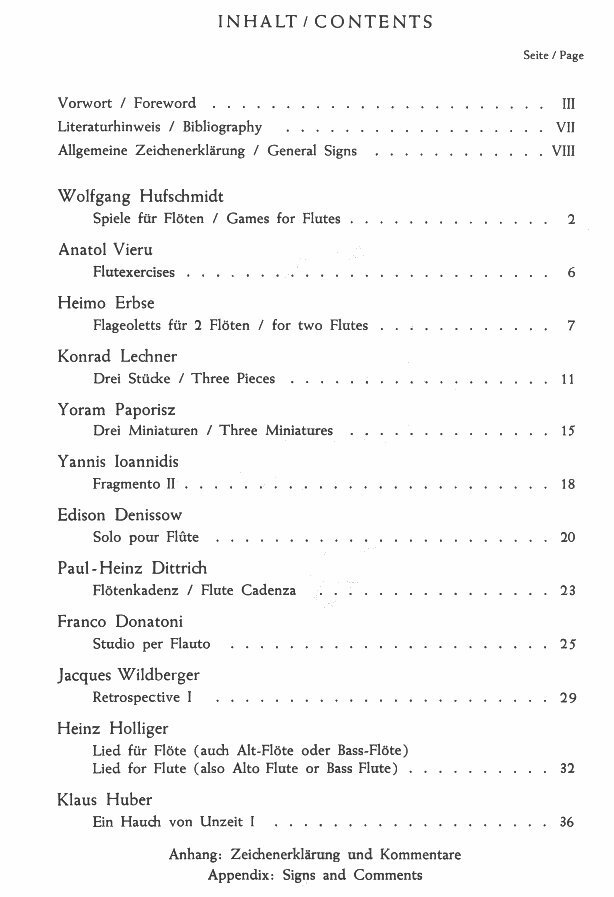
|
F148: Studies for Playing Avant-Garde Music (Studien zum Spielen Neuer Musik) for Flute by Aurèle Nicolet. Breitkopf, (1973), 50+ pages. The book provides detailed instruction in English and German for playing 12 works for flute that use extended technique. Works by Edison Denissow, Yannis Ioannidis, Franco Donatoni, Heinz Holliger, Klaus Huber, and 7 more composers are included. Full flute parts are included as well as explanations of notation and multiphonic fingerings. A brief bibliography and list of works is included. Click on the cover image to view the Table of Contents for a full list of composers and works. Use your browser's Back button to return. |
21.95
|
|
F217: Supplementary Studies Flute or Piccolo by R.M. Endressen. Rubank, 1937, SS, 24 pages. This book is suggested to be used with an intermediate flute method to provide additional musical studies. It contains 39 studies in keys up to three sharps and three flats. |
5.50
|
|
F066: Technical Flexibility for Flutists by Geoffrey Gilbert. Southern Music Co., SS, 55 pages. A book of organized daily practice routines. These exercises are based on scales, arpeggios, and chords. High notes play an important part. |
12.50
|
|
F196: Technical Mastery for the Virtuoso Flutist by Marcel Moyse edited by Trevor Wye. Zimmermann, 1997, PB, 67 pages. This is a facsimile reprint of the original edition published by Moyse in 1965.The original was done by hand and this edition reproduces that work at a slightly reduced size. It includes 36 numbered exercises and additional explanatory material and examples. The book also has a German translation of the text and a list of corrections. |
26.95
|
|
F015: Tone Development Through Extended Techniques by Robert Dick. Multiple Breath Music Co., SS, 60 pages. The author's perspective is that in working with the new sonorities and techniques (microtones, percussive sounds, whisper and residual tones, glissandi, etc.) will greatly benefit traditional playing. This work develops the strength flexibility and sensitivity of the embouchure and breath support, increasing the player's range of color, dynamics and projection. This book covers: throat tuning, natural harmonics, bending, whisper tones, extended timbres, diffuse tones, bright tones, "bamboo scales," timbral trills, and multiphonics. |
29.95
|
|
F076: Tone Development Through Interpretation by Marcel Moyse. McGinnis & Marx, SS, 79 pages. The study of expression, vibrato, color, suppleness, and their application to different styles with pieces drawn primarily from opera. It includes piano accompaniment and is also useful for oboe. A very popular book. |
39.95
|
|
F098: Top Register Studies for Flute by Thomas J. Filas. Carl Fischer, 1969, SS, 32 pages. This book contains 90 melodious studies in all major and minor keys through 6 sharps and 6 flats for developing fluency on the top register of the flute. |
11.95
|
Bindings: HB: Hard Bound, PB: Perfect Bound (paperback with square spine), SS: Saddle Stitch (paper, folded and stapled), SB: Spiral Bound (plastic or metal)