 |
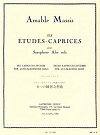
S349: 6 Etudes-Caprices for Alto Saxophone Solo by Amable Massis. Alphonse Leduc, 1954, SS, 10 pages. The six advanced studies are in a variety of styles. The most striking feature is the extensive use of sharp keys and accidentals.Free shipping on this music to the US IF ordered with another book or CD.
(Except other items with free shipping.) |
20.55
|
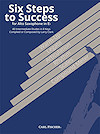 |

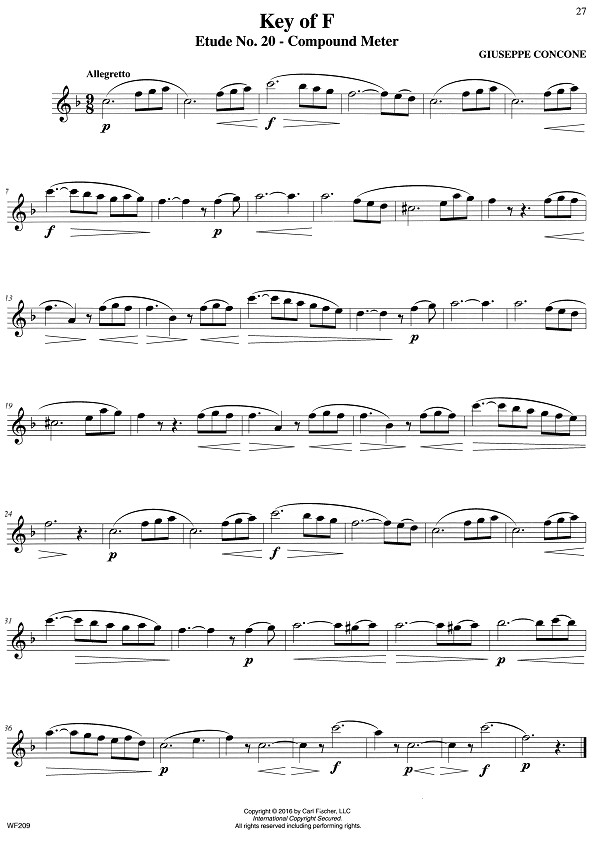
 S1201: Six Steps to Success for Alto Saxophone compiled or composed by Larry Clark. Carl Fischer, 2016, SS, 47 pages. Subtitled 40 Intermediate Etudes in 8 Keys. This book is intended for the intermediate student. It contains etudes that address technique development in warm-ups, legato, articulation, rhythm, scales, and compound meter. For use with a private teacher, or in individual practice, these books offer the perfect transition material for students looking to progress beyond beginning instructional books and build skills to make more advanced repertoire attainable. The studies are somewhat progressive. Click on the cover image to view an etude from the middle of the book. S1201: Six Steps to Success for Alto Saxophone compiled or composed by Larry Clark. Carl Fischer, 2016, SS, 47 pages. Subtitled 40 Intermediate Etudes in 8 Keys. This book is intended for the intermediate student. It contains etudes that address technique development in warm-ups, legato, articulation, rhythm, scales, and compound meter. For use with a private teacher, or in individual practice, these books offer the perfect transition material for students looking to progress beyond beginning instructional books and build skills to make more advanced repertoire attainable. The studies are somewhat progressive. Click on the cover image to view an etude from the middle of the book.
|
12.95
|
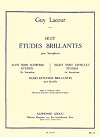 |
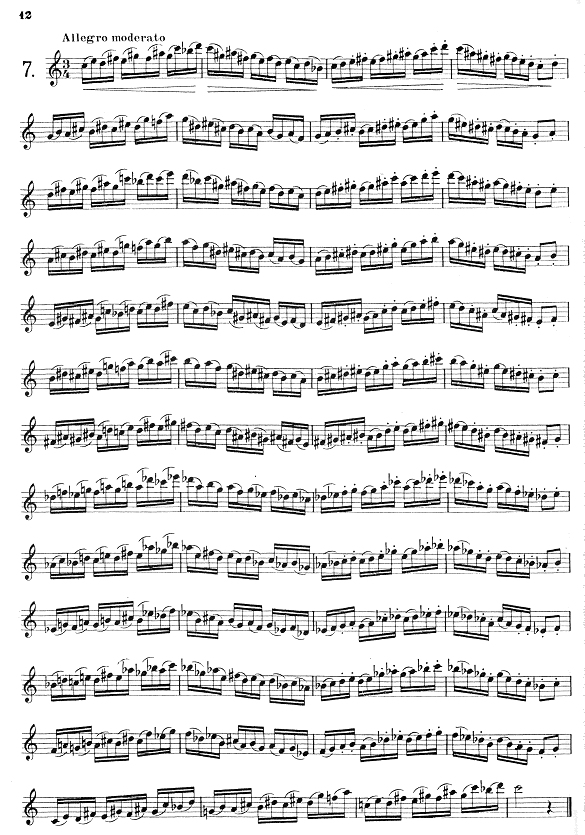
S766: 8 Etudes Brillantes (8 Very Difficult Studies) for Saxophone by Guy Lacour. Leduc. 1963, SS, 11 pages. The introduction by Marcel Mule recommends this book as useful to develop virtuosity. Most of the studies are in keys with four or more sharps or flats. There is a bit of altissimo above the normal range mostly with alternatives provided.
|
22.95
|
 |
S769: Neuf Études (Nine Etudes) for Saxophone in 4 books, Book 1 for Alto Saxophone by Christian Lauba. Leduc, 1996, 18 pages. This volume contains the first four studies which may be performed in concert. They are Balafon (etude for the mastery of circular breathing, delicate dynamics, sound quality with a full clear tone as well as subtones), Savane (consecutive multiphonic sounds), Sanza (etude for the mastery of multiphonic sounds and staccato articulation), and Jungle (slap-tonguing integrated with legato phrasing). Fingerings are given for the multiphonics. Here is a video of a performance of Balafon. Search YouTube for more performances.
|
28.60
|
 |
 / /  S770: Neuf Études (Nine Etudes) for Saxophone in 4 books, Book 2 for Soprano or Tenor Saxophone by Christian Lauba. Leduc, 1996, 19 pages. This volume contains the three studies which may be performed in concert. They are Tãdj for soprano saxophone (melodic etude based upon three modes and varied attacks), Gyn for tenor saxophone (etude based upon the study of attach and resonance), Vir for tenor saxophone (etude for tenor sax summing up the six preceding studies). All of these etudes have multiphonics with fingerings given. S770: Neuf Études (Nine Etudes) for Saxophone in 4 books, Book 2 for Soprano or Tenor Saxophone by Christian Lauba. Leduc, 1996, 19 pages. This volume contains the three studies which may be performed in concert. They are Tãdj for soprano saxophone (melodic etude based upon three modes and varied attacks), Gyn for tenor saxophone (etude based upon the study of attach and resonance), Vir for tenor saxophone (etude for tenor sax summing up the six preceding studies). All of these etudes have multiphonics with fingerings given.
|
29.25
|
 |
S771: Neuf Études (Nine Etudes) for Saxophone in 4 books, Book 3 for two Soprano Saxophones by Christian Lauba. Leduc, 1996, 12 pages (two copies in score format). This volume contains the eighth study which may be performed in concert. Ars (an etude based upon the study of intervals of the fourth and the fith, with a variety of tempo changes). Fingerings are given for the multiphonics. Here https://ummyconverter.com/mp3-to-mp4 is a video of a performance of this piece. |
32.75
|
 |
 S772: Neuf Études (Nine Etudes) for Saxophone in 4 books, Book 4 for Baritone Saxophone by Christian Lauba. Leduc, 1996, 17 pages. The final etude in this set which is Bat for baritone saxophone (grand etude based upon tremolos, trills, melodic glissandi and quarter tones). Fingerings are given for the multiphonics and the performer is also referred to Les Sons Multiples aux Saxophones and Hello! Mr. Sax in this and the other books in this series. S772: Neuf Études (Nine Etudes) for Saxophone in 4 books, Book 4 for Baritone Saxophone by Christian Lauba. Leduc, 1996, 17 pages. The final etude in this set which is Bat for baritone saxophone (grand etude based upon tremolos, trills, melodic glissandi and quarter tones). Fingerings are given for the multiphonics and the performer is also referred to Les Sons Multiples aux Saxophones and Hello! Mr. Sax in this and the other books in this series.
|
27.20
|
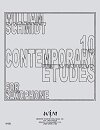 |
S773: 10 Contemporary Etudes for Saxophone by William Schmidt. Western International Music, 1963, SS, 14 pages. Ten studies at the intermediate and advanced intermediate level. They have been written without key signatures at a variety of tempos and rhythmic styles. The final etude in in 7/8. Probably most suitable for students in the final two years of high school or first semester of college.
Free shipping on this music to the US IF ordered with another book or CD.
(Except other items with free shipping.)
|
9.95
|
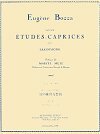 |
S086: 12 Etudes-Caprices for Saxophone by Eugène Bozza. Alphonse Leduc, 1944, SS, 17 pages. These 12 advanced etudes are for the development brilliant technique for the most difficult modern works. It includes rhythms, tonal and metric modulations, and intervals characteristic of demanding mid-century repertoire. |
22.95
|
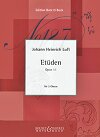 |
WW174: 12 Etudes for 2 Oboes Op. 11 by Johann Heinrich Luft edited by Karl Steins. Bote & Bock, 1964, SS, 24 pages. A famous set of studies for two oboes are also useful for saxophone. In keys to 6 sharps and 4 flats, they are at the advanced high school and college level. There are notes by the editor on the most significant feature of each etude. |
23.50
|
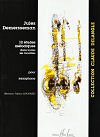 |
S413: 12 Etudes Melodiques for saxophone by Jules Demersseman edited by Fabien Chouraki. Henry Lemoine, 2000, SS, 27 pages. These 12 etudes by Jules Demersseman (1833-1866) were written in about 1866 and are some of the first teaching material written specifically for saxophone. They are suitable for intermediate and advanced students and include a full range of keys. |
21.95
|
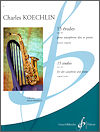 |

S1242: 15 Etudes (15 Studies) Op. 188 for alto saxophone and piano by Charles Koechlin. Billaudot, 2008, SS, 68 + 27 pages. This book provides etudes designed to work on various aspects of saxophone playing. See the table of contents for a description. It is rated as a 7 on the publishers 9 point difficulty scale and surprisingly includes a piano part. Click on the cover image to view the table to contents and the first page of the saxophone part.
|
44.95
|
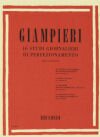 |
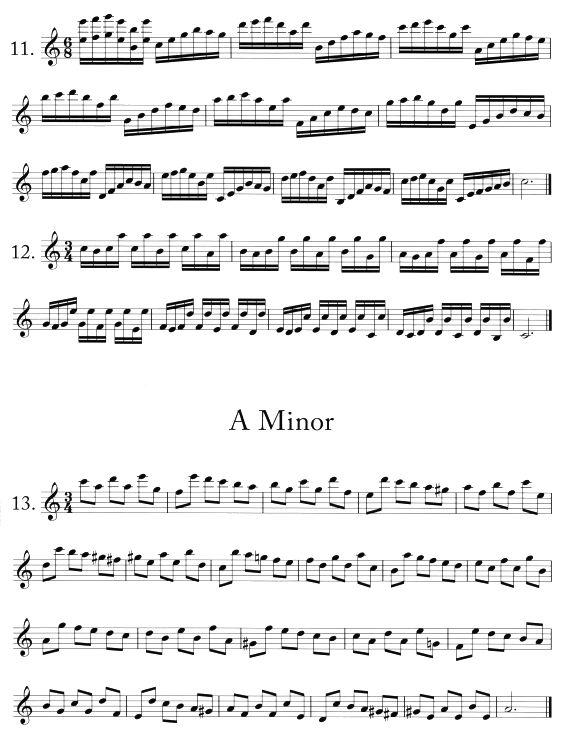
S426: 16 Daily Studies for Saxophone by Alamiro Giampieri. Ricordi, 1963, SS, 29 pages. The Italian title is 16 Studi Giornalieri di Perfezionamento. These exercises take a basic pattern and work it through all the major and minor keys. A good workout at the advanced intermediate level and perhaps a bit beyond. Click on the cover image to view a sampe page. |
16.95
|
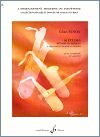 |
S437: 16 Rhythmico-Technical Studies for Saxophone by Giles Senon. Billaudot, 1979, SS, 27 pages. An interesting set of relatively recent etudes at the advanced intermediate and advanced level in keys from two flats to six sharps. |
15.95
|
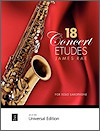 |
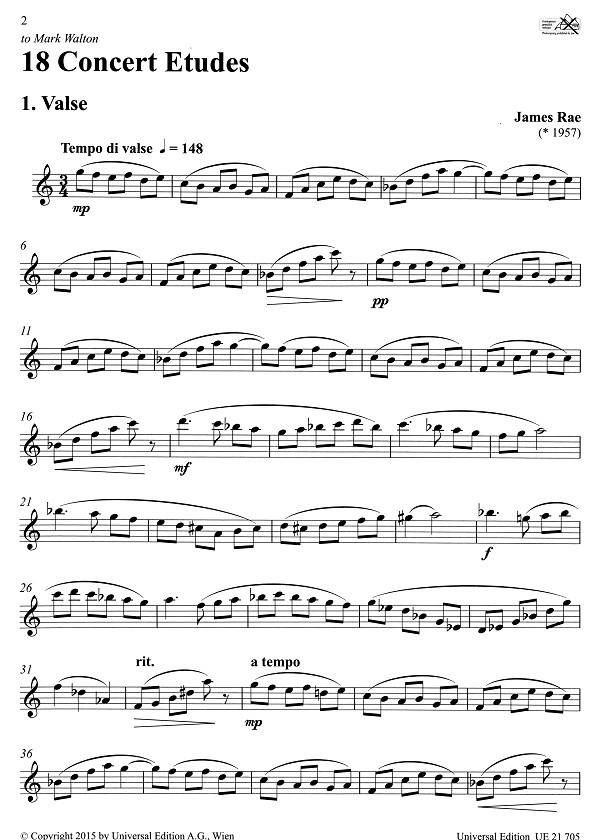
S1179: 18 Concert Etudes for Solo Saxophone by James Rae. Universal Edition, 2015, SS, 36 pages. James Rae has composed these 18 études for the higher-grade/college-level saxophonist. Technique and musicianship are the key issues and they are also ideal as workouts, even for the professional player. Equally, these characterful pieces can be effectively included in concert programs. They are suitable for soprano, alto, tenor or baritone saxophone. Click on the cover image to view the first page. Click here and scroll down to hear and see several of these etudes performed.
|
21.50
|
 |
S081: 18 Exercises or Studies for All Saxophones After Berbiguier by Marcel Mule. Alphonse Leduc, 1943, SS, 23 pages. Intermediate exercises from the flute work of the same name by Benoit Tranquille Berbiguier. Tempos are generally allegro and keys range from 6 sharps to 5 flats with some in minor keys.
|
34.95
|
 |
S022: 20 Modern Studies in Rhythm and Interpretation for Solo Saxophone by James Rae. Universal Edition, 1989, SS, 28 pages. This book has been written to familiarize the saxophonist with the various rhythms and phrasings encountered in modern music. Each study deals with a particular aspect of rhythmic playing ranging from jazz (swing),rock, and funk to contemporary classical. The studies are presented in order of difficulty to enable the player to gauge their progress. These are really excellent and are for intermediate to upper level intermediate players. There is quite a bit of mixed meter. |
19.95
|
 |
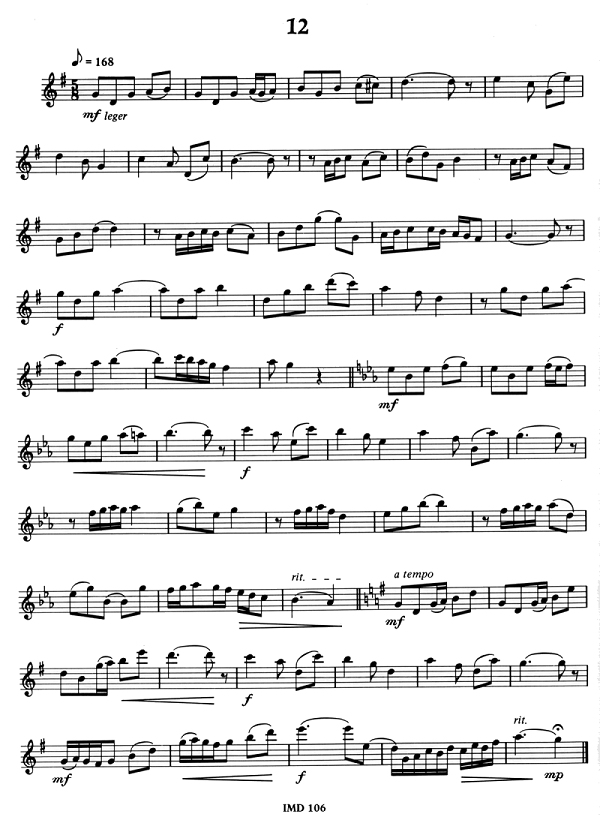
WW088: 20 Recreation Studies for Saxophone or Oboe by Jerome Naulais. International Music Diffusion, 1988, SS, 20 pages. An interesting set of etudes at the intermediate and advanced intermediate level. Many pieces have a contemporary edge. The variety of tempos, meters (including 5/4, 5/8), rhythmic figures and keys (to four flats and sharps) should aid in the player's development and would be good sight reading material for more more experienced students. Click on the cover image to see a sample page.
Free shipping on this music to the US IF ordered with another book or CD.
(Except other items with free shipping.) |
14.95
|
 |
S711: 22 Exercises Transcendants for Saxophone by Marcel Perrin. Alphonse Leduc, 1951, SS, 22 pages. This is accurately rated a 6 on the publisher's 9 grade scale. These etudes move through a variety of keys using accidentals. Click on the cover image to view a sample page.
|
31.65
|
 |
S046: 23 Caprices by Sigfrid Karg-Elert arranged by Robert J. Ford. Southern Music Co., 1991, SS, 24 pages. This set of twenty-three studies has been adapted from a set of thirty flute caprices by Karg-Elert. The studies have been edited with notations to assist the student with learning optional fingerings. The studies feature a variety of keys and some unusual meters. |
15.95
|
 |
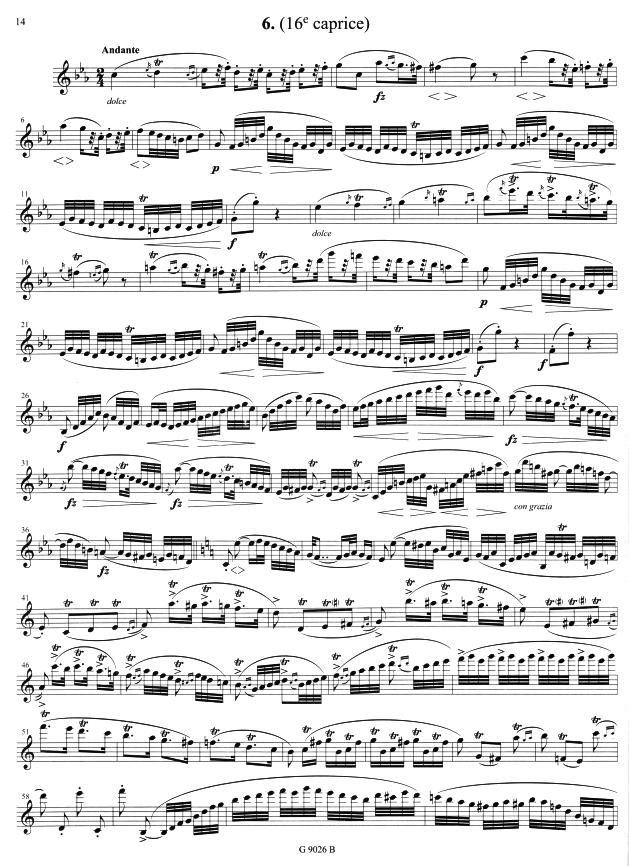
S1005: 24 Caprices by Pierre Rode arranged for saxophone by Erwan Fagant. Billaudot, 2012, SS, 51 pages. Originally for violin, the cover of this book says these caprices have been arranged for alto saxophone but there is no reason why they can't be played on other members of the saxophone family. These are advanced studies which include one duet. The book also includes some suggested altissimo fingerings. Click on the cover image to view a sample page. |
29.95
|
 |
S082: 24 Easy Studies for All Saxophones after A. Samie by Marcel Mule. Alphonse Leduc, 1946, SS, 19 pages. Suitable for second and third year students with keys ranging to 3 sharps and 3 flats.
|
28.60
|
 |
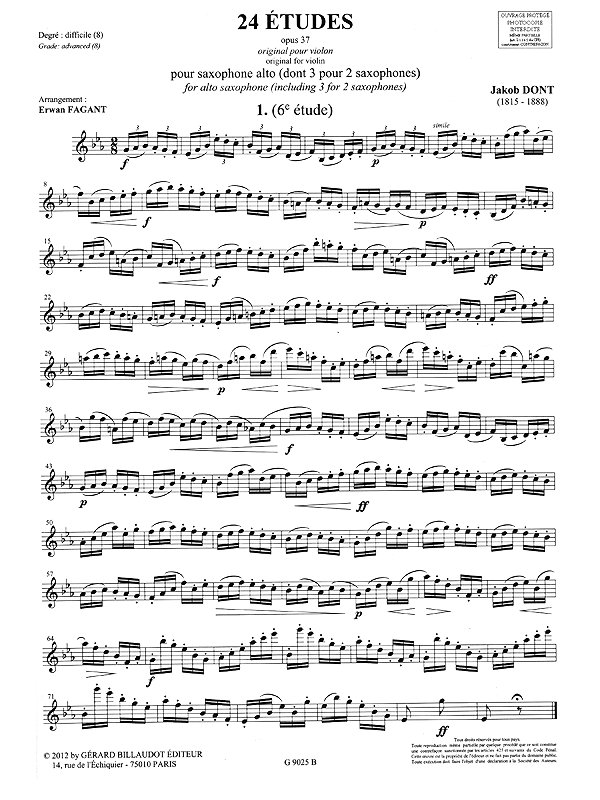
S1006: 24 Etudes Op. 37 by Jacob Dont arranged for saxophone by Erwan Fagant. Billaudot, 2012, SS, 39 pages. Originally for violin, the cover of this book says these caprices have been arranged for alto saxophone but there is no reason why they can't be played on other members of the saxophone family. There are three duets among the 24 etudes. The book also includes some suggested altissimo fingerings. The material in this book is in the publishers advanced category but is not as difficult as Rode studies listed above (S1005). Click on the cover image to view a sample page. |
25.95
|
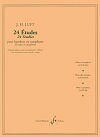 |
Ob160: 24 Etudes (24 Studies) for Oboe or Saxophone by Johann Heinrich Luft edited by Louis Bleuzet. Billaudot, 1926, SS, 43 pages. Johann Heinrich Luft (1813-1877) was a German oboist who worked in the Imperial Theaters of St. Petersburg as a principal player between 1840 and 1860. This is a well known and useful collection of studies at the upper intermediate level. Includes etudes in a variety of styles and in keys to five flats and six sharps.
|
27.45
|
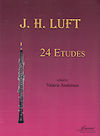 |
WW405: 24 Etudes for Oboe or Saxophone by Johann Heinrich Luft edited by Valarie Anderson. Jeanne, 2012, SS, 41 pages. This is a relatively new edition of these studies. Click on the cover image to view the first two lines of each study. |
17.75
|
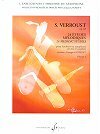 |
WW047: 24 Melodic Studies for Oboe or Saxophone Op. 65 Vol 1 by Stanislas Verroust edited by Georges Goudet. Billaudot, 1977, SS, 12 pages. Studies 1-12. Intermediate level.Free shipping on this music to the US IF ordered with another book or CD.
(Except other items with free shipping.) |
11.95
|
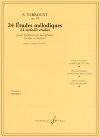 |
WW048: 24 Melodic Studies for Oboe or Saxophone Op. 65 Vol 2 by Stanislas Verroust edited by Georges Goudet. Billaudot, 1977, SS, 12 pages. Studies 13-24. Intermediate level.Free shipping on this music to the US IF ordered with another book or CD.
(Except other items with free shipping.) |
11.95
|
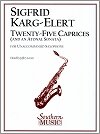 |
S047: 25 Caprices Op. 153 by Sigfrid Karg-Elert edited by Jeffrey Lerner. Southern Music Co., 1985, SS, 47 pages. These were written by the composer for saxophone in 1929 to serve as advanced studies. The studies are in major and minor keys from five sharps to six flats, and also include studies in the Lydian, Mixolydian, Phrygian, and Dorian. The book concludes with an atonal Sonata in four movments. The CD is a recording of the entire book played on various saxophones, soprano through baritone.
|
15.95
|
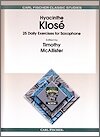 |
S037: 25 Daily Exercises for Saxophone by Hyacinthe Klosé edited by Timothy McAllister. Carl Fischer, 2014, SS, 32 pages. This is a new edition of this book which contains 25 technical studies that are suitable for third and fourth year students. It includes fingering suggestions provided by the editor. Click on the cover image to view a sample page. |
12.95
|
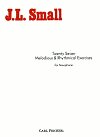 |
S204: 27 Melodious & Rhythmical Exercises for Saxophone or Oboe by J.L. Small. Carl Fischer, 1928, SS, 43 pages. Intermediate level. |
12.95
|
 |
WW013: 27 Virtuoso Studies for Saxophone or Oboe by Luigi Bassi transcribed by Gerardo Iasilli. Carl Fischer, SS, 67 pages. The etudes in this book are in a variety of tempos, styles, and keys. |
15.95
|
 |
S544: 28 Etudes for Saxophone on the Modes of Olivier Messiaen by Guy Lacour. Billaudot, 1972, SS, 57 pages. This series of studies is designed to familiarize saxophonists with the modes of limited transposition used by Olivier Messiaen. Each study is based on one of the seven modes or on one of their transpositions. |
27.95
|
 |
S089: 30 Great Exercises or Studies (Trente Grands Exercices ou Etudes) for All Saxophones after Soussmann Book 1 by Marcel Mule. Alphonse Leduc, 1944, SS, 31 pages. These advanced pieces are more exercises than etudes (many feature short phrases repeating through the range of the instruments and in different keys). Book 1 has 15 exercises starting in C and moving through the circle of fifths in major and minor sharp keys. Click on the cover image to view a sample page.
S090: 30 Great Exercises or Studies (Trente Grands Exercices ou Etudes) for All Saxophones after Soussmann Book 2 by Marcel Mule. Alphonse Leduc, 1944, SS, 31 pages. Book 2 has 15 exercises starting in A sharp minor and moving through the rest of the circle of fifths in major and minor flat keys. |
Book 141.30
Book 2
29.95
|
|
S775: 32 Etudes for Oboe or Saxophone by Ernest Loyon. Billaudot, 1925, SS, 32 pages. There are 32 one page studies at the advanced level in this book. Keys to 4 sharps and 6 flats and in a variety of rhythms and meters including 9/16 and 7/4.
|
20.95
|
|
S036: 35 Melodious Technical Exercises Transcribed for Saxophone by Domenico Gatti transcribed by Gerardo Iasilli. Carl Fischer, 1924, SS, 73 pages. These studies are more varied than the "Technical" in the name would suggest. They are in keys from 3 flats to 5 sharps and are probably suited for third and fourth year students and possibly a bit beyond. |
16.95
|
|
S950: 36 More Modern Studies for Solo Saxophone by James Rae. Universal Edition, 2012, SS, 36 pages. From the composer: "This book was written in the same format as 20 Modern Studies. The pieces are of moderate length and cover a wide variety of styles. As the studies are technically demanding, they are all written in comfortable saxophone keys to allow the student to focus on interpretation. Each study is designed to improve the student's musical as well as technical abilities." Musical styles presented range from classical to jazz to rock. It is ideal for developing musicianship and technique by way of accessible but challenging material. These studies make attractive performance pieces and are also perfect for contest and festival settings. For intermediate to advanced high school/early college level players.
|
21.95
|
|
S111: 48 Etudes by Ferling for Saxophone or Oboe by W. Ferling edited by Ronald L. Caravan. Ethos Publications, 2000, SS, 71 pages. Also includes Three Duos Concertants Op. 13 by Ferling. This book is described as being "enhanced for musical development" and includes two pages of notes as introduction, added dynamic markings in the slower etudes, explanation of ornaments, and fingering suggestions.
|
17.50
|
 |
Ob028: 48 Famous Studies for Oboe or Saxophone by W. Ferling, revised by Albert J. Andraud. Southern Music Co., SS, 47 pages. Also includes 3 duos concertants for two oboes or two saxophones by Ferling, 10 duos by Bernards, Beethoven Trio for Two Oboes and English Horn Op. 87, and pieces by Lunde and Stone. Note: the second parts for the duets are in a separate volume (listed in the Oboe section). This book is being used for the 2015-16 Texas All-State auditions for saxophone and the Association of Texas Small School Bands (ATSSB) auditions.
|
10.95
|
 |
S049: 48 Studies by Ferling for All Saxophones by Marcel Mule. Alphonse Leduc, 1946, SS, 30 pages. In addition to editing the 48 studies by Ferling for oboe, Professor Mule has written an additional 12 studies in major and minor keys. (Ferling did not include the enharmonic keys of C flat major, A flat minor, etc. in his work.)
|
34.95
|
|
/ S610: 48 Studies for Saxophone in E-flat Op. 31 by Franz Wilhelm Ferling edited by Daniel Schmidt with piano accompaniments by John Walker. Carl Fischer, 2010, SS, 55 pages, includes CD of the piano accompaniments performed John Walker (as MP3 files) and PDF files of the piano sheet music, so that the etudes may be performed in recital or for juries. Available for the first time, alto saxophone students can now play the Ferling etudes with accompaniment. This book/CD set provides the tried-and-true education of these 48 fantastic exercises supplemented with audio piano accompaniment, enhancing the practice experience. The preface of the book includes performance notes. |
14.95
|
 |
Ob159: 48 Studies Op. 31 for Oboe or Saxophone by Franz Wilhelm Ferling edited by Louis Bleuzet and Pierre Pierlot. Billaudot, 1970, SS, 24 pages. A very nice edition although the print is on the small side.
|
21.95
|
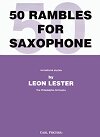 |
S026: 50 Rambles for Saxophone by Leon Lester. Carl Fischer, SS, 32 pages. One of the best books of supplemental pieces around. The melodic and rhythmic material in Lester's "rambles" will please not only young 2-3 year students, but adult beginners as well. |
11.95
|
 |
S056: 53 Studies for All Saxophones Book 1 by Marcel Mule. Alphonse Leduc, SS, 1946, 27 pages. After Boehm, Terschak, and Füstenau. Etudes 1-18.
S057: 53 Studies for All Saxophones Book 2 by Marcel Mule. Alphonse Leduc, SS, 1946, 27 pages. After Boehm, Terschak, and Füstenau. Etudes 19-35
S058: 53 Studies for All Saxophones Book 3 by Marcel Mule. Alphonse Leduc, SS, 1946, 27 pages. After Boehm, Terschak, and Füstenau. Etudes 36-53.
Note: These books are not progressive in difficulty, except that each book starts with etudes in the key of C and progresses to five or six flats or sharps. |
Book 137.35
Book 2
37.35
Book 3
37.35
|
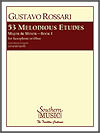 |
Ob032: 53 Melodious Etudes for Saxophone or Oboe Book 1 (1-25) by Gustavo Rossari, transcribed and arranged by Gerardo Iasilli. Southern Music Co., 1966, SS, 27 pages. |
14.95
|
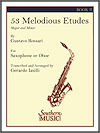 |
Ob033: 53 Melodious Etudes for Saxophone or Oboe Book 2 (26-53) by Gustavo Rossari, transcribed and arranged by Gerardo Iasilli. Southern Music Co., 1966, SS, 32 pages. |
19.95
|
 |
S1317: 64 Musical Studies for Saxophone edited by Rami El-Farrah. Southern Music Co., 2020, SS, 32 pages. This is a compendium of Baroque, Classical, and Romantic-era masterpieces arranged for saxophone. The works are written to serve as a primer to the Ferling Studies or other similar studies. Each lyrical study has been crafted to create a balance of musicality and pedagogy that allows students to improve on all aspects of performance. Players are encouraged to choose works that align with their musical goals, not necessarily in the listed order. Each piece is carefully formatted with style-appropriate dynamics, articulations, and tempos, all of which are carefully tailored to the saxophone. These musical studies give saxophonists the opportunity to experience compositions by Wolfgang Amadeus Mozart, Carl Philipp Emanuel Bach, Ernesto Köhler, Carl Maria von Weber, and many more. Intermediate level with considerable variation within that category. |
12.95
|
 |
S431: 80 Graded Studies for Saxophone Book 1 selected and edited by John Davies & Paul Harris. Faber Music, 1988, SS, 22 pages. This book has studies 1-46 which range from absolute beginner to intermediate. (Note that there aren't any grades assigned to these, the title apparently referring the careful arrangement by progressive difficulty.) The studies are drawn from works by Baermann, Brod, Demnitz, Fetzen, Freillon-Poncein, Garnier, Hinke, Klose, Langey, Lazarus, Prelleur, Stark, Wiedemann and has several original etudes by Harris. Includes a glossary of terms.
S432: 80 Graded Studies for Saxophone Book 2 selected and edited by John Davies & Paul Harris. Faber Music, 1990, SS, 32 pages. This book has studies 47-80 which range from the intermediate level to the advanced intermediate (with a few beyond). The studies are from the works of Arban, Baermann, Blatt, Brod, Demnitz, Ferling, Garnier, Hinke, Langey, Luft, Stark, and Vithum along with some original etudes by Harris. Includes a glossary of terms.
|
Book 111.95
Book 2
12.95
|
 |
S039: 158 Saxophone Exercises by Sigurd M. Raschèr. Wilhelm Hansen, second edition 1968, SS, 61 pages. This extensive series of exercises is based on chords. Some fingering suggestions are provided and the text is in English and German. Overstock Special! While supplies last. Regular price is $14.95. |
14.95
|
 |
S367: The Altissimo Primer by Paul Cohen. To the Fore Publishers, 2014, SS, 45 pages. This book serves as an introduction to the development of altissimo as a natural extension of range. It provides an overview of the overtones and a set of fingerings for the altissimo. Most of the books is devoted to a series of exercises focusing on Scales and Arpeggios, The Equality of Registers, and Cultivating an Artistic Facility. This book now says "Edition 2014" on the cover but I can't tell what may have changed. |
14.95
|
 |
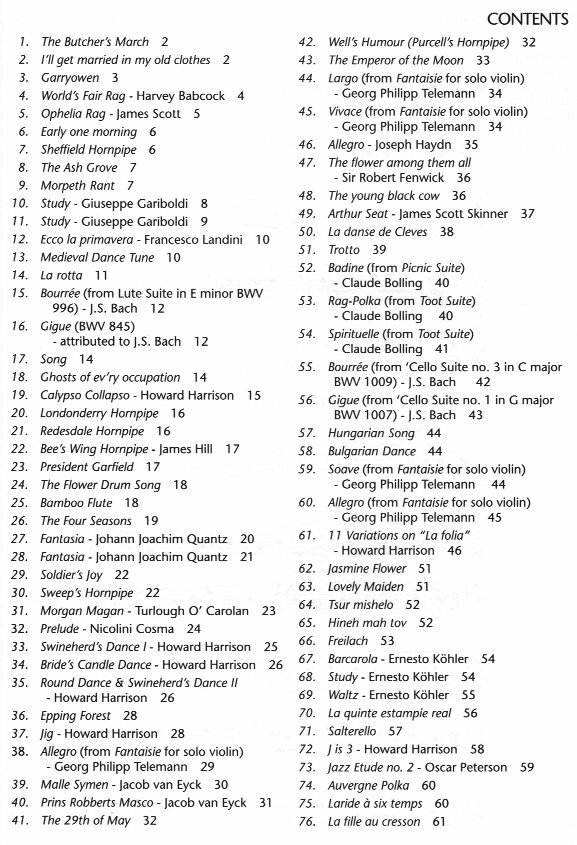
S064: Amazing Studies Saxophone by Howard Harrison. Boosey & Hawkes, 1997, SS, 62 pages. Howard Harrison has collected and arranged 76 pieces for unaccompanied saxophone. They include material drawn from both classical and folk music, with many dances included. Each piece was selected to develop a specific aspect of technique. There is an index to help you find the right study for each technical problem. This book is at the intermediate level. Click on the cover image to view the table of contents. |
24.95
|
 |
S1226: Bach Shapes by Jon De Lucia. Musaeum Clausum Press, 2017, PB, 88 pages. This is a new method book for saxophone that utilizes baroque melodies for interval practice and jazz improvisation. "My idea was to distill some of the iconic scale sequences in Bach’s music into patterns that one could work through all keys, and possible apply to improvisation, though the book is useful for musicians of all styles of music," says the author. He has an extensive description of his book here. Click on the cover image to view a sample page. |
18.95
|
 |
S1205: Basic Technique for All Saxophones by Jack Snavely. Kendor Music Inc., 1970, SB, 82 pages. The book presents scale and chord based exercises in all major and minor keys. It prepares students for complete technical mastery of the instrument. Click on the cover image to view two sample pages. |
19.95
|
 |
S571: Beginning Studies in the Altissimo Register for Saxophone by Rosemary Lang revised and edited by Gail B. Levinsky. Ensemble Publications, 2009, SS, 44 pages. This popular book (originally published in 1971) is now back in print in a new edition. Rosemary R. Lang (1920-1985) was a faculty member at Butler University from 1948 until her death. Gail B. Levinsky is on the faculty at Susquehanna University and was a music student at Butler during the 1970s. This book begins with fundamental techniques for producing altissimo register tones, it provides fingerings for the alto and tenor saxophone with numerous exercises and studies.
|
15.95
|
|
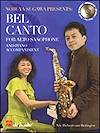
PA051: Bel Canto for Alto Saxophone and Piano Accompaniment arranged by Robert van Beringen. De Haske, 2006, SS, 53 + 25 pages + CD. This book contains a collection of melodic studies that were originally composed for the singing voice by Giuseppe Concone, Mathilde Marchesi and Francesco Tosti (brief biographies are included). As there are many similarities in the techniques of singers and wind players, they are also ideally suited to playing on the saxophone. In particular phrasing, breathing and dynamics are dealt with extensively in these tuneful pieces. This book has 20 pieces at the intermediate and upper intermediate level. The CD includes well-known saxophonist Nobuya Sugawa demonstrating the pieces. Many of the accompanying tracks on the CD have been recorded at multiple tempos.
|
15.95
|
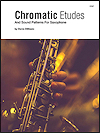 |
S1318: Chromatic Etudes and Sound Patterns for Saxophone by Denis DiBlasio. Kendor Music, 2019, SS, 34 pages. This book by saxophonist Denis DiBlasio contains two sections: chromatic etudes and sound patterns. The 5 etudes explore the chromatic scale, and the performer is encouraged to experiment with interpretation. The 20 sound patterns develop technique, expand the improvisation palette and build on ear training. Intermediate level and up. Click on the cover image to view the table of contents and a sample page.
|
14.95
|
 |
G061: Complete Method for Rhythmical Articulation by Pasquale Bona translated from the fourth Italian edition by Gustav Saenger. Carl Fischer, SS, 72 pages. This is the treble clef edition. This book is in three parts with the first two intended for vocalists and all three parts for instrumentalists. The exercises and etudes (120 in all) which focus on rhythm (not articulation) are progressively more difficult. Some of the exercises have a few notes below the range of the flute, oboe, and saxophone. |
13.95
|
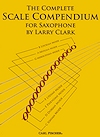 |
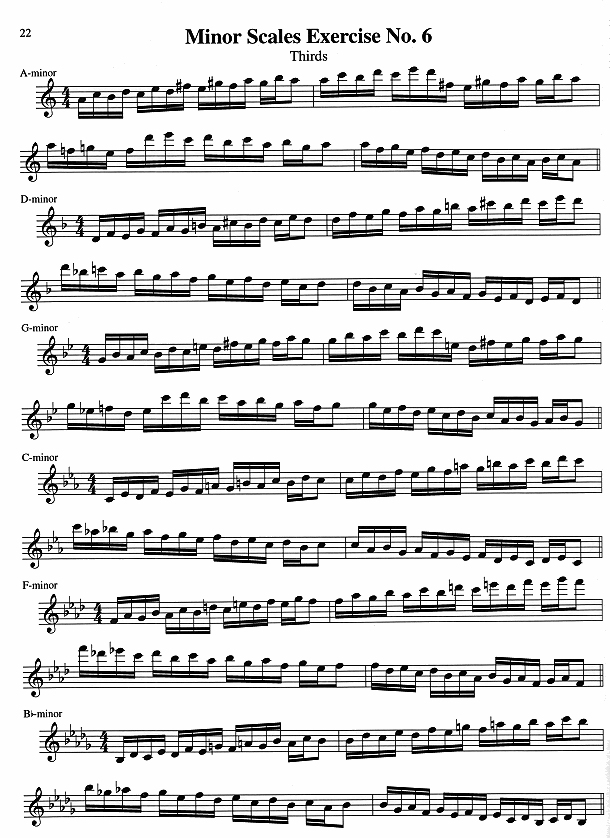
S1038: The Scale Compendium for Saxophone by Larry Clark. Carl Fischer, 2014, SS, 64 pages. This book presents a wide variety of scales in two contexts. First by time of scale and then arranged by key. Included are (all in major and minor except the whole tone and chromatic scales): long tones, scale and arpeggio, tetrachords ascending and descending, mode, thirds, arpeggiated diatonic chords, chromatics, blues scales, and pentatonic scales. Includes a preface and scale theory. Click on the cover image to view a sample page. |
14.95
|
 |
S027: Contemporary Chordal Sequences for Saxophone - 144 Technical Studies by Kalmen Opperman. Carl Fischer, SS, 48 pages. Contemporary composers are writing more technical, exotic lines for the saxophone. The exercises in this book are intended to support and extend the technical expertise of students and professionals required to perform this modern music. |
16.95
|
 |
G068: Contemporary Rhythm & Meter Duets for Treble Clef Instruments by Elliot Del Borgo. Meredith Music Publications, 1996, SS, 31 pages. Based on the concept of Contemporary Rhythm & Meter Studies, these fourteen, two-page duets make extensive use of metric and rhythmic devices, and harmonic and tonal devices commonly found in 20th Century works. They are ideal for any instrument for developing sight-reading skills as well as recital performance, jury exams, and lesson material. |
9.95
|
 |
G066: Contemporary Rhythm & Meter Studies for Treble Clef Instruments by Elliot Del Borgo. Meredith Music Publications, 1996, SS, 31 pages. These 28 etudes make extensive use of metric and rhythmic devices found in 20th century works. Composed as recital/performance pieces, all melodic material is derived from a variety of contemporary patterns including synthetic scales, 12-tone and 7-tone rows, cell-derived patterns, modal scales and traditional major and minor tonalities. |
9.95
|
 |
S083: Daily Exercises (Exercices Journaliers) for All Saxophones after Terschak by Marcel Mule. Alphonse Leduc, 1944, SS, 37 pages. Twenty-six technical exercises based on the works of flutist Adolf Terschak for better intermediate and advanced students. Keys range from 7 sharps to 5 flats. (We have copies of this piece on sale here.) |
36.25
|
 |
S023: Daily Studies for All Saxophones by Trent Kynaston. Alfred Publications, SS, 48 pages. This book includes scales (major, harmonic minor, melodic minor, whole tone, diminished, and chromatic), Arpeggios (13 types), three articulation etudes, and 10 tuning etudes (designed to aid in conditioning students to play in tune). |
14.95
|
 |
S018: Daily Studies for the Improvement of the Saxophone Technique by Larry Teal. Etoile Music/Keiser Classical, 1972, printing of 2009, SS, 40 pages. A useful volume of studies. Included are exercises covering scales, arpeggios, intervals, staccato, chord progressions, trills, alternate fingerings and more. |
19.95
|
 |
S248: On the Exactness of Intonation (De la Justesse d'Intonation) for all Saxophones Jean-Marie Londeix. Alphonse Leduc, 1981, SS, 24 pages. This is a series of exercises for developing the skills needed to play in tune. It is in two sections, first for two saxophones in the same key followed by the same exercises but for a B-flat and E-flat saxophone playing together. The exercises are on octaves, fifths, fourths, major thirds, and minor thirds. |
37.35
|
 |
S188: Studies for Alto Saxophone and Piano (Études pour saxophone alto et piano) Op. 188 by Charles Koechlin. Billaudot, 1970, SS, 60 + 27 pages. Few sets of etudes have piano accompaniment and fewer still have been recorded. These were written by French composer Charles Koechlin (1867-1950) in the the period 1942-44 with each piece dedicated to a specific technique or sound. Included in the fifteen etudes are both intermediate and advanced pieces.
  |
31.95
|
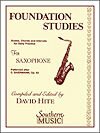 |
S032: Foundation Studies for Saxophone by David Hite. Southern Music Co., 1992, SS, 64 pages. This book is based on the Baermann Book 3 studies (for clarinet) of scales, chords and intervals that have been adapted for the saxophone and further extended by the editor. A very useful book. |
19.95
|
 |
S344: Grands Exercices Journaliers de Mécanisme by Paul Taffanel and Philippe Gaubert adapted for saxophone by Frédéric Juranville. Leduc, 1992, SS, 49 pages. This is the famous T&G exercises for flute adapted for saxophone. The English title of this edition is Big Daily Finger Exercises although the flute version is often called 17 Daily Exercises for the Flute.
|
32.45
|
 |
S1045: Groove Connection Alto Sax (Volume 1) by Klaus Dickbauer. Universal Edition, 2014, SS, 39 pages + CD. A new approach! We tend to take up music study, because we enjoy playing our instrument. Working on scales and arpeggios often seem like drudgery, so Dickbauer puts them "in context" to make them as enjoyable as playing for fun. However, this book is much more than just scales. The Groove Connection is published for various instruments, but all are designed to work together in duo, trio, and larger ensemble enjoyment. The included CD is useful for classroom and individual study. Click on the cover image to view sample pages from this book. |
26.95
|
 |
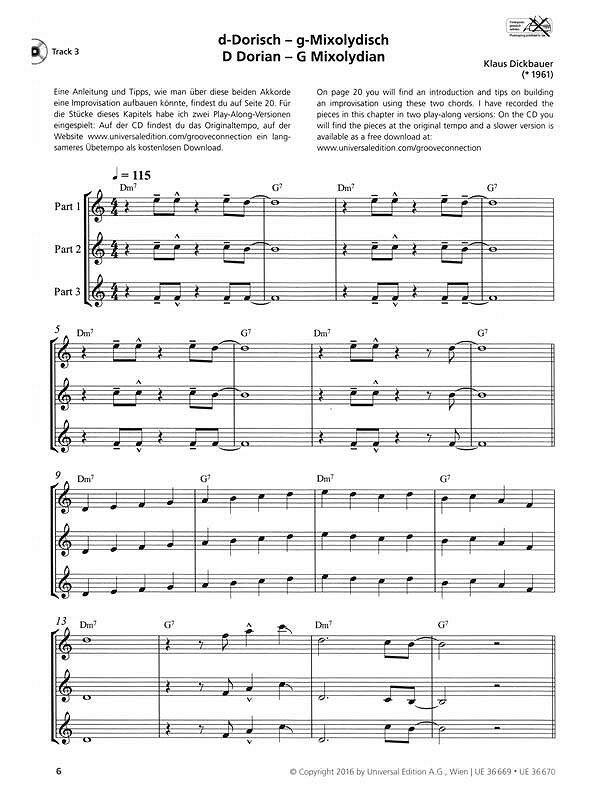
S1199: Groove Connection Alto Sax (Volume 2) by Klaus Dickbauer. Universal Edition, 2016, SS, 44 pages + CD. Klaus Dickbauer believes that scales can be fun. His modern approach to elementary technique can be a highly effective training tool for developing improvisation skills. In the first volume, Dickbauer covered major scales, triads, and interval exercises, combined with groovy beats, in a fresh and contemporary way. He now continues his well-thought-out approach to scales with a concentration on Dorian, Mixolydian, pentatonic, and blues scales, the perfect tools for building first improvisation skills. Methodically sound exercises train students in patterns and motifs to equip them with a sense of confidence and an appetite for learning the art of improvisation. Some of the exercieses have three parts. The CD will be a valuable aid for learning improvisation. Click on the cover image to view a sample page from this book. |
24.50
|
 |
S1046: Groove Connection Tenor Sax (Volume 1) by Klaus Dickbauer. Universal Edition, 2014, SS, 39 pages + CD. Like S1045 (above) but for tenor sax. Click on the cover image to view sample pages from this book. |
26.95
|
 |
S1200: Groove Connection Tenor Sax (Volume 2) by Klaus Dickbauer. Universal Edition, 2016, SS, 44 pages + CD. Like S1199 (above) bur for tenor sax. Click on the cover image to view a sample page from this book. |
24.50
|
 |
S030: Hello! Mr. Sax by Jean-Marie Londeix. Alphonse Leduc, 1989, PB, 113 pages. Subtitled: Parameters of the Saxophone. Text is in French and English. Much of this book is devoted to extended techniques such as multiphonics, microtones, and special techniques of timbre and articulation. However, there sections on vibrato and other techniques that will be of interest to nearly all. Bass through sopranino are covered. |
57.80
|
 |
S249: Intonation Exercises (Exercises d'intonation) by Jean-Marie Londeix. Alphonse Leduc, 1994, SS, 28 pages. This series of exercises to improve intonation are to be played with another instrument sounding the fundamental note. Londeix recommends an organ and says that a cheap electronic one will be just fine. These exercises can be used with both E-flat and B-flat saxophones. A chart is also included for corrective fingerings to sharpen or flatten a note. Instructions are in French, English, and German. |
34.85
|
 |
S123: Mechanical Exercises (Exercises Mecaniques) Vol. 1 by Jean-Marie Londeix. Henry Lemoine, 1961, SS, 24 pages. This book has 32 exercises and instructions and explanations in French and English. These exercises are all between two notes (basic interval exercises). This volume also includes the key to fingering notations in Londeix's book from this publisher.
S124: Mechanical Exercises (Exercises Mecaniques) Vol. 2 by Jean-Marie Londeix. Henry Lemoine, 1961, SS, 19 pages. These exercises, which are in four note groups, are more advanced than the first volume.
S125: Mechanical Exercises (Exercises Mecaniques) Vol. 3 by Jean-Marie Londeix. Henry Lemoine, 1961, SS, 9 pages. More exercises in the same style as volume 2.
|
Vol. 121.95
Vol. 2
17.95
Vol. 3
16.95
|
 |
S368: Melodic Etudes by Ted Hegvik. Northeastern Music Publications, 2007, SS, 36 pages. Subtitled: A Lyric Approach to the Saxophone. It contains a series of short progressive studies for the development of tone, style, and basic saophone idioms. It is a supplemental book for use with any of the standard methods from the very beginning to the early intermediate level. It also includes a four page history of Adophe Sax and his times.
|
12.95
|
 |
S092: Melodious and Progressive Studies for Saxophone Book 1 edited by David Hite. Southern Music Co., 1988, SS, 64 pages. Includes Demnitz: 36 Expressive Studies, Nocentini: 9 Melodic Studies, Baermann: 14 Melodic Etudes, Kayser: 5 Progressive Studies, and major and minor scales. |
15.95
|
 |
S093: Melodious and Progressive Studies for Saxophone Book 2 edited by David Hite. Southern Music Co.,1991, SS, 63 pages. Includes Gambaro: 16 Caprices, Dont: 14 Etudes from Op. 37, and 24 special studies from Berr, Ferling, Lazarus, Ries, Spohr, Kreutzer, etc. |
17.95
|
 |
S094: Melodious Etudes for Saxophone compiled and edited by Larry Clark and Sean O'Loughlin. Carl Fischer, 2003, SS, 80 pages. These 54 etudes are a bit different from the familiar since they are based on vocalises of Marco Bordogni (1788-1856). The etudes are in a variety of keys and difficulty levels from perhaps mid-second year through fourth year of study. There are some pieces in keys with up to five flats or sharps that should prove useful to third year students. |
12.95
|
 |
WW154: Method for Oboe or Saxophone (2nd Part: Progressive Studies) by Joseph Sellner edited by L. Bleuzet. Billaudot, SS, 60 pages. The book contains a large number of short (1 to 3 lines) exercises in keys to four sharps and four flats. Lots of material to practice.
|
26.95
|
 |
S1208: Modern Saxophone Techniques by Frank Catalano. Hal Leonard, 2016, PB, 101 pages with online audio access. Many books present facts, but Modern Saxophone Techniques teaches the developing player how to learn. The concepts presented will keep players learning, maturing, and mastering the saxophone. In the online video, author and virtuoso saxophonist Frank Catalano offers quick tips on many of the topics covered in the book. “In the Band” allows saxophonists to play along on six tunes and studies. Topics include: developing good rhythm; air stream and embouchure; intervals, melodies and bass lines; fingering charts; tonguing techniques; modern harmony tips; split-tones and sub-tones; and an extensive set of exercises in a variety of keys. Here are more details from the publisher's website.
|
24.95
|
 |
S084: New Varied Studies in All Keys by Jean-Marie Londeix. Alphonse Leduc, 1986, SS, 27 pages. Twenty-five etudes from Blumenstengel, Dont, Gaviniès, Kreutzer, Paganini, and Rose with "extreme" high notes. An opportunity for better intermediate and advanced students to practice the altissimo register. |
32.75
|
 |
S205: Neuf Études Transcendantes (Nine Transcending Etudes) by Noël Samyn. Billaudot, 1977, SS, 19 pages. This is a title that does not translate into English in any meaningful way. These are advanced studies designed to incorporate the high altissimo into the repertoire of the performer. These are not altissimo exercises, however, but studies that use the entire range of the instrument. Some fingering suggestions are given.
|
14.95
|
|
Ob109: Oboe, Flute or Sax Scales for Reading by Christopher Weait. Christopher Weait, 2006, SB, 79 pages. These scale and arpeggio patterns are based upon the premise that instrumentalists need to know how scales and arpeggios look in order to be fluent sight-readers and improve finger technique. They are divided into lower and upper registers and progress through 15 keys, including the enharmonic keys. Accidentals are used for each key rather than key signatures. Scales included are: majors with tonic arpeggios, harmonic minors with minor arpeggios, melodic minors with tonic seventh arpeggios, chromatics, whole tones with augmented arpeggios, octatonics (diminished scales) with diminished seventh arpeggios, pentatonic and blues scales. |
25.95
|
|
S580: Paganini for Saxophone (24 Capricci Op. 1) arranged by Raaf Hekkema. Schott, 2009, SS, 61 pages. These are very challenging arrangements for soprano or alto saxophone of Paganini's 24 Caprices Op. 1. Perfect for the advanced student, they feature high altissimo and a few multiphonics. A preface gives an explanation of Dutch saxophonist Hekkema's process of developing these arrangements. There are also short notes on each piece.
|
19.95
|
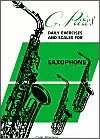 |
S038: Parès Daily Exercises and Scales for Saxophone by Gabriel Parès revised by E. Claus. Carl Fischer, 1912, SS, 36 pages. A basic book of scales and scale based exercises through 4 flats and 4 sharps. It also includes chromatic scales and a few other exercises. |
9.95
|
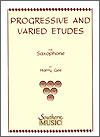 |
S033: Progressive and Varied Etudes by Harry Gee. Southern Music Co., 1992, SS, 64 pages. The book includes study of the embouchure, vibrato, and altissimo (alto saxophone). It includes etudes by Barret, Bach, Ferling, Koehler, and more. It also includes three duets for like saxophones and two duets for alto and tenor saxophones. |
29.95
|
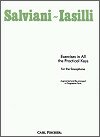 |
S588: Salviani - Iasilli Exercises in All the Practical Keys for the Saxophone. Carl Fischer, 1940, SS, 78 pages. This book has the 16 Salviani-Iasilli exercises in all each of the major keys from four flats and four sharps.
|
16.95
|
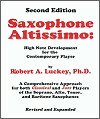 |
S121: Saxophone Altissimo: High Note Development for the Contemporary Player by Robert A. Luckey. Olympia Music Publishing, 1998 (Second Edition), SB, 207 pages. This book features over 300 high note fingerings for the soprano, alto, tenor, and baritone saxophones. It includes excerpts from selected classical alto saxophone solos with recommended fingerings for altissimo tones, as well as overtone exercises and extended range exercises. There are also challenging jazz etudes incorporating the altissimo register that can be performed with Jamey Aebersold's Play-Along, Volume 43, Groovin' High.
|
29.95
|
 |
S1139: Saxophone Aerobics by Woody Mankowski. Hal Leonard, 2015, PB, 110 pages, with downloadable demo and backing tracks. This book contains 365 short exercises to develop a variety of techniques primarily with a jazz orientation. Click on the cover image to view a sample page.
|
19.95
|
 |
S019: Saxophone High Tones by Eugene Rousseau. MMB Music Inc., 1978, 2002, SS, 81 pages, second edition. The ability to exhibit fluency in playing above the saxophone's normal range is no longer a frill or an option, it is a necessity. This book provides the tool to develop and extended range on the soprano, alto, tenor and baritone saxophone. It includes a fingering chart for the normal range and the high tones, exercises that teach the techniques required for high tone production, and exercises to practice these techniques. |
29.95
|
 |
S804: The Saxophone Intonation Workbook by Trent Kynaston. Advance Music, 2006, SS, 54 pages + CD. This book is a thorough, organized approach to saxophone intonation. Basic concepts of embouchure and breathing, understanding the role of your equipment, and developing voicing techniques are all explored. Included are scale and arpeggio studies along with a CD to practice tuning on the alto and tenor saxophones. This is a must for all developing saxophonists. Click on the cover image to view Table of Contents and what is on the CD. |
25.95
|
 |
S605: Saxophone Sight-Reading 1 by John Kember and Graeme Vinall. Schott, 2007, SS, 100 pages. This is not, in my opinion, a book for sight reading but a series 150 supplementary studies from the very beginning to the intermediate level. It moves quite slowly adding notes, keys, and rhythms progressively. This book includes short solos, duets and pieces with piano accompaniment (for both E-flat and B-flat saxophones). Swing style is also introduced in the latter part of the book. This will be a valuable supplement for traditional methods.
|
14.95
|
 |
S382: The Saxophonist's Manual by Larry Teal. Encore Publications, 1978, SS, 40 pages. Subtitled "A Handbook of Basic Concepts," this book is intended to be used in conjunction with beginning methods to help students in certain fundamental practices not usually included in those methods. It should precede the Saxophonist's Workbook (below). It covers posture, hand and finger position, embouchure, breathing, intonation and ear training, vibrato, articulation, tonal shaping, scales, chords, arpeggios, and more. The size and format of this book make it more suitable for use in lessons than the author's The Art of Saxophone Playing which has more detailed coverage of these concepts. |
13.95
|
|
S113: Scales and Arpeggios, Fundamental Exercises for the Saxophone Book 1 by Marcel Mule. Alphonse Leduc, SS, 1948, 30 pages. This book includes scales, scales in thirds, arpeggios, arpeggios on the dominant seventh chord in all major and minor keys. Instructions are in French, English, German, Spanish, and Japanese.
S114: Scales and Arpeggios, Fundamental Exercises for the Saxophone Book 2 by Marcel Mule. Alphonse Leduc, SS, 1946, 36 pages. This book provides more extended exercises on the same material as book 1. Instructions (in the same languages as above) are given at the beginning of the book and then the exercises are presented in an abbreviated form. Major and minor keys through four flats and sharps.
S115: Scales and Arpeggios, Fundamental Exercises for the Saxophones Book 3 by Marcel Mule. Alphonse Leduc, SS, 1946, 36 pages. This book begins with a continuation of the exercises from Book 2 in the remaining keys. They are followed by exercises on chromatic scales, whole tone scales, and augmented fifths.
|
Book 137.35
Book 2
35.55
Book 3
50.70
|
 |
S142: The Scales by Steps and by Intervals (Les Gammes Conjointes et en Intervalles) by Jean-Marie Londeix. Henry Lemoine, 1962, SS, 33 pages. Scales and interval exercises (seconds through octaves) in all major and minor keys. Practice instructions and a few suggested fingerings are given. |
21.95
|
 |
S029: Scales for the Saxophone by Sigurd M. Raschèr. McGinnis & Marx, 1965, SS, 25 pages. A very useful book of scales and scale based exercises. A highlight of this book is the presentation of scales in a variety of rhythms. Some suggested fingerings are given. |
11.95
|
 |
S065: Selected Studies for Saxophone by Himie Voxman. Rubank, 1942, SS, 76 pages. Intermediate-advanced level etudes drawn from many composers in all major and minor keys, plus scales, scales in thirds, and arpeggios. |
8.95
|
 |
S040: Les Sons Multiples aux Saxophones by Daniel Kientzy. Salabert, 1982, PB, 80 pages. Multiphonic fingerings for the sopranino, soprano, alto, tenor and baritone saxophones. French and English text. |
41.95
|
 |
S126: Staccato (Le Detache) by Jean-Marie Londeix. Henry Lemoine, 1967, SS, 18 pages. Exercises to help improve the quality and speed of staccato. They will also gradually help increase the instruments compass through training in the altissimo. Includes some suggested fingerings. |
18.95
|
 |
S1149: Step by Step Saxophone by James Rae. Universal Edition, 2015, SS, 44 pages. A collection of twenty-one easy progressive studies for the beginner and suitable for all saxophones. An optional teacher's part is included designed to give support and encouragement in the lesson. Each study has, on its facing page, clearly defined objectives with tips for successfully acquiring specific skills and space is provided for the teacher's comments for the pupil's easy reference when practicing at home. Pupil/teacher warm-up exercises precede each piece. |
19.95
|
 |
S705: Stratosphere: Altissimo Etudes for Saxophone by Noah Getz. Advance Music, 2011, SS, 47 pages. This book of altissimo etudes is by Dr. Noah Getz, a Washington DC based classical and jazz saxophonist and music educator. In addition to the 20 etudes, this book also includes a brief history of the altissimo register, considerations for developing the altissimo register, and a one page listing of works that include the altissimo register. |
24.95
|
 |
S024: Technique of the Saxophone Vol. 1, Scale Studies by Joseph Viola. Berklee Press, PB, 168 pages. These studies are intended to build a solid base of technique and aid in mastering intonation. This book consists of tonal and polytonal variations in major scales, diads, triads, tetrads, pentads, hexads, and septads.
S025: Technique of the Saxophone Vol. 2, Chord Studies by Joseph Viola. Berklee Press, PB, 162 pages. This book focuses on chord studies in 15 keys, summary studies, and studies on chord sequences.
S048: Technique of the Saxophone Vol. 3, Rhythm Studies by Joseph Viola. Berklee Press, PB, 123 pages. This book features syncopated rhythms and unconventional rhythmic notation to challenge the strongest of readers, double-time exercises in a variety of meters, and 15 etudes incorporating all of the rhythmic concepts presented.
These studies were developed to teach skills that are primarily used in jazz, however, they are not jazz studies. They will be valuable to any saxophonist who wants to improve technique. |
Vol. 119.95
Vol. 2
19.95
Vol. 3
19.95
|
 |
S028. Top-Tones for the Saxophone by Sigurd M. Raschèr. Carl Fischer, SS, 31 pages. Third Edition. This book is the key to mastering the extended upper range of the saxophone. It includes exercises to develop the technique necessary to produce the overtones necessary and fingerings for the tones above top F. Applicable to all saxophones. This book also includes the text in German. |
13.95
|
 |
S091: Varied Studies (Études Variées) in All Keys adapted by Marcel Mule. Alphonse Leduc, 1950, SS, 31 pages. Thirty etudes by the usual suspects (Dont, Kreutzer, Mazas, Paganini, Rode, etc.) at the advanced intermediate level.
|
40.90
|
 |
S729: The Vandoren Etude and Exercise Book for the Saxophone. Carl Fischer, 2011, PB, 84 pages. Subtitled: The Secrets of Ten Master Saxophonists. The Vandoren Company and Carl Fischer Music have teamed up with ten of the finest saxophonists in the world to create a one-of-a-kind etude and exercise book. Each of these saxophone masters share their inner secrets of saxophone playing. This eclectic collection covers a wide range of challenges to mastering the saxophone, containing etudes to develop tone, technique, lyricism, and overall musicianship. No serious student or teacher should be without the innovative wisdom of this collection, which also includes warm-ups, altissimo fingerings and exercises, a complete quarter-tone fingering chart as well as Arabic rhythmic and melodic exercises. Featuring contributions from Serge Bertocchi, Paul Bro, James Bunte, Claude Delangle, Susan Fancher, Steven Mauk, Otis Murphy, Nicolas Prost, Neal Ramsay, and Matthew Sintchak.
|
24.95
|
 |
S835: Voicing, an Approach to the Saxophone's Third Register by Donald Sinta. Meridian Winds, SB, 85 pages. Proficiency in the altissimo register is a necessity for the contemporary saxophonist. This book is a series of exercises that are designed to yield insight, develop control over the supporting physiology, reduce anxiety and failure, and allow and serious student to master this frequently elusive range. This book is the same as the previously available edition of this book with the addition of 6 pages on Donald Sinta. |
24.95
|