Clarinet Music - Solo (Unaccompanied)




Music marked "New!" in gold type is a new publication. Music marked "New!" in teal type is new to our stock.
|
 C2123: Tico-tico no fubá for Clarinet Solo by Zequinha de Abreu arranged by Florent Héau. Billaudot, 2014, SS, 2 pages. This is a famous piece of Brazilian choro music composed by Zequinha de Abreu in 1917. The title can be translated as "sparrow in the cornmeal." It has been arranged for many instruments and also we have editions for clarinet quartet and clarinet choir. This version is at the upper intermediate level and has a duration of about 3 minutes. C2123: Tico-tico no fubá for Clarinet Solo by Zequinha de Abreu arranged by Florent Héau. Billaudot, 2014, SS, 2 pages. This is a famous piece of Brazilian choro music composed by Zequinha de Abreu in 1917. The title can be translated as "sparrow in the cornmeal." It has been arranged for many instruments and also we have editions for clarinet quartet and clarinet choir. This version is at the upper intermediate level and has a duration of about 3 minutes.(Except other items with free shipping.) |
11.95

|
|
C932: Canto XIV (A Klezmer Fantasy for Clarinet Solo) by Samuel Adler. Ludwig Music, 1998, 4 pages. Samuel Adler (1928-) was born in Germany and came to the United States in 1939. He has more than 400 published works. This piece is dedicated to Franklin Cohen. The composer notes that it may be performed as written or with the addition of Klezmer effects. This is an advanced work that ranges high into the altissimo and is in rather small print. The publisher of this piece has closed. We do not have any more stock. We understand that the music has been purchased by another publisher, but we do not have any timeframe for availability.
(Except other items with free shipping.) |
5.95
|

|
C2202: Saints Preserve Us for Solo Clarinet by William Albright. Edition Peters, 1987, 5 pages (plus a page of notes). William Albright (1944-1998) was an American composer, pianist and organist. This is a contemporary work in three movements, subtitled Three Études-prières (prayers) for solo clarinet. The movements are I. St. John of the Cross, II. St. Joan at the Stake, and III. St. Vitus Dance. The notes include stage and movement directions. This is a college level work with a duration of about 5 minutes. Click on the cover image to view the first page.
(Except other items with free shipping.) |
15.95
|
|
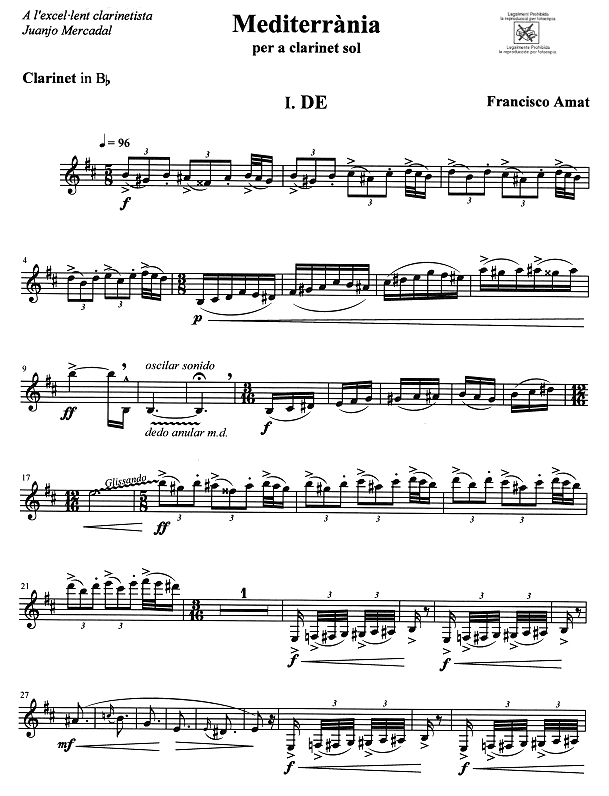
C2563: Mediterrània for solo clarinet by Franciso Amat. Brotons & Mercadal Edicions Musicals SL, 2010, SS, 4 pages (plus a page of notes). This is a piece for solo clarinet, written specially for the First Clarinet Competition "Ciutat de Dénia" 2010 (Alicante). The work has three movements, entitled DE-NI-A in honor of this town in the province of Alicante. The third movement is called A as it is written in A minor and also corresponds to the last letter of the name of the town of Dénia. All the movements in this piece are written in a minor key. The composer wrote that it is important to respect all the dynamics and the metronome speeds. College level with quite a bit of mixed meter. Click on the cover image to view the first page.
(Except other items with free shipping.) |
21.95
|
|
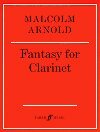
C561: Fantasy for Clarinet Op. 87 by Malcolm Arnold. Faber Music, 1966, SS. A short, sectional solo piece commissioned by the City of Birmingham Symphony Orchestra for an international wind competition. The technical aspects requires quick arpeggios and sudden changes of dynamics. It is a good first unaccompanied work for a beginning level college student. 
(Except other items with free shipping.) |
11.95
|
|
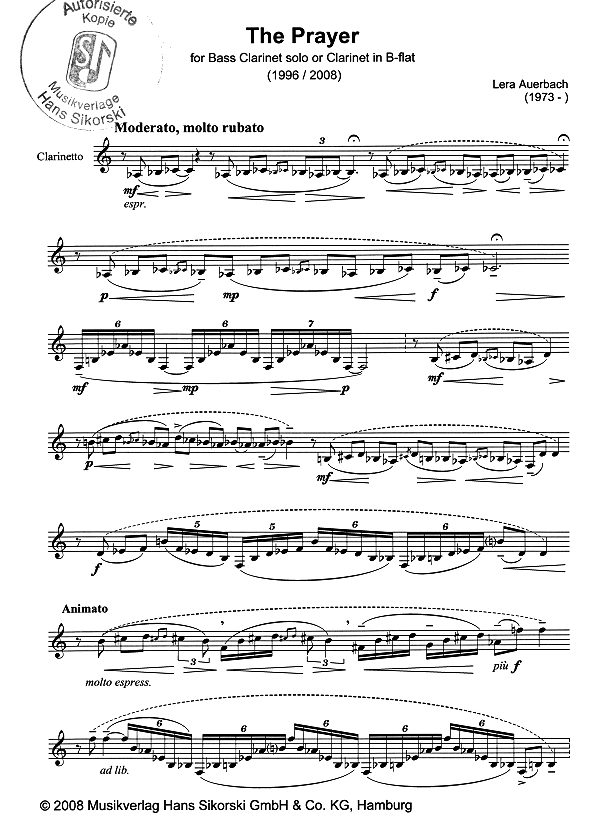
C2140: Prayer for Solo Bass Clarinet or Clarinet by Lera Auerbach. Sikorski, 2008, SS, 4 pages. Lera Auerbach (1973-) is a Russian-born American composer and pianist. This is a college level work with a duration of about 7 minutes. It has a variety of tempos and is written without a key signature but has many accidentals. The lowest note is an F below the staff and there is no altissimo. Click on the cover image to view the first page. (Except other items with free shipping.) |
13.95
|
|
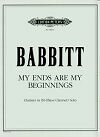
C811: My Ends Are My Beginnings Clarinet in B-flat (Bass Clarinet) Solo by Milton Babbitt. C.F. Peters, 1990, SS, 14 pages. Milton Babbitt (1916-) is an American composer noted for pioneering serial and electronic music.This is a long (about 17 minutes), difficult solo work for clarinet switching to bass clarinet for the middle section. If you search the internet you can find a recording that can be downloaded (iTunes). (Except other items with free shipping.) |
15.50
|
|
(Except other items with free shipping.) |
13.95
|
|
C1511: J.S. Bach Allemande and Courante from Suite #1 for Cello transcribed for B-flat, E-flat Alto or Bass Clarinet by Glen A. Sargent. Shall-u-mo Publications, 1982, 4 pages. Two movements from the popular Bach work for cello. Better high school clarinetists and above. (Except other items with free shipping.) |
9.50
|
|
C1245: J.S. Bach Chromatic Fantasy freely transcribed for clarinet by Stanley Hasty. 2002, SS, 5 pages. This edition was prepared by legendary clarinet performer and educator Stanley Hasty. It also includes a performance on CD by Tom Martin of the Boston Symphony Orchestra, a Hasty student.
(Except other items with free shipping.) |
19.95
|
|
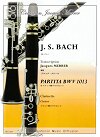
C1819: J.S. Bach Partita BWV 1013 for clarinet transcribed by Jacques Merrer. International Music Diffusion, 2008, SS, 6 pages. This is usually considered a work for flute but since the original manuscript is lost Bach's intentions are unknown. This edition is based on a copy of Bach's manuscript made in the 1720s. A reproduction of the source is included. It is in four movements: Allemande, Corrente, Sarabande, and Bourrée Angloise. This transcription is in G minor. Playing it on a D clarinet would result in it sounding in the original key of A minor. Of course this is a solo work so any clarinet can be used. (Except other items with free shipping.) |
16.95
|
|
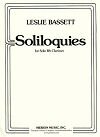
C1196: Soliloquies for solo B-flat clarinet by Leslie Bassett. Merion Music, 1978, SS, 5 pages. Lesslie Bassett (1923-2016) was an American composer and music educator. This is a relatively recent four movement piece for solo clarinet, includes some contemporary notation and a multiphonic chosen by the performer. The music is at times extremely brilliant and technically demanding, at other times serenely beautiful.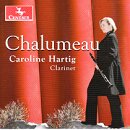 (Except other items with free shipping.) |
10.95
|
|
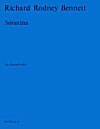
C297: Sonatina for Clarinet Solo by Richard Rodney Bennett. Novello, 1981, SS, 7 pages. A very nice movement work dedicated to Angela Morley. (Except other items with free shipping.) |
8.95
|
|
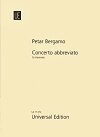
C1838: Concerto abbreviato for Clarinet (solo) by Petar Bergamo. Universal Edition, 1981, SS, 4 pages. Petar Bergamo (1930-) was born in Yugoslavia, where he studied and was also a music professor. He worked as a music editor for Universal Edition in Vienna, the publisher of this piece. This is one of his better known works. It was written for Milenko Stefanović, who gave its first performance in 1966. It is without meter, but has many sections in a variety of tempos. It also has a section with two staves, apparently to make the wide interval jumps (and notes with grace notes) stand out. You can read more about the piece here. (Except other items with free shipping.) |
29.95
|
|
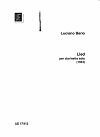
C647: Lied for Clarinet Solo by Luciano Berio. Universal Edition, 1983, 2 pages. Berio (1925-2003) wrote this piece in 1983. It is without bar lines, has many tempo changes and some modern notation. However, it is not nearly as difficult (nor as long) as the Sequenzas.
(Except other items with free shipping.) |
14.95
|
|
C719: Sequenza IXa for Clarinet Solo by Luciano Berio. Universal Edition, 1980, 10 pages. Berio (1925-2003) wrote this piece in 1980. It includes some suggested fingerings. Advanced/professional level. |
22.95
|
|
C298: Three Pieces for Clarinet Solo by Lennox Berkeley edited by Thea King. Chester Music, 1983, SS, 4 pages. Lennox Berkeley (1903-1989) was an English composer who studied with Nadia Boulanger and Maurice Ravel. The composer calls for Clarinet in A. You can listen to it here.
(Except other items with free shipping.) |
11.95
|
|
C1930: Theme and Absurdities for Solo Clarinet in B-flat by Derek Bermel. PeerMusic, 2004, SS, 3 pages. Derek Bermel (1967-) is an American composer, clarinetist and conductor. This is a humorously virtuosic piece for solo clarinet, a spoof of all those lovable yet undeniably annoying theme and various pieces based on some aria. This is a particularly nightmarish tribute in which the variations, in eight-bar chunks, grow steadily in ridiculousness. This piece includes flutter tonguing, glissandos, large interval leaps and altissimo to high C. (Except other items with free shipping.) |
9.95
|
|
C1750: Thracian Sketches for Solo Clarinet in B-flat by Derek Bermel. PeerMusic, 2007, 8 pages. This piece grew out of the composer's studies of the Thracian folk music of Bulgaria in 2001. In begins in the lower register of the clarinet at a tempo of mm=92 and accelerates in stages and slowly ascends to the high altissimo (A-flat). The last marked tempo is mm=240 before a final section to be played as fast as possible. While the first two thirds of the piece is in 5/8, the last three pages have variety of other meters including 6/8, 7/8, 9/7, 10/8, and 11/8. Advanced with a duration of about 8 minutes. Here is a video of the composer performing the last part of this piece.
(Except other items with free shipping.) |
9.95
|
|
C1182: Arias for Clarinet (solo) by David Blake. Novello, 1981, SS, 8 pages. This piece was written for Alan Hacker and was first performed by him in 1979. The composer wrote: "The soloist is cast in the role of an opera singer, a versatile artist who performs in four languages. He wakes in the morning and begins to run through his repertoire. There are four arias, linked and interrupted by recitatives. A climax of expressionist hysteria is reached in the third aria, resolved by the cantilena of the fourth and the return to the somnolence of the beginning." This piece uses flutter tonguing, a very few quarter tones in the altissimo, one multiphonic note, and some contemporary notation. The duration is about 14 minutes. (Except other items with free shipping.) |
13.95
|
|
C1454: Chalumeau for Solo Clarinet in B-flat by William Bolcom. Marks Music, 2005, SS, 6 pages. This piece was written for Caroline Hartig. She has written that it "exploits the extreme registers and dynamics of the clarinet and makes use of of glissandi, portamenti, flutter tonguing, timbrel trills, and harmonic double stops." An advanced work with a duration of about 10:45. (Except other items with free shipping.) |
9.95
|
|
C1201: Domaines for Clarinet Solo with or without Orchestra by Pierre Boulez. Universal Edition, 1970, (clarinet part only). This piece is an example of what Boulez called "controlled chance." The performers choose between possibilities that have been written out in detail by the composer. This complex piece comes with instructions in German, French and English. An advanced work in a large format. |
47.95
|
|
C1699: Graphismes (Graphic Notations) for Clarinet Solo by Eugene Bozza. Leduc, 1975, 4 pages. This set of four is probably not intended for performance, but is described as preparation for the reading of contemporary musical graphic notations. Includes a page of descriptions of the notations. Advanced college level. |
14.20
|
|
C1254: Concerto for Clarinet Solo by Valentino Bucchi. Ricordi, 1997, SS, 6 pages. Valentino Bucchi (1916-1976) was an Italian composer, teacher, and music critic. He composed opera; chamber, vocal, and orchestral music; and some music for films. This is a contemporary piece (composed in 1969) in four movements that includes tremolos, flutter tonguing, a very short phrase with quarter tones, and at the end of the third movement: multiphonics (with fingerings given). Duration about 7 minutes. (Except other items with free shipping.) |
10.95
|
|
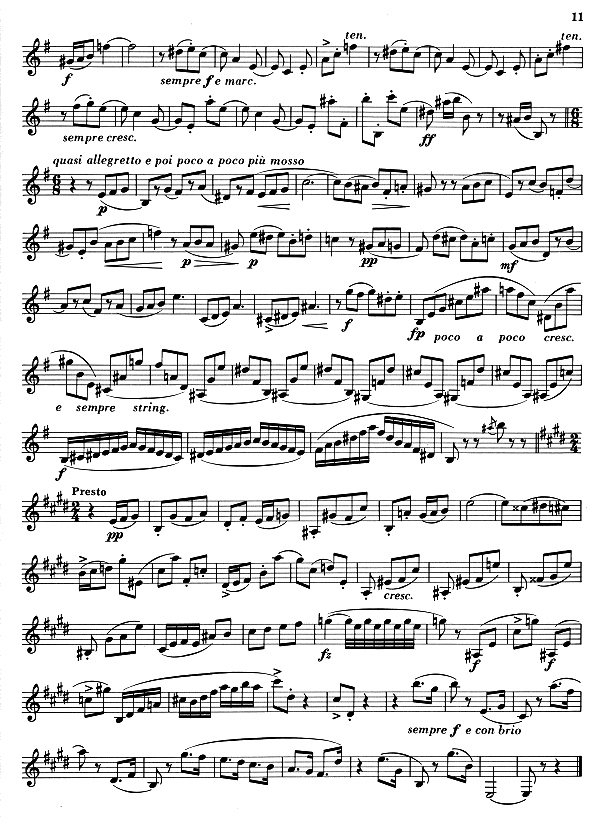
C2170: Suite Op. 37a for Bass Clarinet or Clarinet Solo by Adolf Busch. Amadeus Verlag, 1980, SS, 9 pages. Adolf Busch (1891-1952) was a German-born violinist and composer. Although he was not Jewish, he left Germany in 1927 and later settled in the United States. This four movement solo work was written in 1926. Each of the movements is quite different in character. They are: I. Andante tranquillo, II. Adagio, III. Scherzo, and IV. Vivace. It is college level on the clarinet and advanced college level on the bass clarinet. Click the cover image to view the last page of the music.
(Except other items with free shipping.) |
19.95
|
|
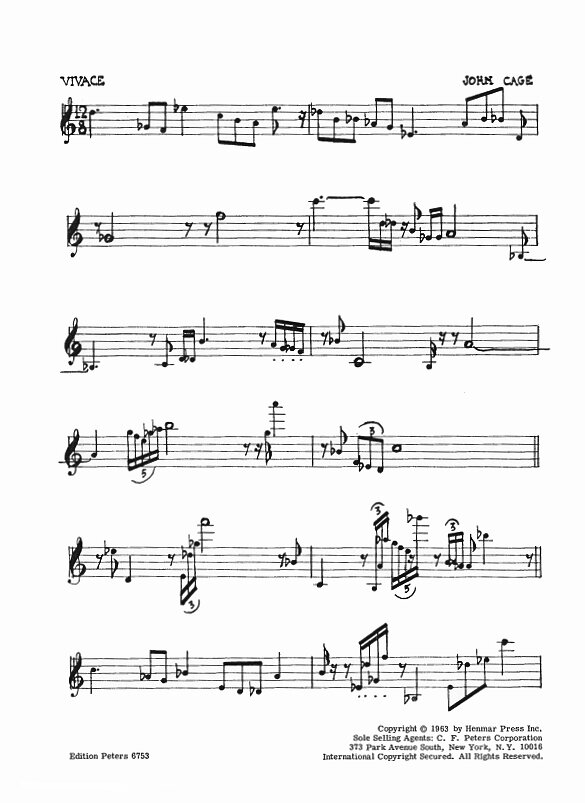
C1809: Sonata for Clarinet by John Cage. C.F. Peters, 1963, SS, 6 pages. Three short movements: Vivace, Lento, and Vivace. The fast movements were written in 1933 and are among Cage's earliest works. The composer made some revisions and added the slow movement before it was published. Some mixed meter and tricky rhythms. Cage had trouble getting this performed after it was written, but college students studying contemporary music should be able to master it. (Note that 2012 is the Cage centennial.) Click on the cover to view the first page. (Except other items with free shipping.) |
17.95
|
|
C423: Arlequin by Louis Cahuzac. Gerard Billaudot, 1972, SS, 2 pages. A characteristic piece for solo clarinet. 
(Except other items with free shipping.) |
10.95
|
|
C1197: Excursions for Clarinet in A by Ronald L. Caravan. Seesaw Music, 1974, SS, 6 pages. "Excursion: a going forth, a journey chiefly for recreation or pleasure, a deviation from a definite path, a digression, a movement outward from a mean position or axis." This piece includes many extended techniques (including multiphonics and quarter tones) and uses contemporary notation. Everything is explained in some detail. Excellent for college students studying this type of music. (Except other items with free shipping.) |
9.95
|
|
C1226: Post Cards Six Sketches for Solo Clarinet in B-flat by Paul Carr. Nova Music Ltd., 1986, SS, 4 pages. The post cards are named: I. Frantic Departure, II. First Impressions of a warm climate, III. Carefree afternoons, IV. Evening in the square, V. Games amongst the ruins, and VI. Girl on a beach under a sunshade. Better high school players and above. (Except other items with free shipping.) |
9.95
|
|
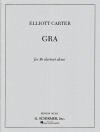
C1054: Gra for B-flat clarinet alone by Elliott Carter. Hendon Music, 1994, SS, 5 pages. "Gra" which means game in Polish was written as a tribute to Witold Lutoslawski to commemorate his 80th birthday. The composer wrote: "This clarinet piece, frequently-changing and playful in character (yet based on the same material throughout), recalls to me my many delightful visits with the composer in America and Poland. This advanced piece has one multiphonic note and gives a fingering suggestion for both the Boehm and German system clarinets. Here is a video of a performance. (Except other items with free shipping.) |
10.95
|
|
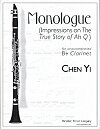
C1647: Monologue (Impressions on The True Story of Ah Q) for unaccompanied B-flat clarinet by Chen Yi. Theodore Presser Co., 2000, 2 pages. Inspired by Lu Xun's (Zhou Shren, 1881-1936) The Bio of Ah Q. Lu Xun is China's best-known 20th Century author of essays and short stories. He called on the Chinese people to rise and give battle to feudalism. Marked Adagio ad lib., this is an advanced work with a duration of 4-5 minutes.
(Except other items with free shipping.) |
6.95
|
|
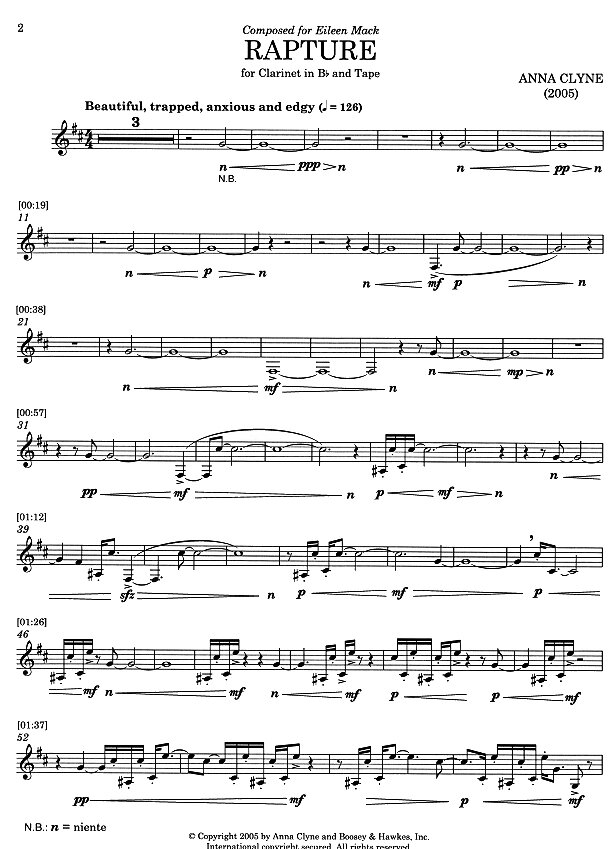
C2143: Rapture for Clarinet in B-flat and Tape by Anna Clyne. Boosey & Hawkes, 2005 (fourth printing 2014), SS, 5 pages + CD. "Rapture was composed for Australian clarinetist, Eileen Mack and was premiered at Symphony Space in New York City with live visuals created by Joshue Ott. In performance, the live clarinetist is processed in real time with a combination of effects often associated with electric guitars; namely distortion and reverb [easily obtainable guitar pedals may be used]. The transformed sound of the clarinet is supported with an intense tape part that comprises vocal recordings and recordings of Mack playing sounds, which range from sustained tones to multiphonics. In a similar process to painting, these recordings were then spliced, manipulated and layered to create the music of the tape part." The music includes instructions on setting up the microphones and equipment for performance. This is an advanced work with a duration of about 7:30. Here is an audio recording. Click on the cover image to view the first page of the clarinet part. |
22.95
|
|
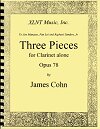
C1452: Three Pieces for Clarinet Alone Op. 78 by James Cohn. XLNT Music, 1999, SB, 8 pages. These pieces are dedicated to Jon Manasse, Fan Lei, and Raphael Sanders. They are: I. Wind Song (Prestissimo), II. Slow Dance (Allegretto), and III. Polonaise (Andante moderato). (Except other items with free shipping.) |
14.95
|
|
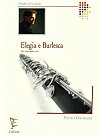
C1622: Elegia e Burlesca for Clarinet Solo by Pietro Damiani. Edizioni Musicali Eufonia, SS, 5 pages. Dedicated to Fabio Di Càsola. Here is an audio file of the entire Elegia which last about 5:20. The Burlesca is in 6/8 at a tempo of Moderatamente Mosso. College level. (Except other items with free shipping.) |
24.95
|
|
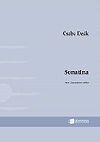
C1396: Sonatina for Clarinet Solo by Csaba Deák. Gehrmans Musikförlag AB, 1965, 5 pages. Csaba Deák (1932-) is a Hungarian born composer who began his music education in Hungary studying clarinet and composition at the Béla Bártok Conservatory. In 1957 he came to Sweden and after further study embarked on his career as a composer and music educator. He is best known for his works for wind instruments. This piece is in three movements: I. Allegretto, II. Rubato, con molto tranquillo, and III. Allegro molto/Allegretto. This looks like a college level work to me, although one of my friends in Sweden said it is often used for conservatory auditions there. The duration is about 5:15. Click here to listen to a recording. Click on the cover image to view some sample pages.
(Except other items with free shipping.) |
14.95
|
|
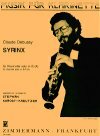
C548: Syrinx by Claude Debussy arranged for clarinet by Stephan Korody-Kreutzer. Zimmermann, 1989, SS. This famous piece for solo flute has been arranged for solo clarinet by Korody-Kreutzer. The key has been raised a half-step to D from D flat, but otherwise is identical to the flute version. Fingering suggestions for both the Boehm and German system clarinets are included. (Except other items with free shipping.) |
13.95
|
|
C1239: Sonate for Clarinet (solo) by Edison Denissow. Breitkopf & Härtel, 1973, SS, 6 pages. Edison Denisov (1929-1976) was a Russian composer and teacher who was blacklisted in 1979. In two movements (I. Lento, poco rubato and II. Allegro giusto), with a duration of about 7 minutes, this piece has mixed meter, challenging rhythmic figures, flutter tonguing and fractional accidentals. 
(Except other items with free shipping.) |
16.95
|
|
C1202: La naissance d'un papillon for Clarinet Solo by Yvonne Desportes. Billaudot, 1977, SS, 10 pages. Not just the birth of a butterfly but the whole life cycle with a musical dedication and three movements: I. La Chenille (Allant.), II. La Chrysalide (Assez libre et très expressif.), III. Le Papillon (Assez vif.). This is a challenging contemporary piece which includes flutter tonguing and some multiphonics (fingerings provided). (Except other items with free shipping.) |
12.95
|
|
C1453: Clair (1980) Two pieces for Clarinet by Franco Donatoni. Ricordi, 1980, 8 (double size) pages. Franco Donatoni (1927-2000) was an Italian composer who was influenced by Boulez and Stockhausen. The liner notes to the Hartig Chalumeau CD call this a "spectacular vehicle for introducing contemporary music to large audiences." While this is technically very demanding it does not use extended technique other than flutter tonguing. Duration of about 9:20.
|
34.95
|
|
C1255: Studio Primo for Clarinet by Gaetano Donizetti edited by Giuseppe Garbarino. Ricordi, 1977, 5 pages. This piece by Italian composer Gaetano Donizetti (1797-1848) was written in 1821 as he was completing his studies. It is believed that the composer was influenced by Paganini's Etude for Solo Violin which had been published the year before as well as other virtuoso Paganini works. Advanced high school/early college level. Duration about 4:45. We also have a version of this piece with piano accompaniment by Bela Kovacs (C2137). (Except other items with free shipping.) |
8.95
|
|
C1104: Vals Venezolano and Contrdanza for Clarinet Solo or Clarinet and Piano by Paquito D'Rivera. International Opus, 1991/1996, SS, 6 + 3 pages. Cuban born D'Rivera serves up two short pieces: Vals Venezolano (dedicated to Antonio Lauro) is a fast 3/4 waltz in the Venezuelan style and Contradanza (dedicated to Ernesto Lecuona) is a Cuban dance. (Except other items with free shipping.) |
15.95
|
|
C268: Sonata Brève for Clarinet in B-flat by Pierre Max Dubois. Alphonse Leduc, 1965, SS, 7 pages. In four movements: Allegro brillante (2/4), Vivo et leggero (2/4 + 3/16), Andante simplice (4/8) and Alla breve (2/2). Has has strong sense of rhythm and is similar to much French music written in the first third of the twentieth century. Facile technique and a quick tongue is needed, but the range is generally confined to the lower two registers. Quite long for a solo piece (14:00); it is good repertoire for advanced college level students.
(Except other items with free shipping.) |
16.20
|
|
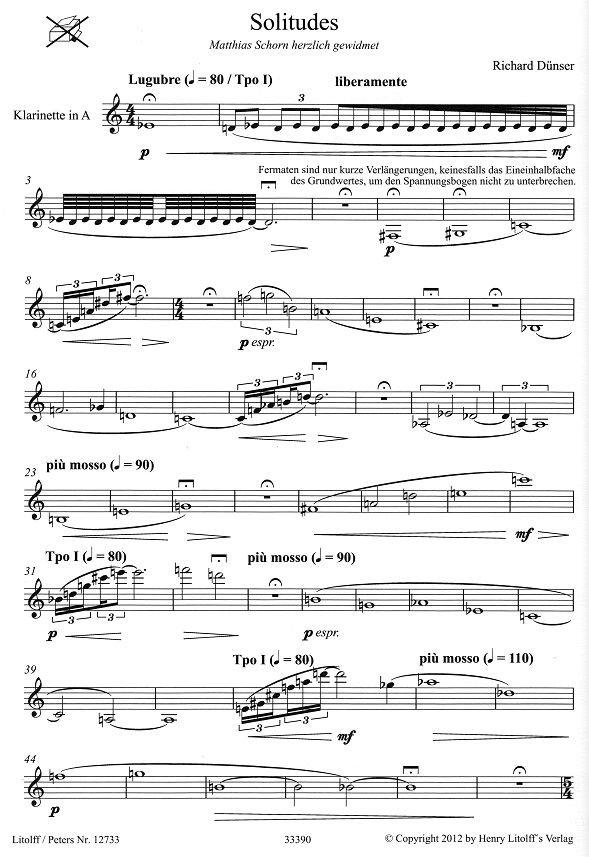
C2559: Solitudes for Clarinet in A by Richard Dünser. Edition Peters, 2012, SS, 4 pages. Richard Dünser (1959-) is an Austrian composer. This contemporary solo piece has the look of more advanced work. It is probably a good introduction to clarinet solo music for an advanced high school student or early college level player. It has many short phrases at (slightly) different tempos. Click on the cover image to view the first page.
(Except other items with free shipping.) |
7.95
|
|
C1607: Daydream in A-flat for Solo Clarinet by Don Freund. Woodwindiana, 2005, SS, 7 pages. Quoting the composer, "This 12-minute unaccompanied solo is fashioned in a way that should allow the listener to notice the cyclical returns of tunes and gestures, and to be consciously aware of implicit relationships of tonality. Daydream in A-flat evokes a state of sweet semi-consciousness." College level. (Except other items with free shipping.) |
14.95
|
|
C1171: Fantasie for Clarinet Solo by Harald Genzmer. Henry Litolff's Verlag/C.F. Peters. 1973, SS, 7 pages. Harald Genzmer (1909-2007) was a German composer and music educator who studied with Hindemith. During the early part of the second world war he served as a military band clarinetist. This piece is in four movements: I. Adagio, II. Vivace molto, III. Lento e rubato (quasi parlando), and IV. Presto, Sempre con fantasia. Prof. Heim rates this piece as a grade 6 and says it requires facile technique.
(Except other items with free shipping.) |
25.25
|
|
C1927: Virtuoso Swing Solo for Clarinet Solo by Armando Ghidoni. Leduc, 2012, 4 pages. Of Italian origin, though French by adoption, Armando Ghidoni brings together in his music the spirits of both Italy and France. An advanced work for clarient solo. Click on the cover image to view the first page of the piece. |
14.20
|
|
C276: Three Bagatelles for Clarinet Solo by Arsenio Giron. Southern Music Co., 1987, 4 pages. Dedicated to Robert Riseling. In three movements (fast/slow/fast). Publisher's grade 4, advanced high school/early college level.
(Except other items with free shipping.) |
7.95
|
|
C428: Clarinet Unlimited by Norbert Goddaer. Woodwindiana, 1999, SS, 4 pages. This work for solo clarinet by Belgian composer Goddaer was written for and dedicated to Kelly Johnson. It starts with a lyrical opening which is followed by a driving, exciting second part which mimics a digital delay effect. For advanced performers. (Except other items with free shipping.) |
6.95
|
|
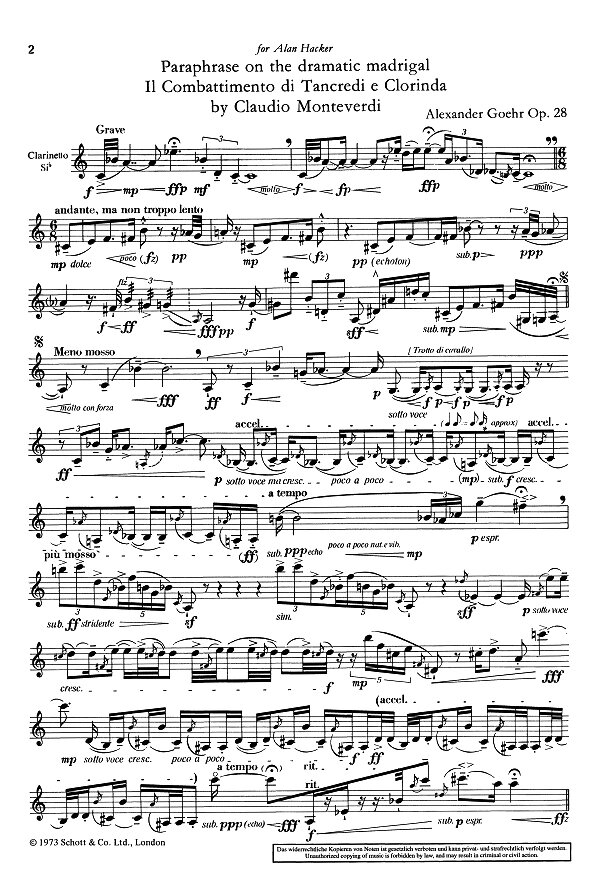
C2019: Paraphrase on the Dramatic Madrigal "Il Clorinda" by Claudio Monteverdi Op. 28 for Clarinet Solo by Alexander Goehr. Schott, 1973, SS, 7 pages. Born in Germany, Alexander Goehr (1932-) has spent most of his life in England where he is a composer and music educator (he has also taught in the United States). This piece is dedicated to Alan Hacker. It is an advanced work which includes some contemporary notation, flutter tonguing, and a small amount of high altissimo. Duration is about 12 minutes. Click on the cover image to view the first page.
(Except other items with free shipping.) |
13.95
|
|
C1693: Sonate pour Clarinet Solo by Ida Gotkovsky. Molenaar Edition, 1986, SS, 22 pages. Ida Gotkovsky (1933-) is a French composer who studied with Nöel Gallon, Oliver Messiaen, Tony Aubin and Nadia Boulanger. She has won many prizes for her compositions. This piece was commissioned by the International Clarinet Society and premiered by Elsa Ludwig-Verdehr in 1986. In four movements: I. Lyrique (Declamando con Brio), II. Scherzo capricioso (Presto sempre stacc.), III. Dolcissimo (Calme Lento), and IV. Final (Prestissimo). An advanced, virtuoso work with high altissimo, glissandi, flutter tonguing and some contemporary notation. Duration about 17:40. |
29.95
|
|
C2735: Three Smiles for Tracey for solo clarinet by Adolphus Hailstork. Theodore Presser Co., 2003, SS, 7 pages. Adolphus Hailstork (19411) is an American composer and educator. He was born in Rochester, New York, and grew up in Albany, New York, where he studied violin, piano, organ, and voice. This perfectly-titled set for unaccompanied clarinet is a set of three short "smiles," or solo preludes that depict and evoke smiles by their cheerfulness. The total duration is 4-5 minutes. Upper intermediate level.
(Except other items with free shipping.) |
9.95
|
|
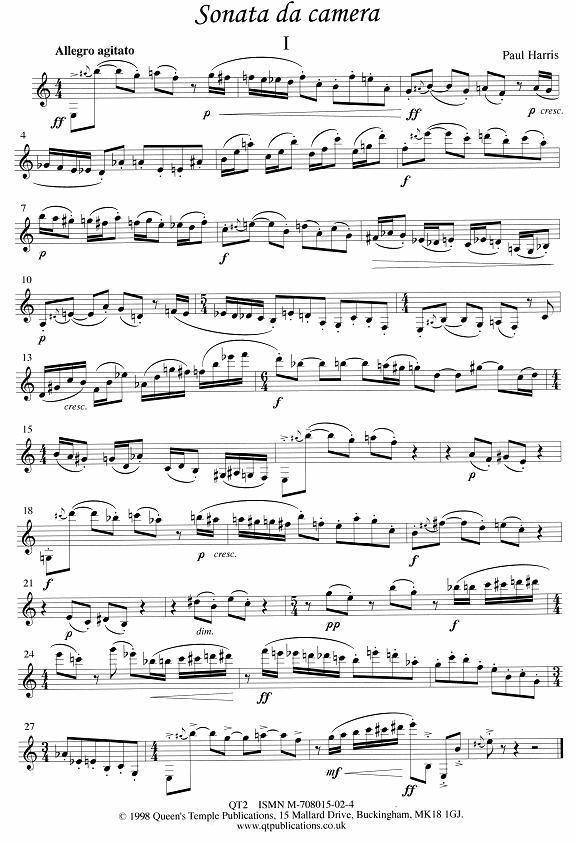
C2380: Sonata da Camera for unaccompanied clarinet by Paul Harris. Queen's Temple Publications, 1998, SS, 4 pages. Paul Harris is a British clarinetist, composer, and music educator. This piece is in four movements: I. Allegro agitato, II. Andante espressivo e rubato, III. Allegro molto e scherzando, and IV. Presto con fuoco. The duration is about 5:40. College level. Click here to listen to an audio recording. Click on the cover image to view the first movement. (Except other items with free shipping.) |
9.95
|
|
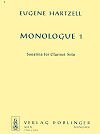
C624: Monologue 1, Sonatina for Clarinet Solo by Eugene Hartzell. Doblinger, 1966, SS, 8 pages. Eugene Hartzell (1932-2000) was born and studied in the United States (through a MM at Yale) but spent most of the rest of his life in Austria. He studied with Hans Erich Apostel, a pupil of Arnold Schönberg and Alban Berg. This piece was written in 1957 during his first period of study in Austria. It is in three movements and is fairly extended for a solo work, about 10 minutes. Advanced level. (Except other items with free shipping.) |
12.95
|
|
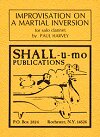
C1509: Improvisation on a Martial Inversion for Solo Clarinet by Paul Harvey. Shall-u-mo Publications, 1975, 4 pages. This piece was written for a student of the composer to use at 1974 of the Royal Military School of Music, England. Since the student was a member of the Band of the Grenadier Guards he based it on an inversion of the march "The British Grenadiers." Here is an audio file of the first part of the piece.
(Except other items with free shipping.) |
12.50
|
|
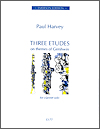
C335: Three Etudes on Themes of Gershwin by Paul Harvey. Emerson Edition, 1975, SS, 11 pages. Etudes for solo clarinet based on the Gershwin tunes "It Ain't Necessarily So," "Summertime," and "I Got Rhythm." All with a jazzy feel. This edition adds an alternate multiphonic ending for Summertime. (Some recordings list the title of this work as Suite on Themes of Gershwin.) 
(Except other items with free shipping.) |
19.95
|
|
C325: O, star! Mosaic for Clarinet Solo by David Philip Hefti. Edition Kunzelmann, 2003, SS. 6 pages. O, star!' is dedicated to Wolfgang Meyer. In 'O, star!', entire passages from the composer's 'SATOR' cycle have been juxtaposed with newly composed motifs, resulting in a colorful mosaic. Tremendous contrasts are an essential characteristic of this expressive music. The solo piece is three parts with opening and coda: a lyrical introduction opens the first part, which is a wild, piercing and loud vivace and presto. This section is followed by a quarter-tone trill that leads into the composition's main part, where freely timed passages contrast with strictly organized measures. A virtuoso climax cuts off this part abruptly to give way to the third and very calm part of this composition, which is dominated by changing timbres, timbre trills and multiphonics. A freely developing line carries through to the composition's end. Includes extended techniques and has multiphonic fingerings for both Boehm and German system instruments. (Except other items with free shipping.) |
20.25
|
|
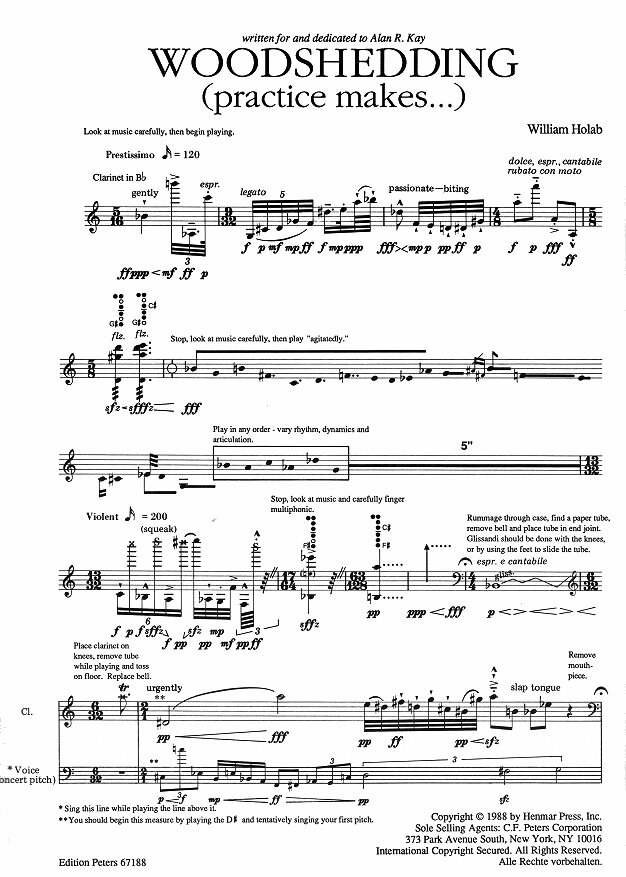
C1925: Woodshedding (practice makes...) Solo Clarinet (E-flat, B-flat, and A) by William Holab. C.F. Peters Corp., 1988, SS, 6 pages. This is a performance piece with which was written for Alan R. Kay and is based on the composer's fantasies about what might happen during a "typical" practice session. It includes extensive directions and requires a portable metronome, a tube to extend the low range, and a cheap plastic clarinet. Includes multiphonics, flutter tonguing and many other effects and contemporary notation. It will take a skilled performer to play this as the composer intended. The middle portion simulates practicing a variety of types of music, with the clarinetist becoming very frustrated by the end. Click on the cover image to view the beginning of this piece. |
12.50
|
|
C383: Lament Op. 25 for Clarinet solo by Alan Hovhaness. C.F. Peters, 1967. This piece for solo clarinet was written in 1935 but not published until many years later. Marked largo, the only difficulty that would confront a high school student is a frequently repeated arpeggio begining on low F. (Except other items with free shipping.) |
7.95
|
|
C1246: Three Studies for solo clarinet by Karel Husa. Baerenreiter Praha (H 7992), 2008, SS, 7 pages. Karel Husa (1921-2016) was born in Prague where he began his studies in composition and conducting, continuing them in Paris in 1946. He taught in the United States from 1954 until his retirement. He has received many awards including the Pulitzer Prize. Three Studies was composed for the 60th Prague Spring International Music Competition and dedicated to Professor Jiří Hlaváč for this 60th birthday. The three contrasting and virtuoso parts - Mountain Bird, Poignant Song and Relentless Machine - progressively represent three different characteristics of playing: espressivo, legato, and staccato. |
24.95
|
|
C305: Five Pieces for Clarinet (unaccompanied) by Gordon Jacob. Oxford University Press, 1973, 7 pages. The title on the cover is Five Pieces for Solo Clarinet. Dedicated to Georgina Dobree. Five movements: Preamble, Waltz, Homage to J.S.B., Soliloquy, and Scherzo and Trio. An interesting and challenging piece for advanced high school and college level students.
(Except other items with free shipping.) |
12.95
|
|
C2203: 5 Grotesken für Soloklarinette by Rudolf Jettel. Kunzelmann, 1971, SS, 6 pages. Rudolf Jettel (1903-1981) was an Austrian composer, clarinetist and music professor. He was principal clarinetist with the Vienna Philharmonic from 1957 to 1978. While I am not sure how grotesque these pieces are they will certainly be a challenge for the college level student. Numbers 1, 2, and 5 are without bar lines while the other two have mixed meter. Click on the cover image to view a sample page.
(Except other items with free shipping.) |
18.25
|
|
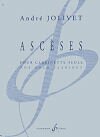
C1192: Ascèses for Solo Clarinet by André Jolivet. Billaudot, 1964, SS, 10 pages. An advanced contemporary work in five contrasting movements which may be played on B-flat or A clarinet. Flutter tounging is the only extented technique required. Some suggested fingerings are included. Duration about 16 minutes. (Except other items with free shipping.) |
14.95
|
|
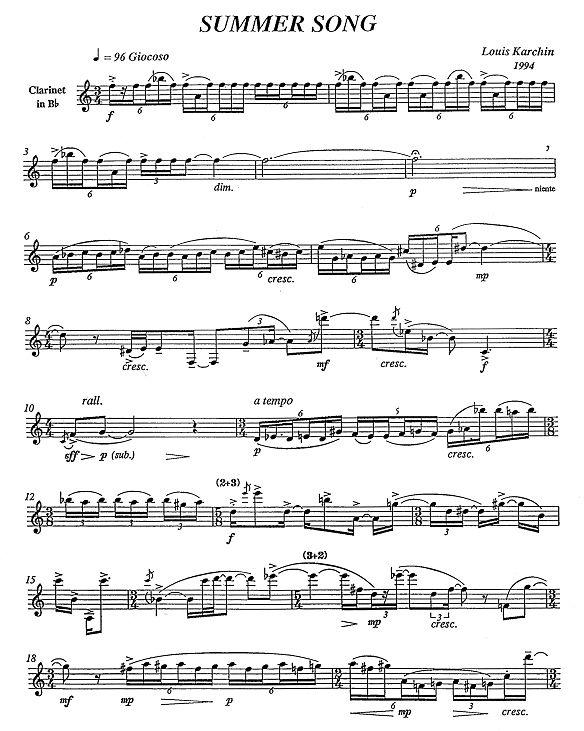
C2567: Summer Song Clarinet Solo by Louis Karchin. C.F. Peters, 1996, SS, 9 pages. Louis Karchin (1951-) is an American composer and conductor. This work for solo clarinet is notable for the significant amount of mixed meter it contains. The basic tempo is not especially fast; all between 72 and 96. The duration is about 6 minutes. Click on the cover image to view the first page. (Except other items with free shipping.) |
12.50
|
|
C546: Sonate for Clarinet Solo Op. 110 by Sigfrid Karg-Elert. Zimmermann, 1965, SS, 7 pages. Dr. Norman Heim calls this piece one of the great works for unaccompanied clarinet. It is a continuous composition in four movements with many markings in German relative to tempo and style. The work is difficult and demands great technical facility. It is a first-class recital work for the professional performer. (Except other items with free shipping.) |
12.95
|
|
C1157: Sonata Op. 8 for clarinet alone by Michael Kibbe. Michael Kibbe, 1994, SS, 3 pages. Three movements: I. Allegro moderato, II. Adagio, con rubato, and III. Allegro vivo. A relatively brief (3:40), college level work. (Except other items with free shipping.) |
6.95
|
|
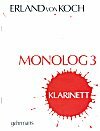
C396: Monolog 3 for solo B-flat clarinet by Erland von Koch. Gehrmans, 1977, SS, 5 pages. A two movement work for solo clarinet that may also played using any clarinet from E-flat to bass. (Except other items with free shipping.) |
14.95
|
|
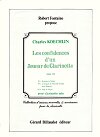
C1472: Les confidences d'un Joueur de Clarinette Op. 141 Nos. 1, 3, & 15 for clarinet solo by Charles Koechlin. Billaudot, 1988, 3 pages. Charles Koechlin (1867-1950) was a French composer and teacher. He was a student of Fauré who influenced his music and about whom he wrote a biography. These three pieces are part of a set of 18 for various combinations of instruments, including a few with orchestral accompaniment, that were composed in 1934 for a film The Confessions of a Clarinet Player that was never made. They are all marked for Clarinet in A. 1. Romance de Kasper, 3. Le bouquet de fleurs des champs pour Magrédel, and 15. Rage de Kasper (there are some low E-flats in this piece which appear to have been ignored on the recording). College level with some high altissimo. (Except other items with free shipping.) |
6.95
|
|
C1473: Monodies Op. 216 for Clarinet in A by Charles Koechlin. Max Eschig, 1948/1998, SS, 20 pages. This is the set of all 10 pieces of which the tenth is also sold separately and listed below. The are: 1 Le Faune, 2. Le Soir, 3. Le Mer aux bruits innombrables, 4. Pastoral, 5. La Chasse d'Artémis, 6. Idylle, 7. Chant funéraire, 8. Monodie. 9. Monodie for clarinet in B-flat, and 10. Le Repos de Tityre. There is a wide range of difficulty but taken as a whole they are college level. The CD has recordings of 1, 2, 3, 5, and 10. (Except other items with free shipping.) |
17.95
|
|
WW129: Le Repos de Tityre, Monodie Op. 216 No. 10 for hautbois d'amour or clarinet in A by Charles Koechlin. Max Eschig, 1948, 2 pages. (Number 10 from the work listed above.) This unaccompanied work is marked Très calme, dans le sentiment d'une pastorale. An expressive piece which is not difficult. (Except other items with free shipping.) |
7.95
|
|
C1205: Flammes, Cinq études pour Clarinette by Janos Komives. Editions Jobert, 1978, 10 pages. Janos Komives (1932-2005) was a Hungarian composer and conductor who relocated to France in 1956 where he remained after completing his studies. This work (Flames) was written for Guy Deplus in 1975. It is a set of five etudes which were inspired by the sounds of a fire in a fireplace. It is a challenging contemporary work but does not include extended technique. The duration is about 9 minutes. (Except other items with free shipping.) |
15.95
|
|
C2687: Caprice for Clarinet Solo by Anders Koppel. Edition Wilhelm Hansen, 2005, 5 pages. This is a delightful piece that was composed in 2004. It was written specifically for the 3rd Carl Nielsen International Clarinet Competition, in Odfense, 2005. Either B-flat or A clarinet may be used. It looks a bit like an etude. Here is a video. Click on the cover to see a sample page.
(Except other items with free shipping.) |
14.95
|
|
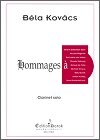
C703: Hommages Clarinet Solo by Béla Kovács. Edition Darok, 1994, 39 pages. A very popular set of nine pieces by Hungarian clarinetist and composer Kovacs. He composed them as supplementary study material for (advanced) students, but also intended them to be performed in concerts. They pay tribute to nine composers: Hommage à J.S. Bach, Hommage à N. Paganini, Hommage à C.M. von Weber, Hommage à C. Debussy, Hommage à M. de Falla, Hommage à R. Strauss, Hommage à B. Bartók, Hommage à Z. Kodály, and Hommage à A. Khatschaturian. Several call for A clarinet. Many of these pieces are now available individually with piano accompaniment. The first one is here. They are listed along with Kovacs' other works for clarinet and piano.
|
42.95
|
|
C1424: Im Memoriam Solo Clarinet by Béla Kovács. Edition Darok, 2009, 3 pages. This is dedicated by the composer "To the memory of my colleague" who was D.T. (cover) or (T.D. in the Hungarian style on the music). This work has some extended technique such a flutter tonguing, ad lib. double tonguing, slap tonguing, and two multiphonic notes with fingerings provided. (Except other items with free shipping.) |
13.95
|
|
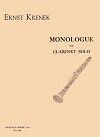
C1118: Monologue for Clarinet Solo by Ernst Krenek. Rongwen Music, 1958, SS, 3 pages. Ernst Krenek (1900-1991) was an Austrian born composer of Czech ancestry who lived in the United States from 1945. This 1956 work is relatively brief (4 minutes) and in five movements: I. Moderato, II. L'istesso tempo, III. Larghetto, IV. Allegretto, and V. Allegro appassionato. While not difficult technically, it is useful for early college students to study interpretation of unaccompanied atonal music.
(Except other items with free shipping.) |
6.50
|
|
C1361: Vier Impressionen for Clarinet Solo by Karlheinz Krupp. Hofmeister, 2000, SS, 6 pages. Karlheinz Krupp (1932-) is a German composer and music editor. The four impressions are: I. Tänzerisch, heiter; II. Energisch, nicht zu schnell; III. Im freien Zeitmaß, sehr lebendig; and IV. Andante/Allegro/Allegretto/Vivace. Intermediate level and just a bit beyond.
(Except other items with free shipping.) |
8.95
|
|
C1250: Pastoral Fantasy Op. 59 for Clarinet Solo by Bozidar Kunc. Rongwen Music, 1958, SS, 6 pages. Božidar Kunc (1903-1964) was born in Zagreb, Croatia, studied piano and composition at the Zagreb Music Academy. In 1951 he moved to the United States at the invitation of his sister Zinka, a celebrated opera singer at the Metropolitan Opera. Kunc was to remain her accompanist for the rest of his life. He composed music in all forms except opera. This is a sectional piece which begins A capriccio (con libertá), followed by Allegretto con moto (increasing in speed to Allegro), Allegretto, Allegro vivace, and concludes Poco più allegro. College level with a duration of 4:20.
(Except other items with free shipping.) |
5.95
|
|
C1870: Moonflowers, Baby! a jazz essay for solo clarinet by Meyer Kupferman. Soundspells Productions, 1986, SS, 12 pages. Meyer Kupferman (1926-2003) was an American composer and clarinetist. An advanced piece in jazz style that can optionally be accompanied by an improvised drum part. It is sectional with the following tempo markings: Medium bounce-easy going, Slow blues tempo/Tempo I (from the first section), Fast and smooth, Cadenza (slower), Very fast, Slower, and Slow blues tempo. There are a number of performance of this work on YouTube (I prefer this one as I think some of the others are too fast). There is also one with the optional improvised drum accompaniment.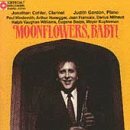
(Except other items with free shipping.) |
19.95
|
|
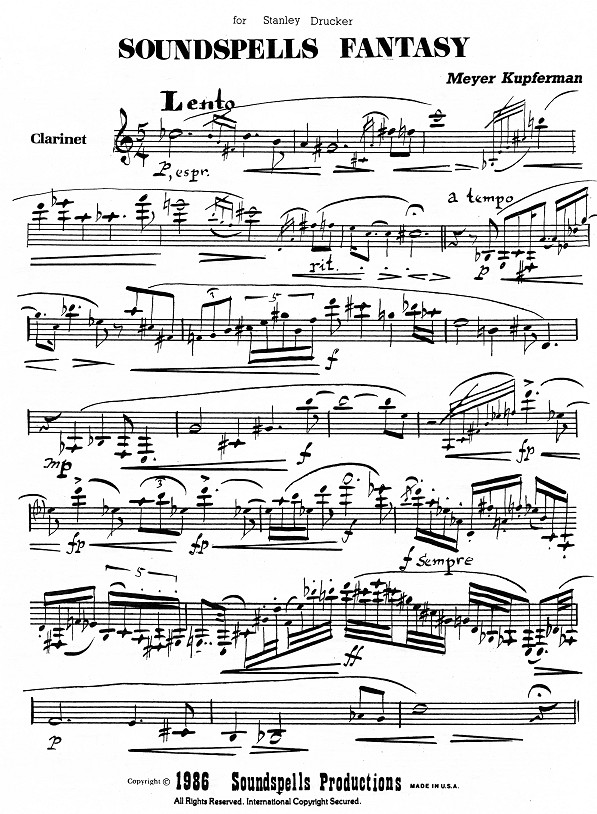
C2457: Soundspells Fantasy for (solo) clarinet by Meyer Kupferman. Soundspells Productions, 1986, SS, 4 pages. This piece is dedicated to Stanley Drucker. It is in 5/4 throughout and begins at a Lento tempo but includes faster tempos. It is being used for the International Clarinet Association 2017 Young Artist Competition. Click on the cover image to view the first page. (Except other items with free shipping.) |
10.95
|
|
C1251: Serenade for Clarinet Solo by Ezra Laderman. Rongwen Music, 1958, SS, 5 pages. Ezra Laderman (1924-) is an American composer. This work has four pieces: A Single Voice (Allegro), Rubatoism (Moderato), Song for a Solo Reed (Andantino), and March in Rondo. Early college level with a duration of 8 minutes. (Except other items with free shipping.) |
8.50
|
|
C1184: Reflections for Clarinet (solo) by André Laporte. Chester, 1971, 3 pages. André Laporte (1931-) is a Flemish composer and a champion of contemporary music. A contemporary piece with fractional tones, extended articulation techniques, multiphonics, and contemporary notation. About 8 minutes. (Except other items with free shipping.) |
8.50
|
|
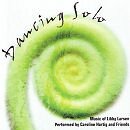
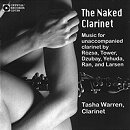
C306: Dancing Solo for solo clarinet by Libby Larsen. Oxford University Press, 1994, SS, 12 pages. Commissioned and premiered by Caroline Hartig. The composer wrote, "Dancing alone—improvising with the shadows, the air, on an inner beat, upon a fleeting feeling—has always enthralled me. In Dancing Solo I am making a dance for the clarinet, a dance composed of color, rhythm, beat implied and explicit, and breath: the music is the dance and the dance is the music."
(Except other items with free shipping.) |
21.95
|
|
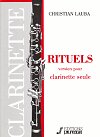
C1482: Rituels for Clarinet Solo by Christian Lauba. Fuzeau, 1989, 8 pages. Christian Lauba (1952-) is a French composer of contemporary music and teacher of composition. This is an advanced solo which makes extensive use of extended techniques including multiphonics, flutter tonguing and other articulation techniques, vibrato, fractional tones, etc. This is sold out and the publisher has no plans to reprint it. | |

|
C429: Inner Light by Daniel Levin. Woodwindiana, 2003, SS, 4 pages. For solo B-flat clarinet. Inner Light is lyrical, chromatic and rhythmically jaunty. It features frequent meter and tempo changes. Early college level. Click here to listen to an except from the middle of the piece. Click on the cover image to view the second page. (Except other items with free shipping.) |
5.00
|
|
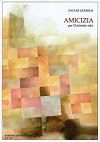
C1395: Amicizia for Clarinet Solo by Ingvar Lidholm. Nordiska Musikförlaget, (1981), 4 pages. Ingvar Lidholm (1921-) is a Swedish composer and music educator. His early style was influenced by Igor Stravinsky, Béla Bartók and Paul Hindemith. Later he became atonal, and sometimes serial. Amicizia is the Italian word for friendship. This is a contemporary piece for solo clarinet at the upper college level. It includes altissimo to B-flat but no extended techniques. There are three written movements with the first movement repeated to make four: I. (and IV.) amabile, II. drammatico, III. scherzando. Duration is about 8 minutes. You can listen to a recording here. (Except other items with free shipping.) |
17.95
|
|
C1252: The Mime for Clarinet Solo by Arthur Lourie. Rongwen Music, 1958, SS, 5 pages. Arthur Lourie (1892-1966) was born in Russia and after living in Berlin (1921) and Paris (1924), relocated to the United States in 1941. This piece is dedicated to Charlie Chaplin. College level with a duration of 5:20. (Except other items with free shipping.) |
6.50
|
|
C2236: Chiral Symmetries for solo clarinet by Eric P. Mandat. Cirrus Music, 2013, 11 pages. Chirality is a property of asymmetry in which an object seemingly identical to its mirror image cannot be superposed on to it (examples hands). This piece was premiered by the composer at ClarinetFest 2014 in Assisi, Italy. This is an advanced piece with fractional tones and many multiphonics (fingerings given). It has six movements: Stars Twinkle, Planets Shine; Strings of Waves of Strings; Dancing on the Light's Edge; Origins; Infinity's Embrace; and The Universe Stops Expanding Briefly to Offer Advice. |
19.95
|
|
C2037: Double Life for solo clarinet by Eric P. Mandat. Cirrus Music, 2007, 9 pages. This piece was written in honor of clarinetist and composer William O. Smith. The first movement is for B-flat and A clarinets played simultaneously. Instructions are provided for inserting corks in the upper joint of the A clarinet. The second movement used a PVC pipe extension (provided) which is inserted between the lower joint and the bell of the B-flat clarinet. The first and second movements use multiphonics (very limited in the first movement) while the third movement has fractional tones. The movements are: I. Double Life, II. Deep Thoughts, and III. To Be Continued... Click on each of the movement names to watch Robert Spring discuss and perform them. Because of the PCV pipe we won't be able to use Media Mail for this item. Please select Priority which is about the same cost as the parcel rate we would have to use otherwise. |
24.95
|
|
C1492: Etude for Barney for solo B-flat clarinet by Eric P. Mandat. Cirrus Music, 1990, 2 pages. This piece was written to honor Barney Childs (1926-2000). The primary feature of this piece is the fractional tones (fingerings given). With a tempo of mm=120 and mostly sixteenth note phrases, this will be a challenging piece. This piece is being used for the 2014 International Clarinet Association Young Artist Competition.
(Except other items with free shipping.) |
6.95
|
|
C1277: Folk Songs for solo B-flat clarinet by Eric P. Mandat. Cirrus Music, 1986, 17 pages. A piece by contemporary clarinetist and composer Eric Mandat which uses fractional tones, multiphonics (fingerings provided), and other extended techniques. Five movements, not actual folk songs but each has a distinct folk-like character from Appalachian fiddling to Japanese shakuhachi music to "star songs." In February 2013, the composer made some additional corrections to this piece. This is the most current version.
|
34.95
|
|
C1297: The Jungle for solo B-flat clarinet by Eric P. Mandat. Cirrus Music, 1989, 13 pages (plus two pages of instructions and a key to the symbols). An advanced three movement piece using fractional tones, multiphonics, and other extended techniques. The composer writes, "Call to Arms - Juxtaposition of static machine-like rhythms and quirky micro-tonal outbursts. Lament - Perfect interval multiphonics gradually pulled out of tune. Apotheosis - Reconciliation between the static rhythms and microtones, or is it surrender?" |
24.95
|
|
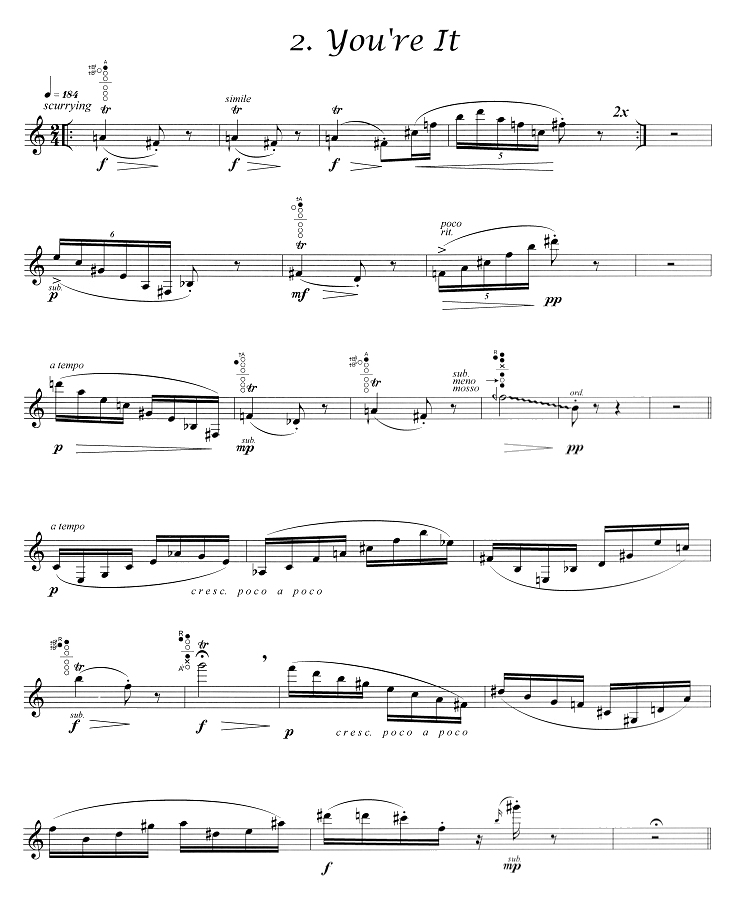
C2235: The Moon in My Window for solo B-flat clarinet by Eric P. Mandat. Cirrus Music, 2007/2010, 9 pages. One reviewer thought the multiphonics in this piece sounded challenging but there have been a number of performances both by the composer and by other clarinetists. Six pieces: 1. Butterfly Morning, 2. You're It, 3. P'nut But'r, 4. Music Box, 5. All Aboard, and 6. The Moon in My Window. The fingerings for multiphonics are give and the composer has provided some notes. Here are audio recordings of this piece (we believe this is the 2007 version). Click on the cover image to view a sample page. |
19.95
|
|
C1298: Preludes, book I for solo B-flat clarinet by Eric P. Mandat. Cirrus Music, 1994, 9 pages. Five short lyrical pieces exploring a variety of multiphonic and microtonal techniques. Illinois Central, ... the looking -glass, ... homage to P.J., ... spin moves, ... in Bill's back room.
|
19.95
|
|
C1921: Rrowzer! for solo B-flat clarinet by Eric P. Mandat. Cirrus Music, 2005, 4 pages (plus a page of notes). Composed in 2005, Rrowzer! is a prelude designed to get audience revved up for the rest of a recital. Using quarter tones and multiphonics, the piece portrays an old grouchy dog snarling at passers-by. Some of the quartertone fingerings even end up produce multiphonics between first and third partials, creating a growling noise. It includes quarter tones and multi-phonics (with fingerings), as well as mixed meter, complex subdivisions, and repeated ostinati.
|
9.95
|
|
C1296: Tricolor Capers (Revised Edition) for solo B-flat clarinet by Eric P. Mandat. Cirrus Music, 1980/2011, 8 pages (plus two pages of fingerings and a key to the symbols). The composer wrote about this three movement work, "Portent - Multiphonic trills and melodic fragments signaling movements 2 and 3. Sway - A drunken quarter tone wobble. Bop - A jazz-inspired frenzy of notes." An advanced work. The composer has updated this work (2011). He has adjusted articulations, added fingerings and courtesy accidentals, changed a few markings to reflect performance practices and fixed a few errors. |
19.95
|
|
C1623: Suite I for Clarinet Solo by Michele Mangani. Edizioni Musicali Eufonia, SS, 5 pages. Four movements, all without bar lines: I. Preludio (Moderatamente cantabile), II. Entrata (Allegro con fuoco), III. Intermezzo (Andante cantabile), and IV. Finale (Allegro tristemente). A contemporary solo composition without any extended techniques. Early college level. (Except other items with free shipping.) |
13.95
|
|
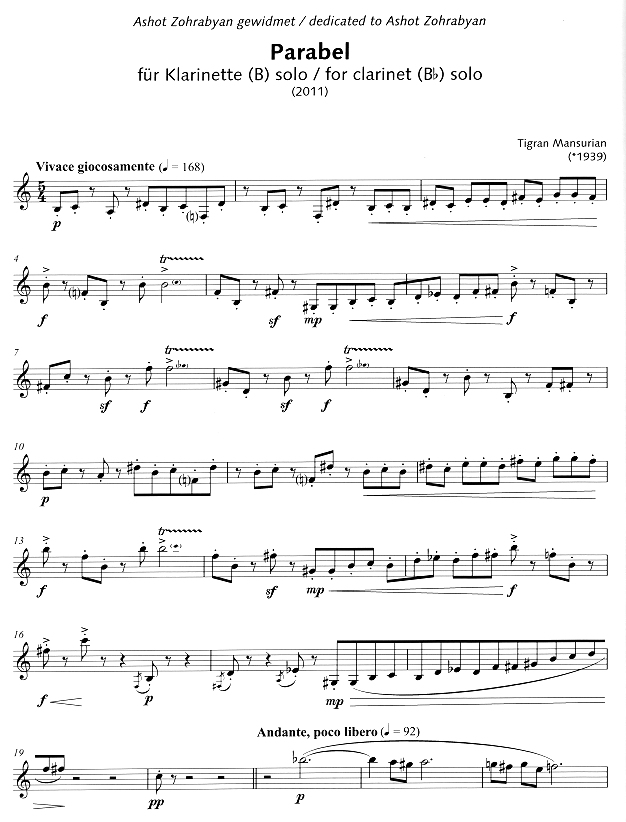
C2560: Parabel for Clarinet Solo by Tigran Mansurian. M.P. Belaieff, 2011, SS, 5 pages. This is a sectional piece with 5 brief sections: Vivace giocosamente; Andante, poco libero; Poco piu mosso and Vivace giocosamente. The composer wrote: "In Armenia, the clarinet is considered a popular instrument. Almost all of our duduk players also play the clarinet. In some villages, they call it gralnet and they call the player gralnetist. In Parable I have tried to combine the clarinet and gralnet with their individual intonation and their characteristic uniqueness in rhythm and color. I have attempted to secure in the amalgamation of the two “clarinets” a dichotomy or paradox that would hold true for a parable." Duration about 5 minutes. You can listen to this piece here. Click on the cover to view the first page of the music.
(Except other items with free shipping.) |
14.95
|
|
C1334: Bug for solo clarinet in B-flat by Bruno Mantovani. Henry Lemoine, 2000, SS, 3 pages. Advanced contemporary work for solo clarinet. Includes a few fractional tones, but no mulitphonics. Here is a performance on YouTube. There is a statement in the YouTube comments that Mantovani wrote this as a representation of a computer breakdown.
(Except other items with free shipping.) |
15.95
|
|
C1398: Monodie for solo clarinet in B-flat by Miklós Maros. Nordiska Musikförlaget, 1976, SS, 5 pages. Miklós Maros (1943-) is a Hungarian born and educated composer who works in Sweden. This piece uses contemporary notation. While extended techniques are not called for, the opening section demands good articulation skills as it is marked presto possibile and molto marcato sempre. The duration is about 7 minutes
(Except other items with free shipping.) |
8.95
|
|
C370: A Set for Clarinet by Donald Martino. McGinnis & Marx, 1957, SS, 7 pages. Professor Norman Heim wrote that this work may be the best, most played, and most difficult unaccompanied work in the clarinet repertoire. It demonstrates an extension of all technical capabilities (with extensive use of altissimo register) and yet is very musical. This piece is reserved for the most advanced player as a challenge and is a wonderful show piece. 
(Except other items with free shipping.) |
11.95
|
|
C1969: Little Symphony (in four movements) on the name BArnEy CHilDS for solo clarinet in B-flat by David Maslanka. Maslanka Press, 1989/2014, SS, 1 page (of music). The Little Symphony was written for the birthday of composer Barney Childs in 1989. It is one rather densely packed manuscript page with a number of repeats which extend the performance duration. It uses pitches derived from his name: B A E C B-flat D and E-flat. For advanced performers.
(Except other items with free shipping.) |
8.95
|

|
C2404: Three Roman Miniatures for solo clarinet by David Matthews. Faber Music, 2001, SS, 5 pages. David Matthews (1943-) is an English composer of mainly orchestral, chamber, vocal and piano works. The three pieces are 1. Animula (Con fantasia), 2. Lacrimae rerum (Lento e mesto), and 3. Actaeon (Vivace). College level (although the middle piece at a slower tempo is easier) with a duration of 5 minutes. Complete program notes are here on the publisher's website. Click on the cover image to view the first page. (Except other items with free shipping.) |
14.25
|
|
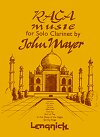
C1646: Raga Music for Solo Clarinet (preferably in A) by John Mayer. Lengnick, 1958, SS, 5 pages. John Mayer (1930-2004) was an Indian musician (violin), composer and music educator who won a scholarship to the Royal College of Music in 1952 and spent the rest of his life in Britain. He was known for fusing Indian and Western music and this was reportedly his first composition in that genre. There are nine short ragas which we understand should be played freely in an improvisatory style: 1. Vilashakhani, 2. Megha (Rainy Season), 3. Vibhasa (Sunrise), 4. Gunakali (Morning), 5. Shri (Afternoon), 6. Pilu (Evening), 7. Puravi (End of Day), 8. Kanada (In the deep of Night), and 9. Vasanta (Spring Raga). College level with a duration of about 9 minutes.
(Except other items with free shipping.) |
9.95
|
|
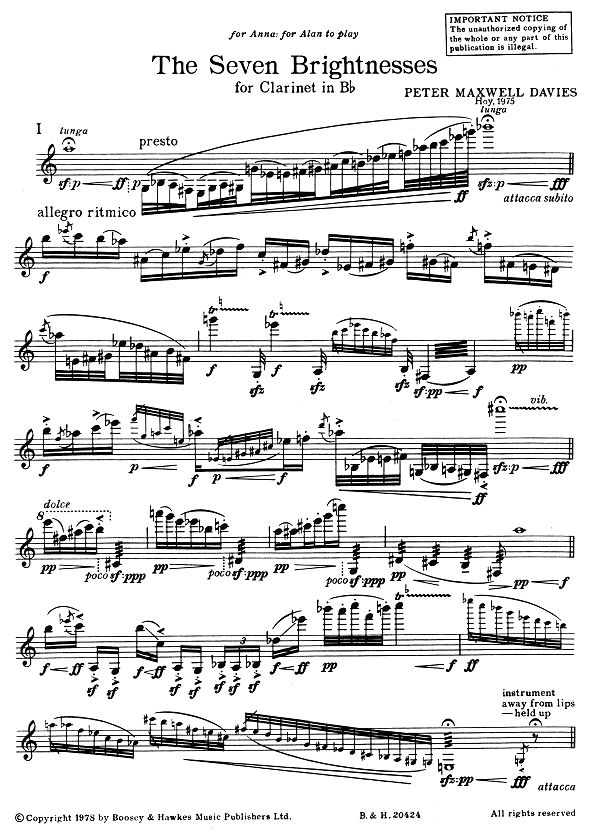
C2628: The Seven Brightnesses for Solo Clarinet by Peter Maxwell Davies. Boosey & Hawkes, 1978, SS, 4 pages. Peter Maxwell Davies (1934-2016) was an English composer and conductor. This piece was written in 1975 for Alan Hacker. It is a very challenging work with high altissimo, flutter tonging, and a bit of multiphonics. It is in five short movements: Presto/Allegro ritmico, Adagio, Adagio espress., Moderato, and Allegro. Each movement is available for listening on YouTube. Search that website for "7 Brightnesses Clarinet" to find it. Click on the cover image to view the first movement. (Except other items with free shipping.) |
15.95
|
|
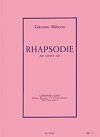
C1052: Rhapsodie for Solo Clarinet by Giacomo Miluccio. Alphonse Leduc, 1979, 4 pages. Marked: Passionale, quarter note = 58 (elasticamente). No bar lines. Upper college level with a duration of about 5:15. |
14.20
|
|
C1498: Registro de Pajarillo for E-flat Clarinet Alone by Jorge Montilla. Woodwindiana, 2010, SS, 4 pages. Jorge Montilla (1970-), a Venezuelan clarinetist and composer, was the founder of the Caracas Clarinet Quartet. This piece was premiered by the composer at the 2006 ClarinetFest in Atlanta. It was inspired by the Pajarillo dance which is the most refined of all fast Venezuelan dances derived from the Joropo. This is a solo showpiece for the E-flat clarinet. After a Moderato opening section, the balance of the piece is Allegro. College level with a duration of 3:30. (Except other items with free shipping.) |
14.95
|
|
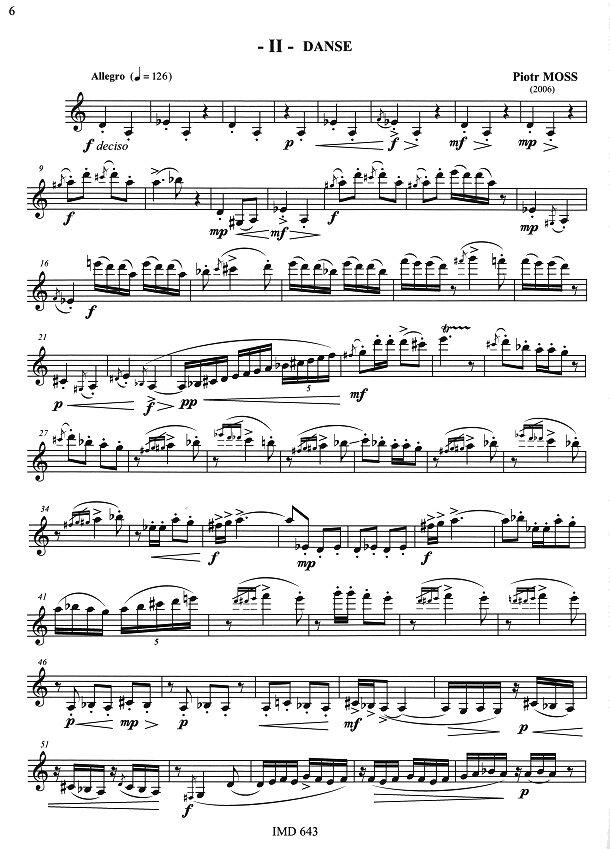
C1820: Méditation et Danse for E-flat Clarinet Solo by Piotr Moss. International Music Diffusion, 2008, SS, 8 pages. Piotr Moss (1949-) is a Polish-French composer who studied in Poland and France (with Boulanger) where he took up permanent residence in 1981. He has written orchestral and chamber music and for TV and films. Meditation is Andante while Danse begins Allegro but has many tempo changes. College level. Click on the cover image to view the first page of the Danse.
(Except other items with free shipping.) |
20.95
|
|
C772: Three Characteristic Studies (Trois Étude de Caractère) for Solo Clarinet by Jean-Philippe Navarre. International Music Diffusion, 2000, 6 pages. This set of three pieces was originally written for E-flat clarinet but can be played on any member of the clarinet family. The three studies are I. Thrène (Adagio), II. Sotto Voce (Non troppo adagio), and III. Perpetuum Mobile (which has no tempo markings but is black with 32nd notes). College level.
(Except other items with free shipping.) |
13.95
|
|
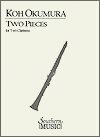
C275: Two Pieces for Solo Clarinet by Koh Okumura. Southern Music Co., 1988, SS, 3 pages. Based on the Japanese folk song music Min-yo. The pieces are titled Lullaby and Cow Caravans' Melody. Here is a performance on YouTube.
(Except other items with free shipping.) |
6.95
|
|
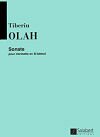
C1256: Sonate for Clarinet in B-flat by Tiberiu Olah. Salabert, 1970, SS, 5 pages. Tiberiu Olah (1928-) is a Rumanian composer of Hungarian descent. After studying in Cluj and Moscow he taught at the Conservatory in Bucharest. His compositional output is primarily chamber, orchestral, and film music. This is a contemporary work for solo clarinet. The only extended techniques required are for articulation (slap and flutter tonguing etc.) Duration about 6:12. (Except other items with free shipping.) |
11.95
|
|
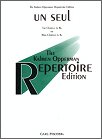
C1676: Un Seul for (Solo) Clarinet or Bass Clarinet by Kalmen Opperman. Carl Fischer, 2000, 2 pages. This piece was written in 1998 and is dedicated to Richard Stoltzman. It is marked Adagio (freely) and has a cadenza near the end. Most of this piece is relatively easy because of the slow tempo, however the cadenza is marked rapido, is noted in 32nd notes and ends on an altissimo A. (Except other items with free shipping.) |
6.95
|
|
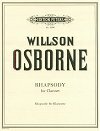
C381: Rhapsody for Clarinet by Willson Osborne. C.F. Peters, 1958. An excellent one movement solo clarinet work for beginning college level. (While originally written for the bassoon, the clarinet version was published at the same time.)
(Except other items with free shipping.) |
13.95
|
|
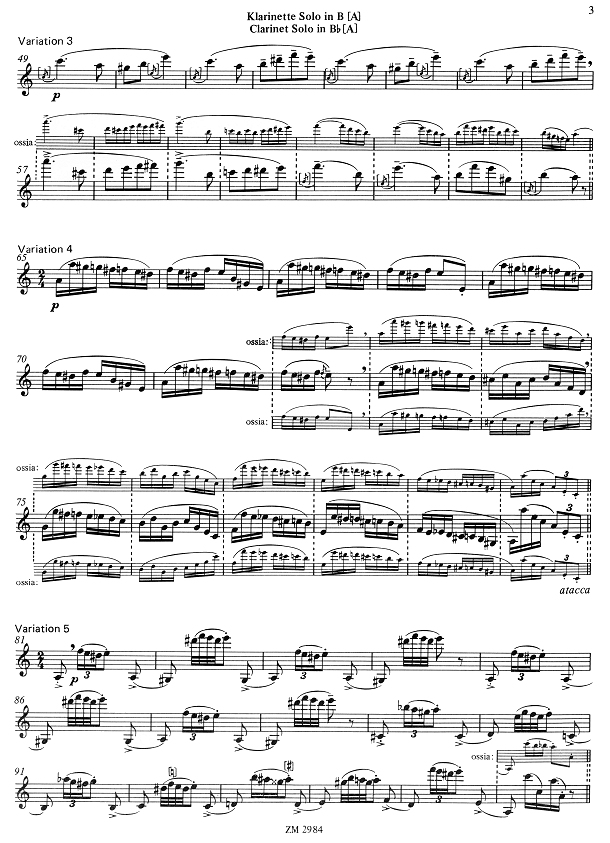
C2201: Capriccio Op. 1 Nr. 24 for Solo Clarinet by Niccolo Paganini arranged by Stephen Korody-Kreutzer. Zimmermann, 1993, SS, 6 pages. This is probably the most famous Paganini caprice. Theme and 11 Variations followed by the Finale. This arrangement has numerous ossia which are sometimes easier, other times more difficult and in some cases both are present. Click on the cover image to view a sample page. (Except other items with free shipping.) |
14.95
|

|
C2018: Monologhi di tutti i Giorni (Monology Všedního Dne) for Solo Clarinet by Jiri Pauer, Schott Music Panton, 1971, SS, 9 pages. Jiří Pauer (1919-2007) was a Czech composer. This piece which was written in 1964 may have been intended as a series of etudes for study (the title can be translated as "Everyday Monologues"). There are seven monologues with a total duration of 9:40. Click on the cover image to view the first page. (Except other items with free shipping.) |
15.95
|
|
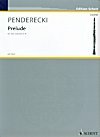
C605: Prelude for Solo Clarinet in B-flat by Krzysztof Penderecki. Schott, 1988, SS, 2 pages. Krzysztof Penderecki (1933-2020) was a Polish conductor and composer. This is a short solo work written in 1987 and dedicated to Paul Patterson. It starts Lento sostenuto and builds in tempo and volume to climax on a high altissimo C then returns to the original tempo and decrescendos for a quiet ending. There are no bar lines. College level. (Except other items with free shipping.) |
10.95
|
|
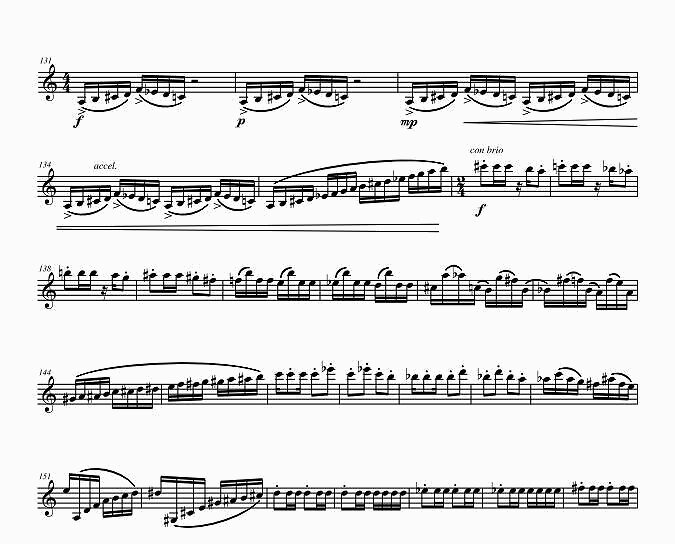
C1995: Fantasía No. 1 "Valle del Mantaro" for Clarinet Solo by César Peredo. Alry Publications, 2012, SS, 4 pages. César Peredo is a Peruvian flutist and composer who studied in Peru and Germany. This piece incorporates many Peruvian themes and rhythms. (The Mantaro Valley, with its main city of Huancayo, lies east of the capital of Peru, Lima. It is a fertile valley containing fields of corn, artichokes, carrots and potatoes, alongside which flows the Mantaro River.) College level with a duration of 5 minutes. Click on the cover image to view a short sample from near the end of the piece.
(Except other items with free shipping.) |
16.95
|
|
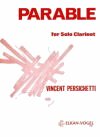
C733: Parable for Solo Clarinet by Vincent Persichetti. Elkan-Vogel, 1974, 3 pages. Vincent Persichetti (1915-1987) was an American composer, teacher, and pianist who is well known to many in the United States for his popular compositions for the concert band. This is Parable XIII (Op. 126) of the 25 he composed between 1965 and 1986. These works are typically in one movement and are written in an improvisatory manner. This is an advanced work but does not require extended technique (other than one note that is flutter tongued). (Except other items with free shipping.) |
6.95
|
|
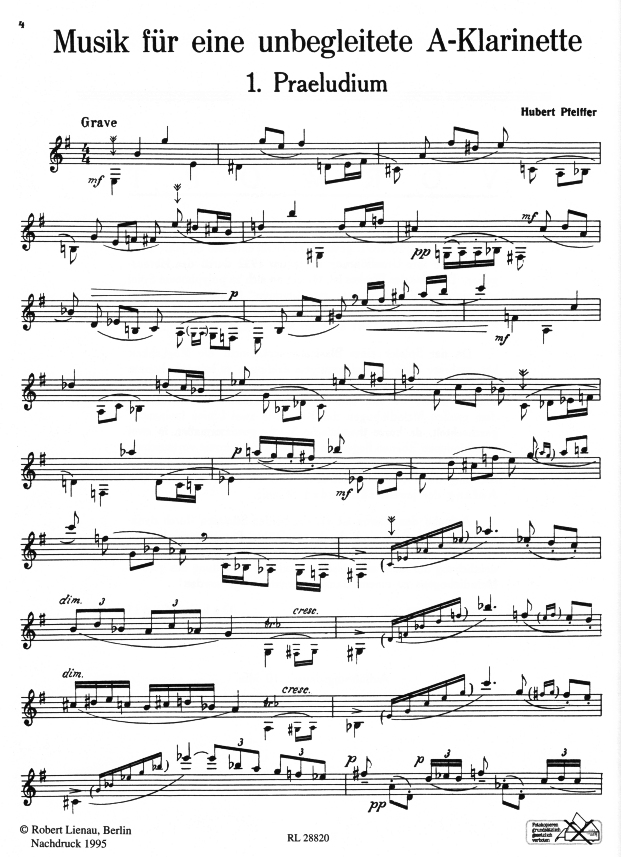
C2210: Music for A Clarinet Solo by Hubert Pfeiffer edited by Oskar Kroll. Robert Lienau, 1995, SS, 7 pages. Hubert Pfeiffer (1891-1932) was a German composer. This piece has three movements: 1. Praeludium (Grave), 2. Scherzo (Molto vivace), and 3. Fuga (Allegro moderato). Early college level with an overall duration of 10 minutes. Here is a recording of the first movement. Click on the cover image to view the first page.
(Except other items with free shipping.) |
12.25
|
|
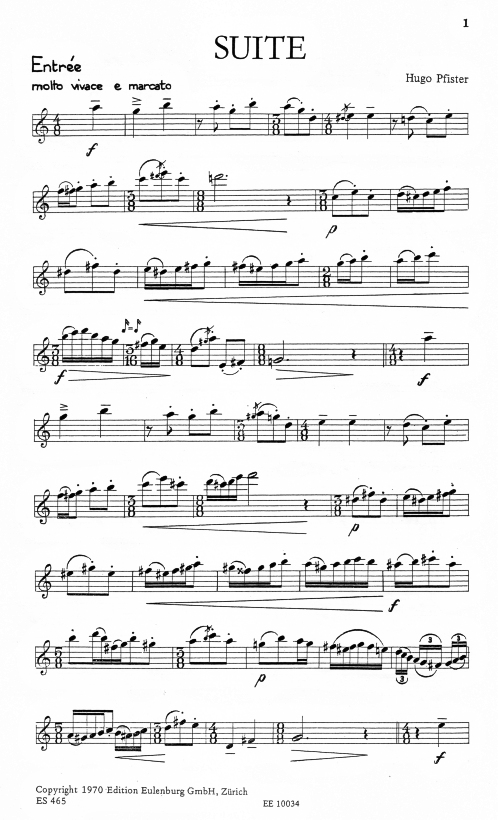
C2207: Suite for Clarinet in B-flat (Solo) by Hugo Pfister. Edition Eulenburg, 1970, SS, 13 pages. Hugo Pfister (1914-1969) was a Swiss composer. This piece has 6 movements: Entrée (molto vivace e marcato), Air (adagio cantabile, non troppo lento), Danse variée (allegro con brio), Petit Dialogue (parlando espressivo), Chanson (andante sostenuto), and Carrousel (allegro molto). This college level piece has quite a bit of mixed meter. Click on the cover image to view the first page.
(Except other items with free shipping.) |
11.95
|
|
C1648: One of a Kind for Solo Clarinet in B-flat by Mark Phillips. Lauren Keiser Music, 1995/2008, 13 pages. One of a Kind was written for a farewell performance by clarinetist David Lewis on the occasion of his retirement from Ohio University. One of a Kind attempts to blur the boundaries between "serious" music and various popular styles. One of a Kind opens with an introspective cadenza which leads directly into movement one. This movement, with its relentless stream of eighth notes, is a virtual perpetual motion machine. It also exploits the clarinet's wide range and agility, as well as its sophisticated fingering system which provides for many alternate fingerings, each with its own distinct tone color and subtle intonation inflection. As the melodic line becomes more and more disjunct it seems to fragment into two (or more) contrapuntal lines — at least some of which may seem influenced by jazz and blues. The introverted second movement is very slow and mostly soft. By exploiting the clarinet's dark, somber tone color and its astonishing dynamic range (especially its ability to play soft tones throughout its various registers), this movement manages to be both expressive and austere. The final movement is a Klezmer inspired whirlwind, which comes unwound in the middle to allow space for a bit of "schmaltz," giving way in turn to a short cadenza before gradually gathering speed again as it heads for a raucous ending. Duration about 13:20. |
14.95
|
|
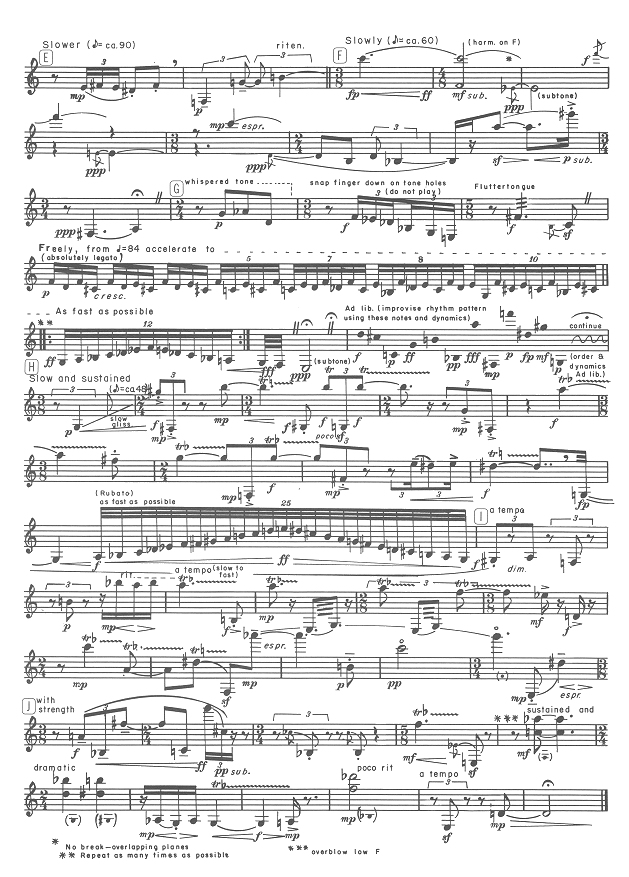
C2724: Fantasy for clarinet by Peter Phillips. Murbo (Bourne Co.) 1970, 2 pages. This piece is dedicated to Bill Smith and is from "A Day in the Life of Frog." It includes whisper tones, flutter tonguing, brief improvised sections, glissando, and multiphonics. Click on the cover image to view a sample page. (Except other items with free shipping.) |
4.00
|
|
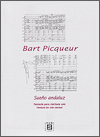
C2562: Sueño Andaluz, Fantasia for Solo Clarinet by Bart Picqueur. B&M Llevant Edicions Musicals SL, 2012, SS, 6 pages. "With Sueño Andaluz, composer Bart Picqueur goes back to his first musical love: the clarinet. The scorching heat of southern Spain makes the brain of the northerner melt down and gives him visions of dancing gypsy-girls with mysterious dark eyes." This is a challenging contemporary work from Spain. Includes fingered vibrato and tremolos, glissando, tongue bends, odd meter, foot taps, and high altissimo. This piece was used for the International Clarinet Association 2018 Young Artist Competition. Click on the cover image to view three pages of the music. (Except other items with free shipping.) |
28.95
|
|
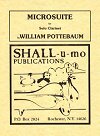
C1510: Microsuite for Solo Clarinet by William Pottebaum. Shall-u-mo Publications, 1979, 10 pages. An intriguing musical composition for solo clarinet which utilizes quarter- and eighth-tones. All microtonal fingerings are clearly presented in the score. Also included is a formal analysis by the composer. Three movements: I. Scherzo Irresoluto, II. Lusingando, and III. Presto assai. Excellent for the study of this technique. Here is an audio sample from the first movement. (Except other items with free shipping.) |
16.95
|
|
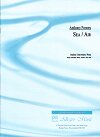
C1342: Sea / Air Solo for Clarinet in B-flat by Anthony Powers. Oxford University Press/Allegro Music, 1987, SS, 6 pages. This piece was written for David Campbell. One of the leading British composers of his generation, Anthony Powers (1953-) studied in Paris with Nadia Boulanger and at York University with David Blake and Bernard Rands. Powers's music is characterized by strong architectonic frameworks that support a language of poetic intensity and magical sonorities. His music often takes its inspiration from the tension between different states, be they physical properties, landscapes, seasons or emotions and in this case between sea and air. This is an advanced work featuring complex meters, high altissimo and occasional flutter tonguing. Duration about 5:15. (Except other items with free shipping.) |
11.95
|
|
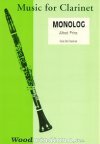
C430: Monolog by Alfred Prinz. Woodwindiana, 1999, SS, 4 pages. This work for solo B-flat clarinet was written by legendary Vienna clarinetist Alfred Prinz for Howard Klug. Dr. Klug writes, "This relatively short and very accessible work was written in one afternoon while on holiday in Bloomington in 1994. Nicely constructed to emphasize both the lyrical and technical capacities of the instrument by a master performer." College level. (Except other items with free shipping.) |
8.95
|
|
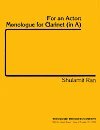
C490: For an Actor: Monologue for Clarinet (in A) by Shulamit Ran. Theodore Presser Co., 1978, SS, 8 pages. The composer wrote: "To me, the [clarinet] in its contemporary usage suggests an incredible gamut of gestures, dynamics, and emotions. Accordingly, in MONOLOGUE, the player assumes the role of a virtuoso actor who, by purely musical means, goes through a kind of wordless 'monodrama.'" This is a one movement, multisection avant garde work, which employs many special techniques.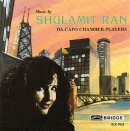
(Except other items with free shipping.) |
9.95
|
|
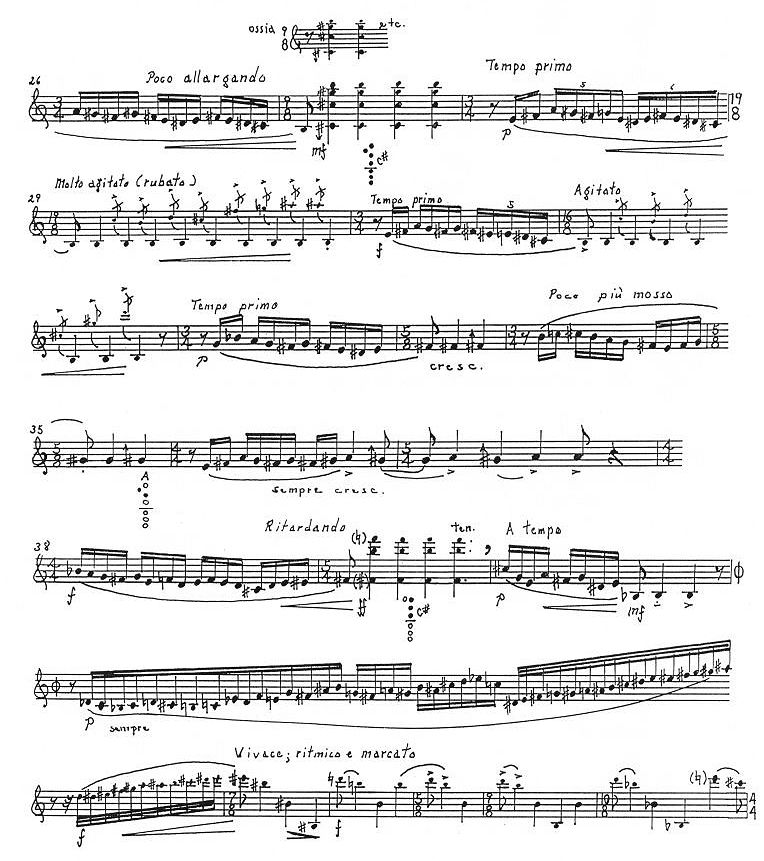
C2206: Solo Music for Clarinet by Thomas Read. Edition Peters, 1990, SB, 13 pages. Thomas L. Read (1938-) is an America composer, violinist, and music professor. This is an advanced, contemporary work written for Steve Klimowski and premiered in 1984. It has three movements: I. Animato, leggiero; II. "Burden" with Interruptions; and III. Andante. It includes quarter tones and a few multiphonics (with fingerings given) and some contemporary notation. It has a duration of 16 minutes. Here is an .mp3 audio sample (not from the beginning). Click on the cover image to view the second page page of the clarinet part. |
15.75
|
|
C1365: Diskurs for Clarinet Solo by Johannes Reiche. Hofmeister, 1995, SS, 6 pages. Johannes Reiche (1955-) is a German composer, conductor, teacher and clarinetist and a proponent of New Music. This is an advanced solo piece. It includes some flutter tonguing, a few multiphonics, and many changes in tempo and dynamic level. The title, "discourse" in English, suggests the work represents a monolog if not a conversation. (Except other items with free shipping.) |
11.95
|
|
C1381: Suolo - Suono Solo for Clarinet by Johannes Reiche. Hofmeister, 1995, SS, 5 pages. This is a modern piece for solo clarinet. It is marked "senza misura, in modo declamatio." It uses some contemporary notation but does not have any extended technique besides a bit of flutter tonguing. There are instructions for a drone tone that can be sounded by a synthesizer, cello or double bass through the first and last third on the piece. An advanced work. (Except other items with free shipping.) |
11.95
|
|
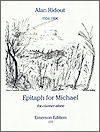
C2150: Epitaph for Michael for Clarinet Alone by Alan Ridout. Emerson Edition, 2001, SS, 1 page. Alan Ridout (1934-1996) was a British composer and music educator. This piece was written in 1976 in memory of Michael Strang who died at the age of 14. This two minute piece is at a slow tempo (mm= 63) and marked Tenderly. While not at all difficult it will probably require at least early high school skills to perform successfully. (Except other items with free shipping.) |
9.95
|
|
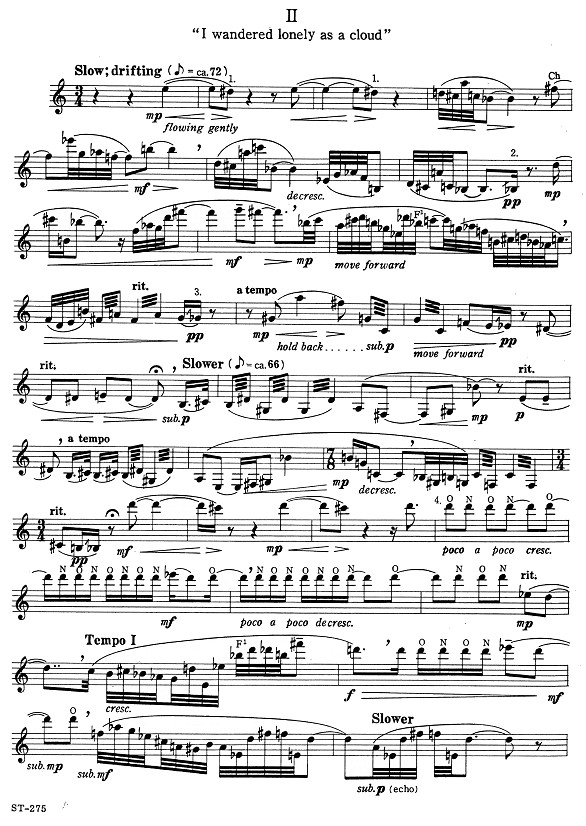
C1335: Three Studies on Flight for Solo Clarinet by Russell Riepe. Southern Music, 1979, SS, 7 pages. Russell Riepe (1945-) is an American composer who holds a Ph.D. in composition from Eastman and studied with Nadia Boulanger. He is Professor and Coordinator of Music Composition Programs at the Texas State University, San Marcos. This work was first performed in 1976 by David Pino who has written some performance notes. It is a contemporary piece in three movements: I. "Your laughter frees me and lends me wings" (Fast and joyful), II. "I wandered lonely as a cloud" (Slow; drifting); and III. "Wild Spirit . . . moving everywhere" (Very fast and spirited). Upper college level with a duration of about 8:30. You can find performances of this work on YouTube. Click on the cover image to view a sample page. (Except other items with free shipping.) |
12.95
|
|
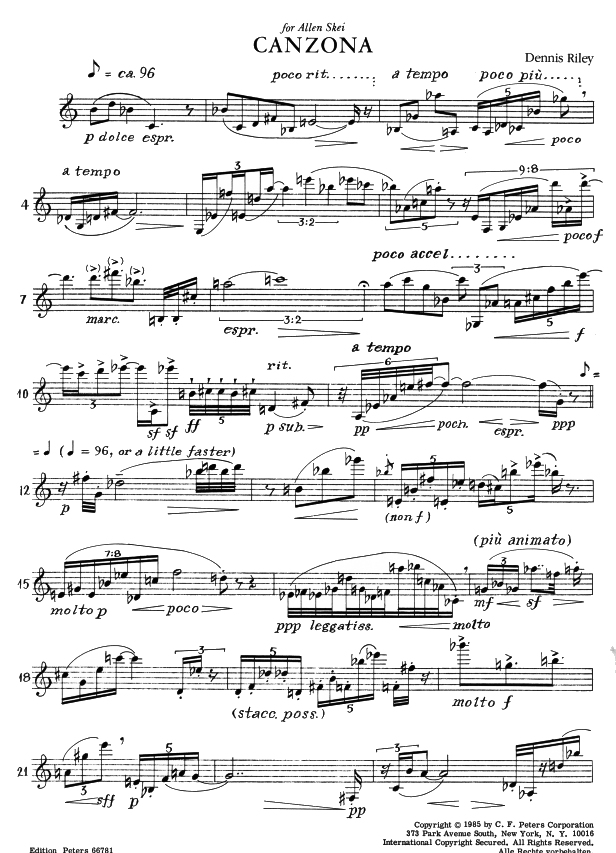
C2209: Canzona for Solo Clarinet by Dennis Riley. Edition Peters, 1985, SS, 3 pages. Dennis Riley (1943-1999) was an American composer. This piece was written in 1977 and has a duration of 4:30. It is a college level contemporary work. Click on the cover image to view the first page. (Except other items with free shipping.) |
9.50
|
|
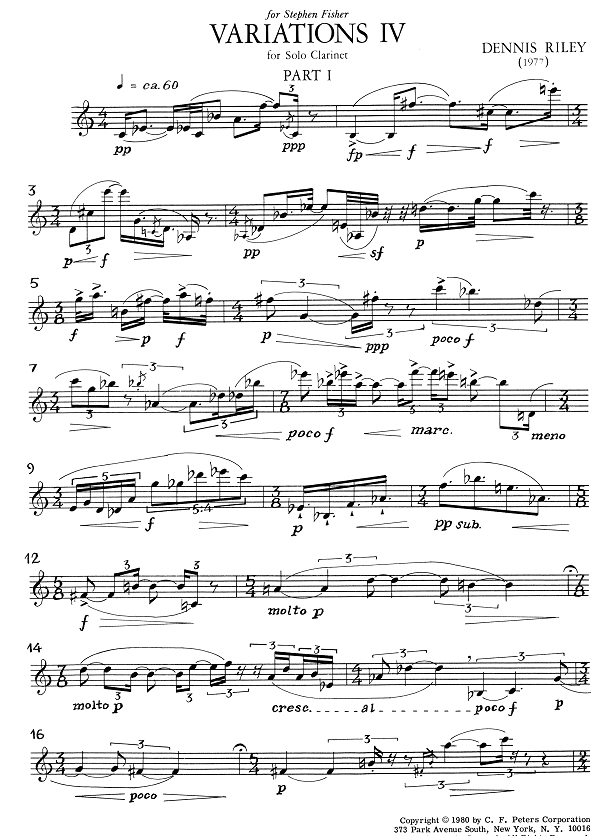
C2205: Variations IV for Solo Clarinet by Dennis Riley. Edition Peters, 1980, SS, 7 pages. This piece was written in 1977 and has a duration of 6:40. It is in two parts that are both at a slow tempo (mm=60) but with some somewhat faster sections. The meter changes in nearly every measure. An advanced work. Click on the cover image to view the first page. (Except other items with free shipping.) |
10.50
|
|
 C2602: Flight of the Bumble-Bee for Clarinet Solo by Nicolai Rimsky-Korsakov arranged by Robert Dalpiaz. Kendor Music Inc., 2018, 3 pages. This unaccompanied arrangement of the famous Nicolai Rimsky-Korsakov classic strives to maintain the integrity of the original, with an eye towards phrasing that is achievable for the (US) grade 5 musician. Idiomatic for the clarinet, this is a great piece to showcase the players dexterity. Duration about 1:50. Click on the cover image to view the first page of the music. (Except other items with free shipping.) |
7.95
|
|
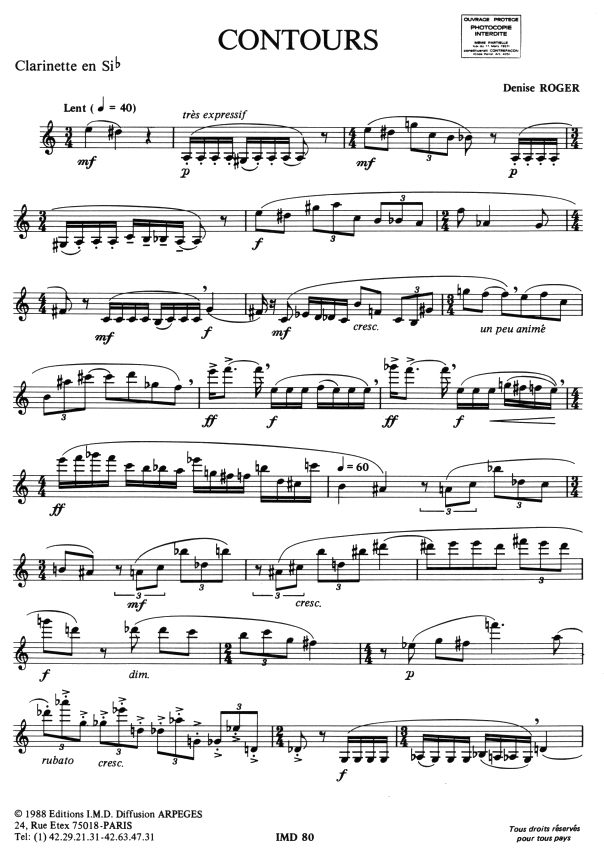
C771: Two Pieces for Clarinet (Contours & Scintillements) for Solo Clarinet by Denise Roger. International Music Diffusion, 1988, SS, 5 pages. Denise Roger (1924-2005) was a French composer and pianist was known for disregarding the trends of contemporary music and keeping her independence, composing in a linear and chromatic style. Contours is marked Lent and begins Lent (mm=40) with the tempo increasing after a few measures. The middle section is agitato followed by a Calmato conclusion. Duration 3:25. Scintillements is marked Avec fantasie with a tempo of mm=120 increasing to mm=138 about a quarter of the way in and returning to the original tempo just before the end. Duration 2:40. Early college level. Click on the cover image to view the first page. (Except other items with free shipping.) |
9.95
|
|
C1124: Wordsworth Miniatures solo clarinet in B-flat by Edwin Roxburgh. UnitedMusic, 2003, SS, 6 pages. Commissioned by Linda Merrick. Edwin Roxburgh (1937-) is an English composer, conductor, and oboist. The miniatures are: 1. Calm is the fragrant air, 2. Waters on a starry night, 3. Thoughts that do often lie too deep for tears, and 4. The cataracts blow their trumpet. College level with a duration of about 7:20. (Except other items with free shipping.) |
13.95
|
|
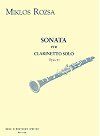
C615: Sonata for Clarinet Solo Op. 41 by Miklos Rozsa. Broude Brothers, 1988, SS, 15 pages. Dedicated to the Marchesa Madeda Mina di Sospiro. This work is somewhat similar to the Sonatina. It has three movements: Allegro con spirito, Andante semplice, Rondo Finale (Allegro capriccioso), two lively outer ones surrounding the beautiful second movement. Some jazz influences may be detected in the final movement. The work is quite long (12:30) for an unaccompanied piece. Larry Combs gave the premier performance and made the premier recording.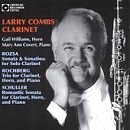
|
7.50
|
|
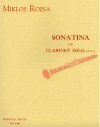
C614: Sonatina for Clarinet Solo Op. 27 by Miklos Rozsa. Rongwen Music, 1958, SS, 11 pages. Dedicated to Bronislau Kaper. In two movements: Tema con variazioni and Vivo e giocoso. The first movement is a theme with seven variations while the second is in rondo-scherzo style but ends with a 5/8 vivace section. Dr. Heim wrote, "There are romantic moments when lyrical but, in general, the music is neo-classic, similar to music prevalent between the two world wars. Rhythm is usually conservative except in variation six of the first movement. The use of the clarinet is simple, but there are moments with great flourish and bravura. An advanced college level student will find this work challenging."
(Except other items with free shipping.) |
7.50
|
|
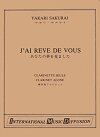
C770: J'ai Rêvé de Vous for Solo Clarinet by Yukari Sakurai. International Music Diffusion, 1988, SS, 6 pages. We have been unable to find any information about the composer of this piece which was written in Paris in 1984. It is an advanced contemporary piece using extended techniques such as flutter tonguing, glissando, and multiphonics (fingerings given). The title can be translated as "I dreamed of you." (Except other items with free shipping.) |
8.95
|
|
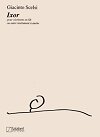
C1866: Ixor for Solo Clarinet by Giacinto Scelsi. Salabert, 1984, SS. 3 pages. Giacinto Scelsi (1905-1988) was a self-taught Italian composer who had a reputation for being eccentric and avant garde. This work which was written in 1956, has been described as "a tiny gestural invocation that bounces out of a few repeated notes" and "stark, poignant and concentrated." Duration is 3 minutes. (Except other items with free shipping.) |
16.95
|
|
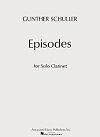
C1200: Episodes for Solo Clarinet by Gunther Schuller. Associated Music Publishers, 1979, 4 pages. An advanced contemporary piece with numerous multiphonics (fingerings given) and some high altissimo. First performed by dedicatee William O. Smith (Bill Smith) who has apparently provided the fingerings. Includes notes by the composer and Smith. Duration is 7 minutes. (Except other items with free shipping.) |
19.95
|
|
C1945: Let me die before I wake for Clarinet Solo by Salvatore Sciarrino. Ricordi, 1982, SB, 3 double size pages. Salvatore Sciarrino (1947-) is an Italian composer of contemporary classical music. This piece features multiphonics and multiphonic tremolos. Fingerings and explanations of the notation are given. Two quite different performances from YouTube: Heinz-Peter Linshalm and Curt Miller. |
29.95
|
|
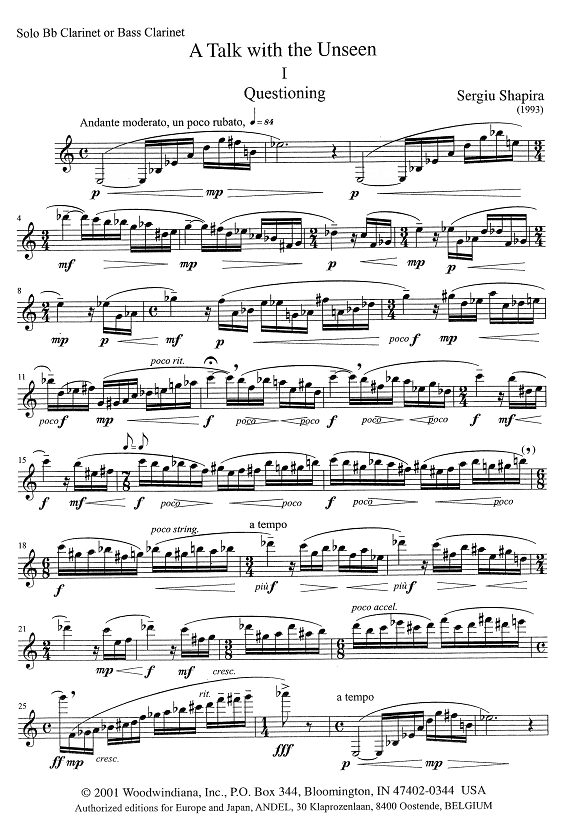
C431: A Talk with the Unseen for Solo B-flat Clarinet or Solo Bass Clarinet by Sergiu Shapira. Woodwindiana, 2001. This work won the Bass Clarinet Alone Composition Contest at the ICA ClarinetFest ’99 in Belgium. Its Romanian born, Jerusalem based composer has woven a story about a search for a superior being into an attractive, and successful, programmatic presentation. Three movements: I. Questioning, II. Struggle, III. Resignation. Includes notes on the composers and the composer's notes on the piece. About 10 minutes in length. Click on the cover image to view the first page of the music. (Except other items with free shipping.) |
11.95
|
|
C918: Cinco Bocetos for Clarinet Solo by Roberto Sierra. Subito Music, 1984, SS, 10 pages. The composer often used jumps from from the low to the high register to create what he calls a polyphonic mirage. Five (obviously) colorful sketches (bocetos): (1.) Preludio (Prelude) starts the set with the exciting rhythms of salsa while (3.). Interludio nocturno (Nocturnal Interlude) glances at the beautiful and ephemeral images of the tropical nights. Rustic songs inspire (2.) Canción del campo (Country Song) and (4.) Canción de la montana (Mountain Song). The cycle closes with (5.) Final con pajaros (Finale with birds) that quotes and old Catalonian folk tune titled Song of the Birds. All pieces are without bar lines. Duration about 8:45.
(Except other items with free shipping.) |
9.95
|
|
C914: Ritmorroto for Solo Clarinet by Roberto Sierra. Subito Music, 1995, SS, 5 pages. The three pieces of Ritmorroto are studies in new rhythmic idea and the simulation of polyphony. In the first piece the rhythmic cells and melodic motives act independently of each other. The second study explores contrapuntal ideas. The last piece is really two different pieces that happen simultaneously; one starts in the low register with loud dynamics and aggressive rhythms and the other starts gently in the high register. Gradually they travel in opposite directions ending in the reverse positions from which they began. Duration about 6 minutes. (Except other items with free shipping.) |
8.95
|
|
C249: Five Pieces for Clarinet Alone by William O. Smith. Universal Edition, 1963, SS, 8 pages. A short suite in varying dance like rhythms. The melodic lines are atonal and are frequently characterized by extremely wide interval leaps.
(Except other items with free shipping.) |
15.95
|
|
C1160: Jazz Set for Solo Clarinet by William O. Smith. SHALL-u-mo Publications, 1981, 6 pages. This five movement solo work, composed in 1978, contains three movements which are traditionally notated and played in swing style. One movement contains multiphonics while another other features humming while playing. College level. (Except other items with free shipping.) |
16.50
|
|
C2247: Solo for Clarinet with Delay System by William O. Smith. SHALL-u-mo Publications, 1983, 7 pages. To perform this piece you will need an MXR Analog Delay, a microphone and and amplifier. While this piece was written more than 30 years ago, the MXR Analog Delay (a guitar effects box shown here) is readily available in both its original version and more recent copies. I suggest that, if possible, you borrow one from an electric guitar playing friend. This piece has five movements which include in addition to the delay effects, key clicks, slap tongue, flutter tongue, humming, speaking and sections with the clarinet in parts with the mouthpiece in the lower part. Instructions are included.
(Except other items with free shipping.) |
9.50
|
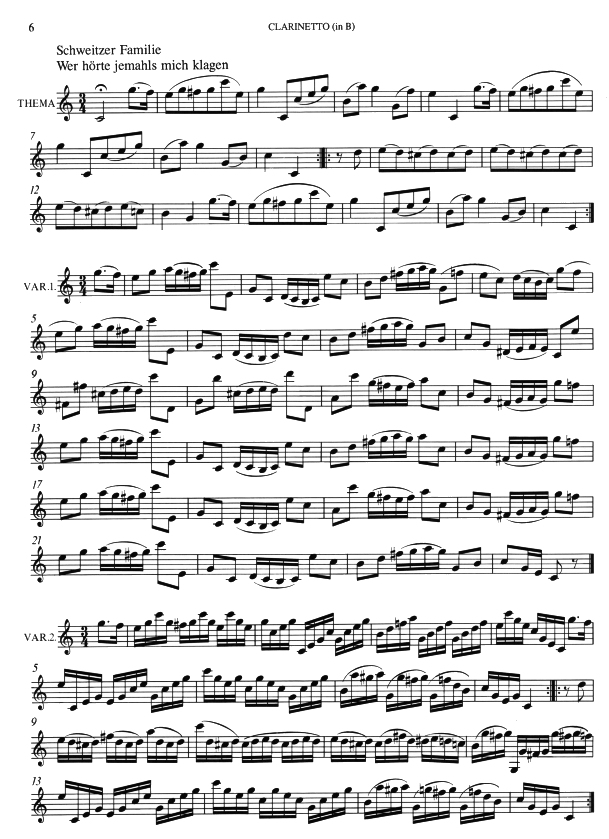
|
C2208: Heitere Variationen für Klarinette Solo by Anton Stadler edited by Fritz-Georg Höly. Kunzelmann, 1990, 14 pages. This book has four pieces which are theme and variations (7 in each one). These are showpieces for solo clarinet. College level. A translation of the title is Cheerful Variations. Here is a video of the final one, Der Dudler. Click on the cover image to view a sample page. |
17.50
|
|
C1074: Trois Caprices pour la Clarinet Seul by Anton Stadler edited by Fritz-Georg Höly. Kunzelmann, 1992, 9 pages. Three caprices for solo clarinet which incorporate popular songs of the day some of which are recognizable such as "du lieber Augustin" in the first caprice, and a bit from The Magic Flute and God Save the King in the second. A showpiece of its time. Advanced high school or early college level. (Except other items with free shipping.) |
16.50
|
|
C304: Three Pieces for Clarinet Solo by Igor Stravinsky. Revised Edition, 1993, edited by Nicholas Hare. Chester Music, 1993, SS, 7 pages. This edition contains notes on the most significant differences between the manuscript and the first published edition from 1920. One of the most popular 20th century unaccompanied pieces for clarinet. The first two movements call for an A clarinet and the last a B-flat clarinet.    
|
14.95
|
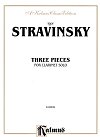
|
C1687: Three Pieces for Clarinet Solo by Igor Stravinsky. Kalmus, SS, 3 pages. This is the original edition of this work. The first two movements call for an A clarinet and the last a B-flat clarinet.
(Except other items with free shipping.) |
6.95
|
|
C253: Sutermeister Capriccio for Solo Clarinet in A by Heinrich Sutermeister. Schott, 1947, SS, 5 pages. A virtuosic piece featuring changing meters, chromaticism, and some rhythmic complexity. 
(Except other items with free shipping.) |
6.95
|
|
C498: Sonata for Clarinet by William Sydeman. C.F. Peters, 1967, SS, 11 pages. For unaccompanied clarinet. This piece has three movements: Theme with four variations (various meters), Scherzo (4/4) and Allegro (3/4). The rhythms can be complex, with quick changes of rhythmic groupings and meters. While the range is conservative, the complexity of this music demands an advanced performer. (Except other items with free shipping.) |
11.95
|
|
C1119: Sonata for Clarinet Solo by Germaine Tailleferre. Rongwen Music, 1959, SS, 4 pages. Germaine Tailleferre (1892-1983) was French composer who studied at the Paris Conservatory and later with Ravel. She was the only female member of Les Six. This brief (4:30) sonata is in three movements: Allegro tranquillo, Andantino Espressivo and Allegro brioso. This music is constructed simply, with lyrical grace and French impressionistic devices and includes a short traditional-style cadenza in the third movement. This work has charm and is good repertoire for college level clarinetists. (Except other items with free shipping.) |
6.50
|
|
C571: D(i)agon(als) for solo clarinet by Augusta Read Thomas. G. Schirmer, 2005, 3 pages. This new piece was commissioned by the friends, family, and students of Russell Dagon and was premiered by J. Lawrie Bloom in May 2005. It is called D(i)agon(als) both to honor the dedicatee and because the composer had used what she calls implied diagonals in the phrases of the piece. There are sub-phrases in imbedded in a phrase and also an imbedded counterpoint with two or three lines going on at once. Marked "Passionate and rubato" it should sound free, spontaneous, jazzy, playful, as if improvised, and alive. For the advanced performer. (Except other items with free shipping.) |
4.95
|
|
C1055: Sonatine Attique for Clarinet Solo in Three Parts by Henri Tomasi. Alphonse Leduc, 1967, SS, 4 pages. This is dedicated to Ulysse Delécluse. I. Giocoso, II. Lent (Mystérieux), and II Giocoso très rythmé. The first and third parts are without bar lines. College level. (Except other items with free shipping.) |
14.95
|
|
C1545: Bao La for Clarinet Solo by Ton That Tiet. Editions Musicales Transatlantiques, 1979, SS, 4 pages. Tôn-Thất Tiết (1933-) is a Vietnamese composer who came to Paris in 1958 to study composition at the Paris Conservatoire. He is know for fusing Asian and Western influences in his music. This piece which was written in 1976 employs contemporary notation and extended techniques such as fractional tones, flutter tonguing, and multiphonics (fingerings given). It has English translations of the French instructions. The duration is about 11 minutes. (Except other items with free shipping.) |
13.95
|
|
C310: Wings for Solo Clarinet or Bass Clarinet by Joan Tower. Associated Music Publishers, 1983, 7 pages. A challenging contemporary work for clarinet. (This work does not include extended techniques.)
(Except other items with free shipping.) |
12.95
|
|
S780: 2 Memorials for Soprano Saxophone or Clarinet by Mark-Anthony Turnage. Schott, 2001, SS, 3 pages. British composer Mark-Anthony Turnage (1960-) is one of the most admired and widely performed composers of his generation. The first piece, Trier, is in memory of Stephen Trier (1930-1999) a British orchestral clarinet and saxophone performer and writer. It is marked Freely (mm=100) and changes meter almost every measure. The second piece, Memorial, is marked Expressive and free (mm=56-60) is without a time signature. Early college level with an overall duration of 5 minutes.
(Except other items with free shipping.) |
9.95
|

|
C2219: Lightshadow-Trembling for solo clarinet by Gergely Vajda. Edito Musica Budapest, 2013, SS, 5 pages. Gergely Vajda (1973-) is a Hungarian clarinetist, composer and conductor. Gergely Vajda composed Lightshadow-trembling at the age of 20 in 1993. Being a clarinetist, he was interested in the possibilities of both traditional and modern ways of playing. Noise elements and sometimes imitations of the sound of folk instruments (bagpipe, reed-pipe) appear in this spectacular concert piece. (This description is from the publisher's website.) An advanced work with a duration of 5:30. Here is a performance on YouTube. Click on the cover image to view the first page of the music. (Except other items with free shipping.) |
11.95
|
|
C281: Two Snacks for Alonesome Clarinet by Burnet Tuthill. Southern Music Co., 1971, SS, 2 pages. Two short pieces for unaccompanied clarinet.
(Except other items with free shipping.) |
4.95
|
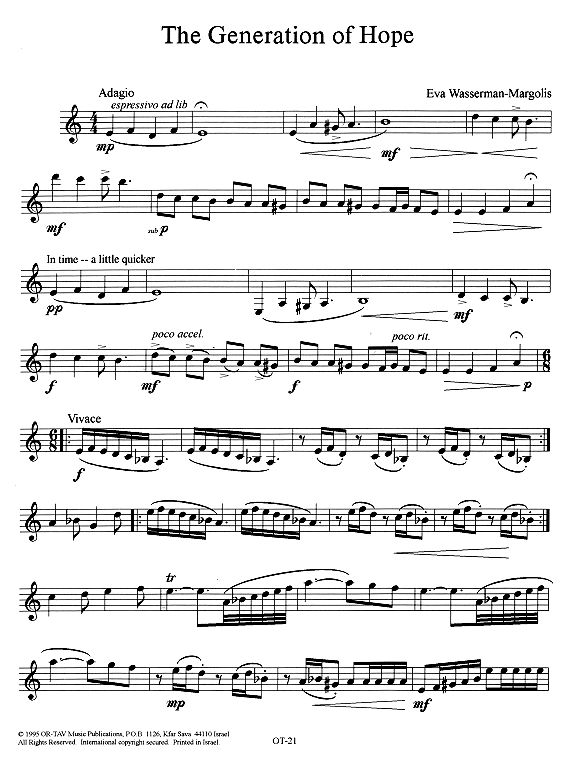
|
C2596: The Generation of Hope for solo clarinet by Eva Wasserman-Margolis. Or-Tav Music Publications, 1994, SS, 3 pages. Eva Wasserman-Margolis is an American-born clarinetist, composer and conductor who lives in Israel. This piece is dedicated to the 22 victims of the bombing of the No. 5 bus line in Tel Aviv on 19 October 1994. It is based on an old chassidic tune, "Am Yisroel Chai" (The people of Israel are alive). High school or early college level. Click on the cover image to view the first page. There are several student performances on the internet.
(Except other items with free shipping.) |
11.95
|
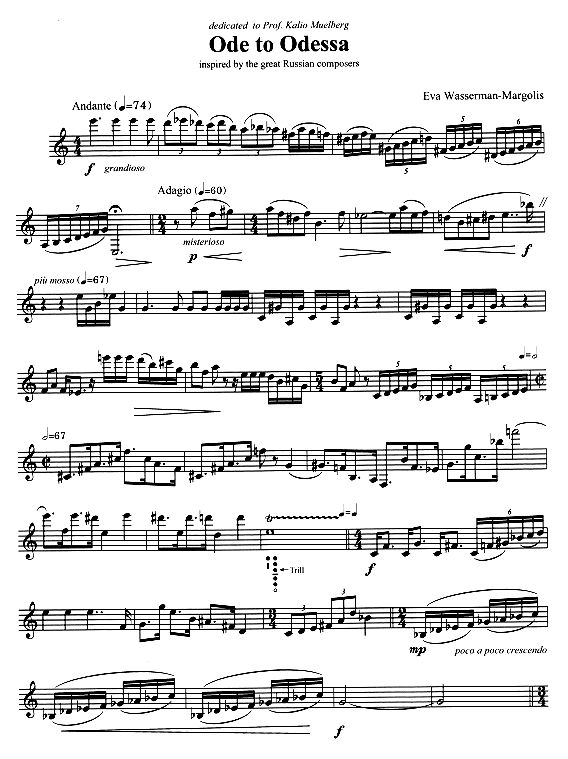
|
C2597: Ode to Odessa for solo clarinet by Eva Wasserman-Margolis. Israel Brass Woodwind Publications, 2001, SS, 5 pages. This piece is dedicated to Prof. Kalio Muelber and was inspired by the great Russian composers. Better high school/early college level. Click on the cover image to view the first page. Here is a performance by a student.
(Except other items with free shipping.) |
9.95
|
|
C1364: Contraventings Op. 46a for Solo Clarinet in B-flat by Graham Waterhouse. Hofmeister, 2000, SS, 4 pages. Graham Waterhouse (1962-) is a British cellist and composer (and the son of bassoon legend William Waterhouse) who has lived Germany in recent years. This piece was originally written for contrabassoon in 1998 and was transcribed for clarinet the same year. It is in a theme and variations format, with a Prelude, six Episodes and a Postlude. It uses a bit of contemporary notation, slap and flutter tonguing, and has a few notes with over-blown harmonics. College level with a duration of about 10 minutes. (Except other items with free shipping.) |
13.95
|
|
C1253: Suite for Clarinet Solo Op. 74 by Egon Wellesz. Rongwen Music, 1957, SS, 5 pages. Egon Wellesz (1885-1974) was an Austrian composer, teacher and musicologist, a pupil of Arnold Schoenberg and an eminent scholar of Byzantine music. He immigrated to Britain in 1938 remained there the rest of his life. The Suite is in four movements: I. Rhapsody (Tempo rubato), II. Serenade (Molto tranquillo), III. Scherzo (Vivace), and IV. Dance (Allegretto). College level with a duration of 8 minutes. (Except other items with free shipping.) |
6.95
|
|
C368: Impressionen by Eberhard Werdin. Doblinger, 1987, SS, 8 pages. "A clarinettist is alone with his clarinet, somewhere in the midst of nature -- on a mountain, at the seaside, in a forest, in a valley, on a river bank -- and he wants to express his thoughts, memories or feelings just by playing his instrument. These brief, unaccompanied pieces should sound like little fantasies. . ." College level.
(Except other items with free shipping.) |
19.95
|
|
C2274: Drei Schattentänze (Three Shadow Dances) for Clarinet (solo) by Jörg Widmann. Schott, 2013, SS, 14 pages (+ notes). Jörg Widmann was born in Munich in 1973. He studied clarinet at the Hochschule für Musik in Munich and at the Juilliard School of Music in New York. The three dances are I. Echo-Tanz, II. (Under)Water Dance and III. Danse africiane. This piece uses an extensive array of extended techniques including fractional tones, articulation techniques, and a few multiphonics. Includes detailed notes on performance. An advanced work with a duration of 10 minutes. Click here to view samples pages on the publisher's web site (click the + under the cover image on the Schott page). |
19.95
|
|
C979: Fantasie for Clarinet Solo by Jörg Widmann. Schott, 2005, SS, 8 pages. An interesting contemporary solo piece using some extended techniques and with some jazz sounds. One multiphonic note is repeated several times throughout the piece. It also includes glissados, high altissimo, and key noises. Duration about 8 minutes. There is a performance on YouTube.
(Except other items with free shipping.) |
15.95
|
|
C1269: Estudio de clarinete Clarinet Solo by Miguel Wirtz. Bassus Ediciones Musicales, 2008, SS, 4 pages. This Study for Clarinet was found in the library of the Royal Conservatory of Music in Madrid and has been dated to about 1808. Nothing is known about the composer except that he wrote some additional music. This edition includes the image of the original composition. (Except other items with free shipping.) |
15.95
|
|
C1058: Clarinet Solitude by Joji Yuasa. Schott Japan, 1983, SS, 6 pages. Joji Yuasa (1929-) is a Japanese composer of contemporary classical music who has lived and taught in the United States since 1981. This piece as written in 1980 for the memorial concerto for Yoshiro Irino, a pioneer of contemporary music in Japan. The beginning motif is based on a twelve-tone series associated with Irino. In the latter half of the piece the contrary motion of the beginning theme appears in a bass part. This piece includes a number of extended techniques including multiphonics (with fingerings for French and German clarinets), special trills, fractional tones, etc. An advanced work with a duration of about 8:20.
(Except other items with free shipping.) |
17.95
|
|
C1692: Monólogo by Javier Zalba. Advance Music, 2010, 2 pages. For unaccompanied clarinet in A or B-flat. The drama of this music passes through various emotional stages, similar to what happens during a theatrical soliloquy. The musical language here is influenced by such genres as Latin jazz and the Cuban canción. A demonstration CD is included.
(Except other items with free shipping.) |
18.95
|
Bindings: HB: Hard Bound, PB: Perfect Bound (paperback with square spine), SS: Saddle Stitch (paper, folded and stapled), SB: Spiral Bound (plastic or metal)