|
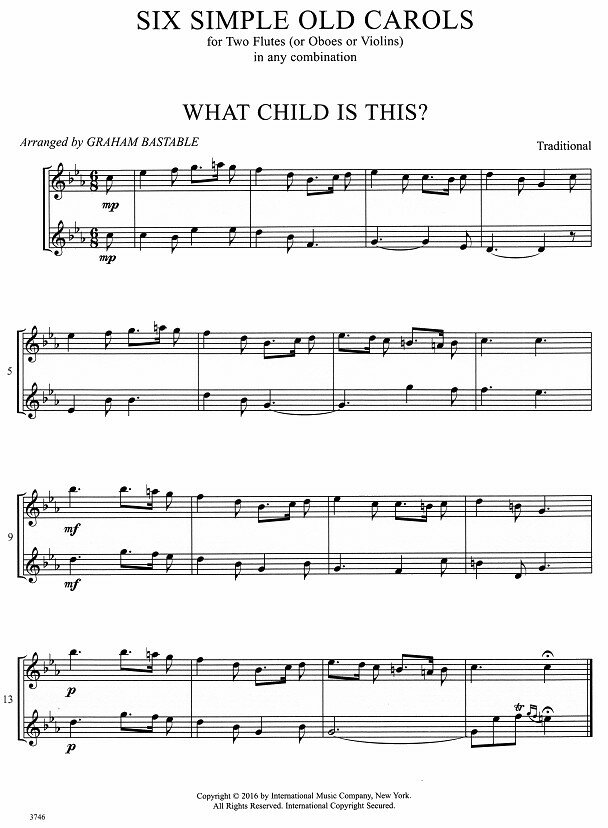
G292: Six Simple Old Carols for Two Flutes (or Violins or Oboes) in Any Combination arranged by Graham Bastable. International Music Co., 2016, SS, 6 pages in score format. These pieces would work just as well for like saxophones as well. They are at an easy intermediate level. Contents: What Child Is This?, Laudemus Cum Armonia, The Seven Joys of Mary, Personent Hodie, Sweet Was the Song the Virgin Sung, and Angelus ad Virginem. Click on the cover image to view a page of the score.
Free Media Mail shipping on this music to US, IF ordered with another item.
(Except other items with free shipping.)
|
12.75

|
|
G76: 10 Easy Jazz Duets (B-flat Instruments) by John La Porta with Greg Nielsen. Warner Bros. Publications, 1996, SS, 23 pages + CD. These books (available for C, B-flat, E-flat, and bass clef instruments) are designed to provide instrumentalists of all ages and opportunity to play duets in a variety of jazz styles. A CD is included making it possible to play the duets alone. The book provides instructions for use with solo and duet practice with the CD, with live rhythm, and for a jazz workshop. Each piece has instructions on the format (which choruses and when) to play.
G077: 10 Easy Jazz Duets (E-flat Instruments) by John La Porta with Greg Nielsen. Warner Bros. Publications, 1996, SS, 23 pages + CD.
|
14.95
14.95
|
|
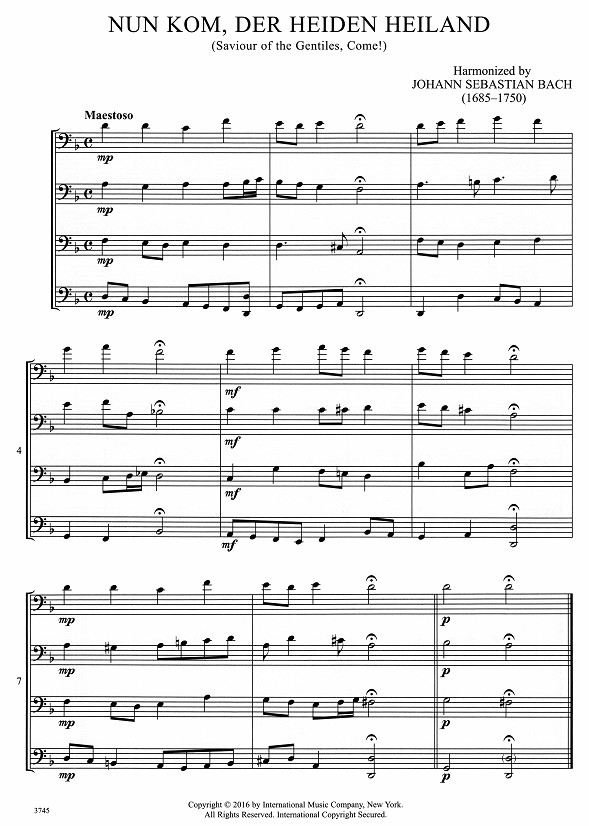
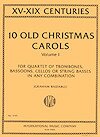
 G291: 10 Old Christmas Carols Volume I for quartet of bass clef instruments arranged by Graham Bastable. International Music Co., 2016, SS, includes score and parts. These carols can be played by any combination of bass clef instruments. Includes performance notes and shows the range of each part. Contents: Coventry Carol; Shepherds, Rejoice!; In dulci jubilo; O Sanctissima; While Shepherds Watched; Nun kom, der Heiden Heiland; Gaudete!; En! Natus est Emmanuel; Psallite Unigemito; and Ding-Dong Ding! Click on the cover image to view a page of the score. G291: 10 Old Christmas Carols Volume I for quartet of bass clef instruments arranged by Graham Bastable. International Music Co., 2016, SS, includes score and parts. These carols can be played by any combination of bass clef instruments. Includes performance notes and shows the range of each part. Contents: Coventry Carol; Shepherds, Rejoice!; In dulci jubilo; O Sanctissima; While Shepherds Watched; Nun kom, der Heiden Heiland; Gaudete!; En! Natus est Emmanuel; Psallite Unigemito; and Ding-Dong Ding! Click on the cover image to view a page of the score. |
16.95
|
|
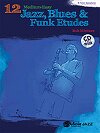
G213: 12 Medium-Easy Blues & Funk Etudes for B-flat Instruments (Tenor Sax, Soprano Sax, Clarinet) by Bob Mintzer. Belwin Jazz/Alfred, 2010, SS, 56 pages + CD. Created for a wide variety of musicians, this book will appeal to both aspiring players and more experienced musicians. It includes etudes in a variety of jazz styles, tempos and time signatures; performance notes and tips for each etude; a play along CD with rhythm section; a transcription exercise; a composition exercise; and a practice page with scales and chords.
G214: 12 Medium-Easy Blues & Funk Etudes for E-flat Instruments (Alto Sax, Baritone Sax) by Bob Mintzer. Belwin Jazz/Alfred, 2010, SS, 56 pages + CD. Edition for E-flat instruments.
|
G213
19.95
G214
19.95
|
|
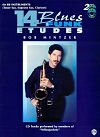
G110: 14 Blues & Funk Etudes for B-flat Instruments (Tenor Sax, Soprano Sax, Clarinet) by Bob Mintzer. Warner Bros., 1996, SS, 57 pages + 2 CDs. Written by veteran jazz musician Bob Mintzer, this collection of studies has been composed for musicians who wish to extend themselves in improvisation, composition, sight reading and general musicianship skills. Each etude has a theoretical explanation, suggestions for performance and tips for practice routines. Chord changes are given for most pieces. Two CDs of combo accompaniments performed by members of the Yellowjackets are included.
G111: 14 Blues & Funk Etudes for E-flat Instruments (Alto Sax, Baritone Sax) by Bob Mintzer. Warner Bros., 1996, SS, 57 pages + 2 CDs. Edition for E-flat instruments.
|
G110
76.95
G111
26.95
|
|
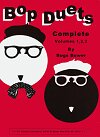
G209: Bop Duets Complete Treble Clef by Bugs Bower. Charles Colin Music, 1980, SS, 78 pages. Originally in three volumes, this book has all 39 duets. Chord changes are in Duet 12 to the end. Upper intermediate level. Excellent for studying this jazz style and playing for fun.
|
17.95
|
|
G306: Carol of the Bells (Bass Clef edition) for Trombone, Euphonium, Bassoon, Cello or Bass Trio by Peter Wilchousky arranged by Larry Clark. Carl Fischer, 1936/2017, 2 pages (score format). This familiar carol has been arranged for trio and can be played by any combination of instruments in this series (available in C, B-flat, E-flat, and bass clef).
Free Media Mail shipping on this music to US, IF ordered with another item.
(Except other items with free shipping.)
|
3.95
|
|
G303: Carol of the Bells (B-flat edition) for Tenor or Soprano Saxophone, Clarinet or Trumpet Trio by Peter Wilchousky arranged by Larry Clark. Carl Fischer, 1936/2017, 2 pages (score format). This familiar carol has been arranged for trio and can be played by any combination of instruments in this series (available in C, B-flat, E-flat, and bass clef).
Free Media Mail shipping on this music to US, IF ordered with another item.
(Except other items with free shipping.)
|
3.95
|
|
G305: Carol of the Bells (C edition) for Violin or Oboe Trio by Peter Wilchousky arranged by Larry Clark. Carl Fischer, 1936/2017, 2 pages (score format). This familiar carol has been arranged for trio and can be played by any combination of instruments in this series (available in C, B-flat, E-flat, and bass clef).
Free Media Mail shipping on this music to US, IF ordered with another item.
(Except other items with free shipping.)
|
3.95
|
|
G304: Carol of the Bells (E-flat edition) for Alto or Baritone Saxophone Trio by Peter Wilchousky arranged by Larry Clark. Carl Fischer, 1936/2017, 2 pages (score format). This familiar carol has been arranged for trio and can be played by any combination of instruments in this series (available in C, B-flat, E-flat, and bass clef).
Free Media Mail shipping on this music to US, IF ordered with another item.
(Except other items with free shipping.)
|
3.95
|
|
G302: Carol of the Bells (Bass Clef edition) for Trombone, Euphonium, Bassoon, Cello or Bass Quartet by Peter Wilchousky arranged by Larry Clark. Carl Fischer, 1936/2017, 3 pages (score format). This familiar carol has been arranged for quartet and can be played by any combination of instruments in this series (available in C, B-flat, E-flat, and bass clef).
Free Media Mail shipping on this music to US, IF ordered with another item.
(Except other items with free shipping.)
|
3.95
|
|
G299: Carol of the Bells (B-flat edition) for Tenor or Soprano Saxophone, Clarinet or Trumpet Quartet by Peter Wilchousky arranged by Larry Clark. Carl Fischer, 1936/2017, 3 pages (score format). This familiar carol has been arranged for quartet and can be played by any combination of instruments in this series (available in C, B-flat, E-flat, and bass clef).
Free Media Mail shipping on this music to US, IF ordered with another item.
(Except other items with free shipping.)
|
3.95
|
|
G301: Carol of the Bells (C edition) for Violin or Oboe Quartet by Peter Wilchousky arranged by Larry Clark. Carl Fischer, 1936/2017, 3 pages (score format). This familiar carol has been arranged for quartet and can be played by any combination of instruments in this series (available in C, B-flat, E-flat, and bass clef).
Free Media Mail shipping on this music to US, IF ordered with another item.
(Except other items with free shipping.)
|
3.95
|
|
G300: Carol of the Bells (E-flat edition) for Alto or Baritone Saxophone Quartet by Peter Wilchousky arranged by Larry Clark. Carl Fischer, 1936/2017, 3 pages (score format). This familiar carol has been arranged for quartet and can be played by any combination of instruments in this series (available in C, B-flat, E-flat, and bass clef).
Free Media Mail shipping on this music to US, IF ordered with another item.
(Except other items with free shipping.)
|
3.95
|
|
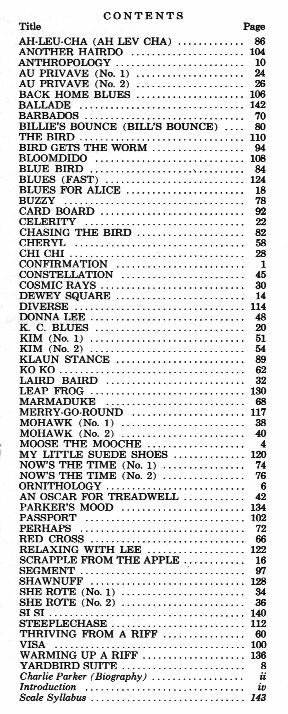
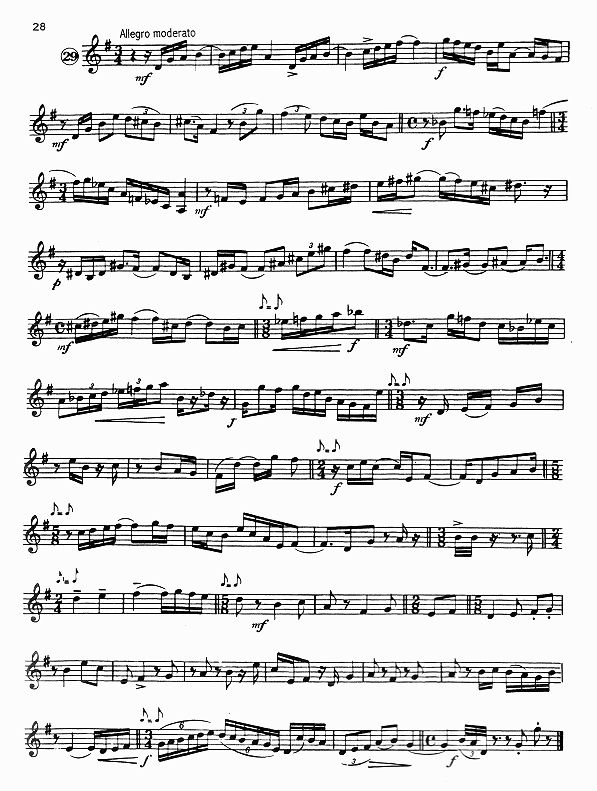
G107: Charlie Parker Omnibook for E-flat Instruments transcribed by Jamey Aebersold and Ken Slone. Atlantic Music Corp., 1978, SB, 144 pages. Sixty solos such as Moose the Mooch, Ornithology, Anthropology, and Yardbird Suite representing a cross section of the music of Charlie Parker. This book includes chord symbols and metronome markings. Click on the cover image to view the Table of Contents. Use your browser's Back button to return. |
17.95
|
|
G106: Charlie Parker Omnibook for C Instruments transcribed by Jamey Aebersold and Ken Slone. Atlantic Music Corp., 1978, SB, 144 pages. Same as above, transposed for C instruments. Flutists will want to take much of this music up an octave. Click on the cover image to view the Table of Contents. Use your browser's Back button to return. |
14.95
|
|
G105: Charlie Parker Omnibook for B-flat Instruments transcribed by Jamey Aebersold and Ken Slone. Atlantic Music Corp., 1978, SB, 144 pages. Same as above, transposed for B-flat instruments. These transcriptions are down an octave from the E-flat edition which puts occasional notes below the range of the tenor sax (you can always take them up an octave). Click on the cover image to view the Table of Contents. Use your browser's Back button to return. |
17.95
|
|
G108: Charlie Parker Omnibook for Bass Clef Instruments transcribed by Jamey Aebersold and Ken Slone. Atlantic Music Corp., 1978, SB, 144 pages. Same as above, transposed for Bass Clef (C) instruments. Click on the cover image to view the Table of Contents. Use your browser's Back button to return. |
14.95
|
|
G045: Circular Breathing for the Wind Performer by Trent P. Kynaston. Warner Bros. Publications, SS, 20 pages. This is a guide to learning circular breathing for all wind instrumentalists. The author discusses breathing and then provides instruction in beginning, intermediate and advanced techniques for circular breathing. |
10.95
|
|
G240: Classical FlexTrios B-Flat Woodwind Instruments arranged by Andrew Balent. Almitra Music/Kendor Music, 2013, SS, 29 pages. These 18 (US) grade 2-3 (several on the upper end of grade 3 at least) cover a wide range of styles from the Baroque era to the 20th Century. Published in score form for any combination of instruments using the appropriate key-compatible books. Click on the cover image to view the table of contents.
G241: Classical FlexTrios E-Flat Instruments arranged by Andrew Balent. Almitra Music/Kendor Music, 2013, SS, 29 pages. We can also order books for Flute and Oboe, B-flat brass instruments, Horn, Bass Clef Instruments, and Percussion.
G242: Classical FlexTrios Piano Accompaniment (optional) arranged by Andrew Balent. Almitra Music/Kendor Music, 2013, SS, 38 pages. These books include the instrumental parts and well as the piano.
|
B-Flat WW
11.50
E-Flat
11.50
Piano
12.50
|
|
G307: Come Down, O Love Divine; Six Pieces for Solo Instrument and Organ by Charles Callahan. MorningStar Music Publishers, 2016, SS, 54 pages (total). Charles Callahan (1951-) is an American composer, organist, choral conductor, pianist, and teacher. A useful collection of settings of six hymns, arranged for organ and solo instrument. The collection includes parts for a variety of instruments including Flute, Oboe, Clarinet, Trumpet, and Violin. Contents: Come Down, O Love Divine; Let Us Break Bread Together; The Lord's my Shepherd; O God, Beyond All Praising; Will You Come and Follow Me; and Remember the Poor. The instrumental parts call for high school level skills and the organ part does not look difficult. Click on the cover image to view sample pages and the Table of Contents which shows the instrumental parts available for each piece.
|
24.95
|
|
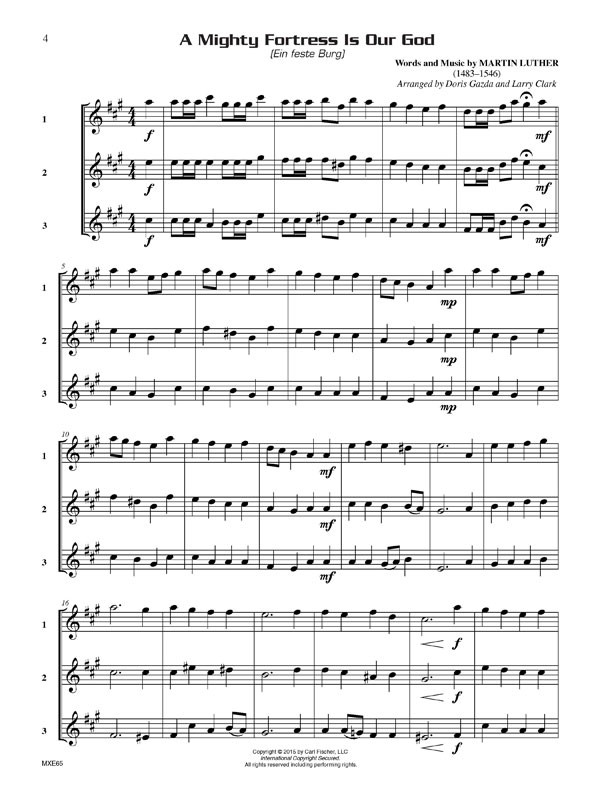
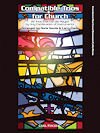
S1159: Compatible Trios for Church for Alto or Baritone Saxophone in E-flat arranged by Doris Gazda and Larry Clark. Carl Fischer, 2015, SS, 44 pages in score format. This unique collection contains trio settings of popular church hymns that can be played by any combination of three instruments, giving you the opportunity to perform these settings with any wind, brass, or strings. A piano score is available that contains piano/keyboard parts along with a concert pitch score of the instrumental music. Includes: A Mighty Fortress Is Our God (Ein feste Burg); Abide with Me (Eventide); Amazing Grace; America, the Beautiful (Materna); Battle Hymn of the Republic; Come, Ye Thankful People (St. George’s Windsor); Eternal Father, Strong to Save; Faith of Our Fathers; For the Beauty of the Earth; God of Our Fathers (National Hymn); Holy, Holy, Holy; Joyful, Joyful; Let Us Break Bread Together; Nearer, My God, to Thee; Now Thank We All Our God (Nun danket alle Gott); Praise God, from Whom All Blessings Flow (Old 100th); Prayer of Thanksgiving (Kremser); Rock of Ages; Still, Still with Thee; The Church’s One Foundation; We, Thy People, Praise Thee (St. Anthony Chorale); andWhat a Friend We Have in Jesus. We carry the books for B-flat, E-flat and bass clef instruments and can order the rest. Click on the cover image to view the first page of the music.
|
14.95
|
|
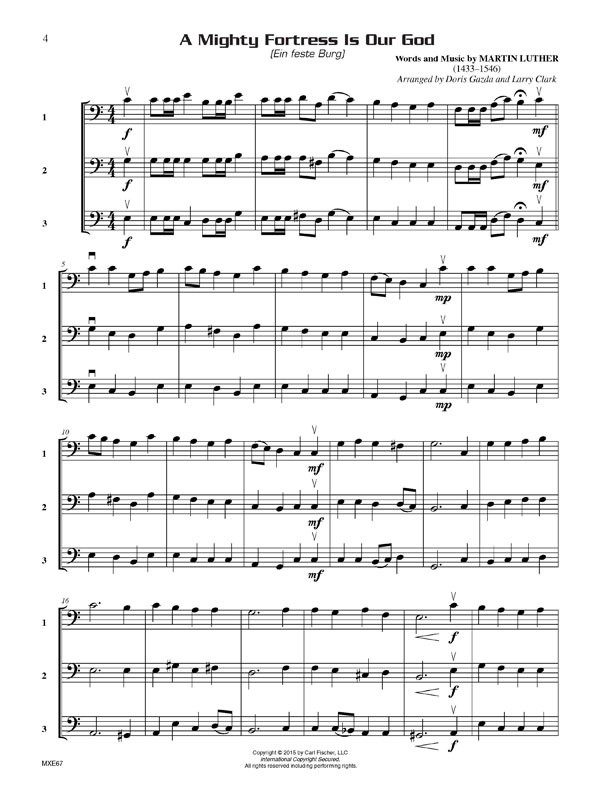
B168: Compatible Trios for Church for Bassoon, Trombone, Cello or Bass arranged by Doris Gazda and Larry Clark. Carl Fischer, 2015, SS, 44 pages in score format. This unique collection contains trio settings of popular church hymns that can be played by any combination of three instruments, giving you the opportunity to perform these settings with any wind, brass, or strings. A piano score is available that contains piano/keyboard parts along with a concert pitch score of the instrumental music. Includes: A Mighty Fortress Is Our God (Ein feste Burg); Abide with Me (Eventide); Amazing Grace; America, the Beautiful (Materna); Battle Hymn of the Republic; Come, Ye Thankful People (St. George’s Windsor); Eternal Father, Strong to Save; Faith of Our Fathers; For the Beauty of the Earth; God of Our Fathers (National Hymn); Holy, Holy, Holy; Joyful, Joyful; Let Us Break Bread Together; Nearer, My God, to Thee; Now Thank We All Our God (Nun danket alle Gott); Praise God, from Whom All Blessings Flow (Old 100th); Prayer of Thanksgiving (Kremser); Rock of Ages; Still, Still with Thee; The Church’s One Foundation; We, Thy People, Praise Thee (St. Anthony Chorale); and What a Friend We Have in Jesus. We carry the books for B-flat, E-flat and bass clef instruments and can order the rest. Click on the cover image to view the first page of the music.
|
14.95
|
|
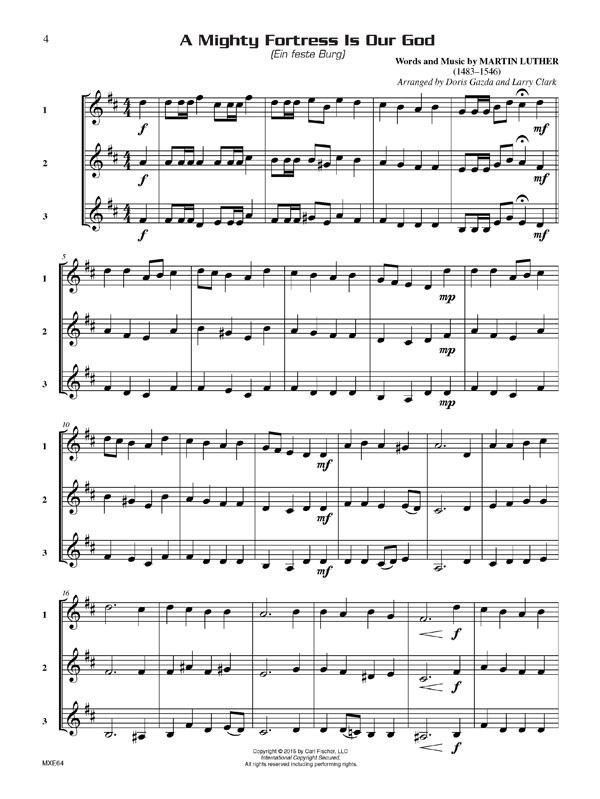
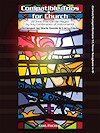
G283: Compatible Trios for Church for Clarinet, Trumpet, Tenor Saxophone or other B-flat instruments arranged by Doris Gazda and Larry Clark. Carl Fischer, 2015, SS, 44 pages in score format. This unique collection contains trio settings of popular church hymns that can be played by any combination of three instruments, giving you the opportunity to perform these settings with any wind, brass, or strings. A piano score is available that contains piano/keyboard parts along with a concert pitch score of the instrumental music. Includes: A Mighty Fortress Is Our God (Ein feste Burg); Abide with Me (Eventide); Amazing Grace; America, the Beautiful (Materna); Battle Hymn of the Republic; Come, Ye Thankful People (St. George’s Windsor); Eternal Father, Strong to Save; Faith of Our Fathers; For the Beauty of the Earth; God of Our Fathers (National Hymn); Holy, Holy, Holy; Joyful, Joyful; Let Us Break Bread Together; Nearer, My God, to Thee; Now Thank We All Our God (Nun danket alle Gott); Praise God, from Whom All Blessings Flow (Old 100th); Prayer of Thanksgiving (Kremser); Rock of Ages; Still, Still with Thee; The Church’s One Foundation; We, Thy People, Praise Thee (St. Anthony Chorale); and What a Friend We Have in Jesus. We carry the books for B-flat, E-flat and bass clef instruments and can order the rest. Click on the cover image to view the first page of the music.
|
14.95
|
|
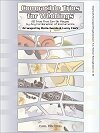
WW369: Compatible Trios for Weddings for Clarinet, Trumpet and/or Tenor Saxophone in B-flat arranged by Doris Gazda and Larry Clark. Carl Fischer, 2016, SS, 46 pages in score format. This unique collection contains trio settings of popular music for wedding ceremonies that can be played by any combination of three instruments--wind, brass, or strings. Included are classic songs for pre-ceremony, processional, recessional, and post-ceremony, such as Air on the G-String, Amazing Grace, Ave Maria, Bridal Chorus, Canon in D, Jesu, Joy of Man's Desiring, Trumpet Voluntary, and Wedding March. We have editions for violin/oboe, E-flat, and bass clef and can order the versions for Flute, Horn in F, Tuba and a piano score that contains piano/keyboard parts along with a concert pitch score of the instrumental music. Click on the cover image to view sample pages from the piano score book which includes the trio parts.
|
12.95
|
|
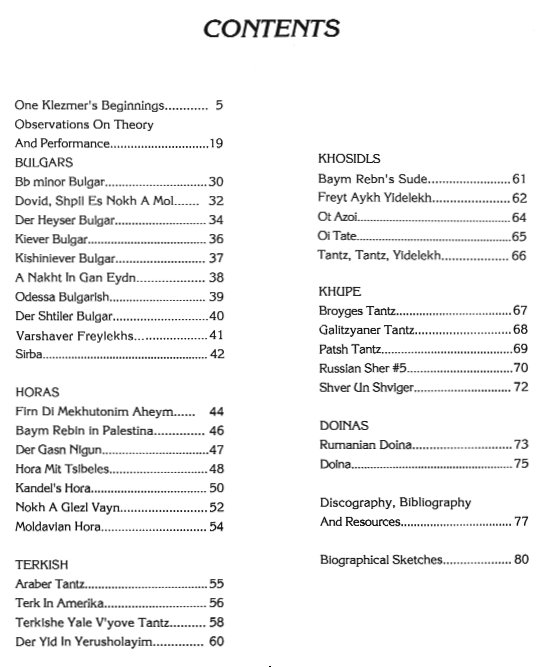
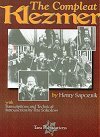
G062: The Compleat Klezmer by Henry Sapoznik. Tara Publications, 1987, PB, 80 pages. This book is the definitive Klezmer anthology. It includes a short history of klezmer music, notes and observations on the theory and performance of klezmer music, 33 annotated melodies, a discography and bibliography, resources, and more. Click on the book cover to view the table of contents. |
19.95
|
|
G061: Complete Method for Rhythmical Articulation by Pasquale Bona translated from the fourth Italian edition by Gustav Saenger. Carl Fischer, SS, 72 pages. This is the treble clef edition. This book is in three parts with the first two intended for vocalists and all three parts for instrumentalists. The exercises and etudes (120 in all) which focus on rhythm (not articulation) are progressively more difficult. Some of the exercises have a few notes below the range of the flute, oboe, and saxophone. |
15.95
|
|
G065: Rhythmical Articulation (for bass clef instruments) by Pasquale Bona selected and transcribed by William D. Fitch. Carl Fischer, 1969, SS, 47 pages. The bass clef edition has Parts II and III from the original, 41 etudes. Useful for bassoon, trombone, cello, euphonium, tuba, and bass clarinetist's who want to work on bass clef. |
14.95
|
|
G069: Contemporary Rhythm & Meter Duets for Bass Clef Instruments by Elliot Del Borgo. Meredith Music Publications, 1996, SS, 31 pages. Based on the concept of Contemporary Rhythm & Meter Studies, these fourteen, two-page duets make extensive use of metric and rhythmic devices, and harmonic and tonal devices commonly found in 20th Century works. They are ideal for any instrument for developing sight-reading skills as well as recital performance, jury exams, and lesson material. |
9.95
|
|
G068: Contemporary Rhythm & Meter Duets for Treble Clef Instruments by Elliot Del Borgo. Meredith Music Publications, 1996, SS, 31 pages. Based on the concept of Contemporary Rhythm & Meter Studies, these fourteen, two-page duets make extensive use of metric and rhythmic devices, and harmonic and tonal devices commonly found in 20th Century works. They are ideal for any instrument for developing sight-reading skills as well as recital performance, jury exams, and lesson material. |
9.95
|
|
G067: Contemporary Rhythm & Meter Studies for Bass Clef Instruments by Elliot Del Borgo. Meredith Music Publications, 1996, SS, 31 pages. These 28 etudes make extensive use of metric and rhythmic devices found in 20th century works. Composed as recital/performance pieces, all melodic material is derived from a variety of contemporary patterns including synthetic scales, 12-tone and 7-tone rows, cell-derived patterns, modal scales and traditional major and minor tonalities. |
9.95
|
|
G066: Contemporary Rhythm & Meter Studies for Treble Clef Instruments by Elliot Del Borgo. Meredith Music Publications, 1996, SS, 31 pages. These 28 etudes make extensive use of metric and rhythmic devices found in 20th century works. Composed as recital/performance pieces, all melodic material is derived from a variety of contemporary patterns including synthetic scales, 12-tone and 7-tone rows, cell-derived patterns, modal scales and traditional major and minor tonalities. |
9.95
|

|
 G259: Develop Sight Reading Treble Clef by Gaston Dufresne edited by Roger Voisn. Charles Colin Publications, 1972, SB, 59 pages. This is the current edition of a book which was originally published in two volumes. The range in which the studies are presented is suitable for all treble clef instruments. This book is progressive. It starts at the intermediate level but gradually introduces more complex rhythms, meters and keys. Click on the cover image to view a sample page from the middle of the book. G259: Develop Sight Reading Treble Clef by Gaston Dufresne edited by Roger Voisn. Charles Colin Publications, 1972, SB, 59 pages. This is the current edition of a book which was originally published in two volumes. The range in which the studies are presented is suitable for all treble clef instruments. This book is progressive. It starts at the intermediate level but gradually introduces more complex rhythms, meters and keys. Click on the cover image to view a sample page from the middle of the book. |
13.95
|
|
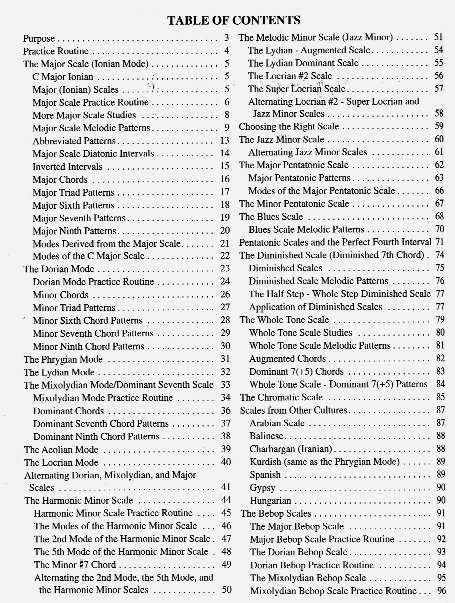
G023: Encyclopedia of Scales, Modes and Melodic Patterns for All Instruments by Arnie Berle. Mel Bay, 1997, SS, 96 pages. This book provides a comprehensive source for many types of scales. It also provides recommendations on how to practice scales and a practice routine. Click on the book cover to view the table of contents. |
14.95
|
|
G070: A Guide to the Understanding and Correction of Intonation Problems by Al "Corky" Fabriozio. Meredith Music Publications, 1994, SS, 30 pages. This book could be titled: How to Tune the Wind Ensemble. It provides details such as pitch tendencies and tuning strategies for the principal wind ensemble instruments, a tuning method for the entire ensemble, and acoustical considerations by instrument of various chords (which could be turned into an exercise). |
12.95
|
|
G33: How to Learn the Alexander Technique by Barbara Conable. Andover Press, Third Edition, 1995, PB, 154 pages. A primer for students of the Alexander Technique, a well-known method for improving freedom and ease of movement and physical coordination. This book provides the first authoritative account of William Conable's concept, Body Mapping, the study of how our ideas about our bodies affect our experience and movement. Includes sections aimed at instrumentalists, vocalists, actors and dancers. |
21.50
|
|
G254: Improvising and Soloing In the Pocket for C Instruments by Richie Cannata and Sean J. Kennedy. Carl Fischer, 2013. SS 32 pages + CD. This book contains 9 original play-along leadsheets (in the styles of Rock, Samba, Bossa Nova, Funk, and Ballads) with melodies and chords. It has music theory and background on each tune. The CD includes .wmv video of a discussion of the compositions and play-along tracks in .mp3 format. For upper intermediate through advanced players. |
14.95
|
|
|
G255: Improvising and Soloing In the Pocket for B-flat Instruments by Richie Cannata and Sean J. Kennedy. Carl Fischer, 2013. SS 32 pages + CD. This book contains 9 original play-along leadsheets (in the styles of Rock, Samba, Bossa Nova, Funk, and Ballads) with melodies and chords. It has music theory and background on each tune. The CD includes .wmv video of a discussion of the compositions and play-along tracks in .mp3 format. For upper intermediate through advanced players. |
14.95
|
|
|
G256: Improvising and Soloing In the Pocket for E-flat Instruments by Richie Cannata and Sean J. Kennedy. Carl Fischer, 2013. SS 32 pages + CD. This book contains 9 original play-along leadsheets (in the styles of Rock, Samba, Bossa Nova, Funk, and Ballads) with melodies and chords. It has music theory and background on each tune. The CD includes .wmv video of a discussion of the compositions and play-along tracks in .mp3 format. For upper intermediate through advanced players. |
14.95
|
|
|
G257: Improvising and Soloing In the Pocket for Bass Clef Instruments by Richie Cannata and Sean J. Kennedy. Carl Fischer, 2013. SS 32 pages + CD. This book contains 9 original play-along leadsheets (in the styles of Rock, Samba, Bossa Nova, Funk, and Ballads) with melodies and chords. It has music theory and background on each tune. The CD includes .wmv video of a discussion of the compositions and play-along tracks in .mp3 format. For upper intermediate through advanced players. |
14.95
|

|
G220: The Logical Approach to Rhythmic Notation Vol. 1 by Phil Perkins. Logical Publications, 1978/1991, SS, 41 pages. Subtitled: A Unison Rhythm Method for All Instrumental, Choral and Keyboard Students. This book begins with basic rhythms and progresses to various sixteenth note combinations. It includes a concept named "Rhythmic Alphabet Patterns" but you do not have to adopt it to find this book useful.
|
16.95
|
|
G063: Note Grouping by James Morgan Thurmond. Meredith Music Publications, 1981, PB, 144 pages. Subtitled: A Method for Achieving Expression and Style in Musical Performance. Fully explains through musical example, the concept of expressive musicianship as taught by Anton Horner, William Kincaid and Marcel Tabuteau. This book clearly illustrates how to teach students to play or sing with expression, musicianship and style and will help to make your performances “come alive.” Here in print are exactly the concepts I was taught by Robert Shaw and Julius Herford...it has had a profound influence upon music education everywhere! Weston H. Noble, Director of Music Activities, Luther College |
34.95
|
|
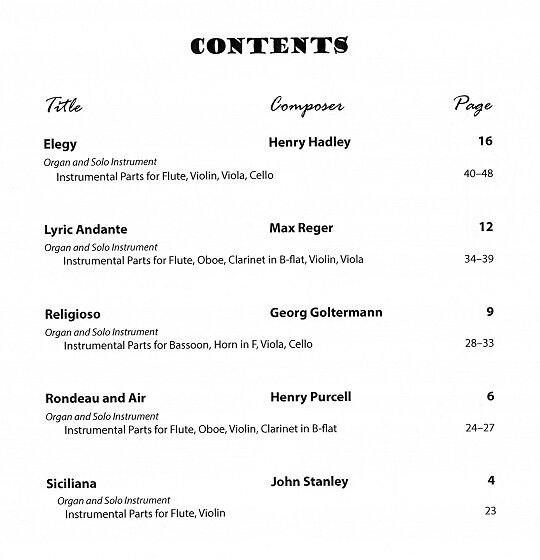
G243: Organ Plus! Volume 4, Five Pieces for Organ and One Instrument edited by Charles Callahan. MorningStar Music Publishers, 2013, SS, 45 pages (total). The fourth volume of this popular and practical series contains five pieces for organ and a solo instrument. Contents: Henry Hadley Elegy, Max Reger Lyric Andante, Georg Goltermann Religioso, Henry Purcell Rondeau and Air, and John Stanley Siciliana. The instruments vary throughout and include Flute, Oboe, Violin, Viola, Clarinet, Bassoon, Cello, and Horn. The instrumental parts call for high school level skills and the organ part does not look difficult. Click on the cover image to view the Table of Contents which shows the instrumental parts available for each piece.
|
20.95
|
|
G25: Ornamentation, A Question & Answer Manual by Valery Lloyd-Watts and Carole L. Bigler. Alfred Publishing Co. Inc., 1995, SS, 64 pages. An excellent and inexpensive introduction to ornamentation. Written to help all musicians, regardless of instruments, it presents a logical step-by-step procedure that makes realizing an ornament and integrating it into a performance simple, stimulating, and rewarding. Covers the Baroque, Classical, Romantic, and Contemporary eras. |
9.95
|

|
G156: Rhythmic Training by Robert Starer. Hal Leonard, 1969, PB, 84 pages. This is an excellent text which gets into the more difficult areas quickly. It contains a series of exercises for all instruments. The areas covered include rhythmic organization (everything from 2 through 8 equal parts plus 12, 16 and more), changing meters, changing the rate of pulse, and polyrhythms.
|
9.95
|
|
G210: Rhythms Complete Treble Clef by Charles Colin and Bugs Bower. Charles Colin Music, 1988, SS, 48 pages. "The most widely used primer in the world for teaching rhythm, syncopation and phrasing [for jazz], employing a very melodic format of 82 exercises in rhythmic structures and combinations of rhythms. While written especially for the [jazz] beginner/intermediate levels, it is used by advanced players (of all instruments) as a daily practice book to maintain facility." |
9.95
|
|
G109: Scales for Jazz Improvisation by Don Haerle. Alfred, 1975, SB, 52 pages. Haerle presents the scales used in improvisation and explains applications. Scales are shown in all keys and treble and bass clefs include blues, Ionian, Dorian, Phrygian, Locrian as well as whole tone, chromatic, augmented and many more. This is also a great aid for memorizing. |
16.95
|
|
S383: Studies in Time Division by Larry Teal. Encore Publications, 1955, SS, 24 pages. Subtitled "A Practical Approach to Accurate Rhythm Perception Concepts." These studies are aimed at developing an accurate rhythmic sense built up from the sixteenth-note time value. They can be used for both private and classroom study and for any instrument (the examples are in treble clef). These exercises start with basic rhythms and conclude with those that might be found in upper intermediate level music. |
9.95
|
|
G075: Stylistic Etudes in the Jazz Idiom compiled by Lou Fischer. Houston Publishing, 1995, SB, 145 pages. Originally intended for All State audition material, the etudes in this book have proven themselves ideal for sight reading auditions, recital performance, individual practice and stylistic development. There are 15 etudes for each instrument (sax, trumpet, trombone, bass trombone, piano, guitar, guitar, bass, and drum). There are five etudes each in the styles of swing, ballad, and Latin/Funk. |
27.95
|
|
G044: Thesaurus of Scales and Melodic Patterns by Nicolas Slonimsky. Amsco Publications, PB, 244 pages. Originally published in 1947, this book is a reference book of scales and melodic patterns. It is primarily a resource for composers, but instrumentalists have also found it useful as a source for ideas in jazz and as exercises for modern classical music. |
29.95
|