This schedule was removed in favor for their new schedules as of September 2006.



lower level of Michener Library,
on the West Campus of UNC
Show times (unless otherwise noted):
Thursdays at 7:00 and 9:15 pm
Fridays at 8:00 pm
Admission: $3 for UNC students, $5 for non-students
Non English language films shown in the original language
with English subtitles. All films are shown in 35 mm.
International Film Series is a volunteer effort.
If you would like to help out, .
Click on the picture for a larger version of the image;
click on the title to go to the film’s official site.
Jan 26-27 (Location: McKee L-152)
 Wal-Mart: The High Cost of Low Price (US, 2005, 95 mins.) With Wal-Mart having recently been in court about their labor practices, there has never been a more relevant time for this detailed documentary which seeks to expose what creator Robert Greenwald believes is an epidemic upon American society. Greenwald explores how Wal-Mart encourages employees to use public welfare rather than give benefits, runs propaganda and spy activities against potential unions, and destroys local businesses in its wake. This is a must see for anyone who is interested in corporate business practices or conscientious consumerism —ds Wal-Mart: The High Cost of Low Price (US, 2005, 95 mins.) With Wal-Mart having recently been in court about their labor practices, there has never been a more relevant time for this detailed documentary which seeks to expose what creator Robert Greenwald believes is an epidemic upon American society. Greenwald explores how Wal-Mart encourages employees to use public welfare rather than give benefits, runs propaganda and spy activities against potential unions, and destroys local businesses in its wake. This is a must see for anyone who is interested in corporate business practices or conscientious consumerism —ds |
February 2-3
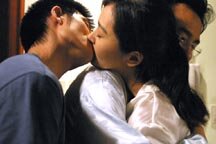 3-Iron (South Korea/Japan, 2004, 88 mins.) Telling his tale through expression and body language rather than through dialogue, Kim Ki-duk, director of Spring, Summer, Fall, Winter…and Spring crafts an unconventional love story about a young man who lives in strangers’ houses while they are away on vacation and a woman who leaves her high class surroundings in order to live a happier life. Together they go from house to house, repaying the owner’s unwitting hospitality by washing clothes and repairing whatever may be broken, whether that be a clock or a bathroom scale. Pay close attention to the end of the film, which is open to multiple interpretations. —db 3-Iron (South Korea/Japan, 2004, 88 mins.) Telling his tale through expression and body language rather than through dialogue, Kim Ki-duk, director of Spring, Summer, Fall, Winter…and Spring crafts an unconventional love story about a young man who lives in strangers’ houses while they are away on vacation and a woman who leaves her high class surroundings in order to live a happier life. Together they go from house to house, repaying the owner’s unwitting hospitality by washing clothes and repairing whatever may be broken, whether that be a clock or a bathroom scale. Pay close attention to the end of the film, which is open to multiple interpretations. —db |
February 9-10
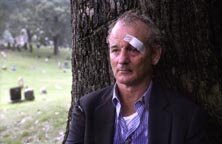 Broken Flowers (US, 2005, 106 mins.) Jim Jarmusch’s latest film stars Bill Murray in the role of a retired computer executive named Don Johnston. Murray is in peak form as a couch potato watching (what else?) Don Juan movies. An anonymous letter from one of his former girlfriends finally brings a sense of purpose to Don’s life as he sets out to discover which of his previous flames might have borne him a child. Each former lover provides a new chapter in his circular route of self-discovery, leading up to one of cinema’s most talked about endings (or lack of endings, depending upon your perspective). Watch how Jarmusch carefully crafts his narrative, using visual clues and minor characters along the way to illuminate the mystery of Don’s life. What do you think the ending means? —dc Broken Flowers (US, 2005, 106 mins.) Jim Jarmusch’s latest film stars Bill Murray in the role of a retired computer executive named Don Johnston. Murray is in peak form as a couch potato watching (what else?) Don Juan movies. An anonymous letter from one of his former girlfriends finally brings a sense of purpose to Don’s life as he sets out to discover which of his previous flames might have borne him a child. Each former lover provides a new chapter in his circular route of self-discovery, leading up to one of cinema’s most talked about endings (or lack of endings, depending upon your perspective). Watch how Jarmusch carefully crafts his narrative, using visual clues and minor characters along the way to illuminate the mystery of Don’s life. What do you think the ending means? —dc |
February 16-17
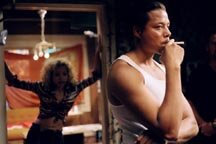 Hustle and Flow (US, 2005, 116 mins.) Terrence Howard plays Djay, an unrecognized rap artist in Memphis who makes his living off of drugs and prostitution while philosophizing on street corners with an erudition usually reserved for scholars. Writer/director Craig Brewer’s passionate portrait of the inner city and its denizens departs from formula filmmaking. Even as Djay’s circumstances are imposed from the outside world, he counters them by developing his artistic ability from within, establishing a multi-racial network of supporters. When the environment doesn’t allow genius to be discovered, genius must be redefined and applied in new ways. —dc Hustle and Flow (US, 2005, 116 mins.) Terrence Howard plays Djay, an unrecognized rap artist in Memphis who makes his living off of drugs and prostitution while philosophizing on street corners with an erudition usually reserved for scholars. Writer/director Craig Brewer’s passionate portrait of the inner city and its denizens departs from formula filmmaking. Even as Djay’s circumstances are imposed from the outside world, he counters them by developing his artistic ability from within, establishing a multi-racial network of supporters. When the environment doesn’t allow genius to be discovered, genius must be redefined and applied in new ways. —dc |
February 23-24
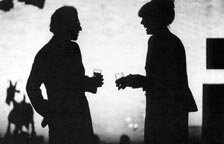 Manhattan (US, 1979, 96 mins.) Manhattan matches writer/comedian Woody Allen with Diane Keaton and Meryl Streep in a lively inner-city narrative that bounces from comedy to romance and back to comedy, ultimately asking if there is really much difference between the two. Allen explores a key question in friendships: if loneliness is the common bond between two people, is their relationship doomed to failure? The film’s opening shot of Central Park at dawn, with Gershwin’s Rhapsody in Blue on the soundtrack, is one reason why many claim that Manhattan is one of the best photographed films in American cinema. —dc Manhattan (US, 1979, 96 mins.) Manhattan matches writer/comedian Woody Allen with Diane Keaton and Meryl Streep in a lively inner-city narrative that bounces from comedy to romance and back to comedy, ultimately asking if there is really much difference between the two. Allen explores a key question in friendships: if loneliness is the common bond between two people, is their relationship doomed to failure? The film’s opening shot of Central Park at dawn, with Gershwin’s Rhapsody in Blue on the soundtrack, is one reason why many claim that Manhattan is one of the best photographed films in American cinema. —dc |
March 2-3
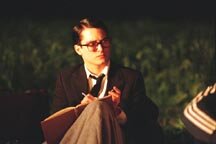 Everything Is Illuminated (US, 2005, 100 mins.) The directorial debut of actor Liev Schreiber stars Elijah Wood as Jonathan, an American in Ukraine who is searching for the woman who saved his Jewish grandfather from the Nazis in World War II. The film’s narrator is a young Ukrainian named Alex, who serves as Jonathan’s guide. Alex’s fascination with American English has not helped him master it, and his humorously offbeat speech perplexes Jonathan as much as it informs him. Despite their partnership, the two are at cross purposes—Alex would rather sidestep his family’s history, even as Jonathan seeks to discover his. Together they traverse beautifully photographed Ukrainian landscapes and follow a trajectory from comedy to tragedy, eventually learning that the past is always part of the present. —dc Everything Is Illuminated (US, 2005, 100 mins.) The directorial debut of actor Liev Schreiber stars Elijah Wood as Jonathan, an American in Ukraine who is searching for the woman who saved his Jewish grandfather from the Nazis in World War II. The film’s narrator is a young Ukrainian named Alex, who serves as Jonathan’s guide. Alex’s fascination with American English has not helped him master it, and his humorously offbeat speech perplexes Jonathan as much as it informs him. Despite their partnership, the two are at cross purposes—Alex would rather sidestep his family’s history, even as Jonathan seeks to discover his. Together they traverse beautifully photographed Ukrainian landscapes and follow a trajectory from comedy to tragedy, eventually learning that the past is always part of the present. —dc |
March 23-24
 If At First You Don’t Succeed (US, 2005, 135 mins. Directed by Greg Van Cott —Second screening on Thursday at 9:30.) Weary collegian Michael Retiel was tightly surrounded by the comforts of childhood for the first 18 years of his life. Now he cannot comprehend the problems his new friends have faced their entire lives. His closest friend who calls himself “Jewman,” has an abusive father, Lenin is a rebel with a cause, Chris wants to fall wildly in love, Amman wants to quit while he still can, Gina wants her perfect man, and Will can't take it anymore. Michael will begin his journey to understand and to “better himself” through the dreams and illusions of another; setting off a chain of events that will affect the lives of his friends, his environment, and his entire mind. —gvc If At First You Don’t Succeed (US, 2005, 135 mins. Directed by Greg Van Cott —Second screening on Thursday at 9:30.) Weary collegian Michael Retiel was tightly surrounded by the comforts of childhood for the first 18 years of his life. Now he cannot comprehend the problems his new friends have faced their entire lives. His closest friend who calls himself “Jewman,” has an abusive father, Lenin is a rebel with a cause, Chris wants to fall wildly in love, Amman wants to quit while he still can, Gina wants her perfect man, and Will can't take it anymore. Michael will begin his journey to understand and to “better himself” through the dreams and illusions of another; setting off a chain of events that will affect the lives of his friends, his environment, and his entire mind. —gvc |
March 30-31
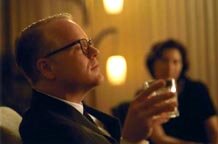 Capote (US, 2005, 98 mins.) Truman Capote’s “non-fiction novel” In Cold Blood was written between 1959 and 1965. During that time two convicted killers languished in a Kansas prison, hoping to avoid execution. Capote was directed by Bennett Miller, based on Gerald Clarke’s book about the author, both of whom demonstrate a parallel agony on the part of the writer, expertly played by Philip Seymour Hoffman. Capote suffered less from the consequences of his flamboyant and conspicuous mannerisms than he did from his own inability to detach from his subject matter. His tortured relationship with killer Perry Smith, whom he pities but also describes as “a gold mine” for his book, leads to his own declining health. Catherine Keener shines in the role of Capote’s friend Harper Lee, the writer who published To Kill a Mockingbird within this same time frame. —dc Capote (US, 2005, 98 mins.) Truman Capote’s “non-fiction novel” In Cold Blood was written between 1959 and 1965. During that time two convicted killers languished in a Kansas prison, hoping to avoid execution. Capote was directed by Bennett Miller, based on Gerald Clarke’s book about the author, both of whom demonstrate a parallel agony on the part of the writer, expertly played by Philip Seymour Hoffman. Capote suffered less from the consequences of his flamboyant and conspicuous mannerisms than he did from his own inability to detach from his subject matter. His tortured relationship with killer Perry Smith, whom he pities but also describes as “a gold mine” for his book, leads to his own declining health. Catherine Keener shines in the role of Capote’s friend Harper Lee, the writer who published To Kill a Mockingbird within this same time frame. —dc |
April 6-7
 Howl’s Moving Castle (Japan, 2004, 119 mins.) This animated feature by Hayao Miyazaki, who also directed Spirited Away, is the story of a wizard named Howl, whose shape shifting castle wanders the territory between two warring kingdoms. Foundationless and fluid, Howl’s moving castle is both unpredictable and full of potential, reflecting the personal conflicts and uncertainties of its occupant. The highly detailed animation, particularly the castle’s ever changing architecture, makes this an unusual visual experience, and its colorful cast of animated characters may remind viewers both of Star Wars and of The Wizard of Oz. —dc Howl’s Moving Castle (Japan, 2004, 119 mins.) This animated feature by Hayao Miyazaki, who also directed Spirited Away, is the story of a wizard named Howl, whose shape shifting castle wanders the territory between two warring kingdoms. Foundationless and fluid, Howl’s moving castle is both unpredictable and full of potential, reflecting the personal conflicts and uncertainties of its occupant. The highly detailed animation, particularly the castle’s ever changing architecture, makes this an unusual visual experience, and its colorful cast of animated characters may remind viewers both of Star Wars and of The Wizard of Oz. —dc |
April 13-14
 Downfall (Germany, 2004, 156 mins. —Second screening on Thursday at 9:45.) In April of 1945, Adolf Hitler, Eva Braun, Hermann Goering, and his family took their last stand for the Third Reich deep beneath the streets of Berlin. This film by director Oliver Hirschbiegel is a fascinating exploration of the bunker mentality of fanatics who even manage to throw parties as the Red Army closes in. Bruno Ganz, credited as Germany’s most accomplished actor, fills a challenging and controversial role with the doddering gait and trembling voice of a defeated Führer. Downfall is a follow-up to the IFS screening of the documentary Hitler’s Secretary and is based on eyewitness accounts from the bunker by Hitler’s stenographer Traudl Junge, who escaped Berlin and lived in Austria until her death in 2003. —dc Downfall (Germany, 2004, 156 mins. —Second screening on Thursday at 9:45.) In April of 1945, Adolf Hitler, Eva Braun, Hermann Goering, and his family took their last stand for the Third Reich deep beneath the streets of Berlin. This film by director Oliver Hirschbiegel is a fascinating exploration of the bunker mentality of fanatics who even manage to throw parties as the Red Army closes in. Bruno Ganz, credited as Germany’s most accomplished actor, fills a challenging and controversial role with the doddering gait and trembling voice of a defeated Führer. Downfall is a follow-up to the IFS screening of the documentary Hitler’s Secretary and is based on eyewitness accounts from the bunker by Hitler’s stenographer Traudl Junge, who escaped Berlin and lived in Austria until her death in 2003. —dc |
April 18
 Murderball (US, 2005, 88 mins.) A sports documentary about overcoming obstacles and defying expectations, Murderball focuses on the athletes of quadriplegic rugby, a sport conducted in custom made gladiator like wheelchairs and originally dubbed “Murderball” due to its aggressive nature. These athletes refuse to be pitied or belittled, proving themselves every bit as capable as everyone else. As team captain Mark Zupan says, “You’re not gonna hit a kid in a chair? Hit me…I’ll hit you back.” Directors Henry Rubin and Dana Shapiro follow the boisterous members of the USA Olympic team as they train for the Paralympic games, sharing stories about their lives and pushing themselves to win the gold medal. —db Murderball (US, 2005, 88 mins.) A sports documentary about overcoming obstacles and defying expectations, Murderball focuses on the athletes of quadriplegic rugby, a sport conducted in custom made gladiator like wheelchairs and originally dubbed “Murderball” due to its aggressive nature. These athletes refuse to be pitied or belittled, proving themselves every bit as capable as everyone else. As team captain Mark Zupan says, “You’re not gonna hit a kid in a chair? Hit me…I’ll hit you back.” Directors Henry Rubin and Dana Shapiro follow the boisterous members of the USA Olympic team as they train for the Paralympic games, sharing stories about their lives and pushing themselves to win the gold medal. —db |
Note: Murderball will be a Tuesday-only screening at 6:15 and 9:15 p.m. with guest speaker Mark Zupan.

|
The International Film Series at UNC was established in 1973 as a faculty initiative with volunteer student support. It is now proudly sponsored by the Student Honors Council of the UNC Honors Program, which provides its planning and leadership. The International Film Series is supported in part with student fees allocated by the Student Representative Council. The Honors Program also invites and gratefully acknowledges support from other faculty and students who are willing to volunteer their time in support of international and independent cinema on our campus.
Learn more about the Honors Program by visiting or contacting our office: UNC Honors Program Telephone (970) 351-2940 If you would like to learn more about film studies, visit the Film Studies Web site and find out about film courses, faculty, and the interdisciplinary Film Studies Minor at UNC. |
At UNC
- UNC Home
- UNC Honors Program
- Film Studies Minor
Elsewhere
- CinemaCSU Film Series in Ft. Collins
- International Film Series at CU-Boulder
- Denver International Film Festival
- Denver Film Society
- The Internet
Movie Database
Other
A shameless self plug:
Skidoo Too : Gargoyles is a modified version of this layout. It has some nifty features that you might be interested in investigating.
If you’ve ever thought about looking to make a donation to Ruthsarian Layouts, you’ll want to check out Skidoo Too : Gargoyles.
And if you’ve ever thought that anyone looking to donate money for a CSS-based layout is just really crazy, you’ll want to check out Skidoo Too : Gargoyles.



